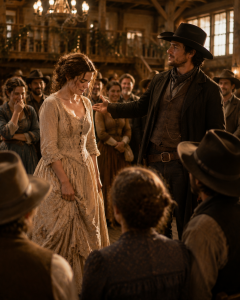
They Laughed at Her Worn-Out Dress — Then One Cowboy Declared She Was the Most Beautiful Woman There

—
PART 1
The wind through the cracks of the Vance cabin always sounded like a mourning song — a reminder, every night, of what the family no longer had enough of to keep the cold fully out.
Aara Vance sat by the dying embers of the hearth, threading a needle for what felt like the hundredth time that night. Outside, the Wyoming territory lay bathed in moonlight, vast and indifferent. Inside, her whole world had narrowed to the light of a single tallow candle and the pile of fabric in her lap.
It was her mother’s dress. Once a vibrant cornflower blue — the kind of silk that had whispered of better days in St. Louis, before the westward trail stole the color from her mother’s cheeks along with everything else. Twenty years in the dust of Copper Creek had faded it to a ghostly slate gray, the fabric worn thin at the elbows and waist. Aara had spent three nights turning the collar, patching tears with scraps from an old sash, sewing tiny glass beads onto it from a tin box she’d found under the floorboards.
“It’s foolish, Aara,” she whispered to herself, the needle pricking her thumb. A bead of blood welled up, stark red against the pale fabric. “Going to the mayor’s jubilee in a dead woman’s rags.”
But she had no choice. The letter from the bank sat on the rough table, its edges crisp with threat. *Final notice of foreclosure.* Banker Julian Blackwood had made it plain — pay the outstanding debt on her father’s cattle loan by month’s end, or the Vance ranch, every acre of scrub and the winding creek that cut through it, would go to auction.
The Jubilee wasn’t a dance to her. It was the one night every powerful man in Silver Springs would be in the same room, loosened by whiskey and self-satisfaction — her only chance to corner Blackwood in front of witnesses and ask, publicly, for an extension he couldn’t easily refuse without looking cruel.
She stood, shaking the dress out. It hung loose on her frame. Since her father, Thomas Vance, had died in last winter’s blizzard, food had been scarce. She was thin now, her collarbones sharp, her hands roughened from chopping wood and hauling water alone. She didn’t look like a lady anymore.
She looked like a survivor.
A knock at the heavy oak door made her jump — late, past the hour decent folk came calling. She reached for the shotgun by the mantle, movements practiced and sure.
“Who’s there?”
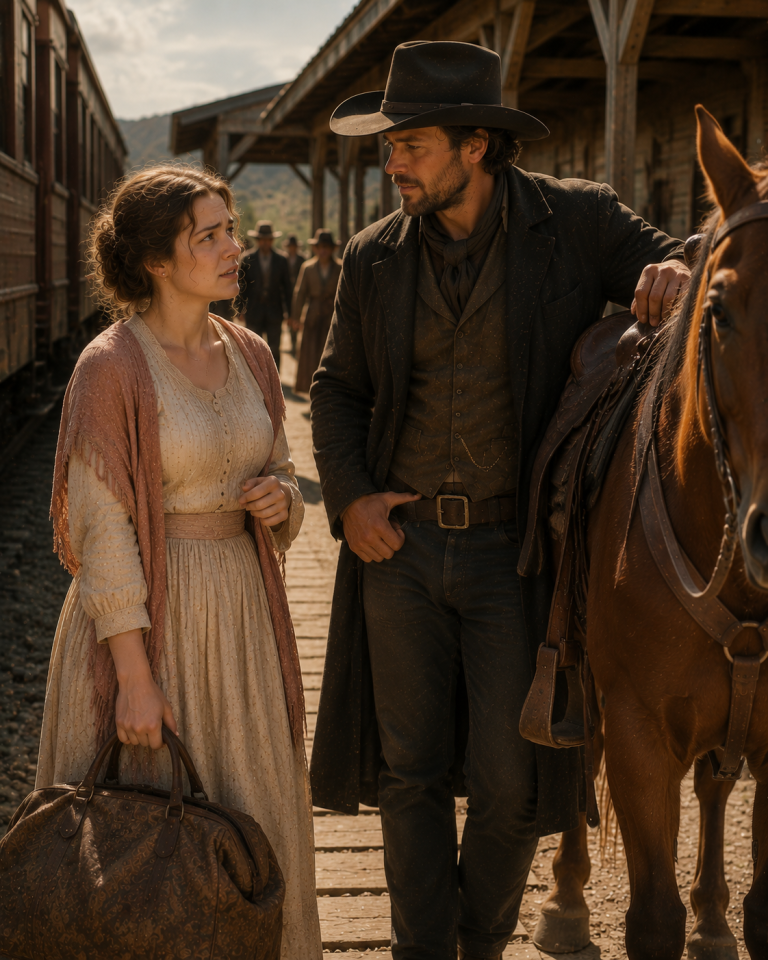
“Just a traveler, ma’am.” A deep, gravel voice, unfamiliar, carrying the slow draw of the deep South mixed with trail grit. “Horse threw a shoe a mile back. Saw your light. Just looking for water.”
She hesitated. Hospitality was the law of the West, but a woman alone learned caution the hard way. She cracked the door, chain fastened, the shotgun barrel visible in the gap.
The man on her porch looked carved out of the mountain itself — tall, shoulders broad enough to block the moon, a battered Stetson pulled low over eyes she couldn’t read in the shadow, dust coating his duster coat. He didn’t look like a bandit. He didn’t look like a gentleman either. He looked dangerous the way a dormant volcano looks dangerous — quiet, and not to be mistaken for harmless.
“Bucket’s by the well,” she said, nodding toward the yard. “Help yourself, then keep moving. I’ve got nothing worth stealing.”
He chuckled — low, rough — and tipped his hat, revealing eyes pale and sharp even in the dark. “Wasn’t planning on stealing, ma’am. Just thirsty.” His gaze dropped, briefly, to the dress still clutched in her left hand. “Fancy night.”
She flushed and pulled the dress behind the door. “None of your business.”
“Fair enough.” He walked to the well, drank deep from the ladle, and turned back before mounting. “Name’s Silas. Silas Thorne, if anyone asks.”
“Nobody will ask, Mr. Thorne,” Aara said coldly. “Nobody comes out this far.”
“Maybe that’s for the best,” he murmured, more to himself than to her, and swung up onto a massive black stallion that favored its left hoof. He tipped his hat once more. “Obliged for the water.”
She watched him vanish into the dark, an odd shiver working down her spine that had nothing to do with the cold, and locked the door behind her.
Tomorrow, she’d walk into the lion’s den wearing a ghost’s dress and pray she came out the other side of it still standing.
—
Silver Springs was booming. Copper in the nearby hills had turned a dusty stopover into a hive of gas lamps and gilded ambition, the newly built town hall ablaze with light and music that clashed against the knot of dread sitting in Aara’s stomach as she hitched her old mare, Bess, out back among the plow horses instead of the shiny carriages up front.
Inside, the hall smelled of cigars, lavender water, and roasting beef — tables groaning under pheasant and honey-glazed ham and cakes she hadn’t eaten in two days’ worth of imagination alone. She stayed near the wall, scanning for Blackwood, and found him by the fireplace — sharp-featured, oil-black hair slicked back, holding court in a suit that cost more than her entire farm. Lydia Sterling, the mayor’s daughter, hung on his arm in emerald Paris satin, gold at her throat, beautiful the way a well-fed predator is beautiful.
Aara steeled herself and pushed through the crowd. “Mr. Blackwood. I need a moment of your time. About the extension.”
Blackwood’s smile vanished the instant he registered who was speaking. “Miss Vance. I didn’t expect you here. The entry fee was substantial.”
“I have a buyer coming from Cheyenne next week for the herd. If you could just give me—”
“This is a party, Aara,” Lydia interrupted, sweet as poisoned syrup, laying a possessive hand on Julian’s chest. “Not a charity ward. Besides, Julian doesn’t discuss business with people of your standing.” Her eyes raked the dress. “Is that your mother’s wedding gown? Good heavens. It smells like mothballs and desperation.”
Laughter rippled through the circle around them. Aara felt heat climb her cheeks. “It’s a fine dress,” she said, chin lifting. “And I’m here to discuss business that concerns the future of my land.”
“Your land?” Julian barked a laugh. “That patch of dirt is barely worth the paper the deed’s printed on. Come Monday, the sheriff clears you off it.”
“My father paid interest on that loan for ten years—”
“Interest isn’t principal, my dear.” He turned back to the crowd, dismissing her outright. “Run along. Go find the buffet. I’m sure you’re hungry.”
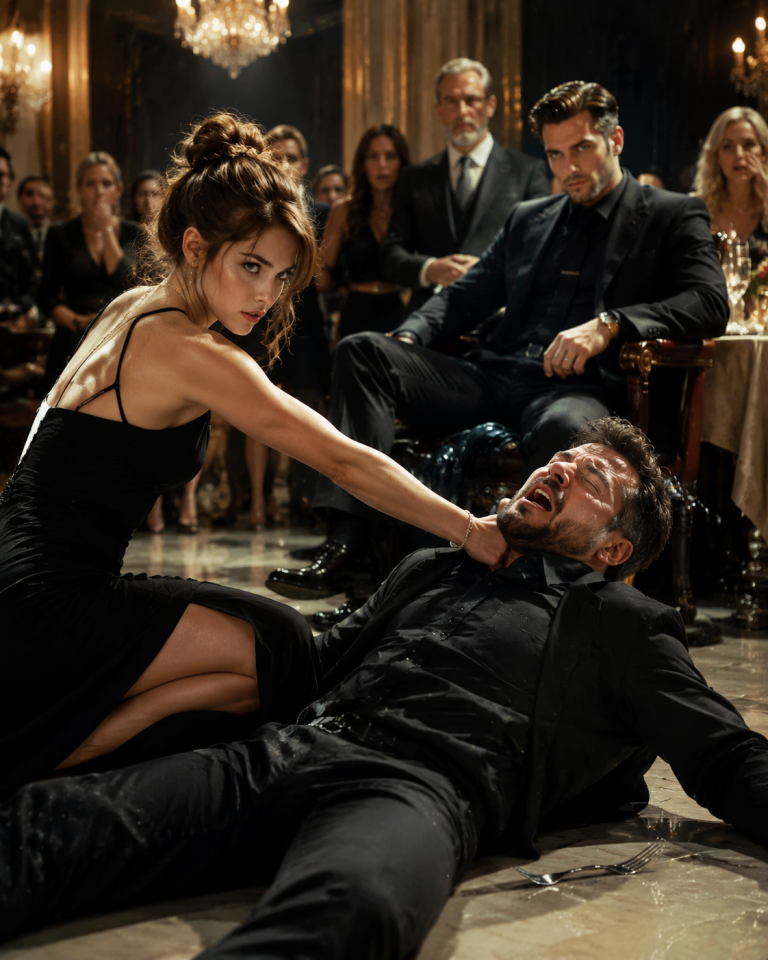
She turned to leave, eyes blurring, the humiliation complete. But Lydia wasn’t finished — she didn’t just want to win, she wanted to leave a mark. As Aara turned, a silk-slippered foot shot out. Aara’s worn boot heel caught on the uneven floorboard. She pitched forward into a waiter carrying a tray of red wine, and the crash that followed was deafening — glass shattering, the tray upending, wine soaking dark across the faded blue silk as she went down hard on her knees.
The music screeched to a stop. The room went silent, then erupted.
“Oh my,” Lydia said, hand fluttering to her mouth in mock horror, eyes dancing with glee. “Look at the mess. Though honestly, that wine’s an improvement on the color. Covers the stains, at least.”
The laughter that followed wasn’t only the elite’s. Shopkeepers and ranch hands joined in, swept along by the cruelty of the moment, and Aara felt herself shrink to something small enough to be swept off a floor along with the broken glass.
“Well,” Julian shouted, stepping forward, “don’t just sit there, girl. You’ve ruined the floor. Get out before I have the marshal drag you out.”
The heavy doors of the hall slammed open with enough force to rattle the walls. The wind swept in and snuffed the nearest candles. The laughter died in every throat at once.
Silas Thorne stood in the entryway, groomed now, sharp, but carrying the same coiled, wild danger from the well. His spurs chimed a slow, deliberate rhythm as the crowd parted for him without being asked. He didn’t look at Julian. He didn’t look at Lydia. His eyes went straight to Aara, still on her knees in the wine and glass.
“I’ve seen packs of wolves with better manners,” he said. Not loud. It carried to the back wall anyway.
—
PART 2
“Who the hell are you?” Julian demanded, stepping forward, face reddening. “This is a private event.”
Silas ignored him entirely. He took off his hat, held it in one hand, and extended the other toward Aara.
“Take my hand, Miss Vance.”
She looked up, bewildered. “I’m a mess. The dress—”
“The dress doesn’t make the woman.” He said it loud enough for Lydia to hear, sweeping his gaze over the stunned crowd. “And right now, looking at this room full of silk and cowards, you’re still the finest woman here.”
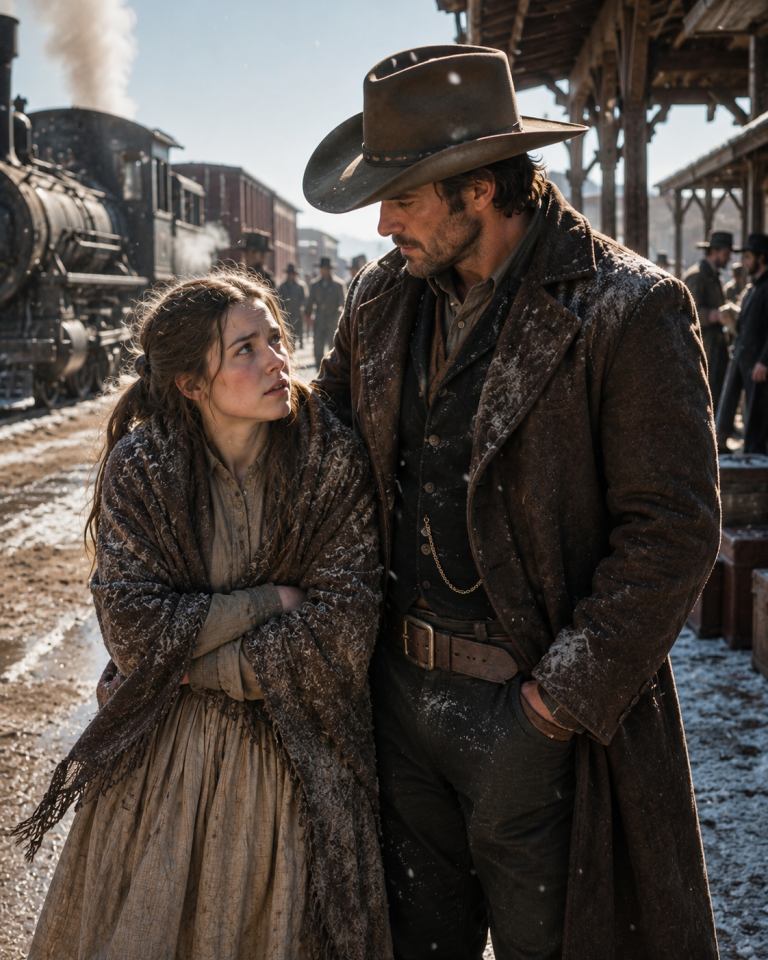
A gasp went through the hall. Aara’s trembling, wine-stained fingers found his. He pulled her up like she weighed nothing, steadied her, unclasped his own duster coat and settled it over her shoulders, covering the stains. It was warm, heavy, smelled of leather and tobacco. It felt, absurdly, like armor.
He turned to Blackwood. “You mentioned something about a debt.”
“Who *are* you?” Julian’s composure was already fracturing. “I’m Julian Blackwood. I own the bank in this town.”
“I know who you are.” Silas pulled a folded document from his vest and tossed it onto the nearest table. “Silas Thorne. This morning I bought the territorial charter for the railroad coming through here next spring.” He let that land before continuing. “I also bought the debt on the Vance ranch from your regional office in Cheyenne. Miss Vance doesn’t owe you a dime anymore.” He glanced back at Aara, a hint of something almost like humor touching his mouth. “She owes me. And I’m a very patient creditor. Shall we dance, Miss Vance?”
The silence that followed felt like it might snap under its own weight. The railroad had been a rumor, a myth traded over card tables for two years — and this stranger held its charter in his coat pocket. Julian’s face drained the color from itself in real time.
“You can’t just buy a debt without my signature,” he sputtered.
“Check the telegraph office,” Silas said, not bothering to look at him. “Wire came through an hour ago. Your superiors in Chicago prefer gold to your slow-moving foreclosure paperwork.”
Lydia dropped Julian’s arm like it had gone hot. She smoothed her skirt and stepped toward Silas with a fluttering smile already forming — “Mr. Thorne, was it? My father, the mayor, would be delighted—”
“I didn’t ask for the mayor.” He cut her off flat, turned his back on her deliberately, and offered his arm to Aara instead.
He guided her out onto the floor before the band leader had fully recovered his nerve, the pianist stumbling into a slow waltz. Aara was stiff at first, her boots clumsy on the polished wood, the eyes of the whole room boring into her back — judging, hating, recalculating. Silas held her firm, his gaze an anchor, hazel eyes flecked gold and holding nothing that looked like pity.
“Why did you do this?” she asked softly. “I can’t repay you. I have no money.”
“You gave me water,” he said, turning her so her back faced Lydia and Julian both. “In my book, that’s a debt worth answering.”
“That’s not enough of a reason to buy a mortgage.” Her instincts were screaming something was wrong. “Men like you don’t do favors for nothing.”
Something tightened behind his eyes. “Men like me,” he repeated, quiet. “I haven’t always been rich, Aara. Power’s just a tool. Sometimes you use it to build. Sometimes you use it to break.” His gaze flicked once, briefly, to Julian across the room. “There’s plenty in this town that needs breaking.”
The song ended. He didn’t release her hand. Instead he leaned in, voice low enough for only her.
“When this ends, I’m taking you home. Not tonight. Not on Bess. You’ve just become the most valuable piece on the chessboard in this territory, and Blackwood is about to get desperate to take it off.” His eyes held hers a beat too long. “Copper Creek isn’t just a name, Aara. It’s a map. And your father knew exactly what it was a map of.”
—
PART 3
The ride out of Silver Springs felt like crossing into a different version of the world entirely, one that had tilted on its axis sometime between the wine and the waltz. The moon hung full over the sawtooth ridge, painting the sagebrush silver and shadow. Silas’s black stallion — a beast he called Coal — moved with a steady, ground-eating gait that swallowed the miles.
Aara sat in front of him, his arms bracketing hers where he held the reins, his chest a wall of warmth against the wind cutting down from the peaks. She was still wearing his duster over her ruined dress, the leather smelling of pine smoke and gunpowder.
“You’re shivering,” he noted, shifting the reins to pull the coat tighter around her.
“I’m not cold.” Her teeth were nearly chattering. “I’m terrified. You just humiliated the two most powerful people in this territory. Blackwood doesn’t forgive. He doesn’t forget, either.”
“Blackwood’s a coyote,” Silas said, dismissive. “Yaps and snaps, runs the second he sees a wolf. You need to stop thinking like prey, Aara.”
“It’s hard not to, when you’ve been hunted for two years.” She looked out at the dark shape of her family’s land, closer now. “Ever since Papa died, the bank, the mayor, the ranchers — they’ve all been circling. Picking off cattle. Poisoning the water trough. Scaring off the hands. I thought they just wanted the grazing land.”
Silas slowed the horse as they entered the narrow canyon pass leading to her cabin. “Grazing land’s a dime a dozen. Copper’s worth money.” He hesitated, choosing the next words with more care than she’d yet heard from him. “But what your father actually found — that’s worth an empire.”
She twisted in the saddle. “What are you talking about? Papa was a cattleman. He didn’t know the first thing about mining.”
“Thomas Vance was a lot of things before he was a cattleman.” Silas’s eyes swept the ridgeline above them out of old habit, alert without seeming to try. “Before he settled here, he was a surveyor for the army. We rode together in ’78, down in the Arizona territory.”
Aara gasped. “You *knew* him? He never once mentioned a Silas.”
“I went by a different name back then.” His jaw tightened. “And he wouldn’t have mentioned me regardless. I was the man who got into trouble. He was the man who got me out of it. That’s the only reason I’m here at all — he sent me a letter three weeks before he died. He knew something was wrong. Knew someone had been at the brakes on his wagon the day he went off the cliff.”
Aara’s heart stopped cold. “Everyone said he lost his way in the blizzard.”
“A man who could navigate by the stars blindfolded doesn’t get lost in his own backyard.” Silas’s voice had gone grim. “He was murdered, Aara. Because of what he found in the creek bed behind your cabin.”
The crack of a rifle split the canyon before she could process the words fully. Silas reacted before the sound had even finished registering, jerking the reins hard right, spurring Coal into the shadow of a boulder. “Hang on.” A bullet whined past her ear and struck rock, spraying stone shards. “Ambush!”
He was off the horse in one fluid motion, Winchester already in hand. “Stay down. They knew we were coming.”
“Who?” Aara cried, sliding off and crouching against the horse’s flank.
“Blackwood’s hired guns. Didn’t even wait for Monday.” He melted into the canyon shadows, firing, drawing return shots away from her position. A cry of pain echoed off the rock above — his shot had found someone. “That’s one,” he called back. “There’s three.”
“Get the girl!” a rough voice shouted from the ridge. “Boss wants her alive.”
Aara’s blood went to ice. They hadn’t just wanted her scared off the land. They wanted her *taken.*
A shadow detached itself from the canyon wall, creeping toward her boulder while Silas’s attention stayed pinned on the ridge fire. A man with a bandana over his face, a knife in hand, reaching for the horse’s reins. He hadn’t seen her at all — he’d only seen the horse, and behind it, an easy target.
Panic surged, but beneath it something harder ignited too. This was her land. These were, very possibly, the men who’d killed her father. Her hand closed around a fist-sized rock without her quite deciding to reach for it.
The man crept closer, whispering something soothing to the stallion. Aara didn’t scream. She didn’t hesitate. She brought the rock down on the hand closing around the reins, felt bone crunch under the blow, and the man howled, spinning to grab her by the collar of the duster.
“You little witch.”
He raised his other hand. It never landed. A shot from twenty yards away caught him mid-swing, and he crumpled, a dark hole blooming in his chest.
Silas stood there, rifle still smoking, his eyes not on the body but on her. “I told you to stay down.”
“He was coming for the horse.” Her voice shook, but her chin stayed level. “I’m not good at following orders, it seems.”
He crossed to her, scanning the perimeter as he moved. “The other two ran. Cowards. Expected a helpless girl, not a fight.” He nudged the dead man over with his boot, pulled the bandana down, and something in his expression went cold and still. “I know him. Railway Pinkerton. Blackwood’s hired private security to do his dirty work — which means this wasn’t a threat meant to scare you off. It was meant to take you somewhere quiet.”
He looked at her then, and for the first time she saw fear in his eyes that wasn’t for himself. He brushed a stray lock of hair from her forehead, his hand warm, steadying.
“You did good,” he said quietly. “But we can’t go to the cabin. They’ll have men waiting there.”
“Where do we go? If they control the town and the road—”
“We go where they won’t follow.” He mounted, pulling her up behind him this time, wanting her close against his back, protected. “Devil’s Pulpit.”
“That’s a sheer drop. The trails are treacherous even in daylight.”
“Your father showed me a way up once. A hidden trail.” He turned the stallion toward the steep path winding into the high country. “It leads to the source. Of the creek. Of the *gold.*” A beat. “It’s not copper, Aara. It never was. Thomas Vance was sitting on the largest gold vein in the Wyoming territory. Tonight you’re going to claim it.”
—
**THE STRONGBOX**
The ascent was a nightmare of vertical drops and shifting shale, wind tearing at their clothes, the valley below a sea of black ink pierced only by the distant lights of Silver Springs. They reached a small plateau just as the first gray light bled over the horizon, the air thin and biting.
“Why didn’t he mine it?” Aara asked, watching Silas tether the horse to a scrub pine, her voice raw with exhaustion and grief both. “We were starving, Silas. Why let us suffer if he had this?”
“Because gold brings blood. Look at what’s happening right now — the moment the rumor got out, Blackwood sent killers.” Silas’s expression had gone somber. “Your father wanted the land rights secured fully first. Mineral rights, water rights, everything, before he filed the claim. He was trying to protect you from the vultures. He was one week from finalizing the patent when he died.”
He led her toward a cluster of boulders forming a natural cave mouth, hidden behind overgrown brush. “He brought me here once. Told me if anything ever happened to him, the proof was inside.”
The cave was shallow but dry. Tucked into a crevice at the back sat a rusted metal strongbox. Silas set it on the ground.
“Do you have the key?”
“I didn’t even know this existed.”
“Your necklace.” He pointed to the cheap silver locket she’d worn since her sixteenth birthday. “Let me see it.”
She unclasped it and handed it over. He didn’t open the locket the ordinary way — he used his knife to pry the back casing loose, and a tiny flat key dropped into his palm.
“He was a clever man,” Silas murmured, fitting the key into the strongbox. It clicked open. Inside: stacks of geological surveys, assay reports, and a pristine government-stamped deed.
“This is it.” He scanned the documents fast. “Survey confirms the vein. And this deed predates the bank’s lien entirely — the land was paid for in full by military land grants your father earned. The bank never had a legitimate claim to any of it. Blackwood’s mortgage is fraudulent.”
Aara took the deed, her fingers finding her father’s signature at the bottom. *Thomas Vance.* Tears welled without permission. “He saved us.”
“He did.” Silas’s voice gentled. “But a piece of paper’s only as good as the man enforcing it. We need to get this in front of the circuit judge in Laramie. Local law’s bought and paid for.”
“Laramie’s a three-day ride. Blackwood will run us down before we clear ten miles.”
“We’re not going to Laramie.” A hard glint settled into his eyes. “We’re going back to Silver Springs.”
“Are you insane? That’s suicide.”
“No. It’s politics.” He checked his revolver. “Governor Campbell arrives in Silver Springs today for the railroad inauguration. Blackwood planned the whole Jubilee to impress him. If we hand this proof to the governor with the entire town watching, Blackwood can’t touch us. He can’t bury the truth in front of the whole territory.”
“We have to walk right back into the lion’s den.”
“Yes.” His gaze held hers, intense. “But this time you’re not walking in as a victim. You’re walking in as the owner of the richest mine in the West. You need to look the part.” He dug into his saddlebag and produced a clean white shirt and a black silk vest. “Put these on. Ditch the dress. Time you rode like a Vance instead of running from being one.”
—
**MAIN STREET, IN BROAD DAYLIGHT**
By the time they reached the outskirts of Silver Springs, the sun stood high and the town buzzed with more activity than the Jubilee ever had — bunting in red, white, and blue, a brass band near the depot, a gleaming locomotive hissing steam at the head of the new track.
They rode down Main Street rather than through the alleys. Aara wore Silas’s shirt cinched at the waist with her riding trousers, wild and fierce and undeniably present. Heads turned. Whispers started immediately.
*Is that the Vance girl? She’s alive. Who’s that riding with her? Is that the gunman?*
They rode straight to the platform where a podium had been raised. Julian Blackwood stood there, tired and anxious, beside a distinguished, gray-mutton-chopped man Aara recognized from newspaper drawings as Governor Campbell. Sheriff Bull Cotter, a massive man with a badge pinned to a greasy vest, stood watch at the stairs.
Julian’s face went white the moment he saw them. He grabbed the sheriff’s arm. “Arrest them. Now. They’re wanted for disturbing the peace.”
Cotter stepped forward, hand on his gun. “Hold it right there, Thorne. Get down off that horse.”
“On what charge, Sheriff?”
“Trespassing. Assault. Blackwood says you threatened him.”
“I’m about to do more than threaten,” Silas said, voice carrying over the crowd, eyes finding the governor directly. “Governor Campbell. I have evidence of land fraud and attempted murder committed by Julian Blackwood.”
The band stopped mid-note. The crowd gasped as one.
“Don’t listen to him, Governor,” Julian shrieked, composure cracking entirely. “He’s a bandit, a liar—”
“Let him speak,” the governor said, authoritative, stepping forward with real interest now. “Who are you, sir?”
“Silas Thorne. And this” — he gestured to Aara — “is Aara Vance, the rightful owner of the land your railroad is trying to cross.”
“Shoot him!” Julian screamed at the sheriff. “He’s reaching for a gun!”
Cotter drew. Aara screamed *no* — but Silas was already faster. He didn’t shoot the sheriff. He shot the hat clean off his head, and the crowd erupted into panicked chaos, Cotter stumbling back and dropping his own weapon in shock.
“Next one goes between your eyes, Bull,” Silas warned, steel-flat. “Governor — I hold in my hand a federal land patent and a geological survey proving Blackwood forged mortgage documents to steal the Vance claim. He killed Thomas Vance to hide a gold vein from public record.”
“Lies,” Julian shouted, scanning the crowd for any escape route. Lydia, watching from the front row, had already begun backing away — distancing herself from a sinking ship with the practiced instinct of someone who’d done it before.
Governor Campbell looked from the shaking banker to the steady man on horseback. “Bring the documents here, son.”
Silas dismounted and helped Aara down. Together they walked up the platform steps past the cowering sheriff, and Aara set the strongbox down in front of the governor herself.
“My father died for this,” she said, her voice ringing clear across the crowd. She turned to Julian, held his eyes. “And you tried to destroy me over a dress. You thought I was weak because I was poor. But you forgot one thing, Mr. Blackwood.”
“What’s that,” he hissed, sweat pouring down his face.
“I’m a Vance,” she said. “We don’t break.”
The governor examined the papers, his brow furrowing and then clearing entirely. He looked up, expression stern. “Sheriff Cotter. Arrest Mr. Blackwood. Fraud, embezzlement, and suspicion of murder.”
The crowd erupted — not in laughter this time, but in something closer to relief, a town’s worth of people who’d lived under Blackwood’s thumb finally allowed to cheer against it.
Julian didn’t run. He lunged instead, pulling a derringer from his sleeve and leveling it point-blank at Aara. “If I go down, you’re coming with me.”
The bang deafened her. She flinched, braced for pain that never came.
Julian fell instead. Silas stood with his revolver smoking, having fired from the hip in a draw so fast almost no one in the crowd had actually seen it happen. Julian lay clutching a shattered shoulder, the derringer skittering out of reach across the platform boards.
“I told you,” Silas said, calm, holstering the gun. “I’m a patient creditor. But your time’s up.”
—
**THE COST OF BEING SAVED**
Aara looked at him in the chaos of the cheering crowd and the deputies hauling Blackwood away, and for one suspended moment the world narrowed down to just the two of them. He had saved her life, her land, her dignity in a single morning. But as the adrenaline drained out of her, a quieter, colder fear crept in to replace it.
The battle was won. But Silas Thorne was a wandering soul by every account she had of him — a man who fixed things and moved on before the dust settled behind him. Would he stay? Or was she just another debt he’d decided, on a whim, was worth repaying?
The weeks that followed turned Silver Springs from a dusty outpost into the center of a frantic gold rush. Word of the Vance vein reached as far as St. Louis, bringing prospectors, investors, and journalists in a steady flood, the once-quiet canyon now ringing with pickaxes and the rumble of new machinery.
Aara sat on her cabin porch — no longer a drafty shack, but the centerpiece of a bustling operation — in a new dress of crisp navy calico that still felt strange on her thin frame. The townspeople who’d once stepped over her without a glance now tipped their hats with exaggerated respect. The butcher saved her the best cuts. The dressmaker offered her services free of charge.
It made her stomach turn. Their kindness had been purchased, not earned, the moment she became worth something to them.
The only person who treated her exactly the same as he always had was Silas — but Silas was pulling away, spending his days at the mine entrance overseeing the new crew he’d wired in from Cheyenne, honest men treating the land right. At night he slept in the bunkhouse with the hands instead of the guest room Aara had quietly prepared for him. He was like a ghost haunting the very life he’d handed her.
One afternoon an opulent black-lacquer carriage rattled up the newly graded road. Lydia Sterling stepped out, diminished — emerald silk wrinkled, face pale and drawn. Blackwood’s arrest had implicated her father in a string of zoning scandals; the Sterlings were fast becoming social pariahs, their influence evaporating like rain in the desert.
“Lydia. To what do I owe the pleasure?” Aara said, wiping her hands on her apron. “I assume you’re not here to trip me again.”
Lydia flinched, clutching her reticule. Her eyes moved over the bustling mine, the healthy cattle in the lower pasture, and something dull and desperate lived in them now where the old contempt used to be.
“I came to apologize,” she said, the words clearly tasting like ash. “For the Jubilee. It was a misunderstanding. Julian — he manipulated all of us.”
“Julian’s a snake,” Aara said evenly. “But he didn’t make you cruel, Lydia. You did that all on your own.”
Lydia swallowed hard. “My father — the town council votes to remove him next week. If it passes, we lose the house. We have nowhere to go.” She stepped closer, forcing a trembling smile. “For the sake of our old friendship, before everything happened — you might speak to the governor. He listens to you.”
Aara looked at the woman who’d laughed while she knelt in spilled wine, who’d built a small cruelty into a public spectacle for sport. “I don’t have old friendships with you, Lydia. I was your target.” A beat. “As for your house — perhaps you can learn to sew. I hear the potato sacks at the general store are quite durable.”
Lydia’s face crumbled. She turned to leave, and stopped only when a shadow fell over her. Silas stood there, shirt sleeves rolled up, scars visible on his forearms, a Winchester resting in the crook of his arm. He looked at Lydia with total indifference rather than anger.
“You heard the lady,” he said. “Ride on.”
Lydia scrambled back into her carriage. As the dust settled, something heavy lifted off Aara’s chest — she’d found her voice, finally, and it had held.
She turned to Silas, smiling. “Thank you again.”
He didn’t smile back. He leaned the rifle against the porch rail and stepped back, maintaining the maddening distance he’d kept for two weeks now.
“I came to tell you I’m heading out, Aara.”
The world seemed to stop turning. “Heading out to — Montana?”
He avoided her eyes, looking toward the mountains instead. “Mine’s secure. Governor’s got the legalities locked down. You’re rich, Aara. You’re safe. You don’t need a gunman shadowing you anymore.”
“I never needed a gunman,” she said, voice rising, closing the gap between them off the porch. “I needed *you.*”
“You don’t know who I am.” His voice sharpened. “You know the man who saved the day. You don’t know the man who spent ten years hunting outlaws in the mud. I’m not a rancher. I’m not a gentleman. I don’t fit in this world you’re building.”
“You fit because I say you fit.” She grabbed his arm; his muscle was rigid as iron under her hand. “You think I care about the gold, the governor, any of it? I care that you were the only person who saw me when I was invisible. Doesn’t that mean anything to you?”
Something in him slipped, just for a second — a depth of longing that took her breath away. He reached out, thumb tracing the line of her jaw, a touch so tender it made her tremble.
“It means everything,” he said quietly. “That’s exactly why I have to go. You’re the sun now, Aara. I’m just the shadow that gets in the way of the light. You have a future. Find a man who can give you peace instead of one who sleeps with one eye open.” He pulled away before she could stop him. “I’ll be gone by first light. Don’t come to the station.”
She watched him walk toward the bunkhouse, her chest cracking open. She’d faced down bankers and hired guns in a canyon at midnight. She had no idea how to fight a man’s own stubborn conviction that he didn’t deserve to stay.
—
**THE TRAIN**
Dawn broke gray and sullen, mirroring the storm inside her. She hadn’t slept, had spent the night pacing the floorboards of an empty cabin, certain of one thing: *he’s wrong. He thinks he’s protecting me. He’s just running.*
The clock read seven fifteen. The morning train to Cheyenne — the express connecting north toward Montana — left at eight.
She didn’t reach for the fine calico or the silks she could now afford without thinking twice. She went to the back of the wardrobe instead and pulled out the old blue dress, her mother’s dress, washed now but still faintly marked with the wine stains that would never fully lift. A map of everything that had happened to her, worn like proof instead of shame.
She threw a riding coat over it, grabbed her father’s hat, and ran for the stable.
“Bess! One last run, girl.”
She rode like something possessed, cutting across open range, jumping fences she’d normally have opened and closed properly, ignoring the road entirely, the wind stinging her eyes as she kept her gaze fixed on the plume of smoke rising over the depot. The whistle blew — the conductor’s final signal.
“No, no, no—” She kicked Bess into a full gallop, skidded into the town square scattering chickens and startled pedestrians, jumped off while the mare was still moving and sprinted for the platform.
The train was already grinding forward, wheels beginning their slow turn, the conductor pulling up the boarding steps. “Wait!” she screamed, pushing through a knot of well-wishers. “Stop the train!”
She ran alongside the moving cars, scanning windows — businessmen, families, soldiers — until she found him on the rear platform of the last car, leaning against the railing, watching the town recede with an expression she could only call miserable.
“Silas!”
He straightened, eyes going wide at the sight of her running, stumbling in the dust, wearing that same damned blue dress.
“Aara, go back!” he shouted over the engine noise.
“You coward!” Her voice cracked. “You’ll face down three gunmen in a canyon, but you’re scared of one woman?” The train was pulling away faster now, distance opening between them she couldn’t close on foot. “I love you!” The words tore loose before she could stop them. “And if you leave, you’re taking the only real thing in this whole town with you!”
He stared at her. Ten yards. Twenty. He looked once toward the horizon he’d been so set on reaching. Then back at the woman shrinking smaller in the dust behind the train.
He vaulted the railing. Didn’t wait for the platform steps — jumped straight into the gravel embankment, rolled through it, and came up on his feet in one motion as the train whistled on without him and disappeared around the bend.
Aara stopped running, chest heaving, tears cutting through the dust on her face. Silas stood, brushed himself off, adjusted his hat, and walked back toward her — unhurried, with the steady, inevitable purpose of a man finally headed somewhere he actually belonged.
He stopped two feet away. “You jumped,” she breathed, laughing through the tears.
“Missed my stop,” he said, voice thick.
“You said you didn’t fit.” She crossed her arms, daring him to take it back properly.
“I was wrong.” He closed the last of the distance, took her face in his rough hands. “I thought I had to be a gentleman to deserve you. Thought I had to be *clean.*” He looked down at the ruined blue dress. “But you wore the dress.”
“It’s my best dress,” she whispered. “It’s the one I was wearing when I met the love of my life.”
He kissed her — not tentative this time, but a claiming, right there on the platform in front of the station master and half the town’s gossips, a kiss that scorched the ground and promised the rest of a life.
A polite cough broke them apart. Governor Campbell stood nearby with a briefcase, visibly amused.
“Mr. Thorne. I assume, since you just jumped off a moving train, you won’t be wiring your resignation to the board of directors after all.”
Aara pulled back, frowning between the two men. “Resignation? Board of directors?”
Silas rubbed the back of his neck, sheepish for the first time since she’d met him. “There’s one thing I didn’t tell you.”
“What?” Her eyes narrowed.
“I didn’t buy the debt on your ranch because I had some savings put by.” He glanced, almost helplessly, at the governor. “And I wasn’t just a surveyor. Or a gunman.”
“He,” Campbell interjected, grinning, “is Silas Thorne Vanderbilt. Owns the Union Pacific West expansion outright. Owns the train you just chased down, the track it runs on, and a fair share of the steel in Pennsylvania besides.”
Aara’s jaw dropped. She stepped back, taking in the worn boots, the dusty coat, the gun belt all over again. “You’re a *tycoon.* You’re one of the richest men in the country.”
“I hate boardrooms.” He shrugged, looking for a moment like a boy caught with his hand in a cookie jar. “I prefer the field. I like to see the land before I decide to build anything on it. That’s why I was out here under another name — wanted to know if Silver Springs was worth a station before anyone with my real name showed up and changed how every deal in this valley got made.”
“And is it? Worth it?”
He looked around the dusty town, then back at her, eyes carrying a gold that had nothing to do with any mine. “It wasn’t,” he said. “It is now. I’m building the headquarters right here. I’m not going anywhere, Aara Vance. I’m done running.”
She looked at a man who could buy most of the country he stood in, who had chosen instead to throw himself off a moving train into gravel just to stay with her, and smiled, squeezing his hand.
“Well then, Mr. Vanderbilt.” She tugged him toward where Bess stood waiting, unbothered by any of it. “You’d better come home. We’ve got a lot of work ahead of us, and I expect you to fix the fence you broke jumping it last night.”
He laughed — a sound rung clean and free, like something let out of a cage it hadn’t realized it was in.
“Yes, ma’am.”
They rode back toward the canyon together — not a poor rancher and a drifter anymore, but something closer to a match neither the bank nor the whole of Silver Springs had ever managed to break. The town watched them go, and for the first time in its short, hungry history, no one mocked the girl in the old blue dress.
They only wished, in the quiet way people wish for things they’ll never say out loud, that they’d been the ones who’d seen her worth first.
**THE END**