SHE WAS REJECTED BY THREE MEN IN ONE DAY AT A FRONTIER TOWN SOCIAL — THEN A GRIEVING WIDOWER MADE HER AN OFFER WITH NO ROMANCE IN IT AT ALL

 —
—
PART 1
The stagecoach lurched to a stop, and Evelyn Mercer’s stomach lurched with it.
Eleven days of travel had left her traveling dress the color of dust rather than its original deep blue, her spine permanently compressed from sleeping upright against shuddering wooden walls. But none of that mattered now, because through the window she could see Dry Hollow — exactly what the letter had promised, and nothing like what she’d hoped.
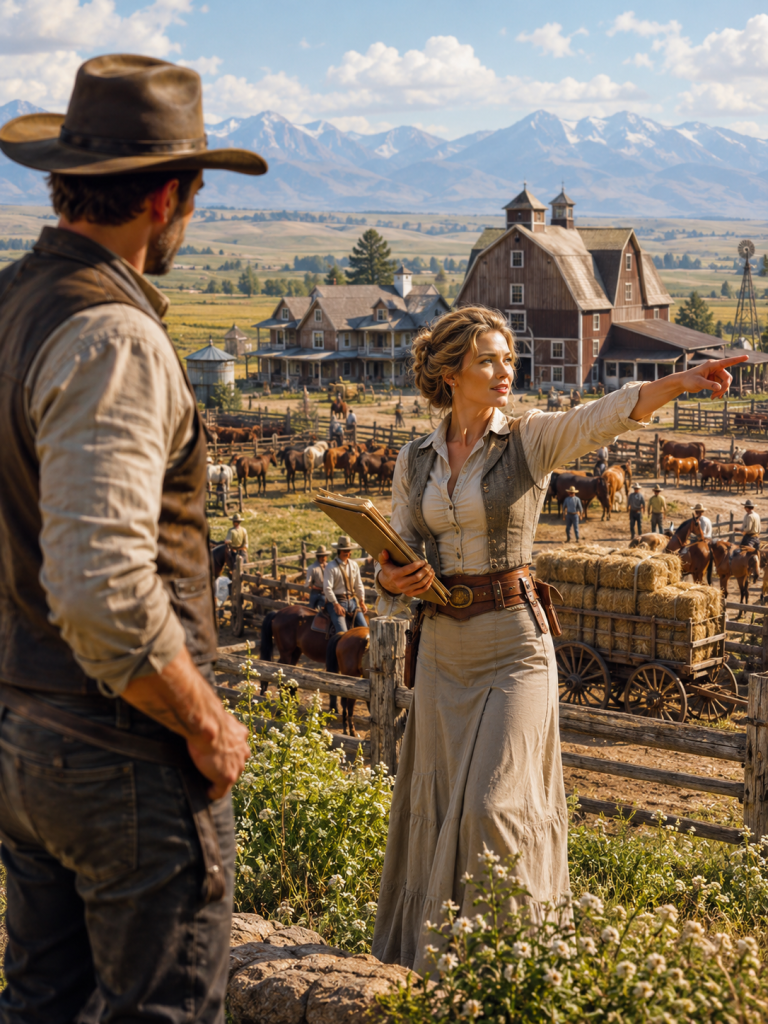
A single dirt street. Buildings leaning like they were tired of standing. And people — dusty, sun-hardened people who stopped whatever they were doing to watch the stage roll in.
Her fingers found the envelope in her pocket, paper gone soft from handling.
*Dear Miss Mercer. I’m a merchant of good standing in Dry Hollow, seeking a woman of moral character and domestic skill. If you are willing to travel west and begin a new life as my wife, I can promise you security, respectability, and a comfortable home. Yours in anticipation, Robert Dalton.*
She’d read it forty times. Built entire conversations in her head with the man who’d written it. Even his name sounded solid. Dependable.
“You the mail order bride?” A woman in her fifties, arms crossed, watched her with an expression somewhere between curious and skeptical, and nodded toward the general store. “That’s him there. The one in the brown vest.”
Evelyn crossed the street, pulse hammering. This was the moment everything changed.
“Mr. Dalton?”
Up close she could see the sweat on his forehead, the way his eyes kept sliding past her shoulder.
“Miss Mercer, you’re — you’re here.”
“Yes.” She tried to smile. “The journey was long, but I’m very glad to finally—”
“I can’t marry you.”
The street seemed to tilt. Her carpet bag slipped from her fingers and hit the dirt.
“I’m sorry?”
“There’s been a complication.” He was actually backing away from her, in front of the entire town. “Martha Hendricks — you don’t know her, but her father owns land adjacent to my store, and when he offered — well, it made business sense—”
“Business sense.” Evelyn heard her own voice like it came from someone else. “You’re refusing to marry me because of business.”
“It’s not personal.” But his eyes said otherwise. They said he’d looked at her and found her wanting — dusty, tired, too plain for whatever picture he’d built in his head.
“Mr. Dalton.” A new voice, cutting through his stammering like a knife. A blond young woman appeared beside him, fresh-looking in a dress that hadn’t seen eleven days of travel. “Is this her?”
“Martha, I was just—”
“You’ve explained the situation?” Martha looked Evelyn up and down with the assessment usually reserved for livestock. “It’s nothing personal, of course, but surely you understand that local connections take precedence.”
“Of course,” Evelyn heard herself say. “I understand perfectly.”
She didn’t understand anything. She bent, picked up her bag with trembling hands, and walked away before her legs could give out. Behind her, Martha’s voice carried, bright and cheerful.
“Well, that was easier than expected. Shall we go look at table linens?”
The street stretched before her like an accusation — twenty yards to the boarding house while every eye in Dry Hollow watched the rejected mail-order bride limp toward whatever came next. She made it fifteen yards before her vision blurred. Ten before the first tear fell. Five before she understood, truly understood, that she had seven dollars to her name and nowhere in the world to go.
**
The boarding house cost fifty cents a night. Evelyn sat on the narrow bed doing arithmetic that ended, no matter how she calculated it, in destitution.
A knock came at the door. “Miss Mercer? My name is Sarah Winters. I run the boarding house.”
Sarah’s kindness was almost worse than cruelty would have been — it meant Evelyn had to hold herself together instead of simply falling apart. There was a social that evening, Sarah explained gently. Two other men had placed advertisements for brides who hadn’t arrived yet. It might be worth attending.
It was logical. Practical. Exactly what any sensible person would do.
The thought made Evelyn want to be sick.
She went anyway, because she’d traveled two thousand miles and risked everything, and what was a little more pride against seven dollars and an empty future?
The church social that followed was, without exaggeration, the most humiliating evening of her life — worse than the street, because this time the rejections came slow and public and cruel, one after another, until half the town was pretending not to watch while listening to every word.
By the time she stumbled outside into the cool night air, pressing her hand against the church’s rough wood wall, trying not to fall apart in front of anyone else, she had exactly one friend in Dry Hollow — a sharp-eyed dressmaker named Grace Miller who found her in the shadows and told her, bluntly, that she’d handled it better than most would.
And exactly one stranger left to talk to. A tall man emerging from the darkness at the edge of town like he’d been part of it all along.
“You’re the mail order bride,” he said. “Heard you had some trouble today.”
Something about the way he stood — weight settled, arms loose, utterly unhurried — told her this was not a man who’d come to mock her.
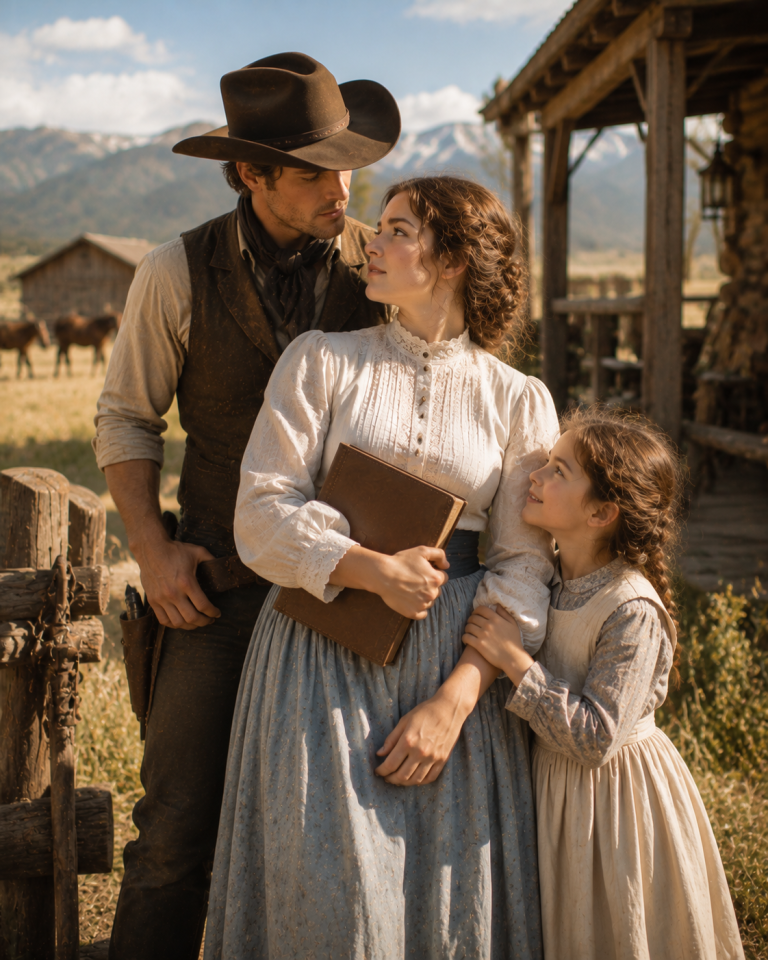
“I’m Caleb Ward,” he said. “I have a ranch twelve miles north. Two children, twins, age seven. They lost their mother last year.”
He wasn’t smiling. He wasn’t performing kindness the way Robert Dalton had performed it in his letters.
“I’m not proposing marriage,” he said. “I’m proposing an arrangement. No false promises, no romance. You’d work hard. So would I. In return, you’d have shelter, food, and my name.”
Evelyn stood frozen in the dark, seven dollars in her reticule and a stranger’s flat, honest offer hanging in the air between them — the first honest thing anyone had said to her all day.
“You have until dawn,” Caleb Ward said. “That’s when I’m leaving. With or without you.”
—
PART 2
He turned to go, then stopped.
“One more thing,” he said. “My children — Nora and Eli — they’re still grieving. They might never stop grieving. If you come to Ward Creek, you won’t be replacing their mother. You’ll be surviving alongside us. If that’s not something you can handle, say no now.”
Then he walked into the darkness and was gone, leaving Evelyn alone with the sound of the social still going behind her — piano music, laughter, the particular buzz of people who’d just watched a stranger’s disaster unfold and were enjoying every second of it.
She should have gone straight back to her room. Instead, she walked to the edge of town, where the prairie stretched out dark and endless under more stars than she’d ever seen back in Philadelphia, and turned Caleb Ward’s words over and over.
An arrangement. Not a marriage. Honesty instead of promises. Survival instead of romance.
It was everything she’d been raised to reject. It was also the only real offer she had left.
There was no sleeping that night. She packed her trunk by candlelight — the green dress, the blue one, her mother’s quilt, the silver locket with her parents’ portraits, all the small worn pieces of a life she was leaving behind for a life she couldn’t picture. At midnight she wrote two letters. One to her aunt in Philadelphia, brief and reassuring and mostly untrue. One to herself, that she folded and tucked into her mother’s journal without ever intending to reread it:
*I am not a coward. I am not desperate. I am making a choice. And if it’s the wrong choice, at least it will be mine.*
Dawn came slow, painting the sky gray and pink. When the first real light touched the street, Evelyn carried her trunk downstairs, where Sarah stood over the coffee pot with her eyebrows already rising in question.
“Caleb Ward?” Sarah repeated, when Evelyn told her. “You’re sure about this?”
“No,” Evelyn said. “But I’m doing it anyway.”
Sarah’s face went careful. “He’s a hard man. His wife’s death — it changed him. Anna was the heart of that family. When she died, it was like the light went out of Ward Creek. The children withdrew. He stopped coming to town except for supplies. I’m not sure what you’re walking into, but it won’t be easy.”
“Nothing about my life has been easy, Mrs. Winters,” Evelyn said. “At least this time I’ll have a roof over my head while I’m struggling.”
Through the window, she watched Caleb Ward climb down from his wagon — a man who moved like he carried weight nobody else could see, all his grace ground down to pure function. He lifted her trunk into the wagon bed without a word of greeting, secured it with practiced efficiency, and helped her up onto the seat with hands that were rough and calloused and entirely impersonal.
“You ready?” he asked.
“Yes.”
“It’s a three-hour ride. Rough road most of the way.”
She didn’t look back as they left Dry Hollow. There was nothing there she wanted to see.
But somewhere at the end of that rough road waited two grieving children — a girl who talked to fill up silence, and a boy who hadn’t spoken a word since his mother died — and Evelyn had no idea, as the wagon creaked over the first mile of prairie, that within a year she would save one of their lives, teach the other to speak again, and fall in love with a man who’d sworn he had nothing left to give.
—
PART 3
The ranch house appeared in the shallow valley just after noon, smaller than Evelyn had expected — one story, weathered wood, a porch sagging on one end. Everything about it looked lonely, like it had been abandoned even though people still lived there.
“This is it,” Caleb said, pulling the wagon to a stop. “Last chance to change your mind.”
Evelyn looked at the crooked curtains, the half-seeded garden, the whole tired shape of the place, and thought about Thomas Garrett’s proposition back in town, about Philadelphia and the debt collectors who’d taken everything.
“I’m not going back.”
The front door opened, and two children appeared. The girl — Nora, small for seven, tangled brown hair, a dress clean but poorly mended — stared at Evelyn with eyes too large for her face. The boy stood half-hidden behind his sister, watching, his father’s solid build even at seven, and something in his eyes that made Evelyn’s chest ache.
Loss. Pure, unfiltered loss.
“Are you going to be our new mama?” Nora asked immediately.
“I’m going to help your father,” Evelyn managed, glancing at Caleb, who was suddenly very interested in unhitching the horses.
Nora’s mouth snapped shut, but she took Evelyn’s carpet bag with small, careful hands and led her inside.
**
That first week fell into a rhythm of endless small tasks — bread that needed proper kneading, chickens that scattered like she’d personally offended them, a garden gone half to seed that ached her back to weed. Nora followed everywhere, filling silence with a stream of chatter that never quite stopped. Eli sat on the fence for hours, silent, watching his father work, carved from the same wood as the posts.
“He thinks if he’s quiet enough, Mama might hear him,” Nora confided one afternoon, kneeling beside Evelyn in the garden. “Like she’s listening from wherever she went.”
The words hit Evelyn square in the chest — the magical thinking grief brought to children, the bargains they made with a universe that didn’t bargain back.
“I know she’s not coming back,” Nora said fiercely. “But Eli doesn’t. Or he does, but he won’t believe it. And Papa won’t talk about her at all, so it’s like she’s just gone. Like she was never here.”
“She was here,” Evelyn said. “The fact that you remember her means she was here.”
Nora considered this, then yanked up a weed with unnecessary force. “Mama deserves to be sad about.”
That evening, Caleb came in from the barn smelling of hay and sweat, poured himself water, and stood in the kitchen doorway with the restless energy of a man working up to something difficult.
“There’s Anna’s things,” he finally said. “Her clothes, her personal items. Still in the bedroom. I haven’t — I couldn’t—”
“You want me to pack them away?”
“I want them gone. Not thrown out. Just somewhere I don’t see them every morning.” He stopped, jaw working. “The marriage. We should do it soon. This week, if possible. It doesn’t need to be anything formal. Just the legal part.”
Her stomach clenched, but what she said was, “No objections.”
**
Thursday arrived cold and gray. Pastor Williams read from a Bible that looked older than he was, in a voice that suggested he’d done this too many times to be moved by it. There was no ceremony beyond the bare legal words — no flowers, no music, no witnesses beyond the pastor and two watching children.
“Do you, Caleb Ward, take this woman?”
“I do.”
“Do you, Evelyn Mercer, take this man?”
Evelyn looked at his weathered face, his tired eyes, the man who’d offered her survival when she’d needed it most. “I do.”
No kiss. No embrace. Just a handshake, businesslike, over as quickly as it began.
“Are you our mama now?” Nora asked afterward.
“I’m your papa’s wife,” Evelyn said, kneeling to the girl’s level. “I’m here to help take care of you. But your mama — your real mama — she’ll always be your mama. Nothing changes that.”
“But you’re going to stay?”
“I’m going to stay.”
Nora threw her arms around Evelyn’s neck and squeezed with everything she had.
That night, lying in her small room, Evelyn turned the new name over in her mind. *Mrs. Evelyn Ward.* It felt like someone else’s.
**
Anna’s trunk waited until Wednesday. The children were outside; Caleb was in the barn. Evelyn knelt and lifted the lid — lavender and something personal, a woman’s scent preserved in cloth. Dresses folded carefully. A hand-knitted shawl. A hairbrush with strands still caught in the bristles.
At the bottom, wrapped in tissue paper, a simple white wedding dress, yellowed slightly with age. When she lifted it, a letter slipped free, addressed in a masculine hand.
She shouldn’t read it. She read it anyway.
*My dearest Anna, tomorrow you become my wife and I find myself unable to sleep for the joy of it. You have made Ward Creek feel like home instead of duty. You have made me believe in futures instead of just surviving days. Whatever comes, whatever hardships we face, I will face them gladly knowing you are beside me. Forever yours, Caleb.*
Evelyn’s hands trembled. She folded the letter back into the dress, packed the trunk with careful reverence, and carried it to the storage room off the kitchen — out of sight, but not discarded. Preserved for whenever the children might want it.
“It’s done,” she told Caleb that evening.
He nodded once, face unreadable. “Thank you.”
**
The weeks fell into something almost comfortable. Evelyn learned the rhythms of ranch life — which chickens were reliable layers, how to shape the perfect loaf, when to bring the garden in before frost. The children slowly, tentatively, began to trust her. Nora stopped asking if she was leaving and started asking other things — had she ever seen the ocean, did she know any stories.
Eli remained silent. But he started showing her his drawings.
The first was of Evelyn herself, back to the viewer, making bread — rendered in remarkable detail for a seven-year-old.
“Is this me?” she asked. He nodded. “May I keep it?” He hesitated, then nodded a third time, and stayed to help dry the dishes without being asked, his movements careful and precise, like performing surgery.
“He likes you,” Caleb said from the doorway, once Eli had disappeared into his room. “He doesn’t show those drawings to anyone. Not even me.”
**
Then the fever came.
It started with Nora looking pale at breakfast. By dinner she was burning, whispering, “Papa, I don’t feel good,” and Caleb’s face went the color of ash the moment he pressed a hand to her forehead.
“It’s the summer fever,” he said, voice hollow. “It’s what killed—” He couldn’t finish.
They carried Nora to bed. Evelyn stripped off her outer clothes while Caleb hovered, useless with fear.
“How long did your wife have the fever before—” Evelyn asked.
“Three days. She was fine in the morning, dead by the end of the third.”
“Caleb.” Evelyn kept her voice level, deliberately steady. “I need you to listen. Go into town. Get the doctor. Take Eli — he shouldn’t see this if it gets worse. I’ll stay with her. I won’t leave her side. Trust me. Please.”
He nodded, and left, and the night that followed was the longest of Evelyn’s life.
Nora drifted in and out of consciousness. Evelyn changed cold compresses every few minutes, forced sips of water past cracked lips, whispered nonsense that meant nothing beyond its sound.
“Mama,” Nora whimpered at one point. “Mama, it hurts.”
“I know, sweetheart.”
“Are you Mama?”
Evelyn’s throat tightened. “No. I’m Evelyn.”
“Oh.” Nora’s eyes drifted closed. “That’s all right. You’re nice, too.”
Near midnight, the fever spiked and Nora began to convulse, her small body shaking violently. Evelyn held her still, kept her from hurting herself, drew on everything her own mother had taught her during a cholera outbreak years ago in Philadelphia. *Keep them cool. Keep them hydrated. Keep them breathing.*
Just before dawn, the convulsions stopped. Nora’s breathing evened. When Evelyn checked her forehead, the fever had broken.
That’s how Caleb found them when he returned with the doctor — Evelyn slumped against the wall, tears streaming down her face, Nora sleeping peacefully beside her.
“She’s alive,” Evelyn managed. “The fever broke.”
Caleb’s knees gave out. He sat down where he stood, staring at his daughter, his face crumpling with feelings he’d locked away for a year.
“You saved her,” he said later, once the doctor had gone. “Anna died because I didn’t know what to do. I panicked. I—” He stopped. “You saved her, and I will never be able to thank you enough for that.”
**
Something shifted in Caleb after that. Not dramatically — he was still quiet, still kept his distance — but he looked at Evelyn differently now. Not with the careful neutrality of a business arrangement, but with something closer to recognition.
One evening, trying and failing to cook dinner while Evelyn recovered from a week of sleeping on Nora’s floor, he burned the beans and slammed the pot down in frustration.
“Anna used to make this look easy,” he said, and her name caught on his voice the way it always did.
“Let me fix it,” Evelyn said gently. “You can rest, too.”
“I don’t need rest. I need to figure out how to cook a simple meal without destroying it.” He turned to face her. “Because if something happens to you, we’re back where we started. Helpless. I don’t want to be helpless again.”
She understood then. This wasn’t about the beans. It was about control — about not being the man who’d watched his wife die without knowing how to stop it.
“Then let me teach you,” she said quietly. “Not today. But soon. That way you’re not helpless. You’re prepared.”
**
It was Eli who broke first, in the barn hayloft on a quiet October afternoon, after Evelyn found him drawing alone and climbed up to sit with him without demanding anything.
“Your drawings are really good,” she said. “I think you’re talking, just not with words. You’re telling stories through your art, and that’s just as valid as speaking.”
His pencil stilled. He stared at her like she’d said something impossible. Then, in a voice so quiet she almost missed it: “She can’t hear me anyway.”
Evelyn’s breath caught. First words she’d heard him speak.
“After she went away, I tried talking to her,” he said, his voice rusty from disuse. “But she didn’t answer, so I stopped. Papa says she’s in heaven, but I don’t know where that is. How can she hear me if I don’t know where she is?”
“I don’t know if she can hear you, Eli,” Evelyn said honestly. “I wish I could tell you for certain. What I do know is that she loved you very much when she was here. And that doesn’t stop just because someone goes away.”
“How do you know?”
“Because my papa died, too. And I still feel his love even though he’s been gone for two years. It’s different than when he was alive — quieter, harder to touch — but it’s still there.” She touched his drawing gently. “Maybe that’s what you’re doing with these. Keeping her love alive by remembering her.”
“I’m scared I’ll forget.”
“Then keep drawing. Draw until the memories are so solid on paper they can’t disappear.”
“Will you help me? Tell me about your papa. How you remember him. So I know I’m doing it right.”
She told him — the booming laugh, the terrible off-key singing, *life is too short to be quiet* — and when she finished, Eli turned his drawing around. Somehow he’d captured her father’s essence without ever having seen his face. Arms spread wide, head thrown back, joy radiating off the page.
“That’s him,” Evelyn whispered. “That’s exactly him.”
Eli smiled — small, tentative, but real. “Thank you,” he said, his voice still quiet but present. “For not being scared of sad things.”
That evening at dinner, he spoke — not much, just *please* and *thank you* and *may I be excused* — but enough that Nora dropped her fork in shock and Caleb froze with his cup halfway to his mouth.
**
“What did you say to him?” Caleb asked later, finding her on the porch under the emerging stars.
“Nothing magical. Just honest things.”
“I tried everything for a year. Pleading, demanding, bribing. Nothing worked. Then you spend one afternoon with him.” He leaned against the rail, studying her face in the dim light. “You’re good with them. Better than I am.”
“That’s not true.”
“It is. Every time I try, I see Anna instead, and I freeze up. You just step in and know exactly what they need.” He was quiet a long moment. “I need to apologize. For bringing you here under false pretenses. I told you this was practical, just an arrangement. But that was a lie. Or a partial one. I needed help, yes. But more than that, I needed someone to pull me out of the hole I’d been living in. And I used you for that without being honest about what I was asking.”
“That’s not fair to you either,” Evelyn said. She stepped closer, closing the distance between them. “Let me tell you what I deserve. I deserve not to starve on the streets of Dry Hollow because three men found me lacking. I deserve a place where my work has meaning. I deserve to build something instead of just surviving.” She met his eyes. “You’ve given me all of that. Maybe it’s not romantic. But it’s real, and it’s mine, and I’m not going to apologize for being grateful.”
Caleb reached out slowly, giving her time to pull away, and tucked a loose strand of hair behind her ear.
“You’re remarkable,” he said. “I don’t think I’ve told you that.”
**
Robert Dalton came back in early October, uncomfortable in clothes too fine for ranch visiting, hat twisting in his hands.
“I came to apologize,” he said. “What I did, rejecting you like that, publicly — it was cruel. Martha and I aren’t engaged anymore. Turns out her father’s land came with expectations I wasn’t willing to meet.” He hesitated. “I’ve been thinking that perhaps I made a mistake. That perhaps if you and I were to—”
“No,” Evelyn said, before he could finish. “I’m married, Mr. Dalton. Happily so.”
“Happily?” His tone turned skeptical. “You married a widower with two children and a failing ranch. Everyone in town knows it was desperation, not happiness.”
The laugh that escaped her was sharp and genuine. “You think you’re offering me *better*? Caleb married me because he saw something worth fighting for, even in my worst moment. Those aren’t the same thing, Mr. Dalton. Not even close.”
“Caleb married you because he needed free labor and someone to mother his children. Don’t pretend it was anything more romantic than that.”
“You’re right. It wasn’t romantic. It was honest. He told me exactly what he needed and what he could offer. No false promises. No sudden changes of heart when someone better came along.” She met his eyes steadily. “I’ll take honest need over romantic pretense any day. And you’re not welcome here anymore.”
Robert stared at her, jammed his hat back on, and drove away without another word. When she turned back to the house, Caleb stood on the porch.
“How long have you been there?”
“Long enough.” He came down the steps slowly. “You didn’t have to defend me like that.”
“I wasn’t defending you. I was defending us.”
“Isn’t it?” The question came out before she could stop it. “Caleb, we’ve been living together for two months. We eat meals together. We raise children together. That’s not an arrangement. That’s a life.”
“A life you signed up for out of desperation.”
“I signed up for it out of necessity. I’m staying because I choose to. Those aren’t the same thing.”
Something shifted in his expression. “You’re choosing to stay?”
“Every day. Even on the hard days.”
“Then what do you want?” He stepped closer, close enough she could feel the heat of him. “I want to stop feeling guilty for being glad you’re here. I want things I have no right to want. Not this soon. Not when Anna’s only been gone a year.”
Evelyn reached up and touched his face. “Anna was your wife. Nothing changes that. But she’s not here anymore, and we are. And I think she’d want you to keep living. Not forget her. Just keep living.”
Caleb leaned forward slowly, giving her time to pull away. When she didn’t, he kissed her — gentle, tentative, like he was asking a question he didn’t know how to voice.
It wasn’t fireworks or destiny. It was just real. Two people trying to find solid ground in the middle of a messy, complicated life.
**
Winter came early that year, transforming the prairie white and vast. Caleb taught her to bank the fires and read the sky for storms; she taught him to make bread that didn’t come out like a brick. Small things passed between them now — a hand on her back in passing, fingers brushing over morning coffee — moments of contact that lasted just long enough to mean something.
One December evening, after the children were asleep, Evelyn sat by the fire finishing a manuscript she’d been quietly writing for weeks — letters distilled into thirty honest pages for women considering frontier marriage. Caleb settled beside her and asked to read it.
He read slowly, his expression shifting from interested to something she couldn’t quite name.
“This is good,” he finally said. “Really good. You don’t pull punches.”
“Should I?”
“No. That’s what makes it valuable.” He set the pages down. “I love you.”
The words hung enormous in the air between them.
“I probably have for a while now,” he said, “but I was too scared to say it. Too worried about betraying Anna’s memory, or rushing things, or ruining what we’d built. But I’m tired of being scared.”
Tears spilled down Evelyn’s cheeks before she could stop them. “I love you, too. I didn’t think I would. Didn’t think this kind of marriage could lead to love. But here we are.”
**
She sent the manuscript to a Denver newspaper on a whim, expecting nothing. Three weeks later, a letter arrived from a woman named Caroline Foster, standing in a town called Silver Creek exactly where Evelyn had once stood — rejected, six dollars to her name, wondering if she’d made a fatal mistake.
Evelyn answered her honestly, without false comfort. Two weeks later, another letter came. Then another. By February she was corresponding with eight women across three territories.
“You’re building something,” Caleb said one evening, watching her sort through the growing pile of correspondence. “Have you thought about making it more formal? Collecting the letters into a guide?”
“Who would publish that?”
“I don’t know. But it’s worth asking.”
In May, an official letter arrived from Henderson and Sons Publishing, offering a contract for *Honest Letters: A Practical Guide for Women Considering Frontier Marriage*, with an initial print run of five hundred copies.
“They want to publish it,” Evelyn whispered.
“My wife,” Caleb said, grinning, lifting her clean off the ground in a rare display of exuberance. “The published author.”
*My wife.* Not his arrangement. Not his practical solution. His wife.
**
At the town’s harvest social that November — the same church hall where she’d endured her humiliation a year before — Thomas Garrett found her again, red-faced and several drinks in.
“Well, if it isn’t the famous Mrs. Ward,” he said, loud enough that nearby conversations stopped. “Too good for honest work. Had to write a book instead.”
“I turned you down because you wanted a servant with a marriage license,” Evelyn said evenly, “and I wanted a partnership. Those aren’t the same thing. I found what I was looking for. I hope you find what you’re looking for, too, Mr. Garrett. Genuinely.”
He stared at her, jaw working, then stalked away.
They danced later, badly and joyfully, stepping on each other’s feet and laughing about it. “I love you,” Caleb said quietly against her hair. “Even when you dance like you’re wrestling a fence post,” she said. “That’s specific criticism.” “I’m a writer. Specificity matters.”
**
Years unfolded from there the way seasons do — slowly, then all at once. The book sold steadily, then well, then remarkably. Letters kept arriving, and Evelyn answered every one, building a quiet network of women helping women across hundreds of miles. Some found good marriages. Some avoided bad ones. A few wrote back years later to say they’d built businesses instead and never married at all.
Nora grew into a girl who talked about becoming a teacher, and eventually did. Eli, still quiet but no longer silent, sold his drawings to the newspaper and later took over the ranch’s daily operations alongside his father. A daughter, Margaret, was born in late autumn, followed by two more children, spreading the family into something larger and louder than that first careful arrangement had ever promised.
Ward Creek Ranch became known, eventually, as a way station — any woman who arrived in Dry Hollow for a marriage that fell through was sent to Evelyn, who gave her a room, no obligation, no judgment, just a safe place to breathe and decide what came next.
“You’re building something that will outlast both of us,” Caleb told her one evening, watching her work through the correspondence pile.
“I’m just doing what needed doing,” she said. “That’s what important things are. Noticing what needs doing, and doing it anyway.”
**
On a warm afternoon in late May, nearly ten years after her arrival, Evelyn stood at Anna’s grave with fresh wildflowers, as she did every spring.
“I hope you don’t mind,” she said quietly to the simple wooden cross. “Me being here. Raising your children. Loving your husband. I’ve tried to honor your memory while building something new beside it. That’s the best I could do.”
Caleb found her there, as he often did.
“I think grief does strange things,” he said. “Makes you desperate enough to take risks you’d normally avoid. If Anna hadn’t died, I never would have placed that advertisement. Never would have offered you an arrangement that turned into everything.” He pulled her close. “I don’t believe in fate. But I believe in making the best of what you’re given. And somehow, impossibly, you and I got given each other.”
That evening, another letter arrived — another desperate woman, another plea for guidance. Evelyn sat down and answered it with the same honesty she’d offered every woman before her, the same honesty a stranger named Caleb Ward had once offered her in the dark outside a church, when she had seven dollars to her name and nothing left to lose.
Through the window, she could see him teaching their youngest to ride, patient and careful. Nora was home visiting, helping Eli frame his latest commission. Margaret read on the porch, small face serious with concentration.
Built from nothing. From rejection and desperation and a stranger’s honest offer. From hard work and harder choices and the slow accumulation of days that became years that became a lifetime.
It wasn’t perfect. It never would be.
But it was real, and it was hers, and that was enough.
That was everything.
THE END