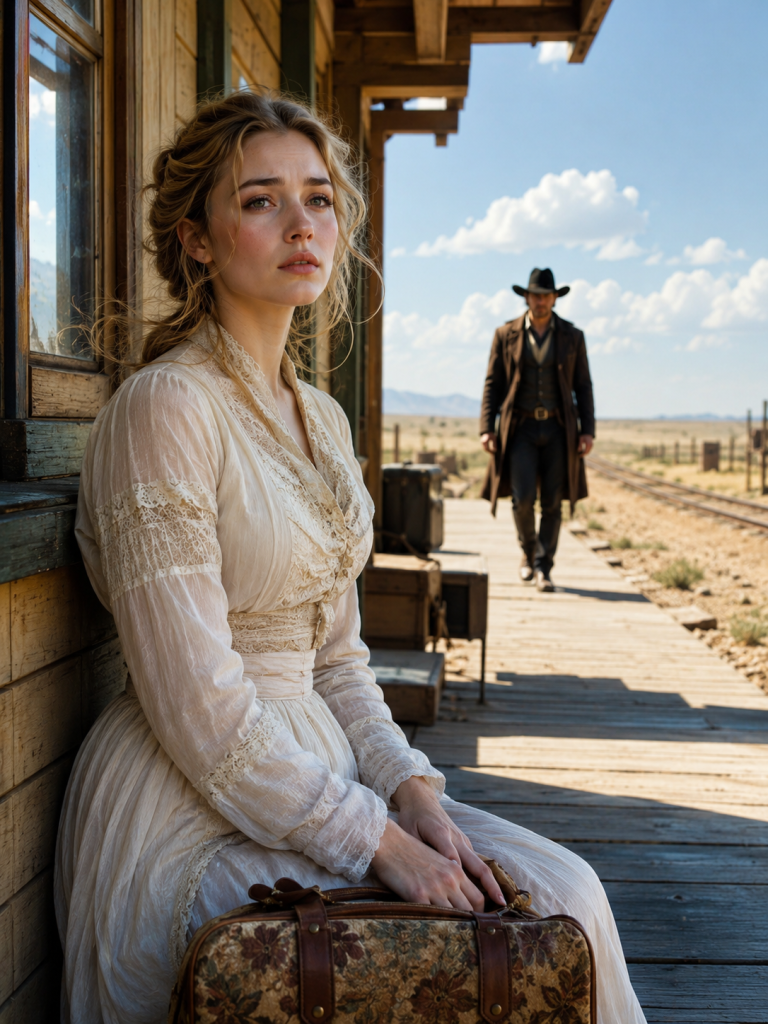
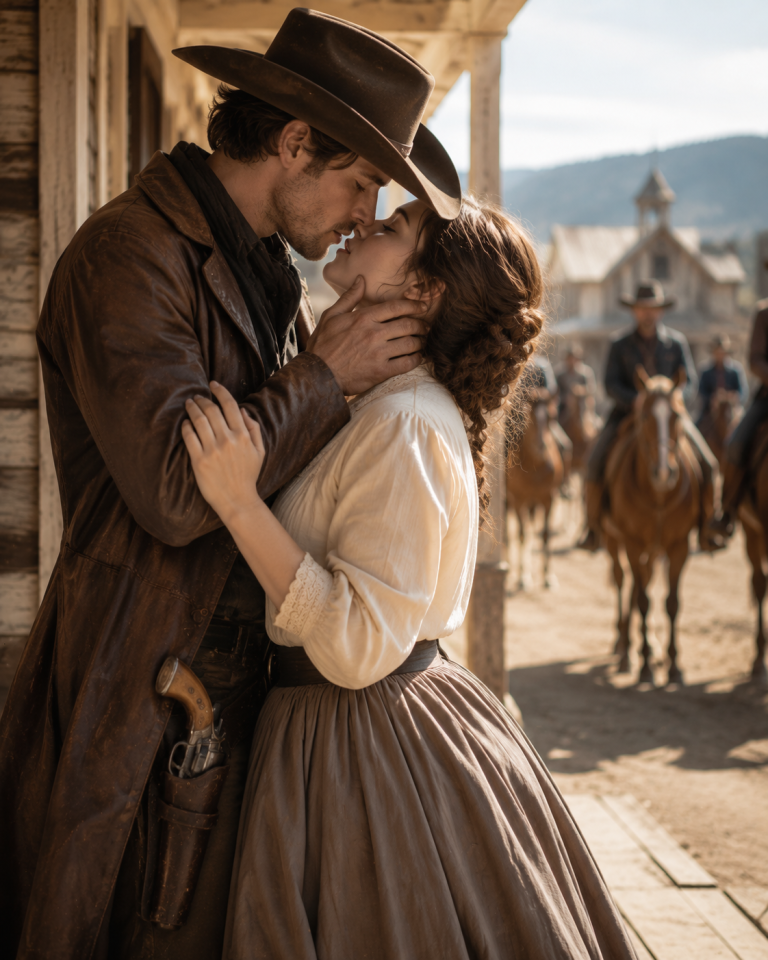
THE TOWN CALLED HER TOO WILD TO BE A WIFE — THEN A STRANGER WATCHED HER SHOOT AND SAID, “THAT’S THE KIND OF WOMAN I’D MARRY”

—
PART 1
The bottle shattered before the echo of the gunshot reached the crowd, and Lydia Monroe worked the lever of her Winchester without lowering it an inch.
“Fluke,” a man laughed.
She fired again. Another bottle vanished.
“A woman with a rifle dies alone,” someone spat.
Then a stranger’s voice cut across the street, low and certain.
*”That’s the kind of woman I’d marry.”*
Every head turned. Nobody was laughing now.
The words hung in the air like gunsmoke, and for a long moment, nobody in Sage Creek moved. Lydia lowered the rifle at last, but she did not turn to look at the man who’d spoken. She’d heard men say things about her before — every version of it, the whispers, the jokes, the pity dressed up as concern. She’d learned the safest thing to do with a man’s words was let them fall to the ground and step over them.
“Who said that?” demanded Dell Harmon, the blacksmith’s son — the one who’d called her a fluke.
The stranger was still sitting on his horse at the edge of the crowd, looking at Lydia the way a man looks at something he didn’t expect to find.
“I did,” he said finally.
“Then you don’t know her,” Dell said, and a few men chuckled, thin and nervous. “That woman’s touched in the head. Trains with that rifle like a soldier. Ain’t natural.”
“Looked plenty natural to me,” the stranger said. “She hit two bottles from forty paces and never blinked. I’ve ridden with men who couldn’t do that drunk or sober.”
“You calling us men?” Dell said, and now the laughter was gone.
The stranger swung down off his horse slowly, the way a man does when he wants everyone to see he’s not in a hurry. He was tall, dust ground into every seam of his coat, and there was a stillness in him that made the younger men take a half step back without knowing they’d done it.
“I’m not calling you anything,” he said. “I’m passing through. Just made an observation.”
Lydia finally looked at him. She had a hard face for a young woman — not unkind, but guarded, the face of someone who’d stopped expecting to be surprised.
“You can keep your observations,” she said. “I didn’t ask for them.”
Something moved at the corner of his mouth, almost a smile. “No,” he said. “I don’t imagine you ask anyone for anything.” He touched the brim of his hat, took his horse by the reins, and walked toward the livery as if the whole thing had never happened.
Her name was on the sign above the door — Monroe’s General Goods, though it was really her father’s name, and he’d been dead two years now. She’d kept it because changing it felt like admitting something.
She did not think about the stranger. Or she told herself she didn’t. Around eleven, the bell over the door rang, and he walked in. She felt it before she saw him — the way a room shifts when someone enters who knows how to fill it.
“Help you,” she said, without looking up from her ledger.
“Coffee. And whatever’s the least likely thing on your shelf to break my teeth.”
She looked up then. “We’ve got biscuits. Day old.”
“Day old’s fine. I’ve had week old. Month old once, in a place I’d rather not name.”
She almost smiled. She caught it in time. He put a coin on the counter, more than the biscuit was worth, and when she moved to make change, he said, “Keep it. It’s the price of a good show.” He nodded toward the window, toward the street where she’d been shooting an hour before. “I paid to see worse in Denver.”
“That wasn’t a show,” she said, harder than she needed to.
“No,” he said, looking at her steadily. “I don’t suppose it was.”
“What was it, then?”
She hadn’t expected the question. Most men either mocked her or made a joke of it, or worse, tried to be gentle, as if her shooting were a wound they’d stumbled onto. This man just asked plain, like he actually wanted to know.
“Practice,” she said.
“Practice for what?”
She hesitated. “For the day I need it.”
He nodded slowly, as though that were the most reasonable answer in the world. “Elias Carter,” he said, and put out his hand.
She shook it. His grip was firm and quick, and he let go the moment it was done — which she noticed, because most men held on a beat too long.
“Lydia Monroe.”
“I know. Whole town knows. They talk about you like weather.”
“And what do they say?”
He took a bite of the biscuit, chewed, considered. “Some of it’s not worth repeating,” he said. “But the general idea is that you’re trouble.”
“And you came in anyway.”
“I’ve spent forty days eating dust behind two thousand head of cattle. Trouble sounds like a vacation.”
That time she did smile, just a little, and hated herself for it. He stayed longer than a man buying a day-old biscuit should have — asking about the store, the town, the road north — and she found herself answering, and then found herself asking questions back, which she never did.
He was a cattleman, or becoming one — a hired trail boss on this drive, saving money for a piece of land somewhere he hadn’t decided yet. Been north to Montana, south to Texas, had the calluses to prove it. No wife.
“Came close once,” he said, unbothered. “She wanted a man who’d settle in a town, take a job in a bank, come home clean every night. Wasn’t me. I told her so. She thanked me for my honesty and married a man named Horace.”
“Do you regret it?”
“Every day I don’t.” He grinned. “You? Man come close?”
Lydia went very still. And here it was — the door she kept locked, the one everybody eventually tried the handle on. She could lie. She could say something sharp and end it. She looked at Elias Carter, and for a reason she couldn’t name, she didn’t do either.
“There was a man,” she said. “Two years back, right after my father died. He was decent. He courted me proper. He’d have made a fine husband. But he came in one day and found me cleaning the rifle. And he watched me do it the way you watch a snake you’re deciding whether to kill. And he said, real gentle, real kind — you won’t need that anymore once we’re married. I’ll take care of that side of things.”
She looked down at the counter. “And I understood right then that marrying him meant putting the rifle down. That he’d have been a good husband to a woman I’d have had to stop being.”
Elias didn’t say anything for a moment. “What’d you tell him?”
“I told him no.” She lifted her chin. “And this whole town’s been telling me I was a fool ever since. That I threw away my one chance. That a woman like me doesn’t get two.”
“Huh,” Elias said. He set down the last of the biscuit. “Seems to me you didn’t throw anything away. Seems to me you kept the one thing you couldn’t do without. Man asks you to be less than you are — that’s not a chance. That’s a cage with the door left open, so you’ll walk in on your own.”
Lydia looked at him, and for the first time in a very long time, she felt something in her chest come loose. She did not have a name for it. It frightened her a little.
What she didn’t know yet — what none of them knew yet, standing in that ordinary Tuesday morning with coffee and a biscuit between them — was that a rider named Boon was about to walk through that same door with news that would turn Sage Creek’s whole world upside down within twenty-four hours: the Barlo gang, six killers who’d been robbing and burning their way north from Pueblo, had gone quiet on the road. And the road they’d take, if they were coming this way, ran straight through Sage Creek.
—
PART 2
Sheriff Boon came in that afternoon, turning his hat in his hands the way he did when he had something to say he didn’t want to say.
“Got a wire from the marshal in Pueblo,” he said, lowering his voice though the store was empty. “The Barlo gang’s moving north.”
Lydia’s hands went still on the counter. Everybody knew the name. Three brothers and whatever hard men they’d collected, robbing banks and burning what they couldn’t carry across half the territory.
“How far north?” she asked.
“That’s the thing. Hit a bank three days ago and went off the road. Nobody’s seen them since. But the road they’d take, if they were coming this way — runs through Sage Creek.”
Boon looked at her, something almost like an apology in his face. “You’re the only person in this town who can shoot straighter than I can. And I’ve got a bad feeling.”
Lydia reached behind the counter, took down the rifle, and laid it on the wood between them.
“How many men has he got?”
“Marshal says six. Could be more by now. They pick up strays.”
“How many can shoot?”
“All of them. That’s what they do.”
She thought about all the times this town had laughed at her — *too wild to be a wife, a woman with a rifle dies alone.* Every one of them would come running to her now, and every one of them would go back to whispering the moment the danger passed.
She thought about it, and then she thought about old Samuel counting his coins, and Mrs. Petri, tiresome as she was.
“I’ll be ready,” she said.
Boon was almost to the door when she spoke again. “The trail boss — Elias Carter. You should talk to him. Man like that’s likely seen more trouble than the whole town put together.”
“He’s staying?”
“He’s got two thousand head of cattle to move north. He’ll be gone in a few days. Why would he stay to fight another town’s fight?”
“No reason at all,” Boon said slowly. “No reason a sensible man would.” And he left, and the words sat there after him, and Lydia found she could not quite let them go.
She closed the store early and went out back to shoot, needing to be alone with the edge of the day’s news. She was on her fourth bottle when a voice said, “You always shoot when you’re worried, or is this a special occasion?”
Elias Carter, leaning against the corner of the building, arms crossed. She hadn’t heard him come.
“You move quiet,” she said. It was almost an accusation.
“Habit. Cattle spook easy, men spook easier.” He nodded at the bottles. “You heard about the Barlos?”
“How do you know about the Barlos?”
“Your sheriff came and found me an hour ago. I’ve seen the Barlo gang’s work two years back, up in a town in the Nations. Got there a day after they’d left.” Something in his face closed, like a door swinging shut on a room he didn’t want to look into. “Wasn’t much of a town left.”
“Then you know what’s coming.”
“I know what might be coming. Might go east. Might go west.”
“That’s what Boon said.”
“Boon’s right.” Elias stopped a few feet from her. “But you don’t believe it. Neither do I. Because a man who robs banks needs three things — supplies, horses, and a bank. Sage Creek’s got all three, and it’s the last real town before the mountains. If I were running from Pueblo and needed one more score before I went to ground for the winter, I’d come here.” He said it flatly, like a man reading a bill of sale. “So would they.”
Lydia felt the cold settle into her — the true cold, that had nothing to do with weather. “You’ve got two thousand head of cattle. You’ve got a drive to finish. You’ve got no reason on this earth to be standing here talking to me about it.”
“My men can move the herd. They don’t need me to walk cows north.”
“That’s not an answer.”
“No,” he said. “It isn’t.”
“Why,” she said instead of pushing further.
Elias looked at her for a long moment. “The truth is I’ve been drifting eleven years,” he said. “Eleven years of other men’s cattle and other men’s land and other men’s towns. And this morning I rode into a place I’d never seen and watched a woman shoot two bottles clean and stare down a crowd that hated her for it. And I thought — there’s a person who knows exactly who she is. You know how rare that is? You know how long I’ve been looking for it, and telling myself I wasn’t?”
Lydia did not move. “I’m not saying I’m staying for you,” Elias said. “That’d be a fool thing to say to a woman I met this morning. I’m saying I’m tired of riding away from things worth staying for. And I’ve got a feeling this town’s about to find out what it’s worth. I’d like to be here when it does.”
She hadn’t known yet, in that moment, just how much that would cost either of them — or that within two days, she’d be standing behind a boarded window with a rifle in the dark, making the hardest shot of her life to save a sixteen-year-old boy’s life, six inches from his skull, with no room at all for error.
—
PART 3
“You’ll likely die,” she told him plainly, in the yard, the rifle forgotten in her hands. “Six men, maybe more. Killers. You could die in a street you don’t even know the name of, for people who wouldn’t spit on you to put you out if you caught fire.”
“I know.”
“And you’re staying anyway.”
“I’m staying anyway.”
She turned, raised the rifle, and shot the fifth bottle clean off the fence, the sound cracking open across the yard like something breaking.
“Then you’d best learn how I fight,” she said, “if you’re going to stand next to me while I do it.”
They worked until dark. She was the better shot, and they both knew it, and neither said it, because Elias Carter, she was learning, was a man entirely without the sickness that made other men need to be better than her.
That night, over coffee at the counter, they talked about the fight coming as if it were a job of work, because that was the only way to talk about it and stay sane.
“A gang like the Barlos, they don’t want to fight,” Elias said. “They want to slaughter. Scare a town so bad it hands over everything and stands still while they take it. The whole thing runs on the town being more afraid than they are. If the town’s not afraid, then it costs them. And men like that, they do the arithmetic. That’s the only chance a place like this has. Make it cost more than it’s worth.”
“You’ve done this before,” she said. “Stood in front of men like that.”
His face did the thing again — the door swinging shut. “I don’t recommend it.”
“You could run, Lydia,” he said later. “You’ve got a horse. You’ve got that rifle. You could be forty miles from here by morning, and nobody could blame you. This isn’t your fight either. You don’t owe these people anything. They’ve made that plain enough.”
And that was the moment — she’d think about it later, all through the days that followed — that he handed her the door and told her she was free to walk through it. No judgment, no shame. The same door she’d been begging the world to give her all her life.
She understood, holding it in her hands at last, that she didn’t want it.
“No,” she said. “I don’t owe them anything. I’m not staying for them. I’m staying because this is mine. This counter, this town, that street where they laughed at me this morning. It’s mine, Elias. All of it, the good and the ugly. And I’m not letting six men with guns take it from me because they think a place like this will roll over. Let them come. Let them find out what it costs.”
Elias Carter looked at her a long moment. “You know,” he said quietly, “when I said that this morning in the street, about marrying a woman like you—”
“Don’t.”
“I meant it. I’m not asking you anything. I know how weak this is. I know a man doesn’t say that to a woman with the Barlo gang on the road, and I’m saying it anyway because I’ve spent eleven years not saying the true thing when it mattered, and I’m done with that. Whatever happens in the next few days, I wanted you to know I meant it. That’s all.”
Lydia sat very still. “When this is over,” she said slowly, “if we’re both still standing, ask me again.”
“Ask you what?”
“You know what.”
Something in his weathered face went soft and young for a moment. “When it’s over,” he said, “I’ll ask.”
—
**A FORT MADE OF FLOWER SACKS**
First light came gray and cold. They boarded windows, kept two for firing. Lydia watched the town’s panic move through Sage Creek like water through a cracked dam — the Petri family loading a wagon with quilts and no plan; the Dolan boys standing uselessly in the street until their mother boxed the eldest’s ear.
“They’re going to get themselves killed,” she said. “Standing around like that, waving guns they’ve never fired.”
“Somebody has to organize it,” Elias said, driving a nail.
“You want me to say it’s me?”
“I don’t want you to say anything you don’t mean. But you’re the best shot in this town and you’ve got the coolest head in it. I don’t see who else it’s going to be.”
Sheriff Boon arrived with Dell Harmon and three young men already arguing — Dell wanted to defend the bank, not “Lydia Monroe’s flower sacks.”
“You give the Barlos the bank without a fight,” Elias said mildly, “you haven’t bought your town safety. You’ve bought it a reputation. Word gets around. Sage Creek, the town that rolls over. Next gang doesn’t even bother robbing you quiet.” He picked the hammer back up. “Besides — you barricade the bank, you’ve drawn them a map to the one building you care about, and stacked all your best men inside it where they can be surrounded and burned out at leisure.”
“He’s right,” Lydia said. “The bank’s a coffin. So’s the saloon. We don’t defend buildings. We defend the street.”
She laid it out — men on the roofs, men in windows, every angle covered, crossfire, so that no matter where a Barlo stood on Main Street, three guns were on him.
“You’ll place them,” Dell said, doubting.
“You got a better shot in this town than me, Dell? You ever placed a gun in your life? You ever fired at something that fired back?” She waited. He said nothing. “That’s what I thought. So you can help, and God knows we need the hands. Or you can stand in the street tomorrow and find out what the Barlos think of your opinions.”
“All right,” Dell said, and it cost him. “What do you need?”
They came at noon — two dozen men and a handful of women, holding rifles and shotguns and one ancient pistol that looked like it might do more harm to the shooter than the target. Lydia stood on the step of her father’s store, and every eye in Sage Creek was on her, and not one of them was laughing.
“Most of you have said things about me,” she said, her voice carrying. “That’s fine. I’m not here about that. I’m here because there are men coming who kill people for a living, and the only reason any of us sees another Sunday is if we’re smarter and meaner than they expect a town like this to be.” She let that sit. “You do what I say tomorrow. Exactly what I say. Some of us live through this. You freeze, you run, you play hero — you die, and you take your neighbors with you. So I need to know right now: can you take an order from me?”
Silence, long and deciding. It was old Samuel — seventy years old, tobacco and coins counted three times — who broke it, stepping forward, shouldering his rifle. “Where do you want me, Miss Monroe?”
That was all it took.
She placed them through the afternoon — Samuel on the church roof for the best angle, Boon at the mouth of the street, Elias across from her own window so between them they covered the center of Main in a crossfire nothing could cross alive. And she saved the hardest job for herself: bait. The store had to look like the town’s weak point, lit and unbarred, as if everyone had run.
“You’re the bait,” Elias said, going very still. “No. You put yourself alone in that store, first man through the door puts a bullet in you. That’s not a plan. That’s you deciding to die usefully. Then we’re both in the store. Upstairs, me down. They come through that door, they don’t find a woman alone. They find me, and I buy you the half second you need, and you make it count from above. You don’t get to do the dying for this town. Not by yourself.”
—
**THE NIGHT THE BARLOS CAME**
Except they didn’t wait for morning. Full dark, hours before dawn, a boy named Tucker came pounding up Main at a dead gallop, screaming that they’d come cross-country, not the road. A rifle spoke in the dark. One flat crack. Tucker’s scream cut off, and the boy pitched into the street and didn’t move.
Everything Lydia had planned went to pieces in a single heartbeat.
“Muzzle flash,” she told Elias, already climbing to her firing position. “They shoot, they show me where they are.”
Cole Barlo’s voice rolled up the street from the dark, big and carrying. *”Sage Creek. This here’s Cole Barlo. You send out your money and your guns and go down on your knees, and maybe we let this town see the sun come up.”* His voice dropped. *”Or we do to you what we done to Elk Hollow. Ask your cattleman.”*
Lydia heard Elias’s breath go out of him, slow and shaking. Elk Hollow — the name he hadn’t said. The town with the church.
“Elias,” she called down. “Look at me. Don’t listen to him. He’s trying to break you before the fight even starts.”
“I hear you, Lydia.”
“You said it. We don’t scare. Say it back to me.”
A silence. Then, steadier: “We don’t scare.”
A torch bloomed to life in the street. Without thinking, Lydia fired. The man dropped it and dropped himself.
“Now who,” Cole Barlo’s voice came, all amusement gone, “did that.”
“That’s one,” she said softly, and chambered the next round.
The gang worked closer through the dark, and Lydia hunted muzzle flashes with a coldness she didn’t know she had in her — two, then two more coming around the alley, dropped before the second man understood what happened to the first. Four.
Then Cole Barlo, rattled, found his cruelty. *”Cattleman, I know you’re in there. I know it’s you.”* And a sound that turned Lydia’s stomach to ice: a child crying.
They had Tucker. Alive the whole time. Knocked cold, dragged into the dark.
*”You send out the money and that rifle woman, and the boy walks,”* Barlo shouted. *”You keep hiding, I open his throat right here where his whole town can hear him do it. You got till I count ten.”*
—
**SIX INCHES**
“Elias, don’t,” Lydia said, hearing him move below.
“He’s a kid, Lydia.”
“And if you go out that door, they shoot you the second you’re in the open. Then they kill the boy anyway.”
“Then what do we do?”
Lydia’s mind ran faster than it ever had. “Where’s the boy? Can you see where they’re holding him?”
“Middle of the street. Man behind him, arm around his throat. Barlo standing off to the left.”
“Which side’s his head? Is he tucked behind the boy, or is he showing?”
“He’s crouched, using the kid as a shield. But he’s tall, Lydia. His head’s above the boy’s. Just barely.”
She moved to the front window, eased the barrel through the firing gap, an inch at a time. A target the size of a fist in the dark at forty paces, with a child’s life six inches below it. If she was off by a hand’s width, she killed the boy. If she flinched. If the wind moved.
“Lydia,” Elias said, very quiet. “Can you make that shot?”
Every bottle, every dawn, every jeer of *too wild, too dangerous* — all of it had been practice for exactly this. Her father had told her so. Now she would find out if it was true.
“Yes,” she said. And she meant it, and she also knew no one alive could be sure of that shot — but the boy died for certain if she didn’t try, and certain was the one thing she couldn’t accept.
She settled her cheek against the stock. She breathed out slow, the way her father had shown her before she was tall enough to see over the counter. She let the world narrow to the pale shape above the boy’s head.
“Elias,” she whispered. “When I fire, you go for the boy. Barlo will be looking at his dead man. You’ll have one heartbeat. Use it.”
She fired.
The man’s head snapped back. He dropped, and the boy dropped with him, free — the arm around his throat gone slack. Elias was already out the door, running, scooping Tucker up, turning as Lydia fired over their heads to drive Barlo back behind the water trough. Then they were inside, all three alive, gasping.
Lydia’s hands were shaking now that it was safe to shake. She had not missed. All those mornings, all those years — she had not missed.
“Five,” she whispered, and her voice broke on it.
—
**THE FIRE**
Cole Barlo, out in the dark, had done his arithmetic and it had come up wrong — and a man like that does not accept a wrong answer. “So I’m going to stop treating this town like a town,” he called, something flat and final in his voice now. “Because it ain’t a town. It’s got you in it.”
A man crept around the back of the store with a torch and coal oil. Elias killed him at six feet, but the torch fell into the spilled oil, and fire ran across the floor of Monroe’s General Goods in a bright, hungry line.
“Out!” Elias roared. “We can’t hold it.”
But the front was where the last living Barlos waited. They were caught between the fire and the gun.
“We are not going out that front door to die on Cole Barlo’s terms,” Lydia said, smoke stinging her eyes, looking at her father’s burning store. “It’s my store. And if it’s going to burn, then I decide how. And I decide who’s standing in the street when it does. We come out shooting together, on our terms.”
Elias looked at her through the rising smoke. “You,” he said, “are the most dangerous woman I have ever met.”
“I know. Now grab the boy. We’re going out the front.”
They came out fast and low, breaking in opposite directions — not the scared, stumbling shapes Cole Barlo had planned to gun down. Barlo got one wild shot off before Lydia’s round took him high in the shoulder, spinning him around, his gun in the dirt, and he screamed — a real scream, the sound of a man discovering how it feels from the other side.
But the sixth man was still standing, calm, and his first shot caught Elias in the shoulder. He went down to one knee, the boy still shielded beneath him.
“Get the shooter, Lydia. Get him.”
The man was already swinging his aim back to finish Elias, and Lydia knew she couldn’t bring her rifle around in time. So she stepped into the open, into the light of her own burning store, and made herself the target — because a killer will always take the standing woman over the kneeling man.
“Hey! You want the one who killed your friends? Here I am!”
The half-second she bought with her own body was enough. Elias lifted his ruined gun arm and fired. The shooter dropped.
“Six,” Lydia whispered.
“One more,” Elias said.
Cole Barlo, dying, beaten, raised his pistol with his off hand — not at her, not at Elias, but at Tucker, frozen in the dirt. His last strength for the one thing that had always come easiest to him.
Lydia didn’t aim. There was no time. She fired from the hip, from ten thousand mornings of practice burned into her hands, and the shot took Cole Barlo through the chest. He didn’t move again.
Silence. Real silence. It was over.
—
**AFTER**
She had killed five men herself that night, and she made herself count it, made herself not look away. She dropped the rifle in the dirt — she who had never mistreated a weapon in her life — and went to hold Tucker, shaking worse than she was.
“It’s over,” she told him. “You saved lives tonight.”
Then she turned to Elias, ash-colored, still down, and pressed her hands against the wound. “Don’t you joke. Don’t you dare joke,” she said, when he tried a weak smile about it being the same shoulder as last time.
“I forbid you to die,” she told him, tears finally coming, she who hadn’t cried in front of another living soul since her father died. “You do not get to die in the street now that it’s over.”
“I’ve been shot before, Lydia,” he said, gray and half in shock, his hand finding her wrist, “and I lived through it because I had a reason to, or I didn’t much care whether I did. This is the first time in eleven years I had something I actually wanted to live for. So I expect I’ll be all right.”
Doc Feeney arrived, pulled her hands gently away — *let me in there, you’ve slowed it, that’s the only reason I still let you in* — and gave her the words she needed: the bullet went clean through, he’d lost blood, but he had the constitution of a mule. He’d live.
The store burned to the ground. By dawn, it was a black skeleton. She stood in the doorway of Doc Feeney’s and watched the last smoke rise.
“I’m sorry about the store,” Boon said.
“It’s just a building. It was my father’s — but my father wasn’t the building. My father was the man who put a rifle in my hands when I was ten and told me the world would try to take it away from me, and I should never let it. The building burned. What he gave me didn’t. Six men found that out last night.”
Boon took off his hat. “This town owes you its life. I know what we said about you all those years. I’m ashamed of it. And I’ll spend whatever’s left of my time in this job making sure nobody in this town ever forgets what a rifle woman did for them when the killers came.”
“You don’t owe me an apology,” Lydia said. “You were the first man in this town to ask me what I could do. That’s worth more.”
—
**THE PROPOSAL**
On the fifth day, with the fever broken and color back in his face, Elias took her hand.
“You told me that first night in the store — when it was over, if we were both still standing, I should ask you again.”
“I remember.”
“Well, it’s over, and we’re both still standing. More or less. I’m doing my standing sitting down, but the principle holds.” He took a breath. “I’ve been drifting eleven years, Lydia. Told myself I liked the freedom. It was a lie the whole time. I wasn’t free. I was just alone and calling it free so it wouldn’t hurt so much. And then I rode into this town and watched a woman shoot two bottles and stare down a mob, and for the first time in eleven years, I didn’t want to keep riding.”
“You’ve known me a week,” Lydia whispered — the last of her walls, the last defense of a woman told her whole life she was too much to be loved.
“I’ve known you through six dead men and a burning building and a shot I’ve never seen another living soul make. There’s not a thing about you I don’t want, and not a thing I’d change.”
“Yes,” said Lydia.
“What?”
“I said yes. Ask me whatever you were going to ask. The answer’s yes.”
He laughed, a real laugh that pulled at his wound and made him wince. “I was going to do it proper. Get down on a knee.”
“You’ve got a hole in you the size of my thumb. You’re not getting down on any knee.”
“No,” he admitted, “I suppose not.” All the humor went gently out of his face. “Lydia Monroe, will you marry me? Not so I can take care of you — Lord knows you don’t need it. Marry me so I can stand next to you. That’s all I’ve ever wanted. I just didn’t have the name for it till I met you.”
“I’ll stand next to you,” she said, “for the rest of my life. Yes.”
—
**THE MAN IN THE GOOD COAT**
On the sixth day, trouble started again, in the shape of a man named Harlon Voss, representing the Cattleman’s Trust out of Denver, offering to buy Lydia’s burned lot for a generous price — cash in hand, a fresh start, away from bad memories.
“How’d you hear about us, Mr. Voss?” Lydia asked, not taking the paper. “The fire was six days ago. Denver’s four days’ ride. You’d have had to leave near the very morning it happened.”
“News travels,” Voss said, his smile not changing, though something behind it did.
“Not that fast,” Elias said from the bed, swinging his legs over the side. “News doesn’t travel that fast. But a plan does. You didn’t hear about the fire in Denver, Voss. You knew about it before it happened, because you were counting on it.”
He laid it out — a company buying up Main Streets across the territory too slowly for its liking, and someone with a notion: what if a town got hit? Scared towns sell cheap.
“How much were you paying the Barlos to burn towns you had your eye on?”
It was Tucker, sitting quiet in the corner, who broke it open — standing, pointing, trembling. “I know your voice. You were at the Hendricks place the night they took me. I heard you through the wall. You said, burn the store and the bank, leave the rest standing. We don’t want the whole town gone. We just want it scared.”
Voss ran. Dell Harmon clotheslined him flat in the dirt of Main Street and sat on him.
In his coat, they found letters — careful men writing to other careful men, naming towns, naming prices — and a list. Sage Creek was on it, uncrossed, because Sage Creek had refused to die on schedule.
—
**THE TRIAL, AND THE STORE THAT ROSE AGAIN**
The trial was held in Denver, before a territorial judge, because the crimes crossed too many county lines. Lydia rode there to testify, Elias beside her though Doc Feeney said loudly he shouldn’t, Tucker terrified but willing.
“Being brave isn’t not being afraid,” Lydia told the boy in the courthouse hallway, the way her father had once told her. “Being brave is being afraid and telling the truth anyway.”
Tucker told the court what he’d heard through the barn wall. Lydia told them what had actually happened — the six men, the fire, the deed pressed into her hands before the ashes were cold.
“Random violence doesn’t leave the bank standing so it can be bought,” she told the jury. “Those men had orders, and they followed them right up until they ran into a town that wouldn’t lie down and be burned. He didn’t come to Sage Creek to buy land. He came to collect on a murder he’d already paid for. The only thing that went wrong with his plan was that some of us refused to die on schedule.”
Harlon Voss was convicted. The letters named men in Denver. The crossed-off towns began, one by one, to learn the truth of what had been done to them.
They rebuilt the store that autumn. Dell Harmon came the first day with his hammer and didn’t leave until the last nail was driven. When it was finished, the new sign didn’t say Monroe’s General Goods. It said **Monroe and Carter**.
“You didn’t have to do that,” Elias said.
“You bled in the last one,” Lydia said, slipping her hand into his. “That buys a man his name on the new one. Monroe was my father’s dream, and I honored it. This one’s ours.”
—
**THE WEDDING**
They married in the spring, in the churchyard, because the church itself was too small for everyone who wanted to come — and everyone wanted to come. Boon gave her away. Tucker stood up beside Elias, sixteen and no longer afraid of much of anything.
When the preacher asked if anyone had cause why these two should not be joined, old Samuel called from the back: “The only cause I ever heard was that she carried a rifle. And I reckon we all learned what a fine thing that turned out to be.”
The whole churchyard laughed, warm and kind, and Lydia laughed with them — at herself, at the rifle, at all of it — because the laughter had changed its nature entirely, and she understood now that being laughed *with* was one of the sweetest sounds in the world.
That night, on the porch of their new store, Elias said, “You remember the first thing I ever said about you, out in the street, before I even knew your name?”
“I remember.”
“They mocked you for that rifle your whole life. And I rode in, a stranger, and looked at the thing they mocked you for, and said, *that’s the kind of woman I’d marry.* And I meant it before I had any right to. I’ve never in my life been more right about anything.”
Lydia Carter looked out at the street where six men had come to burn her town and died in it instead — the street that was hers now, wholly and finally hers, the way her father had always told her it could be, if she was only brave enough to hold on to who she was.
“I wasn’t too much,” she said quietly, and it was not sorrow in her voice, and not even triumph. It was peace. “I was never too much. I was just waiting for someone who wasn’t too little.”
Elias took her hand, and did not answer, because there was no answer needed. Together they sat and watched their town settle into sleep beneath the wheeling stars — the rifle woman that nobody had respected, who had faced down killers and liars and a whole territory’s worth of men who thought they knew what a woman ought to be, and had beaten every one of them not by becoming what they wanted, but by refusing, to the very end, to be anything other than exactly who she was.
THE END