SHE SHOWED UP AT THE COLDEST RANCHER IN MONTANA’S DOOR WITH $43 AND A FRAUDULENT LIEN ON HER LAND — SHE WASN’T ASKING, SHE WAS PROPOSING A TRADE

*Part 1*
The woman on Cole Mercer’s porch had mud on her boots and nothing left to lose.
“My name is Evelyn Hart,” she said, before he’d even asked. “I was married to Thomas Hart, who ran the Twin Elk spread near Foresight, until he died fourteen months ago. I’m not here because I heard you’re rich, and I’m not here because someone told me you might be looking for company. I’m here because I’ve got a fraudulent lien filed against my property by a man named Victor Hail. I’ve got forty-three dollars to my name and I need somewhere to stay while I build a legal case that will take him apart piece by piece. I can cook, I can keep books, I can manage a supply ledger, and I can work. I’m asking for shelter and honest work in exchange for honest labor. Nothing else.”
Cole studied her. He was thirty-eight, the wealthiest cattle baron in Beaverhead County, and the most deliberately unavailable man in Montana Territory. Six years ago, a woman named Charlotte Pierce had taken everything he’d been foolish enough to offer — his name, his trust, his plans for a life that meant something — and handed it back to him in pieces. He had learned the lesson thoroughly. He did not intend to unlearn it.
“Who told you to come here?” he asked.
“Margaret Aldis in Dylan Creek. She said you were the only man in the county who wouldn’t try to turn a woman’s trouble into an obligation.”
“Margaret Aldis talks too much.”
“She also said—” Evelyn tilted her head slightly. “Are you going to let me stand here in the heat, or are we going to have a real conversation?”
He had turned away women with tears, women with charm, women with connections and beauty and calculated warmth he recognized and despised. He had never turned away a woman who looked at him like this — as though she wasn’t asking for mercy, just making a reasonable proposal and waiting for a reasonable response.
“Come inside,” he said. “We’ll talk.”
She laid her satchel on the kitchen table like a boundary. “Victor Hail filed a lien against Twin Elk three months after Thomas died, claiming Thomas had borrowed four thousand dollars from Hail’s Lending Company in 1884. Thomas never borrowed a cent from anyone in his life. I have his records — every transaction, every payment, every note. But the lien is in the county register, and my attorney in Foresight says fighting it will take six months and money I don’t have.”
“Why Dylan Creek?”
“Because Victor Hail has relationships with three judges in Foresight County and none here. And because Beaverhead County has a land court session in September, and if I establish legal residence and file a proper counterclaim, I have a better chance of a fair hearing.” She met his eyes. “I also know you’ve had trouble with Hail’s associates before. Senator Whitmore tried to acquire the eastern parcel of Blackstone Ridge two years ago through a surrogate buyer, and you fought it off. That tells me you understand what it means to be targeted by men who think the law belongs to whoever pays for it.”
Cole was quiet a moment. She was right on both counts.
“You said you can keep books,” he said.
She reached into her satchel and produced a small bound journal — meticulous column entries, cross-indexed, not a single eraser mark. He turned three pages before handing it back.
“My current bookkeeper is leaving at the end of the month.” He paused. “The bunkhouse isn’t appropriate. There’s a small room off the cookhouse. Clean. Private. I’ll give you room, board, and a fair wage in exchange for the books and whatever else needs doing. You keep your legal work separate from your duties here.” He held her gaze. “And I want no misunderstanding about what this is. This is an employment arrangement. Nothing more.”
Something between amusement and respect crossed her face, settling toward respect.
“Mr. Mercer,” she said. “I buried my husband fourteen months ago, and I’ve spent every day since fighting a man who thinks a woman with a dead husband is the easiest target in the territory. I did not ride forty miles in July heat to find a husband. I came to find ground to stand on. That’s all.”
—
By the second day, three things had happened that Cole hadn’t anticipated. Evelyn had found a forty-dollar discrepancy in the supply ledger his outgoing bookkeeper had missed for three consecutive months. She’d reorganized the cookhouse storage in a way his fiercely territorial old cook Joseph had not only tolerated but welcomed — Cole had actually heard the man laugh, a sound he heard maybe twice a year. And she’d been up before him. He found the horses already fed at 4:30 in the morning, the troughs full, the floor swept.
“She asked me about the Hail situation,” his foreman Hank said. “I told her what I knew. She listened real careful. Didn’t say much. But she had this look — like she was putting things in order in her head. Like she was already three steps ahead.”
On the fourth day, she knocked on his study door — knocked and waited, which most of his household had stopped doing years ago, and he hadn’t noticed he’d missed it until now. She spread three pages of her own notes across his desk. She’d traced the supply discrepancy back through the chain and found a pattern: his current supplier had been padding invoices by a small enough margin to avoid easy detection, but consistently enough that over two years it amounted to nearly nine hundred dollars.
“You did this on your own time,” Cole said.
“You’re letting me live here,” she said, as though that settled it.
“I’ll take this to my attorney,” he said. “You’ll want to be there when I do. Your work. Your name should be on it.”
“Thank you, Mr. Mercer.”
“Cole,” he said. He wasn’t sure why he said it. He hadn’t invited anyone to use his first name in a very long time.
She looked at him steadily. “Thank you, Cole.”
—
The letter arrived on a Tuesday, and it changed everything — a claim filed in Helena County on behalf of Senator Elliot Whitmore, asserting prior purchase rights on the southeastern parcel of Blackstone Ridge, based on an 1879 land grant. Thirty days to respond.
Evelyn read it and went very still. “He’s moving on two fronts,” she said. “Hail is coming after me and Whitmore is coming after you at the same time.” She looked up. “Victor Hail was a business associate of Senator Whitmore starting in 1881. I found that in the Helena Gazette archives while I was building my case against Hail. I don’t think they’re coming after us separately. I think we were never separate targets.”
“They want the ranch,” Cole said.
“They want the water rights attached to the ranch,” she said. “If Whitmore gets the southeastern parcel, he controls the creek access. If Hail gets Twin Elk, he controls the southern grazing corridor. Together, they’d have leverage over every small rancher between here and Foresight.”
She opened her trunk and began pulling out fourteen months of carefully dated, organized files — laying them on the desk like a hand of cards she’d been waiting for the right moment to play.
They worked past midnight. Neither of them suggested stopping.
—
*Part 2*
Three days later, Hank found Cole alone in the stable. “She’s good, boss,” he said. “I’ve been here eleven years. I’ve never seen you sit down with anybody at a desk like that. Working, talking it through. Like a partner.”
“It’s a practical situation,” Cole said.
“Sure it is,” Hank said, in the tone of a man who believed no such thing.
Partner. Cole hadn’t used that word in six years, hadn’t let himself think it. Now it was following him through the heat and the work and the long silences of Blackstone Ridge, and he couldn’t figure out how to put it back where it came from.
That evening on the porch, Evelyn had found the original 1879 land grant filing in the territorial archives — describing a completely different parcel than the one Whitmore was claiming. The boundary description had been altered sometime between 1879 and 1883.
“How did you find that?” Cole asked.
“I wrote to the archivist three weeks ago,” she said. “I was building my case against Hail, and I thought it was worth knowing who Hail was connected to. So I started pulling the thread.”
She had come here with more than her own legal defense. She’d arrived carrying intelligence on his enemy he hadn’t even known he needed, gathered quietly, weeks before she’d ever knocked on his door.
“Why didn’t you tell me about the land grant filing when you arrived?” he asked.
“Because I didn’t know if I could trust you yet,” she said. “And because it was mine to hold until I was sure it would be used right.”
“And now?”
She held his eyes for a long, steady moment. “Now I’m sure.”
The wire came back from Helena Friday afternoon — *original grant found* — and Cole rode home faster than he needed to. But that same evening, Hank warned him: two riders had scouted the ranch, one with a Hail Land and Lending letterhead visible in his coat pocket. Hail knew Evelyn was here. He knew Cole was involved. The timeline had just gotten shorter.
Cole made a decision that surprised him with how quickly and certainly it came. He walked to the cookhouse and knocked on Evelyn’s door.
“Tomorrow night,” he said. “Not Monday morning. We leave tomorrow night and we’re in Dylan Creek before dawn. I want the filing done before Hail’s men can get a wire to Helena.”
She didn’t flinch. “They’ve already been here,” she said, not as a question — already adjusting. “I’ll have everything ready by eight.”
“Seven,” he said.
“Seven.”
He turned to go. “Cole,” she said, and he stopped. “Thank you.” Not politely, at a distance, the way she’d said it before — she meant it, and he felt the difference land somewhere behind his sternum and stay there.
They rode out before the dark lifted, reached Dylan Creek at first light, and Cole knocked on the courthouse door at 7:42 in the morning, asking clerk Abner Walsh to accept an irregular early filing — because a party hostile to the claim might try to file something first, and Cole wanted the record to show they’d gotten there first.
Walsh let them in. Evelyn walked him through fourteen months of documentation in twenty-two minutes — clear, supported, airtight — and by the time she finished, Walsh had his stamp in hand before she asked for it.
“That’ll do it,” he said, noting the filing at 7:54 a.m. on account of exceptional circumstances.
Something released in Cole’s chest. He looked at Evelyn holding the stamped document, and saw, for just a moment, the same three seconds of quiet he’d started to recognize — the breath behind the composure, fourteen months of fighting alone finally cracking open into relief.
But Victor Hail was already in Dylan Creek by Thursday afternoon, with a lawyer named Greer known for winning cases through procedural exhaustion, and a settlement offer designed to make her case disappear. And when Hail cornered them both on the main street of Dylan Creek, he made the mistake of implying, in front of half the town, that Cole’s interest in Evelyn’s affairs was something other than what it was — the oldest, filthiest play in the book, meant to make her position look like dependency instead of competence.
She didn’t need Cole to answer for her. She answered for herself, in front of everyone who mattered in Beaverhead County — and by the time she finished, Victor Hail understood, for the first time, exactly what kind of woman had walked onto Cole Mercer’s porch six weeks earlier with forty-three dollars and nothing left to lose.
—
*Part 3*
“Mr. Hail,” Evelyn said, standing in the middle of Dylan Creek’s main street with the whole town watching. “I managed Twin Elk’s finances for eight years, identified and documented your fraudulent lien without legal training, located the original territorial archive document that invalidates your partner’s land claim, and filed a counterclaim in a county where you have no political relationships. I did all of that on forty-three dollars and a borrowed horse.” She held his eyes with the absolute directness that was her particular brand of devastation. “Mr. Mercer offered me a job because I’m competent. If you’re implying otherwise, you’re welcome to say so clearly, so I can add it to the record.”
The street was not crowded, but it wasn’t empty either. Three men outside the hardware store had stopped talking. May from the cafe stood in her doorway. Ericson, the merchants’ association chairman, was visible through his office window directly across the street.
Hail understood, in that moment, that this conversation was being witnessed by exactly the kind of people whose opinion would matter come September, and that he had walked into a situation he hadn’t fully mapped.
“I look forward to the court proceedings,” he said, with a smile that cost him something, and walked away.
Evelyn let out a slow breath once he was gone — not the private three-second kind she allowed herself when she thought no one was watching, but a full breath, almost shaky at the edges, the kind that comes when your body reminds you it was afraid even when your voice wasn’t.
“That was the bravest thing I’ve seen in a long time,” Cole said quietly.
“I was terrified,” she said, just as quietly.
“I know,” he said. “That’s what makes it brave.”
She turned and looked at him, something in her face open in a way it hadn’t been before. “Can we go home?” she said. The word *home* landed in the air between them, and she heard it, and a faint color came into her face. Cole didn’t remark on it. He filed it away the way he’d been filing away small things for weeks, and let it be what it was.
—
Four days later, Joseph the cook found an unmarked envelope hand-delivered to the ranch’s mailbox, addressed to Mrs. E. Hart in handwriting neither of them recognized. Inside was an unsigned letter detailing, in careful and knowledgeable language, the internal structure of Hail’s lending operation, three additional targeted properties, and a bribed county clerk who’d altered records. At the bottom, two sentences that changed the shape of everything:
*Thomas Hart’s original loan records with Hail Land and Lending were destroyed in March of 1886, not because they didn’t exist, but because they did exist and showed repayment in full. The lien is not just fraudulent. It is evidence of deliberate fraud and destruction of legal documents, which is a criminal matter, not a civil one.*
Evelyn went very still. “Thomas made a payment in March of 1886,” she said. “I have the record. He noted it as a final payment on a short-term note, but I found no corresponding account with Hail, so I assumed it was a different lender.” She stopped. “He borrowed from Hail and paid it back, and Hail destroyed the evidence of repayment to manufacture a debt that didn’t exist.”
For the first time since she’d arrived at Blackstone Ridge, her composure cracked — not dramatically, but enough. Cole watched a woman who had been right all along finally see the proof of it, and felt the full weight of fourteen months of fighting alone land on her all at once.
He put his hand over hers on the desk. No words. She looked down at it, then up at him, and didn’t pull away.
“We need to get this to your attorney today,” she said, her voice steady again, almost.
“I’ll wire him this morning,” Cole said, not moving his hand. “Evelyn — I was going to say that Thomas would be proud of you.”
She looked at him a long moment, grief and exhaustion and the long relentless forward motion of a person who had refused to stop, all visible for one moment before she brought it back under her own authority. “Thank you,” she said, barely above a whisper.
“You’ve been fighting this alone for fourteen months,” Cole said, standing. “You’re not alone anymore.”
—
Cole’s attorney, Douglas Fen, arrived Saturday morning and read the anonymous letter twice, Evelyn’s formal statement three times. “Do you understand what you have here?” he asked. “If we can corroborate this letter with one verifiable piece of external evidence that Thomas Hart’s loan was repaid, Hail isn’t looking at a civil dispute over a fraudulent lien. He’s looking at a criminal indictment.”
Evelyn produced Thomas’s ledger without a word — the payment marked to *HLL*, dated precisely when the letter claimed the account had been destroyed.
“This is your corroboration,” Fen said. “A contemporaneous record in the deceased’s own hand, at the precise time the anonymous letter claims the account was closed.”
“Do it,” Cole said. “All of it. Whatever resources it takes.”
The three days Fen spent drafting the full filing were, in Cole’s private accounting, some of the strangest and most clarifying days he could remember. Evelyn was up before him every morning, at the desk by six, precise and unwasteful in every answer she gave Fen. At dinner one evening, Hank made a comment about fall supply contracts, and Evelyn offered an observation on pricing that made him look at her, then at Cole, with an expression that said plainly, *she’s good, boss* — the same words as weeks earlier, but with more certainty behind them now.
That night, after the house had gone quiet, Evelyn said, “You’ve been thinking about something specific for about four days. I’ve been watching you decide.”
“Charlotte Pierce,” Cole said finally. “We were engaged in the spring of 1881. There was another man — a business associate of her father’s — she’d known him before she knew me, and she chose not to tell me when she accepted my proposal. She let me build a life around the assumption she intended to share it. And then she didn’t.” He paused. “I wasn’t broken by it. I was recalibrated. I decided the cost of being wrong that way again was higher than the cost of preventing it.”
“So you closed the door,” Evelyn said.
“I closed the door. Every woman who came near Blackstone Ridge in six years had a clear view of it from the outside.” He looked at his coffee. “You’re the only one who didn’t try to open it. You just went about your business, and the door opened anyway.” He held her eyes. “I don’t know what to do with that.”
“I buried Thomas fourteen months ago,” Evelyn said, “and I haven’t stopped moving since, because if I stop, I have to feel how tired I am.” She paused. “I didn’t come here looking for anything except ground to stand on. That’s still true. And it’s also true that I’ve spent thirty days noticing things about you I wasn’t expecting to notice. I don’t know what to do with that either.”
“Then we’re in the same position,” Cole said.
“We’re in the same position,” she agreed.
Neither of them moved to leave.
—
The week before the September court session, Victor Hail made his mistake — a formal settlement offer through Greer’s office, withdrawing the original lien in exchange for Evelyn dropping the counterclaim, signing away further legal action, with $800 attached, framed as compensation for inconvenience.
“He’s scared,” Evelyn said. “The criminal referral reached Helena. He’s trying to make this go away before the court session.” She set the letter down. “I’m not signing it. He destroyed Thomas’s records. He manufactured a debt that didn’t exist. He filed a fraudulent lien against a grieving widow, and then sent a man to stand in my yard and measure the fence.” She paused. “No.”
“We draft the refusal today,” Cole said. “We reference the criminal referral directly. I want Hail to know we are not stopping.”
“Draft it together,” she said. “I want my name on the language.”
They spent two hours on nine paragraphs of precise, calm, legally grounded refusal that Cole privately considered one of the most quietly devastating documents he’d ever read — Evelyn’s particular gift for arranging specific, verifiable facts into an order that made their meaning inescapable.
The night before the court session, Cole couldn’t sleep. He found Evelyn at the kitchen table at 2 a.m., already awake.
“Whatever happens tomorrow,” she said, “I want you to know what you’ve done here has mattered. Not just the resources. You stood on that street in Dylan Creek and told Hail I was not alone. That mattered more than anything else.”
“You would have gotten there without me.”
“Maybe. Eventually. But eventually might have been too late, and alone might have broken something.” She paused. “Having someone in my corner made that easier.”
“You’ve been in mine too,” Cole said. “I want you to know I’m aware of that.”
“When this is over,” Evelyn said, “I need to decide what comes next.” She held his eyes. “Do you want me to stay? Not as an employee. Not as a practical arrangement. Just here, at Blackstone Ridge, with you.”
Cole thought about post by post, and Thomas Hart’s wisdom passed through the woman he’d loved. He thought about Charlotte, and the difference between a lesson about not trusting and a lesson about who to trust.
“Yes,” he said, without hesitation, without the careful management he’d applied to his own feelings for six years. “I want you to stay.”
Evelyn reached across the table and set her hand over his, the same gesture returned. “All right,” she said. “Then I’ll stay.”
—
The Beaverhead County Land Court convened at eight sharp on a Tuesday in September, and every seat was filled — ranchers, merchants, and townspeople who had decided, without coordination, that this hearing was worth showing up for.
Fen presented forty minutes of documentation without ornament: Thomas Hart’s ledger entry, the certified territorial archive record, seven prior Hail acquisitions following the identical pattern, subpoenaed company records showing systematic account destruction, and the anonymous letter as corroborating context.
Then Evelyn testified for twenty-two minutes — no appeal to sympathy, no performance of distress, just facts in chronological order, cited by exhibit number, answered with precise clarity under cross-examination.
“My motivation is accurate accounting,” she told Greer, when he suggested her counterclaim was personal animosity. “The lien claims a debt that was repaid. The records proving that repayment were destroyed by the lender. I want the accurate record restored. That’s not animosity. That’s arithmetic.”
Someone in the gallery laughed — recognition, not disrespect.
Judge Bowmont dismissed the Whitmore claim outright, the altered filing contradicted by the original surveyor’s own boundary notation. On the Hail lien, he ruled the counterclaim substantially supported — the ledger entry, the documented pattern across multiple prior acquisitions, the lender’s inability to produce any original loan documentation — and vacated the lien entirely, noting the criminal referral would remain in the record.
The room didn’t erupt. It exhaled, warmly, and then Ericson started clapping, and the sound built into something real.
“We did it,” Evelyn said.
“You did it,” Cole said. “I just held the door open.”
She shook her head. “Post by post.”
“Post by post,” he said.
—
Three days later, a man named Gerald Puit arrived at Blackstone Ridge — the clerk who’d processed Thomas Hart’s final loan payment in March of 1886, instructed by Hail’s office manager to pull the account and remove it from active records, and who had finally, at considerable personal cost, decided he could no longer stay silent.
“I should have come forward sooner,” he said, hat in his hands. “I know that.”
Evelyn looked at him a long moment, weighing anger against pragmatism. “You’re willing to testify to the territorial prosecutor?”
“Yes. That’s why I’m here.”
“Then you came at the right time,” she said. “Even if it wasn’t the soonest possible time. I’m not going to tell you it doesn’t matter that you waited. It does matter. Thomas deserved better. But what you’re doing now also matters, and I’ll make sure the prosecutor understands you came forward voluntarily.”
“Your husband was an honest man,” Puit said. “I’m sorry for what was done to his name.”
“His name is clear now,” Evelyn said. “That’s what counts.”
After he left, she sat at the kitchen table for a long time. “It’s really over,” she said finally.
“It’s really over,” Cole said.
“I don’t know how to not be fighting,” she said.
He understood that more precisely than he could have explained — six years of his own version of the same armor, the same permanent readiness for the next thing that would require him to hold his ground.
“You learn,” he said. “It takes longer than you think and less time than you fear. Is that what you did after Charlotte?”
“Eventually,” he said. “I made the mistake of keeping the armor on for six years longer than I needed it. I don’t recommend that approach.”
The edge of her mouth moved. “Noted.”
—
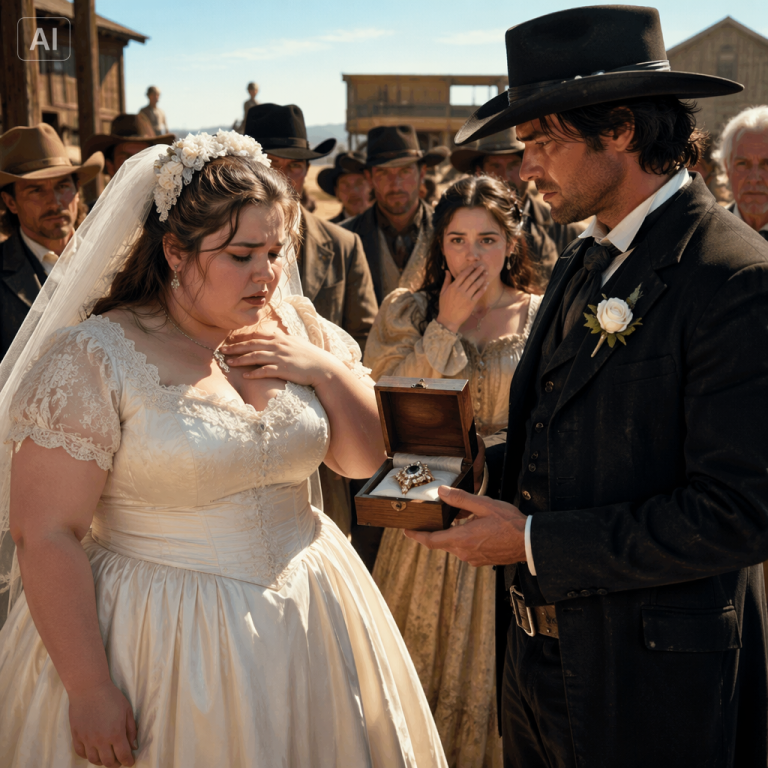
They married in the Dylan Creek church on a Saturday in April — Hank as witness, Joseph in the back pew with his hat on his knee, Margaret Aldis in the front row looking entirely justified in her satisfaction, since it had been her suggestion that started all of this. Judge Alderman performed the ceremony, brief and specific and real.
Afterward, on the porch of Blackstone Ridge, with the April valley green after the long Montana winter, Evelyn said, “I want to talk to you about something. The hands’ children — there are eleven families on this ranch, and not one of them has a school closer than Dylan Creek. I want to start a school. Not a formal building yet. Just a room, a teacher, a regular schedule.”
Cole looked at this woman who had walked onto his porch with nothing but her own competence and her refusal to be beaten, who had dismantled a corrupt land operation, uncovered a nine-hundred-dollar fraud, and sat with him in a kitchen at two in the morning and said the truest things he’d heard in years — already, on their wedding day, thinking about what needed to be built next.
“The room off the south barn,” he said. “It’s not being used. Good light in the mornings.”
“You’re not even going to think about it?”
“I thought about it the moment you said it. The answer was obvious.”
She smiled — the real one, unguarded, the one that changed her whole face, the one he’d spend the rest of his life looking for reasons to see.
“We’ll need a teacher,” she said. “Write to the normal school in Helena.”
“I’ll write Monday,” she said.
“Write Sunday,” he said. “We’re efficient people.”
She laughed, and he put his arm around her, and she leaned into him with the ease of someone who had finally, after a very long time, found solid ground and knew how to stand on it.
Cole Mercer had spent six years convincing himself that the closed door was the safe door — that keeping people at a distance was wisdom rather than fear, that the walls he’d built were protection rather than prison. He had been wrong, and it had taken a woman with forty-three dollars and a satchel full of truth and the absolute refusal to beg for anything to show him exactly how wrong he’d been.
Evelyn Hart had not tried to melt him. She had not performed warmth or engineered affection. She had simply arrived, and worked, and told the truth, and stayed — post by post, day by day — until the walls he’d built with such care became not a barrier between them but a foundation beneath them both.
On a Saturday in April, with the Montana spring coming green and unhurried over fourteen thousand acres, Cole Mercer looked at his wife and understood something he had been learning slowly for six months and now knew completely: the right person doesn’t break down your walls. They make you wonder, quietly and then not so quietly, why you ever needed them at all.
Blackstone Ridge had always been his.
Now, finally, it was theirs.
THE END