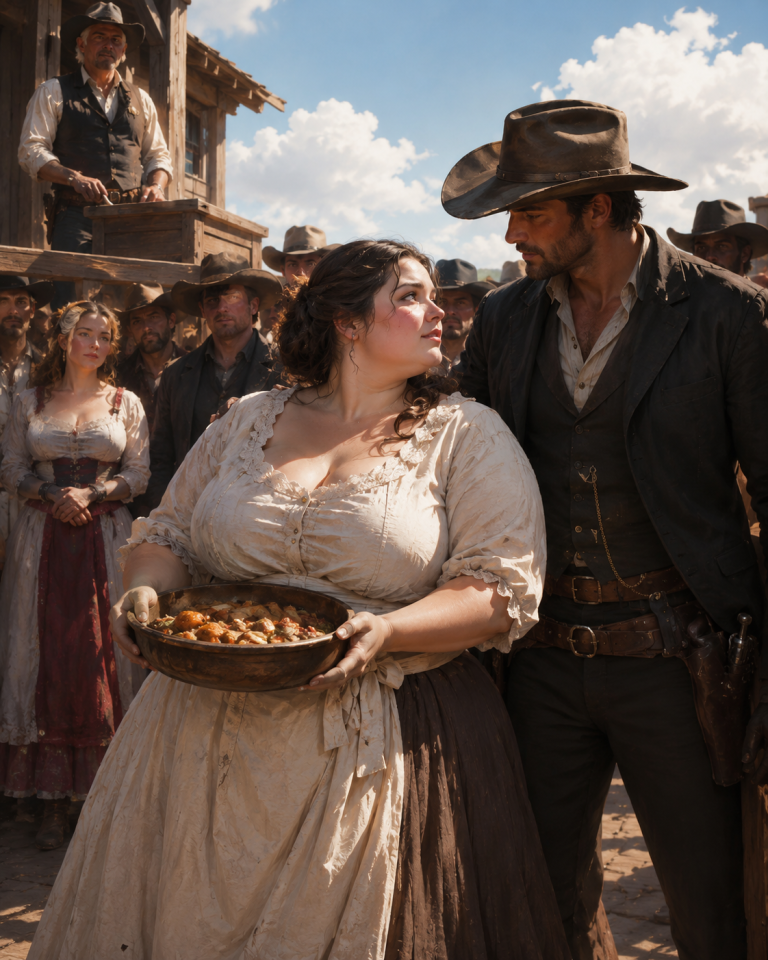
HE ANSWERED HER DESPERATE FLIGHT WEST WITH A JOB OFFER INSTEAD OF PITY — THEN HIS BROTHER BROUGHT THE MAN WHO’D RUINED HER STRAIGHT TO THE RANCH

# Part 1: The Tin of Salve
The train lurched to a stop with a screech that set Josephine’s teeth on edge. She stood before the conductor could announce the station. Not that there was much to announce. Through the smudged window, all she could see was dust and a single wooden platform that looked like it might collapse if you sneezed on it.
“Silver Fork,” the conductor called, eyeing her with the kind of curiosity that made her skin crawl. “You sure this is your stop, miss?”
“I’m sure.” She wasn’t sure of anything, but she’d learned that certainty in your voice could cover a multitude of doubts.
She gathered her carpet bag and the small trunk that held everything she owned, which wasn’t much anymore, and stepped down onto the platform. The heat hit her like a fist — dry, relentless, nothing like the humid summers back east. The train pulled away, leaving her alone in a silence so complete it felt aggressive.
A man leaned against a post near a wagon — tall, broad-shouldered, hat pulled low enough that she couldn’t see much of his face. He didn’t move, didn’t call out, just watched her with the patience of someone who had all day.
“Mr. Cole?”
He pushed off the post. Weathered — that was the word that came to mind. Not old, but worn in the way good leather gets worn. Used hard, built to last. His eyes were pale, gray or blue, she couldn’t tell in the harsh light, and they took her in with an efficiency that made her want to fidget.
“Miss Reed?” It wasn’t a question.
“I appreciate you meeting me,” she said, keeping her voice level.
“The journey was longer than I expected.”
“It usually is.” He picked up her trunk like it weighed nothing and carried it to the wagon. “You bring anything else?”
“Just the bag.”
He nodded once and held out a hand to help her up onto the wagon seat. His hand was calloused, rough, and he let go the second she was seated. The wagon rolled forward and Silver Fork disappeared behind them within minutes.
She lasted about twenty minutes before she broke. “Your letter mentioned you had a working ranch. Cattle?”
“Some. Horses mostly.”
“How much land?”
“Enough.”
Josephine bit the inside of her cheek. “I should tell you—” She stopped. What should she tell him? That she’d never done a day of real labor in her life? That she was running from a scandal so thick it had choked the life out of everything she’d known?
“Should tell me what?” He didn’t look at her, but she felt the weight of his attention shift.
“I’m not experienced with ranch work. But I learn quickly, and I’m not afraid of hard work.”
“You afraid of anything?”
The question caught her off guard. Something about the flatness of the landscape made dishonesty feel pointless. “Yes. I’m afraid of a lot of things.”
He nodded like that was the first sensible thing she’d said. “Good. Fear keeps you careful. Careful keeps you alive out here.”
The ranch appeared gradually, rising out of the prairie. A house that had seen better decades, a barn leaning slightly left, outbuildings scattered like afterthoughts — but solid, functional. Built by someone who cared more about whether something worked than whether it looked pretty doing it.
“You’ll take meals with me,” he said, showing her the small spare room. “Breakfast at dawn, supper at dusk. You miss breakfast, you work hungry.”
“What will I be doing?”
“Everything. Feeding stock, mending fence, hauling water, chopping wood, cooking, cleaning, whatever needs doing. I work this place alone, which means I work dawn to dark and then some. You’re here to help carry the load. Can you do that?”
“Yes.”
“We’ll see.”
Supper was beans and cornbread, eaten in a silence that didn’t seem to bother him at all. “You got people back east?” he asked.
“No. Not anymore.”
He studied her a moment, then nodded like that explained plenty. “Dishes are yours tonight. I’ll be in the barn if you need anything. Door locks from the inside. Use it.”
The first scream woke her after midnight — a coyote after the chickens. Thaddeus was out the door with his rifle before she’d fully processed what was happening. A gunshot cracked across the dark prairie. He came back with a dead coyote and lost chickens, matter-of-fact about the whole thing. “You did good,” he told her. “Not panicking.”
“I was panicking.”
“But you didn’t run around screaming about it. That’s what counts.”
Dawn came exactly as early as promised. The work was brutal — mucking stalls, hauling water bucket by bucket across pastures that seemed to stretch forever, patching the chicken coop, mending fence. By the time they returned to the house that evening, every part of Josephine ached. Her hands were a mess of blisters.
“Let me see,” Thaddeus said, and disappeared into his room, coming back with a small tin. “Give me your hand.”
His touch was surprisingly gentle as he worked the salve into her raw palms. “Keep them clean,” he said. “They’ll toughen up.”
“Everything about me needs to toughen up, apparently.”
The corner of his mouth twitched — not quite a smile, but close. “You lasted the whole day. That’s more than most would.” He closed the tin and set it on the table between them. “Keep this. Use it every night till your hands heal.”
She turned the little tin over in her sore hands after he’d gone to bed, and felt something unfamiliar settle in her chest. Not happiness exactly. Not peace. But maybe the smallest seed of possibility.
It lasted exactly three more days.
# Part 2: The Storm and the Letter
The days fell into a brutal, comforting rhythm, and Josephine’s hands did toughen, just as he’d said. On the fourth morning, frost coated the ground. “Storm’s coming,” Thaddeus said. “Big one.”
They spent the day preparing — splitting wood, securing the barn, bringing in the horses. That night the snow came in sheets, wind screaming against the windows. Thaddeus tied a rope from the porch to guide himself to the barn and back, checking the terrified horses through the worst of it while Josephine kept the fire fed and waited, sick with worry each time the door slammed shut behind him.
“You’ve done this before,” she said, during a brief lull.
“Every winter. Some worse than others.” He almost smiled. “Lost the barn roof one year. Spent three days in here with four horses and a cow.”
When the storm finally broke on the third day, they stood together assessing the damage, and something had shifted between them — not friendship exactly, but the beginning of respect.
“Can I ask you something?” she said, emboldened by whiskey and exhaustion. “Why did you place that advertisement?”
“Place is too much for one person,” he said finally. “Been running it alone for three years, since my brother left. Tried hiring local, but nobody wants ranch work out here. Figured someone from back east might be desperate enough to try.”
“Desperate,” she repeated.
“You going to tell me what you were desperate to get away from?”
She told him, finally, sitting in the dim kitchen after three days of surviving together. “A man destroyed my reputation. Made sure everyone believed I was something I wasn’t. I refused him. He didn’t take it well.”
Caleb — no, Thaddeus — nodded slowly. “And now he’s three thousand miles away.”
“That’s the idea.”
The letter arrived on Saturday. Thaddeus read it and swore, sharp and vicious, entirely out of character. “My brother,” he said. “He’s coming back. Wants to discuss the future of the ranch.” His jaw tightened. “It means he probably lost all his money and wants mine.”
# Part 3: What the Land Was Worth
Wesley Cole arrived the following Tuesday, stepping off the same train Josephine had ridden six weeks before — but where she’d arrived alone and uncertain, Wesley arrived with luggage, attitude, and a calculating edge that made her skin prickle. “So you’re the help,” he said, dismissive as furniture.
That night’s supper turned toxic. “I want to sell the whole property,” Wesley announced. “There’s a cattle company out of St. Paul making offers. Continental Cattle. Good offers.”
“I don’t want somewhere better,” Thaddeus said. “I want here.”
“You either buy me out or we force a sale,” Wesley said. “Either way, I’m done with this place.”
A week later, he brought someone else home. Josephine was in the barn when she heard the wagon, looked out, and felt her entire body go cold.
Reginald Voss stepped down, smiling like he owned the world.
“Miss Reed,” he called, pleasant, poisonous. “What a remarkable coincidence.”
“We’re not acquaintances,” Josephine said, forcing her voice steady.
“No, I suppose that’s fair. Though you certainly made an impression in Boston. The whole city was talking about you.”
Thaddeus stepped between them. “You’re not welcome here, Voss.”
But Wesley overruled him — it was half his ranch, and Voss stayed, sleeping in the barn, watching Josephine with an assessment that made her skin crawl every time their paths crossed. Over dinner one night, he needled her mercilessly about her father’s debts, the “desperate circumstances” of her past, until Thaddeus’s fork hit his plate with a crack. “That’s enough.”
Later, alone, Josephine told him everything — how Reginald had courted her after her father’s death, how she’d refused him, how he’d retaliated with rumors that ruined her in every parlor and newspaper in Boston. “None of it was true,” she said. “But he was wealthy, connected, believed. I was a woman alone with no one to defend me.”
“He’s here for a reason,” Thaddeus said. “My brother didn’t bring him by accident.”
A neighboring rancher, Margaret Doyle — sharp-eyed, no-nonsense, riding in with news that Continental Cattle’s expansion threatened her own water rights — became an unexpected ally. “If your brother’s working with them, you need to know what you’re up against,” she warned. “They play dirty. I know a lawyer in Bozeman. Everett Lang. He’s not afraid of corporations.”
The company’s own representative, a slick man named Pike, arrived days later with an “offer” wrapped in threats. “Denver — Continental Cattle acquires the properties we want, one way or another.”
Then the barn burned. Kerosene, deliberately spilled, deliberately lit, while Wesley and Voss stood watching from a safe distance with expressions that weren’t nearly surprised enough. Thaddeus and Josephine dragged all six horses out through smoke and collapsing timber, and when it was over, Thaddeus caught Wesley by the shirt. “Did you burn my barn?”
“There’s a kerosene can by the door,” Voss said, all false concern. “Perhaps one of you left it there.”
Thaddeus’s fist caught him in the jaw. Wesley pulled a pistol. “That’s enough,” he said, and in the standoff that followed, Voss threatened assault charges with chilling calm before he and Wesley rode off, leaving the barn a smoking ruin.
The community rebuilt it within a week — neighbors showing up at dawn with lumber, women bringing food. Two weeks later, they found the ranch’s gentlest mare dead in the pasture. Poisoned. Another message.
“They’re not going to stop,” Thaddeus said, “not until I give in, or there’s nothing left to fight for.”
“Then we make them stop,” Josephine said. “Everyone has secrets, Thaddeus. We find theirs and we use them.”
She confronted Voss directly one evening, dressed in her old Boston finery, drawing him into a confession — that he’d tracked her across the country deliberately, that he and Wesley had conspired together, that Continental Cattle’s illegal water diversions and suspicious fires formed a documented pattern across three territories. Margaret, hidden outside the window, wrote every word down.
Armed with the confession, the documentation of Continental Cattle’s crimes, and Margaret’s testimony, they confronted Wesley and Voss the next morning. “Withdraw your petition,” Thaddeus said, “sign over your interest for fair market value, and get out of my territory.”
Voss’s mask cracked. “You’re making a mistake. When I make things personal, people lose everything.” He leaned toward Josephine. “Maybe it’s not your reputation this time. Maybe it’s your life.”
Thaddeus had him by the throat against the wall before the threat finished landing. Wesley drew his gun; Margaret burst in with her rifle already raised. They left — Voss storming out in fury, Wesley slower, looking almost regretful.
It wasn’t over. That night someone threw a burning bottle through the window; Josephine and Margaret doused it before it spread. The next morning, desperate, Josephine rode alone into town and offered Voss a devastating bargain: she’d convince Thaddeus to sell, testify the ranch was unmanageable, admit he’d won completely — if he dropped the fabricated assault charges he’d filed against Thaddeus and left the territory forever.
Voss, savoring the total surrender, agreed.
But when she told Thaddeus in his jail cell — because Voss’s retaliatory charges had already landed him there — he refused outright. “You’re not sacrificing everything we fought for,” he said. “We fight this the right way, or we don’t fight at all.” He took her hands. “Don’t undo everything you’ve become by giving him what he wants.”
She agreed. They would fight.
The miracle, when it came, wasn’t one they’d engineered. Pike, drunk in a saloon, bragged too loudly about the arson and the harassment campaign — overheard by a traveling journalist. Within forty-eight hours the story broke across the territorial papers: Continental Cattle’s pattern of intimidation, illegal water diversion, predatory acquisition, names named. The governor ordered an investigation. Continental’s assets were frozen. Pike was arrested. Voss, desperate to avoid the scandal touching him, fled the territory entirely, his threats amounting to nothing after all. Wesley, seeing which way the wind blew, withdrew his petition and offered to sell his share to Thaddeus on fair terms, payable over time.
Thaddeus was released within hours.
“I can’t believe it,” Josephine said as they rode back to the ranch together. “He just left.”
“You stayed,” Thaddeus said. “He ran. Remember that.”
*
The territorial disaster fund approved enough relief money to help rebuild what the fires and threats had cost them. That night, standing on the porch overlooking land they’d nearly lost, Thaddeus turned to her.
“I don’t have much to offer,” he said. “A damaged ranch, debt that’ll take years to pay off, work that’ll break your back.”
“Sounds familiar.”
“I’m asking anyway. Marry me. Build this place with me. Not as my help. As my partner in everything.”
She looked at this man who’d given her a chance when she had nothing, who’d taught her that strength wasn’t about never falling but about getting back up, who’d shown her that home was something you built with your own scarred hands.
“Yes,” she said. “On one condition.”
“What’s that?”
“No more heroic rescues. My heart can’t take it.”
He laughed — the first truly free sound she’d heard from him in months. “Deal.”
They married three weeks later, with half the county in attendance, not because anyone knew Josephine well, but because they understood what the fight had been about — protecting what you’d built from people who wanted to take it simply because they could.
Six months later, when spring finally broke the hold of a brutal winter, Josephine stood in the yard where she’d first stepped down from that wagon, her hands calloused, her face weathered, stronger than she’d ever been and somehow more herself than she had ever been back east. In the kitchen sat the same little tin, refilled a dozen times since, worn soft at the edges from handling.
A train whistle sounded in the distance — someone else’s arrival, someone else’s gamble on a new life.
Josephine smiled and went back to work.
There was always more work. But now it felt like building instead of surviving, and in the end, that made all the difference.
THE END