SHE WAS LEFT AT THE ALTAR AND RAN INTO THE DESERT IN HER WEDDING DRESS — A STRANGER ON HORSEBACK FOUND HER AND OFFERED MARRIAGE INSTEAD OF RESCUE

PART 1
The church bells had stopped ringing an hour ago. Eliza Carter stood alone at the altar, her hands trembling around a wilting bouquet of desert wildflowers. The white lace dress her mother had sewn by candlelight now clung to her skin, damp with sweat and humiliation. Her veil hung crooked, torn where she’d caught it on the church door searching for him.
Victor Hail was gone.
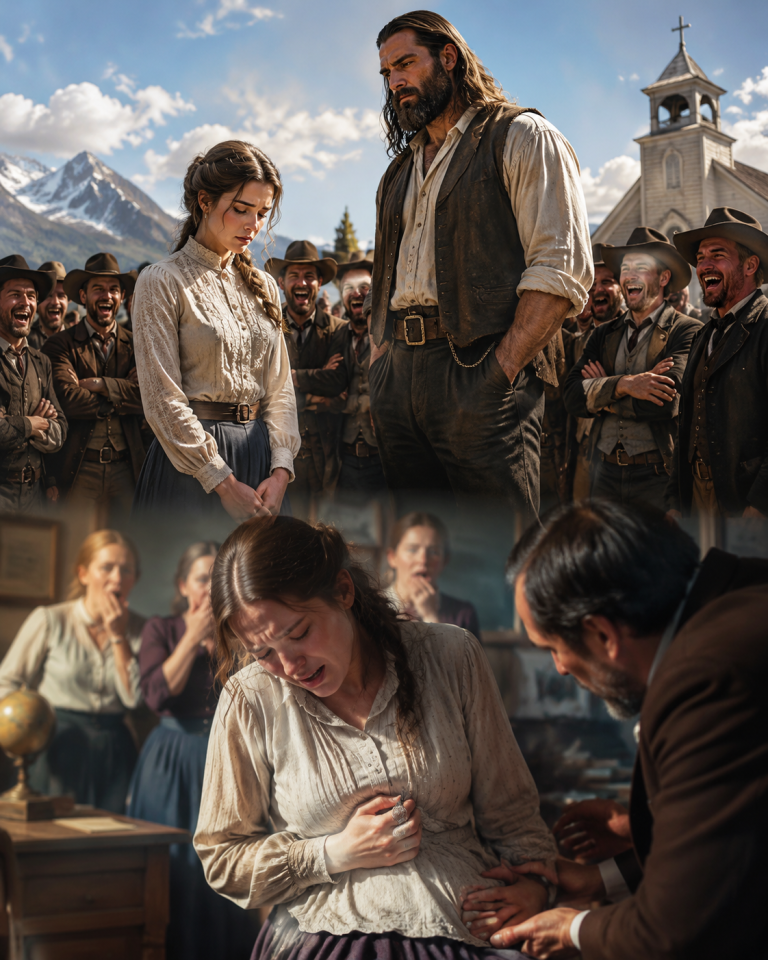
The pews had emptied one by one, the townspeople shuffling out in awkward silence, eyes heavy with pity or barely concealed amusement. She’d heard the whispers. *Poor thing. What kind of man leaves a woman at the altar? What kind of woman gets left?*
That last one cut deepest.
When the last person finally left, she stood alone in the chapel, staring at the empty space where Victor should have been standing. The preacher had awkwardly excused himself. Even he couldn’t bear to witness her humiliation any longer.
She wanted to scream, to cry, to collapse. Instead, she walked.
The sun was setting when Eliza finally stopped moving. She didn’t know how far she’d gone. Miles, maybe. Her feet ached, her dress was shredded at the hem, her carefully pinned hair had tumbled loose down her back. She’d kicked off her satin shoes somewhere along the way — delicate things with no place in the wild.
The frontier stretched endlessly around her, all red dust and sage brush and jagged rock formations. The sky was bruised purple and orange. She sank down onto a flat rock, her body finally giving out, and for the first time since the church, let herself cry — ugly, choking sobs that tore through her chest.
When the tears finally stopped, the sky was fully dark. She was alone. Truly, terrifyingly alone, and she had no idea what to do next.
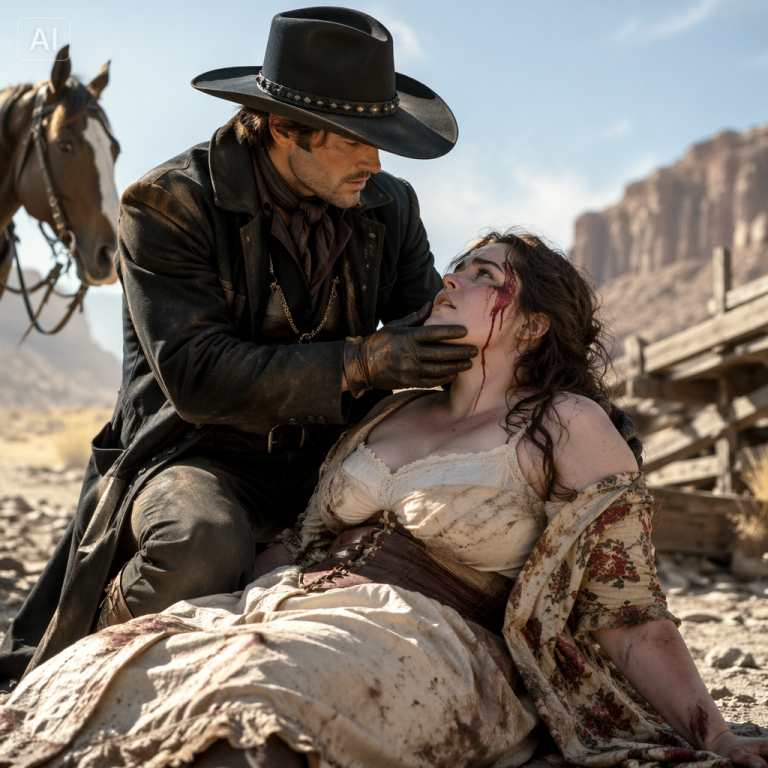
The sound of hooves broke the silence. Eliza’s head snapped up, heart hammering. She wasn’t sure if she should be relieved or terrified. Out here, a stranger could be salvation or death, and there was no way to know which until it was too late.
The rider appeared over the crest of a low hill, silhouetted against the stars — a man on a dark horse, moving slow and deliberate. He wasn’t in a hurry. That fact alone set her nerves on edge. Men in a hurry were usually running from something. Men who took their time were usually hunting.
He stopped a few yards away, studying her. Eliza forced herself to stand.
“You lost?” His voice was low, rough, like gravel underfoot.
“No.” Her voice came out stronger than she expected. “I know exactly where I am.”
“Do you?” It wasn’t a question. He swung down from his horse with an easy grace that spoke of years in the saddle. Tall, broad-shouldered, his face shadowed beneath his hat brim, but she could see the sharp line of his jaw. He didn’t look friendly. “You’re a long way from anywhere,” he said, closing the distance with slow, measured steps. “And unless I’m mistaken, that’s a wedding dress.”
“It was. The wedding didn’t happen.”
“I can see that.” He stopped a few feet away, close enough now that she could see his eyes — dark, unreadable, scanning her like a problem to be solved. “You got family in town?”
“No. Friends? Not anymore. Money? No.”
He let out a slow breath. “So you ran out into the desert in a wedding dress with no plan, no supplies, and no destination.”
“That about sums it up.”
For a moment he just looked at her. Then the corner of his mouth twitched. “You’re either brave or stupid.”
“Maybe both.”
“Yeah.” He tipped his hat back, revealing more of his weathered face. “Maybe both.” He turned back toward his horse, and for a moment Eliza thought he was going to leave her there. Panic flared. “Wait.” He paused, glancing over his shoulder. “Please.” The word tasted like ash. She’d never begged for anything in her life. “I need help.”
“I can see that.”
“Then help me.”
He studied her a long moment. “What’s your name?”
“Eliza. Eliza Carter.”
“Caleb Boon.” He didn’t offer his hand. “I’ve got a ranch about ten miles north of here. I need a wife.”
Eliza blinked. “I’m sorry?”
“A wife,” he repeated, as if it were the most practical thing in the world. “Someone to manage the house, cook, help with the books, keep things running when I’m out with the herd.”
“You’re asking me to marry you?”
“I’m offering you a job,” he corrected. “Marriage is just the legal framework. Keeps things simple. Keeps people from talking.”
Eliza stared at him, trying to process what she was hearing. This complete stranger was proposing marriage like a business transaction. No romance, no promises. Just cold, hard practicality.
“You don’t even know me,” she said.
“Don’t need to. You need shelter. I need help. That’s all that matters.”
“That’s insane.”
“Maybe.” He shrugged. “But you’re the one standing in the middle of nowhere in a torn wedding dress. I’d say your options are limited.”
He wasn’t wrong.
PART 2
“What if I say no?” Eliza asked quietly.
Caleb’s expression didn’t change. “Then I wish you luck, Miss Carter. You’re going to need it.” He moved toward his horse again, and this time she knew he wouldn’t stop.
“Wait.” He paused. Eliza took a deep breath, feeling the weight of the moment settle over her like something physical. This was it — the line between her old life and whatever came next.
“I’ll do it,” she said. “I’ll marry you.”
Caleb turned back, eyes searching hers. “You sure?”
“No.” She laughed, sharp and brittle. “But I’m doing it anyway.”
For the first time, something that might have been approval flickered across his face. “Good enough. Get on the horse.”
They rode through the night in silence, Eliza pressed against a stranger’s back, trying not to think about how strange it all was. Without a word, Caleb shrugged out of his jacket and handed it back to her — leather and smoke and something clean, like sage after rain. Just before she drifted off, exhausted, she heard him speak, quiet: “You’ll be safe. I promise you that much.”
Dawn broke over a low, sprawling ranch house built from rough-hewn timber and stone. Beyond it, land stretched in every direction — endless open range, dark cattle like smudges against pale grass, jagged snow-capped mountains in the distance. Beautiful. Utterly isolated.
“Welcome home,” Caleb said, no warmth in his voice, just fact.
Inside, the house was as practical as the outside — bare walls, a stone fireplace, two bedrooms. “You’ll take the smaller room,” Caleb said. “I’ll stay in the other. We keep things separate. Clear boundaries.” When Eliza’s expression flickered, he added bluntly, “This isn’t about that. I’m not looking for a wife in the traditional sense. I’m looking for a partner. Someone I can count on.”
“I understand.”
“Do you?”
“I didn’t come here expecting romance, Mr. Boon,” she said, lifting her chin. “I came here because I had no other choice. But I’m not going to be a burden. I’ll earn my keep.”
Something shifted in his expression. “Good. Out here, there’s no room for dead weight.”
The first days were brutal. Eliza had grown up the daughter of a seamstress and a bookkeeper — she knew how to read, sew, manage a household budget. She didn’t know how to haul water, scrub a floor raw, or coax a temperamental stove into cooperation. Caleb worked harder than she did and rarely spoke except to give instructions, but one evening, coming in from the barn, he paused at the window.
“You did good today,” he said quietly. “The corral fence. I saw you fixed the broken slat.”
“It wasn’t much.”
“It was something.” It was the first real acknowledgment he’d given her, and somehow it made the loneliness a little easier to bear.
Two weeks in, three riders approached — rough men, gun belts slung low. Their leader, Jack, tipped his hat with exaggerated politeness, taunted Caleb about his sudden marriage, and mentioned, almost casually, that there’d been trouble with rustlers lately. “Would be a shame if you lost any cattle.”
After they left, Caleb told her the truth: cattle going missing, fences cut, small ranchers getting squeezed out by an organized operation. “It’s someone running an operation, and they’re not going to stop until they control all the land around here.”
That night, unable to sleep, Eliza thought about Victor — a man who’d wanted a wife who’d smile and never ask questions, an ornament, not a person. Caleb wanted a partner. He’d been clear about that from the start. And even distant, even reluctant with words, he’d never once treated her like she was less than him.
She rolled onto her side and, for the first time since the church, felt something that might have been hope.
PART 3
The weeks turned into months, and Eliza found her rhythm — reading the sky for weather, baking bread that didn’t come out like a brick, mending fence posts without blistering her hands quite so badly. Caleb left small signs of acknowledgment: coffee already poured, firewood stacked, an old book left on the table with no explanation.
One afternoon she watched him gentle a wild stallion in the corral, his voice low and steady until the animal’s fear broke. “Horses are easier than people,” he told her afterward. “You just have to be patient. Show them you’re not a threat.”
“Is that how you see me? As a threat?”
“No.”
“Then why do you keep me at arm’s length?”
He was quiet a long moment. “Because the last person I let close left me with nothing but scars.” He walked off before she could ask more.
That night at dinner, Eliza made a decision. “I want to learn to shoot.”
Caleb taught her the next morning — how to breathe, how to squeeze the trigger instead of jerking it, how to focus on the target and nothing else. She practiced every morning after that, growing steadier, more confident, feeling a little less like the girl who’d been left at the altar and a little more like someone who could survive anything.
*
Midsummer, the rustlers struck for real — running the herd, trying to scatter it into the open range. Caleb and Eliza rode into the chaos together, firing into the air to turn the cattle back, the rustlers eventually breaking off into the darkness.
“You did good, Eliza,” Caleb said afterward, and smiled — really smiled — for the first time since she’d met him. She felt alive.
The victory brought tension instead of relief. Caleb rode the perimeter for days, barely sleeping, until Eliza confronted him over a cold dinner. “You’re going to work yourself into the ground.”
“I’m fine.”
“You’re not fine.”
“Why do you care?” he asked quietly. “This isn’t your fight. You could leave. Go back to town.”
“Aren’t you?” she shot back. “Maybe I was at first. But that’s not why I’m staying now. Because this place matters. Because you gave me a chance when no one else would. Because I’m not the kind of person who runs when things get hard.”
Neighbors arrived soon after — Ben and Mary Henderson, warm and practical, inviting them to a meeting of all the ranchers who’d been hit. “We can’t fight them alone,” Mary said firmly.
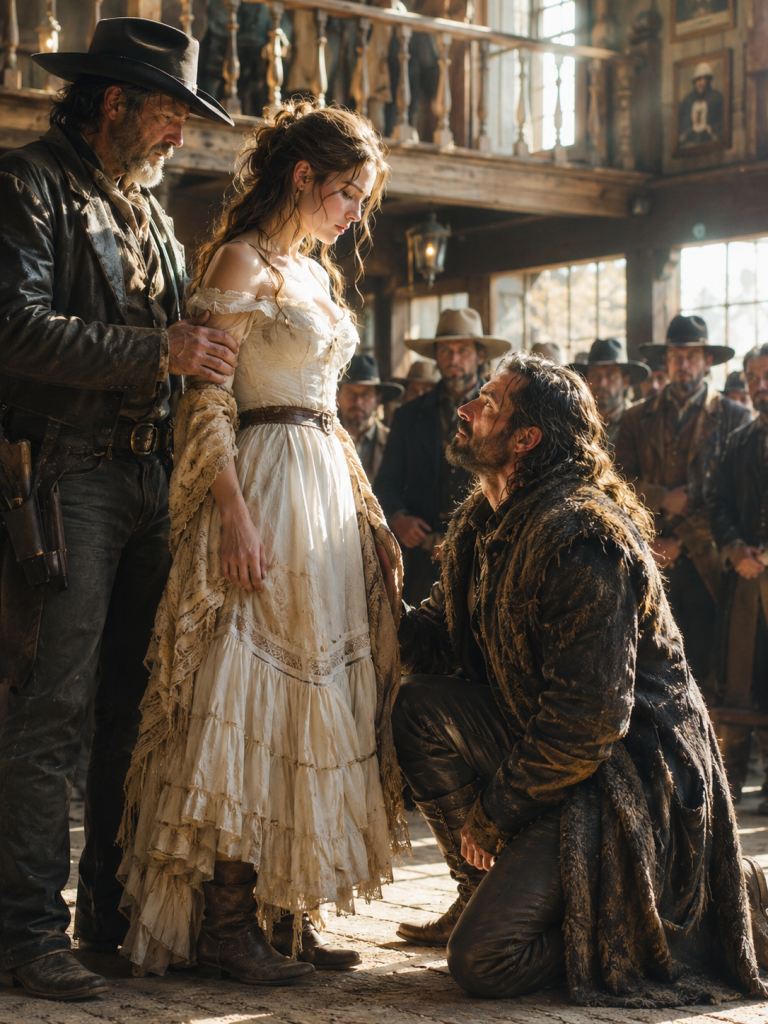
At that meeting, a hostile rancher named Tucker sneered that they were “letting women into war councils now” and mocked Eliza’s broken engagement. She looked him straight in the eye: “I was desperate enough to leave behind a man who was all talk and no substance. So I came out here and found one who actually knows how to work, how to fight, how to stand by his word. Can you say the same?”
The room laughed. Tucker didn’t respond.
The plan that emerged was Caleb’s: lookouts, alarm systems, traps to turn the rustlers’ own tactics against them. On the ride home, Caleb said quietly, “You didn’t have to defend me.” “I know. But I wanted to.” He was silent, then: “Thank you.” “You’re welcome.”
Two nights later, rustlers returned under cover of darkness, and this time Eliza stepped out of the shadows with her rifle leveled at Jack’s chest. “Drop your gun and get out, or I’ll drop you instead.” He believed her. “This isn’t over,” he warned, riding off.
“No,” Caleb agreed. “It’s not.”
*
Word came that the attacks were escalating into something coordinated — a syndicate, backed by investors, trying to drive small ranchers out entirely. Then came the worst news: the Patterson ranch had been burned, two sons dead, and the rustlers were planning a coordinated strike on multiple ranches within days.
“If things go bad,” Caleb told Eliza, taking her by the shoulders, “you run.”
“Absolutely not. We stand together or we don’t stand at all.”
He pulled her into an embrace so sudden it stole her breath. “You’re going to get yourself killed,” he said against her hair.
“Not if you keep me alive.”
They rode to the Henderson ranch, now transformed into a makeshift fortress — overturned wagons, boarded windows, armed men everywhere. As night fell and the attack began, a rider emerged into the firelight, dressed like a dandy among rough men, cold cruelty in his eyes where Eliza had once seen only charm.
Victor Hail.
He’d been behind everything — the rustling, the syndicate, an “aggressive expansion” scheme funded by investors back east. And he’d come for revenge. “You’re going to come out here, get on a horse, and ride back to town with me,” he told Eliza. “Or everyone here dies.”
“I’d rather die,” Eliza said.
“That can be arranged.”
Ben Henderson refused to hand her over. Victor gave them five minutes, then began throwing torches. The house went up in flames. In the chaos, the ranchers retreated through a hidden tunnel to the old well, drawing the rustlers into a devastating counterattack from behind — exactly as Caleb and Eliza had planned.
The fight was brutal and close. Eliza killed a man for the first time in her life, no hesitation this time, cold determination in its place. Caleb fought hand-to-hand, saving her from a rustler who got too close. And Victor, cornered and raging, raised his gun on Eliza — only to be shot by his own man, Jack, who’d had enough. “I didn’t sign up to die for your pride,” Jack said flatly, before Victor collapsed in the dirt.
The fight was over.
*
“It’s over,” Caleb murmured into Eliza’s hair as she finally let herself feel the weight of it all. “We’re safe. And that bastard can never hurt you again.”
The Henderson house was ash by dawn, but Mary stood watching it burn with quiet resolve. “It’s just a house. We can build another. What matters is we’re all alive.”
In the aftermath, a territorial marshal confirmed everything — Victor’s conspiracy, his connections to corrupt investors back east, the network that had terrorized small ranchers for months. “What he did,” the marshal told Eliza gently, “trying to force you to marry him, threatening all these people — that’s not on you.”
*
Back at their own untouched ranch, Caleb and Eliza fell into a new rhythm — one without the old walls between them. One evening over dinner, he took her hand across the table.
“I’ve been thinking. We got married out of necessity. But that’s not what this is anymore, and I don’t want to keep pretending it is.” He asked her, properly this time, without desperation or deals: “Eliza Carter Boon, will you marry me for real this time? Because I love you.”
“We’re already married,” she said, smiling through tears.
“I know. But I want to do it right. Vows. A celebration of what we’ve built together.”
“Then yes.”
That night, she knocked on his door instead of retreating to her own room. “I don’t want to be alone,” she said simply. “Neither do I,” he answered, and they lay together, fully clothed, talking long into the night — about a woman named Rachel who’d broken his trust years before, about the loneliness he’d built around himself, about how Eliza had made him want to try again.
“I love you,” she whispered.
“I love you too.”
*
The community rallied to rebuild the Henderson house that autumn, and on a bright morning, with the new house finally standing, Caleb and Eliza married again before the whole community — this time with real vows.
“You gave me a chance when I had nothing left to offer but stubborn pride,” Eliza said. “You taught me that I don’t need rescuing. I just need someone who won’t try to make me smaller to fit into their life.”
“You taught me that strength isn’t just about surviving alone,” Caleb said. “It’s about being brave enough to let someone stand with you.”
The celebration was joyous — food, music, dancing under the stars. Even Tucker approached with an apology. “You proved yourself ten times over. You’re as much a part of this community as anyone.”
*
Winter came, and with it a request from Mary: would Eliza start a school for the ranch children? She said yes, and by December had ten students gathered in a corner of the community hall, hungry for letters and numbers and stories of the world beyond the frontier.
That winter also brought a blizzard, and with it a stranger nearly frozen to death outside their barn — a young ranch hand named David. Caleb and Eliza saved his life, and when the storm broke, Caleb offered him work and a room in the barn. “You didn’t nearly die,” Caleb told him. “You fought to survive. That takes the kind of grit we value.”
Spring brought news that the territorial government would fund a proper schoolhouse, with Eliza as its official, paid teacher — recognition for the community she’d helped build from nothing.
That same season, sitting on the porch, Eliza told Caleb she thought she was pregnant. He went very still, then pulled her into an embrace so tight she could barely breathe. “A baby. We’re going to have a baby.”
Their daughter, Clara, was born the following March during a late winter storm — named for Eliza’s mother, welcomed into a community that would nurture and protect her as fiercely as her parents did.
*
Years passed. A son, James, arrived two years later, named for Tucker, who’d become one of Caleb’s closest friends. The cooperative the ranchers had built expanded to two dozen operations. The school grew, added a second teacher. Clara grew into a bright, fearless child who could ride almost before she could walk.
On their fifth anniversary, Caleb took Eliza back to the rock formation where they’d first met — where she’d collapsed in her torn wedding dress, certain her life was over.
“Do you ever regret it?” he asked. “Saying yes to a stranger’s crazy proposal?”
“Not for a single second,” Eliza said. “Best decision I ever made. Even though it was born from desperation — especially because of that. Because it forced me to be brave when I wanted to give up. Because it brought me here. To you. To this life we’ve built.”
She leaned against him, looking out at the land that had tested and transformed her — still harsh, still unforgiving, but beautiful and wild and full of possibility, just like the woman she’d become.
Eliza Carter had been left at the altar, abandoned and humiliated, with nothing but a torn dress and broken pride.
Eliza Boon had built an empire from that wreckage — not of land or wealth, but of purpose and love and unbreakable community. A teacher. A mother. A leader. Someone who’d helped forge a place where people looked out for each other, where hard work and integrity mattered more than money or status.
She hadn’t needed saving.
She’d needed the space to become strong. And in that becoming, she’d found everything — partnership, purpose, love, and a legacy that would outlast them all.
She took Caleb’s hand, squeezed it tight, and together they mounted their horses, riding toward the warm lights already visible in the distance — toward their children, their future, their home.
She’d run into the wilderness with nothing.
And found everything.
THE END