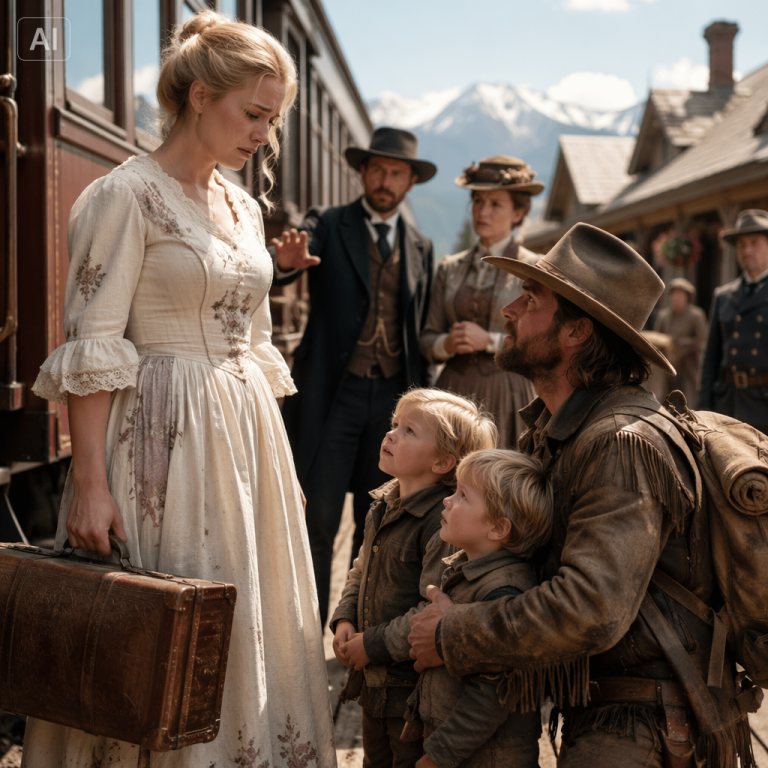
THEY LEFT HER TO FREEZE IN A VALLEY FOR SAYING NO — THEN A STRANGER ON HORSEBACK HEARD HER BREATHING

## PART 1
The cold didn’t care that Elena Cross was still breathing.
It wrapped around her ribs like iron bands, tightening with each shallow gasp. Snow had filled her mouth when she’d tried to scream. Her hands, bound behind her back with rough hemp that had already rubbed her wrists raw, had gone numb an hour ago. Or maybe three hours. Time stopped meaning anything when you were freezing to death.
She lay where they’d thrown her — half-buried in a snowdrift at the bottom of Iron Hollow Valley — and tried to remember how to fight.
But fighting was how she’d gotten here.
Three days earlier, she’d been a different kind of desperate. Her husband, Thomas, had been dead for two weeks. Pneumonia that turned his lungs to stone in four days flat. They’d buried him in frozen ground so hard the gravediggers had to build fires to soften the earth. Elena had stood at the grave with dry eyes because she’d already cried herself empty, and the widows of the settlement had whispered about it.
*Not natural,* they said. *A wife should weep.*
According to the good people of Asheford settlement, she should also remarry quickly, choose a man of standing, be grateful when Victor Hail himself expressed interest in making her his third wife. Victor Hail — the settlement’s founder, its self-appointed moral authority, the man who decided which families got supplies and which ones learned what winter hunger felt like.
Elena had different ideas.
*I’d rather freeze,* she told him.
It turned out he’d taken that as a suggestion.
The memory played behind her eyelids now. Victor standing in her cabin three nights ago, backlit by her own fire. His shadow stretching across the floor like something that wanted to swallow her whole. Not a tall man, but the kind who carried himself like height didn’t matter when you owned everything that mattered. Steel-gray beard. Eyes the color of dirty ice.
*You’re making this harder than it needs to be, Elena.*
She’d been scrubbing Thomas’s shirts. Something to do with her hands. She didn’t look up.
*I’m not making anything hard. I said no.*
*You said no.* He repeated it slowly, like the words were in a foreign language. *Do you understand what that means? For a woman in your position?*
*My position.*
*You mean widowed? I mean alone. Unprotected. A woman with no man to speak for her, no sons to provide for her. Do you know what happens to women like that when winter comes?*
*I imagine you’re about to tell me.*
The slap came fast enough to snap her head sideways. Not hard enough to knock her down — Victor Hail was too calculated for that. Just hard enough to remind her that he could.
*I’m offering you a place,* he said quietly. *Security. A future. Most women would be grateful.*
Elena’s cheek burned. She straightened slowly, meeting his eyes for the first time.
*I’m not most women.*
*No.* Something cold moved behind his gaze. *You’re not.*
He’d left. But the threat hung in the air like smoke.
By morning, the settlement council had called an emergency meeting. By noon, they’d declared her unfit to maintain property alone and seized her cabin for redistribution. By sunset, when she tried to argue, they’d called her hysterical, dangerous, a corrupting influence on the other women. By midnight, they’d come for her.
Four men. She’d recognized three of them — neighbors she’d fed during the last hard winter, men whose wives she’d helped birth babies. Their faces were stone as they hauled her from what used to be her home. She’d fought, screamed until her throat bled, clawed Jacob Fletcher’s face hard enough to leave marks. It hadn’t mattered. They tied her hands, gagged her, and dragged her three miles into Iron Hollow Valley.
*You made your choice,* Jacob had said, not meeting her eyes as he cut the ropes around her ankles. *May the wilderness teach you the humility you refuse to learn among civilized people.*
Then they’d left.
—
That was six hours ago. Maybe seven.
The sun was dying now, bleeding out across the western ridge. Elena had managed to work the gag off by scraping her face against a rock, but her hands were still bound. She’d tried to walk, made it maybe twenty feet before her frozen legs gave out.
She was going to die here.
The thought arrived with surprising clarity. Almost peaceful. She was going to die in this valley, and by morning she’d be another shape under the snow, and in a week or a month some hunter might find her bones and wonder whose daughter she’d been.
*No.*
The word came from somewhere deeper than thought. Some animal part of her brain that didn’t care about settlements or justice or whether fighting was ladylike. It just knew one thing: survive.
Elena rolled onto her side, ice crackling in her hair. Her fingers were useless, but she still had arms. She dug her elbows into the snow and dragged herself forward six inches. Then six more. Her dress caught on something and tore. She kept moving.
A sound stopped her.
Hoofbeats.
She froze, listening. It was full dark now — the kind of darkness that turned trees into monsters and made distances impossible to judge. But she heard it clearly. A horse moving slow through the snow.
Coming closer.
*They’d come back.*
Terror shot through her like lightning, burning away the numbness. They’d come back to finish it, to make sure she was dead. She tried to move faster, but her body had nothing left.
The hoofbeats got louder.
Then a voice, rough and irritated:
*”What the hell?”*
Not Victor’s voice.
The horse stopped. She heard the creak of leather as someone dismounted, boots crunching through snow. She managed to roll onto her back and looked up at a figure silhouetted against the stars.
*”You alive?”*
The voice was male, deep, with the kind of weariness that came from seeing too many things that shouldn’t be possible.
Elena tried to speak. Her throat produced something between a croak and a wheeze.
The figure moved closer and she got her first real look at him. A man in a heavy coat, probably forty or close to it, with a face that looked like it had been carved from the same rock as the mountains. Dark hair going gray at the temples. Eyes that didn’t miss anything.
He crouched beside her. Those eyes went hard when he saw the ropes around her wrists.
*”Who did this?”*
She managed one word: *”Settlement.”*
His jaw tightened. He pulled a knife from his belt — and for one wild moment, Elena thought *this is it, this is how it ends.* Saved from freezing just to get her throat cut by a stranger in the dark.
But he just cut the ropes, carefully, and she felt blood start to return to her hands in hot, agonizing waves.
*”Can you stand?”*
She tried. Made it halfway before her legs buckled.
He caught her — movement so smooth and automatic it was clear he’d done this before, caught falling things — and lifted her like she weighed nothing.
*”I’ve got a ranch,”* he said, already moving toward the horse. *”Two hours from here. You’ll live that long if you don’t quit on me.”*
*”Who—”* Her voice cracked. *”Who are you?”*
*”Caleb Ward.”* He settled her on the horse, then swung up behind her. *”And you just used up all the small talk you’re getting tonight. Save your strength.”*
The horse moved and the world started to blur. Elena felt herself slipping, consciousness fraying at the edges. She grabbed onto Caleb’s coat with numb fingers.
*”Why?”* The word came out barely audible. *”Why help me?”*
He was quiet for so long she thought he wouldn’t answer.
Then: *”I don’t leave people to die. Even when they probably deserve it.”*
She would have argued.
But darkness took her first.
—
—
PART 2
When Elena opened her eyes, she thought she’d died after all, and this was whatever came after.
Warmth. Real warmth — the kind that didn’t come from a failing fire in a drafty cabin, but from somewhere solid and permanent. A bed with a mattress and blankets that smelled like lye soap and cedar. Rough-hewn beams crossing a ceiling. Daylight streaming through a window, bright enough to hurt.
She tried to sit up. Her body had other ideas.
*”Easy.”* A woman’s voice, matter-of-fact. *”You’ve been out two days. Your body needs time to remember how to work.”*
Elena turned her head — even that hurt — and saw a woman probably ten years older than her, weathered in the way frontier women got weathered. All competence and hard-earned survival.
*”Ward Ranch. Caleb found you half frozen in Iron Hollow. I’m Marie, his foreman’s wife. I’ve been keeping you alive.”*
She brought over broth, thin and salty and the best thing Elena had ever tasted.
*”The settlement,”* Elena said between sips. *”How far?”*
*”Far enough they won’t come looking without a reason.”* Marie settled into a chair, watching her with eyes that had seen plenty of hard stories. *”Caleb said you were tied up. Said it looked like someone meant for you to die out there.”*
So Elena told her. Not everything — her throat was still raw, her thoughts still scattered. But enough. Victor Hail. The forced marriage. The seized cabin. The valley.
Marie listened without interrupting. When Elena finished, she nodded once, like none of it surprised her.
*”Men like that,”* she said quietly. *”They can’t stand a woman who knows her own mind. Makes them feel small. And small men do terrible things to feel big again.”*
*”I should have just agreed,”* Elena heard herself say. *”I should have—”*
*”No.”* Marie’s voice cut through the self-recrimination like a blade. *”Don’t you dare. What happened to you wasn’t your fault. It was theirs. Every man who put his hands on you, every person who looked away — that’s on them.”*
Something cracked open in Elena’s chest.
She’d been holding herself together through sheer stubbornness, but kindness — real kindness, without conditions — broke through what stubbornness couldn’t hold.
She started crying. And once she started, she couldn’t stop. Great heaving sobs that hurt her ribs and made her head pound. Marie didn’t try to comfort her, didn’t pat her hand or tell her it would be all right. She just sat there, steady and present, letting Elena break apart in a place where it was safe to break.
When the tears finally stopped, Elena felt hollow but lighter. Like she’d been carrying something too heavy and had finally set it down.
*”What happens now?”* she asked.
Marie stood, collecting the empty cup. *”Now you heal. Then you decide what comes next. Caleb doesn’t turn people away, but he doesn’t keep anyone prisoner either. When you’re strong enough, you make your own choice about where you go.”*
*”And if they come looking for me?”*
Something fierce moved across Marie’s face.
*”Then they’ll learn that Ward Ranch isn’t settlement territory. We don’t follow their rules here.”*
Elena looked at this woman she’d known for two days, who’d kept her alive without being asked, who’d listened without judgment, who’d just drawn a line in the snow on behalf of a stranger.
She didn’t know it yet.
But she’d just found her people.
—
## PART 3
She met Caleb properly on her third day up.
She’d been sitting on the porch of the small cabin, watching the morning routine of the ranch, when he appeared.
*”You’re looking less dead,”* he said by way of greeting.
*”You really know how to flatter a woman.”*
The corner of his mouth twitched. Might have been a smile. Hard to tell.
He had the same hard face as that night in the valley, the same eyes that didn’t miss anything — but in daylight she could see more. Lines at the corners of his eyes from years of squinting into sun and wind. Hands that had built things and fixed things and, she suspected, done a fair amount of fighting when the occasion required.
*”Thank you,”* she said. *”For finding me. For bringing me here.”*
He shrugged, uncomfortable. *”I was heading back from checking fence lines. Took a different route because the main trail looked bad. Found you. Lucky.”*
*”Maybe.”* Something unreadable crossed his face. *”Or maybe someone was looking out for you.”*
He didn’t say who. Elena didn’t ask.
*”The settlement,”* she said carefully. *”Will they come looking?”*
*”Probably not. They think you’re dead. As far as they’re concerned, problem solved.”* His jaw tightened. *”But if they do come — they’ll find out I don’t give a damn about their authority. This is my land. My rules.”*
*”What are your rules?”*
Caleb looked at her for a long moment. *”Work hard. Deal straight. Don’t hurt people who don’t hurt you first. Everything else is just details.”*
It sounded too simple to be real. But as Elena healed and started moving around the ranch, she saw it in action. Nobody bowed and scraped to Caleb. People spoke their minds. When a decision needed making that affected everyone, everyone got a say. Women’s voices counted the same as men’s — not because it was declared from on high, but because it was simply how the place functioned.
It wasn’t paradise. There were arguments, disagreements, the normal friction of people trying to survive together. But it was *honest*. And after years of living under Victor’s careful architecture of control, honest felt like oxygen.
—
One evening, sitting outside watching the sun die behind the mountains, Caleb found her.
*”You’re thinking too loud,”* he said, settling onto the porch step beside her.
*”Didn’t know thoughts had volume.”*
*”Yours do. You get this look like you’re arguing with someone who’s not there.”*
Elena pulled her shawl tighter. *”I’m trying to figure out what I’m supposed to do. Where I’m supposed to go.”*
*”You planning on leaving?”*
*”I can’t stay here forever. This isn’t my place.”*
*”Could be.”* His voice was careful. *”We could use another set of hands. Marie’s been saying we need help with the preserving and the sewing.”*
*”Just like that? You’d let a stranger stay?”*
*”You’re not a stranger anymore. And I’ve seen how you work. You’re not afraid to get your hands dirty. That counts for more than a familiar face.”*
Elena turned to look at him. *”Why did you really save me? The truth.”*
Caleb was quiet, staring out at the darkening valley. When he finally spoke, his voice was rough.
*”I had a sister once. Ruth.”*
He told the story without decoration. A sister who’d married a man their parents approved of — good family, good prospects, all the right things on paper. A man who turned out to have a temper and a heavy hand. Ruth had tried to leave. Her husband and his family said she was being hysterical, dramatic. Said she needed discipline.
*”They found her in a river three months later. Officially, she slipped and fell.”*
A long pause.
*”Everyone knew the truth. Nobody did anything about it.”*
His hands curled into fists. *”I was seventeen. Couldn’t do a damn thing except watch them bury her and pretend it was an accident. So when I saw you in that valley, tied up and left to freeze because you said no to some powerful man who thought he owned you—”* He stopped. *”I guess I was trying to do for you what I couldn’t do for Ruth.”*
*”I’m sorry,”* Elena said quietly.
*”Don’t be. Just don’t waste the chance you got.”*
*”I don’t feel very big right now.”*
*”You survived.”* He stood, dusting off his pants. *”That’s big enough.”*
—
She stayed.
The first sign of trouble came three weeks later. A settlement rider appeared at the gate carrying a message stick — the frontier equivalent of an official summons — and read from a rolled proclamation about a woman named Elena Cross, *declared unfit and expelled for moral corruption and threat to community peace.*
*”Should this woman appear on your property,”* the kid read, his voice trying for authority and landing somewhere around nervous, *”you are obligated under territorial cooperation law to return her to settlement authority for proper judgment.”*
Caleb let him finish.
*”First,”* he said, his voice dangerously quiet, *”there’s no such thing as territorial cooperation law. You made that up, or Victor did. Second, Elena Cross is a resident of Ward Ranch now. That makes her my concern, not the settlement’s. Third, you can tell Victor Hail that if he wants to discuss anything, he can come here himself instead of sending a kid to read made-up rules.”*
The rider’s face went red. *”She’s a criminal.”*
*”No.”* Elena stepped forward. *”I’m a woman who refused to be property.”*
The rider’s eyes went wide when he saw her. *”You’re supposed to be dead.”*
Elena smiled. It wasn’t friendly. *”Sorry to disappoint.”*
After he left, Marie spoke from the porch.
*”That’s going to bring them here.”*
*”I know,”* Caleb said.
*”Could get ugly.”*
*”It already was ugly. Now it’s just going to be honest about it.”*
—
They didn’t have to wait long.
A dead coyote hung from the gate two days later with a note: *Return what you stole or learn the price of defiance.*
Then supplies became hard to get — the general store in the nearest town suddenly claiming they were out of stock on items they’d had in abundance a week before. The blacksmith who’d been shoeing their horses for three years suddenly had no availability.
*”He’s smart,”* Elena said, watching another supply wagon turn away at the gate. *”He can’t beat us in a straight fight, so he’s trying to starve us out.”*
The ranch prepared. Not for war — Caleb was clear about that — but for the possibility of trouble. Firing positions in the barn loft. Reinforced windows. Every adult who could hold a rifle got one.
Elena threw herself into the work partly to be useful, partly to keep from thinking too hard about what she’d set in motion. She learned basic first aid. She helped preserve vegetables, mended clothes, mapped the ranch’s vulnerabilities with the focus of someone who’d spent years trying to predict how power moved.
Late one night, unable to sleep, she found Caleb already awake and watching the perimeter.
*”I’m scared,”* she admitted, because honesty felt like the only currency that worked here.
*”Good. So am I.”*
*”You don’t look scared.”*
*”I’ve had more practice hiding it.”* He finished his coffee. *”Get some sleep. Real sleep, not just lying there with your eyes closed. Tomorrow’s going to be another long day, and you’ll need your strength.”*
*”What if they come tomorrow?”*
*”Then they come and we deal with it. But sitting up all night worrying won’t change anything except make you too tired to fight if you need to.”*
Elena wanted to argue.
But exhaustion was pulling at her, and for the first time in weeks, she slept hard and dreamless.
—
She woke to the settlement on the horizon.
Twenty riders, armed and carrying torches, sitting their horses just beyond the ranch’s property line. And at the front, dressed in black like he was attending a funeral, was Victor Hail himself.
Elena was wrist-deep in dishwater when she saw them from the kitchen window. For one absurd moment she thought about finishing the plates before dealing with the armed men who’d come to drag her back to hell. Routine felt safer than reality.
She went outside instead.
*”I told you to stay inside,”* Caleb said without looking at her.
*”You don’t get to tell me anything. This is my fight.”*
*”It’s about to be everyone’s fight.”*
Victor rode forward slowly, his nineteen riders staying back like a threat that didn’t need to be spoken. Up close, he looked exactly as Elena remembered — gray beard perfectly trimmed, eyes cold as January ice, sitting his horse like he was passing judgment from on high.
*”Mr. Ward,”* Victor said, inclining his head with false courtesy. *”I believe we have a misunderstanding to clear up.”*
*”No misunderstanding,”* Caleb said flatly. *”You want Elena. She’s not going anywhere. That about cover it?”*
*”Lawfully,”* Elena interrupted, her voice coming out harder than she expected. *”He said ‘lawfully expelled.’ You tied me up and left me to freeze. There wasn’t a trial. There wasn’t a vote. You just decided I didn’t have the right to say no to you.”*
Victor looked at her then — really looked at her — and something ugly moved behind his pleasant expression.
*”You were given a choice, Elena. A generous offer, in fact. You chose poorly.”*
*”I chose not to marry you. That’s not a crime.”*
*”It is when your refusal threatens the moral foundation of our community.”* He shifted in his saddle, addressing Caleb now, as if Elena wasn’t worth engaging directly. *”Surely you understand, Mr. Ward. A society requires order. When individuals place their own desires above the common good, chaos follows.”*
*”Funny thing about order,”* Caleb said. *”It tends to benefit the people making the rules.”*
Victor pulled out a piece of paper. Unfolded it with theatrical precision. *”According to our records, Thomas Cross borrowed against future harvest to cover medical expenses. Those debts transferred to his widow upon his death. Until they’re repaid, she belongs to the settlement.”*
Elena’s stomach dropped. She remembered Thomas, desperate and dying, signing papers Victor’s men had brought. She’d added her name where they told her to, too worried about keeping her husband alive to read the fine print.
*”Name your price,”* Caleb said, his voice tight. *”I’ll pay whatever debt you claim she owes.”*
Victor smiled. It was the smile of a man who’d been waiting for exactly this.
*”Three hundred dollars.”*
Silence dropped like a stone. Three hundred dollars was a fortune out here — more than most families saw in five years. An impossible sum, and everyone knew it.
*”You’re trying to buy a person,”* Caleb said.
*”I’m collecting a legitimate debt.”* Victor looked back at his riders, then let his gaze move slowly over the buildings and the people watching from windows. *”And if we refuse — I’d be very concerned about fire season. Terrible thing, these dry frontier winters. A single spark can burn down everything a man’s built.”*
The threat hung in the air like smoke.
Caleb’s hand moved toward his belt. Three of Victor’s riders reached for their rifles.
*”Don’t,”* Elena said quietly, putting a hand on Caleb’s arm. *”He’s trying to provoke you. He wants an excuse.”*
Victor’s smile widened. *”Smart girl. I always said you had potential, Elena. Such a waste.”*
She stepped forward, away from Caleb’s protective stance.
*”If I come with you, will you leave the ranch alone?”*
*”Elena—”* Caleb’s voice was sharp.
*”I need to think about it,”* she said, cutting him off. *”Give me until tomorrow. Come back then and I’ll have an answer.”*
Victor considered this. Finally, he nodded. *”Tomorrow, dawn. But if you’re not here, or if you’ve run — the deal is void, and Mr. Ward will learn exactly how far the settlement’s reach extends.”*
He wheeled his horse and rode off, his twenty men following. Slow and steady, making sure everyone understood they weren’t afraid, weren’t in a hurry, weren’t concerned about anything Ward Ranch might do.
When they were gone, Caleb rounded on Elena.
*”What the hell was that? Buying time for what? You’re not seriously considering—”*
*”I’m considering that he just threatened to burn down your ranch and kill everyone here if I don’t cooperate.”*
*”That doesn’t matter—”*
*”It matters to me.”*
Marie stormed out of the house. *”You think going back there will save anyone? Men like Victor don’t make deals. They make examples. You go back, you’re dead within a month.”*
*”She’s right,”* John said from the porch. *”This isn’t about debt or law or any of that. He can’t afford to let you get away with defying him. You’re a symbol now. Every woman in that settlement who’s thought about saying no, they’re watching to see what happens to you.”*
Elena knew they were right.
She also knew what Victor was capable of. Families who crossed him finding their livestock dead, their wells poisoned — always with plausible deniability, always with some explanation that wasn’t quite believable but couldn’t quite be proven false.
*”So what do we do?”* she asked. *”He’s got twenty men. That’s just what he brought today. The settlement can field three times that many if he calls them up.”*
*”We don’t fight,”* Caleb said slowly, like he was working through it as he spoke. *”We prepare to fight. And we make sure he knows it’ll cost him more than he’s willing to pay.”*
—
The ranch transformed over the next eighteen hours.
The barn became a fortified position. Windows were reinforced. Trenches dug around the perimeter. Every adult who could hold a rifle got one and a quick lesson in how to use it. Elena worked alongside everyone else, hauling sandbags and boarding windows, her hands blistering and her back screaming. She welcomed the pain. It was better than thinking.
That night, unable to sleep, she found Caleb checking the fortifications one last time. He looked exhausted. She realized he probably hadn’t slept since Victor’s visit.
*”You should rest,”* she said.
*”I’ll rest when this is over.”*
*”What if it’s never over? What if Victor keeps coming back, keeps escalating—”*
*”Then we keep fighting.”* He turned to face her. *”You think I don’t know the odds? I know exactly what we’re up against. But if I back down now, I become everything I swore I’d never be. I become my father.”*
*”You’ve never mentioned your father.”*
*”Not much to mention. He was a coward. Watched his daughter get beaten and broken by her husband and did nothing because making waves would have been uncomfortable. Told himself he was being practical, being smart.”* Caleb’s hands curled into fists. *”When Ruth died, he didn’t even blame her husband. He blamed her for being difficult.”*
A long silence.
*”I swore I’d never be like him. Never look away. Never make excuses. Never let fear make me small.”*
*”This isn’t about your father,”* Elena said gently. *”This is about right now. Real people, real consequences.”*
*”I know. And I can’t make you stay. If you want to go — if you think that’s the right choice — I won’t stop you. This is your life. Your decision.”*
Elena thought about it. Really thought about it. She could leave, disappear into the frontier, find some other settlement far enough away that Victor’s reach didn’t extend. Start over. Spend the rest of her life looking over her shoulder.
Or she could stay.
*”I’m staying,”* she said.
Caleb nodded once, like he’d known all along what she’d choose.
*”Then we’d better get some sleep. Tomorrow’s going to be interesting.”*
—
Victor came back with thirty riders.
He stopped at the same spot as before, just beyond the property line, and called out: *”Elena. Come out where I can see you.”*
She stepped onto the porch. Kept her spine straight despite the way her legs felt.
*”I’ve made my decision,”* she said. *”I’m staying here. The debt you claim doesn’t exist — the contract was signed under duress, and you have no legal authority to enforce it anyway. Go home, Victor.”*
His face darkened.
*”That’s unfortunate. I was hoping reason would prevail.”*
*”Reason did prevail. Your version of justice doesn’t extend past your settlement line.”*
*”Everything extends past the settlement line. The frontier is lawless precisely because good people fail to impose order. I’m trying to build something better.”*
*”You’re choosing chaos.”*
*”I’m choosing freedom.”*
*”Freedom.”* Victor said the word like it tasted bad. *”You sound like the revolutionaries who think tearing down structure will somehow liberate humanity. It never does. It just creates space for stronger men to fill.”*
*”Then maybe we need different structures. Ones that don’t require women to surrender their lives to avoid being murdered.”*
Victor’s pleasant mask finally cracked completely.
*”You self-righteous little fool. You think you’re striking a blow for independence? You’re signing death warrants. Not just your own. Everyone here.”*
He gestured to his men. They started moving forward.
*”That’s far enough,”* Caleb said. Steel in his voice. *”You cross onto my land without permission — that’s trespassing. I’m within my rights to defend my property.”*
*”Your rights,”* Victor laughed. *”We’re three days from the nearest marshal. By the time anyone arrives to investigate, this will all be settled.”*
*”So will you,”* John said from the barn loft, his rifle clearly visible now. *”First shot I take drops you. Your men might burn us down, but you won’t be around to see it.”*
Victor’s horse shifted nervously, sensing the tension. For the first time, Victor looked uncertain.
Then a voice from the back of his group.
*”This is wrong.”*
Everyone turned.
One of the riders — a man probably in his fifties, with the weathered face of someone who’d built something real and watched it get corrupted — had removed his hat.
*”David Pierce,”* Elena said, recognizing him. One of the settlement’s original families.
*”David,”* Victor said, his voice dropping to a warning tone. *”Now is not the time.”*
*”It’s past time.”* David rode forward, stopping between the two groups. *”I didn’t sign up for this, Victor. For burning out neighbors. Threatening women. Acting like we’re some kind of army. I’ve kept my mouth shut for too long. Gone along because it was easier than standing up. But this—”* he gestured at the ranch— *”this isn’t right. And everyone here knows it.”*
A woman’s voice spoke from the back of the riders. *”He’s got a point. Elena didn’t do anything wrong. She just didn’t want to marry you. And for that, you’d kill people?”*
Victor’s face went purple. *”All of you will return to the settlement immediately or face expulsion yourselves.”*
*”Expel me then,”* David said. *”I’m done.”*
He turned his horse and rode away — back toward the settlement, away from Victor and everything Victor represented. After a moment, three others followed. Then two more. Within minutes, Victor’s force had shrunk by nearly a third.
The remaining riders looked uncertain, glancing at each other and at Victor, clearly wondering if they were on the right side of this.
Victor sat frozen in his saddle, watching his authority evaporate in real time.
Finally, his voice came out tight with barely suppressed rage: *”This isn’t over. You’ve made an enemy today, Ward. You and everyone who stands with you.”*
*”I’ve had worse enemies,”* Caleb said.
Victor wheeled his horse and rode off. The remaining riders followed. No swagger this time, no slow ride to demonstrate power. They left like men who’d lost something important and weren’t sure how to get it back.
When they were gone, the ranch erupted in relief. People laughing, crying, holding each other.
Elena found herself shaking — the adrenaline finally catching up with her. Marie appeared with a flask of something strong, and Elena drank without asking what it was.
*”We won a battle,”* Caleb said, approaching them. *”War’s not over.”*
*”Can’t you just enjoy the victory for five minutes?”* John said, clapping him on the shoulder.
*”I’ll enjoy it when Victor Hail is no longer a threat.”*
—
He was right to be cautious.
Victor changed tactics. Riders appeared at the ranch’s borders — watching, not threatening, just present. Supplies became harder to get. The blacksmith who’d shod their horses for three years suddenly had no availability.
But something else was happening too.
Families started arriving. People who’d left the settlement after Victor’s failed confrontation. Three families at first. Then more. They told Elena things she hadn’t known — stories of other women who’d disappeared or died under suspicious circumstances. Sarah Mitchell, who’d refused to let her daughter marry a man twice her age and had subsequently fallen down a well. Katherine Brooks, who’d questioned the settlement’s tithing system and died of food poisoning three days later.
*”We need to document this,”* Elena said to Caleb one night. *”Get statements, dates, details. Build a case.”*
*”A case for who? There’s no law out here except what people make themselves.”*
*”Then maybe it’s time there was.”*
The idea took root slowly. If Victor was using the settlement’s isolation to operate above the law, then the solution was to bring the law closer. To reach out to territorial authorities. To document the abuses. To force someone official to pay attention.
Elena started writing.
Every story the refugees told her — every suspicious death, every woman silenced. Marie helped her organize. Together they built something like a case file, evidence of a pattern of abuse stretching back years.
*”This is dangerous,”* Marie said, reading the latest additions. *”If Victor finds out you’re doing this—”*
*”He already wants me dead. This doesn’t change that.”*
*”It changes the stakes. Before, this was personal. Now you’re threatening to bring down his entire operation.”*
*”Good,”* Elena said. *”He’s hurt too many people for too long.”*
—
The final confrontation came on a night when the moon was dark and the stars provided the only light.
Elena was dreaming about snow when the gunshot woke her.
She stumbled to the window. The ranch was burning — not everything, not yet, but the barn was lit up like a torch, flames climbing the walls. Dark shapes moved between the buildings. More gunfire erupted from the direction of the main gate.
Victor had come to finish it.
Caleb met her in the main room, loading rifles with hands that moved too fast, too practiced. When she entered, she saw something in his face she’d never seen before.
Fear. Real and raw.
*”I told Marie to get you to safety.”*
*”She tried.”* Elena looked at the rifles. *”Where do you need me?”*
*”In the cellar—”*
*”Where do you need me?”*
Half a second’s hesitation. Then he grabbed a rifle and thrust it into her hands.
*”West window, second floor. Jon’s up there already. Anyone who gets past the outer defenses, you slow them down. Don’t try to be a hero. Just make noise and make them think twice.”* He was already moving toward the door. *”And Elena — don’t die. I don’t have time to feel guilty about it tonight.”*
Then he was gone.
—
The battle lasted an hour that felt like a week.
Elena positioned herself at the south window beside Jon, her hands shaking so badly it took three tries to get the rifle settled. Below, the yard was chaos — Caleb and David behind an overturned wagon, returning fire at shapes in the darkness. The barn fully engulfed, flames reaching toward the sky like desperate hands.
Movement caught her eye. Three men breaking from the treeline, running low toward the main house. Carrying torches.
*”Jon,”* she said, her voice coming out steadier than she felt. *”South side. Three men with fire.”*
She aimed at the lead runner, hearing Thomas’s voice in her memory: *Breathe out slowly. Squeeze. Don’t pull. Follow through.*
She fired. The recoil slammed her shoulder and her shot went wide by at least six feet, but it was close enough to make the men dive for cover, their torches falling into the dirt.
*”Good enough,”* Jon said. *”Keep them pinned.”*
She fired again and again — not aiming for kills, but for intimidation. One of the men got brave and tried to rush forward. Jon’s rifle cracked and the man went down screaming, clutching his leg. The others retreated into the darkness.
*”Reload,”* Jon said. *”This is just the opening act.”*
He was right. But a full hour into the fight, Jon made a sound — half gasp, half curse — and slumped against the wall. Blood spreading across his shirt, high on the left side.
*”How bad?”*
*”Bad enough.”* His face was gray. *”Get Marie.”*
*”I’m not leaving you.”*
*”Get Marie or I bleed out right here. Go.”*
Elena ran.
—
The barn collapsed while Marie worked on Jon. The sound of it hit Elena physically — all those supplies, all that winter feed, the structure they’d built and reinforced and fought for, caving in on itself in a column of sparks.
*”He’s going to try again,”* she said, staring out at the darkness. *”At dawn, when he can see what he’s doing. We’ve got maybe two hours.”*
Caleb appeared in the doorway, his face black with smoke. *”I’m open to suggestions.”*
Elena was quiet for a moment. Then:
*”We need to change the equation. Right now, Victor thinks he can win through attrition. Burn us out, wear us down. We need to make him think differently.”*
*”How?”*
*”He’s not here for the ranch. He’s here for me.”* She met Caleb’s eyes. *”What if we give him what he wants?”*
*”Absolutely not.”*
*”Not actually. But what if he thinks I’m running? What if he sees me trying to escape and has to split his forces to chase me? That’s fewer men attacking the ranch. You use that opening to hit his main force hard enough to break their momentum. And when his men catch up to me—”* She shook her head. *”They won’t. I’m not actually running. I’m leading them in a circle back toward the ranch.”*
The room went quiet.
*”That’s the stupidest plan I’ve ever heard,”* Marie said.
*”Do you have a better one?”*
Silence.
*”It could work,”* David said from the doorway, still bleeding from a cut above his eye. *”Victor’s obsessed with her. He’ll take the bait.”*
Caleb looked at Elena, and she saw the war happening behind his eyes — the need to win versus the refusal to sacrifice the person he was trying to protect.
*”I’m not asking permission,”* Elena said quietly. *”I’m telling you what I’m going to do. You can help me do it smart, or I can do it alone and probably die. Your choice.”*
*”That’s not a choice.”*
*”Sure it is. It’s just not one you like.”*
For a long moment, nobody spoke. Outside, fire crackled. Men called to each other in the darkness. The ranch was dying by inches and everyone in the room knew it.
Finally, Caleb spoke.
*”If we do this, we do it right. Fast horse, good route, someone covering your escape. And you come back alive.”*
*”I’ll do my best.”*
*”Your best better be excellent.”*
He gave her his fastest horse — the gray mare that could run all day without tiring — and something else. A brass compass.
*”My father’s,”* he said. *”Only thing of his I kept. Take it.”*
*”Caleb—”*
*”You’re going to need it more than I will.”*
Elena took it. The brass was warm from his pocket.
*”I’ll bring it back.”*
*”You better.”*
She mounted up, her heart hammering in her fingertips. Caleb looked up at her, and for once his carefully controlled expression cracked.
*”I didn’t save you from that valley just to watch you die out here.”*
*”Then I guess I’d better not die.”*
She kicked the mare into a gallop and rode like hell itself was chasing her.
Because it was.
—
They came after her exactly as she’d predicted.
At least a dozen riders, drawn by the sight of her silhouette against the pre-dawn sky, Victor’s men abandoning their positions at the ranch to chase the one thing their employer wanted most.
She led them into the canyon trail — narrow, treacherous, full of turns that the mare took by instinct in the darkness. Gunshots cracked off the rock walls above her head. She took the left fork where the trail split, circling back toward the ranch through rough country where horses couldn’t follow easily.
Then she dismounted, slapped the mare’s flank to send her running up the trail, and pressed herself into a crevice between two boulders.
The riders thundered past, chasing the sound of hoofbeats.
Elena counted to thirty. Then moved.
She was halfway back down the trail when a hand grabbed her from behind.
She screamed and spun, bringing up the pistol, but whoever had grabbed her was faster. The gun went flying. She was slammed face-first into the stone wall.
*”Found you.”*
Victor’s voice. Triumphant and hateful.
He spun her around, his hand around her throat. *”Not quite choking. But close.”*
*”You’ve caused me a remarkable amount of trouble,”* he said. *”All because you couldn’t accept your place.”*
Elena clawed at his hand. *”My place isn’t under your boot.”*
*”No. Your place is in the ground with the rest of the defiant fools who thought they could challenge order.”* He squeezed tighter. *”I’m going to kill you now. Then I’m going to kill everyone at that ranch. And when it’s over, I’m going to tell a story about a tragic attack by bandits, and everyone will nod and accept it because that’s what people do. They accept the story told by the man with power.”*
Spots danced in Elena’s vision.
She fumbled at her belt. Her fingers closed around a knife she’d almost forgotten — a small thing, barely more than a letter opener borrowed from Marie’s kitchen.
She drove it into Victor’s side.
Not deep — the blade was too short, and she was too weak from lack of air. But deep enough to make him let go with a howl of pain.
Elena fell, gasping, her vision clearing slowly.
Victor staggered back, hand pressed to the wound, blood seeping between his fingers. He stared at her with something that looked like genuine surprise.
*”You stabbed me.”*
*”You were choking me.”*
He lunged and Elena scrambled backward, her hand finding a rock. She threw it at his head, missed, found another one — bigger. This one connected with his jaw hard enough to snap his head sideways.
Victor went down.
Elena ran.
—
She stumbled into the ranch yard just as the sun broke over the eastern ridge, painting everything in gold and red.
The shooting had stopped.
Victor’s men were pulling back, retreating toward the treeline — some of them with their hands up. And Caleb was standing in the yard talking to men Elena didn’t recognize. Men in uniforms.
*”Law,”* David said, appearing beside her. *”Real law. Not frontier justice or settlement authority. Territorial marshals.”*
*”What happened? Where’s Victor?”*
*”Canyon Trail,”* she managed. *”I stabbed him, but I don’t think I killed him.”*
Something dangerous moved across Caleb’s face as he crossed to her. He looked her over like he was checking for missing pieces.
*”You hurt?”*
*”Just bruises. Victor tried to choke me.”*
*”What are the marshals doing here?”*
The lead marshal stepped forward. *”Marshal Robert Hendricks. We received a report about illegal activities in the Asheford settlement. Forced labor, illegal imprisonment, possible murders. We were already on route when we heard the shooting.”*
Elena’s brain was moving slowly, but pieces were clicking together.
*”The documentation. The case file we built—”*
*”Someone sent it to the territorial office three weeks ago,”* Hendricks said, *”along with a request for investigation.”*
Elena looked at Caleb, who was studiously avoiding her gaze.
*”You sent it,”* she said. *”When?”*
*”The day after Victor’s first visit.”* He looked at her then. *”Figured we should have backup plans.”*
*”You didn’t tell me.”*
*”I didn’t want to get your hopes up in case they didn’t come.”* A pause. *”Or in case they came too late.”*
The marshals found Victor an hour later, trying to reach his horse despite the knife wound. He fought them. Had to be subdued with force.
When they brought him back to the ranch in chains, his face was purple with rage and blood loss. He was still shouting about rights and authority and injustice — the language of every man who’d built a kingdom on other people’s suffering and called it order.
His eyes found Elena in the crowd.
*”You did this. You destroyed everything I built.”*
*”No,”* Elena said, standing despite the exhaustion pulling at her. *”You destroyed it yourself. I just made sure people knew about it.”*
The marshals took him away.
Elena watched him go and felt nothing. Not triumph, not satisfaction. Just a bone-deep weariness and, somewhere underneath it, the first quiet stirring of something she hadn’t felt since Thomas died.
The possibility of forward.
—
Caleb found her on the porch steps an hour later.
*”How’s Jon?”*
*”Marie says he’ll live. Going to have an impressive scar, though.”*
*”How many did we lose?”*
*”Two dead on our side. Four wounded besides Jon. Victor lost six, eight wounded.”* He sat down beside her. *”Could have been worse.”*
*”Could have been better.”*
*”Could have been a lot of things.”* He was quiet for a moment. *”You stabbed Victor Hail.”*
*”He was choking me. Seemed like the thing to do.”*
*”Marie says you used a kitchen knife.”*
*”It was what I had.”*
Something that might have been a laugh moved through him. *”You rode into a canyon with armed men chasing you, doubled back on foot, fought off a man twice your size with a kitchen knife, and walked away. That’s either brave or insane.”*
*”Can it be both?”*
*”Usually is.”*
They sat in silence, watching the ranch come back to life. People already working on the barn, salvaging what they could. Families emerging from the cellar, blinking in the sunlight. Children running around like the night’s terror had never happened.
*”What happens now?”* Elena asked.
*”Marshals will investigate. Take statements. Probably arrest half the settlement council for complicity. Then they’ll set up proper territorial governance.”* He glanced at her. *”You’ll need to testify.”*
*”I know.”*
*”Could take months. You’d have to stay.”*
*”Is that a problem?”*
*”No.”* Caleb’s voice was quiet. *”I was hoping you’d stay anyway.”*
Elena looked at him. Really looked at this man who had saved her life, given her shelter, stood between her and violence, asked for nothing in return except that she not give up. Who had sent that documentation to the territorial office — quietly, without telling her, building contingencies while she slept.
*”I don’t have anywhere else to go,”* she said.
*”You could. After this, after what you did — you could go anywhere. Start over somewhere Victor’s shadow doesn’t reach.”*
*”Maybe I don’t want to start over,”* Elena said. *”Maybe I want to finish what we started here. Building something better than what Victor had.”* She looked out at the ranch, at the people moving through it, at the land that had become — somewhere in the past weeks — something she could imagine belonging to. *”You said this place is supposed to be different. Somewhere people don’t have to bow to tyrants. I’d like to help with that.”*
Caleb studied her face.
*”It won’t be easy. Rebuilding, establishing real law, dealing with settlement refugees who are going to need somewhere to go when the marshals clean house. We’re looking at years of hard work.”*
*”Good,”* Elena said. *”I’m tired of easy things that turn out to be traps.”*
Something shifted in his expression — the careful control dropping away to show something warmer underneath.
*”I’m glad you’re staying.”*
*”So am I.”*
—
They stayed.
The trial happened in late spring, in the territorial capital where proper courts existed. Elena sat in the witness chair and told the truth clearly and completely while Victor’s lawyer tried to paint her as a troublemaker, a woman who’d refused reasonable social expectations and caused chaos through her defiance.
*”You refused Mr. Hail’s proposal of marriage, correct?”*
*”I refused to marry a man I didn’t love. Yes.”*
*”And you understand that in frontier society, a widow often requires male protection.”*
*”I understand that some men use the frontier as an excuse to treat women like property. That’s not the same thing.”*
The jury deliberated for six hours. When they returned: *Guilty on all counts.* Twenty-five years in territorial prison.
As they led Victor away, he looked at Elena one final time. She met his eyes and felt nothing. No triumph. No satisfaction. Just the quiet certainty that this chapter was closed.
Outside the courthouse, David was waiting with the others.
*”It’s over,”* he said.
*”It’s over,”* Elena confirmed.
They celebrated that night with tough steak and watered-down whiskey in the only decent restaurant in the territorial capital, and it tasted better than anything Elena had eaten in years.
*To justice,* David raised his glass. *Imperfect, but real.*
*To justice,* they echoed.
—
Ward’s Landing, they started calling it.
The ranch became a community — a real one, built with systems and elections and a written charter. The Ward Ranch Charter laid out governance, profit-sharing, dispute resolution, and the fundamental principle that all residents had equal voice regardless of gender, background, or how long they’d been there.
They voted on it. Passed 38 to 2.
Elena found herself in an unexpected role — not quite in charge, but the person people kept coming to with questions, problems, requests. A leader without meaning to be one.
*”You’re good at this,”* Caleb said one evening, finding her surrounded by papers. Housing assignments. Work schedules. Supply inventories.
*”Good at what? Being overwhelmed?”*
*”Good at organizing chaos into something functional. Good at making people feel heard.”* He leaned against the door frame. *”I’m offering you a partnership. Equal say in how this place runs, how we handle the growth, what we build next.”*
*”What does a partnership entail exactly?”*
*”Honestly, I’m making this up as I go.”* Something like a smile. *”But I figure we split responsibilities. I handle the operational side. You handle the community side. Major decisions we make together. Profits get divided among everyone who works here, proportional to contribution.”*
*”That’s not how most ranches operate.”*
*”Most ranches aren’t trying to build something different.”* He moved into the room, sitting on the edge of the desk. *”Victor ran the settlement like a kingdom with himself as king. I don’t want to repeat that mistake. This place should belong to the people who work it.”*
*”I accept,”* Elena said. *”On one condition.”*
*”What’s that?”*
*”We put it in writing. Clear rules, clear structure, so if either of us dies or leaves, the system survives.”*
Caleb smiled — the full expression, the one that transformed his usually serious face into something she’d never quite expected the first night she’d looked up at him from a snowdrift.
*”You really have thought about this.”*
*”I’ve seen what happens when power isn’t constrained. I’m not letting it happen here.”*
—
The years that followed were exactly as complicated and difficult and worth it as Elena had feared and hoped.
The community grew to nearly three hundred people. Two schools, a proper hospital, a grain mill that served five surrounding settlements. They held elections. People argued. Systems broke and got fixed and broke differently. It was exactly what democracy looked like in practice — messy, slow, and infinitely better than the alternative.
Elena stepped down from the council after two terms, as she’d planned. Let other voices lead. She taught instead, helped communities across the territory build similar systems, traveled with Caleb to settlements that were watching what Ward’s Landing had built and wondering if they could do the same.
Three years in, the territorial governor’s office sent a man with official papers and an invitation: adviser to the territorial government on community development and democratic structures.
*”The governor wants me to advise the government?”*
*”You literally spent years building a functional government from nothing,”* Caleb said. *”That’s exactly what you’re good at.”*
She thought about the woman she’d been in that valley. Certain she would die forgotten.
She took the position.
—
The work at the territorial capital was exactly as frustrating and bureaucratic as she’d expected. The governor was well-meaning but cautious. The other advisers were mostly men who’d built their careers on frontier strongman mythology and weren’t thrilled about a woman suggesting their approaches were fundamentally flawed.
But Elena had learned patience along with everything else.
She didn’t try to change everything at once. She started with documentation — with case studies, with evidence that democratic systems actually worked when implemented properly. She traveled constantly, helping communities transition from authoritarian to democratic governance.
In a settlement called Riverside, she met a young woman named Clara who reminded her powerfully of herself. Clara had refused to marry the settlement founder’s son and was facing retaliation for her defiance.
*”I don’t know what to do,”* Clara said, her voice shaking. *”If I stay, they’ll make my life hell. If I run, I have nowhere to go.”*
Elena looked at this woman standing at the same crossroads she’d faced years ago.
*”You have a third option,”* she said. *”Stay and fight. Organize the other women who are tired of being treated as property. Document the abuses. Build a case. Then bring it to the territorial authorities and force them to intervene.”*
*”That’s dangerous.”*
*”So is running. So is giving up. At least fighting means you have a chance of winning.”*
Six months later, word came that Riverside had successfully removed its founder from power and established a democratic council. Clara had been elected to one of the seats.
That was worth everything.
—
On a spring morning in her fourth year with the territorial government, Elena received word that Victor Hail had died in prison. Pneumonia, the official report said. She felt nothing when she heard. No satisfaction. No relief. Just acknowledgement that a chapter had truly closed.
Caleb sent a letter with the news: *Marie says to tell you she’s planting flowers where the council building used to stand. Seemed appropriate.*
Flowers where the council building used to stand.
Life growing where power had died.
It felt like the right ending.
—
She came home at forty-two.
Ward’s Landing had grown in her absence to nearly three hundred people. The council was on its eighth election cycle with entirely different faces than when she’d left. But the core remained — the fundamental belief that people deserved to govern themselves. That voices mattered. That power needed to be distributed and temporary or it would corrupt.
Elena bought a small piece of land on the outskirts of town and built a cabin. Not large — just enough for one person and the occasional visitor. She helped with the schools, taught civic governance to anyone who wanted to learn, wrote extensively about democratic systems and frontier justice.
She learned, finally, to exist without crisis.
One year after her return, Caleb appeared at her cabin with a proposal that wasn’t quite a proposal.
*”I’ve been thinking,”* he said, settling into the chair across from her. *”We’ve known each other almost eight years now. We’ve built a community together, survived a war, changed how frontier governance works. We’re good partners.”*
*”We are,”* Elena agreed. *”Not sure where this is going.”*
*”So I was thinking maybe we should formalize that partnership.”* He paused. *”Not marriage necessarily — I know that word carries weight for you. But building a life together. Intentionally. Making it official somehow.”*
*”What would that look like?”*
*”However we want it to look. We’re making up all the rules anyway. Might as well make up ones that actually fit who we are.”*
They made it official in front of the community. Not a traditional wedding — a commitment ceremony that acknowledged their partnership without invoking the language and structures that had been used to oppress. Two people choosing to build forward together.
—
Thirty-two years after Caleb found her in Iron Hollow Valley, Elena stood at the dedication ceremony for the new Ward’s Landing Community Center.
It was built on the exact spot where the original barn had burned during Victor’s attack. Flowers had grown there for years before they’d finally decided to build something permanent.
A young girl approached her after the ceremony — maybe ten years old, with serious eyes.
*”My teacher said you helped start this place. That you fought bad people and won.”*
*”I survived bad people,”* Elena said, *”and helped build something better. That’s not quite the same as fighting and winning.”*
*”Did you get scared?”*
*”Every day.”*
*”But you did it anyway.”*
*”I did it anyway. Because being scared and doing nothing felt worse than being scared and trying.”*
The girl thought about this seriously.
*”I want to be brave like you when I grow up.”*
*”Then don’t be like me,”* Elena said. *”Be like yourself, but braver. Figure out what matters to you and fight for it. Even when it’s hard. Especially when it’s hard.”*
The girl nodded like this was wisdom worth keeping, then ran off to join her friends.
—
Caleb was waiting for her when the crowd cleared.
*”Ready to go home?”*
*”Yeah,”* Elena said. *”I’m ready.”*
They walked back through streets she’d helped plan, past buildings she’d helped raise, through a community that had grown beyond anything she’d imagined that first desperate winter. The sun was setting, painting everything in gold and red. The air smelled like wood smoke and bread baking.
Elena thought about the journey from that frozen valley to this moment. All the pain and fear and fighting. All the building and teaching and changing. The messy, imperfect accumulation of choices made by people who’d decided they deserved better than what they’d been given.
She’d been meant to disappear. To die forgotten in a valley as punishment for refusing to be property.
Instead, she’d lived.
She’d fought.
She’d helped build something that outlasted her individual contribution. Something that spread beyond Ward’s Landing to dozens of communities across the territory. Something that eventually became so ordinary it was unremarkable — democratic councils, equal voices, the idea that power had to be earned and shared and returned.
Small choices, accumulated over years, adding up to a life that mattered.
That evening, sitting on their porch, watching the stars come out, Caleb asked the question he’d asked before.
*”How do you feel?”*
Elena thought about it honestly.
*”Like I did what I was supposed to do,”* she said. *”Not what someone else decided for me. What I chose for myself.”*
She looked out at the dark valley — beautiful and wild and no longer frightening.
*”And that’s enough.”*
It was.
After everything — the valley and the fear and the fighting, the building and the compromising and the growing — being able to say she’d lived a life she chose was enough.
Somewhere in the distance, a coyote called.
The sound used to frighten her, back at the settlement, where every wilderness noise was painted as a threat.
Here it just sounded like the frontier.
Wild and harsh and beautiful in its refusal to be tamed.
She’d learned to be like that, too.
—
**THE END**