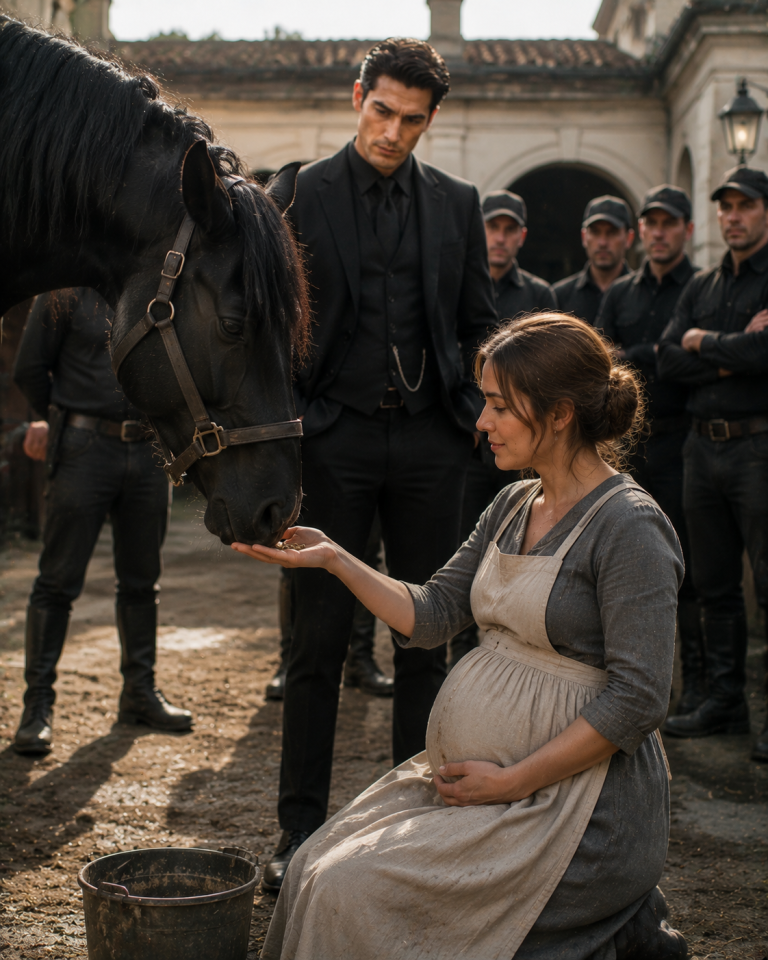
SHE ANSWERED A STRANGER’S ADVERTISEMENT FOR A WIFE — THEN FOUND HIS LOCKED ROOM

## PART 1
—
The stage coach lurched over another rut, and Elena pressed her gloved hands flat against the faded calico of her dress to keep from sliding off the bench.
Four other passengers. A salesman who’d talked himself hoarse by noon. A minister’s wife whose disapproval radiated like heat off a stove. A young couple who couldn’t stop touching each other’s hands — the bride’s ring still so new it caught the light like a small, private sun.
Elena had claimed the corner window before anyone else had a chance. She hadn’t moved in eight hours.
The Montana landscape rolled past. Endless and brutal and beautiful in a way that made her chest ache. She’d grown up in Philadelphia, where buildings stacked on top of each other like cordwood and the sky was something you caught in pieces between rooftops. Then Ohio. Then Kansas. Teaching positions that lasted until some man’s wife decided Elena was too young, too unmarried, too much of a threat. Never mind that she’d never looked twice at a married man. Never mind that she’d spent her evenings alone, correcting arithmetic papers by candlelight, eating day-old bread because it was cheaper.
She was thirty-one years old and she was tired.
Tired in a way that had nothing to do with sleep.
She’d stopped believing in romance around the same time she’d stopped believing her father would come home from the war. Some things just didn’t happen for some people. And the sooner you accepted it, the less it hurt.
So when she’d seen the advertisement in the back of a two-month-old newspaper someone had left in the boarding house parlor, something had clicked into place inside her. Not hope — she’d learned better than that. Something closer to recognition.
*Wanted: woman of sound health and moral character. Purpose: marriage and motherhood. Compensation: security, shelter, respect. Sentimentality: none. Respond to R. Calder, Calder Ranch, Montana Territory.*
Here was a man who wasn’t pretending.
She’d written back the same night. His response arrived three weeks later. Short. Factual. A date. A train fare enclosed. *Bring whatever belongings you value. Trips to town are infrequent.*
She’d read it seventeen times before the ink dried on her reply. Not because she was uncertain — uncertainty was a luxury she’d lost years ago. But because she’d learned the hard way that what men didn’t say mattered more than what they did.
—
*”Calder Station — ten minutes!”*
Elena’s stomach clenched. Her hands stayed steady.
The station was nothing more than a flat stretch of dirt where the road widened. A water trough. A sign so worn by wind that the letters were barely readable. And a single rider beside a black horse, so still he could have been carved from the same stone as the mountains behind him.
She stepped down into Montana dust, and the world felt wider than it ever had. The wind carried sage and distance.
The rider swung off his horse in one fluid motion and walked toward her. Tall. Broad across the shoulders in the way of men who’d spent their lives working with their backs. His face was weathered, lined at the corners of the eyes, hard the way stone was hard — not cruel, just unyielding. Dark hair. Darker eyes. A jaw that looked like it had forgotten how to smile.
“Miss Ward.” Not a question.
“Mr. Calder.” She met his gaze the way she’d learned to meet every skeptical school board and dismissive landlord. If you flinched first, you lost.
He studied her the way she’d seen buyers study horses at auction — checking for soundness, durability, value.
“You’re older than I expected.”
Most women would have been offended. Elena just shrugged. “Your advertisement didn’t specify an age requirement.”
Something flickered in his expression. Gone before she could name it.
“No,” he said. “It didn’t.”
—
The wagon crested a low rise two hours later, and the ranch spread out below them.
Elena hadn’t let herself imagine it. Imagining was another luxury. But even without expectations, the sight of it made her breath catch.
The house was larger than she’d expected — logs weathered to silver gray, a wide porch wrapping around two sides. Behind it, a massive barn. Corrals where horses moved like dark water against the fence lines. Beyond that, grassland rolling toward distant bluffs, dotted with cattle that looked like toys from this height.
It was an empire. Small and self-contained. A kingdom carved from wilderness by someone who refused to bend.
“It’s impressive,” Elena said.
Rhett’s hands tightened on the reins. Just for a moment.
“It’s work.”
He showed her the house without ceremony. The kitchen. The pantry. The room at the east side with morning light coming through hand-hemmed curtains. He listed the rules the way a man recites a contract: meals at six, noon, and six. The study was private. The barn workshop was private. The books on the shelves had belonged to his mother and would stay where they were.
He said the last part quickly. His jaw went tight.
“She passed ten years ago,” he said. Before Elena could respond, he was already turning toward the door. “I’ll be in from the barn at six.”
Elena stood alone in her new room, listening to his boots disappear down the hall.
She went to the window. Looked out at the land that went on forever.
She should have been afraid.
Instead, she felt something closer to relief.
—
The minister came on the third day. The ceremony lasted twelve minutes. Two ranch hands in clean shirts shifted their weight and stared at the floor while Reverend Miller read words that had been binding strangers together for centuries. Rhett’s voice was steady when he spoke his vows. Elena’s didn’t waver either.
When it was over, there was no kiss.
Rhett offered his hand instead. Elena shook it.
They stood alone in the main room while afternoon light slanted through the windows.
“Well,” Rhett said.
“Well,” Elena echoed.
“Nothing changes yet.” He said it quickly, like he’d been rehearsing. “You keep your room. When you’re ready — if you’re ready — you let me know.”
She hadn’t expected consideration.
“Thank you,” she said.
He shrugged. Uncomfortable with gratitude, she realized. *It’s the right way to do things.*
“Most men wouldn’t think so.”
“I’m not most men.”
Elena looked at him then. Really looked. At the lines around his eyes. The weight he carried in his shoulders that had nothing to do with physical labor.
“No,” she said. “You’re not.”
—
—
## PART 2
—
They found a rhythm. Not comfortable. But not hostile either.
He answered her questions about the ranch. Fixed a squeaking hinge on the pantry door without being asked. Left coffee made in the mornings. She explored the house while he worked — the bookshelves with their surprising collection of Tennyson and Byron, the agricultural manuals stacked alongside poetry that told her something about who he’d been before life had worn that person down.
On the second day, she found photographs in a drawer.
A stern-faced couple who had to be his parents. A younger Rhett — something almost like lightness in his expression. And tucked at the back, a woman with dark hair and a tentative smile, wearing a dress too fine for ranch life.
Elena didn’t ask about her.
Some questions invited ghosts into the room. And there were already enough of those.
—
On the eighth day, she went looking for him and found an unlocked door she hadn’t noticed before — a door at the end of the hall that stuck when she pushed it, swollen from disuse, then gave way suddenly and spilled her into a room full of afternoon light.
It had been a woman’s room. That much was clear from the delicate furniture. A vanity with an oval mirror. A wardrobe with carved doors. A sewing table positioned near the window.
But everything was covered in dust so thick it looked like snow.
Whoever had lived here was long gone — and no one had bothered to pack her things away.
Elena moved slowly through the space. The wardrobe held dresses, outdated in style but expensive in fabric. The vanity drawer held hairpins and ribbons, a comb with several teeth missing. And on the sewing table, a piece of embroidery sat half-finished. The needle still threaded with blue silk.
This was the woman from the photograph. The one with the tentative smile.
This had been her life. Her space. Her things — abandoned so completely it was as if she’d simply evaporated.
Elena was still standing there, her hand hovering over the embroidery, when she heard his voice from the doorway.
“You shouldn’t be in here.”
She turned. Rhett stood at the threshold, his expression locked down tight in a way she’d never seen before — not angry exactly, but close. The cold kind of fury that lasted.
“I’m sorry. The door was unlocked and I thought—”
“You thought wrong.”
He stepped into the room. “This stays closed.”
“Who was she?”
His jaw clenched. Muscle jumping. “No one you need to know about.”
“I’m living in this house,” Elena said, keeping her voice level. “If there are things I should understand—”
“There’s not.”
“If you have shrines you’re maintaining, I need to know where they are.”
“Get out.”
Elena walked past him close enough to feel the heat of his anger radiating like a fever. Went back to the kitchen. Plunged her hands into the bread dough.
Her hands were shaking.
But she forced them steady.
—
## PART 3
—
She didn’t sleep well that night.
The wind worked at the shutters. Somewhere a horse whinnied. And beneath all of it, that particular quality of silence that radiated through walls — the heavy quiet of a man who had built his walls so high that even he couldn’t see over them anymore.
The next morning, Rhett was gone before dawn. No coffee made. No note.
Elena found him in the barn, mucking out stalls with violent efficiency.
“I’ll have breakfast ready in twenty minutes,” she said from the doorway.
He didn’t look up. “Not hungry.”
“You need to eat.”
“I’ll eat when I’m ready.”
Elena crossed her arms. “Is this how it’s going to be? You get angry and disappear?”
That got his attention. He straightened, pitchfork in hand, and the look he gave her could have stripped bark off a tree.
“You want to talk? Fine. Let’s talk about boundaries. Let’s talk about respecting someone’s privacy instead of pawing through their things.”
“I wasn’t pawing through anything.” Her own anger rose to meet his. “I was exploring a house I’m supposed to live in, and I found a room that’s clearly a memorial to someone you won’t mention. You want privacy? *Lock the damn door.*”
“I shouldn’t have to lock doors in my own house.”
“*Our* house.” The word landed sharp. “You married me. That makes it mine too. Even if you’d rather pretend I’m just passing through.”
Rhett’s knuckles went white on the pitchfork handle.
“You don’t know anything about it.”
“Because you won’t tell me.” Elena’s voice dropped, steadied. “You want me to navigate this place blind, follow rules you won’t explain, stay out of rooms you won’t identify. That’s not a partnership, Rhett. That’s servitude with extra steps.”
The silence stretched.
“Then maybe you should leave.”
The words hung between them, sharp and final.
Elena felt them land. Felt the sting. But she didn’t flinch.
“Maybe I should,” she said quietly. “But I won’t. Because I made a commitment, and I keep my commitments even when they’re hard. Even when the person on the other side acts like a wounded animal instead of a man.”
She walked out before he could respond.
—
He came in an hour later.
Elena was on her knees scrubbing a kitchen floor that was already clean, taking her anger out on non-existent dirt. She heard him in the doorway. Didn’t turn.
“Her name was Catherine.”
She sat back on her heels.
Rhett moved into the kitchen — pulled a chair, sat down heavily, like the story was too much to carry standing.
“We were engaged six years ago. She came from Boston. Her father had business with the territory governor, and she thought the frontier would be romantic.” His mouth twisted. “It wasn’t. She hated everything about it. The isolation. The work. The wind. But she stayed because I asked her to. Because I promised her it would get easier.”
He looked at his hands. Calloused. Scarred.
“Three months before the wedding, she left. Didn’t tell me she was going. Just packed her things, took the stage back east. Left a note.” A long pause. “Said she couldn’t do it. Couldn’t be the kind of woman this life required.”
Elena set down the brush.
“I kept her room the way it was. Told myself I’d pack it up eventually.” The corner of his mouth moved. Not a smile. “Eventually never came.”
“I’m sorry.”
“Don’t be. She made the right choice.” His voice was flat, matter-of-fact, the way a man talks about something he’s rehearsed until it stopped hurting. Or learned to believe it had. “This life isn’t for everyone. It breaks people who aren’t strong enough.”
“Is that what you’re worried about?” Elena asked. “That I’ll break too?”
“I’m not worried about anything.” He looked at her directly. “I learned my lesson. Don’t expect. Don’t hope. Don’t trust that anyone will stay.”
“And yet you sent for me.”
“Because I needed an heir. Not a wife. There’s a difference.”
The bluntness should have stung. Maybe it would have, if Elena hadn’t understood exactly what she’d signed up for.
“I know there’s a difference,” she said. “I’m not here for romance either.”
She picked up the brush again. Went back to scrubbing.
“I’m here because I was tired of being alone. Tired of teaching other people’s children while having none of my own. Tired of rented rooms and temporary positions, and knowing that every year I got older made me less valuable on a market I never wanted to be part of in the first place.”
Rhett was quiet for a long moment.
“That’s honest.”
“It’s the truth.”
She glanced up and found him watching her with an expression she couldn’t read. Something careful in it. Searching.
“I won’t go in that room again,” Elena said. “But I won’t apologize for walking through an unlocked door in a house I’m supposed to belong to.”
“Fair enough.” He stood, settled his hat. “And I’ll stop acting like you’re going to bolt at the first sign of difficulty.”
“That would be appreciated.”
He almost smiled. *Almost.*
“Breakfast still available if you don’t mind it cold.”
“I’ve had worse.”
—
They found a different rhythm after that.
Not easy. But something had shifted — a foundation settling into place. Not friendship, not trust, but maybe the beginning of something that could become those things if they were careful.
On the eighth day of November, the temperature dropped hard and the sky turned the color of old pewter. Elena walked out to the barn and found Rhett working a young horse on a long lead line — the animal wild-eyed and fighting, crow-hopping and throwing its head, while Rhett’s hand stayed steady on the rope. Not pulling. Not yanking. Just maintaining constant pressure and waiting.
Elena leaned against the fence and watched.
There was something hypnotic about it. The contest of wills playing out in a space no bigger than a room.
“He’ll break himself if he keeps that up,” she said.
Rhett didn’t turn. “He’ll figure it out.”
“How long have you been out here?”
“Since four.”
Three hours. Without coffee. Elena did the math and kept the thought to herself.
“What happens if he doesn’t figure it out?”
“Then he’s not worth keeping.”
The assessment was delivered without emotion. Elena found herself wondering if Rhett applied the same standard to people. If he was watching her the way he watched this horse — waiting to see if she’d panic and bolt, or settle into the weight of the rope.
“Breakfast is ready when you are,” she said.
“I’ll be another hour.”
She turned back toward the house. Behind her, she heard his voice drop — low and steady, talking to the horse in words she couldn’t make out. Not commands, exactly. Something closer to negotiation.
—
When he came in, his hands were raw from rope burn. He ate without speaking. When he finished, he pushed back from the table and looked at her for the first time that morning.
“You don’t have to wait on me.”
“I know.”
“I mean it. If I’m late, eat without me.”
“And if I choose to wait?”
His jaw tightened. “Why would you?”
“Because it’s civilized. Because sitting down to a meal together is one of the few normal things about this arrangement.” She carried the plates to the basin. “Take your pick.”
Something shifted in his expression. Surprise, maybe. Or the beginning of respect.
“You’re not what I expected.”
“You’ve said that before.”
“I mean it more now.” He crossed to where she worked. Not close enough to crowd, but close enough that she could smell horse and leather and lye soap. “What did you expect, exactly? Some shrinking girl who’d faint at the sight of blood? A woman so desperate she’d agree to anything?”
“Both of those,” Rhett said. “At least.”
“Well, I’m neither.” Elena scrubbed harder than necessary. “I don’t faint, and I agreed to this with my eyes open. If that’s disappointing—”
“It’s not.” He stood still, watching her. “It’s better. For what I need.”
She turned to face him. Water dripping from her fingers.
“A partner who can handle herself,” he said carefully, like he was picking through a field of buried traps. “Who doesn’t need coddling or protecting from reality.”
“Is that what this is?” she asked. “A partnership?”
“It could be.”
“I thought it was a transaction.”
“Maybe it’s both.”
They stood like that, the morning light cutting between them. Elena could see the lines around his eyes, the old white scar along his jawline that she’d never asked about. There was a man underneath all that weathering, she thought. Someone who’d wanted things before life had ground those wants down to nothing.
She looked away first.
“Did the horse settle?” she asked.
It was a deliberate retreat. Rhett accepted it.
“He’s got sense,” he said. “He’ll come around.”
—
Three weeks into November, the storm warnings came — and then the storm itself.
Snow piled against the windows until the light filtering through was dim and blue-tinged. The wind didn’t stop. Just changed pitch. Sometimes a low moan, sometimes a shriek that made the shutters rattle.
And with the storm came a problem they could no longer avoid.
Rhett found her in the kitchen on the afternoon it started, his face tight with the particular frustration he usually kept locked away.
“Lost three head,” he said, shrugging out of his coat. “Found them in the ravine past the north fence. Broke through the ice.”
“I’m sorry.”
“It’s not your fault.” He poured himself coffee, drank it black and too hot. “It’s mine. Should have moved them closer before the freeze set in hard.” He set the cup down harder than necessary. “Three head might not sound like much. But that’s money we won’t have come spring. Breeding stock I can’t replace easily.”
“What can I do?”
“Nothing.” He stared at the cup. “There’s nothing to do except write it in the loss column and move on.”
But he didn’t move on. He stood there, jaw working, like he was chewing on words he wouldn’t say.
“It’s not just the cattle,” Elena said quietly.
His eyes cut to her. Sharp.
“You’ve been wound tight for days. Ever since the Mallister boy came by with that message from town.”
“That’s none of your concern.”
“We’re married. That makes most things my concern.”
“We’re married on paper.” His voice went flat. “Don’t confuse that with something it’s not.”
The words landed like a slap. But Elena held her ground.
“Fine. Keep your secrets. But don’t take your frustration out on me just because I’m the only one here.”
She turned back to the stove. Behind her, after a long silence:
“The bank’s raising interest rates.”
Elena’s hands stilled.
“The loan I took out three years ago to expand the herd. They’re changing the terms. Want an extra two percent starting January.”
“Can you afford that?”
“If we have a good calving season. If the market holds. If winter doesn’t drag on too long.” He laughed, bitter. “Too many ifs.”
Elena set down the spoon. Turned to look at him.
“How much do you need?”
“More than I have.” He moved to the window, stared out at the white expanse. “I put everything into this place. Every dollar, every hour. Built it from nothing into something that could sustain a family. And now some banker back east decides he wants more, and there’s not a damn thing I can do about it except pay or lose it all.”
The pieces clicked into place.
The advertisement. The urgency. The specific request for a woman who could bear children quickly.
He hadn’t just wanted an heir for legacy. He’d needed one for leverage. A family meant stability — meant the bank would be less likely to call the loan if things went south.
“That’s why you sent for me,” she said. “Not just for a child. For insurance.”
Rhett’s shoulders tensed.
“I told you from the start what this was.”
“You told me you wanted an heir. You didn’t tell me you needed one to save your ranch.”
“Would it have changed your answer?”
Elena considered it honestly.
“No,” she said. “But I would have appreciated knowing the full picture.”
“The full picture is this.” He turned from the window. “I’m forty-two years old. I’ve worked this land for twenty years, and I’ll be damned if I let some banker take it because he wants to squeeze more profit out of people who are already bleeding.” His gaze locked onto hers. “You want honesty? Fine. I married you because I needed a wife and a child to present to the bank board. Proof that I’m building something permanent. Without that, they’ll call the loan. With it, I have a chance.”
A pause.
“And if you don’t get pregnant, we’re both in trouble. Because I’ll lose this place, and you’ll have nowhere to go.”
The bluntness was almost refreshing. No softening. No apologies. Just the raw truth laid out like a hand of cards.
“How long do we have?” Elena asked.
“Six months. They want to review the loan in April.”
She did the math. Even if she conceived tonight, she wouldn’t be showing much by April — but the fact of pregnancy would be enough. Proof that Rhett was serious about building something instead of just holding on to dirt.
“Then we have a problem,” she said. “Because this arrangement you wanted — separate rooms, taking our time — that doesn’t work with a six-month deadline.”
Rhett’s gaze locked onto hers. She saw the conflict there. The war between what he’d promised and what he needed.
“I won’t force you,” he said.
“I know. But I also know what’s at stake now.” Elena wiped her hands on her apron. Made herself hold his eyes. “You need a child, and I agreed to give you one. The timeline just moved up. That’s all.”
“That’s not all.” He crossed the kitchen in three strides, stopping close enough that she had to tilt her head back to look at him. “Don’t make it sound simple. Don’t pretend there’s no difference between doing this because you’re ready and doing it because a bank gave me a deadline.”
“Isn’t that what marriage is for most people? Doing things because circumstances require it rather than because you feel like it?”
“Maybe. But I won’t have you hating me for it after.”
Elena almost laughed.
“Rhett. I came here knowing exactly what would be expected of me. The only thing that’s changed is the urgency.” She held his gaze. “If you’re asking whether I’m willing to uphold my end of our agreement, the answer is yes.”
“Just like that.”
“Just like that.”
He searched her face. Looking for hesitation or fear.
Elena kept her expression neutral, even though her heart was beating hard enough to hurt.
“When?” he asked. His voice had gone rough.
“Tonight.”
—
What happened that first night was not romantic.
It was not kind, exactly, though Rhett tried — tried harder than she’d expected a man with his walls to try. It was awkward and careful and over too quickly, leaving Elena staring at the ceiling in the dark, feeling the residual ache and a hollow feeling she hadn’t anticipated.
He left without speaking. She lay alone.
*The first time was over,* she told herself. *That has to count for something.*
But it didn’t feel like enough.
The storm lasted three days, trapping them inside with nowhere to go and no way to pretend the nights weren’t happening. Each time was a little less clinical. Each time, Rhett was a little more careful. Each time, Elena lay in the dark afterward and tried to figure out how to keep her heart out of it.
She was failing.
She just hadn’t admitted it yet.
—
When Rhett went to town for two days in mid-November, Elena found herself standing outside Catherine’s room again.
The door was still unlocked. Still swollen in the frame.
She went in.
She’d promised she wouldn’t. But Rhett wasn’t here, and the curiosity had been eating at her since the first time, and she needed to understand something she couldn’t name.
She looked closer this time. The dresses in the wardrobe were expensive but practical — made for someone who’d expected to work. The books on the shelf were poetry and philosophy, not the romance novels a frivolous woman would choose. And tucked in the back of the vanity drawer, beneath the hairpins and ribbons:
A letter.
Elena hesitated. Then pulled it out.
The paper was yellowed. The ink faded. She unfolded it carefully and read.
It was from Catherine to her mother, dated two months before she left.
*I am drowning here, Mama. Not in water, but in absence. In being invisible to the one person who should see me most.*
Elena read it twice. Her chest tightening with every word.
Catherine had written about loneliness. About watching Rhett disappear into his work day after day, coming home too tired to talk, too focused on the ranch to notice her. About feeling like an accessory — something he’d acquired because it was expected, not because he wanted *her* specifically.
She wrote about the silence. Not peaceful silence, but the kind that pressed down until you couldn’t breathe.
And she wrote about the slow realization that she would never be enough. Because what Rhett really loved was this land, and it would always come first.
Elena folded the letter carefully. Put it back where she’d found it.
She left the room and went to sit at the kitchen table with her hands wrapped around a cup of coffee she didn’t drink.
She understood now.
Understood why Rhett had locked himself down so completely. He’d tried once to build something real, and the woman he’d chosen had looked at his life and found it insufficient. So he’d learned to expect nothing. Offer nothing. Make sure no one could hurt him that way again.
But understanding it didn’t make the situation easier.
If anything, it made it worse.
Because Elena could see clearly now that Rhett wasn’t just protecting himself. He was protecting *her* too, in his own broken way. Keeping distance so she wouldn’t drown like Catherine had. Maintaining the walls so neither of them would mistake this arrangement for something it could never be.
The problem was that Elena was already drowning.
Not in absence. In the slow, unwilling realization that she wanted more than the deal they’d made. She wanted conversations that went deeper than weather and supply lists. She wanted to know what kept him awake at night, what he’d dreamed about before life had ground those dreams down to survival.
She wanted to matter to him. As more than a means to an end.
That wanting was dangerous.
It wasn’t part of the agreement.
—
Rhett returned late on the third day. He came in looking exhausted — face windburned, eyes shadowed. Elena had dinner ready: roast chicken, potatoes, carrots from the root cellar.
They ate in near silence.
Halfway through the meal, he set down his fork.
“The bank manager asked after you.”
Elena went still.
“I told him we were building something.” He said it flatly, like reciting a fact. “He seemed satisfied.”
“What are we actually building?” Elena asked.
Rhett looked at her.
“I don’t know yet.”
The admission sat between them. Heavier than the silence that followed.
That night, Rhett knocked on her door around ten — and this time, something was different. He didn’t move toward the bed. He stood near the window, staring out at the darkness.
“I’ve been thinking,” he said.
“About what?”
“About this.” He gestured between them. “About what we’re doing and how we’re doing it.”
Elena set down the book she’d been holding without reading.
“About last night. The night before. All of them.” His jaw tightened. “I don’t want to keep doing it like this. Like it’s something we’re both just enduring until it’s over.”
“What else is there?”
“I don’t know.” He turned to face her. “But there has to be something between treating you like a broodmare and pretending this is a love match.” He ran a hand through his hair. “Catherine left because I didn’t know how to give her anything beyond this ranch. I’m not going to make that same mistake.”
Elena’s breath stopped.
“What are you saying?”
“I’m saying this arrangement we made — it’s not working. Not the way it is now.” He moved closer. Stopped just out of reach. “We’re married. We’re going to have a child together if we’re lucky. We share a life, even if we’re both pretending we don’t. We can keep trying to maintain these walls.” He paused. “Or we can admit they’re already crumbling, and figure out what to build instead.”
“You want to change the agreement.”
“I want to acknowledge reality.”
He sat beside her on the edge of the bed. Not touching. The mattress dipping under his weight.
“I come to your room because I have to, not because I want to. And I hate that. I hate reducing you to an obligation.” His voice dropped. “At least to me, it does. And I think it does to you too, even if you won’t admit it.”
Elena’s hands twisted in her lap.
She’d been so careful. So controlled. She’d built the same walls he had, just from the other direction — arriving at this arrangement with clear eyes and realistic expectations, refusing to let herself want more than what had been promised.
“What do you want from me, Rhett?”
“I want you to stop pretending this is easy.” He looked at her directly. “I want to try to build something real. Not a love story, maybe. But a partnership. Something more than just survival.”
“That’s not what we agreed to.”
“Agreements can change.”
“You married me because you needed an heir to save your ranch,” Elena said. “I married you because I needed security and a place to belong. Those things haven’t changed.”
“No. But *we* have.” His hand found hers. His fingers lacing through hers tentatively — the gesture of a man who’d forgotten he was allowed to reach for things. “Or at least I have. Somewhere between shoveling snow together and watching you refuse to complain when everything’s hard, I started to care about more than just what you can give me.”
“Don’t say things you don’t mean.”
“I’m not.” His grip tightened. “I want to know what you think about when you stare out that window for hours. I want to understand why you chose teaching when it clearly made you miserable. I want to hear you laugh — which I haven’t yet, but I think about more than I should.”
Elena stood up.
Moved away from him. Wrapped her arms around herself to hold something together that was already breaking apart.
“You’re asking for things I don’t know how to give. I came here with realistic expectations. I accepted what this was. And now you’re moving the boundaries, asking for connection I didn’t prepare for.”
“I know. And if you can’t give it, I’ll accept that.” He stayed where he was. “But I needed to say it. Needed you to know that this isn’t just obligation anymore. At least not for me.”
The silence stretched.
Elena looked at the window. At her own reflection in the glass — a woman who had spent thirty-one years being practical, accepting less than she deserved, learning to want only what was offered.
“What if I do care?” she said quietly. “What if I’ve been lying to myself just as much as you have? What happens when the bank still takes everything and we’re left with nothing but feelings we weren’t supposed to have?”
“Then at least we’ll have tried for something more than survival.”
“That’s not enough.”
“It’s more than I’ve had in six years.”
The rawness in his voice broke something in her.
She turned to look at him. This man who had built walls so high they blocked out the light, and who was standing now in the middle of his own rubble, asking her to help him build something different.
“I read Catherine’s letter,” she said.
Rhett’s expression shuttered.
“You went in that room after you promised.”
“I know. I’m sorry.” Elena moved closer. “But I needed to understand what happened, and you weren’t going to tell me.” She stopped in front of him. “She wrote about drowning in absence. About being invisible to you. And I understand why you pulled back after that. Why you made this arrangement so clinical.” She reached out. Touched his face. “You were trying to protect us both from drowning the same way.”
“I failed.”
“No. You just learned the wrong lesson.” Her fingers curved against his jaw. “Catherine drowned because she needed more than you could give while you were building this empire. But I’m not asking you to choose between me and the ranch. I’m asking you to let me help carry the weight. Instead of facing it alone.”
Rhett’s hand came up to cover hers.
“I don’t know how to do that.”
“Neither do I. But we can figure it out together.”
He pulled her into his arms — sudden, tight, holding her close enough that she could feel his heartbeat against her chest. Elena wrapped her arms around him and let herself feel the solid reality of him. The tremor running through his frame that said he was just as scared as she was.
“I don’t want to hurt you,” Rhett said against her hair.
“You will anyway. That’s what people do when they care about each other. They hurt each other and forgive each other and keep trying anyway.”
“That sounds exhausting.”
“It is.” She pulled back just enough to look at him. “And I want it anyway. I want more than just surviving this marriage. I want to build something that matters.”
Rhett kissed her then.
And it was nothing like the careful, mechanical kisses from before.
This was hunger and desperation and the breaking of every wall they’d both been maintaining for months. Elena kissed him back with equal intensity — pouring six weeks of loneliness and want and denied hope into the contact.
When they finally broke apart, both of them were breathing hard.
“Stay,” Elena said. “Not because you have to. Because you want to.”
“I want to.” His hands framed her face. “But if we do this, it can’t be like before. I can’t keep treating you like an obligation.”
“Then don’t.”
—
That night was different.
Slower. More deliberate. Rhett paid attention to her in ways she hadn’t expected — learning what made her breath catch, what made her tense, adjusting with a patience that undid her more than any gesture of passion would have.
Elena let herself be present. Let herself feel instead of endure.
When it was over, he didn’t leave.
He stayed, pulling her against his side, his fingers tracing idle patterns on her shoulder.
“Tell me something,” he said quietly. “Something I don’t know about you.”
Elena thought about it.
“I wanted to be a writer when I was young,” she said. “Wrote stories about places I’d never been and people who were braver than I was.”
“Why didn’t you?”
“Because writing doesn’t pay rent.” She turned her head to look at him. “Your turn.”
“I wanted to be an architect.” He said it like he was confessing something. “Design buildings instead of just maintaining them.”
“Why didn’t you?”
“My father died. The ranch needed running.” His thumb traced along her shoulder. “Wanting things for yourself is a luxury when people depend on you.”
They lay there in the darkness, sharing pieces of abandoned dreams. Outside, the wind moved across open land with its constant, restless presence. Inside, two people who had started as strangers began the slow, difficult work of becoming something else.
—
February arrived with a letter from the bank.
The envelope was cream-colored. Expensive. The kind that held bad news dressed up in formal language.
Elena carried it back from the mailbox tucked inside her coat, delaying the moment. When Rhett read it, his jaw tightened in the particular way she’d learned to recognize — not hot anger, but the cold kind.
They’d moved up the timeline. The review was in two weeks.
“We tell them the truth,” Rhett said. “The ranch is profitable. We’re building something sustainable.”
“And if they want proof we’re building a family?”
He looked at her.
“Too early to know.”
Elena nodded. But something had shifted in her body over the past week. Something she couldn’t name. A subtle change in how she moved through the world, like her center of gravity had quietly relocated.
She waited three more days before saying anything.
Found him in the barn on the fourth morning.
“I think I might be pregnant.”
Rhett froze. The brush he’d been using on Ranger’s coat hung loose in his hand.
“You *think*?”
“I’m late. Not by much, but enough to notice. And I feel different.” She wrapped her arms around herself. “I could be wrong. It’s too early to be certain.”
“But you don’t think you’re wrong.”
“No.”
He crossed the distance between them in two strides and pulled her into his arms. Elena felt him trembling. Or maybe that was her. Maybe it was both of them, holding each other up against the weight of possibility.
—
The morning of the bank meeting, Elena dressed in her best outfit — a navy dress she’d remade from one of Catherine’s abandoned gowns, altered to fit her frame and stripped of its excessive decoration. She looked respectable. Settled. Like a woman who belonged exactly where she was.
They walked to the bank together, not speaking, their hands clasped tight enough to hurt.
The lead banker was a Mr. Hutchinson — gray-haired and sharp-eyed, the kind of man who’d built a career on knowing when people were lying. He opened his folder without preamble.
“I’ll be direct,” he said. “Your loan is underwater based on current market projections. The land value hasn’t appreciated as anticipated, and your herd size doesn’t provide sufficient collateral for the amount outstanding.”
Rhett laid out the counter-arguments, calm and precise: the herd had grown thirty percent since the loan was issued. The land assessment was from a drought year. Current conditions justified a higher valuation.
Hutchinson looked at Elena.
“I understand you married recently, Mrs. Calder.”
“In September,” Elena confirmed.
“And you’re settling into ranch life.”
She felt the trap in the question. The implication that she was unsuited. That she’d run.
“I prefer it,” she said. “Teaching other people’s children was never as satisfying as building something of my own.”
“Building what, exactly?”
“A home. A family. A legacy.” She held his gaze. “My husband and I are partners in every sense of the word. I understand the ranch’s finances as well as he does. I know what we’re working toward and what’s at stake.” She didn’t look away. “This isn’t a marriage of convenience. It’s a genuine partnership built on shared goals and mutual respect.”
One of the other bankers leaned forward.
“Are you expecting a child, Mrs. Calder?”
Elena paused. Too early to confirm. Too important to deny.
“We’re hopeful,” she said carefully. “We’ve only been married six months. These things take time.”
—
The meeting lasted an hour.
When it was over, Hutchinson sat back and looked at them both.
“I’ll be frank. Under normal circumstances, we’d call this loan in and cut our losses.”
Elena kept her face neutral. Beside her, she felt Rhett go very still.
“However,” Hutchinson continued, “you’ve demonstrated commitment to making this work. The ranch is well-managed. The improvements are documented. And your partnership appears genuine.” He looked at Elena. “You remind me of my own wife, Mrs. Calder. She came west with nothing and built a life through sheer determination. I respect that.”
He slid a paper across the table.
“We’ll extend the loan on modified terms. Higher interest rate — three percent instead of two. But we’ll give you another two years to demonstrate sustained profitability, contingent on quarterly reviews. If you fall behind, we reserve the right to call the loan immediately.”
It wasn’t what they’d hoped for.
But it was more than they’d feared.
“We’ll take it,” Rhett said.
—
The doctor’s office smelled like linseed oil and camphor.
The physician — an older woman with kind eyes and a no-nonsense manner — examined Elena and delivered the news with a small, certain smile.
“About six weeks along. Everything looks healthy. Late October, early November, I’d say.”
Elena felt relief and terror in equal measure.
A child. Real and growing. No longer just possibility, but certainty.
Rhett’s hand found hers under the doctor’s desk and squeezed hard enough to hurt.
Outside on the street afterward, he stopped walking. Just stood there in the pale winter sun, like a man who needed a moment to find his footing.
“I’m going to be a father,” he said. Wonder in his voice. Like the word was a country he’d been told he’d never get to visit.
Elena looked at him.
This hard man. This wounded, careful, infuriating, decent man who had built his life around not wanting things — and who was standing now in the middle of a street in a small Montana town, completely undone by the possibility of a child.
“You’re going to be insufferable,” she said.
He laughed. A real laugh — surprised out of him, unguarded.
It was the first time she’d heard it.
She thought about what he’d said, weeks ago. *I think about hearing you laugh more than I should.*
She understood now what he’d meant.
—
The calving season started in March and nearly destroyed them.
Eighteen-hour days. Two lost calves, and Elena standing at the window at three in the morning watching lamplight move between the barn and the bunkhouse, waiting. Her body changing in ways that were fascinating and frightening and sometimes, in the late evenings when she sat with her hand on her belly feeling the first tiny flutterings of movement, astonishing.
Rhett adapted. Learned to read her moods. Knew when she needed space and when she needed to be held. Left wildflowers on the kitchen table sometimes — just a small bunch, no note — because he’d seen her stop and look at them when she passed.
He never said *I noticed you like those.* He just put them there.
It was the most romantic thing anyone had ever done for her.
By mid-April, the calving was done and the count was better than expected. Rhett updated the ledgers with numbers that actually justified the bank’s continued investment. The first quarterly review was a formality. Hutchinson signed off without drama, noted the documented pregnancy, and as he was leaving, pulled Rhett aside.
“You’ve got a good woman there,” he said. “Don’t take that for granted.”
“I won’t,” Rhett promised.
He didn’t.
—
Summer arrived with heat that turned the air thick and golden.
Elena was enormous. Uncomfortable in every position. Counting down the days.
“I can’t do this for two more months,” she told Rhett one particularly miserable evening in August.
“Yes, you can. You’re the strongest person I know.”
“I’m a whale.”
“You’re beautiful.”
“You’re a liar.”
He kissed her forehead. “But you appreciate the effort.”
She did. She told herself she didn’t and she did completely.
September cooled things down. The baby was active now — movements visible from the outside, little feet or fists pushing against her skin. Rhett spent hours with his hand on her belly, talking to the child who couldn’t possibly understand but seemed to respond to his voice anyway.
“What are you telling them?” Elena asked one night.
“Everything about the ranch. The horses. The way snow looks on the mountains.” He paused. “About their mother, who’s the bravest person I’ve ever met.”
Elena’s throat went tight.
“You’re going to spoil them before they’re even born.”
“That’s my right as a father.”
—
Elena’s water broke on October 28th, a week early, while she was making bread.
The labor was almost twenty hours. Brutal in ways she hadn’t prepared for, despite the warnings. There were moments when the pain erased everything — her name, her history, the whole carefully constructed world she’d built around herself. There was only the next breath and the next and the next.
Rhett stayed with her the entire time.
Held her hand. Let her crush his fingers. Whispered encouragement even when she was beyond hearing words, just a voice, steady and there, the same way he’d stood in that corral with the rope in his hands and waited.
And then, finally: a cry.
High and furious. Absolutely certain of its own importance.
“It’s a girl.”
Elena collapsed back against the pillows, more exhausted than she’d ever been in her life.
The doctor placed a tiny red-faced creature in her arms — screaming her displeasure at the world, dark-haired, small fists clenched like she was already ready to argue.
“Anne,” Elena whispered.
Rhett was crying.
Actual tears tracking down his weathered face as he looked at his daughter for the first time. Elena watched him — this man who had taught himself not to expect anything, not to hope, not to leave himself open to loss — and she watched him look at Anne and simply forget every lesson he’d learned.
“She’s perfect,” he said.
“She’s *loud.*”
He laughed. Elena laughed too, which hurt everywhere, but she didn’t stop.
—
The third quarterly review happened in early November, with Anne two weeks old.
Hutchinson came to the ranch this time instead of making them travel. He reviewed the books — continued profitability, strong calving numbers, documented improvements — and then asked to see the baby.
Elena brought Anne out, wrapped in the blanket Mrs. Jensen had made.
Hutchinson’s stern face softened.
“My congratulations.” He looked at the tiny girl for a long moment. At the dark hair. The small fists. “She’s beautiful.”
“Thank you,” Rhett said.
Hutchinson closed the ledger.
“When you first came to me with this loan, I had serious doubts. You’ve proven me wrong at every turn.” He slid a final document across the table. “I’m recommending to the board that we convert this to a standard mortgage at market rates. You’ve more than demonstrated your ability to manage the property and your commitment to building something sustainable.”
After he left, Rhett pulled Elena into his arms, careful of the baby between them.
“We did it.”
“We’re not out of debt yet.”
“No.” His arms tightened. “But we’re on solid ground. The ranch is ours as long as we keep making payments. And the payments are manageable now.”
Elena looked around the house. Their home. Earned through work and hope and refusing to give up when everything seemed impossible.
“I can’t believe we’re here,” she said.
“Where?”
“Safe. Settled.” She looked at Anne, sleeping through the conversation with her characteristic certainty that the world would accommodate her. “A family. I came here expecting nothing but survival, and somehow we ended up with everything.”
“Not everything,” Rhett said.
“What are we missing?”
He kissed her. Soft and slow, unhurried, the way he’d learned to be with her.
“This,” he said against her mouth. “I love you, Elena. I should have said it months ago, but I was too scared. Too convinced that admitting I cared would somehow ruin it.”
She pulled back to look at him.
“I love you too,” she said. “Have for a while. But I thought keeping it to myself was safer.”
“We’re both idiots.”
“Agreed.” She kissed him again. “But we’re idiots who figured it out eventually.”
—
On their fifth anniversary, Rhett found Elena in the kitchen after the children were in bed.
Anne was five by then, with her mother’s stubbornness and her father’s dark eyes. James was three, already following Rhett around the barn like a shadow, serious and deliberate in the way of children who are carefully memorizing everything. And Margaret, who had arrived the previous spring, was sleeping in the cradle Rhett had carved by hand — horses and mountains in the wood, fine enough to last for generations.
Rhett pulled a paper from his pocket.
“Read it,” he said.
Elena unfolded it.
The original advertisement. Stark and unromantic — *Wanted: woman of sound health and moral character. Purpose: marriage and motherhood. Compensation: security, shelter, respect. Sentimentality: none.*
She hadn’t seen it in years.
She looked at him.
“Why are you showing me this?”
Rhett took the paper from her hands. Walked to the fireplace. And dropped it into the flames.
They stood and watched it burn — the words curling and blackening, disappearing into ash and smoke.
“Because we don’t need it anymore,” he said. “We haven’t needed it for a long time. We started with a transaction, but we built something real. And I wanted to mark the moment when we stopped being a deal and became a choice.”
Elena moved into his arms.
“I choose you,” she said. “Every time. Even knowing how it started. *Especially* knowing that. Because we could have stayed strangers who shared a house — and instead we became something neither of us expected.”
“A family.”
“Yes.”
Outside, the land stretched endlessly under a sky full of stars — the same sky Elena had looked up at on her first night, when the world felt too big and she’d stood in an unfamiliar room and tried not to want anything.
Inside, children slept. Animals were safe in the barn. And two people who had come together out of desperation had built a life worth fighting for.
The ranch would outlast them both. Pass down to Anne and James and Margaret, who would pass it to their own children in time. But the legacy wasn’t just land and cattle.
It was the knowledge that sometimes the best things came from the hardest beginnings.
That love wasn’t always the starting point.
Sometimes it was the destination you reached by refusing to give up — by choosing, each day, to try. To build. To become something more than survival.
Elena had come to Montana expecting nothing but a roof and security.
She’d found a partner, a family, and a home carved from wilderness and will.
Rhett had advertised for a transaction and discovered that what he’d really needed, all along, was someone who would stand beside him, challenge him, and refuse to let him settle for less than he deserved.
They’d both gambled on a deal that seemed impossible.
And they’d both won something neither of them had known they were playing for.
The contract burned to nothing in the fireplace.
Outside, snow began to fall — gentle and steady, covering the land in fresh white, the same way it had covered everything that first night she’d arrived, when Montana had felt so enormous it might swallow her whole.
Now it just felt like home.
Rhett held her in the firelight, one hand warm at the small of her back, and they stood together watching the past disappear into smoke.
Neither of them said anything else.
There was nothing left to say.
—
**THE END**