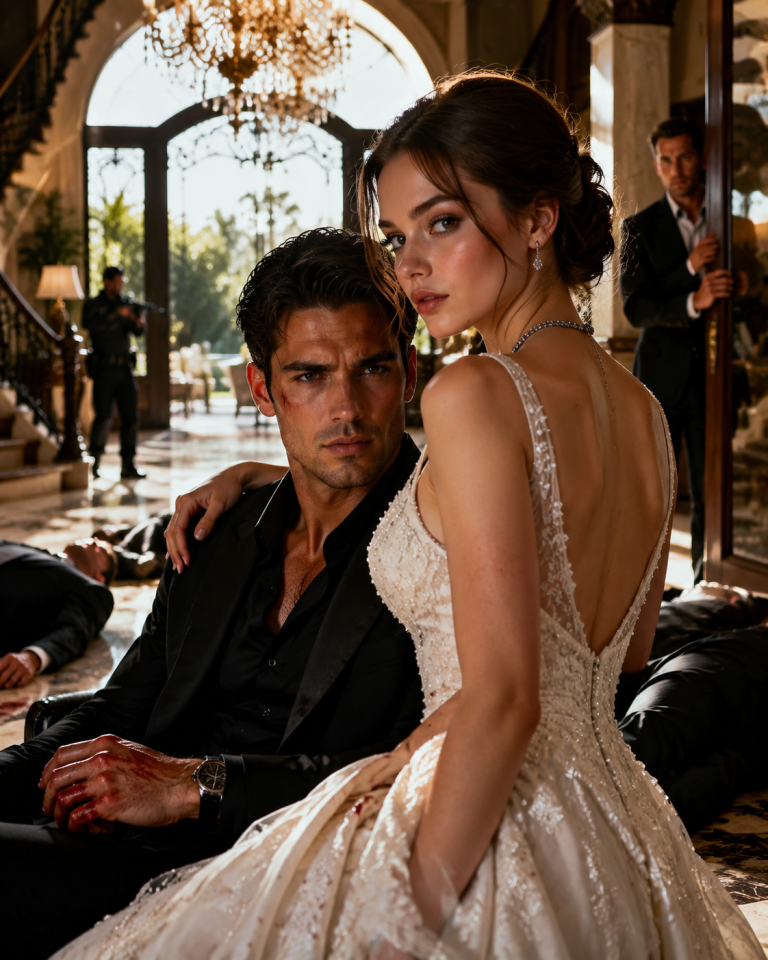
Rejected Seven Times As A Mail-Order Bride — Then The Territory’s Most Ruthless Rancher Rode In Just For Her

PART 1
The dust never settled in Clemson’s Ridge. It hung in the air like judgment, thick and yellowing in the late afternoon sun, coating the wooden platform and the anxious faces of the waiting women.
Evelyn Hart stood at the far end of the line. Her calloused hands were folded so tightly her knuckles had gone white. She had positioned herself there deliberately. Last in line meant last to be humiliated. Last to hear the silence that followed when a man’s eyes skipped right over her like she was part of the scenery.
Thirty-one years old in 1867. That made her a relic.
She watched the other women arrange their skirts, pinch their cheeks for color, and practice demure smiles that promised everything and demanded nothing. Most were barely twenty, fresh-faced and hopeful. Evelyn had known better for a long time.
“Think anyone will take her this time?” The whisper carried from behind her, meant to be heard. “Seventh try, isn’t it? Lord, that’s just sad. My husband says she’s got a reputation. Too stubborn. Too mannish.”
Evelyn didn’t turn around. Responding only proved she’d heard, and proving she’d heard gave them exactly what they wanted. Instead, she kept her gaze fixed on the horizon where the mountains cut sharp teeth into the sky. Freedom lived somewhere past those peaks. Or oblivion. At this point, she wasn’t particular about which.
Mr. Thornton, the general store owner who fancied himself the town’s unofficial mayor, stepped onto the platform. “Ladies, gentlemen will begin arriving shortly. Remember, modest behavior, pleasant demeanors, and for heaven’s sake, smile. Nobody wants a sour-faced wife.”
Several women giggled nervously. Evelyn remained perfectly still. She wore her best dress—gray cotton, practical cut, mended in three places. No lace. No ribbons. No illusions.
The first wagon appeared on the eastern road. Then another. Evelyn counted six wagons total. Six men. Fourteen women. The arithmetic wasn’t encouraging.
One by one, the men made their selections. The first took a tiny redhead. “You’ll do. Got a strong back?” The second examined teeth like he was buying a horse. By the time the fifth man made his choice, only four women remained.
The sixth man was older, with kind eyes. He walked slowly down the line. When he reached Evelyn, he stopped. Her heart, traitor that it was, jumped.
“Ma’am,” he said quietly. “How old are you?”
“Thirty-one.”
He nodded slowly. “You’ve been doing this a while, haven’t you? The selection circuit?”
“Yes.”
“Why hasn’t anyone chosen you?”
It was the most direct question anyone had ever asked. Evelyn considered lying, softening it. But what was the point? “I’m told I’m too old. Too plain. Too opinionated for a proper wife.”
“Are you opinionated?”
“Depends on the opinion.”
A smile ghosted across his weathered face. “Fair enough.” He glanced back at the other three women, then returned his attention to Evelyn. “I’m looking for someone to help with my daughter. She’s twelve. Needs a firm hand, but a kind heart. You got children of your own?”
“No.”
“I appreciate your honesty, ma’am. I do. But I think someone younger might be better suited. My Sarah needs a mother who can keep up with her for the long haul.”
He moved to the youngest of the remaining women, a frightened-looking girl of nineteen, and made his offer. She accepted immediately.
Just like that, Evelyn was alone on the platform again.
Mr. Thornton approached, his expression uncomfortable. “Miss Hart, I—”
“It’s fine,” she cut him off. “Same arrangement as before. I’ll stay the night at the boarding house, catch the morning stage to Silver Creek.”
“Actually, Miss Hart, about that.” Thornton shifted his weight. “Mrs. Carmichael at the boarding house asked me to mention… you’ve stayed there six times now. She’s concerned about the optics. The optics of housing a woman who’s been rejected so many times.”
The words settled over Evelyn like dust. Her failure was contagious.
“I see,” her voice came out steady. “Is there another boarding house?”
“Not in Clemson’s Ridge. But there’s a decent camping spot about a mile west.”
Evelyn nodded once sharply and stepped down. She picked up her carpet bag. Thirty pounds of failure in worn leather. She started walking west, toward the creek, toward another night sleeping rough.
She’d made it maybe fifty yards when she heard it. Thunder. But the sky was clear.
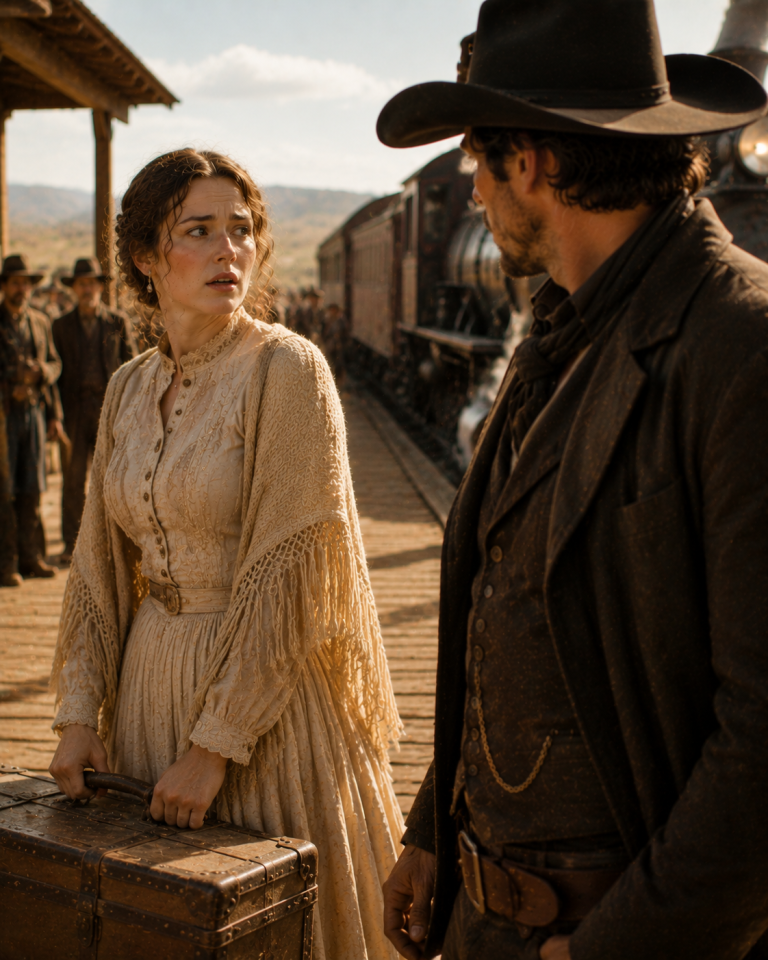
She turned. A rider was coming fast from the north, pushing his horse hard enough to shake the ground. Black horse. Black coat billowing behind him. Dark hair. Broad shoulders. He rode like someone who’d been born in a saddle.
He pulled up hard in front of the platform, his horse sliding to a stop in a spray of dirt. He dismounted in one fluid motion.
Tall. Maybe six-foot-three. Built like someone who’d spent his life doing hard labor. His face was all hard angles, a scar cutting through his left eyebrow. Dark eyes that looked like they’d seen too much and remembered all of it. Everything about him said danger. Controlled power that could snap loose at any moment.
“I’m looking for Thornton,” he said. His voice was deep, rough-edged.
“That’s me,” Thornton hurried forward, suddenly obsequious. “Mr. Rourke, we weren’t expecting you, sir.”
“And is the selection over?”
Rourke’s eyes swept the square. “Just finished, I’m afraid. All the women have been chosen except—” He hesitated, glancing toward Evelyn.
Rourke followed his gaze. His dark eyes locked on her for exactly three seconds.
“Except Miss Hart is still available,” Thornton stammered. “But I should mention she’s been through the selection process several times without success. She’s a bit older. Thirty-one.”
Something flickered across Rourke’s face. Not disgust. Not disappointment. Something closer to interest.
“She healthy?”
“As far as I know.”
“Can she work? Hard work. Ranch work.”
“I don’t know. Miss Hart!” Thornton called across the square. “Could you come here, please?”
Evelyn’s feet moved before her brain caught up. She walked toward them, very aware of how she must look. Up close, Rourke was even more imposing. He occupied space in a way that made everything else seem smaller.
“Miss Hart,” Thornton began. “This is Mr. Caleb Rourke. He owns the—”
“I know who he is,” Evelyn said. Everyone in the territory knew. The Rourke ranch was the largest in Colorado. Thousands of acres. More wealth and power than most small towns.
Rourke’s scarred eyebrow lifted slightly. “Do you? What have you heard?”
“That you’re fair but ruthless. That you built your ranch from nothing. That you don’t suffer fools. And that you’ve been widowed twice.” She paused. “That the last woman who tried to marry you for your money disappeared under mysterious circumstances.”
Someone gasped. Thornton made a strangled noise. Evelyn realized she’d just said that last part out loud.
Rourke’s mouth twitched. “She didn’t disappear. I put her on a stage to San Francisco with enough money to start over and explicit instructions never to return. Not mysterious. Just permanent.” His eyes hadn’t left hers. “You always this direct?”
“Only when I’ve got nothing left to lose.”
“And you’ve got nothing left to lose.”
“I’m standing here alone on this platform for the seventh time. What do you think?”
“I think,” Rourke said slowly, “that you just answered my question about whether you can speak your mind.” He turned to Thornton. “Give us a minute.”
Thornton scurried away. Evelyn and Rourke stood there, sizing each other up. The sun had dropped low, painting everything in shades of orange and shadow.
“I’ll be direct, too,” Rourke said finally. “I need a wife. Not for romance. Not for companionship. I need a partner who can help run my ranch. Do you know what that means?”
“I can guess.”
“Guess.”
Evelyn took a breath. “It means managing a household with thirty or more men. Cooking, cleaning, budgeting. It means isolation. It means being the only woman in a sea of hard men who won’t respect me just because you put a ring on my finger. It means proving myself every single day or being eaten alive.”
Rourke studied her. “You left out the hardest part. Dealing with me.”
Despite the exhaustion, Evelyn almost laughed. “I assume that was implied.”
“I need someone tough. Are you tough, Miss Hart?”
“I’m still standing, aren’t I?”
“I appreciate the consideration,” Evelyn said, shifting her bag. “But let’s be honest. You wrote in here looking for the selection, and all that’s left is me. The woman nobody else wanted. You’re not here because you chose me. You’re here because I’m what’s available.”
She started to turn away.
“You’re wrong.”
Evelyn looked back. Rourke stepped closer. Close enough that she had to tilt her head back to maintain eye contact.
“I didn’t ride in here looking for the selection,” he said, his voice dropping an octave. “I rode in here looking for you.”
“That’s not possible. You didn’t know I existed.”
“Thornton sent a list. Names, ages, basic information. I read it three weeks ago. I was supposed to arrive this morning, but I had a situation with rustlers. I rode straight through to get here before you left.”
Evelyn’s heart was doing something complicated in her chest. “Why?”
“Because every other woman on that list was between seventeen and twenty-three. Fresh, young, expecting romance. I don’t have time to raise a child bride who cries when ranch life gets hard. You’re thirty-one. You’ve been rejected seven times. You’ve faced seven different humiliations, and you’re still here, still trying. That’s not desperation, Miss Hart. That’s endurance. That’s exactly what I need.”
PART 2
Morning came too early and too bright. Evelyn woke to sun streaming through the thin curtains of the boarding house room Rourke had forcibly secured for her the night before. Her body was stiff, her mind racing. She had made a deal with a stranger.
Outside, the wagon waited. Rourke was already at the reins, looking entirely too rested. He offered his hand to help her up. His palm was warm and rough against hers.
“Three days,” he said, snapping the reins. “Maybe two and a half if we push.”
For the first hour, they didn’t speak. The landscape rolled past in an endless sea of grassland and distant purple mountains. Finally, Rourke broke the silence.
“You always this quiet?”
“I was under the impression you didn’t have time for small talk.”
“I don’t. That’s why I’m asking about you. Where you’re from. How you ended up answering mail-order advertisements.”
Evelyn considered deflecting. But if they were going to do this, he’d find out eventually. “Missouri. My father was a shopkeeper. My mother died when I was twelve. I raised my younger brother. When I was twenty-three, my father remarried. There wasn’t room for both of us, so I left.” She watched a hawk circle overhead. “I taught school for three years. Until I turned thirty, unmarried. The school board decided I was setting a bad example for the children. Corrupting them with my spinsterhood.”
“That’s horseshit,” Rourke said bluntly. “You’re not defective. They were looking for someone easily controlled. You don’t fit that mold.”
They fell into a comfortable silence. By the third day, the terrain grew rugged. The mountains loomed closer, solid walls of stone and pine.
Then, the valley opened up without warning.
Spread across the floor was the Rourke Ranch. The main house dominated the center, two stories of solid timber and stone. Surrounding it was an entire complex of barns, stables, and bunk houses. Cattle dotted the distant grassland.
As they descended, men emerged from buildings. Work slowed. By the time the wagon rolled into the main yard, forty men had gathered.
Rourke pulled the wagon to a stop. The silence was profound. Evelyn could feel the weight of every single eye on her. Assessing. Judging.
“Stay in the wagon,” Rourke said quietly. He looked at her, his dark eyes entirely serious. “Remember what I told you on the trail. Firm. Clear. No apologies. You’re there because I chose you. Use it.”
He jumped down. Evelyn took a breath, grabbed her carpet bag, and stepped down into the dirt.
PART 3
The silence in the yard was deafening. Evelyn could feel the hostility radiating from the men, thick and tangible. They were weathered, hard-eyed, and entirely unaccustomed to taking orders from a woman.
Rourke didn’t coddle them. He turned to the crowd, his voice carrying without him having to shout. “Where’s Garrett?”
A tall man with a thick beard pushed through. “Right here, boss. Wasn’t expecting you back until tomorrow.”
“Made better time,” Rourke said. He gestured to Evelyn. “This is Miss Evelyn Hart. She’ll be helping run the household operations. You’ll treat her with the same respect you’d give me. Pass that along. Clear?”
A few of the younger men grinned. An older man in the back crossed his arms and scowled.
Garrett recovered first. “Understood, boss. Welcome, Miss Hart.”
“Thank you,” Evelyn said, keeping her voice level. She didn’t smile. She didn’t fidget. She just stood there, letting their stares wash over her.
Rourke offered his hand. She took it, acutely aware of every man watching her movement. She was dusty, rumpled, travel-worn. But she kept her head high as he guided her toward the main house.
The whispers started before they’d gone ten steps. *He’s joking. Look at her. She’s ancient.*
“Shut up,” Garrett’s voice cut through the murmurs. “You heard the man. Show some respect.”
Inside the house, a woman in her late fifties with severe gray hair met them. Martha, the housekeeper. She looked Evelyn up and down with the thoroughness of a general inspecting troops.
“This way, Miss Hart,” Martha said crisply. “You look like you’ve been dragged behind that wagon. We’ll remedy that immediately.”
Martha led her to a second-floor room. It was simple but comfortable. A large bed, a wardrobe, a washstand. Far nicer than anywhere Evelyn had stayed in months.
“Bath first,” Martha instructed. “Then change. Be ready in an hour to meet with him.”
An hour later, scrubbed clean and dressed in her only other outfit—a dark blue dress—Evelyn made her way to Rourke’s office.
He stood at the window, looking out over the ranch. He turned when she entered. “Better?”
“Much. Thank you.”
“Sit down. We need to talk about tomorrow.”
Evelyn sat. Rourke remained standing. “Tomorrow morning, I’m calling a meeting of all the men. I’m going to introduce you properly and explain your role. After that, you’ll be on your own with them. I’ll be dealing with ranch operations. You’ll handle the household.”
“Think you can manage?” he asked.
“I’ll find out.”
“That’s not confidence. It’s honesty.” He pulled out a ledger. “This is the household budget. Starting next week, this is your responsibility. Track expenses, authorize purchases. Can you handle numbers?”
“I kept books for my father’s shop for years.”
“Excellent. You’ll also manage meal planning, coordinate cleaning, handle correspondence. It’s a lot. But it’s manageable if you’re organized.”
“I’m organized.”
He closed the ledger. “One more thing. The men are going to test you. They’ll push boundaries. You need to shut it down immediately. Don’t wait for me to handle it. You handle it yourself.”
“Understood.”
The morning meeting happened in the largest barn. The smell of hay, leather, and unwashed bodies was overwhelming. Evelyn stood beside Rourke near the front. Martha was positioned near the back, arms crossed, watching.
When the murmuring died down, Rourke stepped forward. He didn’t make grand gestures. He just started talking.
“Most of you met Miss Hart yesterday. She’ll be living here permanently and taking over household operations. She has my full authority. If she tells you something needs doing, it needs doing. If you have a problem with her authority, you take it up with me. And I promise you won’t enjoy that conversation.”
An older man spoke up, his tone carefully neutral. “No disrespect, boss. But most of us have been running things just fine without additional oversight. Why do we need someone new changing how things work?”
“Because ‘just fine’ isn’t good enough anymore,” Rourke said, his voice hardening. “This ranch has tripled in size. We need better organization. I’m not asking for your approval. I’m telling you how things are going to work. Anyone who can’t accept that is welcome to collect their wages and leave.”
Silence settled over the barn. Rourke turned to Evelyn. “Anything you want to add?”
This was it. The moment of truth. Evelyn stepped forward. Her heart hammered against her ribs, but her voice was steady.
“I’m not here to make your lives harder. I’m here to make this operation run more efficiently. Better organization means fewer supply shortages. Better planning means less wasted time.” She paused, meeting as many eyes as she could. “I know most of you don’t want me here. That’s fine. You don’t have to want me here. You just have to work with me. Do your jobs, answer questions honestly, and we’ll get along fine. Give me problems, and I’ll give you problems right back. Fair enough?”
Someone in the middle snorted. “Mighty confident for someone who just got here.”
“Confidence has nothing to do with it. This is simple math. Mr. Rourke hired me to do a job. I’m going to do that job whether you like me or not. Your opinion of me doesn’t change my responsibilities.”
The older man’s jaw tightened, but he didn’t respond.
“That’s all,” Rourke said. “Get back to work.”
As the men dispersed, Evelyn let out a breath she hadn’t realized she’d been holding.
“Well?” she asked Rourke.
“You didn’t fall apart. That’s better than I expected.”
The real test came that afternoon. Evelyn was reviewing supply lists when a young ranch hand appeared in the doorway. “Miss Hart, there’s a problem with the bunk house. Water pump’s broken. We can’t wash up.”
“Show me.”
The bunk house smelled of sweat and leather. A dozen men were inside, watching her. The pump in the corner had a loose handle.
“When did it break?” Evelyn asked.
“This morning. Jensen tried to fix it, but he made it worse,” the young man said.
“I didn’t make it worse. It was already busted,” Jensen argued defensively.
“Enough,” Evelyn said sharply. Both men stopped. “Where’s the nearest working pump?”
“Main house. But that’s a long walk.”
“Then you’ll make the long walk until this one’s fixed. Who here knows anything about pump repair?”
Silence.
“We’re ranch hands, ma’am, not mechanics,” Jensen said. “Pumps are someone else’s job.”
“Whose job?”
More silence.
Evelyn examined the pump. The handle was stripped, but the mechanism was intact. She’d watched her father repair similar pumps a hundred times. “Anyone have tools?”
Someone produced a basic toolbox. Evelyn dug through it until she found what she needed.
“You’re going to fix it yourself?” Jensen sounded incredulous.
“Unless you’d rather wait for Mr. Rourke to find time in his schedule, which might be next week.” She started working on the bolt. “Or you could make the long walk. Your choice.”
The men watched in silence. It took longer than it should have. Her hands were smaller, and the bolt was stuck tight. But eventually, she got it free. She found a replacement, installed it, and worked the handle. Water sloshed into the basin.
“There. Fixed. Next time something breaks, try fixing it yourselves before running to management. We’re all busy.”
She walked out before anyone could respond, her heart racing. Behind her, she heard stunned silence, then low voices. *Didn’t expect that. Think she’ll last. Longer than I thought.*
Martha was waiting when she returned. A slight smile on her weathered face. “Heard you fixed the bunk house pump. Word travels fast. You impressed some of the men. Jensen’s telling everyone you got that bolt unstuck faster than he could have.”
“I just did what needed doing.”
“Exactly. Which is more than most women in your position would attempt.”
The next three weeks followed a brutal pattern. Wake before dawn, coordinate breakfast, handle crises, push back when the men tested boundaries. When two hands got into a fist fight, she docked their wages. When a delivery driver tried to short them on supplies, she caught the altered handwriting on the manifest and sent him packing.
Word spread. Miss Hart wasn’t decorative. She wasn’t soft. She was grudgingly someone who knew what she was doing.
By the end of the first month, the open hostility had faded to mere skepticism. They followed her directions. They stopped testing every boundary.
That evening, Rourke summoned her to his office. He looked exhausted.
“I heard about the pump,” he said. “And how you handled the delivery driver. You proved you’re not just here to give orders. You’re willing to do the work. That matters to men like these.”
“I just fixed a broken pump.”
“You did more than that. Good work today.” He paused. “You holding up?”
“I’m tired. But I’ll manage.”
“You always say you’ll manage. That’s not the same as saying you’re fine.”
“Because I’m not fine. I’m overwhelmed. But I’m still standing.”
He nodded. “Fair enough. Get some sleep.”
The days blurred into a routine of survival and slow, hard-won respect. Then, Rourke had to leave for three days to handle a water rights dispute with a neighboring ranch.
“I’ll be gone,” he told her. “Garrett will handle ranch operations. You handle everything else. Think you’re ready?”
“No. But I’ll do it anyway.”
“Good answer.”
The second day of his absence, Thomas Greer arrived.
He rode in in a fancy wagon pulled by matched horses, dressed in clothes too fine for frontier travel. He approached the main house like he owned it.
“I’m here to see Caleb Rourke,” Greer announced to Martha.
“Mr. Rourke isn’t available,” Martha said, her expression immediately suspicious.
Evelyn stepped out onto the porch before Martha could say more. “I am in charge. State your business.”
Greer looked her up and down, his expression shifting to barely concealed contempt. “And who exactly are you?”
“Evelyn Hart. I manage household operations and handle Mr. Rourke’s affairs in his absence.”
“My business is with Rourke, not his housekeeper.”
“Then you’ll have to wait. Good day.”
“Wait,” Greer’s voice hardened. “I represent the Territorial Land Development Company. We have a legal claim on a section of Rourke’s northern pasture. We’re willing to settle this quietly, but we need someone authorized to negotiate.” He pulled papers from his coat. “We have documentation proving that land was never properly transferred.”
Evelyn took the papers and scanned them quickly. They looked official. Stamps, signatures, legal language. But something felt wrong. The dates were inconsistent. The land description didn’t quite match the historical records she had memorized.
“These documents are fraudulent,” she said.
Greer’s face flushed. “Excuse me?”
“The land description references boundary markers that didn’t exist until 1862. These documents are supposedly from 1860. Either someone made a mistake, or someone’s running a con.”
“You’re calling me a liar.”
“I’m calling these documents suspicious. Mr. Rourke will review them when he returns. If they’re legitimate, he’ll address them. If not, you’ll leave and not come back. Martha, please show Mr. Greer out.”
Greer didn’t move. “You’re making a mistake. My company has significant resources. We can make life very difficult for this ranch.”
“And Mr. Rourke has significant resources, too. Plus a very good lawyer and a reputation for not tolerating fraud. Try to intimidate him if you want, but don’t waste time trying to intimidate me.”
Greer’s expression hardened into something cold. “Caleb Rourke isn’t here to protect you, Miss Hart. You might want to remember that before you make enemies you can’t handle.”
“Is that a threat?”
“It’s friendly advice. Accidents happen on the frontier. Fires. Fence cutting. Cattle stampedes. Would be a shame if this lovely ranch suffered some unfortunate incidents.”
Evelyn felt ice slide down her spine, but she kept her expression neutral. “And it would be a shame if anything happened to you or your men on your way back. The frontier is dangerous. Bandits. Wild animals. You should be careful.”
Greer stared at her for a long moment. Then he laughed, a forced, ugly sound. “You’ve got nerve. We’ll be back. And next time we won’t be nearly so polite.”
He climbed into his wagon and left. When he was gone, Evelyn’s legs nearly gave out.
Martha grabbed her elbow. “That was either very brave or very stupid.”
“Probably both.”
Rourke returned late the following evening. Evelyn met him in the yard and told him everything. She handed over the copied documents she’d had Martha duplicate.
Rourke listened without interrupting. When she finished, he was quiet for a long moment. “Then you handled that exactly right. Those documents are fake. I can tell just from the paper quality. Greer was testing us. You called his bluff.”
Relief flooded through Evelyn. “I wasn’t completely sure.”
“Yes, you were. You just doubted yourself afterward. Don’t. Trust your instincts. They’re good.”
Two weeks later, the attack came.
It was just after midnight. Evelyn woke to the smell of smoke and the sound of men shouting. She was out of bed before her mind fully caught up.
She yanked open her door and nearly collided with Rourke in the hallway, a rifle in his hands.
“Stay in the house,” he ordered.
“Like hell. Where’s the fire?”
“Eastern barn. Could be accident. Could be Greer.”
“That’s our grain storage. If it goes, we lose half our winter supplies.” She pushed past him. “I’m not hiding while the ranch burns.”
They burst outside into chaos. The eastern barn was fully engulfed, flames climbing into the night sky. Men were forming bucket lines from the creek.
“Forget the barn!” Rourke’s voice cut through the noise. “It’s gone. Wet down the surrounding buildings so the fire doesn’t spread. Move!”
Evelyn joined the bucket line without thinking. Her hands blistered almost immediately from the rough rope handles. Pass, dip, pass, dip. Over and over until her arms screamed and her lungs burned from smoke.
By dawn, the barn was nothing but smoking ruins. Three horses were gone, along with grain stores worth thousands.
Evelyn sat on the ground near the creek, her hands raw and bleeding, her face covered in soot. Rourke found her and dropped down beside her.
“You should have stayed in the house,” he said, his voice rough.
“You should have known I wouldn’t.”
He looked at her blistered hands. “Martha needs to treat those.”
“Martha needs to treat everyone. I’ll wait my turn.”
“We lost a lot tonight,” she said quietly.
“We lost things. Things can be replaced. No one died.” Rourke’s jaw tightened. “Greer won’t stop. But neither will I. This just went from business to personal.”
The next day, Rourke’s lawyer, Morrison, arrived. He confirmed Evelyn’s suspicions. Greer’s documents were sophisticated forgeries. The Territorial Land Development Company was a shell corporation.
“We can prove fraud,” Morrison said. “But collecting damages will be nearly impossible. The legal system moves slowly.”
“We need to do more than just react,” Evelyn said, sitting in the office with them. “Greer’s strategy relies on us being isolated. We should flip that. Go on the offensive.”
“How?” Rourke asked.
“Information. Greer’s probably running the same con on other ranchers. If we find them, coordinate with them, we present a unified front. Suddenly, he’s not fighting one wealthy rancher. He’s fighting a coalition.”
Morrison looked impressed. “That’s brilliant. Multiple plaintiffs make the case stronger. I can identify every rancher in the territory who’s dealt with them. Give me two weeks.”
“Do it,” Rourke said. “And make sure Greer knows we’re coming for him.”
The coalition met at the Rourke ranch a month later. Twelve ranchers, all victims of Greer’s extortion. Evelyn helped organize the meeting, spreading maps and documents across Rourke’s desk.
“We file a joint civil suit and criminal complaints,” Morrison presented. “We make this too big and too public for law enforcement to ignore.”
“What do we do in the meantime?” a grizzled rancher named Reynolds asked.
“We protect each other,” Rourke said flatly. “Share information. If Greer hits one of us, we all respond. United front.”
Evelyn nodded. “He’s counting on us being isolated and afraid. We prove we’re neither.”
Reynolds grinned at her. “I heard you fixed your own pump and handled Greer’s threats without backing down. That true?”
“It’s true.”
“Then I’m inclined to listen to you, Mrs. Rourke.”
The territorial marshal arrived two weeks later with a warrant for Greer’s arrest. The coalition’s evidence had attracted the governor’s attention. Greer was part of a larger criminal network. The barn burning had just been the beginning.
“You saved lives by organizing that coalition,” the marshal told them. “If you’d fought this alone, Greer would have escalated until someone got killed.”
After the marshal left, Rourke pulled a ledger from his desk. “I need to show you something. I’ve been tracking ranch finances since you took over. Under your management, household costs have decreased by eighteen percent. You’ve saved this ranch almost ten thousand dollars.”
“I was just doing the job you hired me for.”
“You were doing it exceptionally well.” He pulled out another document. “I’ve set up a separate account in your name. Ten percent of ranch profits go directly to you. Independent of household wages. That money is yours legally and completely.”
Evelyn stared at the document. Ten percent of Rourke profits would make her independently wealthy. “Why?”
“Because you’ve earned it. Because you’re my partner. And because if something happens to me, I want you protected. The ranch itself goes to you in my will, but this gives you liquid assets immediately. You deserve to have something completely yours. Something you built.”
Tears stung her eyes, but she blinked them back. “Thank you. That means more than you know.”
“You came here with nothing. Just a carpet bag and seven rejections. You’ve built yourself into someone essential to this entire operation.”
The winter months were the busiest of her life. The eastern barn was rebuilt. The coalition grew. Evelyn became a resource for the entire region, teaching other ranch wives her systems.
One evening in late February, Rourke appeared in her office doorway. He looked uncharacteristically uncertain.
“Got a minute?”
“Of course.”
He sat across from her. “When I married you, I told you this was a practical partnership. No romance. Just mutual benefit. I need to revise that statement.”
Evelyn’s heart jumped.
“Somewhere along the way, it stopped being just practical. You’re not just someone who helps run my ranch. You’re someone I trust completely. Someone I respect more than almost anyone.”
“Caleb—”
“Let me finish. I’m not good at this. I don’t love you the way I loved Sarah. That kind of all-consuming passion died with her. But what I feel for you is different. Deeper. Built on actually knowing who you are and choosing you anyway.”
Evelyn’s throat tightened. “What are you saying?”
“I’m saying this partnership has become more than I expected. When I look at you, I don’t see convenience. I see someone I genuinely want in my life. Someone who makes everything better just by being here.”
It wasn’t poetry. But it was honest. And coming from him, it meant everything.
“I feel the same way,” she said quietly. “When I came here, I was just trying to survive. But you saw me. Really saw me. And you gave me the chance to become more than I thought I could be.”
“So, we’re agreed. This is more than just a practical arrangement.”
“Yes. This is more.”
He smiled, a real, warm smile. He stood and offered his hand. She took it, and he pulled her to her feet. Then, he did something he’d never done before. He pulled her into an embrace. Nothing passionate, just steady and warm and reassuring. Evelyn leaned into it, resting her head against his chest.
By the time spring arrived, the Rourke ranch had been transformed. Evelyn stood one morning on the porch, watching the sun rise. Six months ago, she’d been standing on a selection platform, invisible and rejected. Now she was standing in front of a home she’d helped build.
Rourke joined her, his coffee steaming. “What are you thinking about?”
“How far I’ve come. I spent years wanting someone to choose me because I was desirable or lovable. Turns out what I actually needed was someone to choose me because I was useful and competent.”
“You’re all of those things. But you’re more than that. You’re the reason this ranch is thriving. You’re the reason I remember what it’s like to have a partner I actually trust.”
“I need to tell you something,” Evelyn said. “I’m planning to start a project. A school. There are at least twenty children scattered across the ranches with no access to education. I want to build a small schoolhouse near the property line.”
Rourke considered this. “That’s ambitious. You’ve already thought this through completely, haven’t you?”
“Of course. I don’t propose ideas I haven’t planned.”
He smiled. “All right. Build your school. I’ll cover construction costs. If my wife wants to build a school, she builds a school.”
The school became reality by midsummer. Evelyn taught fifteen children that first session. She loved watching their faces light up when they understood something new. It was something that would outlast her.
Two years after Evelyn’s arrival, the ranch hands organized an anniversary celebration. Evelyn stood in the yard, looking around at everything that had been built. Rourke stood beside her, his hand resting lightly on her back.
“Speech!” someone called out.
Evelyn had never been one for public speaking. But these were her people now.
“Two years ago,” she said, her voice carrying across the yard, “I stood on a selection platform for the seventh time. Seven times rejected. Seven times told I wasn’t good enough. I’d started to believe they were right.”
The yard went quiet.
“But then someone saw me differently. Saw strength instead of stubbornness. Saw competence instead of difficulty. And that changed everything. Not because it magically fixed me. I wasn’t broken. But because it gave me the chance to show what I was actually capable of.”
She looked at Rourke.
“I learned something important. Being chosen isn’t about being perfect or beautiful or young. It’s about being seen clearly by someone who values you for exactly who you are. Sometimes the person who chooses you isn’t doing it out of romance. They’re doing it because they recognize in you the same determination they carry in themselves.”
She turned back to the crowd. “All of you have become family to me. You gave me a chance. You let me prove myself. Thank you for seeing me.”
The applause was genuine and warm. Martha was dabbing at her eyes.
As the celebration continued, Rourke pulled Evelyn aside. “That was a good speech. Do you have any regrets about how this started? About choosing practical partnership over romance?”
Evelyn considered the question. “No. Because what we built is stronger than romance ever could have been. Romance fades when reality hits. What we have gets stronger with every challenge we face together.”
“You gave me something better,” she said, meeting his eyes. “You gave me respect. Trust. A place where I’m essential instead of tolerated. That’s worth more than any love story.”
Rourke pulled her close. This time, when he kissed her, it wasn’t the brief formality of their wedding. It was real, and warm, and full of genuine affection built over two years of shared struggle.
When they pulled apart, he rested his forehead against hers. “I don’t know if what I feel for you is love in the traditional sense. But it’s real. It’s solid. And it’s not going anywhere.”
“Good. Because neither am I.”
They stood there together while the celebration continued around them. Two people who’d found each other not through romance, but through honest recognition.
Evelyn thought about the woman she’d been standing on that platform, convinced her life was over at thirty-one. That woman would be stunned by who she’d become. She’d been rejected seven times before finding her place. Turns out she’d just been waiting for the right person to see her clearly.
The ranch spread before her in the fading light. Thousands of acres. Dozens of people who respected her. A school full of children. All of it built on the foundation of one man looking past every younger, prettier option and choosing the woman everyone else had rejected.
Evelyn Hart had spent years being invisible. Now, standing beside her husband on land they’d built together, she was finally completely, undeniably seen.
And she was unstoppable.
THE END