THE MOUNTAIN MAN BOUGHT A MUTE ORPHAN FROM A MOB WITH GOLD — THEN THE CHILD PULLED A BURNED POCKET WATCH FROM HER DRESS AND DESTROYED THE MOST POWERFUL MAN IN TOWN

PART 1
November, 1883.
The Sangre de Cristo Mountains, Colorado Territory.
Samuel Cole had lived alone at the eight-thousand-foot timberline for ten years, and in that time he had learned that the wilderness, for all its brutality, did not possess a single ounce of malice. It did not decide to be cruel. It did not choose its targets. A blizzard froze everything equally. A rockslide buried without preference. The cold was simply cold — honest and absolute and without the particular ugliness of intention.
Men were different.
He came down to Oak Haven twice a year, no more. The mining town sat in the valley like a muddy scar, sprawling and loud with the particular energy of a place where money was being made and everyone was pretending they deserved it. Samuel traded his trapped furs at Miller’s mercantile, collected his flour and his coffee and his salt, and left before sunset. He kept his hat pulled low and his answers short, and the town mostly left him alone because he was large enough and grim enough that ignoring him felt like the sensible choice.
This particular descent, in late November with the first heavy blizzard threatening on the horizon, was supposed to be the same as all the others.
He heard the commotion before he saw it — the particular sound of a crowd that has gathered not from emergency but from entertainment. He rounded the corner of the mercantile onto the main street and found them assembled outside the newly built brick church: forty, maybe fifty people, standing in the freezing sleet with their faces arranged into the expressions of men and women performing a duty they actually enjoyed.
In the center of the ring, curled against the wrought iron fence like an animal that has stopped expecting rescue, was a child.
Samuel stopped walking.
She couldn’t have been older than six. Her dress was burlap — actually burlap, the kind of fabric you wrapped cargo in — soaked through with mud and meltwater and plastered to a frame so small and thin it was almost incomprehensible that a living person occupied it. Her bare feet were tucked beneath her body, the skin of them showing the blue-gray undertone that meant the cold had already begun its serious work. She had a tangle of raven hair matted across her face and enormous gray eyes that moved across the crowd with the systematic desperation of a creature cataloguing every exit and finding none.
*Send her to the state workhouse in Denver.*
Mayor Archibald Sterling stood at the edge of the ring, leaning on his silver-tipped cane with the easy authority of a man who had never once questioned whether his authority was legitimate. He was expensively dressed for a muddy Tuesday afternoon, which was its own statement. His voice carried the smooth, reflexive confidence of someone accustomed to being agreed with.
*The orphanage has no room for the spawn of an outlaw. We all know who her father was, and we all know how her wretched mother died. Bad blood breeds bad blood. The stagecoach leaves tomorrow. She can sleep in the livery tonight.*
Beside him, Reverend Josiah Hail nodded with the expression of a man outsourcing his conscience. *It is a tragic thing. But Oak Haven cannot bear the financial burden.*
A woman in the crowd pulled her daughter physically away from the fence — away from the child behind it — and the motion was so casual, so unremarkable to her, that Samuel felt something shift in his chest. Something that had been quiet for ten years. Something he’d assumed, on the Missouri trail over the grave of the woman he’d loved, was permanently finished.
Sterling raised his cane.
He pointed it down at the shivering girl like a man indicating livestock.
*Get up, you wretched thing. Move to the stables.*
Samuel’s hand closed around the silver tip before it could descend another inch.
The crowd gasped. It was the sound of forty people inhaling simultaneously, which in the sleet and the cold created a brief, absurd cloud of collective white vapor. Sterling turned, his face moving through surprise toward outrage, and found himself looking up at a man broad enough to eclipse the weak November sun.
Samuel was not, by nature, a man who made speeches. He said what needed to be said and nothing else.
*The only wretched thing here,* he said, *is a town that lets a child freeze on church steps.*
He shoved the cane back. Sterling stumbled into the reverend. Samuel didn’t watch either of them recover — he was already kneeling in the slush, and up close the girl was worse than she’d appeared from the edge of the crowd. The fever was in her already; he could feel the unnatural heat radiating from her skin before he’d even touched her. Her lips were cracked and bleeding. The tremors running through her body were not entirely from the cold.
He unclasped his buffalo coat and wrapped it around her completely. Then he picked her up.
She weighed almost nothing.
*Cole!* Sterling had recovered. His voice had found its authority again, that smooth, carrying boom that filled town squares and courtrooms. *She is a ward of this town until the coach arrives. You cannot simply take her.*
Samuel straightened. He looked at Sterling, then at the assembled faces of Oak Haven — the merchants and prospectors and respectable wives, all of them finding somewhere else to look.
He reached into his leather pouch. He pulled out a solid ounce of raw mountain gold — the good kind, the kind he’d pulled from the creek above the timberline — and dropped it in the mud at Sterling’s feet.
*Consider her bought.* He turned toward the ridge. *If any man follows me up, I won’t be using gold to settle the dispute.*
He walked back into the wilderness with the child against his chest.
—
The blizzard broke early.
He had four miles of trail between Miller’s mercantile and his cabin, and the storm gave him two before it turned serious. By the third mile, he was moving through whiteout conditions with the girl tucked inside what remained of his coat, his body a windbreak, his legs driving through drifts that reached his knees and then his thighs. She was unconscious by the time the cabin appeared through the trees, the faint orange glow of the banked embers visible through the window like a signal fire.
He got the door open.
He got her inside.
He got the fire built back up, and the blankets, and the willow bark tea, and then he sat in the rocking chair beside her cot and did not sleep for four days.
He prayed to a god he hadn’t spoken to in a decade. Not for himself — he had learned, on the Missouri trail, that the arithmetic of prayer did not work in his favor. He prayed for the child, whose name he learned later was Sadie Montgomery, whose mother had died in a cabin fire two weeks prior under circumstances the town called suspicious and then stopped talking about entirely.
On the fifth morning, the fever broke.
Sadie opened her eyes.
She looked at him without fear — which surprised him more than anything else about her — and he understood, in the way you understand things without language, that she had not looked at anyone without fear in two weeks. The absence of it in her gray eyes, directed at him, felt like something he needed to be careful with. Something that could break.
She did not speak. He learned quickly that she wouldn’t — not because she was incapable, but because the thing that had happened to her had taken speech somewhere Samuel couldn’t reach. He did not push. He talked to her instead, filling the silence of the cabin that had been only his silence for ten years. He explained how to read the clouds for incoming weather. How to carve a whistle from hollow reed. How to move through snow without sound.
She followed him everywhere.
A small shadow with gray eyes and raven hair and a solemn, watchful attention that reminded him, painfully, of the way very young things learn to survive the world.
Three weeks passed.
He had begun to think, in the careful way a person thinks about something they are afraid to want, that perhaps this was what the rest of his life looked like.
Then Clara Jenkins rode up the ridge.
—
PART 2
He heard the horse before he saw the rider — a single set of hoofbeats on the ice-slicked trail, cautious and deliberate, the gait of an animal being ridden by someone who respected the mountain without being afraid of it.
Samuel came out of the tree line with his axe on his shoulder and stopped.
She was already dismounting. A woman in a heavy wool riding skirt, dark hair escaping from beneath a practical hat, saddlebags over one arm that clinked with the particular sound of glass bottles. She smoothed her skirt, looked up at him, and did not flinch at all.
In Samuel’s experience, people flinched.
*What do you want?* He stepped between her and the porch where Sadie sat carving pine with a dull spoon, bundled in the oversized wolf-skin coat he’d fashioned for her.
*I came to check on the girl.* Her voice was steady. Direct. She met his eyes without the performance of bravery — just actual calm, which was different and rarer. *The town may have abandoned her, Mr. Cole. I did not. I’m Clara Jenkins. I’m a nurse.*
*She doesn’t need a nurse.*
*Then a few minutes of examination will confirm that.* She looked past him to Sadie, and her expression shifted into something genuine and careful. *Please. Just let me check her lungs are clear after that fever.*
He read her face for a long moment. He had become, over ten years of solitude, a precise reader of faces — of the minute muscular betrayals that separated honest concern from performed kindness. He found no performance in Clara Jenkins.
He lowered the axe and stepped aside.
She was still there when the snow squall rolled in.
The trail back to Oak Haven disappeared under six inches of fresh powder in less than an hour, and so Clara stayed, and the three of them sat by the fire while the storm worked itself out over the mountains, and Samuel Cole had his first real conversation with another adult human being in longer than he could honestly calculate.
It was Sadie who changed everything.
The girl had been sitting quietly on the rug with a piece of birchbark and a charcoal stick from the hearth, drawing with the absolute focused concentration of a child working out something that has no other outlet.
Clara knelt beside her. *What are you drawing, sweetheart?*
Sadie stopped.
Her hands began to tremble.
She pushed the birchbark forward and scrambled backward, pressing herself into the shadow of Samuel’s chair.
Clara picked it up.
The color left her face before she’d fully processed what she was seeing.
A house on fire. A man standing outside it, holding the door shut. And in the man’s hand, drawn with the exaggerated, damning precision of a traumatized child rendering what she cannot say aloud: a walking cane with a sculpted wolf’s head handle.
There was only one such cane in the entire valley of Oak Haven.
—
PART 3
Clara set the birchbark down on the table with the careful deliberateness of someone handling a thing that could explode.
The fire crackled. The storm pressed at the shuttered windows. Sadie had made herself very small behind Samuel’s chair, her hands over her ears, her eyes fixed on the floor with the expression of a child replaying something on the inside of her eyelids that she cannot make stop.
*Abigail Montgomery’s property,* Clara said. Her voice had gone very quiet. The quietness of calculation, not of shock — she had moved through shock quickly and was already on the other side of it, in the territory where the implications live. *It sits on the edge of the old limestone ridge. Sterling has been buying up the adjacent plots for months. Every homesteader in that corridor. Every one.*
She looked at Samuel.
*Abigail owned the water rights to the entire eastern drainage. Without her parcel, his land is worthless for cattle.* She pressed her fingers to her mouth, then lowered them. *When she wouldn’t sell — Samuel, he burned her alive.*
Samuel’s jaw had closed into something hard and permanent. He was looking at Sadie — at the small, curled shape of her, at the hands over her ears. At the child who had been standing in the freezing mud outside the church while the man who murdered her mother pointed a silver-tipped cane at her and called her wretched.
He understood now why Sterling had wanted her sent away.
A mute orphan with no family, dispatched to a Denver workhouse in the middle of a Colorado winter, would not have survived the journey. That had been the design. Not cruelty for its own sake — Sterling was not that simple — but efficiency. The only witness to a murder was also the town’s most convenient burden, and one neat solution addressed both problems simultaneously.
*We go to the territorial marshal in Pueblo,* Clara said.
*Sheriff Boon is Sterling’s,* Samuel answered. *Has been for years. We take this to him, Sadi disappears. And so do we.*
Clara was silent for a moment, acknowledging the shape of the trap they were in.
*The pass is snowed in,* Samuel continued. *We can’t make Pueblo until the spring thaw.* He moved to the window, pressed his face close to the cold glass, peering into the dark. *And Sterling won’t wait until spring. When the weather breaks, he’ll send men up here. Boon will come with a warrant — rescuing the nurse, arresting the mountain man who stole a ward of the town. Nice and legal. Sadi goes back down the mountain, and she doesn’t arrive in Denver.*
The wind shifted direction outside, and with it came a sound.
Samuel went still.
It was barely a sound — the snap of a branch under weight, the muffled crunch of a horse’s hoof breaking through iced-over snow. Sounds that the storm was designed to cover. Sounds that only registered to ears that had spent a decade learning to separate the mountain’s language from everything foreign to it.
*He didn’t wait for the weather to break,* Samuel said.
He turned to Clara. In the firelight, he could see her processing it — the speed of it, the implication, and beneath that the particular courage of a woman who has already decided what she’s going to do even before she knows what it is.
*Hide Sadi in the root cellar beneath the floorboards.* He was already moving, pulling the Winchester from the wall rack, checking the cylinder of the Colt at his hip. *Don’t come out. No matter what you hear.*
*There could be half a dozen of them.* Clara crossed the room in three steps and grabbed his arm. *You can’t fight them alone, Samuel.*
He looked down at her hand on his coat. Then at her face.
He had not, in ten years on this mountain, looked at a person’s face in quite this way — with the particular attention that you give something you are afraid of losing before you have even had it. Clara Jenkins looked back at him without flinching, which he was beginning to understand was simply what she did, and the expression in her green eyes was not the desperate plea he would have expected.
It was trust. Absolute and unconditional, offered like a fact.
He raised his hand and touched her face — just his thumb along her jaw, a single motion — and it was the first time he had touched another person in tenderness since a grave on the Missouri trail, and the weight of the decade between those two moments moved through him like weather.
*I lost everything once,* he said. *I ran to these mountains because I was too weak to bear it. I’m not running anymore.* He looked past her to Sadie, who had come out from behind the chair and was watching him with her gray eyes full of a question she couldn’t ask. *I won’t let them touch you. And I won’t let them touch my daughter.*
The word arrived in the cabin’s warm air and stayed there.
Clara pulled him down by his lapels and kissed him.
It was brief. Desperate. The kind of thing that happens at the exact intersection of love and genuine mortal fear, and it was entirely honest, and when it was over Samuel pulled away and looked at her for one second longer — memorizing, in the unconscious way of a man who has learned that things can be taken — and then went out the back door into the blizzard.
Clara knelt beside Sadie.
*I need you to be very brave,* she said softly, pulling up the heavy oak trapdoor set into the floorboards near the hearth. *Can you do that for me?*
Sadie looked at her. Then at the trapdoor. Then she reached into the small pocket of her dress and closed her hand around something, and nodded.
Clara helped her down into the dark.
She followed, pulling the trapdoor shut above them, and in the close earthy darkness of the root cellar she held Sadie tight against her chest and listened.
—
The sounds came in fragments.
The cabin door going inward with a crack that shook the floorboards above their heads. Sheriff Boon’s voice, muffled by the timber but recognizable — that particular drawl that always carried an undercurrent of casual menace. *Search the place. Find the nurse and the brat. Put a bullet in the mountain man if he twitches.*
Then: boots on the floor, heavy and multiple, moving in different directions.
Then: a door opening. Cold air dropping through the cracks in the floorboards, sudden and sharp.
Then: nothing from inside the cabin.
From outside, the sounds came in pieces that Clara assembled into a picture she couldn’t fully see. Shouted commands cut short. The panicked whinny of a horse. A heavy impact — the sound of a body hitting frozen ground, definitive and close. Then another. Then a prolonged, terrible silence that was worse than the noise had been.
Clara gripped Sadie tighter.
The girl was not shaking. She was sitting very still in the dark with her hand closed around whatever was in her pocket, and her stillness had a quality to it that Clara recognized from the sickbeds of children who have already survived the worst thing and know that survival is a thing you do by going very quiet inside yourself and waiting.
The floorboards creaked directly above them.
Clara’s hand found the cast iron skillet she’d brought down.
The trapdoor lifted.
Samuel stood in the rectangle of pale light, dusted entirely white, breathing harder than usual. There was bruising along his jaw that hadn’t been there before, and a thin line of dried blood at his temple. He was otherwise entirely intact, which seemed, in the moment, like a kind of miracle.
*It’s safe,* he said, and offered his hand.
He helped Sadie up first. Then Clara.
*Boon and his men are tied to the pines,* Samuel said. He was already scanning the cabin, taking inventory with the focused efficiency of a man moving to the next problem. *But we can’t wait. Sterling knows where they went. When they don’t come back, he’ll know what happened.* He looked at Clara. *We go down tonight. We finish this in the morning.*
Clara looked at him — at the bruised jaw and the dried blood and the absolute, steady calm of him — and nodded.
*Then we finish it,* she said.
—
Sunday morning broke over the Sangre de Cristo Mountains with a cold that felt almost sacramental.
The blizzard had moved through in the night, exhausting itself against the upper peaks, and what it left behind was the particular silence of fresh snowfall — total, absorbed, the world muffled under three feet of clean white that caught the early light and held it. The sky above Oak Haven was a hard, perfect blue.
Inside the newly built brick church, the air was exactly the opposite of that clarity.
It was hot with the press of bodies — the entire town packed shoulder to shoulder in their Sunday best, the smell of damp wool and melting boot-snow and tallow candles creating an atmosphere that was neither sacred nor comfortable. Reverend Josiah Hail sweated through his collar at the pulpit, his sermon about divine obedience and the swift judgment of sinners delivered in a voice that kept losing its thread and having to find it again.
His eyes went, every thirty seconds, to the front pew.
Mayor Archibald Sterling sat with his back perfectly straight and his hands folded over the silver wolf’s head of his cane, and his expression was the expression of a man who has sent his problems to be resolved and is now waiting with the patient confidence of a person who has never had a problem fail to be resolved. He was, in his tailored charcoal suit and his polished shoes, the picture of established order. The foundation on which the town was built.
The oak doors at the back of the church hit the stone walls with a crack that every person in the building felt in their sternum.
The sound rolled through the pews like something physical. The altar candles went out in the blast of freezing air that followed. Women grabbed at their shawls. Men half-rose from their seats. The reverend’s Bible nearly left his hands entirely.
Samuel Cole stood in the arched doorway with the morning sun behind him.
He looked, to the assembled congregation of Oak Haven, like something that had been sent. His buffalo coat was caked in dried frost and pine needles. His face was bruised along the jaw. The thin line of dried blood at his temple had gone dark. He was enormous in the doorway — not just physically enormous, but enormous in the way of a presence that reorganizes the space it enters, that makes the building seem smaller and everything previously occupying it seem temporary.
He walked down the center aisle.
The congregation parted without meaning to, the way water parts for something moving through it with enough certainty.
Beside him, Clara Jenkins walked with her chin at a height she’d never previously thought to carry it. Her green eyes moved across the pews without apology — across the women who had pulled their children away from a freezing orphan, across the men who had nodded along with a verdict they knew was wrong because the man delivering it was wealthy and they were not. She looked at them all, and they looked away first.
And on Samuel’s left side, her small hand gripped entirely inside his massive one, walked Sadie Montgomery.
She wore a thick wool shawl Clara had wrapped around her shoulders that morning, and resting against her chest, on a cord Samuel had strung at the fire in the dark before dawn, was a small wooden wolf he’d carved for her over three weeks of evenings. She looked at the floor as she walked, and then — as the silence of the assembled town compressed around them — she looked up.
She found Sterling immediately.
Her face went the color of ash.
Sterling rose from the front pew slowly, with the deliberateness of a man performing composure.
*Cole.* His voice found its authority instinctively, the way a reflex finds its target. *You have considerable nerve coming into a house of God after kidnapping our nurse and stealing a ward of this town.*
*I didn’t steal her.*
Samuel’s voice filled the vaulted space without effort. He stopped in the center aisle, ten feet from the mayor, and his voice settled over the congregation like something falling from height.
*I saved her from the man who murdered her mother.*
The murmur that moved through the pews was not uniform. It was layered — shock on top, and underneath it, in those who had perhaps noticed things and not said so, something closer to recognition.
*Lies.* Sterling’s face colored in a way that was slightly wrong — the flush came too fast, too hot, betraying the effort behind the control. He struck the tip of his cane against the floor. *Arrest him. Where is Sheriff Boon? Fetch the sheriff.*
*Boon is tied to a spruce tree at eight thousand feet.* Samuel paused to let the sentence complete itself in the minds of his audience. *Singing quite thoroughly about the money you paid him to ensure a little girl didn’t survive a Colorado winter.*
The congregation’s murmur sharpened.
Clara stepped forward.
She reached into her saddlebag and produced the birchbark drawing, and she held it above her head so that the whole church could see it — Sadie’s crude, precise, damning charcoal lines, the burning house, the man at the door, the wolf’s head cane exaggerated in the hand of a child who had no other language for what she’d witnessed.
*Abigail Montgomery didn’t die by accident,* Clara said. Her voice was clear and level and carried the particular authority of someone who has spent years being heard in rooms where people are frightened and need to understand something quickly. *Mayor Sterling has been buying the limestone ridge for months. Abigail owned the water rights to the eastern drainage. When she refused to sell, he locked her inside her cabin and set it ablaze. This child watched it happen from the woods.*
Sterling produced a laugh. It was a good performance — theatrical, dismissive, scaling down the threat by treating it as absurd.
*A child’s scribbles.* He spread his hands. *A mute, traumatized orphan who hasn’t spoken a single word. That is your grand proof. You bring this pathetic garbage into my town to ruin a good man’s name.*
*No,* Samuel said.
One word. The stillness inside it was more effective than volume.
*The drawing isn’t the only proof.*
He looked down at Sadie.
She was trembling — he could feel it through her hand, the fine, rapid vibration of a child standing in front of the man who had destroyed her world while the whole town watched. She looked up at him, and he looked back at her, and what passed between them in that moment was not instruction. It was simply the look of a man who has thrown himself through a blizzard and stood down armed deputies and crossed a decade of grief to get to this place, saying with his eyes what he would have said out loud if he’d had the words for it: *I am here. I am not going anywhere. You are not alone.*
Sadie let go of his hand.
She took two steps forward.
Her small hand went into the pocket of her dress, and she opened her palm to the light of the church windows.
The pocket watch sat in the center of her scarred hand like a piece of evidence that the world had been waiting to produce.
The glass face was shattered completely. The hands had melted into the dial, fused there by heat so intense and sudden that they’d deformed mid-motion and stayed that way, frozen at the exact minute the cabin roof had come down. The casing was blackened and warped, the intricate metalwork buckled by the same fire that had taken its owner.
But on the back, in the heavy engraving that good watchmakers make deep enough to survive anything: *A.S.*
*When Abigail realized she couldn’t break the door down,* Samuel said, and his voice had changed — the grit in it was still there, but underneath it was something raw, the specific rawness of a man who had gone back to bury a woman in the ashes of what had been done to her, *she reached her arm through the shattered window. She couldn’t reach the man holding the door shut. But she could reach his watch chain. She grabbed it and pulled until the chain broke, just before the roof came in.* He looked at Sterling. *I found it in the ashes when I went to bury her.*
The silence in the church was absolute.
Sterling’s hand moved to his chest. To the silk waistcoat where, by habit, the weight of a heavy silver chain should have registered. His fingers found nothing.
His face, in the absence of the color that had been in it a moment before, was the face of a man watching the story he had been telling himself collapse from the inside.
*And,* Clara said, and her voice rang clear and cold as the morning outside, *look at his cane.*
Every eye in the church dropped to the silver-tipped walking stick in Sterling’s hand.
The congregation of Oak Haven looked. They looked properly, the way you look at something when someone tells you to really see it, and they saw what they should perhaps have noticed weeks ago: the sculpted wolf’s snout was charred. Not scratched, not discolored — charred, pitted, deformed by heat so sustained and direct that the silver itself had partially melted. The detailed carving of the animal’s face was ruined on one side, where the metal had been pressed for long minutes against a burning timber door while the woman on the other side of it was dying.
The church erupted.
Not gradually. All at once, the way a structure fails — everything holding, and then nothing holding, and in between no middle state. Men who had tipped their hats to Archibald Sterling for twenty years were on their feet. Women were weeping. A silver prospector in the third pew was gripping the back of the pew in front of him with both hands, his knuckles white, staring at the mayor with an expression that had no politeness left in it.
What crashed over Oak Haven in that moment was not merely the revelation of one man’s guilt. It was the revelation of their own. They had stood in the sleet and watched a child be condemned. They had pulled their children away from her. They had nodded along while a man they’d known for years, whose donations had built their church and funded their school, disposed of a traumatized six-year-old like spoiled cargo — and the reason they had nodded, the reason none of them had asked questions, was because asking questions of powerful men is expensive, and it had simply been easier not to.
That cost had a face now. It was standing ten feet away in a wolf-skin shawl with a burned pocket watch in its palm.
At the pulpit, Reverend Josiah Hail’s composure gave way entirely.
He went to his knees behind the wood, and the sound he made was not dignified. It was the sound of a man who has been a coward for a long time and is now, too late, reckoning with it.
*I knew,* he wailed, his voice cracking open. *He threatened the church’s funding. I knew he coveted her land. I knew and I said nothing. God forgive me. God have mercy on my cowardly—*
Sterling was no longer listening to the reverend.
The polished surface of him had cracked in the last thirty seconds with the speed of ice under sudden weight, and what emerged was something that had always been underneath: a cornered man, calculating his remaining options at high speed, finding them reduced to one.
He dropped the ruined cane.
His hand went inside his coat.
Samuel was already moving.
He covered the distance in three strides and his fist connected with Sterling’s jaw with the finality of a door slamming shut on everything the mayor had built. The impact lifted Sterling off his feet — genuinely off them, an inch of air between his polished shoes and the cold stone floor — and he came down on his back and did not get up.
The church went silent again.
Then silent remained.
Samuel stood over the unconscious man for one moment, breathing hard, and then the fury drained from his shoulders like water finding its level, and what was left beneath it was something different and unfamiliar and overwhelming.
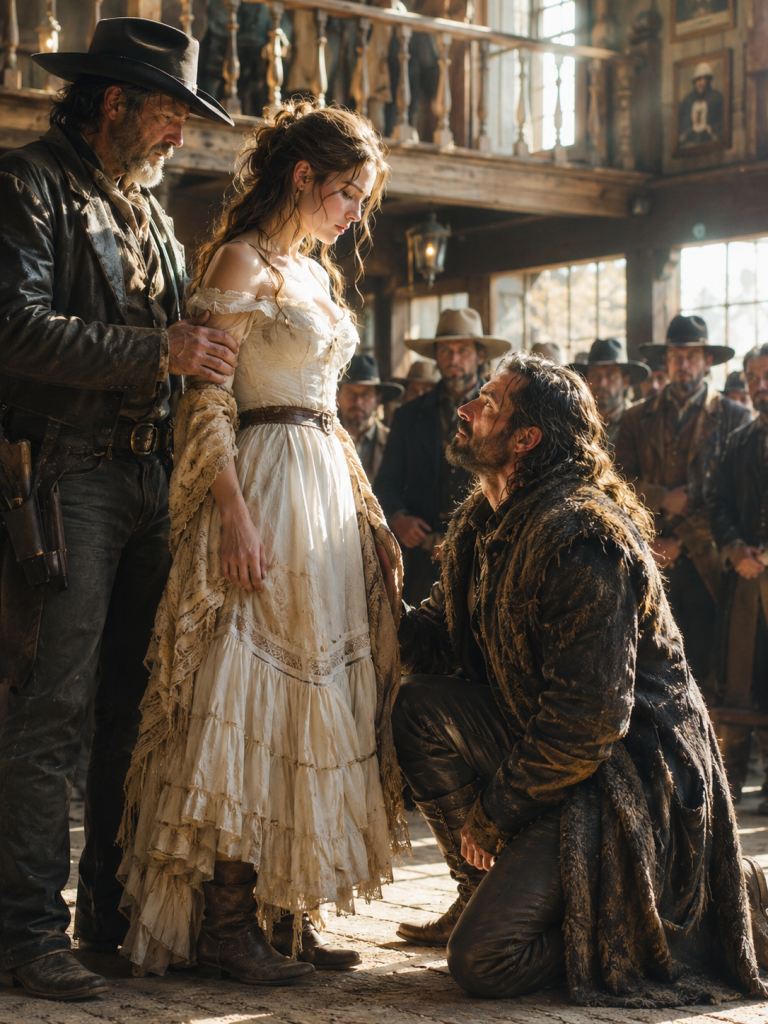
He went to his knees on the floor of the church aisle.
It was not a collapse — his body didn’t give. It was a choice, the deliberate lowering of a man who has been holding himself at maximum tension for so long that the release, when it comes, can only be managed by getting lower. He opened his arms and Sadie came into them, and he buried his face in her raven hair and held her the way you hold a thing you nearly lost, which is entirely and without reservation.
Clara was beside him before he’d heard her move.
Her arms went around his broad, shaking shoulders, and she pressed her face against his neck, and the three of them held on to each other on the cold stone floor of the Oak Haven church while the congregation of the town that had tried to discard one of them and failed to protect another and looked away from a third watched and felt, every one of them, the specific weight of what they’d allowed.
Some of them broke first. Some of the harder ones held out longer. But the mountain man weeping openly into a small girl’s tangled hair while the nurse who’d ridden up a frozen ridge to check on a stranger’s child held them both — that sight did something that no speech and no evidence and no confrontation could have done, which was remind the assembled respectable citizens of Oak Haven that the thing they had been performing — piety, community, the civilized order of a proper frontier town — was not the same as the thing currently happening on the floor in front of them.
Love, actual love, the kind that rides into blizzards and goes back to bury the dead and throws itself in front of armed deputies and carries a sick child four miles through a whiteout, looked like this.
It looked nothing like what they’d been doing.
—
Arthur Pendleton’s Pinkerton operatives arrived from Denver six days later, when the pass was finally clear.
They were thorough, professional men who took detailed depositions and collected evidence with the bureaucratic efficiency of a machine that has done this many times. Sheriff Boon, comprehensively cooperative after three days tied to a pine tree at high altitude, provided testimony that made Sterling’s case both simple and airtight. The birchbark drawing. The pocket watch. The charred wolf’s head cane. The financial records — Sterling’s meticulous land acquisition documents, which his lawyers had assembled with the confidence of a man who believed the legal architecture of his crimes would never be examined.
Archibald Sterling went to trial in Colorado Springs in February.
He maintained his composure through the proceedings with the discipline of a man who has cultivated a public self for decades and cannot stop performing it even when the audience has turned entirely against him. He was convicted on charges of first-degree murder and conspiracy and sentenced to hang, which he did in March, on a cold clear morning that the newspapers described as the frontier’s belated correction of a long-standing error.
Reverend Hail resigned his post and left Oak Haven before the trial. He was replaced by a younger man from St. Louis who delivered his first sermon on the subject of moral courage, by which he meant specifically the courage to speak when it is inconvenient, and the congregation of Oak Haven, chastened and newly attentive to the distinction between these things, listened with an attention they had not previously paid.
—
The spring thaw came late to the Sangre de Cristo that year, but when it arrived it transformed the mountains quickly, the snowfields receding up the slopes over the course of three weeks to reveal the dark earth and the matted brown grass and, gradually, the green that had been waiting beneath all of it since November.
Samuel came down from the mountain in April.
Not for flour and coffee and salt — for something else, which was the specific and purposeful descent of a man who has decided, after a decade, that isolation was never actually what he needed, only what was available to him when he couldn’t bear anything better.
He filed a deed with the county clerk’s office in Pueblo for forty acres in the valley floor below the timberline — good land, south-facing, with water access from the creek that ran off the eastern drainage of the limestone ridge. Abigail Montgomery’s water rights had passed, in the absence of any other heir, to Sadie, and Clara had ensured this was properly registered before the ink on Pendleton’s case report was dry.
The cabin took most of the summer to build.
Samuel built the way he did everything: with attention to what would last. Clara had opinions about the kitchen that turned out to be correct in ways he hadn’t anticipated, and Sadie had opinions about the porch that he implemented immediately and without negotiation, because she was six years old and had earned the right to opinions about the porch. The three of them worked through the long mountain summer days with the focused, accumulated energy of people who have been given something they’d stopped expecting and are taking it seriously.
The day Clara and Samuel were married was the first day of September.
The reverend from St. Louis came down from Oak Haven, which was a two-hour ride, because Clara had asked him to and because a wedding on the valley floor at the base of the Sangre de Cristo Mountains in early September, with the aspens going gold on the slopes and the creek running clear past the new stone foundation, was the kind of thing a man rode two hours for.
Sadie stood beside Clara throughout the ceremony in a white dress Clara had sewn over three evenings by firelight, and she held Clara’s hand with her left hand and Samuel’s with her right, and when the reverend reached the portion of the ceremony that required a response from the assembled witnesses — *do you support this union, and all that it requires?* — Sadie looked up at Samuel with her gray eyes wide and solemn and clear.
And spoke.
Not a sentence. Not even a complete word. Two sounds that she’d been carrying inside the silence for almost a year, that had been waiting for the exact right moment to become real again.
*Papa,* she said. *Yes.*
The sound was barely a whisper. It was barely above the level of the creek and the breeze in the aspens and the distant shift of the mountain finding its autumn configuration.
Samuel went still.
Clara’s hand tightened around Sadie’s.
The reverend from St. Louis, who was a professional and had conducted many ceremonies under various difficult conditions, found that he required a moment.
Samuel knelt.
He looked at the small girl who had not said a single word since the night her mother burned, and who had chosen her first word carefully — had saved it, perhaps, for when she was certain it was true.
He folded her into his arms.
He didn’t say anything. There were no words with sufficient structural integrity for what he was feeling, and he had never wasted words on things that didn’t need them. He just held her, there in the autumn morning with the mountain behind them and the valley spreading out below and the woman who would be his wife standing with her hand on his shoulder and her face tipped up toward a sky that had gone, impossibly, blue.
After a long moment he stood.
He looked at the reverend.
He looked at Clara.
*Continue,* he said.
—
That winter, Sadie began to talk.
Not all at once — in the careful, tentative way of someone testing whether language is still safe, whether the words will behave, whether the world will receive them without damage. Single words first. Sentences by December. By February, long detailed observations about the behavior of the snowshoe hares, which she tracked with a focused, scientific intensity that made Clara laugh and Samuel look at her with the quietly dazzled expression he wore whenever she did something that caught him unprepared.
He had returned to trapping, as the ranch’s finances were built in part on his pelts and the rest on Clara’s medicine — she had established a proper practice in the valley, riding out to neighboring homesteads and the handful of ranches in the wider area, which meant she was gone sometimes for two and three days at a time. When she came home, the fire was built up and there was something on the stove, and Sadie was at the table with her schoolbooks, and Samuel was in the chair by the window with the particular stillness of a man who is content and knows it.
*You’re watching for me,* Clara told him once, hanging up her coat in the doorway, catching him doing it.
*I’m watching for weather,* he said, which was also true.
She crossed the room and kissed him. He caught her around the waist with one arm and held her there in the firelight, and Sadie at the table made a face and said, *I’m trying to do arithmetic,* which was both the complaint of an eight-year-old and evidence of a life so ordinary and so complete that none of them quite had words for it yet.
They were working on the words.
They had time.
—
In the spring of the following year, Clara expanded her practice to include Oak Haven proper, and on one of her visits she stopped at the lot beside the church where the wrought iron fence still stood around the space that Sadie had once pressed herself against in the freezing sleet.
Someone had planted a small garden there over the winter.
Bulbs, mostly — crocus and early snowdrops, the first things out of the ground in March, pushing up through the frost in the space where a child had once curled like an animal that had stopped expecting rescue.
Clara stood there for a while.
Then she rode home up the ridge, through the aspens and the pines, to the cabin in the sunlit valley where the smoke was already rising from the chimney and someone was on the porch — too small to be Samuel, which meant Sadie — sitting with her feet hanging off the edge and her face turned up toward the late afternoon light.
Clara tied her horse and walked across the yard.
She sat down beside Sadie on the porch, and the girl leaned automatically into her side, and they sat together in the last of the day’s warmth and looked out at the valley and the mountains beyond it, the peaks still holding snow on their upper shoulders in the particular way they did through April, white and permanent and indifferent and, somehow, from this angle, entirely benevolent.
*Clara,* Sadie said.
*Mm?*
*Do you think she can see it?*
Clara looked at her. At the small serious profile, the gray eyes trained on the middle distance.
*I think,* Clara said carefully, *that she knew it would be like this.*
Sadie considered this.
*Good,* she said.
The door opened behind them, and Samuel came out with two tin cups of coffee and the large rough-knit blanket he’d taken from the upstairs chest weeks ago and never taken back, because it seemed to have settled permanently on the porch. He draped it over them both without comment, the way he did the things that mattered, without announcement or ceremony, and then he sat on the step below them with his coffee and looked out at the same valley and the same mountains.
The sun finished going down.
The first stars came out over the Sangre de Cristo, specific and bright in the cold dry air, the way they only are at altitude.
None of them said anything for a long time.
There was nothing that needed saying.
—
*THE END*