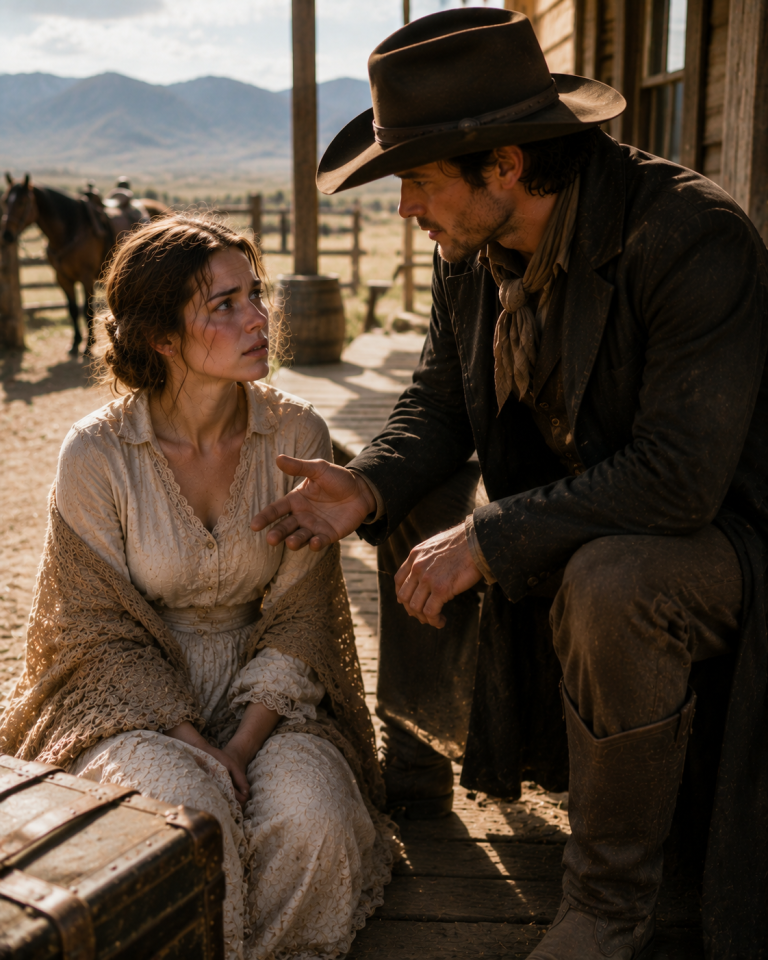
HE PAID $50 IN GOLD DUST FOR THE BRIDE THEY CALLED A MONSTER — THEN HE PULLED THE SACK AWAY AND COULDN’T BREATHE

PART 1
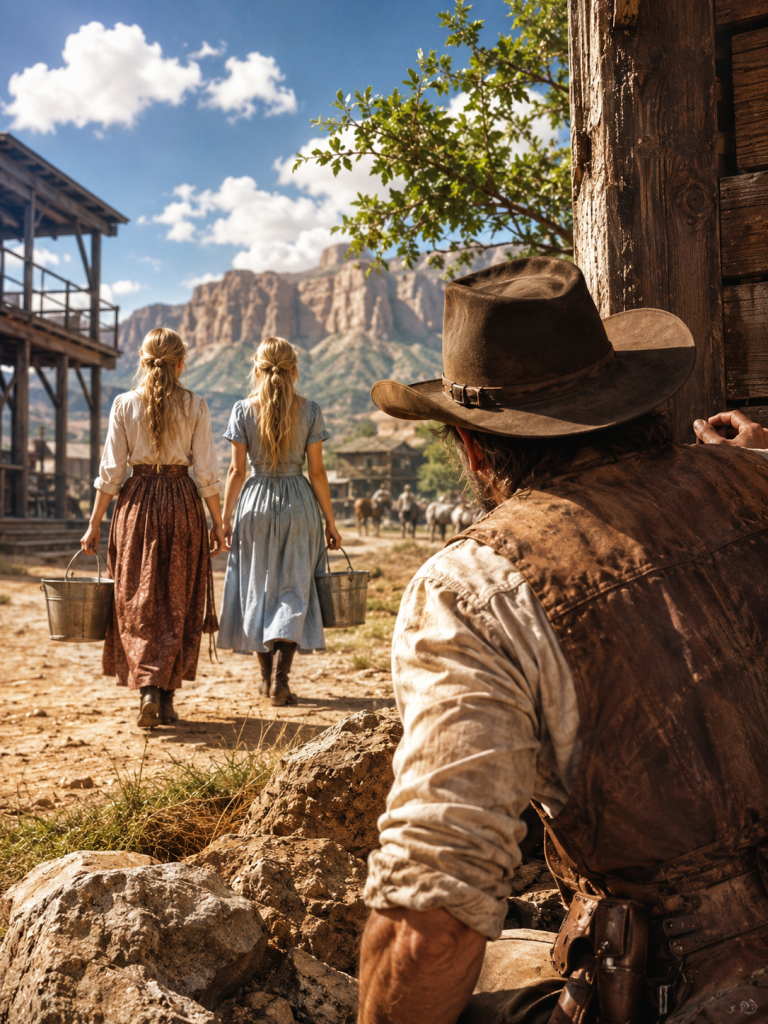
The wind came down off the Bitterroots like it had a grudge against the whole town of Orofino, Idaho Territory, cutting through wet wool and woodsmoke and the sour reek of cheap whiskey that never quite left the muddy streets in November of 1884.
Cyrus Creed hated this town. He always had.
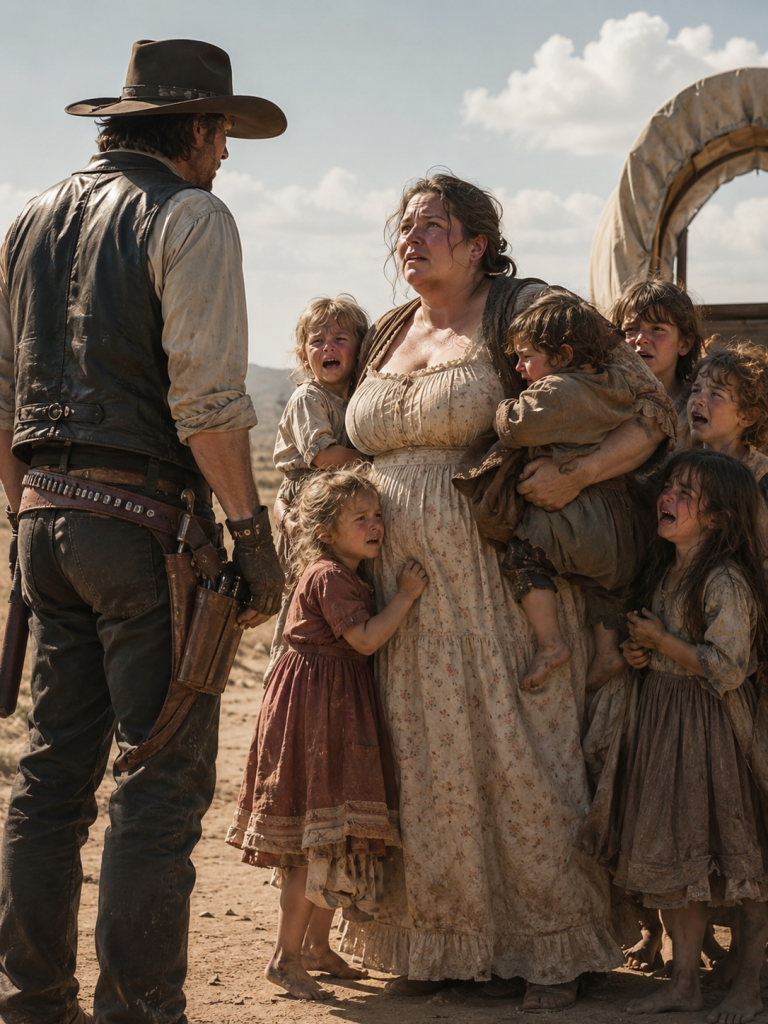
He was a mountain man, six-foot-three of buffalo hide and old scar tissue, a man who came down out of the high country twice a year only because a man needs salt and gunpowder even if he doesn’t need people. A jagged line ran down his jaw where a cougar had tried to take his face off five winters back. He’d won that argument. Most people who looked at him assumed he’d lost a few others.
He was loading his mule, Goliath, and minding nobody’s business but his own, when the crowd in the town square told him otherwise.
Thaddeus Cooper was standing on the back of a freight wagon, waving a piece of parchment like a preacher waving scripture, except what he was selling wasn’t salvation.
“Gentlemen, I won’t lie to you,” Cooper hollered, grinning around a mustache stained yellow with tobacco. “This here’s a ruined lot, brought all the way from St. Louis to marry Mr. Jeremiah Higgins, the copper baron himself. But when Higgins lifted her veil, he like to lost his lunch. Contract’s dissolved. The girl’s disfigured. A monster, gentlemen.”
Laughter went up around the wagon, ugly and loud.
Cyrus’s eyes moved past Cooper.
A woman stood beside him in a mud-spattered gray dress, arms wrapped around herself, shoulders drawn in like she was trying to disappear inside her own body. A burlap feed sack was tied over her head. Someone had slashed two rough holes for eyes. You couldn’t see a thing through the weave.
A drunk miner in the front row hurled a clump of frozen mud. It caught her in the shoulder. She flinched, made a small broken sound, and didn’t fight back. She only made herself smaller.
“I need to recoup her stagecoach fare,” Cooper said, wiping spit off his lip. “Twenty dollars. Put her to work scrubbing floors, slopping hogs. Keep the sack on and she’ll earn her keep. Do I hear twenty?”
“Wouldn’t pay two bits for a monster,” someone shouted.
Cyrus felt something old and cold twist in his chest.
He knew what it was to be looked at and judged before a word was spoken. He remembered the way people used to flinch from his own scarred face, back before he’d stopped caring what people thought. But this wasn’t a scar being mocked. This was a person being auctioned like livestock, and fifty men were laughing about it.
“Ten dollars,” Cooper said, some of the swagger leaking out of his voice now. “Someone give me ten or I’ll leave her out here to freeze, I swear it.”
The woman started to cry. Quiet. Muffled by the burlap. But it cut through the wind and landed somewhere under Cyrus’s ribs, and he didn’t decide to move so much as find himself already moving.
The crowd parted for him. Boots crunching frozen mud. He reached into his coat, pulled out a heavy pouch of river gold, and threw it. It struck Cooper in the chest with a thud that silenced the whole square.
“There’s fifty in there,” Cyrus said, voice like stones grinding together. “Write the bill of sale.”
Cooper weighed the pouch in his palm, greed splitting his face wide open. “Sold. To the mountain man.” He scratched something on the parchment and handed it down. “Her name’s Josephine. Fair warning, Creed — don’t take that hood off till you’ve got a strong stomach and a bottle of whiskey handy.”
Cyrus didn’t answer him.
He stepped up to the wagon and held out one enormous gloved hand.
Josephine looked down through the two crude eyeholes at the hand, then up at the size of the man attached to it. She had been handed off by a cruel father to a vicious fiancé, and now she belonged, on paper, to a stranger built like the mountains behind him. Her fingers were shaking so badly it took her three tries to find his palm.
“Come on,” Cyrus said, and something in his voice didn’t match the rest of him at all. “Let’s get you out of the wind.”
The ride up into the Bitterroots took five hours through deepening snow, Cyrus walking ahead leading the horse, Josephine wrapped in spare wool blankets, silent the entire way. Every time he glanced back to check on her, her head dropped, the burlap swaying.
“You don’t have to wear that thing out here,” he called back once, over the wind. “Ain’t nobody up this mountain but me and the elk.”
She shook her head violently, both hands flying up to grip the twine at her throat.
She was terrified of what would happen when he finally saw her.
*Abomination*, Higgins had screamed at her. *A freak of nature no man could look at without being sick.* If this giant of a man saw what was under the sack, he might leave her on the mountain to die the way Cooper had threatened.
Cyrus didn’t press it. He figured she’d take it off when she was ready, or when she got hungry enough to realize a person can’t eat stew through burlap.
By nightfall they reached his cabin — heavy pine logs, a stone fireplace, furs on the floor, everything spartan but scrubbed clean. He got the fire roaring, set venison stew over the flames, and poured her a tin cup of coffee she wrapped both hands around like it was the only warm thing left in the world.
He sat across from her at the small wooden table, pulled off his gloves, and studied her for a long moment.
“Listen to me, Josephine,” he said, low and steady. “My name’s Cyrus Creed. I live up here because I don’t much care for the company of people down there. They’re cruel, and they’re quick to judge.” He leaned forward. “I didn’t buy you to be my slave. I bought you because no living creature deserves to be treated like a dog in a fighting ring. You’re safe here. Nobody’s ever going to hurt you again.”
Josephine sat frozen. The warmth, the smell of food, the low protective rumble of this stranger’s voice — it was more than she’d braced herself for. She’d expected to be thrown in a corner. She’d expected worse than that.
“The stew’s almost ready,” Cyrus went on gently, “but you can’t eat it through a feed sack. Whatever’s under there — it won’t scare me. I’ve watched a grizzly tear a man apart. I’ve looked at my own face in the mirror for five years. Nothing you show me is going to make me throw you out.”
Her hands crept up to the knot at the back of her neck. They shook too hard to work the twine.
Cyrus stood, came around the table slow, no sudden movements.
“May I?” he asked.
She hesitated. Then gave the smallest nod.
His hands were enormous, calloused from a decade of ropes and rifles and hard winters — and they were feather-light as he found the knot and began to work it loose. Josephine squeezed her eyes shut inside the hood, bracing for the gasp of disgust. The demand for his money back.
The twine gave way.
Cyrus lifted the burlap up and off.
For one long second, the only sound in the cabin was the fire.
Then Cyrus made a sound like the air had been knocked clean out of him, and stumbled back half a step, the sack slipping from his fingers to the floorboards.
Josephine’s face crumpled. She buried it in her hands.
“I know,” she sobbed, the words raw and broken. “I know it’s hideous. I’m sorry. I’m so sorry.”
—
PART 2
“Hideous?”
Cyrus’s voice had lost every trace of the gruffness it carried a moment before. It came out cracked, almost a whisper.
“Josephine. Look at me.”
She lowered her hands slowly, opening her eyes, bracing for revulsion.
What she found instead was awe. Plain, unguarded, unmistakable awe.
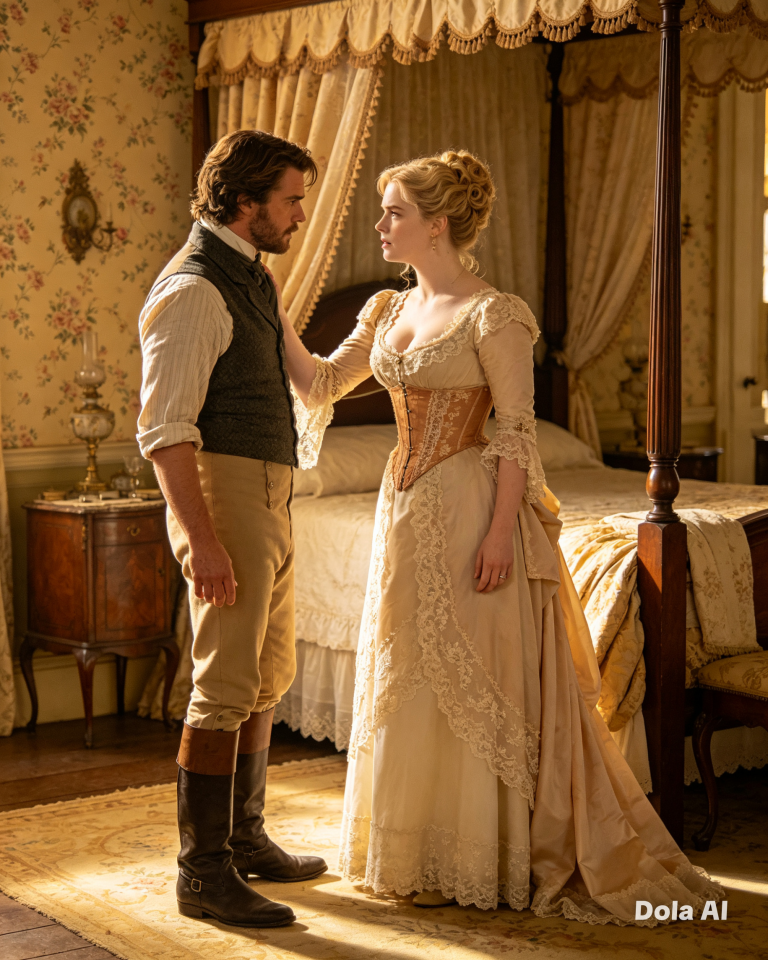
Because Josephine Caldwell was not a monster. She was, without one shred of doubt, the most beautiful woman Cyrus Creed had ever laid eyes on — porcelain skin flushed pink from the fire, high cheekbones, a cascade of dark mahogany hair tumbling loose down her back, eyes the color of a storm rolling in over open water.
But as Cyrus dropped to one knee beside her chair, he saw the rest of it. The reason for the sack. The reason Jeremiah Higgins had thrown her away like garbage.
It wasn’t a deformity.
It was a brand.
High on her left cheekbone, stark and raw against her skin, sat the letter **H**, seared in a crude circle. A cattle brand. Fresh enough that the edges still looked angry.
The blood went loud in Cyrus’s ears.
“Higgins did this to you,” he said. It wasn’t a question. It came out flat and lethal.
Josephine flinched, tears spilling and stinging where they crossed the burn.
“Yes,” she managed. “My father owed him thousands. He sold me to clear the debt. When I got to St. Louis, Higgins said since he’d paid for me, he owned me — entirely. Before the wedding, even.” Her breath shook. “I fought him. I hit him with a fire iron. He overpowered me. He took the branding iron from the hearth and told me if I was going to act like a wild mare, he’d mark me like one.”
She looked away from him, toward the fire.
“Then he laughed. Told me no man would ever look at my ruined face with anything but disgust. He paid Cooper to sell me off like a sideshow, just to finish humiliating me.”
Cyrus reached out. He didn’t touch the burn. His palm cupped her jaw on the unmarked side, his thumb brushing a tear away.
“Higgins is a dead man,” he said quietly. It wasn’t a threat. It was a vow, spoken the way a man speaks a fact.
“But he was wrong about one thing, Josephine.” His eyes held hers, and there was no pity in them anywhere — only something fierce and unshakable. “You’re not ruined. You’re the most beautiful thing I’ve ever seen. That mark doesn’t mean you belong to him.” His voice dropped lower. “It means you survived him.”
For the first time in months — sitting in a rough-hewn cabin miles from anywhere, across the table from a scarred stranger twice her size — Josephine felt something she’d thought Higgins had burned out of her for good.
She felt safe.
For four months, the Bitterroots sealed shut around them, and something quiet and unlikely grew in that isolation — Cyrus grinding willow bark and pine sap into salves for her cheek, teaching her to set snares, to read tracks, to hold a Winchester steady against her shoulder until the recoil stopped scaring her. By spring, the brand had healed into a faint silver scar she no longer hid behind her hair, and something that felt dangerously close to love had settled into the cabin like it had always belonged there.
But four hundred miles east, in a St. Louis saloon thick with cigar smoke, a drunk auctioneer named Thaddeus Cooper was bragging to anyone who’d listen about the giant mountain man who’d paid fifty dollars in gold for Jeremiah Higgins’s “ruined leftover.”
The story reached Higgins within the hour.
And Jeremiah Higgins did not forgive the woman who had struck him with a fire iron and lived to be loved by another man.
He was already hiring guns.
—
PART 3
Jeremiah Higgins had told himself, for six months, that Josephine Caldwell was dead. It was easier that way. A man of his standing — copper mines from Butte to the Coeur d’Alenes, a seat reserved at every table that mattered in St. Louis — did not spend his nights thinking about a branded, discarded bride who’d frozen to death somewhere in a nameless mountain range. He had convinced himself of it the way rich men convince themselves of anything: by simply deciding it was so and refusing to hear otherwise.
Thaddeus Cooper’s drunken bragging in a smoke-thick saloon ended that fiction in the space of one sentence.
*”Sold that ruined mess to some giant of a trapper up in Idaho Territory. Fifty dollars in gold dust, if you can believe it. Man didn’t even blink.”*
Higgins set down his brandy so hard the glass cracked.
She was alive.
She was alive, and worse — she was *wanted*. Some rugged nobody had looked past the mark Higgins himself had burned into her face and decided she was worth fifty dollars and, evidently, a good deal more than that. The thought arrived in Higgins’s chest like a physical wound. It wasn’t grief. It wasn’t even truly desire. It was the particular, ugly rage of a man who has been told — by the world, by his mirror, by the silence of a woman he broke — that something he considered his property had escaped, and worse, had been *chosen* by someone else.
He had marked her. He had put his initial on her skin the way a rancher marks a calf. In his mind, that had settled the matter permanently. Whatever became of her afterward — beggar, corpse, laundress — she remained, in some twisted ledger only he kept, *his*.
Within a week, Higgins had emptied a portion of his fortune into six men with cold eyes and repeating rifles, led by a former Pinkerton named Gideon Holt who’d been drummed out of the agency for reasons nobody asked about twice. Higgins outfitted the posse with the finest horses money could buy and rode with them himself. He wanted to watch.
“We burn the cabin,” Higgins told Holt, polishing a silver-plated revolver in the parlor of Orofino’s only hotel, his three-piece suit absurd against the mud-caked frontier town outside the window. “Kill the mountain man. The girl stays alive. I have a cage waiting for her in Missouri.”
He said it the way another man might discuss shipping arrangements.
—
High above the town, unaware that the past had finally climbed the mountain after them, Cyrus Creed woke before dawn to a prickling at the back of his neck that had kept him alive through a decade of hard winters. He slid out of bed without waking Josephine, curled beneath the wolf-skin blankets, and stepped out onto the porch into gray pre-dawn mist.
Goliath was pacing the corral, ears pinned flat.
The birds had gone silent.
Every instinct Cyrus had ever trusted told him the same thing at once: *men were coming.*
He moved fast — back inside, bolting the door, shoving the heavy table against it. The noise woke Josephine, who sat up clutching the blankets to her chest.
“Cyrus. What is it?”
“Trouble.” He tossed her the Winchester and a box of shells, already strapping on his revolvers. “Stay away from the windows. Root cellar, now.”
“No.”
She was already pulling on her boots.
“If it’s animals, we shoot them.” She racked the lever of the rifle, and there was nothing shaking in her hands anymore. “If it’s men—” her fingers grazed the faint silver scar on her cheek, “—I won’t be taken again.”
A gunshot answered before Cyrus could argue. Glass exploded across the floor.
“CREED!” a voice bellowed from the tree line — Gideon Holt. “We’ve got you surrounded. Send out the stolen property and we’ll make it quick. Fight us, we’ll roast you alive in that pine box.”
Through a crack in the shutters, Cyrus counted six men fanning out among the ponderosas — and behind a boulder, absurd in a tailored suit and bowler hat, exactly as Josephine had described him a hundred times in the dark: Jeremiah Higgins.
“Higgins,” Cyrus said, and the word came out like something being loaded into a chamber.
“I’ll draw their fire,” he told Josephine, voice dropping to a flat, deadly calm. “When they reload, take the man by the woodpile. Can you make the shot?”
She looked at him — the man who’d paid fifty dollars for her life and never once asked for anything in return. “I won’t miss.”
Cyrus kicked the door open a foot, enough to level his shotgun, and fired. Bark exploded off a pine trunk; one of Higgins’s men screamed and dropped his rifle, clutching a shoulder full of buckshot.
The clearing answered with a wall of gunfire. Bullets chewed into the log walls, splinters flying like shrapnel. Cyrus dropped low, rolled to the window. In the half-second lull while the mercenaries worked their levers, Josephine rose, braced the Winchester on the sill, sighted the man by the woodpile, and squeezed the trigger the way he’d taught her — like holding a fragile egg.
The rifle cracked. The man fell backward into the mud and didn’t get up.
“She’s armed!” Holt shouted, panic edging into his voice. “Burn it! Throw the lanterns!”
A man broke from cover with a lit kerosene lantern. Cyrus drew and fired twice without hesitation. The lantern shattered against frozen ground, flame guttering out uselessly in the mud.
“Cowards!” Higgins shrieked from behind his boulder, every trace of polish gone from his voice. “Shoot them! I’m paying you to kill, not hide!”
Cyrus slipped out the back while Josephine held the front window, moving through the underbrush the way he’d moved through these woods for ten winters — silent, invisible, lethal. He flanked two of the mercenaries and put them down before either man knew he was there.
Watching his men fall one after another to a single trapper and a woman with a rifle, Gideon Holt broke. He abandoned cover and ran for his horse. Cyrus stepped out of the tree line, shotgun leveled. Holt froze, dropped his weapon, and fled on foot into the woods instead, choosing the wilderness over the barrel pointed at his chest.
A shot cracked from behind Cyrus.
Pain tore through his left shoulder, white and total. He went down on one knee in the bloodstained snow, turning to find Jeremiah Higgins ten yards off, silver revolver shaking in both hands, sweat ruining his collar.
“You filthy savage,” Higgins spat. “She’s mine. I paid for her. I *marked* her.” He cocked the hammer.
Cyrus’s hand moved toward his dropped revolver. He wasn’t going to make it.
*Crack.*
Higgins screamed. The revolver flew from his hand in a spray of twisted metal, and he collapsed to his knees clutching a shattered wrist.
Cyrus looked back toward the cabin.
Josephine stood on the porch, Winchester still pressed to her shoulder, smoke curling from the barrel. Her eyes were cold and steady, and there was nothing left in them of the woman who used to flinch from thrown mud in a town square.
She came down the steps without hurrying, stepping past the wounded and the dead, and stopped a few feet from Higgins with the rifle trained on his chest.
He looked up at her, agony and disbelief fighting for space on his face. “Josephine — you’re — ” He scrambled backward through the mud on his knees. “You’re a monster.”
“No,” she said, and her voice carried clean across the sudden quiet of the valley. “I am a survivor.”
She lowered the rifle.
Cyrus pushed himself up, one hand pressed to his bleeding shoulder, and came to stand beside her, towering over the whimpering man in the mud like something out of the mountain itself.
“Get up, Higgins.”
Higgins scrambled upright, cradling his ruined hand, certain he was about to be executed where he knelt.
“Run,” Cyrus said instead, and pointed toward the snow-choked pass. “You’ve got no horse, no gun, and the wolves are waking up hungry. If you make it down, you tell them Josephine Caldwell is dead. Tell them the mountain took her.” His voice dropped. “Because if I ever see your face in my territory again, I won’t waste a bullet on you. I’ll use my knife.”
Higgins didn’t wait to be told twice. Whimpering, slipping in the mud, he turned and ran blind into the wilderness.
He survived the descent — barely. Frostbite claimed three of his toes before he reached the valley floor, and the terror of that mountain followed him into every dream he had for the rest of his life. He never spoke Josephine’s name again. His copper empire eventually swallowed the scandal, the way money always does, but the man who came down off that mountain was never quite the one who’d gone up it.
—
Cyrus turned to Josephine, blood soaking through his sleeve, and found he was smiling anyway.
“Are you all right?” he asked, low.
She dropped the rifle and threw both arms around him, careful of the wound, her face pressed into his coat.
“I’ve never been better, Cyrus Creed,” she whispered, and rose onto her toes to press her lips against his while the sun finally broke through the morning mist and spilled gold light across a valley still smoking faintly at its edges.
The blood would wash away with the spring rains. The broken window would be repaired before the week was out. And the man who had once bought a “ruined” bride in a feed sack out of nothing more than a stranger’s fury at cruelty discovered, in the years that followed, that he hadn’t rescued anyone at all.
He had found the other half of his own scarred, stubborn, unbreakable life.
Their cabin stood in that valley for another forty years. People in town told the story different ways over the decades — some said Cyrus Creed had shot six men single-handed to defend his wife, others swore it was Josephine who’d done most of the shooting, and a few of the old-timers, the ones who’d actually known them, always said the same thing when asked which version was true.
*”Don’t matter which one of them fired the shot that mattered. Matter is neither one of them ever needed saving again after that morning. They’d already saved each other, months before, in a cabin with the door shut against the whole rest of the world.”*
The brand on Josephine’s cheek never fully vanished. She wore it the way some people wear a wedding band — not hidden, not explained, simply hers. And on quiet evenings, long after the gunsmoke and the fear had settled into nothing but a story told by a fire, Cyrus would sometimes reach across the table and rest his thumb against that faint silver scar, the same place his hand had first touched her the night he pulled the sack away.
Not with pity.
Never with pity.
Only with the same fierce, unwavering something he’d felt the first moment he saw her face and understood, in an instant, that the whole town had been wrong about her — that she wasn’t ruined at all, that she never had been, and that some people don’t need saving so much as they need one person willing to see past the sack, past the scar, past everything the world tried to convince them made them unlovable.
The mountain kept their secret the way it kept everything — quietly, permanently, without judgment.
And every winter after that, when the snow sealed the valley shut again, it sealed in two people who had stopped being outcasts the moment they found each other.
**THE END**