SHE TRAVELED 2,000 MILES TO MARRY A STRANGER — HE TOOK ONE LOOK AT HER AND CALLED HER A FRAUD IN FRONT OF THE WHOLE TOWN, THEN A MOUNTAIN MAN STEPPED OUT OF THE PINESc

Part 1
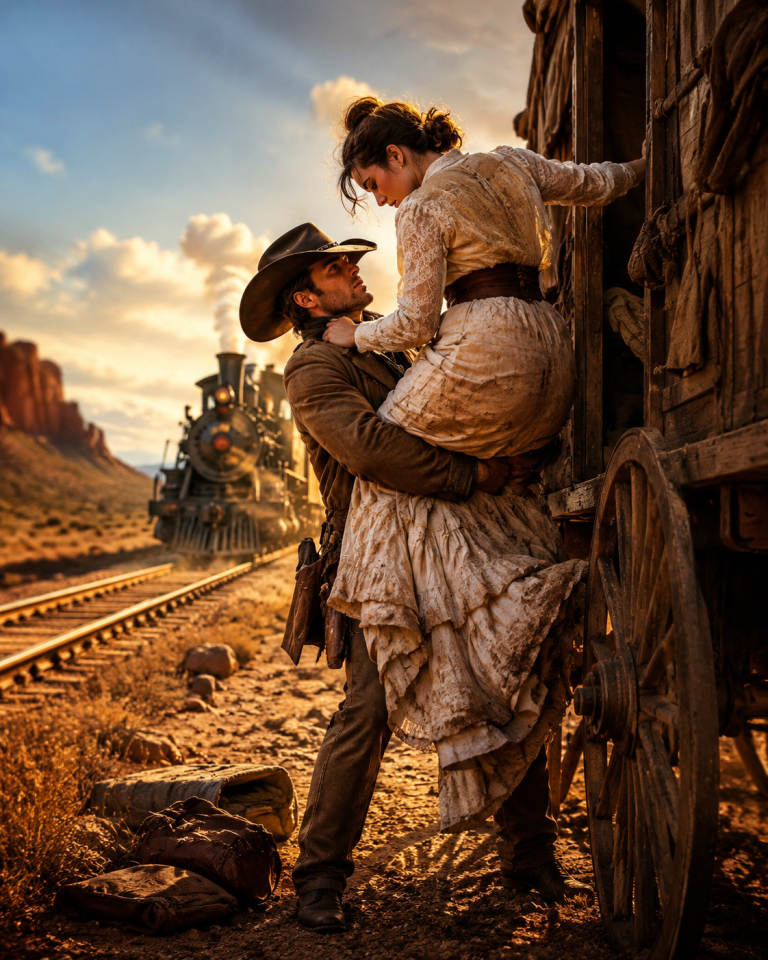
The steam engine let out a final, exhausted shriek as it ground to a halt against the sun-baked planks of the Oak Haven, Colorado railway station. It was August of 1883, and the air was thick with coal smoke, dry pine, and the heavy dust of the frontier.
Inside the stifling carriage, twenty-six-year-old Clara Whitmore wiped a bead of sweat from her brow, her heart hammering like a trapped sparrow. Clara was not what the dime novels or the fashion plates of Boston deemed a beauty — where the fashionable women of the era were willow-thin, corseted into fragile, breathless shapes, Clara was built with a sturdy, undeniable softness. Broad shoulders. A full waist. Heavy hips. For years she’d endured the thinly veiled pity of her aunts, the outright mockery of suitors, the whispered cruelty of a society that only valued women for their ornamental frailty.
Desperation and a deep, aching loneliness had driven her to the matrimonial advertisements in the back of a western gazette, where she’d found Mr. Hyram Jenkins. His letters had been full of poetic promises — a prosperous mercantile owner seeking a companion, a woman of substance to build a frontier life with. In a rare moment of vulnerability, Clara had sent him a photograph, carefully angled to soften the true breadth of her figure. He’d sent the train ticket back. She’d packed her whole life into two leather trunks and boarded, ready to become a bride.
Stepping down onto the platform, she smoothed the skirts of her travel-stained blue dress, adjusted her bonnet, and scanned the crowd. Through the miners and ranchers and women in pragmatic calico, a man in an impeccably tailored suit — entirely out of place in the frontier dust — stepped forward, holding a piece of parchment Clara recognized as her own last letter to him.
She offered a tentative, hopeful smile. “Mr. Jenkins?”
Hyram Jenkins stopped dead. His eyes flicked from the tintype photograph in his hand to the woman standing in front of him, and the charming smile he’d been wearing dissolved into something closer to disgust.
“You?” His voice was loud enough to turn heads across the platform. “You are Clara Whitmore.”
“I am.” The hopeful smile faltered on her lips. She suddenly felt too large, too visible under the harsh midday sun.
Hyram let out a barking laugh with no humor in it at all. “Good God in heaven. The photograph was a downright fraud. I ordered a wife, madam, not a prize-winning heifer.”
The words hit Clara like a physical blow. The color drained from her face, her chest tightening so hard she forgot how to breathe. The ambient chatter of the platform died into a heavy, voyeuristic silence as the townsfolk stopped to watch.
“Mr. Jenkins, please.” Her voice cracked. “We had an agreement. We have a legal contract.”
“A contract built on deceit!” Hyram spun toward the gathering crowd, playing to them — a man of some standing in Oak Haven, wielding it like a weapon. “Look at her. I paid fifty dollars for a train ticket expecting a respectable, decent-looking bride. Instead Boston sends me a mountain of a woman who looks like she ate the bride before boarding the train.”
A ripple of snickers moved through the onlookers. A woman in a vivid green dress — Leticia Brooks, the town’s most vicious gossip, and though Clara didn’t know it yet, Hyram’s frequent companion — stepped forward, fanning herself lazily.
“Oh, Hyram,” Leticia cooed, sweeping her eyes over Clara with malicious delight. “You’d have to reinforce the floorboards of the mercantile just to let her inside. She’s twice the size of my draft horse.”
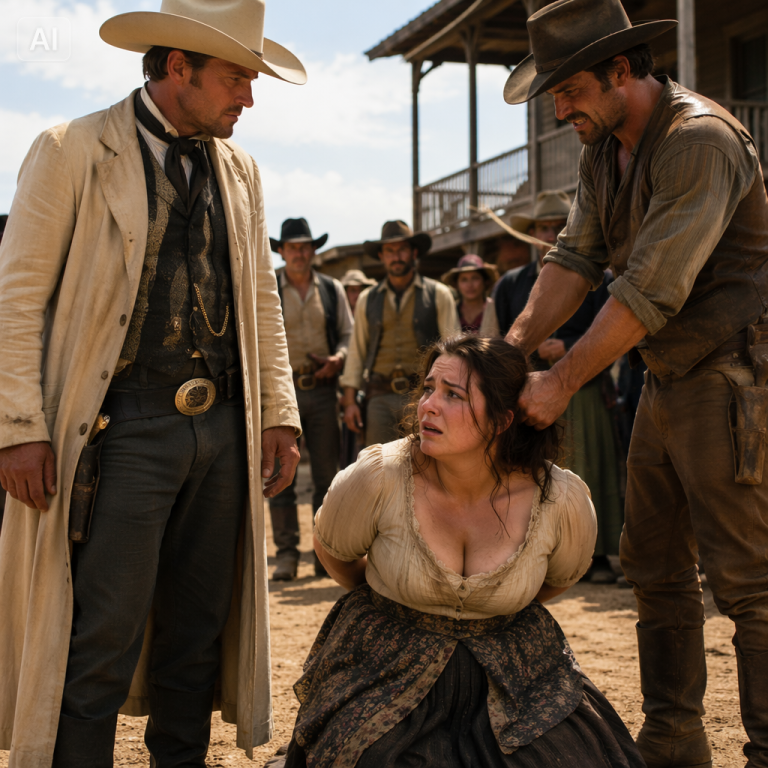
Laughter erupted, loud and cruel. Clara stood frozen, her face burning with a humiliation so complete it made her physically ill. She scanned the faces around her — ranch hands, respectable wives, merchants — and found nothing but amusement. She’d traveled two thousand miles to be the punchline of a cruel frontier town.
Hyram reached into his breast pocket, pulled out the marriage contract bearing both their signatures, and tore it in half, letting the white scraps flutter into the dirt at her feet.
“I won’t have you,” he sneered, close enough now that she could smell the pomade in his hair and the whiskey on his breath. “You are a fat, ugly fraud. You can take yourself to the gutter for all I care, because no man in this territory will ever touch a bloated cow like you.”
He turned on his heel and marched off with Leticia clinging to his arm, leaving Clara utterly alone on the platform. The train whistle blew again, and the locomotive chugged away, taking with it her last connection to the world she’d known.
Clara sank to her knees in the dust, trembling hands clutching her carpet bag, and the tears she’d fought so hard to hold finally spilled over.
—
The sun dipped behind the jagged peaks of the Rockies, casting long, bruised shadows over Oak Haven. The spectacle at the station had ended hours ago, the town moved on to its evening routines, and Clara still sat on one of her heavy trunks outside the locked station master’s office. She’d tried Mrs. Gable’s boarding house, the only respectable lodging in town, but Mrs. Gable — fearing the wrath of a man who held the mortgage on her property — had shut the door in Clara’s face, saying they didn’t take in discarded women.
The night air turned fiercely cold. Clara shivered in her sweat-stained dress, stomach growling, forty-two cents in her pocket the entire sum of her remaining fortune. She was stranded, terrified, and entirely broken.
Two drunken miners stumbled out of the saloon across the street, their eyes landing on her solitary figure in the dim light, and began to alter their course toward her, leering, muttering between themselves. Clara shrank back against the wooden wall of the station, heart pounding, searching desperately for a rock, a stick, anything.
Before the men could cross the muddy street, the heavy swinging doors of the livery stable burst open, and a massive silhouette filled the frame.
He looked less like a man and more like a force of nature — at least six-foot-four, shoulders broad enough to eclipse the street lamp behind him, dressed not in the wool suits of the townsfolk but in worn buckskin and a heavy wolf pelt coat. A thick dark beard covered the lower half of his face, hair brushing his collar, a hunting knife the size of a short sword at his hip beside a heavy Colt revolver.
This was Silas Lockwood — a man of the high timber, a trapper and guide who only came down from Blackwood Ridge twice a year to trade pelts for coffee, salt, and ammunition. He despised the town, its noise, its greed, its cruelty. He’d been loading his pack in the livery when he witnessed the spectacle at the station that afternoon — watched Hyram Jenkins break a woman’s spirit for the crime of not fitting into a corseted dress — and had felt a dangerous rage flare in his chest, held it in check, waiting to see what she would do.
Now, watching the two drunkards close in on her, his patience ran out entirely.
Part 2
Silas stepped into the street, his boots making no sound in the dirt, a predator’s grace carried in a massive frame. He put himself between the miners and the boardwalk before they’d covered half the distance.
“Evening, boys.” His voice was a deep, graveled baritone that seemed to vibrate in the cold night air.
The two men stopped, and whatever liquor courage they’d been running on evaporated the second they looked up at him. Silas was a known quantity in Oak Haven — men told stories about him fighting off a grizzly with nothing but a hatchet.
“We weren’t doing nothing, Lockwood,” one stammered, hands raised. “Just going for a walk.”
“Walk the other way.” Silas didn’t raise his voice. He didn’t need to. The lethal promise underneath it sent both men scurrying back toward the saloon like whipped dogs.
Clara watched, wide-eyed and trembling, as the giant of a man turned his attention to her, stepping up onto the boardwalk. Up close, he smelled of pine resin and woodsmoke and clean snow. His face was weathered, a faint silver scar crossing his left cheekbone, but his eyes — a startling, clear gray — were gentle in a way nothing else about him was.
“Ma’am.” He tipped a battered, wide-brimmed felt hat.
“Please.” Clara pulled her carpet bag tight to her chest. “I have no money. I have nothing worth taking.”
Silas’s jaw tightened — not at her, at the town that had made her afraid to say anything else. “I ain’t looking to take anything from you, Miss Whitmore. I saw what happened earlier. I saw what that peacock Jenkins did.”
Clara flinched, looking away, the shame rushing back hot and fresh. “Then you know what I am. A laughingstock.”
“I know what he is,” Silas corrected, firm. “A coward and a fool. A town that laughs at a crying woman ain’t worth the dust on your boots.” He glanced at her trunks, then back to her face. “You’re shivering. You have a place to stay?”
“The boarding house refused me.” A tear tracked through the dust on her cheek. “Mr. Jenkins told them not to take me in. I suppose I’ll have to sleep here until I can find work for a return ticket.”
“You sleep out here, you’ll freeze by midnight, or worse.” Silas said it as simple fact, then looked up toward the darkening mountains. “I’ve got a cabin up on Blackwood Ridge. Harsh ride, and it ain’t much to look at — logs, a hearth, a roof. But it’s warm, it’s safe, and the bears up there have better manners than anyone in Oak Haven.”
Clara stared at him, stunned. Every rule of propriety she’d ever been taught in Boston screamed against riding off into the wilderness with a strange, heavily armed mountain man.
But propriety had already gotten her abandoned and mocked once tonight.
Part 3
She looked into his gray eyes and found no pity there, no mockery, and — most importantly — when he looked at her figure, no disgust. He looked at her like she was a person.
“Why?” Clara’s voice shook. “Why would you help me?”
“Because out here, we don’t leave people to freeze,” Silas said simply. “And because no woman should be made to feel small just because there’s more of her to love.”
The words came out so casual, so sincere, that Clara let out a choked sob. Before she could talk herself out of it, she nodded.
“Okay. Yes. I will come with you, Mr. Lockwood.”
Without another word, Silas bent down. The trunks that had taken two railway porters to move, he lifted like they were filled with feathers, lashing them expertly to the back of a massive draft horse he called Goliath.
“Can you ride?” he asked.
“I’ve never been on a horse in my life,” Clara admitted, cheeks burning.
Silas gave a low, rumbling chuckle that somehow warmed the frigid air. “Then we’ll make it a first.” He set his hands at her waist — for one second she braced for him to struggle under her weight, and instead he lifted her effortlessly, setting her sideways in the saddle of a calm roan mare, the sheer physical strength of him staggering to witness up close.
The climb took three agonizing hours, the trail steep and narrow, lit only by a full moon. Silas walked ahead of the horses the whole way, leading them through treacherous switchbacks, an unmoving anchor in the dark. By the time they reached a clearing near the summit, Clara was exhausted, legs numb, hands frozen to the saddle horn. Through the trees, a sturdy log cabin appeared, bathed in moonlight, so fully integrated into the forest it looked like it had grown there.
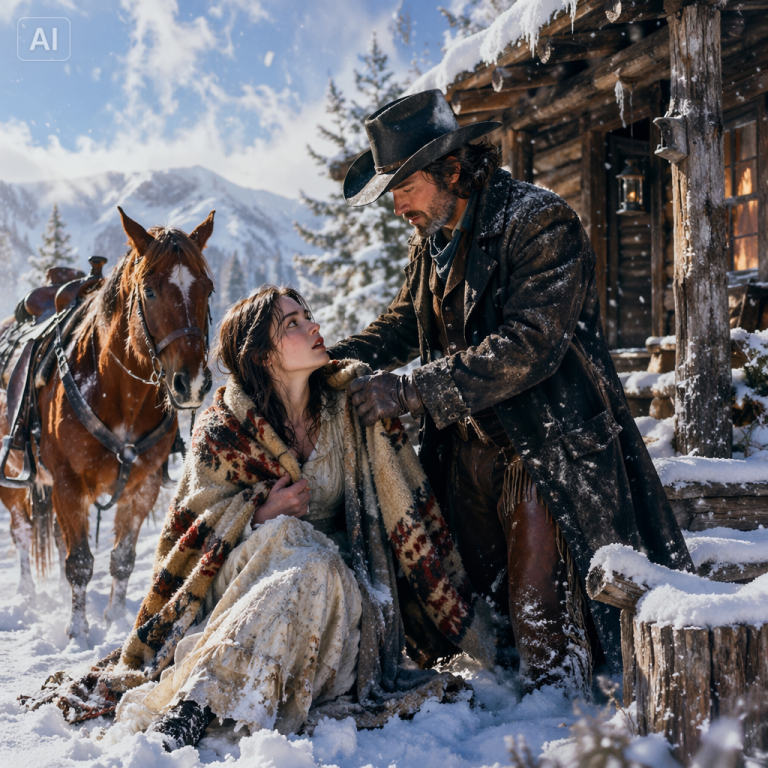
Silas helped her down, half carrying her when her legs gave out, settling her into a heavy wooden rocking chair by a stone hearth. Within minutes he had a fire roaring, driving the cold back, a wool blanket over her shoulders and a tin cup of black coffee sweetened with wild honey pressed into her hands.
Clara looked around the cabin — masculine, full of traps and drying herbs and hand-carved furniture, but immaculately clean. Silas sat on a stool across from her, feeding pine into the fire, and didn’t push her to speak. He simply let her exist in the quiet warmth.
“I am completely ruined,” Clara said finally, staring into the flames, the reality of her situation finally landing.
“You ain’t ruined,” Silas said, voice soft but absolute. “You’re just replanted. Sometimes the soil in the valley’s too sour. Takes the high ground to let roots grow.”
Clara looked at him — truly looked — and found underneath the beard and the scars and the intimidating size a profound stillness. She pulled the blanket tighter, the smell of woodsmoke comforting in a way she hadn’t expected. For the first time since boarding a train in Boston, she didn’t feel the need to suck in her stomach or hide her shape.
“Thank you, Silas.”
“Get some rest, Clara.” Her own name, in his voice, carried a quiet reverence that made her heart skip. “Tomorrow’s a new day on the mountain.”
As she closed her eyes, listening to the crackle of the fire and the steady, protective presence of the man sitting guard, Clara realized a terrifying, wonderful truth: she was safer here in the untamed wild than she had ever been in the civilized world.
—
The transition to mountain life was brutal, but transformative. Autumn gave way to the freezing grip of a Colorado winter, and Clara did not magically shrink into a waifish figure — nor did she want to. The mountain demanded strength, and her body, sturdy and resilient, was perfectly suited for survival. She learned to swing an axe until her arms built thick, capable muscle. She learned to skin rabbits, preserve venison, navigate snow-blind trails on snowshoes. Through all of it, Silas was her shadow and her teacher.
Their days filled with the grueling labor of survival; their evenings steeped in a quiet, growing intimacy. They’d sit by the fire, Silas carving wooden figures while Clara mended clothes, trading pieces of their pasts. She learned he’d retreated to the mountains after the Civil War, disgusted by the greed and cruelty he’d seen in men. In Clara, he saw the exact opposite — a heart as expansive and beautiful as the wilderness itself.
“You move like the wind through the pines, Clara,” Silas murmured one evening, his deep voice filling the small cabin. He reached out, his calloused thumb tracing the line of her jaw. “Strong. Steady. Beautiful.”
It was the first time a man had ever called her beautiful without a sneer or a hidden agenda behind it. Clara leaned into his touch, warmth cascading down her spine, and understood that whatever had started between them out of simple gratitude had turned, somewhere along the way, into something far fiercer.
There was a night in January, deep into the coldest stretch of the winter, when Clara finally asked him the question she’d been carrying since the porch in Oak Haven.
“Did you ever think, that first night, that you’d made a mistake? Taking in a stranger like that?”
Silas didn’t look up from the wood he was carving, but his hands slowed. “Thought a lot of things that first night. Mistake wasn’t one of them.”
“Everyone else thought it was. Half the territory, probably, by the time Hyram finished telling it.”
“Half the territory’s wrong about most things.” He set the carving down and looked at her properly, firelight carving deep shadows into the lines of his face. “I’ve lived alone on this mountain twelve years, Clara. Buried a wife back east before the war ever started, buried what was left of my faith in most people somewhere in a Virginia field a few years after that. I wasn’t looking to be surprised by anybody ever again.” He shook his head slowly. “Then a woman sat down on a train platform with forty-two cents and a busted heart and didn’t beg, didn’t collapse all the way down, just cried like somebody who still had enough fight left to be furious about it. I’ve trapped grizzly, Clara. Never once in my life seen anything with that much backbone left standing after being kicked that hard.”
Clara felt something in her chest crack open, gentler than grief, warmer than gratitude. “I didn’t feel like I had any fight left. Not that night.”
“Didn’t need to feel it. Just needed to have it.” Silas reached across the space between their chairs and covered her hand with his, calloused and enormous and careful the way it always was with her. “Same as now. You’ve got it, whether you feel it tonight or not. Man doesn’t get twelve years of solitude wrong about people too often, and I wasn’t wrong about you.”
Outside, the wind picked up, driving snow hard against the shutters, and neither of them moved to build the fire back up. They sat instead in the kind of silence that had stopped needing to be filled, two people who had both been discarded once by people who never deserved to hold them, learning slowly and carefully how to be kept instead.
Their isolation broke in late February, when a lone rider fought his way through a late-season blizzard, half-frozen and exhausted. Silas, ever vigilant, pulled the man inside — Charlie Siringo, the legendary Pinkerton operative, hunting a ring of rustlers moving stolen cattle through the mountain passes. He stayed three days recovering his strength, and in that time, watched the dynamic between the towering trapper and the formidable, confident woman who kept the cabin running with practiced ease.
“You’ve got a rare kind of fortitude, ma’am,” Siringo told Clara on his final morning, tipping his hat with genuine respect. “Most folks would break up here. You look like you were born to rule it.”
Before riding out, he pulled Silas aside. “Keep your rifle oiled, Lockwood. Been asking questions down in Oak Haven. That mercantile owner, Hyram — he’s drowning in bad debts. Made a fool of himself investing in a dry silver mine. He’s desperate. And I heard him asking the assayer about the property lines up here on the ridge. Thinks there’s untouched ore beneath your timber.”
Silas’s gray eyes went cold. “Let him try.”
That night, once Siringo’s tracks had vanished back down the mountain, Silas sat cleaning his rifle by the fire longer than he needed to, his silence carrying a different weight than his usual quiet.
“You’re worried,” Clara said. It wasn’t a question.
“Man like Hyram doesn’t stop being cruel just because he’s desperate. Gets worse, generally. Cornered animals bite hardest.” Silas ran the cloth down the barrel once more, then set it aside and looked at her, really looked, the way he had that first night by the hearth. “I won’t have him coming up here and finding you unprepared. Not after everything it took to get you standing steady again.”
“Then teach me,” Clara said, and there wasn’t a tremor anywhere in it.
He studied her for a long moment, and whatever he saw settled something in him, because he didn’t argue. He crossed to the mantle, took down the Winchester, and set it in her hands instead of his own, showing her the weight of it, the balance, the particular give of the trigger.
“Feet apart. Don’t fight the kick — let it move through you instead of against you.” His hands settled briefly over hers, correcting her grip, patient in the same unhurried way he’d taught her to swing an axe and read a coming storm off the shape of the clouds. “You’ve already survived worse than Hyram Jenkins once, Clara. Difference is, this time you won’t be doing it alone, and this time you won’t be doing it unarmed.”
By the time the last of the winter thawed off the ridge, Clara could hit a pine cone at forty paces more often than she missed, and something had settled into her spine that Boston, corsets, and every mocking voice on that train platform had never managed to put there — the plain, unshakeable knowledge that she was capable of defending the life she’d built.
—
Down in the valley, Hyram Jenkins’s empire was already crumbling under him. The town’s folk, once amused by his cruelty, had grown tired of his inflated prices and worse temper. Leticia Brooks had left him for a wealthier man the moment his funds started drying up. Facing complete financial ruin and the threat of prison for embezzling from his own investors, Hyram made a fatal, desperate calculation. If he could force Lockwood off his claim and find the silver himself, he could save everything.
He hired four ruthless enforcers, men with no morals and cheap guns, and waited for the spring thaw.
May brought the violent melting of the snows, turning the mountain trails into treacherous mudslicks. It was on a misty, overcast Tuesday that Hyram and his hired guns finally rode up into the clearing outside the Lockwood cabin. He looked worse for wear — his once-impeccable suit stained and frayed, his face gaunt with desperation. He rode at the center of his men, expecting an empty cabin, or at worst an unprepared trapper.
He did not expect to find Clara.
She stood on the wide front porch, holding Silas’s heavy Winchester with the casual ease of a seasoned hunter — men’s trousers, a thick canvas coat, hair braided tight down her back. The terrified, humiliated woman from the train platform was gone entirely, replaced by something fierce and uncompromising.
“That’s far enough, Hyram.” Her voice rang out clear and steady, echoing off the pines.
Hyram pulled his horse up short, eyes widening. “You — you’re still alive?” A desperate, ugly laugh. “I should’ve known a heifer like you wouldn’t starve easily. Where’s the mountain man? Tell him to come out and surrender the deed to this land, or my men will shoot you where you stand.”
“He doesn’t need to come out.”
A deep, graveled voice echoed from the treeline behind Hyram’s men. Silas stepped out of the dense cover of the evergreens, a double-barreled shotgun resting light in his hands. He hadn’t been in the cabin at all — he’d been tracking a cougar, and instinct had brought him circling back at exactly the right moment.
The hired guns panicked, caught between the giant behind them and the woman with the steady rifle in front. Their courage evaporated on the spot.
“Don’t be fools!” Hyram shrieked, drawing a small derringer from his coat. “Shoot him!”
Before he could aim it, a loud crack split the clearing. Clara hadn’t hesitated — she fired a warning shot that shattered a thick pine branch inches above Hyram’s head, showering him with needles and bark. His horse reared, terrified, throwing him face-first into the freezing, churning mud of the spring melt.
Seeing their employer humiliated and thoroughly outgunned, the four enforcers threw their weapons down and raised their hands. Silas kicked the guns into the brush and secured the men with heavy rope while Hyram scrambled onto his knees, spitting mud, his face twisted between rage and terror.
“You can’t do this,” he sputtered. “I am a man of standing.”
“Not anymore.” A new voice cut in. Charlie Siringo rode up the trail, the Oak Haven sheriff and two deputies behind him. The Pinkerton tipped his hat to Clara. “Morning, folks. Sorry we’re late to the party.” He produced a stack of legal papers and looked down at the mud-soaked, trembling Hyram. “Hyram Jenkins, you’re under arrest for fraud, embezzlement, and attempted claim jumping. Your mercantile’s seized. Your accounts are frozen.”
It was the kind of inescapable justice that felt, to Clara, like something the mountain itself had arranged. The man who’d publicly stripped her of every scrap of dignity was dragged away in chains, weeping, stripped in turn of his wealth, his status, and his freedom — bound for a territorial prison and a broken future that mirrored, almost too neatly, what he’d tried to hand her on that station platform.
As the deputies led the prisoners down the mountain, the clearing fell silent, save for wind moving through the pines. Silas crossed to the porch, eyes never leaving Clara, and took the Winchester gently from her hands, setting it aside before pulling her into his arms.
“You didn’t need me to save you,” he whispered, forehead pressed against hers, voice thick.
“I did.” Clara looked up into his clear gray eyes. “You saved my heart, Silas. When the world tried to crush it. It belongs to you now, entirely.”
Silas dropped to one knee on the wooden planks of the porch, taking her hands — sturdy, capable hands, hands that had learned to swing an axe and hold a rifle and mend a torn shirt with equal steadiness — in his own.
“Clara. This mountain is harsh. But it’s ours. Will you do me the honor of being my wife? Not somebody’s mail-order bride. My true equal, in all things.”
Tears blurred her vision, joy this time instead of grief. She didn’t care anymore about corsets, or the opinions of the valley below, or any of the rules she’d once believed decided a woman’s worth. She had found her kingdom. She had found the man who saw it, and her, exactly as they were.
“Yes,” she breathed, and pulled him up into a kiss that sealed the whole of it — the mountain, the mercy, and the life neither of them had known to hope for on the night a train pulled away and left her sitting alone in the dust.
THE END