HE PAID FOR A MAIL-ORDER BRIDE TO SURVIVE THE WINTER ALONE — SHE STEPPED OFF THE STAGE MUTE WITH TERROR, THEN UNLOCKED A TRUNK THAT BROUGHT HIS DEAD BROTHER BACK FROM THE WAR

Part 1
The Bitterroot Mountains carried the ghosts of a man’s past on unforgiving winds, and Casey Higgins had spent twelve years up in their jagged teeth learning to live with the ones that followed him.
He stood six-foot-four, shoulders broad enough to block a doorway, a man carved out of the same granite as the peaks he called home. Trapper. Hunter. To the folks down in the mud-choked valley of Missoula, something close to a ghost himself — he came down from the timberline twice a year to trade beaver pelts and elk hides for flour, coffee, gunpowder, and the heavy silence that isolation bought a man cheap.
But a man wasn’t meant to freeze in the dark alone forever. At forty-two, the silence of the cabin had started to ring in Casey’s ears. The winters kept getting longer, the cold sinking deeper into bones battered by a lifetime of hard labor and a war he refused to speak of.
It was Reverend Thomas Alder who’d planted the seed the previous spring.
“A man needs a hearth, Casey,” the reverend had said. “And a hearth needs a woman’s touch. There are good, God-fearing widows and spinsters back east whose lives were ruined by the war. Women who need a strong roof and a steady hand, same as you need a voice to break the quiet.”
Casey had reluctantly agreed. He’d paid Jebediah Cole, the town postmaster, a small fortune in silver to run the advertisement in the St. Louis papers. The letters went back and forth for six months. Her name was Abigail. Twenty-eight. A seamstress with no surviving family. Her handwriting was neat, her requests simple — safety, a warm fire, a man who didn’t drink his wages or raise his fists. Casey had written back in his clumsy, heavy hand, promising her exactly that.
Now it was late October, 1878. The sky above Missoula hung the color of bruised iron, threatening the first real blizzard of the season. Casey stood on the boardwalk outside Cole’s mercantile, hands shoved deep in the pockets of his buffalo hide coat, watching the stagecoach tear down the muddy main street — four horses frothing at the bit, driven by one-eyed Jack Sullivan, hitting a rut hard enough to skid the whole coach sideways into a cloud of freezing dust.
Casey’s chest tightened. A flutter of panic he hadn’t felt since he was pinned under Confederate artillery fire at Shiloh.
Jack hopped down, spitting tobacco into the frozen mud. “Got a delivery for the mountain man.” His one good eye fixed on Casey, half amused, half respectful. “Though I’ll tell you, Higgins, she ain’t much bigger than a wet barn cat. Didn’t say a single word the whole ride from Bozeman.”
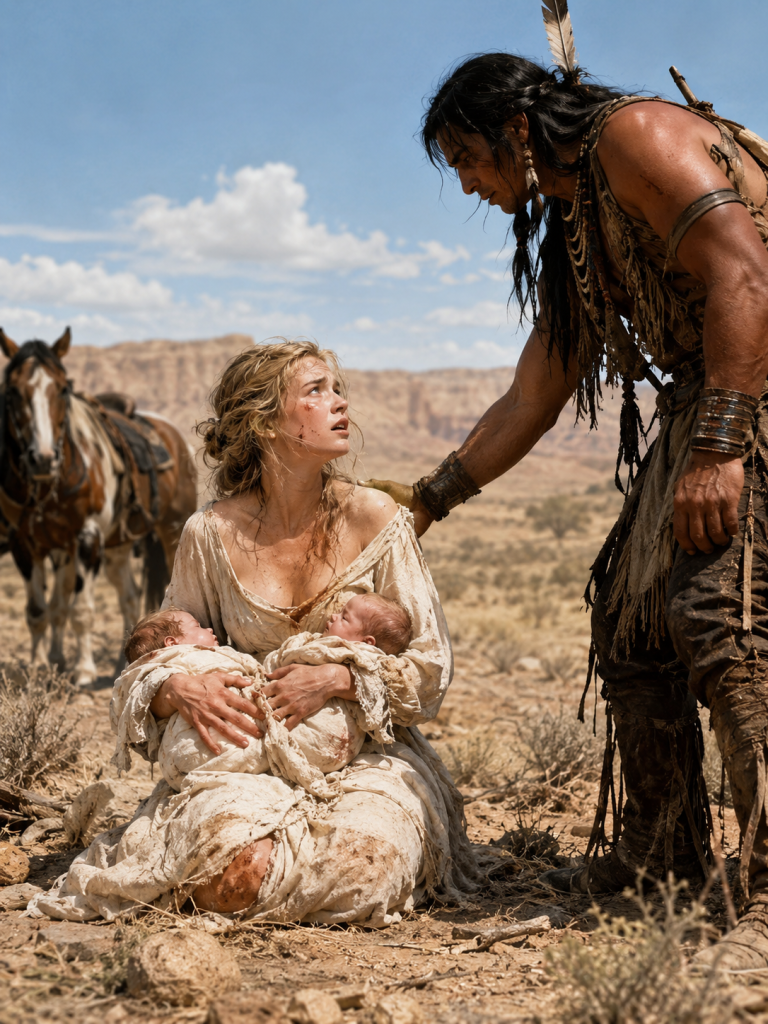
The coach door creaked open. Casey pulled his hat off out of instinct, and the woman who stepped down out of the dim interior made his heart skip an irregular beat. Not the sturdy, practical seamstress he’d pictured. Terrifyingly fragile — a faded gray wool dress hanging off a narrow frame, a heavy mourning bonnet hiding the upper half of her face, her shoulders pulled up to her ears like she expected the sky to fall on her. She clutched a worn leather satchel to her chest with white knuckles, hands trembling in the frigid air.
“Abigail?” Casey’s voice came out too loud, too rough, for the delicate creature in front of him.
She flinched at the sound of it. Slowly lifted her head. Beneath the bonnet’s brim, Casey saw a pale, heart-shaped face, lips chapped and split by the wind, eyes cast down and refusing to meet his. She gave a single jerky nod.
“Welcome to Montana territory,” Casey offered, crushing his hat in both hands. “I’m Casey. Casey Higgins.”
She said nothing. Just tightened her grip on the satchel and let out a shuddering breath.
“Trunk’s strapped to the back, Higgins.” Jack hauled a massive ironbound chest out of the coach’s boot, and it hit the boardwalk with an ominous thud that made the planks groan. “Heaviest damn thing I ever hauled. What’s she got in there — anvils?”
Casey tipped Jack a silver dollar and hefted the trunk onto his shoulder, grunting. Unnaturally heavy. Far heavier than clothing or household goods had any business being. He glanced at his bride, but she was staring hard at the mud, jaw locked tight with silent anxiety.
The ceremony in Reverend Alder’s parlor was grim and hollow. Abigail stood beside him like a ghost. When it came time for her vows, she only nodded, voice failing her completely. The reverend shot Casey a look of real concern, but Casey just set his jaw. *She’s terrified,* he thought. *Traveled halfway across the country to marry a stranger who looks like a bear. I’d be mute with terror too.*
Within the hour they were seated in his buckboard, beginning the brutal four-hour climb into the Bitterroots. Casey tried conversation a few times — the ribbon of the Clark Fork below, the jagged peak of Lolo Mountain in the distance — and every time he spoke, she tensed and shrank away on the bench. He gave it up, and the rest of the ride passed in silence broken only by the ominous rattle of that heavy trunk in the wagon bed. Something about the woman beside him wasn’t simple shyness. She carried a weight, a suffocating dread that seemed to bleed into the freezing mountain air around them.
By the time the roof of his cabin came into view through thickening snow, Casey had started to wonder if bringing this fragile stranger into his harsh, unforgiving world was the greatest mistake of his life.
The storm hit full force just as he got the mules into the lean-to barn. Wind shrieked against the log walls like a dying animal, driving sheets of white snow sideways. Inside, the cabin smelled of cured leather and old woodsmoke. Casey lit the kerosene lamps, throwing warm light over bear pelts and hanging traps and the Henry repeating rifle over the mantle.
Abigail stood frozen just inside the door, melting snow dripping off her bonnet, eyes darting to every corner of the room like a trapped animal calculating an exit.
“Take off your wet things,” Casey said gently, keeping his distance. “I’ll get the fire going. Warm in a few minutes.”
She didn’t move. He built the fire himself, and when he turned back, she had finally removed the bonnet with trembling fingers — revealing hair hacked short and uneven near the jaw, like it had been cut with a dull blade in a hurry, and eyes, when she finally lifted them, a striking piercing gray, hollowed out by something Casey had only ever seen before in the eyes of soldiers coming back from the worst of the trenches.
He fed her venison stew. She ate like she hadn’t eaten in days, eyes constantly cutting to the locked door and the frost-choked windows. And when night fully descended and the wind battered the timber door on its hinges, Casey stood by the fire, aware of every inch of space his body took up in that small room, aware that somewhere behind him his new wife sat rigid in a chair, staring into the flames like she was bracing for something far worse than a wedding night.
Part 2
“Abigail.” Casey’s voice was low. He saw her shoulders flinch at the sound of the name. “You don’t need to be afraid of me. I know what was expected tonight. I know the vows we took. But you’re trembling like a leaf in a gale.”
He pulled a heavy wool blanket from a chest and dropped it on the floor by the hearth.
“You take the bed. I’ll sleep by the fire. Take all the time you need to get used to this place. To me. I won’t lay a hand on you in the dark.”
He turned his back, giving her privacy, laid out his own bedroll on the hardwood.
Ten minutes passed in heavy silence, broken only by the crackling logs and the screaming blizzard outside. Then Casey heard a sound that turned his blood to ice. Not the rustle of sheets. A sob — deep, ragged, tearing its way out of a human throat like it had been buried alive.
He sat up. Turned toward the bed.
Empty.
Abigail was kneeling on the floor at the center of the room. She hadn’t undressed for bed. She’d used an iron key from her satchel to unlock the massive, heavy trunk Jack Sullivan had complained about, the lid thrown all the way back.
Casey rose slowly, stepping closer. “Abigail. What is it? What’s wrong?”
She turned to look at him, tears streaming silently down pale cheeks, and shook her head violently — rejecting the name outright. With trembling hands she began unbuttoning the high collar of her gray dress.
Casey looked away on instinct, his sense of honor flaring. “Ma’am, you don’t have to—”
A sharp, guttural sound tore out of her throat and forced him to look back. She’d pulled the dress and shift down off her left shoulder, exposing her collarbone. Casey’s breath caught in his chest. Across her pale skin, climbing up the side of her neck, was a mass of thick, raised scar tissue — not a burn. Branded deep into the flesh just below the collarbone was a crude, jagged letter *C*, ringed by scars that could only have come from rope burns.
The mark of captivity. Of brutal, repeated torture. And, Casey understood in the same instant, the reason she couldn’t speak — her vocal cords damaged beyond repair.
Before he could fully process the horror of it, she reached back into the trunk. Bypassed the neatly folded dresses. Pulled out a bundle wrapped in oilcloth, and with shaking hands, held it out to him.
Casey stared at the object, his knees going weak, the air punched clean out of his lungs.
A tattered, blood-stained Union cavalry jacket. Tarnished brass buttons. Blue wool gone stiff with dried gore. A silver sharpshooter’s medal pinned to the breast.
He knew this coat. He had watched the man wearing it get shot off his horse at Shiloh, had carried the guilt of leaving him behind, swallowed by the mud of a Confederate advance, every single day for sixteen years.
“Gideon,” Casey whispered, his voice cracking around a name that tasted like ash.
Part 3
The woman who was not Abigail reached into the trunk again. She pulled out a small slate chalkboard and a stick of chalk, her hand flying across it, the squeak of chalk cutting through the roaring storm outside. She thrust the board against his chest.
Casey looked down through eyes suddenly blurred with hot, stinging tears. The messy, hurried script read: *My name is Clara. I was his wife. He did not die at Shiloh. He died three weeks ago in a Dakota mining camp.*
The ground seemed to tilt beneath him. The heavy oak walls of the cabin felt like they were closing in.
Sixteen years. Gideon had been alive for sixteen years. He’d survived the war. He’d grown up. He’d taken a wife.
Clara wiped the slate clean with the heel of her hand and wrote again, faster this time, her face a mask of grief and terror. *He told me to find you. He said you were the only man who could stop them. The men who murdered him are coming for the gold in this trunk. They are coming for me.*
Casey fell to his knees on the hardwood, the bloody cavalry jacket clutched desperately to his chest. The stoic, unbreakable mountain man who hadn’t shed a tear in over a decade let out a raw, broken wail that rivaled the wind screaming outside. The secret hadn’t just altered his night — it had reached into the foundation of his life, his grief, his sixteen years of silent penance, and shattered all of it into dust.
He wept until dawn, understanding that the war he thought he’d left behind had finally followed him up the mountain.
—
Dawn broke over the Bitterroots without warmth, only a cruel, blinding glare off four feet of fresh, suffocating snow. Inside, the fire had burned down to a mound of glowing embers. Casey hadn’t slept. He sat with his back against the log wall, Gideon’s stiffened jacket across his knees, eyes bloodshot and hollowed out — sixteen years of stoic armor stripped away overnight, leaving behind something colder and far more focused.
Clara woke in the bed, her hand flying instinctively to her throat. When she saw him watching her from the gloom, she froze.
Casey stood slowly, the floorboards groaning under his weight, and walked to the open trunk. Morning light through the frosted window caught the dull gleam of something Clara had pried up from beneath a false bottom.
Not clothing. Gold — raw, jagged nuggets the size of walnuts, and heavy ingots stamped with a Dakota assay mark. Enough wealth in that box to buy half of Missoula outright.
Casey didn’t care. He kicked the lid shut with the heel of his boot, the crack loud enough to make Clara flinch.
“I don’t care about the yellow dirt,” he said, voice a raspy whisper worn raw by the night’s grief. He picked up the chalkboard and tossed it onto the furs beside her. “I care about the blood on that jacket. Start writing, Clara. And don’t leave a single damn thing out.”
Her hands shook as she took up the chalk. For the next hour, the only sound in the cabin was the frantic squeak of it against slate, punctuated by the scrape of her palm wiping the board clean for the next horrific chapter.
She wrote of how Gideon had wandered west after the war, his mind fractured, his body scarred. Of how they’d met in a mining camp in the Black Hills — two broken people finding a kind of solace in each other. Of how Gideon had struck a vein of pure gold deep in quartz, a secret he’d guarded fiercely, and how secrets in the gold camps bled out like a severed artery.
*A man named Cullen Montgomery found out,* she wrote, her handwriting turning sharp and jagged with remembered terror. *He rode with a gang of bushwhackers, former raiders. They cornered Gideon at the claim. They dragged me from the tent. Cullen wanted the map to the main vein. When Gideon wouldn’t talk, Cullen put a running iron in the fire.*
Clara stopped writing. Her hand went to the high collar of her dress. Her breathing turned shallow and ragged.
Casey closed his eyes, fists clenching so hard his knuckles went white.
“The brand,” he murmured. “The C. For Cullen.”
Clara nodded slowly, tears welling again, and began to write faster. *They burned me. They crushed my throat so my screams wouldn’t echo down the canyon. Gideon broke. He gave them a map — but it was a fake, leading them into a box canyon. While they were gone, Gideon managed to untie me. He was gutshot, dying. He loaded this trunk into a wagon, hid me under a tarp, and told me to run. He said his brother in the Bitterroots was a giant, a man who hunted bears. He said find Casey. Casey will kill them all.*
Casey stared at the board a long moment.
“And Abigail?” His voice had hardened into something new. “How did you become my bride?”
*I made it to Bozeman,* Clara wrote. *I met Abigail in a boarding house. We shared a room. She was terrified of coming here. But three days before the stage was set to leave, she caught trail fever. She died in the night. I had Cullen’s men two days behind me. I had a trunk of gold and nowhere to hide. I stole her letters. I stole her ticket. I put on her mourning veil to hide my scars. I am so sorry, Casey. I used you to survive.*
She held the board up like a shield, eyes squeezed shut, bracing for his fury. She expected him to drag her out into the snow, hand her over to the law, or worse.
Instead, she felt the gentle weight of a massive hand settle on her shoulder.
She opened her eyes. Casey knelt beside the bed, his face inches from hers. Whatever grief had lived there overnight had hardened into something else entirely — cold, focused, and utterly lethal.
“You didn’t use me, Clara,” he said, his voice steadying with every word. “Gideon sent you to me. He knew exactly what he was doing. And as far as I’m concerned, you’re my family now. You’re under my roof.”
He stood, crossed to the mantle, and took down the Henry repeating rifle.
“Cullen Montgomery.” He tested the lever action, the metallic clack loud in the quiet cabin. “How many men ride with him?”
*Six,* Clara wrote quickly. *Heavily armed. They tracked the wagon to Bozeman. They know I got on the stagecoach.*
“Good.” Casey turned to a heavy wooden crate in the corner and pried the lid off with his hunting knife. Inside, dozens of massive steel-jawed bear traps, their teeth rusted and cruel in the morning light. “Blizzard covered our tracks up the mountain, but they’ll find the stage driver in Missoula. One-eyed Jack talks too much when he drinks, and he loves to drink. They’ll know exactly which trail we took.” He began hauling the traps toward the door. “They’ll have to wait for the snow to crust before they can ride horses up that pass. Gives us maybe a day. Maybe two, if God is kind.”
He looked back at her, a grim, humorless smile touching his mouth.
“You rest, Clara. Eat whatever you can find in the larder. Tonight, we turn this cabin into a slaughterhouse.”
—
That night, while the wind settled into a low, steady moan outside, Casey worked by lantern light, oiling the Henry and checking every cartridge in his belt twice over. Clara sat across from him at the oak table, watching his hands move with the same steady precision he’d used to build the fire her first night in this cabin, and found herself, for the first time since Gideon’s death, unafraid of a man’s hands entirely.
She took up the chalk again, not out of urgency this time, but because the silence between them had started to feel like something worth filling.
*Why did you weep for him? You said he was dead sixteen years. You’d already grieved him once.*
Casey didn’t look up from the rifle. “Grieved him and buried him both, in my head, the same week. Told myself it was clean, since I never found the body to bury for real. Man tells himself a story long enough, it starts feeling true whether it is or not.” He set the rifle down, finally meeting her eyes. “Finding out I’d buried him wrong for sixteen years — that he was out there living and dying without me ever once looking — that’s not grief you already spent. That’s brand new grief, stacked right on top of the old kind.”
Clara wrote again, slower. *I’m sorry I’m the one who had to bring it to your door.*
“Don’t be.” Casey shook his head. “You didn’t bring the grief, Clara. You brought the truth. Ain’t the same thing, even if it feels like it tonight.” He looked toward the shuttered window, toward the dark beyond it where five armed men were somewhere closing the distance between Bozeman and this ridge. “Truth’s a hard thing to carry alone. Man shouldn’t have to do it by himself, same as he shouldn’t have to die alone in the cold. Gideon used to say that, near the end of the war. Reckon it’s still true.”
She reached across the table, not for the chalk this time, but for his hand, and Casey let her take it — his enormous, scarred palm swallowing her smaller one whole — and for a long moment neither of them moved, two people who’d both been carved down to something raw and honest by the same violent inheritance, sitting together in lantern light with a war coming up the mountain behind them.
—
The attack came on the second afternoon, under a sky so bright it burned white off the snowfields. For two days Casey had prepared. The cabin was no longer a home — it was a fortress. Windows sealed with thick oak planks, leaving only narrow firing slits. The mules dragged inside, restless in the corner. Hidden beneath the drifts outside lay a deadly ring of steel traps, carefully placed and waiting.
Inside, the air held tense and quiet. Casey sat near the hearth, a mug of black coffee cooling in his hand, the rifle across his lap. Across the room, Clara stood — no longer the frightened woman off the stagecoach, but something harder, steadier. She wore his clothes now, sleeves rolled, a heavy revolver strapped at her side. Her hands still trembled. Her eyes no longer did.
The warning came from the mules — a sudden, anxious cry. Casey froze. The mountain had gone silent in that particular way that meant danger was already close. He moved to the window, peering through the slit. Shapes emerged from the treeline. Five riders, pushing slowly through the snow, breath steaming in the cold, heavily armed. At their front rode a man Casey recognized even at a distance.
“Cullen,” he muttered.
Clara rose behind him, pale but resolute, gripping the revolver in both hands.
“Stay low,” Casey said quietly. “Let them come.”
Cullen halted his men within shouting distance, his voice carrying easy across the frozen air, demanding Clara be handed over, threatening fire and death if refused.
Casey answered with silence.
Then with a shot. The rifle cracked through the stillness, and one rider dropped instantly, thrown from his saddle. Chaos followed — the others scattering for cover, bullets chewing into the cabin walls, orders shouted over the gunfire. One man broke off, circling toward the rear. Clara heard him before she saw him, the crunch of boots through snow, her heart pounding, but she held her position.
Outside, the man crept forward with fire in hand — and the ground snapped shut beneath him. A trap. He fell screaming, the attack cut short before it could begin, and Casey ended the threat fast, before the screams could carry far enough to warn the others.
At the front, Cullen and his remaining men charged, using brute force against the door until it shuddered and burst inward. Casey met them head-on. The confined space erupted — one attacker fell immediately, another fired and grazed Casey’s shoulder, and he barely reacted, closing the distance and overpowering the man with raw force.
Then movement behind him. Cullen, weapon already raised.
Everything slowed.
A thunderous shot rang out from across the room. Clara stood with the revolver, smoke curling from the barrel. Cullen staggered, wounded, shock chasing the confidence clean off his face.
Casey turned, breathing hard. The fight was over — but it wasn’t finished. He crossed the room slowly, deliberately, the weight of sixteen years in every step, and picked up Gideon’s old jacket, holding it where Cullen could see it clearly. Recognition flickered across the outlaw’s face. Then fear.
Casey didn’t hesitate. He seized the man and dragged him out into the snow. Cullen struggled, pleaded, offered gold — anything. Casey didn’t care. The cold air bit deep as he stood over him, blade in hand, the mountain silent and watching.
“This isn’t about gold,” Casey said quietly. It was about something older. Something owed. And now, finally, it was time to collect.
—
The bitter winds eventually washed the blood from the mountain, but the bond forged in the fires of that vengeance never came loose.
Casey never got the quiet seamstress he’d ordered from a St. Louis newspaper. He found something far stronger instead. Clara’s voice never came back — the damage was too deep, too old, and no amount of healing would undo what Cullen Montgomery’s rope and iron had taken from her. But in the vast, silent, sweeping expanse of the Bitterroots, the two of them found they understood each other perfectly without a single word passing between them, the way only two broken people fully rebuilt from the same wreckage ever can.
They stood together at the edge of the ridge that spring, watching the snowmelt run silver down the mountainside, two ghosts finally done running — keeping every last one of the past’s shadows at bay, together, for good.
THE END