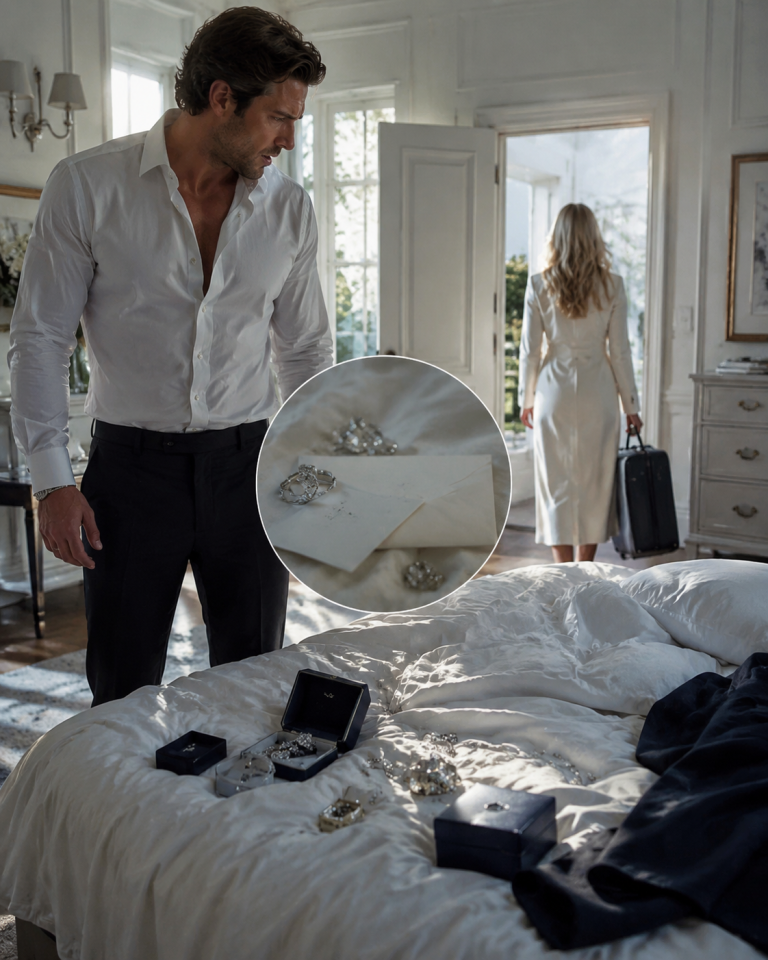
I FOUND HIS MISTRESS’S DRESS FOLDED IN MY LAUNDRY — I MAILED IT BACK WITH A NOTE SHE’D NEVER FORGET

## PART ONE
It wasn’t a receipt, or a lipstick stain, or some stranger’s perfume clinging to the wrong collar.
It was a dress.
Champagne silk, folded lazily under my cashmere throw like it had every right to be there — thin straps, a low back, a slit cut high enough to make an entrance before the woman wearing it did. I stood in the marble laundry room of our fifty-fourth floor penthouse, holding another woman’s dress between two fingers, while Manhattan glittered below like it had been paid to keep secrets.
My husband, Weston Callahan, walked in five minutes later, tie loosened, mouth tired, wedding ring still on.
“Whose dress is this?”
He glanced at it once. Just once. Then he smiled.
That was the moment I knew he was lying.
“Oh,” he said, too casually. “That’s Nora’s. She left it here last weekend.”
Nora was his sister. Nora was six months pregnant. Nora was allergic to silk.
I looked at the man I’d loved since I was twenty-two and naive enough to mistake ambition for strength. Then I looked down at the dress, still warm from the dryer, and I did not scream, and I did not cry.
I folded it neatly, boxed it in white with a black satin ribbon, and wrote a card in my best hand.
*Next time, take the man and your laundry.*
Then I had it delivered. By midnight the next night, that box would end a marriage, expose a mistress, collapse a company, and finally reveal a name my husband had spent six years underestimating.
Mine.
—
Luxury teaches people to lie beautifully. A poor man lies with panic in his eyes. A rich man lies with a fountain pen in his pocket and a voice so calm it makes you feel vulgar for doubting him.
Weston had been educated for it.
“Margot,” he said, “you’re being dramatic.”
I stood barefoot in my robe, holding the gift box like courtroom evidence. “I asked one question. Whose dress is it.”
“I answered.”
“You said Nora. Nora wears maternity leggings and your old Yale hoodie. She was here for ninety minutes on Sunday and spent most of it sick in the guest bathroom.”
“She brought clothes. Maybe she forgot them.”
“She’s allergic to silk.”
“Maybe it isn’t silk.”
I smiled — not because anything was funny, but because there’s a particular moment in a marriage when you realize the man across from you no longer believes you’re intelligent enough to insult properly.
“It’s charmeuse,” I said. “Bias cut, custom hem, atelier stitching under a removed tag. Saks sells something close for thirty-eight hundred dollars. This one was tailored to a body.”
He stared at me. He’d forgotten, of course — men like Weston loved marrying women with taste right up until that taste became a weapon. Before I was Mrs. Callahan, before I learned to smile beside him at fundraising dinners while donors called him a visionary, I’d studied fashion history at Parsons. I could read fabric by touch, cut by seam, and desperation by perfume.
This dress smelled like jasmine, amber, and expensive insecurity.
“Why are you analyzing a dress,” he snapped.
“Because it was in my home.”
“Our home.”
“No,” I said softly. “My home. I bought this penthouse before you proposed.”
Anger flickered across his face — the bruise beneath his tailored calm. Weston hated being reminded that the life people envied him for hadn’t started with him. He’d built Callahan Capital, yes. I’d built the silence around it — the dinners, the donor wives I’d charmed, the birthdays and allergies and old scandals I remembered so he never had to. I’d been the beautiful frame around his portrait for six years.
He’d forgotten that frames can be removed.
“I’m late,” he said, checking his watch. “Board lunch at The Grill.”
“With Delphine Rousseau?”
The name landed between us like glass breaking. His face barely moved, which is exactly how I knew it mattered.
“She’s in communications,” he said.
“She works late.”
“Margot.”
“And wears jasmine.”
His eyes sharpened. “You need to be careful.”
The first honest sentence he’d said all morning.
“Careful,” I repeated.
“You’re upset, I understand. Just don’t embarrass yourself.”
There are sentences that live in a woman’s bones forever. He said it the way men have said it for centuries, the exact instant a woman stands too close to the truth.
I ran a hand over the black ribbon on the box. “You’re right,” I said, and watched his shoulders relax, watched him mistake my calm for surrender. “I’ll handle it privately.”
He stepped in, lowering his voice into the register that used to make me forgive wounds I hadn’t yet admitted were wounds. “Good girl.”
Once, those two words would have sounded intimate. Now they sounded like a leash.
He kissed my forehead and left, phone already in hand, without realizing he’d just left the door wide open behind him.
The moment the elevator closed, I called our doorman. “Theo, I need a package delivered.” I gave him the Tribeca address — the glass tower where twenty-eight-year-old women with no family money somehow afforded seven-thousand-dollar rent because powerful men called it mentoring. “And make sure she signs for it herself.”
There was a pause on the line. Theo had worked our building long enough to know the difference between dry cleaning and war.
“Absolutely, Mrs. Callahan.”
I poured coffee, opened my laptop, and typed two words into my private files. *Delphine Rousseau.* It took eleven minutes to find the first lie, and twenty-three more to find the second. By noon, I understood that my husband’s mistress wasn’t only sleeping with him.
She was helping him steal from me.
## PART TWO
Delphine’s Instagram was a gallery of almosts — almost famous, almost elite, almost invited — rooftops she didn’t own, gala seats an assistant had arranged, hotel suites cropped to hide who’d paid for them. Our housekeeper, Renata, leaned over my shoulder while I scrolled.
“That is not a mistress,” she said, crossing herself out of habit rather than faith. “That is a raccoon that found your laundry.”
I laughed for the first time all morning.
At 1:07 the unknown number called. I said nothing until a polished, shaking voice asked, “Is this Margot?”
“Delphine,” I said warmly. “I was wondering when you’d call.”
“You sent me a dress.”
“I returned what you left in my home.”
“We were never in your bed,” she said, too quickly, answering a question I hadn’t asked.
“Interesting,” I said. “I never mentioned the bed.”
She inhaled sharply. “You don’t understand. Weston loves me.”
The oldest line in the world, delivered like breaking news. “Did he tell you he’s leaving me?”
“He is.”
“After the Sterling Gala tomorrow?” I asked, naming the fundraiser my late mother had founded twenty-five years earlier, held every winter at the Hollis Hotel — a hotel that, as of that morning, was not merely a venue. It was mine.
Her pause told me everything. Weston attended that gala every year not from generosity, but because the room held the exact donors his failing fund desperately needed.
“That gala matters to him,” Delphine said.
“No,” I said. “It matters to me.”
She laughed, a small cruel sound. “Margot, don’t take this the wrong way, but everyone knows you’re just his wife.”
I looked at my reflection in the window glass. *Just his wife.* The words should have cut. Instead they clarified. I saw myself the way they did — the quiet woman in diamonds who let him speak first, who mistook discretion for dignity while they mistook it for weakness.
“I’ll give you one piece of advice,” I said. “When a man tells you his wife is nothing, ask yourself why he’s still using her name in rooms that matter.”
Silence. Then, “What does that mean?”
Another call was coming through — Weston. I smiled. “It means you should have taken the man,” I told her, “not my laundry,” and hung up to answer him.
“What did you do?” he demanded.
“Returned a dress.”
“You humiliated her.”
“Leaving it in my laundry was careless. Returning it was manners.”
“She’s crying.”
“How inconvenient.”
“Stop, before you make this worse.”
I opened the bottom drawer of my vanity, where a velvet folder from my mother’s attorney had waited, unopened, since her funeral. “I agree,” I said. “Things are already quite bad.”
“This isn’t who you are.”
That one nearly landed, because he was right — I was no longer the woman he thought he’d married. I had become the woman he deserved.
Inside the folder, beneath my full legal name, sat three words Weston had never respected enough to fear: *Majority Beneficial Owner.* My mother had built a hospitality empire from a single hotel in Boston into a constellation of properties across the country, and when she died I inherited more than money. I inherited leverage. The Hollis Hotel, the security contracts, the donor list, the gala’s own event recordings — and, as of an emergency meeting that afternoon, the note on Weston’s most dangerous loan.
By four o’clock my attorney, Marcus Feld, arrived with a garment bag and a stack of documents. “You’re sure?” he asked.
Inside the bag was a black velvet gown my mother had worn the year she announced her foundation’s first hundred-million-dollar endowment.
“I’m sure.”
“One more thing,” Marcus said. “You were right about Delphine. She’s been feeding Callahan Capital internal donor strategy from inside the foundation office. She’s on payroll through a shell consulting agreement.”
The betrayal finally had a shape — names, dates, transfers. Something that could bleed.
“Can we prove it?” I asked.
“Beautifully.”
—
The Hollis rose over Fifth Avenue that gala night like a promise carved in limestone and gold. Weston arrived first, of course — he’d always loved being first into a room that wasn’t his — smiling on the carpet in a midnight tuxedo while Delphine hovered twenty feet away in silver, pretending professional distance. She hadn’t worn the champagne dress. A pity.
I stepped out in my mother’s black velvet gown, a diamond collar at my throat that she’d bought herself after her own divorce, because she believed every woman deserved jewelry that looked like a warning.
“Who are you wearing?” a photographer called.
“My mother,” I said, and watched it ripple through the press line like something alive.
Weston’s proud smile died the second he saw Marcus step out of the car behind me, and died further when the hotel’s own security director greeted me with a bow.
“Why is he here?” Weston asked.
“Legal reasons.”
“Not the place.”
“You keep saying that,” I said, leaning close enough for the cameras to read intimacy and miss the blade underneath. “But this is exactly the place.”
Inside, senators and hospital chairmen and media executives came to kiss my cheek all evening — not his. With every greeting, his posture changed a little more. Confusion is a quiet humiliation.
“Since when do you handle foundation approvals?” he asked at dinner.
“Since always.”
“Your mother’s trustees—”
“Advise. I decide.”
At 9:40, the charity auction began — Aspen trips, a private chef, a painting nobody understood — until the auctioneer smiled and said, “And now, a special addition from Mrs. Margot Hollis-Callahan.”
Weston turned slowly. “What did you do?”
I stood, took the microphone, and let the room quiet around me.
“My mother believed money only mattered when it moved toward someone who needed it more,” I said. “Tonight I’m adding an item to the auction in her honor. Not a vacation. Not jewelry. Truth.”
A few nervous laughs. Then I told them about the dress in my laundry basket — the champagne silk, the note, the sister he’d used as an alibi, standing right there, pregnant, blindsided. Phones rose across the room like a wave.
“The card said,” I continued, “*next time, take the man and your laundry.*”
The room erupted — not loudly, worse than that, a wave of shocked laughter and the electronic click of a hundred recordings starting at once.
“Sit down,” I told Weston, when he tried to reach the stage.
He froze. Not because I’d raised my voice. Because I hadn’t.
“I’m not finished,” I said.
## PART THREE
“For years,” I told the room, “my husband has enjoyed standing beside my family’s name. Many of you invested in Callahan Capital because you believed you were dealing with stability. Unfortunately, stability isn’t contagious.”
Marcus stepped toward the stage with two attorneys and the hotel’s head of security behind him.
“As of this afternoon,” I said, “the Hollis Trust has acquired the distressed note on Callahan Capital’s largest private debt obligation — callable immediately in the event of fraud or misuse of confidential foundation information.” I looked at Delphine. “Ms. Rousseau received payments through a shell vendor while accessing donor strategy she was never authorized to see.”
“No,” she whispered.
“Yes,” I said.
“This is defamation,” Weston said, rising.
“Every statement Mrs. Hollis-Callahan has made tonight,” Marcus said clearly, “is already documented and delivered to your counsel and the relevant regulators.”
*Hollis-Callahan.* Not just Callahan. I watched the room hear the difference — one name marital, the other inherited, and only one of them with teeth.
“I could have handled this privately,” I told the ballroom. “I considered it. But my mother once told me: never let a man make a ballroom out of your silence. So tonight, I’m not silent.”
Weston climbed toward the stage. Security closed the gap before he reached it.
“You think this makes you powerful?” he spat.
“No,” I said. “I was powerful before you betrayed me. This just made you notice.”
Then his sister Nora stood, crying, and said the sentence that would go viral before mine did. “You told me she was unstable. You told me she was drinking. You used my name for your affair — you let me hug her on Sunday while you knew?” Her hand went to her belly. “You break things and make women clean them up.”
Delphine cried out that she hadn’t known about the money, hadn’t known she was being used. It might even have been true. It didn’t make her innocent — just cheaper than she’d realized.
“We can end this now,” Marcus murmured.
I thought of the man who’d once brought me coffee in bed during a storm on the Cape, who’d cried at my mother’s funeral and held my hand so tight I mistook grief for unity. I thought revenge would taste like champagne. It tasted like ash.
“One more thing,” I said, and returned to the microphone.
“Tonight’s auction item is truth, and the opening bid is mine.” I lifted a final document. “I’m donating ten million dollars, in my mother’s name, to establish the Eleanor Hollis Emergency Housing Fund — for women rebuilding their lives after betrayal or financial abuse.”
The applause began without hesitation this time. It grew, real and warm, and within twelve minutes the fund had raised thirty-seven million dollars, one paddle after another rising across the ballroom while Weston stood in the middle of it all, no longer a husband, no longer a king — just a man everyone had watched become small.
Then Julian Marsh walked in.
I hadn’t expected him yet. Tall, composed, dark-haired, the kind of man who’d warned me six months earlier that Weston’s accounts smelled like smoke. He set a paddle on the linen. “Marsh Media bids five million,” he said, “on the condition that Mrs. Hollis-Callahan chooses the first shelter location.”
“So that’s what this is,” Weston snapped. “You and Marsh?”
“No, Weston,” Julian said evenly. “This is what it looks like when a woman has allies you never bothered to notice.”
By half past ten, Weston was escorted out through a side corridor. Delphine left through the kitchen. By morning I’d been renamed the *Silk Dress Wife* across every feed in the country, and a stranger in Kansas had posted a video of herself folding laundry, whispering, “Ladies, check the basket.”
—
Renata laughed so hard at the clips she had to sit down. “You are famous,” she said.
“I’m divorced,” I corrected.
“Not yet.”
“Soon.”
Messages poured in for days — apologies from donors, invitations from morning shows, and thousands of messages from strangers who’d found earrings in cars, baby clothes in apartments they’d never visited, women who’d been told they were crazy for noticing what was right in front of them. I read as many as I could, and then I cried — not for Weston, but for every woman who’d folded evidence with shaking hands and been told not to embarrass herself by exposing the person embarrassing her.
Nora came by at noon in leggings and one of Weston’s old hoodies. “I’m burning them slowly,” she said, when I noticed. She handed me an envelope she said she’d forgotten to give me months earlier — Weston’s handwriting inside: *I know I’ve been absent. After the fund closes, everything will change. I’ll make it up to you.* Dated four months back.
*After the fund closes.* Not the deal. Not the quarter. My fund. My family’s network. My mother’s legacy.
That was when the last soft piece of him finally died in me — not a man who’d fallen in love, but a man who’d needed a ladder, found someone willing to hold it, and planned to climb over my name while calling me unstable the moment I noticed.
It should have shattered me. Instead, it set me free.
That evening Julian came by with a paper bag instead of flowers. “Soup,” he said. “You exposed a financial scandal in couture, raised thirty-seven million dollars, and became a national meme in under a day. I assumed you hadn’t eaten a vegetable.”
I laughed despite myself, and we ate at the kitchen island while snow thickened against the windows, turning them into mirrors where I could see us standing close, not touching yet, but close enough that the room felt warmer than it had in months.
“Everyone thinks last night was revenge,” I said.
“Wasn’t it?”
“Partly. The other part was proof. That I existed outside of what he did to me.”
“You existed before him,” Julian said. “You’ll exist after him. Last night just introduced the world to someone your mother already knew.”
The divorce took four months. Weston fought, of course — men who build their whole identity on control rarely surrender gracefully — but the courts were unmoved, and so were the lenders. Callahan Capital collapsed within weeks, in a way the finance blogs called sudden, though nothing about it was sudden to anyone reading the footnotes. Delphine rebranded as a wellness consultant in Miami and posted about protecting her energy. Nora had a daughter in April and named her Eleanor. I cried when she told me.
That May, I walked through the first property purchased by the housing fund — a former boutique hotel in Brooklyn, arched windows, good bones, being converted into transitional apartments with a playroom, counseling offices, a rooftop garden. I stood in an empty, sunlit unit and imagined a woman arriving with two suitcases and a sleeping child, locking the door behind her, and understanding that no one cruel had a key.
That was when I finally understood what my mother had been trying to teach me all along.
Revenge can burn a house down. Power builds a door someone else can walk through.
“You’re smiling,” Julian said, beside me.
“I think I’m happy.”
“You sound surprised.”
“I am.”
I reached for his hand. He let me take it — no fireworks, no dramatic kiss against a skyline, just fingers fitting together in a room still being rebuilt.
—
People still ask about the dress — where she bought it, whether Weston ever apologized, whether I planned the speech from the start. The truth is less glamorous than the story became. I was a woman standing in a laundry room, holding proof that my life had been treated carelessly. I didn’t feel powerful. I felt cold. Then angry. Then, finally, awake.
The dress became a symbol because it was simple enough for strangers to understand — a mistress left something behind, a wife sent it back, a man learned that humiliation isn’t created by exposure, but by behavior finally seen clearly. But the dress was never really the point. The point was the lie he’d expected me to swallow, the sister he’d used, and the woman I’d finally remembered how to be.
Months later, on a warm Sunday, I stood in that same laundry room with Nora’s daughter asleep in a carrier nearby while Nora folded tiny onesies at the counter, Renata made coffee, and Julian assembled a bookshelf in the next room that absolutely did require the instructions he insisted he didn’t need.
Nora held up a small pink dress and smiled. “At least this one belongs here.”
I’d spent years believing love meant protecting a man’s image. Now I knew it looked like a sister telling the truth in a ballroom, a friend bringing soup, a lawyer sliding documents across a desk, a housekeeper calling a mistress a raccoon, and women opening doors for other women and staying until they made it through.
The last time I saw Weston, outside the courthouse, he looked smaller in daylight. “Was it worth it?” he asked.
I thought of the fund, the women moving into safe apartments, Nora’s daughter, my mother’s gown, and my own reflection in that ballroom glass, no longer waiting for anyone’s permission to be seen.
“Yes,” I said, and walked away.
That night I found the old white gift box on a closet shelf, black ribbon still tied, slightly crushed but intact. I didn’t throw it out. I left it exactly where it was — not as a trophy, but as a reminder that some women find evidence and break, and some women find it, fold it neatly, tie it with a ribbon, and send it back to where it came from.
And sometimes, if the world happens to be watching, the laundry becomes a legacy.