She Walked Into My Husband’s Investor Gala Wearing My Gown — With My Initials Still Sewn Into the Seam

## PART 1
Before Dominic Calloway married me, he had a pitch deck and a rented suit.
I am not being cruel. It is simply what was true. I met him seven years ago at a wine dinner in Napa, where he was the most interesting person in the room and the least financially stable. He had a concept — boutique experiential hotels built around regional culture and craftwork — and a gift for making you feel, while he talked, that you were already sitting in one of the lobbies he’d only drawn on paper.
I invested in people like him. Not romantically, not yet. Professionally. My mother had built Voss Capital from shipping contracts and family patience, and when she handed it to me at forty-three, it came with her only formal piece of advice: *back builders, not performers.*
Dominic seemed like a builder.
I built him one. Maybe that’s where I went wrong.
We married three years in, when his first property in Asheville had opened to real reviews and real occupancy rates, and when I had let myself believe that love and investment were separable categories. I believed it until they weren’t.
The first time his company nearly died — a contractor dispute in Savannah, winter flooding, a lender pulling out while the walls were still wet — I brought in rescue capital through a vehicle called Meridian Note Partners. A Delaware entity controlled by the Voss Family Trust. I did not tell Dominic. He was already sleeping badly, snapping at his assistant, blaming everyone in his orbit for problems he’d partly created.
I told him: *a regional fund came through.* He nodded and slept better and in the morning called himself resilient.
The second time was worse. A failed acquisition in Charleston. Payroll stress behind press releases. He sat in our kitchen in a beautiful suit and raged at the market like a man discovering for the first time that the world did not owe him the life he’d imagined.
Meridian came back in, this time with a preferred equity structure.
He signed everything Petra put in front of him without reading it closely.
Men do that when they’re frightened. They reach for the rope without checking where it’s tied.
Petra had written a morality clause into the agreement. Not as punishment or expectation — simply as protection, the way you insure beautiful things not because you plan to break them but because you understand that beautiful things get broken. If Dominic’s conduct exposed the company to reputational harm, undisclosed conflicts, or the misuse of company funds for personal purposes, Meridian could exercise control provisions.
When I signed my copy in Petra’s office, she said, “This is elegant work.”
I said, “Let’s hope we never need it.”
We needed it.
The signs arrived slowly, the way bad news does — not in one announcement but in accumulated details that each seemed explainable. A gold earring in his car, shaped like a tiny compass, that he said probably belonged to his assistant. His phone going dark at dinner. A weekend in Seattle for a “site visit” that produced no photographs and no stories. The name Nadia, mentioned once in a conversation about brand photography and never again.
I did not confront him.
I called Petra.
“I think there’s someone else,” I said.
She asked: “Do you want comfort or clarity?”
“Clarity.”
“Then let’s find out what we’re working with.”
The clarity arrived quickly and at some volume. Nadia Chen had been hired eight months earlier as a creative director. She was thirty, ambitious, and photographically aware of every room she entered. Dominic described her in meetings with a slight change in register I noticed the way you notice a small change in air pressure before rain. She accompanied him to investor dinners as “part of the brand evolution.” She appeared in two photographs from a Chicago conference that he had not mentioned attending.
But the affair alone would not have been enough. Affairs are survivable — men apologize, companies issue statements, donors forgive. I needed the affair to become something else.
And Dominic, who had always believed I was the quiet part of us and he was the engine, delivered everything I needed without being asked.
He paid for her travel through marketing accounts. He promised her a stake in the company’s expansion without board approval. He sent her an investor summary three weeks before she was authorized to see it. And he allowed her ideas — some of which had originated in memos I had written years before and passed to him with the gentle encouragement of a woman who cared more about the outcome than the credit — to be publicly attributed to her at a board presentation.
Helpful private thinking, building someone else a public reputation.
Our housekeeper, Dot, came to me on a Tuesday morning with the look of a woman who has been holding something for too long.
“He had someone come while you were in Boston,” she said. “She needed a garment bag, he told me. I didn’t know she took anything from the closet until after she’d gone.”
I asked what she took.
Dot’s eyes went liquid.
“The dark red one. The long one with the—”
“I know which one,” I said.
I walked into the closet and stood in front of the empty space where it had been. The hanger was still there. It swung slightly in the air from the vent.
He hadn’t just brought her into my marriage.
He’d dressed her in it.
Something went quiet inside me — not broken, precisely, but the way a room goes quiet when everyone in it has finally understood something at the same time.
I called Petra.
“The investor gala is in three weeks,” I said. “Dominic asked me to give the keynote.”
A pause.
“And will you?”
“Yes,” I said. “I will give the best keynote of my career.”
—
## PART 2
I arrived at the Aldover alone and let the photographers have one clean shot before I went inside.
“Mrs. Calloway — where’s Dominic?”
“Already here,” I said, and kept moving.
Inside, the ballroom was doing what ballrooms at these events always do: performing abundance for people who already had it. Scale models of unbuilt properties glowed under track lighting. The string quartet played things no one was listening to. Investors compared flight times and summer plans and stood in clusters that mapped the exact shape of who owed what to whom.
Dominic found me before I found him.
He came across the room too quickly — a tell — and kissed my cheek with the warmth of a man who has been waiting to perform reassurance.
“You look wonderful,” he said.
“So does Nadia.”
His face moved through several expressions very fast.
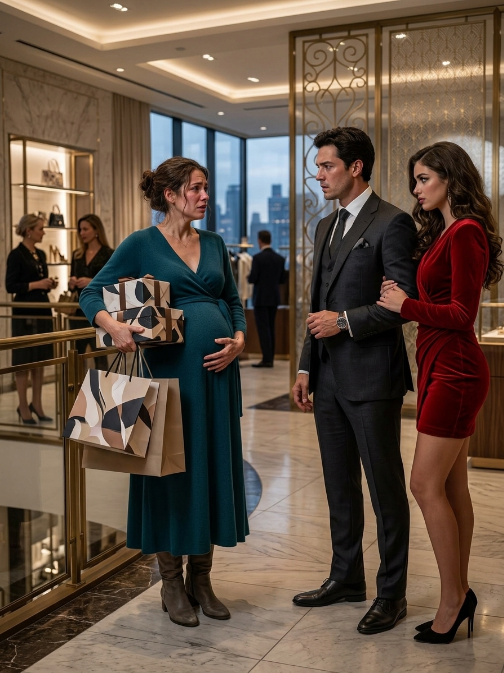
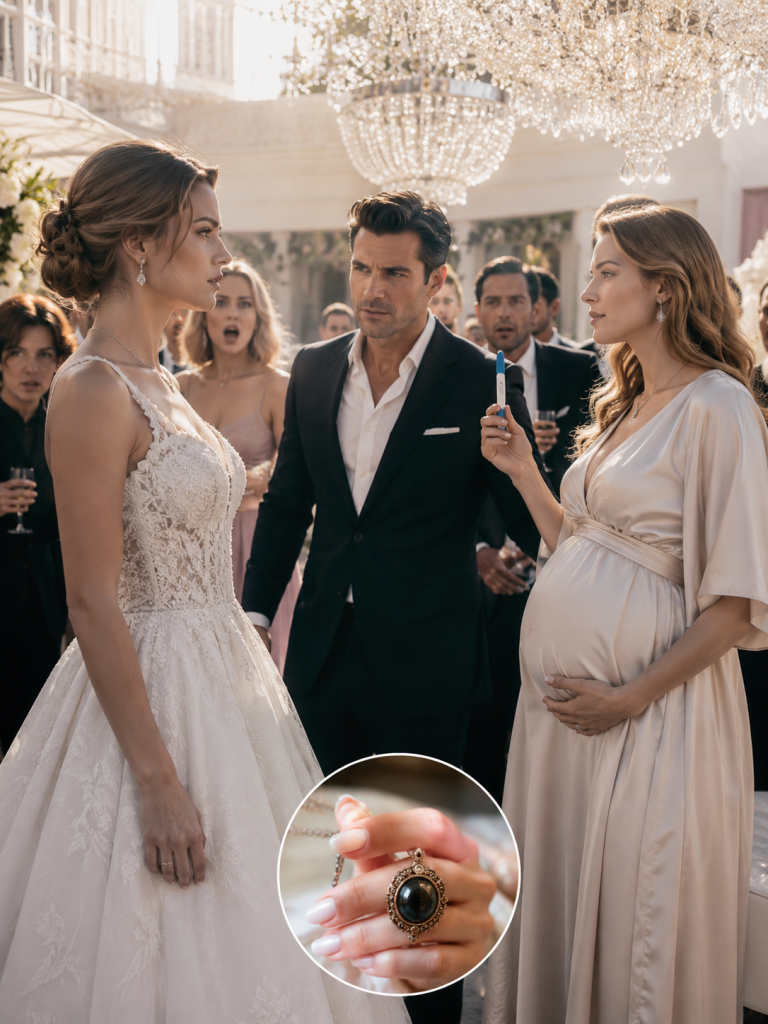
She was across the room, in my gown, with her hand resting on the arm of a man Dominic needed a check from. My necklace — a graduated diamond chain from my mother’s estate — sat at her throat. She was laughing. She was radiant. She had no idea yet that the dress had a detail she hadn’t been told about.
“It’s not what—” he began.
“We both know that sentence doesn’t finish well,” I said. “Tonight, just let it happen.”
He frowned.
“Let what happen?”
“The evening.”
He searched my face, looking for the fight he expected. I gave him none. I was pleasant, unhurried, present. I talked to investors about regional development trends. I asked about their children and remembered the right names. I stood beside my husband when it was useful and moved away from him when it wasn’t, and I watched Nadia grow more confident as the hours passed, which was fine. She could have tonight. Tonight was what I needed her to have.
Just before the speeches, she crossed my path near the east corridor.
Up close, the gown was even more what it was. She wore it the way certain women wear things — with the unconscious authority of someone who believes possession and ownership are the same.
She extended her hand.
“Lena. I’m glad we could all be here together.”
What a remarkable sentence to say to a wife.
I didn’t take the hand. I touched the left seam of the gown instead, two fingers just below her hip. “There’s something sewn inside,” I said. “Black thread. My initials.”
Her fingers flew to the seam involuntarily.
“Your—”
“*L.V.* The atelier includes them on custom work.” I smiled. “Just so you know what you’re wearing.”
Her eyes went to Dominic across the room.
His were elsewhere.
The first crack.
The coordinator signaled dinner. We sat. Dominic performed magnificently. Nadia recovered and laughed in the right places. The investors ate the food and drank the wine and asked questions about yield projections and groundbreaking timelines.
At eight-fifteen, Dominic took the stage.
His speech was polished the way surfaces are polished — smooth enough to hide what’s underneath. He spoke about persistence, about partnership, about the people who believed before there was evidence to believe in.
Then he introduced Nadia as “the creative force behind the next chapter.”
The applause rose.
Petra materialized at my elbow in a charcoal suit, holding two glasses of water.
“You can still go home,” she said, without judgment.
I looked at the stage. At Dominic glowing under the lights. At Nadia beside him, in my silk, with my diamonds, accepting credit the way people accept compliments — a little too quickly.
“No,” I said. “Silence is how men like him become myths.”
The coordinator opened the green room door.
Dominic’s voice carried through: “And now, the woman who has always been my quiet foundation—”
*Quiet foundation.*
How small he thought the word quiet was.
I walked onto the stage.
The applause shifted — became uncertain, alert. A room full of people who understood that something about the evening had changed direction.
Dominic leaned toward me. His lips found air.
I placed the folder on the podium.
“Good evening,” I said.
—
## PART 3
The room didn’t know what it was watching yet.
That was fine. In thirty seconds it would.
“I was asked to speak tonight about vision,” I said. “But vision is only useful if it’s attached to accurate information. So before we close this evening, I’d like to offer something this company has rarely provided its investors.”
A laugh, uncertain, from Table Three.
“The truth about where the money came from.”
The screen behind me changed.
Timeline. Two dates. Two rescue events. Two tranches of capital that had come in under a name no one in this room recognized as mine.
“Calloway Collective has experienced two near-failures in seven years. In both cases, recovery capital was provided not by Dominic’s network, not by market confidence, not by the mythology of a self-made founder — but by Meridian Note Partners, a Delaware vehicle controlled by the Voss Family Trust. My trust.”
The room’s quality of silence changed. Rich people get quiet differently when money is involved — not empty, but concentrated.
Dominic stepped forward.
“Lena—”
I did not look at him.
“The 2021 agreement included governance provisions,” I continued. “Among them, a clause requiring that the CEO’s conduct not create undisclosed conflicts, reputational harm, or misuse of company funds for personal purposes.”
Petra stepped onto the stage.
She did not raise her voice. She never needed to.
“Good evening. I am Petra Ashby, counsel for Meridian Note Partners. The board was notified at six this evening that Meridian has initiated a control review under Section 9 of the 2021 Preferred Equity Agreement.”
Dominic said, “This is insane.”
No one turned toward him. The room was watching Petra.
“Effective immediately, pending ratification at the board session tomorrow morning, Mr. Calloway’s discretionary authority over company accounts is suspended. Ms. Chen’s access to confidential investor materials is revoked. An independent audit has been authorized.”
Nadia’s hand went to the necklace.
Then I clicked the remote again.
Expense summaries. Flights. Hotel charges. An equity conversation in writing. An email in which Dominic had written, to Nadia, about our marriage: *She’ll cooperate. She always does.*
The room read it. I watched them read it.
Some faces showed disgust. Most showed something quieter — recognition, the specific expression of people who had suspected something for a while and were now having the suspicion confirmed.
Dominic turned to me.
“You planned this.”
“No,” I said. “I documented it. You planned it every time you chose to.”
Nadia stepped backward. The train of the gown whispered on the stage floor.
“Dominic,” she said. “Tell them—”
He looked at her with an expression I had never seen directed at me in seven years of marriage: the flat, quick contempt of a man who has been caught and is already calculating the least expensive way out.
“Not now,” he said.
Two words.
The entirety of what she had risked, summarized.
Her eyes filled.
I looked at the diamonds at her throat — my mother’s diamonds — and let the pity pass.
The screen changed one final time.
An ownership structure. Meridian’s protective rights. Conversion provisions. A second vehicle called Voss Hospitality Partners, quietly assembled over the past eighteen months — long before the earring, before Dot’s revelation, before any of this became acute — because I had always known that building something inside someone else’s company was temporary shelter, not a home.
“Two of Calloway Collective’s institutional investors have signed conditional agreements with Voss Hospitality Partners,” I said. “The board will vote tomorrow on a proposed acquisition of the properties division. Existing projects will be protected. Employees will not be affected.”
Victor Hanes, in the front row, who had once told Dominic during a site visit that his wife had “good instincts for aesthetics,” stood up.
“Are you saying this is already agreed, Mrs. Calloway?”
I looked at him for a moment.
“I’m saying the documents are readable,” I said. “I’d recommend taking the time.”
Dominic heard it. He had signed things without reading them. I watched him understand that sentence at full cost.
The board vote the next morning took nineteen minutes.
By nine-fifteen, Dominic was no longer CEO.
By noon, the press had reorganized our entire marriage into headlines.
I did not read them. Dot did, apparently, and her expression across the kitchen for the rest of the week was one of concentrated, barely contained satisfaction.
—
He came back to the house on a Tuesday evening.
I had expected anger — Dominic was rarely quiet when he was losing. But he came in through the front door with the particular stillness of a man whose arguments have run out, and found me in the study, and sat down without being asked.
“Was any of it real?” he said.
The question was sincere enough that it hurt, which surprised me. I thought I had processed past the place where he could still reach.
“Yes,” I said. “For a long time, it was the realest thing I had.”
He looked at his hands.
“I loved you.”
“You loved being backed by me,” I said. “That’s a different thing. It felt similar from the inside, I imagine.”
He didn’t argue.
That was how I knew it was true.
I took off my wedding ring. Set it on the table between us. Oval diamond, platinum band, chosen by a man who understood jewelry as statement rather than symbol.
“Petra’s handling everything from here,” I said. “The house has been spoken to. You can arrange supervised time for your belongings.”
He stared at the ring.
“Nadia’s gone,” he said, not as accusation. Just information.
“I know.”
“She said I misled her about us.”
“She wasn’t entirely wrong.”
He looked up. Whatever he saw in my face made him stop talking. He left twenty minutes later with a bag and the expression of a man learning for the first time that exits can be owned by other people.
The gown came back two weeks later.
A flat box, white tissue, professional cleaning receipt folded inside. Nadia’s handwriting on a card tucked beneath the tissue:
*Lena — I know I have no standing to say this. I believed what I wanted to believe because it was easier than believing what was actually true. That’s on me. I’m sorry for what I was part of.*
I read it twice.
Then I carried the gown to the sewing room and called the atelier.
“I want it restructured,” I said. “Not restored. Transformed.”
Three weeks later it came back as a jacket — clean lines, structured shoulder, the silk retained but recut into something that gave nothing away for free. The initials had been moved. They were on the outside now, small and deliberate on the inner collar.
*L.V.*
Present. But not performing.
—
Voss Hospitality Partners held its first investor reception six months later at a building on Park Avenue that I had chosen because the lobby had good light and better bones.
I wore the jacket.
When I walked into the room, the conversation didn’t stop — but it gathered itself, turned. Not the way it turned for Grant, or for Dominic, or for any man I had ever stood beside. It turned toward me.
Petra was at the front with a glass of wine and a look of complete composure.
Dot, who had come as my guest, cried quietly behind an arrangement of white branches.
And near the back, in a gray suit and no visible agenda, was Marcus Lund — the restructuring attorney who had navigated the acquisition with such complete absence of drama that I had initially found him almost alarming. He sent documents on time. He answered questions directly. He did not explain my own industry back to me. Once, late in a negotiation that had gone longer than anyone planned, he had walked me to my car through a November rain and said, “You don’t have to make it look effortless. It just has to work.”
I had thought about that sentence more than made sense.
He approached after my remarks.
“Congratulations,” he said. “On all of it.”
I noticed he used my first name, not the title.
“Thank you, Marcus.”
His eyes moved briefly to the jacket. “That’s beautiful.”
“It used to be evidence,” I said.
“And now?”
I looked around the room. My name on the building’s signage. My investors. My work. My next chapter, not borrowed from anyone or built inside anyone else’s company.
“Now it’s just mine,” I said.
He smiled — the kind that didn’t want anything from you, which made it the most interesting kind.
“What does that feel like?”
I thought about it honestly.
“Like a room where I decide who comes in.”
—
The months that followed were not all clarity and forward motion. There were mornings I woke with my hand reaching across a bed that no longer held anyone, the body slow to update its habits. There were meetings where men congratulated me with the particular note of surprise that revealed what they had assumed about me before. There were evenings when I sat alone in the new brownstone in Carroll Gardens — wide-planked floors, good windows, a garden Dot had already begun filling with lavender — and cried without strategy or witnesses, just grief for a love I had tried to save until saving it cost me myself.
But the life that was emerging was mine in a way the previous one hadn’t been. Not because Dominic had controlled me — he hadn’t, not exactly. But I had spent seven years making space for his expansion, trimming my own edges to make the frame around him cleaner. I had been the foundation he called quiet.
Foundations are not quiet. They are load-bearing.
I started saying that out loud in rooms where people needed to hear it.
Dominic remarried within eighteen months — quickly, which told me what I needed to know about what he was looking for. Nadia launched a small consultancy focused on women-owned hospitality brands. She sent a donation request to Voss’s charitable arm six months later. I approved it without a note.
Mercy is not the same thing as forgetting. It is simply refusing to let someone else’s worst decision be the last thing they ever give you.
As for me: I sold the Greenwich house and bought a brownstone and planted lavender and filled the office walls with work by artists no one had collected yet. I sat on two nonprofit boards. I learned, slowly, to sleep through the night.
One autumn evening, Marcus and I walked through the Brooklyn Bridge Park after a dinner that had started as professional and shifted without announcement into something that required a longer walk home. He told me about the summer he spent in Portugal before law school and the jazz records he never played for guests because he worried it would seem like performance. I told him about my father’s shipping ledgers and my mother’s rule about pearls and the red silk dress I had unmade and remade and now owned completely.
He listened without interrupting.
At the waterfront, he asked: “Can I see you again? Outside of work?”
The old Lena would have looked for certainty in his face before answering. Would have measured risk and vulnerability and the precise distance between where we were and somewhere that could hurt.
The woman standing at the water knew that certainty wasn’t something another person could hand you. You carried it yourself or you did without.
“Yes,” I said. “But unhurried.”
His smile came slowly, the way things come when they don’t need to perform.
“Unhurried is exactly right.”
—
People will tell the story however they need to.
They’ll talk about the gown, the ballroom, the slides on the screen, the mistress going pale, the husband who signed without reading. They’ll make it a reel, a cautionary tale, a toast between women at a restaurant when the wine arrives. That’s fine. Let them use it however it’s useful.
I know what actually happened.
I loved a man who mistook my generosity for simplicity. I backed a company that was only ever technically his. I learned, later than I should have but earlier than many do, that being someone’s foundation is not the same as being beneath them.
The dress is a jacket now.
The initials are still there.
I own everything the clause protects and several things it doesn’t, because I have been building for myself this whole time — quietly, which people confused with passively, which was their mistake and eventually my advantage.
He thought the quiet wife was scenery.
She was the architecture.