THE MAFIA DON HID HIS PARALYSIS FROM EVERYONE EXCEPT THE ACCOUNTANT HIRED TO FIND HIS TRAITOR

**PART 1**
Blood dries a specific shade of brown against white cotton, and that was the detail Vera Marchetti couldn’t stop staring at — not the wheelchair, not the bodyguards, not the marble corridor stretching toward a door two men in dark suits guarded like it led somewhere sacred.
She’d been summoned three days earlier by a lawyer named Percy Ashworth, gray-haired and unbothered, who’d shown up at her small accounting office in Fishtown with a contract thicker than her rent ledger and an offer that made her hands go still over her keyboard.
*Sixty thousand dollars. Ninety days. Full access to the books.*
“Whose books?” she’d asked.
“Marchetti — no relation, I checked — Vitale Roso’s,” Percy said, and watched her face for the flicker of recognition he clearly expected. “You’ll have heard the name.”
She had. Everyone in this end of the city had heard the name Roso the way you heard about a fault line — something you didn’t discuss over dinner, just adjusted your foundations around. Six months earlier, someone had put two bullets into the man at a shipping dock on the Delaware, and the story that reached the papers said he’d survived. What it didn’t say was how.
Vera had taken the job anyway. Her mother’s medical bills didn’t care whose money paid them.
Now she stood in a marble hallway too grand for comfortable breathing, waiting to meet the man whose organization she’d been hired to audit for the leak that had nearly killed him.
“He’s in the study,” Percy said, stopping before a set of double oak doors. “Try to be useful. Try not to be memorable.”
“Is that a warning?”
“That’s a professional courtesy.” He almost smiled. “Everyone who’s been both in that room has regretted it.”
The doors opened onto low copper light falling across a desk buried in paper, a wall of books that looked read rather than displayed, and beneath the leather-and-tobacco smell of the room, something colder underneath — the particular sterile tang of antiseptic layered under expensive cologne, the smell of a wound someone was trying very hard to make invisible.
Then she saw him.
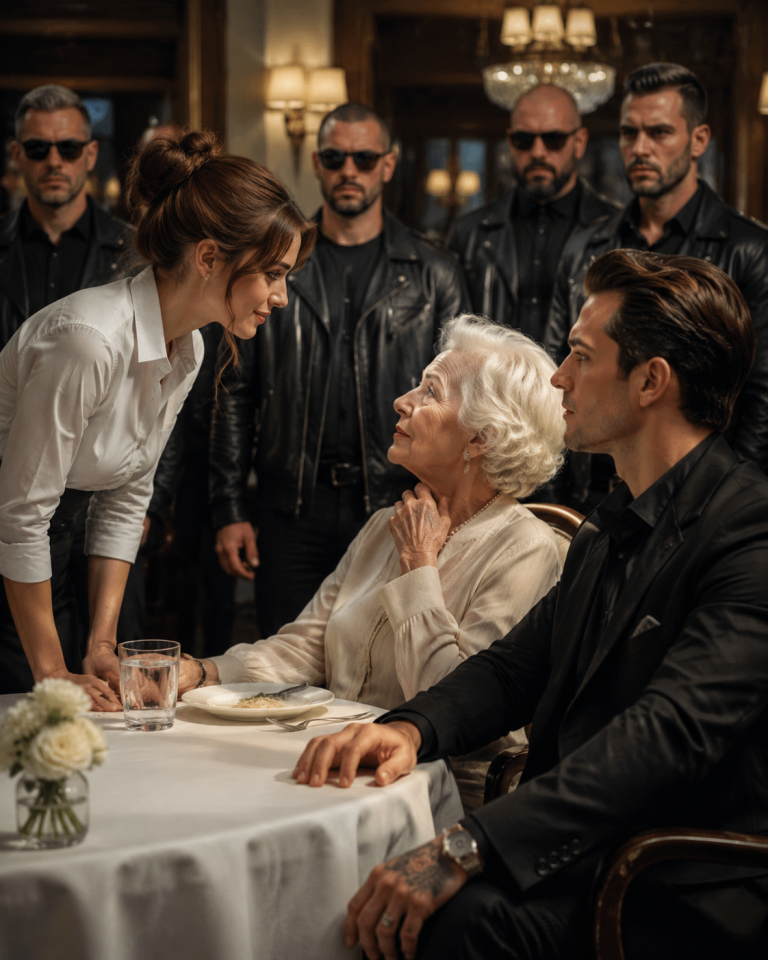
Vitale Roso sat angled beside the desk in a wheelchair, hands braced on its rims like they’d fused there, shoulders too broad for the frame holding him. A white shirt, sleeves rolled to the elbow — except the left cuff, buttoned all the way down, fastened in a hurry.
When he lifted his eyes to her, they were dark and unhurried, the eyes of a man who registered everything and decided later what he’d let you see him decide. He wasn’t the abstraction the newspapers had built. He was worse. He had breath. A pulse. A fresh cut healing near his temple.
“Ms. Marchetti,” he said. “Sit. I’ll stand.” A fraction of amusement crossed his mouth. “Figuratively.”
Percy closed the door behind her and didn’t leave — just took up a position by the bookshelf, a silent fixture.
“I run a shipping and logistics operation,” Vitale said. “Six months ago someone inside it decided my death was worth more than my continued employment. I didn’t die. I did lose the use of my legs, temporarily, according to my doctor, permanently according to my own patience running out. Somewhere in four years of ledgers is the name of the person who arranged it. Find it.”
“That’s a very large ‘somewhere.'”
“You come recommended as someone who finds discrepancies other accountants are paid not to find.”
“I come recommended as someone who needs the money,” Vera said. “I won’t pretend otherwise if you won’t.”
Something shifted behind his eyes — not warmth, exactly. Recognition. “Good. I don’t tolerate lying. It’s the one house rule that actually matters.”
“What are the others?”
“You’ll have a room in the east wing for the duration. The underground garage is off-limits.”
“Why?”
“Because I said so.”
“That’s not an answer.”
“For today, it is.” His mouth almost moved again. “You’re free to leave the grounds whenever you like, Ms. Marchetti. You are not a prisoner here. You’re a consultant with a ninety-day contract and, I suspect, very little patience for men who think a title should frighten you.”
“You’d suspect correctly.”
Her phone rang at the bottom of her bag. She’d forgotten the outside world still existed.
She glanced at him, silently asking permission she didn’t technically need. He gave a small nod anyway.
“Vera?” Her friend Della’s voice came through tight, close to panic. “Tell me you’re not actually in that house. Tell me I can come get you right now.”
“I’m fine, Della. It’s a job.”
“It’s the Roso family, Vera. I looked it up. Please tell me he’s not in the room.”
“He’s in the room.”
A pause, then the click of a lighter — Della smoking again, something she only did when frightened for someone else. “Tell him if he touches you I’m calling every reporter in this city.”
Vera looked at Vitale. He was watching her without any attempt to disguise it, elbows on the arms of the chair, fingers laced.
“My friend says if you touch me, she’s calling the press.”
“Tell your friend,” he said, without looking away from Vera, “that if anyone touches her, I’ll walk the story to the studio door myself — assuming I can walk by then.”
The joke landed strangely, dry and self-aware in a way she hadn’t expected from him.
Della exhaled hard on the other end. “Okay. That’s — okay, that’s actually reassuring somehow. Call me tonight.”
Vera hung up, phone still warm in her palm.
That was when she noticed it again — the buttoned cuff, and beneath the fabric’s edge, a thin dark stain that had escaped it. Old enough to have been washed once. Fresh enough it hadn’t fully come out.
Blood.
He saw her looking. His eyes dropped to his own wrist, then returned to her, calm and unapologetic, as if to say: *now you’ve seen it, decide what you’re going to do with that.*
“Percy,” he said, still watching her, “show Ms. Marchetti to her room. The ledgers will be delivered to the library by morning.”
She left the study with her suitcase banging against her leg, heels too loud on the marble, and understood — somewhere in that too-high-ceilinged corridor — that whatever this ninety-day contract actually was, it had already become something considerably more complicated than an audit.
**PART 2**
For four days, Vera buried herself in the ledgers. She found the small thefts first — a foreman skimming diesel costs, a customs broker padding invoices — the ordinary corrosion any large operation grows if nobody’s watching closely enough. She flagged each one and left them on Vitale’s desk without comment, and each time, something in his face eased a fraction, the recognition of a tool proving sharper than expected.
She also learned the mansion’s rhythms. Breakfast in near silence, broken by Percy’s needling humor and Vitale’s dry, exact replies. The way Vitale’s right-hand man, a broad, watchful captain named Reyes, treated her with careful neutrality. The way Vitale never let anyone see him struggle — until the third night, when she heard a dragging sound in the corridor at eleven, uneven weight, a body compensating for what it could no longer do on its own, and then a dull thud she recognized instantly as a man falling out of his chair.
She stood at her door for two full minutes, hand on the knob, and did not open it. She understood, without needing to be told, that opening it would cost him more than the fall already had.
The next morning he told her to pack. “You’re done here by afternoon,” he said, not looking up from his coffee. “I’ll have Percy arrange the car.”
“I haven’t finished the ledgers.”
“You’ve finished enough.” His eyes finally lifted, and she understood then that he knew she’d heard him fall the night before — knew it with the same certainty she’d known it herself. “I won’t give you the chance to hear that twice.”
She didn’t pack. She drank her coffee slowly and looked back at him until he looked away first, and that was the end of the conversation — neither of them raised it again, and by nightfall she was still in the east wing.
Three nights later, a low, contained sound through the wall pulled her out of sleep at 3 a.m. She found him shirtless, fevered, the dressing on his side dark with more than sweat. She didn’t ask permission. She found gauze, alcohol, ointment in his dresser drawer, and cleaned the wound with hands that didn’t shake, even when his fingers closed hard around her wrist for two seconds before the fever took the fight out of him.
“You don’t have to do this,” he rasped.
“I know,” she said. “Someone needed to, and I can’t work with a man who’s dying quietly next door.”
He said nothing about it at breakfast the next morning. Neither did she.
It was Percy who noticed something shifting between them — the way Vitale started finding reasons to be in the library when she was, the way a captain named Marcus Voss, second only to Reyes in the household, had started asking her too many careful questions in the garden about her routine, her friend Della’s salon, what time she usually left the grounds.
That night, crossing the corridor to bed, Vera stopped at the window overlooking the garden and saw Voss below, alone, phone to his ear, speaking fast and low in Italian. She caught only two words clearly.
*Ragazza. Debito.*
The girl. The debt.
Voss looked up at the window where she stood, and held the look a beat too long to be accidental — and Vera understood, with sudden cold certainty, that the man she’d been hired to expose might already be standing three feet from her every single day.
**PART 3**
She didn’t sleep that night. By morning, she’d already decided: she wasn’t going to sit on a suspicion when Vitale had hired her precisely to stop sitting on suspicions.
She found him in the study at seven, before Percy or Reyes had arrived, sunlight still gray through the tall windows.
“I need to tell you something, and I need you to actually listen instead of deciding what it means before I finish,” she said.
He set down his coffee. “Go on.”
“Marcus Voss. He’s been asking me questions in the garden for a week — my routine, Della’s salon, what time I leave. Last night I saw him on the phone. He said two words in Italian I recognized. *Ragazza. Debito.* The girl. The debt.”
Something in Vitale’s face went very still — not surprise, she realized. Confirmation.
“I’ve suspected Voss for three weeks,” he said quietly. “I didn’t have the last piece. You just gave it to me.”
“What does that mean?”
“It means the man who arranged the dock shooting six months ago has been living in this house the entire time, waiting to finish the job — and he’s been circling you because you’re the one person actually looking hard enough at the books to find him.”
The air in the room changed temperature.
Vitale called Reyes and Percy in within the hour. Vera sat at the edge of the desk while the three of them laid a map across it — the port, three warehouses, one crossed out twice in red pen.
“Voss set a meeting tonight,” Reyes said. “Thinks the boss doesn’t know.”
“I’m going,” Vitale said.
“In the chair or on your feet?” Vera asked. A month ago the question would have been cruel. Now she watched him actually weigh it.
“In the chair to the car. On my feet inside, leaning on Reyes if I have to. But on my feet.”
“I’m coming.”
“No.” His hand found her wrist, thumb pressing once, deliberate. “You stay here with Percy and six men on the perimeter. If it goes wrong, you and Percy leave through the side gate and go to Della’s. It’s already arranged.”
She hated that the arrangement had been made without her. She understood, too, that this was one battle where hating it changed nothing.
“Come back whole,” she said instead.
He held her wrist two seconds longer than necessary, and left.
—
The night crawled. Percy taught her a card game with rules he invented as he went, clearly just to keep her hands busy. At 1:19 a.m. the phone rang and Percy answered before the second ring.
“Both of them whole,” he said, hanging up, and something in his face — a man who’d clearly seen decades of nights like this — finally allowed itself to relax. “Your boss is walking back to the car. Reyes is complaining about it.”
Vera was on the stairs before she’d decided to move.
The car came up the side drive twenty minutes later. Vitale got out bracing on the doorframe, favoring his left side, blood on his sleeve.
“Not mine,” he said before she could ask. “It’s Voss’s. Where he needed to be.”
She didn’t ask more. Some answers didn’t need saying aloud.
He climbed the steps with Reyes’ arm under his, not hiding the effort this time, and when they reached the landing he said, simply, “Thank you,” and Reyes nodded once and left them.
In the study, she knelt and opened his jacket at the shoulder, checking despite his insistence the blood wasn’t his. It wasn’t. She let out a breath she’d been holding since the car left the grounds.
“Tell me,” she said.
He told her — the warehouse, the smell of motor oil and blood, Voss’s smile withering when Vitale walked in on his own legs instead of arriving in the chair everyone had assumed would keep him weak forever. How he’d asked Voss exactly one question — *how much did they pay you* — and gotten an answer so small it was almost an insult to thirty years of supposed loyalty.
Vera didn’t flinch hearing the rest. She just said, quietly, “Good.”
“You’re terrifying, Vera.”
“I learned from the right documents. Ledgers don’t lie. People do.”
His hand rose to her cheek, thumb tracing slow along her jaw. Then he looked down at his own left foot — and it moved. Toes contracting once inside the leather shoe, slow, deliberate, undeniable.
“Vitale—”
“It happened in the car,” he said, voice lower than she’d ever heard from him. “Reyes was driving. I didn’t tell him. Only you.”
“Only me.” Something warm rose in her chest and stopped behind her eyes. She placed her hand over his knee like the gesture itself might undo whatever had just happened if she moved too fast. “The doctor sees this tomorrow. Promise me.”
“I promise.”
—
Dr. Halloway confirmed it three weeks later, after daily physiotherapy and two falls Vitale swallowed in silence rather than let anyone see: real progress, not total, but significant. Within a month he’d walk short distances alone, longer ones with a cane.
“You taught me something,” Vitale told her afterward, sitting on the physio table, sunlight cold through the single tall window. “For five months I lied to Reyes, to Percy, to everyone, and told them it was a matter of days. Hiding it nearly cost me the one person who never once flinched at what she actually saw.”
“I wasn’t hired to flinch,” Vera said. “I was hired to find what was hidden. Turns out that included you.”
He laughed — short, low, more real than anything she’d heard from him in ninety days.
Her contract ended on a Tuesday in October, the ledgers finally clean, Voss’s theft and treachery fully documented and buried in a report only three people would ever read. Percy delivered the final payment himself, sixty thousand dollars and a bonus he called “hazard pay for putting up with all of us,” and told her the car would take her home whenever she was ready.
She wasn’t ready. She realized it standing in the garden under a magnolia going copper at the edges, watching Vitale take nine unsupported steps toward her, leaning only lightly on a cane he was already learning not to need.
“I could hire you again,” he said, stopping in front of her, slightly out of breath, deeply pleased with himself anyway. “There are always more ledgers.”
“That’s a terrible reason to keep someone around.”
“Then stay for a worse one.” He reached for her hand, and this time there was no debt behind the gesture, no contract enforcing it, nothing but a man who’d spent five months hiding his weakness from everyone except the one person he’d hired to find exactly that. “Stay because I’m asking, not because anyone’s paying you to.”
Della, when Vera called her that night to explain she wasn’t coming home after all, was quiet for a long moment.
“You sound different,” she finally said. “Lighter. Are you sure about this, Vera?”
Vera looked out at the garden, at the lit windows of a house that no longer felt like someone else’s fortress, and thought about all the things she’d walked in expecting to find — corruption, danger, a job that paid her mother’s medical bills and nothing more.
“I’m sure,” she said. “I found what I was actually looking for. I just didn’t know it wasn’t in the ledgers.”
She hung up, and outside, the magnolia dropped one more copper leaf into the dark, and for the first time in longer than she could remember, Vera Marchetti wasn’t counting the cost of anything at all.