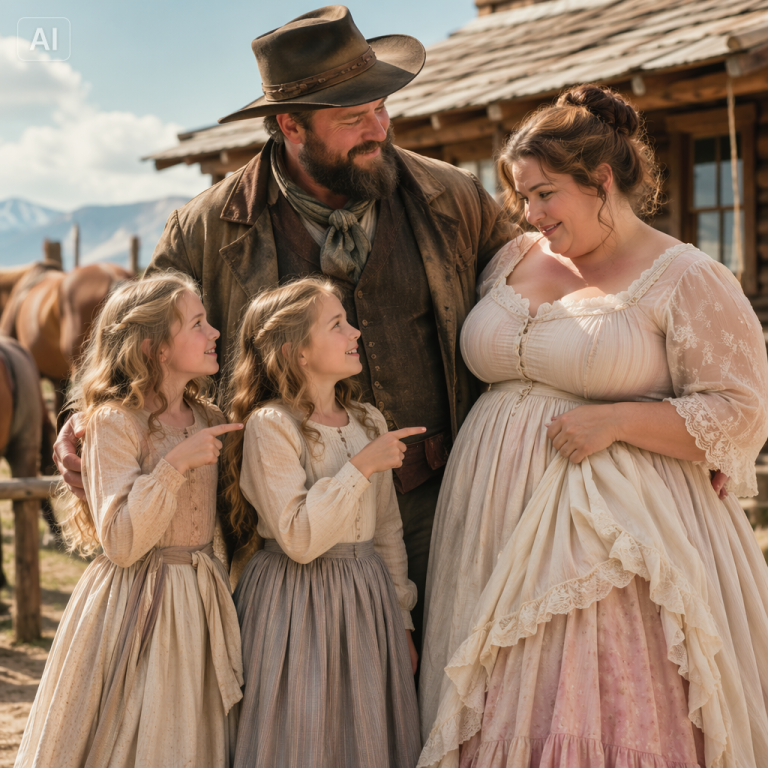
he Rode Through a Blizzard to Save the Woman Who Once Called Her “More Than They See” — What She Found at the Door Changed Everything

Part 1
There was flour under her fingernails the morning she heard the news.
Judith Crane didn’t stop kneading. She just listened, the way she’d learned to listen to everything in Iron Ridge — from the edges, never the center, because the center of a room had never once belonged to her.
“The Hawthorne woman won’t last the week.”
Old Mrs. Pellet said it the way people say things they’re secretly glad about. A great family, finally cracking. A fearsome man, finally small.
Judith set down the dough.
Everyone in town knew Edward Hawthorne. Everyone had read his notice, nailed to the post outside the feed store three weeks back, ink still smudged from the cold when he’d hung it: *Wife wanted. Must be capable of hard winters and harder work. Silk and softness need not apply.*
Half the town had laughed. The other half had sent their daughters up the mountain anyway — seamstresses, a schoolteacher, even the banker’s girl from Cartwell in a covered carriage — and watched them come back down red-eyed and empty-handed. Not one had been *enough.*
Judith hadn’t laughed. She’d stood at the corner of the store reading that notice twice, thinking not of Edward Hawthorne at all, but of his mother. Of a winter fifteen years gone, when a woman in a good wool coat had sat down on a cold step beside a crying twelve-year-old girl and pressed a lavender handkerchief into her hand.
*You are more than they see.*
Nobody had ever said that to Judith Crane again. She hadn’t needed them to. Once had been enough to survive on.
By the time Mrs. Pellet finished her gossip and the bell over the bakery door had stopped its rattle, Judith was already untying her apron.
She didn’t leave a note. There was no one in Iron Ridge who required one. The morning loaves were shaped and rising under cloth by the time she pulled her grandmother’s satchel down from its shelf — old leather, dark with forty years of handling, the same satchel May Crane had carried up mountain trails before Iron Ridge was anything but a mark on a surveyor’s map.
Inside: dried yarrow. A tin of pine-resin tallow. Black kohash root wrapped in cloth. And at the very bottom, tied twice in twine, a paper parcel of something her grandmother had only ever called *root fire* — a compound Judith had watched used exactly once in her life, on a man whose leg had gone black with infection. He had screamed through the night. By morning, he had asked for broth.
She had never used it herself. Not on a living person.
Outside, the sky had gone the color of an old bruise, clouds swollen and greenish at the belly — the kind old-timers read like scripture. *Real snow tonight,* they’d say. *The kind that closes roads.*
Judith looked up at that sky for a long moment. Then she went to the livery and paid two weeks’ wages to rent Cornet, the biggest, steadiest draft horse they had, and rode east, toward the treeline, toward the place where the road stopped being a road and became a suggestion.
She had heard all the stories about Edward Hawthorne. A man built like something the mountain assembled for its own purposes. A man who’d once carried a felled elk three miles on his back rather than admit his horse had gone lame. A man who looked at every woman who answered his notice and delivered the same flat verdict:
*Not strong enough.*
Judith Crane was not a banker’s daughter. She was not soft, or small, or anything Iron Ridge had ever considered worth a second glance. She was large-handed and plain-faced and good — unnervingly good — at things nobody had bothered to ask about.
She had made peace with being overlooked a long time ago. What she had never made peace with was being *powerless.* Those, she’d learned, were not the same thing at all.
Snow began to fall as Cornet climbed, fat flakes catching in Judith’s lashes, the light dying fast behind the ridge. She thought of Esther Hawthorne’s hands — warm, certain, pressing lavender cloth into a weeping girl’s fist fifteen years ago.
*One of them, at least, had meant it.*
The gate came into view through the whiteout first — iron, hanging slightly askew on one hinge, and *open.* That, she hadn’t expected.
She dismounted, tied Cornet beside a lean-to sheltering two horses and a mule, and climbed the porch steps of a house twice the size it had looked from the ridge, lamplight burning gold behind glass someone had wiped clear from the inside.
Someone was keeping vigil.
Judith knocked.
The door opened, and the man who filled the frame was exactly what the stories promised, and somehow still a shock to stand in front of. Tall enough to duck the lintel. Broad in the way of men who never had to cultivate it. No shirt. Blood dried dark along one forearm — the kind that comes from hours of helpless hovering near something you can’t fix.
His eyes moved over her, fast, cold, assessing. She recognized the look. She’d worn the receiving end of it her entire life.
“No,” Edward Hawthorne said.
—
Part 2
Judith kept her hand on the strap of her satchel.
“You haven’t heard what I’m offering.”
“I don’t need to.” His gaze swept over her once more, the same impersonal efficiency he’d no doubt used on every woman before her. He’d already decided she had nothing to give. That told her more about the smallness of his imagination than anything the town had ever said about him. “The trial’s closed. Go back down the mountain before the road’s gone entirely.”
Judith didn’t move.
“I’m not here about your notice.” She held his eyes. “I’m here about your mother.”
Something flickered across his face, gone before she could name it.
“The doctor’s already—”
“The doctor,” Judith said quietly, cutting clean through the sentence, “has never seen what’s in this satchel. And he’s never once watched a wound like your mother’s survive the night.”
The silence between them stretched long enough for snow to gather on Judith’s shoulders. She didn’t brush it off. She’d learned, over a lifetime of being measured and found wanting, that the person who moved first in a silence like this one was the person who’d already lost.
So she waited.
Above them, through the ceiling, came a sound — faint, wet, wrong. Lungs working far harder than lungs should have to.
Edward stepped back from the door.
He didn’t say *come in.* He didn’t say anything. But the space where his body had been was open now, warmth pressing outward into the cold, and Judith understood the concession for exactly what it was. She crossed the threshold without ceremony and set her satchel on the entry bench.
“The doctor said keeping her comfortable was the only—”
“What color is the wound?” Judith asked, already unbuckling her coat.
He stopped mid-sentence. A muscle worked in his jaw.
“Dark purple at the edges. Black in the center.”
Judith nodded once — the way her grandmother used to nod when a diagnosis confirmed itself. Not satisfaction. Grim efficiency.
“How long since it changed from red?”
“Three days.”
“And the smell?”
Something moved across his face that wasn’t disgust. It was grief — the specific kind that belongs to a man who has sat with an unbearable thing long enough that saying it out loud still has the power to undo him.
He looked away.
“Yes.”
“Then we don’t have the night to argue about it,” Judith said, lifting the satchel. “Show me the room.”
What she found upstairs told her everything the town of Iron Ridge never had — about the doctor’s verdict, about the fever, about exactly how many hours separated Esther Hawthorne from her last breath. Judith Crane had walked into that room believing she was there to fight an infection.
She had no idea yet that she was also about to discover *why Esther had asked for her by name* — a detail Edward hadn’t told her yet, one that would change everything he thought he understood about his mother, about the notice he’d nailed to that post, and about the woman standing at his mother’s bedside with her sleeves already rolled to the elbow.
—
Part 3
The upstairs room was small and fiercely warm, a cast-iron stove burning high in the corner, furs piled on the narrow bed with a generosity that verged on frantic. In the middle of all that warmth, diminished by it somehow, lay Esther Hawthorne.
She was smaller than Judith remembered. Memory had kept her larger — a woman who’d moved through Iron Ridge with the quiet authority of someone comfortable in her own consequence. But illness had been doing its work. Her white hair spread thin against the pillow. Her hands, folded at her sides, were the hands of someone who had stopped reaching for things.
Her chest was still moving. Shallow, labored, irregular.
But moving.
Judith set the satchel on the bedside table and opened it without haste — the tin of pine-resin tallow, the wrapped kohash root, the parcel of root fire set at the very top of the order of things, within reach for when its time came.
She became aware that Edward hadn’t left the doorway.
“I’ll need clean water,” she said without turning. “Boiling. And cloth — linen if you have it, cotton if you don’t.” She paused. “And then I’ll need you to do something that will be very difficult for you.”
She heard him exhale.
“What?”
“Wait,” Judith said. “And trust me.”
He brought the water without argument, which surprised her more than she let show. She’d expected another round of cold assessment — a more articulate version of the dismissal he’d offered at the door. Instead, he disappeared downstairs, and she listened to the clank of the iron pot, the creak of the pump handle, the particular focused efficiency of a man who’d finally been handed something solid to hold onto in a night that had offered him nothing but helplessness.
By the time he returned with the pot and a stack of linen folded with near-military precision, Judith had turned back the furs and examined the wound by candlelight. She understood exactly what she was dealing with.
The infection had tracked inward along the tissue, following the path of least resistance the way all destructive things do. The edges were the purple-black Edward had described, tight and shining with fluid that had nowhere left to go. The smell was faint but unmistakable.
She’d made it in time. Barely.
She worked without speaking for a while. Edward stood at the foot of the bed, arms crossed, watching with the coiled, useless tension of a man accustomed to problems that yielded to force. He had no instrument for this one. No way to lift it, break it, outlast it by sheer will. All he could do was stand still and watch a woman he’d insulted less than an hour ago try to save the one person in the world he couldn’t survive losing.
“She spoke this afternoon,” he said finally. His voice came from somewhere quieter than before, stripped of its earlier armor. “For about ten minutes. She asked for water. Asked if the horses were fed.” A pause. “That’s her. That’s still very much her.”
“She didn’t ask for a doctor?”
“No. I think she already knew what one would say.” Another pause, longer this time. “She asked for you.”
Judith’s hands stilled over the compress for the length of one breath.
“What did she say. Exactly.”
He cleared his throat, the awkwardness of a man unused to reporting tenderness. “She said, *the Crane girl knows the old ways. Someone should go down and fetch the Crane girl.*” His jaw tightened. “I didn’t go. I didn’t even know who she meant. Not at first.”
Judith thought of a lavender handkerchief pressed into a child’s palm without ceremony, without the giver expecting to be remembered for it — the kind of goodness so constant it doesn’t register to the person doing it as anything remarkable at all.
“She remembered me,” Judith said. It came out quieter than she’d meant it to.
“She remembered everyone worth remembering,” Edward said. And for the first time since she’d stepped through his door, there was nothing guarded in his voice at all — just the plain, unarmored truth of a son terrified of losing his mother, who had finally run out of ways to hide it.
Judith looked up at him across the bed. In the low firelight, the fearsome beast of Iron Ridge looked exactly like what he was: a man standing at the edge of a loss he had no idea how to survive.
“Then let’s make sure she has more mornings to remember,” Judith said. “Hand me the root fire. It’s time.”
He handed it over without hesitation. Something in that — the absence of argument, the speed of his trust — told her something had already shifted in him that neither of them had named yet.
—
The compound was dense and dark, the color of old bark, its smell hitting the back of the throat like woodsmoke laced with something mineral, and beneath that, something sweeter — the way certain forest floors smell after rain. Her grandmother had never written down the full recipe, trusting instead that the knowledge would pass the way it always had — hand to hand, woman to woman, through the simple, radical act of being present when it mattered.
“I need you to understand what’s about to happen,” Judith said, unwrapping it with care. “This will draw the infection out through the tissue. It will look worse before it looks better. There will be fluid. There will be a smell. And she may wake.” She looked up, met his eyes directly. “If she wakes, she may be in pain, and I need you to hold her still without panicking. Because if she moves at the wrong moment, we lose everything we’ve gained.”
“I won’t panic.”
“Most people say that,” Judith said evenly. “And then the moment arrives, and they discover they were wrong.” She held his gaze without apology. “I’m not questioning your courage. I’m asking you to prepare for something specific. There’s a difference.”
Something moved through his face — not defensiveness this time, but the effortful, unfamiliar work of a man revising an assessment of himself in real time.
“Tell me exactly what you need me to do.”
So she told him. He listened the way she imagined he listened to everything that mattered — completely, without interruption, eyes fixed on her face like the instructions were being written somewhere he intended to keep them. When she finished, he asked one practical question about the angle of his grip. She answered it. Then they turned to Esther together, and began.
The next forty minutes were the longest Judith had spent in a sickroom since the night she’d sat with her own dying mother — and she’d believed for years that nothing would ever match that particular weight of time. She was wrong again. This was different in character but equal in cost: the compressed, airless time of a crisis that takes everything you have and doesn’t care what it costs you.
She packed the root fire in careful increments against the wound’s edge, working outside in, giving the compound time to penetrate before advancing. The smell sharpened almost at once — corruption drawing toward the surface — and she heard Edward’s breathing change, controlled, deliberate, a man actively managing himself by force of will. But he didn’t step back. He didn’t look away.
At the twelve-minute mark, Esther stirred. Her eyes opened halfway, clouded with fever, and a sound rose out of her that wasn’t quite a word but carried the shape of protest — the body’s instinctive resistance to pain.
“Hold her,” Judith said.
Edward was already there, both hands steady on his mother’s shoulders, his face close to hers, speaking low and continuous in a voice Judith hadn’t expected to ever hear from him. Not commanding. Not managing. Just talking to his mother the way a man talks when he’s forgotten anyone else is in the room. Telling her she was safe. Telling her he had her. Telling her, in a voice stripped down to almost nothing, that she wasn’t allowed to leave him yet.
Esther’s body gradually stilled beneath his hands.
Judith worked on.
At the thirty-eighth minute, the wound changed. She felt it through the cloth before she saw it — the almost imperceptible yield of tissue finally surrendering what it had been holding. The smell shifted from corruption to something raw and cleaner underneath.
Judith sat back on her heels and exhaled for what felt like the first time in an hour.
“It’s moving,” she said quietly. “The infection is moving out.”
Edward looked up from his mother’s face. Whatever was in his eyes when they found Judith’s, she didn’t have a name for it yet.
“Tell me what to do next.”
“Keep the compress warm. Rotate it every twenty minutes.” She nodded toward the wound. “If the skin starts to lighten from purple toward red — even a little — that’s the blood coming back. That’s what we want.”
He took her place at the bedside with a care that was almost ceremonial, as if being trusted with this one task had conferred on him a responsibility he intended to honor precisely.
Judith moved to the plain wooden chair in the corner and, for the first time since riding out of Iron Ridge, let herself stop moving. Exhaustion hit all at once, the way it always waits politely until you finally sit down. Her back ached from the ride. Her hands were stiff with cold that hadn’t fully left them. Outside, the blizzard had reached its full voice, wind finding the gaps in the timber and making its presence known in long, low registers that moved through the walls like something alive.
She’d been sitting maybe ten minutes when Edward spoke.
“You’re cold.”
It wasn’t a question. She hadn’t realized she was shivering, but apparently she was.
“I’m fine,” she said, which was mostly true.
He looked at her a moment, the expression of a man recalculating the ethics of a situation he hadn’t anticipated finding himself in. Then he crossed to the hook by the door and took down a flannel shirt — heavy, dark, worn soft with years of use — and held it out without a word.
Judith looked at it. Then she took it, because she was practical above all things, because she was cold, and because pride was a luxury belonging to people with more options than she’d ever had. She pulled it around her shoulders. It smelled of woodsmoke and pine resin, and it was large enough to wrap twice around her, which neither of them commented on.
“Thank you,” she said.
He returned to the bedside, rotated the compress, checked his mother’s breathing. Then, in the way of people who’ve been alone with a large silence long enough that speech becomes its own kind of necessity, he asked:
“How did you learn it? The medicine.”
“My grandmother. May Crane.”
“You knew her?”
“My mother did.” He was quiet a moment, eyes on Esther’s face. “She said she was the most capable woman she’d ever met. That Iron Ridge didn’t deserve her.” A pause. “She said the same of you, once. I didn’t know who she meant then, either.”
Judith absorbed that in silence — something both tender and painful in it. The idea that Esther had been speaking her name in this house, in this room, while Judith had been invisible in the valley below, moving through her narrow, sufficient life without knowing she existed in anyone’s story but her own.
“She was the only person,” Judith said, and stopped.
“Who? What?”
She looked toward the window, at the white darkness pressing on the glass.
“Who ever looked at me and didn’t see a liability.” The words came out with less armor than she’d meant to allow. She considered pulling them back and decided she was too tired for the effort. “Most people look, and they calculate, and the calculation always comes out the same way. Too much of this. Not enough of that.” A pause. “Your notice said as much.”
The silence that followed had a different weight than the ones before it.
“The notice,” Edward said slowly, not looking at her, jaw tight in the way it gets when a person is fighting their own nature to say something true, “was written by a man who thought he understood what strength looked like.” He shook his head once. “I’m beginning to think he was looking at the wrong things entirely.”
Judith said nothing. But something in her chest, long braced against exactly this kind of moment, shifted very slightly toward warmth.
—
The fire burned low sometime after midnight, and Edward rose to feed it without being asked. Judith watched him move through the room — quiet for a man his size, navigating the space around his mother’s bed with an awareness of every creak, the body-knowledge of someone who’d been keeping this particular vigil long enough that it had become its own kind of fluency.
He crouched before the stove, forearms resting on his knees, watching the new logs take.
“Why did you come?” he asked. Not the flat challenge from the doorway. The genuine bewilderment of a man who’d turned the question over for hours and finally decided to just ask it.
Judith considered the real answer, not the practical one.
“Do you remember the winter of 1870?”
He turned his head. “I remember it was bad.”
“I was twelve. My mother had just died.” Her voice stayed even, contained, the way she kept most things — not inviting pity, which she’d never found useful. “I was sitting on the steps outside the general store because I didn’t know where else to go. Hadn’t eaten since the morning before. I was wearing my mother’s coat, too big for me, and I was crying, trying not to, because people kept walking past and I didn’t want to give them the satisfaction of seeing it.”
Edward had turned fully toward her now, firelight behind him, his face in shadow, but she could feel the quality of his attention.
“Your mother came out of the store. She had a peppermint stick and a lavender handkerchief. She sat down next to me on those steps, in her good coat, in the cold, without being asked. Didn’t say anything for a while. Then she pressed both things into my hands and said, *you are more than they see.* And then she went back inside.”
The room went very quiet. Outside, the blizzard had begun its long retreat, wind dropping from a howl to something more resigned.
“She probably didn’t remember it the next day,” Judith said. “People like your mother — the goodness is so constant it doesn’t register as individual moments. It’s just the way they move through the world.” She paused. “But I remembered it every day for fifteen years. Every day I was overlooked in the market. Every day someone looked through me like a window. I remembered that someone had seen me, once, and I held onto it, and it kept something alive in me that might otherwise have gone out.” The fire snapped and resettled. “So when I heard she was dying, and I knew I had something that might help — there was never a question. There was never a calculation. You don’t weigh a debt like that against a blizzard and land on the side of staying home by the fire.”
Edward was quiet a long time. When he spoke, his voice had the roughness of a man handling something fragile he wasn’t used to holding.
“I tried to turn you away,” he said. “I stood in that doorway and looked at you and made the same calculation everyone else has always made.”
“Yes,” Judith said simply. “You did.”
“I was wrong.”
“Yes,” she said again. “You were.”
He absorbed that without flinching, which she respected. A lesser man would have qualified it, or turned it into a story about himself that was easier to inhabit. Edward simply sat with the fact of it.
“The notice,” he said after a moment. “Every woman I turned away — I told myself I was being practical. I was being—” He looked at his hands. “Afraid.”
“Of what?”
His eyes went to his mother. “Of choosing wrong. Of bringing someone into this life who couldn’t sustain it, and losing her the way—” He stopped. “My father died in a January storm, trying to reach a neighbor. The cold took him in under an hour.” His jaw tightened. “I told myself I needed someone strong. What I meant was I needed someone I couldn’t lose.”
Judith looked at him across the room — this large, armored, frightened man who had built his loneliness into a philosophy and called it standards — and felt something that wasn’t quite pity, wasn’t quite tenderness, but lived in the same country as both.
“Heavy logs burn longest,” she said quietly.
He looked at her.
“My grandmother used to say it about people, too.” Judith pulled his flannel shirt a little closer around her shoulders. “The ones who look like too much. Who take up too much space. Who the world keeps trying to cut down to a manageable size.” She held his eyes steadily. “We burn longest, Edward. We last the winter. That’s not a liability. That’s the whole point of us.”
He looked at her for a long moment, and something in his face — the last of the defensive architecture, the final outpost of the distance he’d spent years maintaining — came quietly down.
Neither of them said anything after that. But the silence, for the first time since she’d stepped through his door, was not a space between adversaries. It was something warmer, more tentative, and neither of them moved to disturb it.
At the bedside, Esther breathed on — slow, labored, but steady in a way it hadn’t been before. The compress did its ancient, patient work. The fire held. They watched, and waited, and the long night continued its turning toward dawn.
—
Dawn came the way hard nights end — not dramatically, but with a slow, accumulating insistence, gray light pressing through the frost-crusted window until the candle became redundant and the room resolved itself back into the living world.
Judith hadn’t slept. She didn’t think Edward had either, though at some point in the small hours he’d slid from the chair to the floor beside the bed, back against the frame, head tipped against the wood, eyes closed in the posture of a man who’d given his body permission to rest without surrendering his post. She’d let him be, spending the last hours of darkness with the back of her hand pressed to Esther’s forehead, rotating the compress, watching the wound with the patient, empirical attention her grandmother had taught her — the slow retreat of purple-black from the skin’s edge, the tentative return of color that wasn’t healthy yet, but was moving in that direction.
At ten minutes past six, she pressed her hand to Esther’s forehead and felt it.
The fever had broken. Not gone — that would take days, and rest, and broth, and time — but the raging heat that had been burning through the old woman for four days had crested, and turned. The body had finally won the argument it had been making against the infection all along.
Esther’s skin was damp, cool at the temples. Her breathing, still slow, had lost its rattling, desperate edge, settling into something that sounded, for the first time, like sleep instead of unconsciousness.
Judith exhaled.
She felt Edward wake without hearing him move — the shift in the room’s attention that happens before you actually see someone’s eyes open. He stood, looked at his mother’s face, at the color beginning its long return to her cheeks. His throat moved.
“The fever broke,” Judith said.
He nodded, slow, the nod of a man receiving news his body already knew and needed a moment to properly absorb. He pressed the back of his own hand to his mother’s forehead — a mirror of what Judith had just done, as if he needed the direct, unmistakable evidence of his own skin. Then he stood straight and put his face in his hands for ten seconds. Fifteen, perhaps.
Judith looked at the window and gave him those seconds without comment, because some things aren’t meant to be witnessed directly — only honored by the decent act of looking away.
When she looked back, his hands were at his sides. His eyes were red-rimmed. He didn’t look embarrassed by that, which told her more about him than anything the night had revealed.
“She’ll need watching the next three days,” Judith said, returning to the practical, because the practical was where she was most fluent, and because he needed something to hold onto. “The wound redressed twice daily. I can write down—”
“Stay.”
The word came out plain, without the defensive wrapping he’d put around everything else he’d said to her.
Judith looked at him.
“Not to work,” he said, careful now, in a different way than before — not the carefulness of a man managing distance, but the carefulness of someone who has something to lose and knows it. “This house has been missing something it didn’t have a name for. And I think you know what I mean. I think you’ve known since the moment you rode through that gate.”
Judith stood very still. She thought of the bakery, the dawn-dark and the flour, the quiet arithmetic of a life built around being useful to people who never quite saw her. She thought of the narrow bed above the tanner’s shop and the satchel underneath it, of fifteen years of mornings spent pressing a lavender handkerchief between her palms like a small, private prayer before going out to face the day.
She looked around the room — the cast-iron stove, the timber walls, the window filling now with pale gold morning light breaking clean and cold over the ridge. At the woman in the bed who had once sat down on a cold step beside a crying child and, for one brief moment, made her feel like the world had miscounted her. At the man standing across from her, who had spent an entire night dismantling everything he thought he knew, and arrived at dawn with his hands finally open.
“I’ll need my own room,” Judith said.
Something moved through Edward’s face — beginning as relief, arriving cautiously as something warmer.
“You can have whichever one you want.”
“And I’ll finish the baking orders until Hess finds someone else. I won’t leave him without notice. That’s not negotiable.”
“Understood.”
“And you’ll speak to me the way you spoke to me tonight. Not the way you spoke to me at the door.”
He held her gaze steadily. “That man at the door,” he said, “made a great number of errors in judgment. I intend to spend considerable time correcting them.” A pause, and then, with the particular awkwardness of a man attempting sincerity in a register he’s rarely used, “Beginning, if you’ll allow it, with an apology.”
Judith looked at him a long moment. Then she looked at Esther, sleeping on in her clean, healing quiet, chest rising and falling with the steady rhythm of someone who had decided, without consulting anyone, to remain among the living.
Then she looked back to the window. To the ridge beyond it, blazing now in full cold morning light, the snow unbroken and vast and extraordinarily beautiful — the kind of landscape that doesn’t accommodate smallness, or apology, or the cramped arithmetic of a life lived at the world’s margins.
She had ridden up this mountain in a blizzard with a satchel full of her grandmother’s medicine and fifteen years of quiet, accumulated purpose. She had walked through a door that had been closed against her. She had worked through the longest night of her life, and the fever had broken, and the dawn had come, and the ridge was hers now as much as anyone’s — more, perhaps, because she had earned her view of it in a way silk and softness never could.
“I’ll stay,” said Judith Crane.
Iron Ridge, though it did not yet know it, had just met its Lady of the Ridge.
**THE END**