HE RODE TO A WEDDING TO A STRANGER HIS FATHER PROMISED HIM — THEN SHE LIFTED THE VEIL AND HE FORGOT WHAT HE WAS ABOUT TO SAY

PART 1
Nobody in the Windermere family talked about the agreement out loud. Not at the dinner table. Not on the porch at dusk, when the sky turned the color of old copper and the cattle settled into silence. It was simply understood, the way certain things in ranch families always were, that Byron would honor it because his father had given his word, and a Windermere word was the only currency out here that never lost its value.
Byron had not argued. That was the part that bothered him most, lying awake at night listening to the wind drag itself across the high grass. He had not fought it. Had not even asked the question sitting heaviest in his chest. He had simply nodded at his father’s bedside, watching the old man’s eyes search his face for resistance and find none.
That had been enough. The agreement stood.
What he knew about Iola Sury could fit inside a single breath. Youngest daughter of a rancher two counties west, a man his father had once called the most quietly powerful person he’d ever shaken hands with. Beyond that — nothing. No description. No age, no temperament, no history offered.
The only thing his father’s old foreman, a leathered man named Cord, had said when Byron pressed him, was this: “She’s not what anyone expects.”
Then Cord had walked away and never elaborated.
Byron chose to interpret that as gently as possible. Quiet, he told himself. Perhaps bookish. Perhaps a little severe, the way some women raised on isolated ranches could be — practical to a fault, uninterested in softness. Good. He built a version of her in his mind the way a man builds a fence, not because he wanted to, but because the open space made him uneasy. He wasn’t proud of the picture. He drew it anyway.
The morning of the wedding arrived without drama, without warning — just pale gray light through the bunkhouse window and a rooster making its indifferent announcement to the world. Byron dressed slowly. His good shirt had been pressed and folded on the chair by the door. His boots polished by someone who’d done it quietly, without being asked. Small kindnesses had a way of feeling like pressure when a man was already carrying enough.
He rode out alone. The ranch hands offered to come; he declined with a short shake of his head nobody questioned. The trail west took him through old mesquite and across two dry creek beds before the land opened into the wide grass expanse belonging to the Sury family. He’d never set foot on this land before. It was larger than he expected, the fences old but well-kept — the kind of place that didn’t need to announce itself.
A small white church sat at the edge of the property, modest steeple, the kind of building placed there by someone who understood that faith in remote country needed a permanent address. A handful of wagons already gathered outside. Byron counted them without meaning to, which meant there were people inside who would watch whatever happened next.
He had not thought about the watching. He sat on his horse a moment longer than necessary.
Inside, the church smelled of pine resin, candle wax, something faintly floral he couldn’t name. Perhaps thirty people filled the pews — ranch hands, neighboring families, a few older women in dark dresses studying him with the particular attention of people who’d already formed their opinions. A minister stood at the front, patient and unhurried.
Byron took his place. The doors at the back stayed closed. A minute passed. Then another. He kept his eyes forward, aware of people watching the side of his face, giving them nothing to read — a skill the Windermere men had always possessed, standing still inside a moment moving around them.
Then someone in the back pew shifted. A child whispered. An older woman pressed her handkerchief to her mouth in a gesture that was not quite grief and not quite surprise, but something living between the two.
Byron heard the doors open behind him. Soft, measured footsteps up the aisle — unhurried, deliberate, carrying no apology for the silence they arrived in. He did not turn immediately. He waited, the way his father had always told him to. *Let the moment come to you, son. Chasing it only makes you look desperate.*
Then she was beside him. He turned.
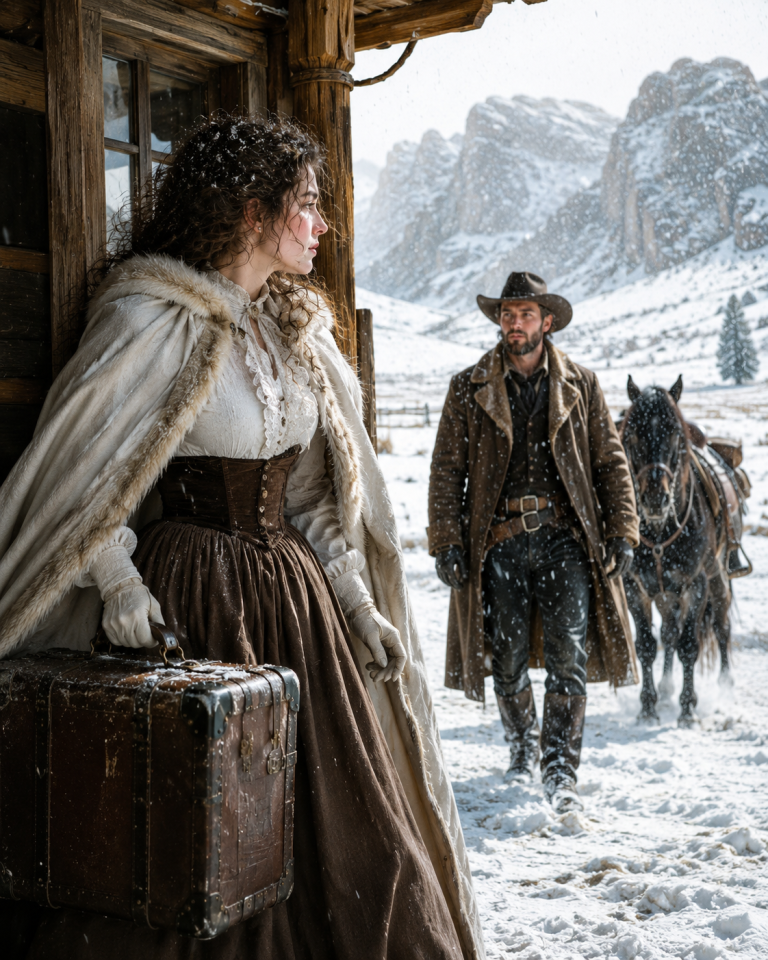
The veil was ivory, fine as morning mist, obscuring everything and nothing at once. But he could see the shape of her — tall, composed, shoulders carrying a stillness that did not come from shyness. She looked straight ahead at the minister. Not at Byron. Not at the room. Just forward, as though she’d already decided that whatever was about to happen, she would meet it standing upright.
The minister began speaking. Byron heard perhaps one word in five, because he was trying to reconcile the woman beside him with the plain, unremarkable figure he’d constructed in his mind over the past three months. The two images would not sit together. They refused to overlap.
He told himself it was the light. The candles. The way fabric and shadow could deceive a man.
He told himself that right up until the minister nodded gently and said the words that meant it was time.
Iola reached up with both hands, slowly, without hesitation, and lifted the veil.
Byron Windermere — a man who had broken horses, buried his father, and never once been described as a man who lost his composure — stood in that small white church in the middle of nowhere and forgot completely what he had been about to say.
The woman beside him was not what he expected. She was not what anyone in that room expected, judging by the silence that fell so completely the candle flames seemed to pause with it.
But what stunned Byron wasn’t simply what he saw. It was the expression in her eyes when she looked at him for the first time — calm, direct, and carrying something underneath he couldn’t name. Something that looked almost like a question she had been waiting a long time to ask.
And then, very quietly, before the minister could continue —
She looked away.
PART 2
The reception was held on the open land behind the church, long tables under canvas rigged between four tall posts, food laid out by women who’d clearly been cooking since before dawn. It should have felt celebratory. It looked the part. But there was a current underneath the surface Byron could feel without naming — the way you sense a change in weather before the sky gives any real indication.
People were watching Iola. Not rudely. Not openly. The way people watch someone they recognize without being certain from where. A sideways glance held a beat too long.
Byron noticed it because he was watching her too, working considerably harder to make it look like he wasn’t. She moved through the gathering with a quietness that wasn’t timidity — spoke when spoken to, smiled a small, deliberate smile offered selectively, meaning more when it came.
Cord appeared beside him with the particular silence of a man who’d spent decades moving around livestock and applied the same skill to human gatherings.
“You all right?” Cord asked.
“Fine,” Byron said.
Cord looked at him the way old men look at young ones who’ve just said something technically accurate and entirely unconvincing. He didn’t push it. Watched the gathering a moment.
“Her father was Edmund Sury,” he said.
Byron turned his head slightly. “Was?”
“Passed fourteen months ago. Left everything to her. Every acre, every head of cattle, every account at every bank from here to the territorial capital.” He paused, letting it settle. “She’s been running it alone since. Didn’t tell anyone outside the county. Didn’t ask for help. Just ran it.”
Byron looked across the gathering to where Iola stood, listening patiently to an elderly man telling a very long story with great personal investment.
“Why didn’t anyone say that?” His voice came out quieter than he intended.
Cord picked up a piece of cornbread, examined it without particular urgency. “She asked them not to.”
—
The guests thinned as the afternoon did, wagons pulling away in ones and twos, the older women clearing tables with the efficiency of long practice. The canvas came down. The land returned slowly to its natural silence.
Byron found himself alone with his wife for the first time, standing perhaps six feet apart near the remnants of the gathering. Iola had removed the veil hours ago; it hung folded over one arm now, ivory fabric trailing slightly, and she was looking out at the land with an expression Byron couldn’t fully read.
“I didn’t know about your father,” he said finally. “Or the property. Nobody told me.”
She turned to look at him. “I know. I asked them not to.”
“Why?”
She considered that a moment, genuinely, as if deciding how much of the true answer to offer. “Because I needed to know whether you’d show up,” she said, “knowing nothing. Having no reason beyond your father’s word.”
“And if I hadn’t?”
Something moved across her expression. Not quite a smile. Not quite relief.
“Then I would have had my answer,” she said simply. “And we both would have been spared considerably more complicated problems down the road.”
He was quiet a moment. “You were testing me,” he said. Not an accusation. A recognition.
“I was being careful,” she corrected gently, without apology.
They rode back to the Sury ranch as the stars asserted themselves in the darkening sky, and when they reached the house — larger than Byron had expected, two stories, stone foundation, a wide wraparound porch — Iola showed him to a room upstairs without ceremony.
“The house runs on a schedule,” she said at the doorway. “I’ll explain it tomorrow. There’s a lot to learn, and no reason to rush it into one night.”
Byron nodded. Then, because something in him needed to ask: “Do you always make decisions this carefully?”
She rested one hand on the door frame, looked at him with the same direct eyes that had undone him in the church.
“I used to make them quickly,” she said. “It didn’t serve me well.”
She said good night and pulled the door gently shut behind her.
Byron sat on the edge of the bed for a long time. Something from her past had announced itself in her silence tonight, though he couldn’t yet say what — and three days later, it would ride straight up to their front gate on a horse too clean for this country.
PART 3
The rider was well-dressed for this country, which was itself a signal — his jacket fit too well, his horse too clean. He arrived at the front gate on a Tuesday morning while Byron was helping a hand repair a section of fence, and asked for Iola by her previous name, with a familiarity in his tone that Byron noted more than the name itself.
Iola came out onto the porch. For the first time since Byron had met her, the composure she carried like a second skin shifted. Not dramatically. Not visibly to anyone who wasn’t watching closely. But Byron was watching closely. She went still in a way different from her natural stillness.
The rider smiled up at her. “Iola. It’s been a while.”
She did not return the smile. “Mr. Aldine.”
“I heard you got married,” Aldine said, eyes drifting briefly to Byron with a measuring look, neither friendly nor openly hostile. “Congratulations. I thought perhaps we might still have some unfinished business to discuss.”
“We don’t,” Iola said.
“I think you know that’s not entirely accurate.”
The silence that followed had weight. Byron set down the fence tool and turned to face the rider fully. Iola, without looking at him, said quietly, “Go inside, please.”
The first time she had asked him for anything.
He did not move.
Byron stood where he was, fence tool loose in his hand, and looked at Aldine with the patience of a man who’d decided that whatever was about to happen, he intended to be present for it. Not aggression. Not performance. Just the quiet, unmovable quality certain men develop after years working land that doesn’t forgive carelessness.
Iola felt it before she saw it. She glanced at Byron briefly, something in her expression shifting in a way she didn’t fully control.
Aldine noticed too. His smile adjusted, became more careful.
“I don’t believe we’ve been introduced,” Byron said, conversational. Easy — the kind of easy that costs something to maintain.
“Reginald Aldine. I’m an old acquaintance of your wife’s family. Business, mostly.” He said the last word with a looseness implying it covered considerable range.
“What business?”
Aldine glanced at Iola. “Perhaps your wife can explain the details. She understands them better than most.”
“I’m asking you,” Byron said.
The silence stretched long enough to become its own answer. Aldine wasn’t accustomed to being held in place by a question — readable in the slight tightening around his jaw, the way his horse shifted beneath him.
Iola stepped off the porch. “Reginald,” she said quietly, coming to stand beside Byron in a positioning that was deliberate and unmistakable. “Whatever you came here to reopen, the answer is the same as when you asked it fourteen months ago. Nothing has changed.”
“Everything has changed,” Aldine said, his social pleasantness dropping like a coat he no longer needed. “Your father is gone. You’ve been running that property alone, which means the original agreement he refused is still sitting on the table. I have patient investors, Iola. Patient men do not stay patient indefinitely.”
“What agreement?” Byron said.
Iola looked at him, and this time she didn’t look away.
—
They sat on the porch together that evening after Aldine had gone — sent away without resolution, but also without the victory he’d ridden in expecting. The ranch had settled into its dusk routine, cattle moving slowly toward water.
“My father refused to sell the eastern portion of the land,” Iola said, holding a cup of tea she wasn’t drinking. “Three thousand acres along the creek bed. Aldine represented a group of men who wanted it for water rights. They made the offer four times. My father refused four times.” A pause. “After he died, Aldine came back. He assumed I would be easier to move.”
“Was he right?” Byron asked.
She looked at him steadily. “What do you think?”
Byron almost smiled. “I think he rode away without what he came for.”
“He’ll come back,” she said. “He always does.” She stopped, looked out at the land. “Now there are legal questions about the property that marriage complicates or simplifies, depending on how things are structured. My father’s lawyer is working through it. But Aldine knows that too. He isn’t unintelligent.”
Byron was quiet a moment. “Is that why you agreed to this?” he asked. “The marriage. Protection for the land.”
It was the question that had been living underneath everything since the church. He hadn’t asked it until now because he wasn’t certain he wanted the answer.
Iola turned her cup slowly in her hands. “It was part of the reason.”
“In the beginning. And now?”
She was quiet long enough that the evening insects began their first tentative sounds in the grass below the porch.
“Now I’m less certain about my original reasoning,” she said quietly. “Which is an uncomfortable position for someone who prefers to be certain.”
—
The weeks that followed moved with the rhythm of the land — according to what needed doing rather than what anyone felt like doing, and there was something clarifying in that. Byron learned the Sury Ranch the way he’d learned everything difficult in his life: by showing up before he was ready and paying close attention.
He learned Iola rose before dawn without exception, kept the ranch accounts in a leather ledger with a precision that would have impressed men twice her age, and was harder on herself than on anyone who worked for her — which was exactly why the hands respected her. He learned she read in the evenings by lamplight, history mostly, occasionally law, and held strong opinions about water management that she expressed with a directness that still occasionally caught him off guard. He learned she laughed rarely, but when she did it was without reservation, and changed her whole face — and that he had begun, without fully admitting it, to listen for it across whatever distance separated them at any given moment.
She learned him too, and he watched it happening — the gradual accumulation of small observations. That he checked the horses last thing every night without being asked. That he fixed things quietly, without reporting he’d fixed them. That he was uncomfortable with gratitude expressed too directly, so she learned to offer it sideways, in practical acknowledgment rather than open statement.
Two careful people, learning each other in careful increments. Slow. Honest. Nothing like the life Byron had imagined for himself — and he had almost entirely stopped mourning the version he’d pictured before.
—
Aldine returned on a Thursday morning, six weeks after the wedding. This time he brought a lawyer. Byron met them at the gate, having known they were coming — not through any particular intelligence, but through the simple logic of knowing what kind of man Aldine was, and how that kind of man operated once his patience wore through.
He had spent the previous week with Iola and her father’s lawyer, going through every document, every deed, every recorded agreement in the Sury ledgers. He understood the land now, at least on paper. More importantly, he understood precisely what Aldine wanted, and precisely why he could not have it.
“Mr. Windermere,” Aldine said from his horse, making the name sound like a question.
“Mr. Aldine.” Byron did not step aside from the gate.
The lawyer, young, clearly more accustomed to offices than open country, cleared his throat. “We’re here regarding the eastern acreage and the water rights therein. As Mrs. Windermere’s husband, you now have joint—”
“I’m familiar with what I have,” Byron said. “I’m also familiar with what you have — a verbal agreement refused in writing four times by Edmund Sury, which has no standing.” He looked at Aldine directly. “You’re welcome to test that in territorial court. I understand the judge in this district is a thorough man.”
Aldine studied him a long moment. “Your wife has been educating you.”
“My wife is considerably more patient than I am,” Byron said. “I’d take the offer she’s prepared for the southwest parcel — which is fair, and documented — and ride back to wherever you came from before I stop being polite about this.”
They took the offer. Not immediately — men like Aldine never concede immediately, it’s a point of personal philosophy — but by the end of the following week, through the lawyer, the agreement was signed. The eastern acreage and its water rights remained Windermere land, and would remain so now for considerably longer than either Iola or Byron would be alive to see it.
—
Iola read the signed document at the kitchen table on a Friday evening. Twice. Then she set it down and looked across at Byron with an expression he hadn’t seen on her before — open, in a way she rarely allowed, like a window painted shut for years finally worked loose.
“Thank you,” she said.
“You would have managed it without me.”
“Yes,” she said. “But I didn’t have to.”
Such a small thing to say. Such a quiet, uncomplicated acknowledgment of a fact. But Byron understood, by now, that for Iola Windermere, admitting she had not faced something alone was not a small thing at all. It was perhaps the most significant thing she knew how to offer.
He reached across the table and covered her hand with his. She looked down at it, then back up at him.
She did not pull away.
—
The following spring, the Windermere Ranch — as people in the surrounding county had taken to calling the combined property, understanding instinctively it now operated as a single thing — welcomed its first child into the world, on a morning that arrived with the particular clarity certain spring mornings carry, as though the air itself had been washed clean overnight.
Byron sat outside the bedroom door for four hours, staring at the floor, not pretending to be calm. When Cord finally opened the door and looked at him with an expression that answered every question before Byron could ask it, Byron stood slowly, pressed one hand briefly against the old foreman’s shoulder, and walked inside.
Iola was exhausted in a way that redefined the word — lying against the pillows, hair loose, eyes heavy, a look on her face Byron had never seen before. Not the composure. Not the directness. Not the careful measuring that had defined her since the moment he’d first seen her in that church. Just something unguarded and complete.
She was holding their daughter.
Byron sat beside her on the edge of the bed and looked at the small, astonishing fact of the child in her arms, and could not find a single word that felt adequate. So he said nothing. He put his arm around Iola’s shoulders, and she leaned into him — actually leaned, without calculation, without careful positioning. Just the simple human weight of someone finally allowing herself to rest.
They stayed like that while the morning light moved slowly across the floor. Outside, the land stretched in every direction — every acre held, every fence line intact, every creek still running as it always had. The eastern pasture caught the early sun the way it did every year at this season, the grass carrying that brief, brilliant green the summer would eventually burn back to gold.
It was theirs. All of it. And more than the land — the life built on top of it, slowly and honestly, without either of them fully anticipating where the other would fit until they already had.
Byron looked at Iola. She was looking at their daughter with an expression that answered every question about who she was more completely than anything she had ever said or done in his presence.
He thought about the man who had ridden west three seasons ago with low expectations and quiet resignation, building a picture of a stranger in his mind because the open space made him uneasy.
He thought about how wrong that man had been.
And he was grateful, in the particular, uncomplicated way a man is grateful when life corrects him gently instead of harshly, that he had shown up anyway.
THE END.