EVERY MAN WHO EVER TRIED FOR THE RANCHER’S DAUGHTER RODE AWAY HUMILIATED — THIS DRIFTER JUST GOT DOWN OFF HIS HORSE AND ASKED FOR WORK

PART 1
Nobody in Caldwell Flats could explain why James Harville stayed.
They’d watched men try before — men with better boots, better bloodlines, considerably better sense — and every single one of them had walked away from the Brighton ranch with their pride in pieces and their hats in their hands. Charlotte Brighton had a way of making a person feel small without raising her voice. She didn’t need to. One look from her was enough.
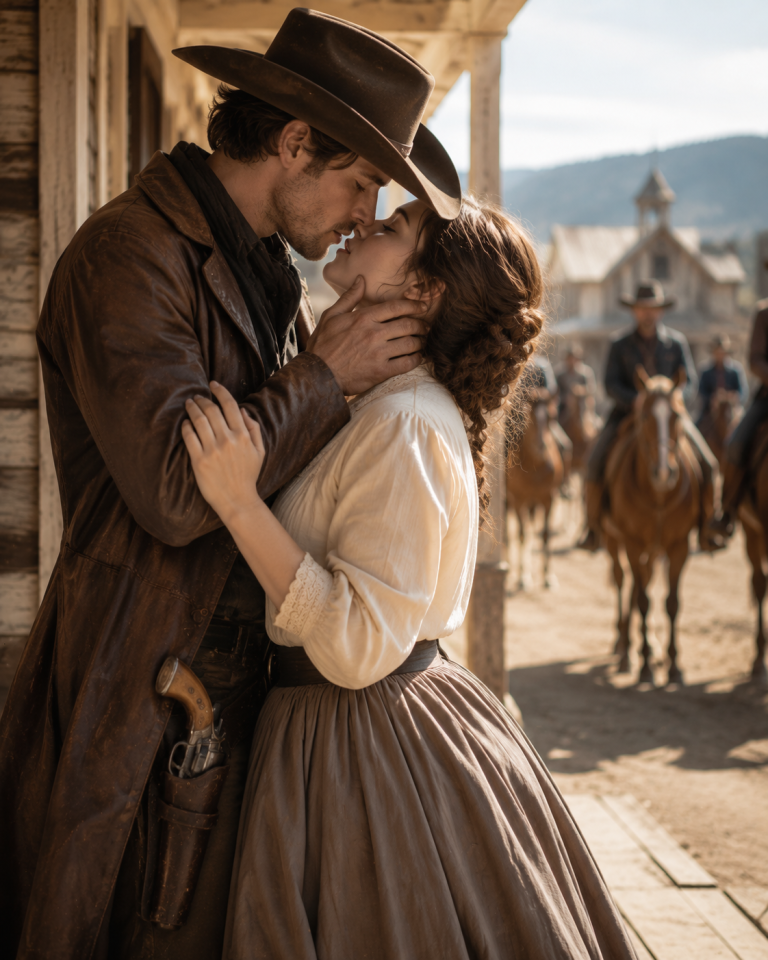
And yet, on a Thursday morning in late October, James Harville rode through the front gate of the Brighton property, took one long look at the woman standing on the porch with her arms crossed and her expression set like cold iron, and decided, without any apparent hesitation, to climb down from his horse and ask Walter Brighton for work.
The town had been talking about the Brighton ranch as long as anyone could remember. Walter Brighton had built it from almost nothing — forty years of hard decisions, dry summers, and a stubbornness bordering on legendary. He owned more land than any three families combined in that part of the territory, ran over four hundred head of cattle, and employed a rotating crew of hands who came and went with the seasons.
What didn’t rotate was his daughter.
Charlotte had grown up on that land, learned to ride before she could properly read, and somewhere along the way decided the world owed her a certain distance. Most people in Caldwell Flats simply gave it to her.
James was not from Caldwell Flats. He’d come down from the northern counties with a single saddlebag, a calm people sometimes mistook for slowness, and a reputation among the few who knew him for being the kind of man who finished what he started. Thirty-one years old. Working cattle ranches since fifteen. Not looking for trouble. Not looking for conversation. Looking for honest work and a fair wage — and Walter Brighton, who’d just lost two experienced hands to a competing outfit near the river, was in a position to offer both.
Charlotte was not consulted on the hiring. That, more than anything, seemed to be the root of the problem.
She found her father in the stable that afternoon, boots sharp on the wooden floor, voice carrying the particular tone she reserved for matters she considered beneath discussion.
“You hired another drifter.” Not a question.
Walter didn’t look up from the harness he was mending. “I hired a ranch hand. There’s a difference.”
“Not in my experience.”
He glanced up, briefly. “Your experience is limited, Charlotte.”
She left without responding, which was its own kind of answer. James, working quietly in the adjacent stall, said nothing either. He kept his eyes on his work and his thoughts to himself. It was a habit that would serve him well in the months ahead.
James settled into the rhythm of the ranch within a week — not the kind of man who needed to announce himself. He worked steadily, learned the land quickly, and got along well enough with the other hands, most of whom had developed the same strategy for dealing with Charlotte Brighton: stay out of her way, and agree with whatever she said when avoidance wasn’t possible.
James didn’t adopt that strategy. Not out of boldness, exactly. He simply didn’t see the point.
The first real exchange happened eleven days after he arrived. A section of the eastern fence had come down overnight, and two younger hands had spent the better part of the morning arguing about the most efficient way to fix it. Charlotte rode out to check progress and found them still arguing, the fence still down, three cattle standing at the gap with considerable interest in the open pasture beyond.
She dismounted, her expression suggesting she was reconsidering her opinions on the intelligence of the human race.
“Is there a reason this fence is still open?” she asked, to no one in particular and everyone at once.
James was already pulling posts from the supply wagon. He didn’t look up. “There will be in about twenty minutes. Less if those two stopped talking.”
The younger hands went quiet. Charlotte turned to look at him with an expression that had ended more than one man’s employment on this ranch. James met it briefly, then went back to the posts.
She stood there a moment. Then, without a word, remounted and rode back toward the house.
That evening, Douly — a weathered hand who’d worked the Brighton ranch seven years — sat down beside James at the bunkhouse table and studied him the way a man studies someone he’s trying to determine is brave or simply uninformed.
“You know who she is,” he said. Not quite a question.
“Rancher’s daughter.”
“Walter Brighton’s *only* child,” Douly said. “Runs this place as much as he does. Has done since her mother passed.” He paused. “She was fourteen when that happened.”
James was quiet a moment, turning his coffee cup slowly. “How long ago was that?”
“Eleven years.”
James nodded once and said nothing more. But something behind his eyes shifted quietly, the way a door shifts when a draft moves through a room. Not opening. Not closing. Just acknowledging the air had changed.
He lay awake that night longer than usual, staring at the bunkhouse ceiling. *Fourteen years old.* He thought about what it meant to lose the person who softened the world for you, at an age when the world still needed softening. He thought about what a person might build around themselves in the years that followed, and why, and what it might cost them.
He had no plan. He was not that kind of man. But somewhere between the fence line that morning and Douly’s quiet words that evening, something had settled in him — a patience, or perhaps a decision so understated he couldn’t quite name it himself.
He only knew that when Charlotte Brighton had turned that look on him and found nothing to push against, something in her expression had shifted. Just for a moment. Just enough.
And in James Harville’s experience, a moment was usually where everything began.
PART 2
By January, something had shifted between James and Charlotte — not dramatically, not in any way either of them had announced. More like the way a room feels different after someone has quietly rearranged the furniture in the night. Everything in a slightly different place. Nothing named.
She’d started speaking to him directly rather than through the other hands — small things, a question about feed rotation, a comment on the south pasture fence. Her voice, when she addressed him, had lost its sharpest edge, though it kept its precision. She was not warm. But she was unmistakably present with him in a way she wasn’t present with anyone else on the ranch.
James noticed. Gave no indication he noticed. This, more than anything else he did, seemed to unsettle her.
One afternoon in late January, she found him alone at the water trough repairing a cracked timber, and stood watching him work longer than any practical reason justified.
“You’re not what I expected,” she said finally.
He kept working. “What did you expect?”
“Someone easier to dismiss.” Something in her voice — not softness exactly, but the faint outline of where softness used to live. Like an old mark on a wall where a picture once hung.
James set down his tool and looked at her directly. Not with challenge. Just the steady, unhurried attention he brought to everything.
“I’m not planning on being dismissed,” he said.
Charlotte held his gaze three full seconds — for her, the equivalent of a confession — then turned and walked away. Her steps, just for a moment, were slower than usual.
That thaw kept moving through February’s deep quiet, right up until the day everything came to a head — not with a dramatic event, but a small one.
Charlotte had ridden out alone to check the northern boundary, something she did regularly without telling anyone. The temperature dropped sharply overnight, and by midmorning the trail back had turned genuinely treacherous — a thin sheet of ice beneath fresh snow that looked solid and wasn’t. Settler, her mare, slipped on a hidden drop in the trail. She didn’t fall completely, but the recovery was hard and sudden, and Charlotte came off — landing on a slope steeper than it looked, thirty feet from her horse, cold and shaken, her left ankle twisted badly enough that standing sent a sharp, clear pain up her leg.
She sat in the snow and assessed her situation with the same expressionless practicality she brought to everything. Settler stood unhurt twenty feet up the slope. The ranch was a forty-minute ride. She could not ride reliably on this ankle. The temperature was still dropping.
She was not frightened. She was, for the first time in a very long while, genuinely uncertain what came next.
James had noticed her absence by late morning and said nothing immediately — Charlotte came and went as she pleased and didn’t appreciate being tracked. But by the time midday passed and the ranch thermometer had dropped another four degrees, he saddled his horse without explanation and rode north.
He found her forty minutes later, sitting upright against a rock, her expression set in a way that made clear she’d been rehearsing how to receive help without appearing to need it.
He dismounted. Looked at her ankle. Looked at the slope. Looked at the sky.
“Can you stand on it?”
“Partly.”
He nodded, helped her up without making a production of it, got her onto his horse, collected Settler’s reins, and started back at a careful pace. They rode several minutes in silence, snow falling lightly, unhurried, around them.
“You didn’t have to come,” Charlotte said finally.
“I know.”
Another silence. Then, quietly, so quietly the wind nearly took it: “How did you know where to look?”
“I pay attention,” he said.
She didn’t respond to that. But she didn’t look away from the trail, either — and something in the set of her shoulders was different from usual. Less deliberately constructed. Like a sentence that had forgotten to finish itself.
That evening, James sat alone in the barn checking the horses, his last habit of every day, when he heard footsteps on the floor and looked up.
Charlotte stood in the doorway. Walking carefully, ankle wrapped, holding two cups of coffee with the slightly self-conscious air of someone who’d decided to do something before she could think herself out of it.
She crossed the barn and held one cup out to him.
PART 3
He took it. She sat down on the bench across from him without being invited — which meant she had stopped waiting for permission to be somewhere. At least here. At least with him. That was not a small thing.
They drank their coffee in the dim light. Outside, the wind had settled. The horses shifted quietly in their stalls.
“Douly says you turned down an offer,” Charlotte said. “From the Harold outfit near the river. Better wages.”
James looked at his cup. “Douly talks too much.”
“He does.” She waited. “Why did you turn it down?”
James turned the cup in his hands, the way he always did when choosing his words carefully. “Because I’m not finished here.”
Charlotte looked at him steadily. The barn light was soft and honest, and there was nowhere to redirect her gaze. “What does that mean?” she asked, and her voice had none of its usual armor in it. Just a voice. Just a question. Just a woman sitting in a barn on a winter evening, asking the only thing she actually wanted to know.
James set his cup down. “It means I came here for work,” he said. “And somewhere along the way I found something worth staying for that had nothing to do with the cattle.”
The silence that followed wasn’t uncomfortable. It was the kind that happens when something true has been said and the air needs a moment to settle around it. Charlotte looked down at her cup, a muscle working in her jaw. When she looked back up, her eyes were steady, but something moved behind them — not quite emotion, but the place where emotion lives just before it becomes undeniable.
“I’m not easy,” she said.
“I know,” he said. “You’ve mentioned that. More or less.”
Something flickered across her face. Not quite a smile. The ancestor of one. “And that doesn’t concern you?”
“Not particularly. Easy isn’t what I’m looking for.”
She was quiet a long time after that, long enough that the barn settled into its nighttime sounds — the small movements of horses, something distant calling in the dark valley. When she finally spoke, her voice was lower, and careful in the way that means something different from guarded.
“There was someone,” she said. “When I was seventeen.”
James said nothing. He simply stayed present the way he always did, fully, without demand.
She told him. Not everything, not all at once, but enough — the words coming out measured and deliberate, the way someone releases something they’ve carried a long time and isn’t entirely sure they remember how to put down. The young man. The misplaced trust. What it had cost her to find out what he’d done with it. She told him without self-pity, which made it harder to hear, not easier. Pain described without decoration is the most honest kind.
James listened to all of it. When she finished, he didn’t rush to fill the space with reassurance. He sat with what she’d said and let it be what it was.
“He was careless with something valuable,” he said finally. “That says everything about him. And nothing about you.”
Charlotte Brighton looked at him a long moment. Something in her face shifted — not dramatically, not all at once, but the way a landscape changes when the cloud cover finally breaks and light comes through at a new angle, changing the appearance of things that had been there all along.
“You’re a strange man, James Harville,” she said.
“So I’ve been told.”
This time, the smile came small and brief and entirely real. It changed her face in a way that made James understand, with sudden and complete clarity, exactly why he had turned down the Harold outfit and every other reason he might have had to leave.
—
Spring came to the Brighton Valley the way it always did, insistent and incremental, pushing up through the cold ground with a patience that made winter feel, in retrospect, like something that had never intended to stay. The cattle moved back to the upper pastures. The days lengthened. The ranch returned to its full, purposeful rhythm.
Walter Brighton sat on his porch one April evening and watched his daughter walk across the yard beside James Harville, the two of them talking in the low, unhurried way of people who have learned each other’s silences as well as their words. Charlotte said something he couldn’t hear, and James laughed — a real laugh, unguarded — and she looked sideways at him with an expression Walter hadn’t seen on his daughter’s face in eleven years.
He recognized it because it was her mother’s expression. Eleanor had worn it the same way. That particular look of someone who has found a place to set down what they’ve been carrying.
Walter sat very still on his porch and let himself feel the full weight of that moment without looking away from it.
They were married in September on the ranch, under a sky so clear and blue it looked deliberate. Walter stood beside his daughter at the ceremony with the straightest back he’d maintained in years, an expression that remained composed right up until it didn’t.
Charlotte wore a dress the color of winter wheat. When she looked at James at the front of that small gathering, her expression was open in a way she had spent eleven years making sure no one ever saw. James looked back at her with the same steady, unhurried attention he’d brought to everything since the first morning he rode through that gate — only now it carried the full weight of what it had become, which was something neither of them had a word for, and neither of them needed one.
Douly stood in the back and pretended, without much success, that the dust was bothering his eyes.
In the years that followed, the Brighton ranch became the Harville-Brighton ranch, though most people in Caldwell Flats simply called it the Harville place eventually, which Walter considered the highest possible endorsement.
James ran the operation with the same quiet competence he brought to everything. Charlotte ran it alongside him with the same sharp intelligence she’d always had — only now it was directed outward instead of used as a wall. They had two children, a boy first, then a girl. The boy had his father’s steadiness and his mother’s eyes. The girl had her mother’s precision and unmistakably her father’s laugh.
Watching them one evening from the porch, the children chasing the last of the daylight across the yard, Charlotte felt something she had no previous reference for — a fullness with no sharp edges to it, no place where it gave way to something harder. She had spent so long braced for the world that she had forgotten the world could simply be this: a porch, an evening, children running, a man’s hand finding hers in the fading light without any preamble or announcement, because some things, after long enough, require neither.
She turned to look at James. He was watching the children with a quiet satisfaction that was, she’d come to understand, his natural state — his default expression when life was exactly what it should be.
“You knew, didn’t you?” she said. “From very early on.”
He thought about it honestly, the way he thought about everything. “I knew it was worth finding out,” he said.
She looked at him a long moment. Then she turned back to the yard, where the children were still running, and let herself lean just slightly against his shoulder — on the porch of the ranch Walter Brighton had built from almost nothing, in a valley that had seen forty years of hard seasons and honest work.
The last of the light moved slowly across the land, and the evening came in soft and without hurry, the way the best things always do.
THE END.