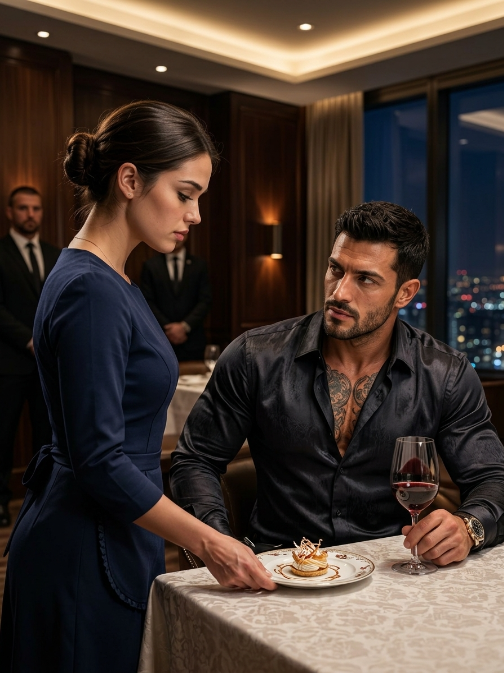
The Waitress Everyone Ignored Whispered Six Words To The Most Dangerous Man In The Restaurant — And Exposed The Deadly Trap Five Men Had Planted Under His Chair

**PART 1**
“If you stand up, you die first.”
That was all the waitress whispered while pouring a $400 bottle of Bordeaux.
And in that one breath, the man everyone feared realized the only person trying to save him was the woman the whole room had spent the night pretending not to see.
The crystal chandeliers of The Aurelia threw broken light across white tablecloths, silver forks, and faces that had spent years learning how to hide hunger behind etiquette. Savannah’s old-money crowd treated the restaurant like a private church where sins were forgiven as long as the check cleared. Judges came here after ruling against people they never had to meet. Developers came here after buying entire neighborhoods on paper. Wives smiled across candlelight at husbands who lied better than they loved.
And between them moved Nora.
At least that was the name on her tag. Nora Ellison. Black uniform. Loose apron. Hair pinned back. Eyes down unless spoken to. Hands steady enough to carry three plates and invisible enough to be forgotten before she reached the next table.
For eighteen months, she had worked at The Aurelia and mastered the art of disappearing in public. She refilled water glasses that were already half full. She replaced napkins no one had noticed dropping. She smiled at men who snapped their fingers and women who looked through her like she was part of the furniture.
The manager still called her “the new girl.” That suited her. Being forgettable was safer than being known.
The restaurant was closing slowly that Tuesday night. The kitchen had begun its ritual of muted metal: pans stacked, burners turned down, knives washed and returned to magnetic strips. The final patrons lingered over cognac and quiet affairs, not eager to return to homes where silence waited with receipts.
Only one table still mattered. The corner booth. A man had been sitting there for three hours, alone, with untouched documents spread in front of him and a glass of red wine he barely drank. He wore a charcoal suit that looked expensive without trying to announce the fact. His hair was dark, touched with silver at the temples. His posture was relaxed in the way only controlled men can appear relaxed — not careless, not soft, but still.
Nora had served him all night. He had said thank you once, so quietly she almost missed it. But she didn’t miss his eyes. Dark. Watchful. Tired in a way money couldn’t fix.
When she poured his first glass, he looked at her for exactly one second. Not through her. At her. The difference was so rare that it had unsettled her more than rudeness would have.
She knew danger. Not from movies. Not from stories. From childhood. From listening to her father’s footsteps on the stairs and knowing whether to hide under the bed or pretend to sleep. From measuring the silence before a slammed door. From loving a man named Derek who smiled like summer and carried violence around like loose change in his pockets.
She had learned long ago that danger rarely looked like rage. Sometimes it wore cologne. Sometimes it held the door. Sometimes it tipped twenty percent.
So when five men entered The Aurelia without the front door chime sounding, Nora noticed. Everyone should have noticed. But rich people often mistake being surrounded by service for being surrounded by safety.
The men did not belong. Their suits were expensive but wrong for the room. Too sharp in some places, too tight in others. Their shoes shone too hard under the chandeliers. Their watches were louder than old money would allow. They moved like men who had been told where to stand before entering.
One by the entrance. One near the kitchen doors. One by the bar. Two near the private dining corridor. The fifth remained near the host stand. Broad shoulders. Scar running from his left ear to his collar. Hands clasped in front of him like he was waiting for a hymn.
The maître d’ stepped forward with his practiced smile. “Good evening, gentlemen. I’m afraid the kitchen is—”
The scar-faced man walked past him. No hesitation. No apology. Protocol did not apply to men who entered rooms already deciding who would leave alive.
The dining room felt the shift before it understood it. Conversations thinned. Forks paused above plates. An elderly couple at table twelve asked for their check in voices too calm to be natural. A businessman closed his laptop and slid it into his bag without looking up. A woman in pearls touched her husband’s wrist, and five minutes later they were gone.
Money knows when to leave danger behind. Staff knew even faster. The manager vanished into his office and shut the door. The sommelier found urgent work in the wine cellar. The busboy, who normally begged for overtime, disappeared through the service exit.
By 10:47 p.m., the room was nearly empty. Only Nora remained. Nora, the five men, and the man in the corner booth who had not moved.
He knew. She saw it in the small tightening of his jaw. The way his right hand dipped below the table for one second, then returned empty. The way his eyes did not follow the men but mapped their positions through reflection, shadow, and sound.
He was not a businessman. Not only. Men did not bring five armed predators into a fine dining restaurant for tax negotiations.
Nora stood at the service station with a clean wine glass in one hand and a linen cloth in the other. Her heart hammered so loudly she thought the scar-faced man might hear it. But her hands did what they had always done in danger. They obeyed. Polish the glass. Fold the cloth. Look ordinary.
Then the scar-faced man turned slightly. His jacket opened half an inch. And Nora saw it. A flash of copper wire. A small black box. Pressure trigger.
The memory hit her so hard she nearly dropped the glass.
Derek, drunk and proud in a cheap Nashville apartment, sitting at a table with three men who laughed too loudly. His hands moving as he explained a setup he said was “elegant.”
“You don’t shoot the guy,” he had said. “You let him kill himself. Pressure plate under the chair. Remote backup in case he gets cute. Once he stands, boom. Looks messy enough to scare everybody and clean enough to send a message.”
Nora had been in the next room pretending to sleep. She had remembered everything. Every wire. Every gesture. Every careless piece of knowledge men had given her because they believed women who loved them stopped listening when they stopped being spoken to.
Now that memory stood between a stranger and death.
Her mind screamed at her to run. She should have run. She had spent eighteen months building Nora Ellison out of borrowed papers, cash rent, quiet shifts, and silence. She could not afford police reports. Could not afford questions. Could not afford her face in a database. Derek’s people were still somewhere in the world, and people like that did not forgive women who disappeared with what they knew.
But the man in the booth would die if he stood. And the five men were waiting for him to stand.
**PART 2**
Nora picked up the Bordeaux. The bottle was a 2015 vintage, heavy and dark, worth more than she had spent on groceries in two months. She walked toward the booth slowly, every step feeling like a contract she could not unsign.
The scar-faced man watched her. She kept her face soft. Service face. Polite face. Invisible face.
When she reached the booth, the man looked up. A question moved through his eyes. She angled her body to block the view from the room, tipped the bottle, and poured. The red wine struck the glass in a steady stream.
Her lips barely moved. “If you stand up, you die first.”
His entire body went rigid. Not visibly to anyone else. But she saw it. A tiny arrest of breath. A flash of calculation. His eyes flicked down to the seat beneath him, then back to her face.
He understood.
She finished pouring to the proper level, straightened, and stepped away. Her knees nearly failed at table eight. So she made herself busy. She cleared dessert plates no one had finished. Set down fresh napkins no one needed. Aligned silverware on an empty four-top because people are less suspicious of servants doing useless work than citizens doing brave work.
The scar-faced man’s eyes followed her. She did not look back.
The man in the booth sat perfectly still. A statue in a suit. The trap had expected panic. A reach for a weapon. A sudden stand. A backward step. Anything that shifted his weight. Instead, he gave them nothing.
**PART 3**
Five minutes passed. One of the men checked his watch. Then again. Then a third time. Their patience frayed quickly. They were not the kind of professionals who enjoyed waiting. They had been paid for an event, a trigger, a death that should already have happened.
Nora saw the man by the kitchen door lift two fingers to his ear. Communication device. Receiving instructions. Her ex-boyfriend’s crew had used the same gesture, the same small touch that looked casual only to people who had never feared men in groups.
She carried a tray into the kitchen. The chef had left. The ovens were cooling. The stainless-steel counters reflected her pale face back at her in pieces. Through the round window in the swinging door, she could still see him in the corner booth. Still. Alive because he trusted six whispered words from a woman whose real name he did not know.
She could escape through the back door. She could vanish now. She could leave him to the bomb squad, if anyone ever called them. She could take her fake identity, her cash in the coffee tin, and another bus south before sunrise.
But the men were still inside. The device was still beneath him. And no one had called anyone. The manager was hiding. The guests were gone. The room had done what rooms often do when power arrives with violence. It had protected itself by abandoning the person in danger.
Nora pushed back through the kitchen doors. She approached the booth again. The scar-faced man’s suspicion sharpened.
“Can I get you anything else?” she asked. Her voice was level. Years of customer service had taught her how to swallow terror and serve it with a smile.
The man in the booth looked at her. For a second, something passed between them. Not gratitude. Not yet. Recognition.
“No, thank you,” he said. “I’m waiting for someone.”
The lie rested between them like a loaded gun. He was waiting for help. Help was not coming.
Then the front door opened. Nora’s heart jumped. Two men entered wearing private security uniforms. The kind The Aurelia used for VIP events. Both had visible sidearms and military posture. The five men tensed instantly.
The scar-faced man’s hand moved toward his jacket. Stopped.
The lead security guard took in the room in one sweep: corner booth, five intruders, one waitress, no manager, no guests. “Gentlemen,” he said, voice calm, “the restaurant is closed for the evening. You’ll need to settle your business elsewhere.”
His partner moved toward the private dining corridor, cutting off the angle. The mathematics changed. Five men with a device versus two armed guards in a public room where police might now arrive.
The scar-faced man weighed it. Then he nodded once. Sharp. Final. The five men moved toward the exit with the bitter discipline of a failed job. They did not hurry. Hurrying admits fear. They walked out as if leaving had been their plan all along.
The door clicked shut behind them. Nobody breathed properly for ten seconds.
“Don’t move yet,” the lead guard told the man in the booth. “They might be watching for panic.”
The man nodded once. Still frozen. Still alive.
Nora stood near table eight, empty tray in her hands. Only now did the reality hit her. Her whole body wanted to shake. Her throat tightened. Her knees threatened to give way. She pressed the tray against her apron so hard the metal edge bit into her fingers.
The security guard at the window watched the street. Minutes crawled. Finally, he spoke into his radio. “Clear. Vehicle departed south on Bay Street.”
The other guard turned to the booth. “Bomb squad is on the way. Nobody touches the seat until they clear it.” Then his gaze shifted to Nora. “Miss, you should evacuate.”
Civilian. Collateral. Dismissed.
She should have accepted the gift. Instead, she looked at the man in the booth for the first time without the mask. His face was pale beneath the expensive grooming. A fine tremor ran through his shoulders now that the adrenaline had nowhere to go. His eyes locked on hers.
“How did you know?” he asked.
The question was quiet. But the room heard it. The guards looked at her with new attention.
She could lie. She had lied for eighteen months. But something about the way he had trusted her whisper made another lie feel like cowardice.
“I recognized the setup,” she said. “My ex-boyfriend worked with people who used pressure triggers.”
The words changed the room. The guards no longer looked at her like a waitress. The man in the booth did not look surprised. Only more focused.
“What’s your name?”
“Nora.”
The lie came automatically. The name tag said it for her. His eyes dropped briefly to the plastic rectangle pinned above her heart. Then lifted back to her face. He knew. Not the truth, maybe. But the lie.
His mouth curved faintly. “Thank you, Nora.”
The way he said it made the false name sound like a secret they both agreed to keep.
Sirens approached. Blue light flashed against the windows. Soon the room would fill with police, bomb technicians, questions, reports, cameras, signatures, databases, and men with clipboards who believed official forms could contain what had happened.
The man in the booth understood before she did. “You should go,” he said quietly.
She stared at him.
“Before they start taking statements,” he added. “Before your name goes in a report.”
Her chest tightened. He saw too much. Maybe because his life depended on reading people quickly. Maybe because people who live in danger recognize others who have made homes beside it.
She hesitated. Then remembered the watch. “The man with the scar checked his watch three times,” she said quickly. “They were on a timeline. This wasn’t just about you. Something else was coordinated.”
His eyes sharpened. Information landed. He nodded once. “Go.”
She moved before courage ran out. Through the kitchen. Past the cooling ovens. Out the back door into an alley smelling of rain, garbage, and old fryer oil. Behind her, authority flooded the dining room. Ahead of her, the night opened. She did not look back.
—
Her apartment was a fourth-floor walk-up in a building that had survived better decades and worse tenants. The hallway smelled like dust, cigarette smoke, and someone’s overcooked rice. The stairs creaked under her shoes. By the time she reached her door, her hands shook so hard the keys scraped paint from the lock.
Inside, she did not turn on the lights. A streetlamp outside the window cast enough orange glow over the room. One bed. One table. Two chairs. A cracked mirror. A kettle. A duffel bag half-packed because women like her never fully unpacked.
She untied her apron and realized she was still holding it like proof of a crime. The fabric smelled of wine and fear. The name tag caught the light. Nora. She unpinned it and dropped it into the kitchen drawer.
Her real name was Sophie Callahan. She had not heard it spoken by anyone who loved her in almost two years.
Sophie sat on the edge of the bed in her black uniform and stared at the water-stained ceiling. She had saved a man’s life. The thought should have made her feel something clear. Pride. Relief. Purpose. Instead, she felt hollow. Saving someone powerful had made her visible. Visibility was dangerous.
Her phone buzzed in her purse. She ignored it. Then it buzzed again. And again. The manager, probably. Demanding to know why she had abandoned her shift, as if a bomb threat would be categorized somewhere between tardiness and poor attitude.
She thought of Derek. His easy smile. His hands on her waist. His voice explaining things she was never supposed to remember. The first time he called her “mine,” she thought it meant beloved. Later, she understood men like Derek often use the same word for women, cars, debts, and guns. Mine did not mean cherished. It meant controlled.
The night she left Nashville, she took only two bags and $1,800 cash hidden in a cereal box. She dyed her hair in a gas station bathroom in South Carolina. By Savannah, Sophie Callahan had become Nora Ellison, a woman with borrowed papers, no past, and enough fear to look ordinary.
For eighteen months, it had worked. Until tonight.
She lay back without changing clothes and watched darkness fill the ceiling cracks. By sunrise, Nora would be gone too.
The phone buzzed again near dawn. Seven missed calls from The Aurelia. Three texts from the manager. One voicemail from an unknown number.
Sophie pressed play with dread already in her stomach. “Miss Nora Ellison, this is Detective Sarah Chen with the Savannah Police Department. We need you to come in and provide a statement regarding last night’s incident at The Aurelia. Please contact this number at your earliest convenience.”
Sophie sat upright. Police. Statement. Name. Reports. Databases. Photographs. Everything she had avoided for eighteen months had found her before breakfast.
Nora Ellison did not really exist. Not enough to survive law enforcement. The social security number she had used was not exactly fake, not exactly real, and definitely not something she could explain under fluorescent lights.
If she went in, they would pull threads. If she did not go in, they would pull harder.
Her phone buzzed again. A text from another unknown number. An address in the historic district. 2 p.m. No name.
Before she could breathe, a second message appeared. *You saved my life. I’d like to return the favor. Come alone.*
Sophie stared at the screen. The man from the booth. Of course. He had found her number. Found the name she used. Maybe found the apartment too. A powerful man with enemies who planted bombs did not send texts blindly.
She should have been terrified. She was. But beneath the fear was something stranger. Relief. Someone understood the danger of a police report without needing a confession. Someone had seen the fear behind the false name. Someone knew that the waitress who disappeared through the kitchen was not rude, cowardly, or guilty. She was running.
—
At 1:55 p.m., Sophie stood across from the address in the text. It was a law office in a building older than the country’s good intentions. Brick facade. Wrought-iron balconies. Polished brass. The kind of place where money did not shout because it owned the echo.
She wore jeans, a gray sweater, and no jewelry. Her hair was tied back. Her face was pale beneath the little makeup she used to hide sleeplessness.
Inside, a receptionist looked up. Professional smile. Quick assessment. Dismissal. “Can I help you?”
“I have a two o’clock appointment.”
The receptionist checked the screen. Surprise flickered and vanished. “Third floor. Suite 304.”
Sophie took the elevator with brass fixtures and a manual gate. Her reflection warped in the metal: tired eyes, stiff shoulders, mouth set too hard for someone her age.
Suite 304 read: ROCCA & ASSOCIATES — PRIVATE CONSULTANTS.
She did not know what that meant. She was certain it meant something else.
The waiting room was quiet, all leather chairs and abstract art. No receptionist. No sound except the soft hum of climate control.
Then a door opened. He stepped out. The man from the booth. Not in the charcoal suit now. Black slacks. White shirt. Sleeves rolled to the elbows. Casual, but not careless. His presence still changed the room, but without the restaurant’s candlelight and death trap beneath him, he looked more human. Still dangerous. But human.
“You came,” he said.
“You found me.”
“Yes.”
“At least you’re honest about it.”
“Only because lying would insult you.”
That was not what she expected.
He gestured toward the open office door. She entered. The room was smaller than she imagined. Bookshelves. A clear desk. A window overlooking the street. No weapons visible. No theatrical intimidation. That, somehow, made it worse. Power that does not need display is harder to measure.
“Sit, please.”
She did, but on the edge of the chair. Ready to run.
He remained standing, leaning against a bookshelf. “I’m Gabriel Rocca.”
The name landed. She knew enough about Savannah whispers to understand the weight of it. Rocca meant shipping. Restaurants. Real estate. Security firms. Political donations. Old crimes wearing new paperwork. Men who smiled in public and settled matters elsewhere.
“You’re not just a restaurant owner,” she said.
“No.”
“Good. I hate wasting time pretending.”
A faint smile touched his mouth.
“The police want a statement from me,” she said. “I can’t go.”
“I know.”
“You don’t know anything.”
“I know Nora Ellison begins eighteen months ago. Before that, nothing useful. No school records that hold up. No employment trail. No proper tax history. Which means Nora Ellison is a wall someone built quickly.”
Sophie’s hands tightened in her lap. “That sounds like a threat.”
“It’s not.”
“Men like you don’t research people as a hobby.”
“No,” Gabriel said. “I researched you because you saved my life and then ran from police faster than a guilty person or a terrified one. I needed to know which.”
“And?”
His eyes held hers. “Terrified.”
The word entered her like a key turning. She looked away first.
“What do you want?”
“Your real name.”
She almost lied. The old instinct rose sharp and automatic. But he had sat still on her whisper while death waited beneath him. He had warned her to leave before statements. He had given her the courtesy of not pretending ignorance.
“Sophie,” she said. “Sophie Callahan.”
Gabriel repeated it once, softly. “Sophie.”
Her name sounded strange in his voice. Not stolen. Returned.
“The device under my chair was military grade,” he said. “Bomb squad confirmed it. The police investigation will widen. They’ll pull staff records, security footage, personal histories. If your face enters the wrong system, whoever you’re hiding from may find you.”
She felt her stomach drop. “Derek,” she whispered before she could stop herself.
Gabriel did not pounce on the name. A lesser man would have. He simply waited.
“My ex. He worked with crews who used pressure triggers. I heard things I wasn’t supposed to hear. When I left, I took enough knowledge to make him want me silent if he ever found me.”
Gabriel’s expression darkened. “Does he know you’re in Savannah?”
“I don’t think so.”
“After last night, he might.”
The truth sat between them. Cold. Practical. Unforgiving.
“I can make you disappear properly,” Gabriel said.
Sophie laughed once. Not because it was funny. Because if she did not laugh, she might break.
“What does that cost?”
“Not what you think.”
“I doubt that.”
“I can give you clean documentation. Real background. A life that survives scrutiny. Housing. Security. A way to stop running under names that crack if anyone presses too hard.”
“Why?”
“You saved my life.”
“That pays for a thank-you card. Maybe cash. Not a new life.”
Gabriel pushed away from the bookshelf and came to sit on the edge of the desk, keeping himself at eye level. “You’re right. There is another option.” Of course. Here came the trap. “You work for me.”
Sophie stared. “There it is.”
“Not as property. Not under coercion. As an employee. Initially front-of-house work at one of my restaurants. Visible, legitimate, paper trail clean. But I also need what you did last night.”
“Whispering bomb warnings?”
“Observation. You see details trained people missed.”
“Because trained people weren’t invisible.”
Something in his face shifted. Respect, maybe. “Yes.”
She leaned back. “What do you really do, Gabriel?”
He did not answer immediately. That alone made the answer more honest.
“My family has interests. Most legitimate. Some complicated. I manage them, protect them, and keep worse men from taking them.”
“Translation?”
His gaze did not move. “Organized power with legal borders and dangerous neighbors.”
“You mean crime.”
“I mean survival with lawyers.”
Despite herself, Sophie almost smiled. Almost.
“People planted a bomb under you,” she said. “That usually means your neighbors are very dangerous.”
“The Costanzo family wants control over port access and shipping interests. Killing me quietly would have helped them.”
“That was quiet?”
“The plan was to make it look like an equipment failure after I stood to leave. Panic. Damage. Confusion. A tragedy during closing. No gunfight. No witnesses who understood what they saw.”
“But I understood.”
“Yes.”
“So now they know about me.”
His silence answered.
Sophie stood and walked to the window. The street below moved normally. Cars. Pedestrians. A woman carrying flowers. Men in suits. Life performing innocence.
“What if I say no?”
“Then I give you twenty thousand dollars and a number for someone who can get you decent papers. You leave tonight. No obligations.”
She turned. “That’s it?”
“That’s it.”
“No threats?”
“No.”
“No ‘you know too much’ speech?”
“You already know too much. Threatening you would not improve the situation.”
She studied him carefully. He looked back without pressure. That unsettled her more than force would have. She was used to men who pushed. Men who cornered. Men who called control protection and expected gratitude for narrowing the exits.
Gabriel was offering choices. That made him harder to distrust.
“Why me?” she asked. “You must have people trained for this.”
“I do.”
“Then why offer a job to a waitress with a fake name and a dangerous ex?”
“Because when death walked into that restaurant, every trained person left the room. You walked toward me with a wine bottle.”
The words struck somewhere deep. “You’re making it sound noble.”
“It was.”
“I was terrified.”
“That does not make it less brave.”
Sophie looked down. She hated how badly she wanted to believe him.
“If I work for you,” she said, “I need truth. No pretty lies because you think I can’t handle the ugly parts.”
“Agreed.”
“I keep my own money.”
“Of course.”
“I’m not your responsibility.”
“You are under my protection.”
“That sounds similar.”
“It is not. Responsibility can become ownership. Protection should not.”
She met his eyes. “You say that like someone who knows the difference.”
“I learned late.”
That answer stayed with her. She thought of her apartment. The water-stained ceiling. The packed duffel. The fake name in the kitchen drawer. The police voicemail. Derek somewhere in the world, perhaps not looking for her yet, but capable of starting.
Running had kept her alive. It had not given her a life.
“When would I start?” she asked.
Gabriel’s shoulders eased by half an inch. “Tomorrow.”
“Where?”
“Rivermark. One of my waterfront restaurants.”
“And tonight?”
“You move.”
“I don’t remember agreeing to that.”
He looked at her. “You don’t go back to an address the police and possibly the Costanzos can connect to you.”
“That was not a request.”
“No,” he said. “That was tactical advice. You can ignore it. I would prefer you didn’t.”
She should have argued. Instead, she heard herself say, “Fine.”
Gabriel stood and extended his hand. “Welcome to Rocca & Associates, Sophie Callahan.”
She looked at his hand. Then took it. His grip was firm but not claiming. There were calluses on his palm. Unexpected, like evidence that he had not always been a man behind desks.
“Thank you,” she said.
“No,” he replied. “Thank you.”
—
The corporate apartment was on the fifteenth floor of a glass tower downtown, too clean and bright to feel real. White walls. Gray sofa. Stainless-steel kitchen. Floor-to-ceiling windows looking over Savannah’s church steeples, live oaks, rooftops, and river shining beyond the city like a promise made by someone untrustworthy.
Everything Sophie owned sat in two duffel bags by the door. Gabriel’s driver had taken her to the old apartment. She packed in twelve minutes. Clothes. Cash. Papers. One photo of her mother. A cheap necklace she never wore but always kept. Nothing else was worth grieving.
Gabriel stood near the kitchen island. “There’s food in the refrigerator. Building security knows your name. No visitors without approval. Phone on the counter is clean and programmed with my number.”
Sophie looked around. “This is too much.”
“No. This is temporary.”
“Temporary luxury is still luxury.”
“Would you prefer a bad motel?”
“No.”
“Then we agree.”
She turned to him. “Do you always solve problems by moving people into apartments?”
“Only people who save me from explosives.”
“Small category.”
“Very.”
He walked toward the door. “Gabriel?”
He paused. “Why are you really doing this?”
The question was quieter now. No challenge. Only fear wearing honesty.
He considered her for a moment. “Because last night, you walked into the blast radius for a stranger. I have spent ten years building walls between myself and everyone. You ignored all of them before we had even properly met.”
“That sounds inconvenient.”
“It is.”
“But?”
His eyes softened slightly. “But rare things deserve protection.”
Then he left.
Sophie stood alone in the apartment, looking out at the city. For the first time in years, the silence did not feel like something hunting her. It felt like space.
—
Three days passed in a strange suspension. Gabriel called twice a day. Morning: practical. *Did you sleep? Did anyone contact you? Do you need anything?* Evening: softer, though he pretended otherwise. *Are you eating? Did the building feel secure? Did you notice anything unusual?*
She learned quickly that he hated mornings, drank black coffee, and paused before answering personal questions because he was unused to being asked them without motive. He learned she took too much sugar in her coffee, hated closed doors behind her, and flinched when someone entered a room too quietly.
He never mentioned the flinch. He simply started knocking.
The documents arrived on the fourth day. Driver’s license. Social Security card. Birth certificate. Employment history. Tax records. A clean, boring, sturdy life for Sophie Callahan. Not Nora. Sophie. Born in Mobile. Community college in Macon. Retail jobs. Restaurant experience. A paper trail so ordinary it could survive being ignored.
She held the license for a long time. Her own face. Her own name. A fictional past built to protect a real future.
She should have felt disturbed. Instead, she cried in the bathroom because nobody had ever spent this much effort making her exist safely.
—
Her first day at Rivermark began at 9 a.m. The restaurant sat on the waterfront, all glass, dark wood, and blue-gray light reflected off the river. It smelled like coffee, salt air, lemon, and polished floors. The manager, a composed woman named Renata, trained her without asking too many questions, which meant Gabriel had briefed her well.
Sophie learned table numbers, wine service, menu timing, regulars, kitchen routes, and emergency exits. Especially exits.
At noon, Gabriel arrived. He took a table near the kitchen. Not hidden. Not obvious. Present.
Sophie brought him water. “Table seven,” she said quietly while filling his glass. “Same drink for forty minutes. He watches the private dining room every time the kitchen doors swing open. Not here to eat.”
Gabriel’s eyes flicked once. “Good catch.”
“Costanzo?”
“Probably.”
“Should I be worried?”
“Yes.”
She appreciated that he did not lie. “Should I act worried?”
“No.”
“That I can do.”
He looked up at her, and for one second the noise of the restaurant faded. Then he said, “You’re very good at this.”
“At what?”
“Looking terrified and calm at the same time.”
She leaned closer as if adjusting his napkin. “That’s called being a woman around dangerous men.”
His expression darkened. Not at her. For her. She walked away before either of them had to name it.
—
Weeks passed. Sophie settled into Rivermark’s rhythm. Lunch rush. Dinner service. Staff meetings. Inventory. Reservations. The hum of a business that appeared normal because the dangerous parts stayed beneath the floorboards.
Every evening, she gave Gabriel a report. Most were small. A man asking too many questions about private dining. A courier who used the wrong delivery entrance. A black sedan circling twice. A bartender pocketing cash from tip-out.
Gabriel listened to all of it. Never bored. Never patronizing. He treated her observations like currency.
The first time one of his security men rolled his eyes while Sophie mentioned a customer’s repeated glances toward the kitchen, Gabriel dismissed him from the meeting. Not loudly. Not dramatically. Just said, “If you cannot respect the person who saved my life, you cannot protect mine.”
The man went pale. Sophie said nothing. But later, in the empty hallway outside Gabriel’s office, she stopped him.
“You didn’t have to do that.”
“Yes,” he said. “I did.”
“Because I saved your life?”
“Because you were right. The customer was surveillance. My people confirmed it ten minutes later.”
“Oh.”
“And because no one who works for me gets to mistake quiet for stupid.”
That sentence stayed with her. So did he. Not constantly. Not in the way Derek had stayed, filling every room with need and noise. Gabriel existed beside her with a restraint that made her feel safer than declarations would have. He noticed without crowding. Protected without grabbing. Asked without demanding.
It was unfamiliar enough to feel dangerous.
—
Then the black SUV appeared. A Tuesday morning. 6:12 a.m. Sophie stood at the window of the fifteenth-floor apartment, coffee warm in her hand. The street below was still soft with early light. Delivery trucks. Joggers. A dog walker with three leashes tangled around one wrist.
And one black SUV across the street. Tinted windows. No visible plates. Stillness too deliberate to be parked by chance.
She called Gabriel before fear had finished forming. “There’s a vehicle watching the building.”
His voice changed instantly. “Description.”
“Black SUV. No plates visible from here. West side of the street. Been there since at least six.”
“Step away from the window.”
She did.
“Lock the door. Do not leave. I’m sending a team.”
The call ended. No comfort. No wasted words.
Twenty minutes later, two men dressed like maintenance workers approached the SUV. Sophie watched through the reflection in a framed print rather than directly through the glass. One circled the vehicle. The other looked beneath it.
Her phone rang. “It’s clean,” Gabriel said. “No explosives. Surveillance only.”
“Only,” she repeated.
“It’s a message.”
“They know where I am.”
“Yes.”
“They want me scared.”
“Yes.”
“It’s working.”
His pause was brief. “Fear means your instincts are functioning.”
“That’s not comforting.”
“It wasn’t meant to be. It was meant to be true.”
Sophie sank onto the sofa. “I should disappear.”
“No.” The word was immediate. Too immediate.
“You don’t get to decide that,” she said.
“You’re right.” Silence. Then his voice returned, lower. “You’re right. I’m sorry.”
Again, the apology disarmed her. Not because it fixed anything. Because it arrived without a fight.
“What I mean,” Gabriel said, “is that disappearing gives them proof intimidation works. But if you choose to leave, I will help you.”
She closed her eyes. Running waited like an old road. Familiar. Ugly. Always available.
“I’m tired,” she whispered.
“I know.”
“No. You don’t. I’m tired of closets, fake names, cash apartments, memorizing exits, never buying furniture because I might need to leave before sunrise.”
“Then don’t leave,” he said.
“I can’t stay in this glass box if they can watch it.”
“You won’t.”
“Where am I going?”
His answer came after one breath. “My house.”
She almost laughed. “No.”
“It is secure.”
“No.”
“It has private gates, reinforced windows, old construction, and no public access.”
“Still no.”
“Sophie—”
“I know how this goes. Woman in danger moves into powerful man’s house. Protection becomes dependence. Dependence becomes control.”
“I am not Derek.”
The name stopped her. He had never said it before. She had only mentioned Derek once.
“I know,” she said quietly. “That’s what scares me.”
—
Gabriel arrived himself. Not a driver. Not security. Him. His house stood near the historic squares behind iron gates and live oaks heavy with Spanish moss. It was old, pale, and imposing, the kind of Savannah house that looked like it remembered wars and dinner parties with equal clarity. Inside, the air smelled like cedar, coffee, old books, and rain.
Sophie stood in the foyer with her duffel bag. “This is too personal.”
“Yes.”
“At least pretend to disagree.”
“I don’t invite people here.”
“Then why me?”
“Because I want you alive.”
The honesty pressed against her chest. She looked up the staircase. “How long since someone stayed here?”
“Years.”
“That sounds lonely.”
“It was efficient.”
“No,” she said. “It was lonely.”
Gabriel did not answer.
The guest room was larger than her old apartment. Blue-gray walls. Heavy curtains. A bed with carved posts. Windows overlooking a garden where camellias bloomed stubbornly against the season.
Sophie placed her bag down. “Do you have security cameras in here?”
“No.”
“Recording devices?”
“No.”
“How do I know?”
He reached into his pocket and handed her a small device. “A scanner. Renata uses the same model for private event sweeps. Check the room whenever you want.”
She stared at it. “You came prepared for my distrust.”
“I respect it.”
Something loosened inside her so suddenly she had to turn toward the window.
—
The Costanzo problem ended because of something Sophie had heard two years earlier and never understood was valuable.
They were eating breakfast in Gabriel’s kitchen three days after she moved in. He made coffee badly and toast well. She sat barefoot on one of the stools, wearing an oversized sweater, feeling oddly domestic in a house built for secrets.
Gabriel was reviewing papers. A shipping company name caught her eye. Halcyon Maritime Holdings.
She froze. “What is that?”
“A Costanzo-linked company out of Mobile.”
“Derek mentioned it.”
Gabriel looked up. Sophie’s pulse quickened as the memory surfaced. Late night. Nashville apartment. Derek drinking with two men. Papers spread on the table. Him bragging.
“Halcyon moves clean on paper,” he had said. “Manifest says textiles. Customs sees textiles. But the container numbers are ghosted through Savannah before Mobile. Nobody checks if the right palms stay greased.”
Sophie repeated everything she remembered. Names. Routes. Phrases. The man Derek called “Uncle Sal” though he was not anyone’s uncle. A warehouse number. A customs broker.
Gabriel listened without interrupting. His coffee went cold.
Within four hours, his people confirmed enough to matter. Within eight, they had financial trails. Within twelve, they had leverage.
The meeting happened two days later in a lawyer’s office that smelled like polished wood and expensive caution. The Rocca side sat on one end. The Costanzo side on the other.
Sophie was not supposed to attend. She attended anyway. Gabriel did not stop her.
An older Costanzo representative named Salvatore Grimaldi studied the documents Gabriel slid across the table. His weathered face did not change much, but Sophie watched his fingers. They paused at the warehouse number. Fear. Small. Fatal.
“You’re offering a trade,” Salvatore said.
Gabriel leaned back. “Your family withdraws from Savannah port interests. You stop all surveillance and action against Sophie Callahan permanently. In return, this package does not reach federal authorities by dinner.”
Salvatore looked at Sophie. “She is not family.”
Gabriel’s voice cooled. “She is under my protection.”
Sophie spoke before anyone else could. “No. I am the reason you’re in this room.” All eyes turned to her. She kept her hands folded on the table.
“You sent men to watch my apartment because you thought fear would make me vanish. That was a mistake. Fear makes me remember things. And I remembered enough to put your Mobile routes in federal hands.”
Salvatore’s eyes narrowed. “You speak boldly for a waitress.”
Sophie smiled slightly. “I whispered six words and ruined a bombing. You should adjust your expectations.”
Silence. Then Gabriel laughed once under his breath. Salvatore did not.
The agreement was signed by noon. Not peace. Never peace. But distance. A line drawn with evidence instead of blood.
—
On the drive back, Sophie watched Savannah pass outside the window. The city looked different now. Not safe exactly. But no longer only a map of exits.
“It’s really over?” she asked.
“The immediate threat, yes.”
“Derek?”
“My people are still looking.”
She turned to him. “I don’t want him killed.”
Gabriel’s eyes stayed on the road. “What do you want?”
“I want him unable to reach me. Legally if possible.”
“Then that’s what we do.”
“You make it sound simple.”
“It won’t be. But simple is overrated.”
When they reached his house, Gabriel parked but did not immediately get out. “You don’t have to stay now,” he said. The words landed harder than she expected. “You’re free to take the documentation, the job, your own apartment, whatever you want. My protection continues regardless.”
Sophie looked at him. There it was. The door open. The cage absent. The choice real.
“What if I want to stay?”
Gabriel’s face changed. Not dramatically. But she saw relief move through him like light behind a shutter. “Then stay.”
“Not because I’m hiding.”
“No.”
“Not because I owe you.”
“No.”
“Not as someone you protect because danger makes you feel responsible.”
He turned toward her fully. “As someone who belongs here because she wants to.”
Sophie looked at the house. The iron gates. The live oaks. The windows glowing warm in the evening. For years, home had meant temporary shelter before the next escape. Now it looked like a question she was finally allowed to answer honestly.
“I’ll stay,” she said. “But I’m keeping the job at Rivermark.”
“I hoped you would.”
“And my own bank account.”
“Obviously.”
“And if I say no to something—”
“It means no.”
She nodded. “Good.”
He reached for her hand slowly, giving her time to refuse. She didn’t. His palm was warm. Callused. Real.
For the first time in years, Sophie did not count exits before entering a house.
—
Six months later, Rivermark was full every night. Sophie stood in the kitchen during dinner rush, expediting orders with a focus that made chefs obey her faster than managers ever had. Her name tag read Sophie Callahan. Her real name. Printed in clean black letters on silver.
She still noticed everything. Table twelve asking too many questions about catering. A man near the bar wearing a jacket too heavy for the weather. A supplier whose invoice numbers skipped strangely. A hostess crying in the storage hallway after a customer cornered her.
Sophie noticed. Then she did something. That was the difference between survival and power.
Gabriel arrived during dessert service and took his usual table near the kitchen, where he could watch her without making it obvious he was watching her. She brought him coffee.
“Quiet night,” she said.
“Is it?”
“Relatively. Table twelve asked if we cater weddings.”
His eyes lifted. “Do we?”
The question was casual. Too casual.
Sophie set down the cup. “We could.”
“Should we?”
She looked at him. For months, they had moved slowly. Carefully. A hand held in the car. Coffee shared before sunrise. Long conversations on the back porch. One kiss under the kitchen light that had left them both silent afterward because some things are too important to rush into language.
Now his question sat between them dressed as business. But they both knew what it was.
“Are you asking as my employer?” she said.
“No.”
“As my protector?”
“No.”
“As the man whose chair I kept from exploding?”
His mouth curved. “Closer.”
She leaned one hand on the table. “Then ask properly when I’m not carrying tiramisu to table six.”
Gabriel laughed. A real laugh. The kind that made his whole face younger. “Tonight?”
“After closing.”
He nodded. “After closing.”
She walked back to the kitchen smiling. Not because danger had disappeared. It never fully does. But because for the first time, her future did not feel like another place she had to flee toward before the past caught up.
—
That night, after the last table left and the staff finished polishing glassware, Sophie stepped into the quiet dining room. The lights were low. The river beyond the windows shimmered dark and silver. Gabriel stood near the bar with a small black velvet box in his hand.
No audience. No performance. No pressure. Just him. And her.
“I had a speech,” he said.
“Did you?”
“It was excellent.”
“What happened?”
“You walked in and I forgot it.”
She stopped in front of him. “That might be your best speech.”
He took a breath. “Sophie Callahan, you saved my life before you trusted me with your name. You taught me that protection without respect is just another form of control. You made this house feel inhabited instead of guarded. You made me want a future I had stopped considering possible.”
Her eyes burned. She hated crying. He knew that. So he did not mention it.
“I am not asking you to belong to me,” he said. “I am asking if you will build a life with me where both of us belong.”
He opened the box. The ring was simple. Beautiful. Not loud. Not designed to impress a room. Designed for her hand.
Sophie looked at it for a long time. Then at him.
“Yes,” she said.
Gabriel closed his eyes briefly, as if the word had struck somewhere deeper than sound. Then he slid the ring onto her finger.
She kissed him first. Because choice mattered.
—
A year later, The Aurelia reopened after renovations under new ownership. Gabriel bought it quietly. Sophie redesigned the staff protocols herself. No employee would ever again be left alone in a room because management valued reputation over courage. Emergency buttons were installed beneath service stations. Security training became mandatory. Staff were told, clearly and repeatedly, that they were allowed to notice danger and act on it.
The old manager did not return. The sommelier did not either. The busboy did. Sophie hired him back with a raise and told him leaving that night had not made him a coward. He cried in the storage room and pretended he had allergies.
On the first anniversary of the attempted bombing, Sophie walked into the corner booth before opening service. The chair had been replaced. The floor refinished. The room polished back into elegance. But she remembered everything. The wine bottle. The copper wire. The red fear in her throat. The six words that changed both their lives.
Gabriel came up beside her. “Do you hate this room?”
She considered it. “No.”
“No?”
“It taught me something.”
“What?”
She looked around the restaurant where she had once been invisible. “That being unseen is not the same as being powerless.”
Gabriel took her hand. Outside, Savannah moved beneath warm evening light. Horse carriages rattled over stone streets. Church bells marked the hour. The river held the last gold of sunset.
Inside, staff prepared for dinner service under chandeliers that no longer felt cruel.
Sophie Callahan had spent years running under names that did not belong to her. She had believed survival meant staying small, quiet, replaceable. She had believed powerful rooms belonged to dangerous men, and women like her survived only by cleaning the tables after they left.
She had been wrong.
Power is not always the loudest man in the room. Sometimes power is the waitress who notices the wire. The woman who remembers what violent men thought she was too harmless to understand. The survivor who whispers a warning instead of walking away.
And sometimes one sentence, spoken softly over a glass of wine, is enough to stop a murder, expose a war, and bring a woman back to her own name.
“If you stand up, you die first.”
Those were the words that saved Gabriel Rocca.
But the choice to speak them saved Sophie Callahan too.
Because that night, in a restaurant full of people who chose silence, she finally became visible.
And she never disappeared again.
THE END.