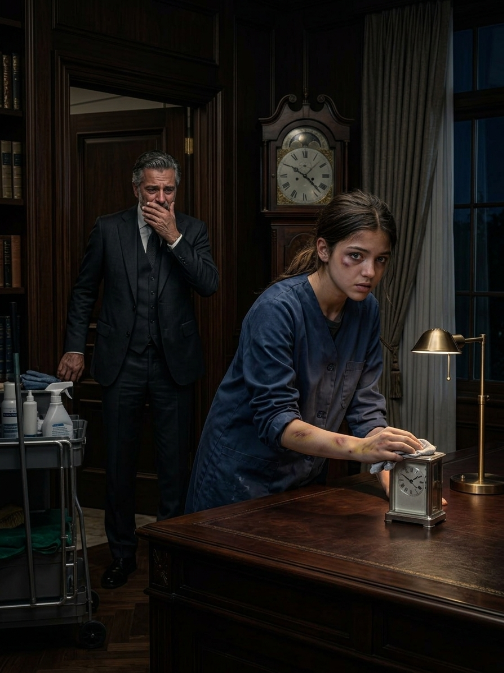
The Maid Hummed A Sicilian Lullaby While Washing His Windows — Then The Boss Realized The Heir Everyone Buried Was Alive In His Penthouse

The glass under Isabela’s fingertips was cold enough to sting.
Boston spread out below in hard gray light, the harbor a strip of dull pewter beneath a sky pressing low over the towers like something waiting to fall. From the forty-third floor, the streets looked distant enough to belong to somebody else’s life — which was probably the entire point of living this high above them.
She wiped slow circles into the window and tried not to think about her checking account.
Rent, due Friday. Rafael’s refill, due Wednesday. Groceries stretched so thin she’d started telling herself soup counted as dinner if there were enough crackers floating in it.
Six months cleaning the homes of Boston’s wealthiest had taught her plenty. Expensive floors scratched easier than cheap ones. Rich women complained about fingerprints on mirrors while leaving lipstick on someone else’s husband. Men with private elevators usually had the filthiest secrets. And every mansion, no matter how polished, kept at least one locked room the staff learned not to notice.
Damiano Conti’s penthouse was different.
It didn’t feel like a home. It felt like a decision. Black marble floors, dark paneled walls, shelves of leather-bound books nobody read for pleasure, a grand piano no one ever touched. Windows so tall they made the whole city look like something he owned simply by refusing to be impressed by it.
And silence. Always silence.
Isabela hummed because silence made her nervous. The melody was old — older than her apartment, older than her grandmother’s hands kneading dough in a kitchen in Providence, older than the stories she’d been told and the ones, apparently, she hadn’t. Her grandmother, Carmela, used to sing it while brushing out Isabela’s hair, voice soft and worn like linen left too long in the sun. Isabela didn’t understand every Sicilian word. She understood the shape of them. That had always been enough.
“You missed a spot.”
The cloth slipped from her hand. She nearly dropped the spray bottle.
The voice came from behind her — deep, accented with something Italian sharpened by years of giving orders rather than requests.
Damiano Conti stood near the doorway. She hadn’t heard him enter. No one ever did.
Thirty-two, composed in a way that looked engineered rather than natural, dressed in a suit that likely cost more than her yearly rent. Broad shoulders, black hair, a scar tracing his right cheekbone so fine it looked drawn in silver thread. His eyes were dark in a way that made people suddenly aware of what they were hiding.
The other housekeepers had warned her. *Don’t ask questions. Don’t touch his papers. Never enter the office uninvited. Don’t sing.* One woman lasted three days. Another two weeks. A third quit after finding blood on a folded white shirt in the laundry basket and deciding she didn’t need answers badly enough to die for them.
Isabela needed the money more than she needed comfort. So she’d stayed.
“I’m sorry, sir,” she said, scrubbing the already-clean glass harder.
He stepped closer. “That song.”
Her hand froze. “What is it?”
“Just something my grandmother taught me.”
She kept her eyes on the window, on her own reflection rather than his — pale face, dark hair escaping its bun, cheap black uniform, a woman working very hard to look invisible in a room engineered to make invisibility impossible.
“I can stop, if it bothers you.”
“I didn’t say it bothered me.” His voice was quiet. Somehow that made it worse.
“Isabela.”
He said her name slowly, like a word he’d once heard in a dream and was only now placing.
“When you finish the windows, my office needs attending.”
“Yes, sir.”
His footsteps turned. Then stopped. “The melody. It’s Sicilian.”
Before she could answer, he was gone, leaving cedar, smoke, and something like power behind him in the air.
—
The office was immaculate, as always — mahogany desk without a paper out of place, heavy curtains, leather chairs, a crystal decanter beside two glasses, books shelved by a private logic that meant everything to a man like Damiano Conti and nothing to the woman paid to dust them.
She knocked at an empty room. Habit. Or fear. Maybe both.
She dusted the shelves, the desk corners, then the framed photograph near the bookcase — a younger Damiano beside an older man with the same eyes and colder posture, a stone villa behind them under Mediterranean light. She didn’t look long. Studying a rich man’s photographs felt like trespassing.
She reached for the decanter. The door opened.
She spun, cloth clutched to her chest. Damiano stood in the doorway, breaking his own rule.
“Sir, I’m sorry, I was just—”
“Sing it again.”
She blinked. “What?”
“The song.”
The door closed behind him. Soft. Final.
“I don’t really sing in front of people.”
“You’ve been singing for the past hour.”
“Humming,” she corrected, before she could stop herself. “It’s different.”
For half a second she thought she’d made a fatal mistake. Then the corner of his mouth lifted — not quite a smile, not kindness, something more dangerous for looking almost human.
“You’re not afraid of me,” he said.
“I’m terrified of you, sir.”
The almost-smile deepened. “And yet you argue.”
Her hand trembled; she set the decanter down before she dropped it. “I should finish the other rooms.”
“Sing for me and you can go.”
She stared. It was absurd. Damiano Conti was infamous for a great many things, and an appreciation for music was not among them. Women drifted through his life like expensive weather — models, actresses, socialites with glossy hair and practiced laughter, appearing on his arm at events and vanishing from the gossip pages within weeks.
None lasted. None mattered.
And here he was, asking a maid to sing.
She took one shaky breath and sang.
Softly at first, the old lullaby trembling out of her, uneven with nerves, then steadier as memory took over — her grandmother’s voice rising inside her own, a kitchen in Providence, steam on the windows, sauce simmering, Carmela’s wrinkled fingers tapping rhythm on the table. The words she didn’t fully understand carried themselves anyway.
When she finished, the silence in the office had changed shape.
Damiano was still. Not bored. Not amused. Still — as if some old locked door inside him had opened without his permission.
“Where did you learn that?”
“My grandmother.”
“What was her name?”
The question sounded innocent. Nothing about this man was innocent.
“Carmela Vitale.”
Something flickered across his face. Danger. Recognition. Memory.
“From which part of Sicily?”
“Palermo, I think. Why?”
He straightened, adjusted a gold cufflink engraved with a crest too fine for her to read from where she stood. “You may go, Isabela. Return tomorrow, as usual.”
She slipped past him carefully, feeling his eyes track her down the corridor.
—
That night her apartment felt smaller than usual. The radiator rattled. Paint bubbled near the window from old water damage. Rafael’s breathing machine hummed steadily from the next room — the sound she’d learned to sleep beside since their mother died and adulthood arrived like a bill nobody had warned her about.
She should quit. Every instinct said so. But quitting meant no rent, no medication, no cushion for Rafael’s next flare-up beyond another emergency loan from a clinic that already looked at her with pity.
At 11:47 p.m., her phone rang. Unknown number.
“Miss Reyes.” Not a question. Enzo — Damiano Conti’s head of security. “Your services are required tomorrow evening. Private event. Mr. Conti specifically requested you.”
Her stomach dropped. “I don’t do events. I’m just the regular cleaner.”
“This isn’t a request. A car will collect you at seven. Wear something appropriate.”
The line went dead.
Her agency supervisor sounded relieved rather than alarmed. “Isabela, honey, this is good news. Mr. Conti’s gone through five housekeepers this year. If he asked for you, you’re doing something right.” “These events pay triple your normal rate.”
Triple. One night could cover Rafael’s medication for months.
That was how the world trapped women like her. Not with chains. With math.
—
**Part Two — The Ballroom, The Necklace, The Name**
At seven exactly, a black Audi with tinted windows stopped outside her building. She wore the only nice dress she owned, a plain black interview dress, and shoes she hated for revealing exactly how practical her life had become.
The car didn’t go to the penthouse. It carried her past downtown, past wet streets and glittering towers, to a sprawling estate behind iron gates and armed men with earpieces — marble floors, crystal chandeliers, priceless art, tailored suits, conversations that paused a fraction too long when she entered.
Enzo met her at the door. “You’re not here to clean.”
“Then why am I here?”
“Mr. Conti wants you to sing.”
“That is not better.”
He left her in an anteroom with her own heartbeat. Ten minutes later, Damiano entered — black tuxedo, hair perfectly styled, the scar catching soft light, beautiful the way storms are beautiful from behind glass.
“You said I was working an event.”
“You are.”
“I thought you meant serving.”
“You’ll sing.”
“I’m not a singer.”
“No,” he said, crossing to a cabinet. “You’re something more interesting.”
He opened a velvet box. Inside lay a sapphire necklace.
She stepped back. “No.”
“It isn’t a gift. It’s part of the costume.”
“My dress is fine.”
“Your dress is inadequate for this room.” The bluntness stung because it was true. “It’s all I have.” “Which is why I procured this.”
Before she could object again, he moved behind her, fingers brushing the back of her neck as he fastened the clasp. The stones settled cold and heavy against her throat, beautiful enough to feel like a collar.
“You represent me tonight,” he said. “Three songs — the lullaby, and two more your grandmother taught you. You speak to no one without my permission. You stay at my side. Understood?”
“Why me? Why not hire a real singer?”
His hands rested briefly on her shoulders. “Because when you sing, you remind me of home.”
Something in his voice made her shiver — possession, and something else. Hunger, but not only physical. A hunger for memory. For proof. For a past buried too deep to stay dead.
“My grandmother used to say the devil always misses heaven,” she whispered.
His laugh was low, without humor. “Then she’d be right about me.” He turned her gently, lifted her chin with one finger. “One night, Isabela. Give me this, and your brother’s medical bills disappear. Permanently.”
Her blood went cold. “How do you know about Rafael?”
“I know everything about the people who enter my home.” His thumb brushed near her lower lip. “Do we have an agreement?”
She should have refused. Should have run. But Rafael’s medicine stood between them like a third person in the room.
“We have an agreement.”
—
The ballroom went silent when she began to sing. She stood beside a grand piano, sapphires she didn’t own resting at her throat, two hundred wealthy gazes pressing against her skin. The first notes trembled. Then the song found its spine — sea wind, stone hills, mothers waiting at windows, lost sons and old names, Sicily remembered by people who’d crossed oceans and carried home only in their mouths.
When the third song ended, applause rose — polite, then surprised, then genuinely moved.
Damiano appeared at her side instantly, hand settling at the small of her back, announcing to the room that she was under his protection. Or his claim. She couldn’t tell which frightened her more.
A silver-haired man approached, smile never reaching his calculating eyes. “Who is your charming companion, Damiano? I don’t believe we’ve met.”
“Isabela Vitale,” Damiano replied smoothly. “A family connection. Recently returned from abroad.”
The lie rolled off him too easily.
The man’s eyes sharpened. “Vitale? From Palermo, perhaps?”
Before she could speak, Damiano’s hand tightened almost imperceptibly. “Isabela doesn’t discuss family matters, Cesare. Surely you understand.”
Cesare Moretti inclined his head. “Of course. Family is everything.” He kissed her hand, holding it a beat too long. “Your voice is a gift, Miss Vitale. Perhaps you’ll sing at my gathering next month.”
“Isabela’s schedule is full,” Damiano said, the warning unmistakable, and steered her away before Moretti could answer.
“You don’t speak to Cesare Moretti. Ever,” he murmured near her ear.
“Who is he?”
“A business associate.”
“That explains nothing.”
“It explains enough for tonight.”
A woman in a red dress slid her hand through his arm with practiced familiarity. “There you are, darling. I’ve been looking everywhere.” Her gaze cut to Isabela, dismissive, cruel in the effortless way beautiful women get when they mistake attention for power.
“Valentina,” Damiano said, voice cooling. “I wasn’t aware you were invited.”
“Don’t be absurd. I’m always invited. Your father adored me.”
“My father tolerated your family’s connections. Don’t confuse that with adoration.”
Isabela tried to step back; his hand recaptured hers.
“And who’s this little songbird? New charity project?”
“Isabela is my guest. Which is more than I can say for you tonight.”
Valentina’s smile faltered — genuine hurt, then anger. “You’ll regret humiliating me.” She stalked off, red dress cutting through the room like a wound.
“Who was that?”
“No one important.”
“That’s never true when men say it.”
His mouth almost softened. “Come. You need air.”
—
He guided her onto a garden terrace. Night air cooled her skin. Fairy lights shimmered in the hedges; security stood at discreet distances, eyes scanning.
“Your singing tonight has created complications,” he said, after a silence.
“I don’t understand.”
“No. You wouldn’t.” He ran a hand through his hair, disrupting it — looking, for one second, less like a statue and more like a man. “Your grandmother, Carmela Vitale. Was she married to Domenico Vitale?”
“Yes. My grandfather died before I was born. How do you know that name?”
“Because Domenico Vitale was my father’s consigliere before he disappeared thirty years ago.”
The ground seemed to move under her. “What?”
“The entire Vitale family was believed dead after a fire destroyed their estate in Palermo.”
“That’s impossible. My grandparents immigrated to America. They ran a small restaurant in Providence. My grandfather died of heart failure.”
“A convenient story,” Damiano said. “One that kept your family safe for a generation.”
“Safe from what?”
He pressed one finger gently to her lips. “Not here.”
Her whole body went cold. “This is insane.”
“This changes everything, Isabela. You can’t go back to your apartment tonight. Perhaps ever.”
“Of course I’m going home.”
“Your brother is being collected and brought somewhere secure, with his medication.”
She stepped back. “You already sent people for Rafael?”
“I sent protection.”
“You mean you kidnapped my brother.”
He looked genuinely offended. “If I wanted prisoners, Isabela, I have far less comfortable rooms.”
“You don’t get to decide my life over some old mob story from before I was born.”
His eyes darkened. “The Carmela Vitale I know of had a birthmark behind her right ear. A small crescent moon.”
Her hand flew to the same hidden mark beneath her hair before she could stop it.
He saw. “So it’s true.”
“No.” Her voice broke. “This cannot be real.”
“Your grandmother left Sicily smuggled out after an attack on your family. Domenico was accused of betrayal — the Morettis pushed the accusation. My father never believed it. He helped your grandparents escape. New papers, new country, new life.”
“My mother never said anything.”
“She may not have known enough. Or she chose silence because silence kept you alive.”
A shape moved at the garden’s edge, retreating into shadow. Damiano’s body shifted instantly, shielding hers. “Enzo. We’re leaving. Through the back. Bring the car.”
“What about your guests?”
“Family emergency.”
Her pulse hammered. “I need my things.”
“Nothing there is worth your life.”
“Rafael’s records. Backup medication.”
“Give Enzo the address. He’ll handle it.”
Everything moved too fast — one moment singing beneath chandeliers, the next slipping through dark gardens, sapphires cold at her throat, her name no longer simple, her future no longer entirely her own.
When the car door shut, it made a sound too much like a gate closing.
“How long have you known?”
“I suspected when I heard the lullaby. When you gave your grandmother’s name, I was nearly certain. Tonight confirmed it.”
“By parading me in front of your enemies?”
“By giving Cesare enough rope to show me his reaction.”
“And if his reaction means he sends someone after me?”
Damiano’s hand found hers in the dark. “Then I move first.”
—
**Part Three — The Stone House, The Photograph, The Choice**
The private residence wasn’t another glass tower. It was a stone house hidden past forests and iron gates, warm on the outside, fortified in ways Isabela could feel without fully seeing. Guards checked the car before it passed. Cameras blinked among the trees. The air smelled of pine and distant water.
An elderly woman waited at the entrance. “You’re late,” she chided Damiano in accented English. “The boy arrived twenty minutes ago. Frightened.”
“Rafael is here?” Isabela pushed past him. “Where?”
“East wing. His equipment is already set up. I gave him his own prescribed medication when his breathing got tight.”
The anger drained out of her so fast she swayed.
“I need to see him.”
“I’ll take you,” the woman said. “I’m Rosa Bellini.”
Damiano touched Rosa’s shoulder with unexpected affection. “Thank you.” Isabela noted the gesture and filed it away. A dangerous man was still, apparently, a man. That made him harder to dismiss.
Rafael was asleep, breathing equipment arranged exactly as it was at home, medications lined up on the nightstand, his favorite pillow and the stuffed bear he swore he only kept ironically tucked beside him.
Seventeen, chronically ill, brilliant, stubborn — the only person left in the world Isabela would have burned herself alive to protect. Now his blood, apparently, made him a target too.
“Are we prisoners here?” she asked Rosa without looking away from him.
“If Damiano wanted prisoners, child, you wouldn’t have fresh sheets, and your brother wouldn’t have his bear.”
“Is it true about my grandmother?”
Rosa’s face tightened with old memory. “It isn’t my story to tell. But I knew Carmela once. You have her eyes.”
—
Morning brought unfamiliar curtains and silk pajamas she hadn’t remembered putting on. Rosa brought breakfast on a tray — berries, yogurt, pastries, coffee in a silver pot. Food for a guest, not a prisoner.
She dressed in jeans and a soft sweater from the closet, all exactly her size. That bothered her — consideration and surveillance often wear the same clothes in houses like this.
She found Rafael at a wrought-iron table in the garden, grinning like someone on vacation rather than someone relocated at gunpoint.
“This place is insane,” he said. “Game room, library, and Carlos says there’s a vintage car collection.”
“Rafael.”
“What? I was scared at first. But they set up all my medical stuff and Rosa made pancakes. If someone’s trying to kill us over some old family thing, I’d rather have the scary men with guns on our side.”
“When did you get so practical?”
“Probably around the third time I almost died.” He grinned to soften it.
She didn’t laugh.
A man in a suit approached. “Miss Vitale. Mr. Conti requests your presence in his study.”
—
The study smelled of leather, mahogany, and secrets. Damiano stood by the window, shoulders tense beneath a tailored shirt.
“You slept?”
“As well as someone can after being told her life is a lie and she’s in danger.”
His mouth quirked. “Fair.” He gestured toward the fireplace chairs. “What I have to tell you will take time.”
“How long do you intend to keep us here?”
“That depends on how you respond to what I show you.”
He set a leather portfolio on the table — photographs, letters, yellowed newspaper clippings, records in Italian. One photograph showed a family gathered on the steps of a villa, twenty people or more, men in suits, women in dresses, children squinting under Mediterranean light.
Isabela’s eyes stopped on a young woman near the edge. Even faded, she recognized her.
Carmela. Young, beautiful, eyes bright with a life Isabela had never known existed. Beside her stood a handsome man, his arm at her waist, and in Carmela’s arms a toddler with dark curls.
“Is that my mother?”
“Yes. Renata Vitale. Two years old.”
Isabela’s throat tightened. Her mother had died when Isabela was eight, Rafael a baby. She remembered warmth, tired eyes, soft hands, lullabies — never Sicily, never this.
“What happened?”
“Domenico Vitale was my father’s most trusted adviser,” Damiano said. “There was conflict with the Moretti family over territory, ports, transport routes, influence. Cesare’s father, Aldo Moretti, accused Domenico of betrayal. My father never believed it. Others did.” He pointed to a clipping. “One night, while most of the Vitale family gathered for dinner, the estate was attacked and burned. Twenty-three people died. Every Vitale was presumed dead.”
“Except my grandparents and my mother.”
“My father helped them escape. False documents. Passage to America. New identities. He kept the secret his whole life. I found it after his death last year.”
Isabela stared at the photograph until the faces blurred. “So my whole life was built on a secret.”
“It was built on survival.”
“What does Cesare want?”
“To keep what his family took.”
“I don’t want territory.”
“That may not matter. In our world, blood matters whether you ask it to or not.”
He unfolded an old map. “The Vitales controlled certain territories — ports, routes, allegiances. When they were believed gone, those holdings were divided. The Morettis received the largest share. A legitimate Vitale heir with proof of the old betrayal destabilizes everything.”
She paced. “I’ll sign something. Renounce it all. We can leave, go somewhere else.”
“There’s no simple leaving now. Cesare has seen you. Your apartment was watched all night.”
“My apartment?”
“Yes.”
“What are my choices?”
Damiano poured two glasses of whiskey, handed her one. “One — new identities, remote relocation, full financial support. You’d never contact anyone from your old life again.”
Her chest tightened. “Two?”
“You formally renounce any claim and remain under my protection here. Restricted movement, security at all times, some semblance of a normal life.”
“And three?”
His eyes met hers. “You claim your birthright. Take your place as head of the Vitale family. I stand as your ally. Together we challenge the Morettis.”
A laugh escaped her. “You cannot be serious. I clean houses.”
“Not anymore.”
“I know nothing about your world.”
“You’d learn.”
“And what do you get?”
“Expanded influence. Restoration of an old alliance. Correction of a debt my father carried to his grave.”
“And?”
For the first time, something uncertain crossed his face. “Perhaps,” he said slowly, “I get to stand beside someone who was never meant to be small.”
The words unsettled her more than any threat had. She asked for time. He gave her the day.
—
**Part Four — What The Song Was Hiding**
Rafael’s answer was immediate. “You should claim it,” he said, as they sat by a koi pond while autumn wind stirred the trees. Isabela had shown him the photograph, explained the fire, the accusation, the three choices.
“Are you insane?”
“Maybe. But think about it. If we disappear, we spend our lives looking over our shoulders. If we renounce, we still live under protection. If we claim it, we at least stop being hunted for something we’re pretending not to have.”
“This is dangerous.”
“My life has always been dangerous,” he said quietly. “At least this danger has a name.” Then: “Besides, I saw how Conti looks at you.”
Heat rose to her face. “Do not start.”
“I’m sick, not blind.”
“You met him yesterday.”
“He set up my medical equipment exactly right, apologized for scaring me, and asked what I needed before telling me what to do. That already puts him ahead of most people.”
“Rafael.”
“I’m not saying marry the man tomorrow. I’m saying don’t pretend this is only about fear.” He softened. “You’ve spent your whole adult life surviving for me. Maybe this is your chance to live for both of us.”
—
That afternoon she found herself drawn to the music room — a grand piano near tall windows facing storm-dark gardens. She played one of the Sicilian songs slowly, hearing it differently now. Some phrases repeated too precisely. Some syllables felt deliberately placed.
“The third verse contains coordinates.”
Damiano’s voice from the doorway. She startled. “I didn’t hear you.” “Most people don’t.”
He entered, dressed for a meeting — dark suit, crisp shirt, gold cufflinks, storm light outlining him like a warning.
“Coordinates to what?”
“A safety deposit box in Zurich. Documentation proving the Morettis fabricated the evidence against your grandfather.”
Her fingers went still on the keys. “My grandmother hid proof in a song.”
“She was clever.”
“She was protecting us.”
“Yes. And perhaps preparing you.”
He sat beside her, close enough that their shoulders nearly touched. “You’ve already decided what you think I should do,” she said.
“I have preferences.”
“Because it benefits you.”
“Because it’s what you deserve.” His hand covered hers on the keys, warm, unexpectedly gentle. “I’ve watched you, Isabela. Watched how you hold your head high while cleaning the homes of people who barely acknowledge you exist. How you sacrifice everything for your brother without letting it make you cruel. How you sing ancient songs without knowing they carry your inheritance. You were born for more than scrubbing floors.”
She pulled her hand back and stood. “If my family was so powerful, why were they destroyed?”
“Because respect breeds envy. Envy invites betrayal.”
“Why are you really doing this?”
Silence. Then he moved to the window. “When I heard you singing in my penthouse, something broke open in me. My father taught me attachment was weakness — that leading meant staying separate, untouchable. I believed him.” Lightning flashed, lighting his profile. “Then you appeared with your songs and your defiance hidden badly under obedience, and I started questioning things I hadn’t questioned in years.”
He turned back. “At first I thought it was desire. Desire is simple — it passes. But it wasn’t only that. It was your resilience. Your soul. The way you carry burdens that would crush most people and still find a reason to sing.”
She couldn’t move. This wasn’t the ruthless man from the ballroom. This was the man beneath the armor, and somehow that was more dangerous.
“I am not a thing to be protected,” she whispered. “Or possessed.”
“No,” he said, stepping closer. “You’re a force to be reckoned with. One I’d rather have beside me than anywhere else.”
For one suspended moment, she thought he might kiss her. Part of her wanted him to.
Then Enzo appeared at the door. “Sir. Cesare is requesting a meeting tonight.”
The mask returned instantly. Cold. Controlled. “Tell him eight o’clock. Standard protocol.”
After Enzo left, Damiano looked at her. “Whatever you choose, my protection stands. I won’t abandon you or your brother.”
—
That night lightning flashed over the estate while Isabela made her decision. Not from fear. Not from gratitude. From recognition. There had always been something inside her that didn’t fit the life she’d been given — a stubbornness, a hunger for belonging, a refusal to bend fully even when poverty and grief had tried to teach her the usefulness of being small.
By morning, she knew.
The DNA test was clinical and quick — one swab from her, one from Rafael, vials sealed for rush analysis. Damiano watched with hawk-like focus, giving instructions about security and confidentiality that made the technician sweat.
Afterward he walked with her through the grounds, autumn leaves cracking underfoot.
“Results tonight,” he said. “Though I have little doubt.”
“And then?”
“Then we move according to your decision.”
She stopped near a stone fountain. “If I claim what you call my birthright, what does that mean, practically?”
“Formal announcement to the families. Verification of documents. Restoration proceedings. Negotiations over territory and holdings. Training. Security. Strategy.”
“And an alliance with you.”
“Yes.”
“Business only?”
His gaze sharpened. “That depends on what you want.”
The air shifted. She held his eyes. “I want to claim what was taken from my family. Not only money, not only power — the truth, the name, the right to decide what happens to us.”
Relief crossed his face, followed by something deeper. “You won’t regret this. I swear it.”
“I have conditions.”
His mouth curved. “Of course you do.”
“Rafael’s safety comes before everything. If I think he’s in too much danger, we reconsider.”
“Agreed.”
“I learn everything. I won’t be a symbol you move around a board.”
“I’d expect nothing less.”
“And whatever happens between us—”
She faltered. His expression softened. “Develops naturally. Without pressure.”
Before she could respond, Enzo approached fast. “Sir. Perimeter breach. Moretti’s men. Six vehicles.”
Damiano changed instantly. “Lock down the house. Get Isabela and Rafael to the secure room.”
“There’s more,” Enzo said grimly. “The new kitchen assistant, Dana — she was making unauthorized calls from the gardener’s shed.”
“A spy.”
“Yes.”
“How long?”
“Minutes.”
He turned to Isabela. “Go with Enzo.”
“What about you?”
“I handle Cesare.” His hand cupped her face briefly. “This was inevitable. He’d never let a Vitale heir rise without testing the ground first.”
—
Enzo pulled her through service corridors. Rafael was already being helped into a wheelchair by Carlos. A hidden elevator carried them down into a reinforced underground suite — medical equipment, supplies, monitors, sleeping quarters. A safe room. A luxury bunker.
On the screens she watched vehicles at the gate, security teams moving, the estate turning colder, more awake.
“Stay here until someone returns with the code phrase,” Enzo said, and left.
“What’s happening upstairs?”
“Moretti is making his move against Mr. Conti. Your existence forced his hand.”
“This is because of me.”
“This conflict existed before you,” Enzo said. “You’re the catalyst.”
On the monitors, Damiano stood in a command room surrounded by lieutenants, calm while chaos formed around him. He didn’t look afraid. He looked like the kind of man fear stepped around.
Isabela understood something suddenly. If she stayed hidden while others acted in her name, she’d begin her restored life already reduced to a symbol.
No.
She turned to Carlos. “Take me upstairs.”
He blocked the door. “My orders are explicit.”
“Your orders are to protect the Vitale heir.”
“Yes.”
“That’s me. I’m telling you I need to be visible. If Cesare wants this fight because of my claim, he should see who he’s fighting.”
“Ms. Vitale, I can’t guarantee your safety.”
“I understand.”
“Isabela,” Rafael said, worried now. “This is insane.”
She turned to him. “You stay here. I need to know you’re safe.”
“I should come with you.”
“No. You’re my line. If anything happens, you carry the name.”
His face changed — he heard what she meant. Carlos hesitated, then nodded. “I can take you to the secondary command room. Bulletproof glass, secure access. You follow every instruction.”
“I will.”
—
**Part Five — The Boathouse, The Bluff, The Proof**
The moment Isabela entered the command room, Damiano turned. Shock, then fury. “What the hell is she doing here?”
“My decision,” she said.
“Get her back downstairs.”
“No.”
The room fell silent. She stepped forward. “If Cesare wants war because of me, he should know exactly who he’s fighting. I won’t hide in a bunker while others bleed for my name.”
“This isn’t a game,” he said, voice low. “These men will hurt you without hesitation.”
“I know. But hiding won’t change the target on my back. You said I was born for more than scrubbing floors. I was also born for more than safe rooms.”
Something shifted in his face. Anger giving way to reluctant respect. Maybe pride. “You’re either brave or foolish.”
“Maybe both. But I’m here. Use that.”
A lieutenant turned. “Sir, Cesare requests direct communication.”
Damiano smiled coldly. “Put him through.”
Cesare’s voice filled the room, smooth and cultured. “This unnecessary violence can end now, Conti. Hand over the Vitale girl and her brother, and my men withdraw.”
Damiano looked at Isabela, asking without words. She nodded, and stepped to the communication system.
“Mr. Moretti,” she said clearly. “This is Isabela Vitale. I understand you have some outdated grievances against my family.”
Silence. Then: “So she exists. The lost Vitale heir.”
“Not lost. Protected. And now returned to claim what rightfully belongs to my family.”
“A slip of a girl with no knowledge, no standing, no power beyond what Conti provides.”
“Perhaps,” she said. “But pawns can become queens if they advance boldly enough.”
A quiet sound moved through the room. Not laughter. Recognition.
“I have evidence,” she continued, “proving your father fabricated the betrayal accusations against my grandfather. If anything happens to me or my brother, it goes to every family head and every authority able to use it.”
A bluff, mostly — they hadn’t retrieved the Zurich box yet — but the song had given her enough to make the threat breathe.
A long pause. “You’re playing a dangerous game.”
“Then meet me. Face to face. Neutral location. You, me, Mr. Conti. Limited security.”
Damiano’s eyes narrowed. “Isabela.” She lifted a hand. *Trust me.*
Cesare agreed. The old boathouse. One hour. Three security each.
—
The meeting felt like walking into a storm holding a candle. Cesare Moretti was older than she’d expected, silver-haired, distinguished, his eyes cold and evaluating, measuring her face, her posture, her mouth, as if searching for ghosts.
“You have her look,” he said. “Carmela was beautiful.”
“So I’ve been told.”
Damiano stood at her side, danger contained but unmistakable.
“Tell me about this evidence,” Cesare said.
“Documents proving your father planted information, bribed witnesses, and manipulated the families into supporting the attack on the Vitales.”
“Even if such evidence exists, the territories have been under Moretti control for decades.”
“Possession is not legitimacy,” she replied.
Damiano’s eyes flicked toward her. Approval.
Cesare’s mouth curved thinly. “What do you want, girl? Money? Recognition? Or are you foolish enough to think you can survive this world?”
She held his gaze. “I want justice for my family, recognition of our rightful claims, restoration of ancestral properties in Sicily, and a revenue share from territories my grandfather controlled.”
Cesare laughed, but it didn’t reach his eyes. “You coached her well, Conti.”
“She requires no coaching,” Damiano said calmly. “Blood tells.”
“And if I refuse?”
Isabela didn’t hesitate. “Then the evidence becomes public. Your family’s reputation suffers, and every family who supported your father’s lie has reason to question what else the Morettis built on fraud.”
The threat hung in the air, heavy, real enough.
After tense negotiation, Cesare agreed to withdraw his men, acknowledge her claim pending DNA confirmation, and review terms through neutral intermediaries. In return, she’d keep the evidence private for now.
Not mercy. Strategy.
As they left, Cesare caught her arm — firm, not threatening. “You surprise me, girl. Perhaps there’s more Vitale in you than I expected.”
She didn’t pull away. “Remember that before you underestimate me again.”
For the first time, his smile looked almost real. “Your grandfather was a formidable negotiator.”
—
Back at the estate, the DNA results arrived by evening. Isabela Reyes and Rafael Reyes were direct descendants of Domenico and Carmela Vitale. Not rumor. Not manipulation. Not a convenient story.
Blood. Proof. Heritage. Birthright.
She sat in Damiano’s study with the formal report spread before her, hands steady now.
“What happens next?”
“Now,” he said, “we solidify your position. Announcements. Alliances. Retrieval of the Zurich documents. Training. Legal restoration of properties. You begin learning everything about the world you’ve chosen.”
“I never thought my life would go from cleaning houses to this.”
“From servant to sovereign,” he said, smiling softly.
The words should have sounded too dramatic. They didn’t.
“And you? Are you my ally?”
His expression grew serious. “From the moment I heard you sing, something in me recognized something in you. A missing piece, maybe. A kindred spirit. I’ll be your strongest ally. Your fiercest defender.”
“Your most loyal partner?”
His eyes darkened. “If you’ll have me.”
The question held many meanings — business, power, loyalty, desire, future. She should have been frightened by how quickly everything had changed. Instead, for the first time in her life, the speed felt less like being swept away and more like finally catching up to herself.
“I think we make a formidable team,” she said.
“The restored Vitale heir and the Conti patriarch,” he murmured.
“More than a team.”
He drew her closer until their foreheads touched. “A force.”
When he kissed her, it felt like a promise and a warning at once. Tender, but not weak. Possessive, but not careless. She kissed him back willingly, recognizing that in this dangerous man she hadn’t found a cage.
She’d found someone who saw the parts of her she’d been taught to hide.
—
**Six months later**, Isabela stood on the balcony of the restored Vitale villa in Sicily. The Mediterranean stretched beneath moonlight like silver silk. Below, gardens glowed with a thousand lights, terraces filled with guests for the formal celebration of the Vitale restoration and the announcement of her engagement to Damiano Conti.
Rafael joined her at the rail, healthier than he’d been in years thanks to specialists Damiano had flown in without ever making a performance of it.
“Quite a view,” he said.
“Hard to believe it’s ours.”
“Hard to believe any of this.”
She touched the sapphires at her throat — the same necklace he’d fastened there that first night. Back then it had felt like a costume. A collar. A warning.
Tonight, it was an engagement gift. Chosen by her. Accepted freely.
“Are you happy?” Rafael asked. “Really happy — not just powerful or secure.”
She looked down at the gardens, at men who’d once dismissed her now bowing with respect, at women studying her with curiosity instead of pity, at the villa her grandmother had lost and somehow preserved through song.
The months hadn’t been easy. She’d studied languages, accounts, family histories, territorial maps, old grievances, legal restoration documents, etiquette, negotiation, and the dangerous art of saying little while understanding everything. Rivals had tested her. Some allies respected only Damiano until she made them understand that standing beside him did not mean standing behind him. There had been threats, setbacks, moments of doubt.
But there had also been exhilaration. Pride. Purpose. Rafael laughing more. Rosa telling stories about Carmela in the kitchen. Damiano, late at night, tie loosened, listening while she practiced Italian phrases and laughing softly when she cursed his grammar corrections.
“Yes,” she said honestly. “I’m happy in a way I didn’t know was possible. This life is complicated. Sometimes dangerous. But it feels right.”
“Good,” Rafael said. “You deserve all of it.”
Damiano appeared in the doorway in a black tuxedo, dark eyes finding her immediately. “It’s time,” he said softly. “Everyone’s waiting.”
She took his arm. As they descended the staircase, faces turned — respect, curiosity, calculation, hope, all of it at once.
“You’re thinking of her,” he murmured.
“My grandmother.”
“She’d be proud.”
“You sound certain.”
“I am.”
They reached the top of the garden steps. Below waited the families, the allies, the rivals — everyone who’d come to see whether the maid who once cleaned windows could truly become the woman who restored a name from ashes.
Isabela stood tall. She thought of Carmela singing in a Providence kitchen, of her mother’s face in a faded photograph, of Rafael asleep beside his breathing machine, of the windows in Damiano’s penthouse where she’d hummed because the silence frightened her, and of the moment he heard the song and the world quietly shifted beneath them both.
The maid who once sang while cleaning glass had found her voice in more ways than one. She’d found proof inside a lullaby. Power inside survival. Belonging inside a name she hadn’t known was hers.
Damiano’s hand settled at the small of her back — not pushing, not guiding, simply there. A presence. A promise.
Isabela looked out over the garden and smiled.
This wasn’t the end of her story. It was the first verse of a song her grandmother had begun long ago.
And this time, she understood every word.