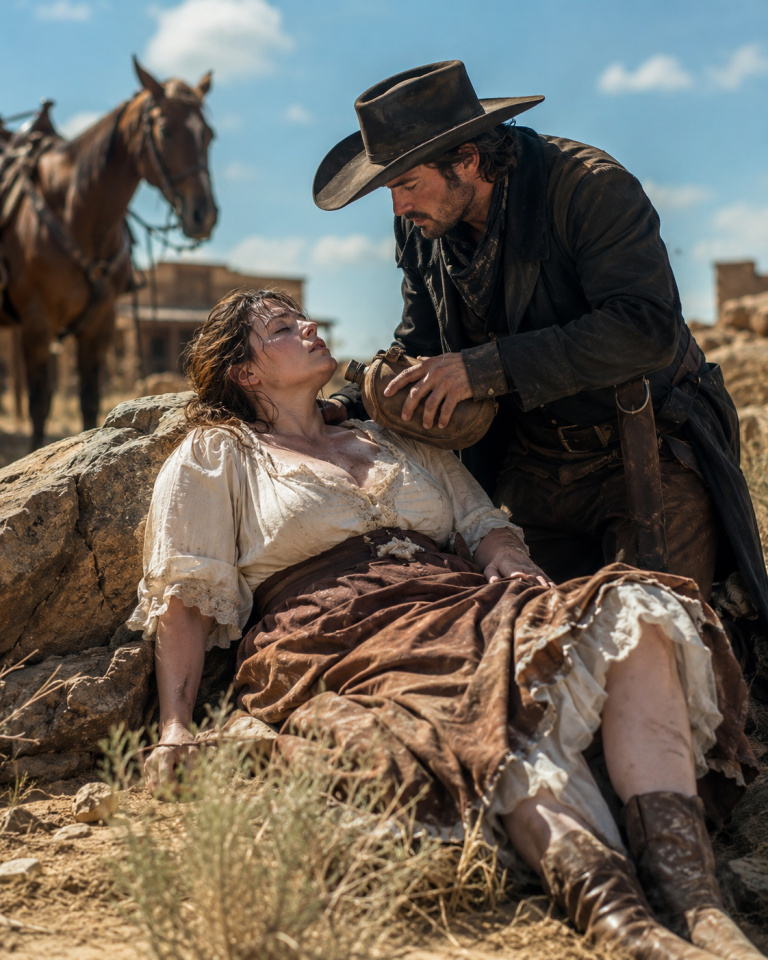
“THAT ISN’T MY BRIDE” — THE MOUNTAIN MAN STARED AS A FUGITIVE IN VELVET STEPPED OFF THE STAGE

**PART 1**
The stagecoach rolled into Ironwood Junction in a storm of dust and outrage, rattling over the ruts of the main road like the whole contraption meant to shake itself apart before it ever reached the stop. The six-horse team came in lathered white, the driver hauling hard on the brake and cursing the animals, the road, and whatever fool in Montana Territory had decided weekly mail delivery ought to be attempted through terrain that seemed personally offended by the effort.
Wyatt Calloway leaned against the post outside the assay office and watched it come in wearing the same expression he wore for most things — suspicion first, patience second, and not one trace of anticipation lodged anywhere underneath either.
He’d been in town since dawn, which alone marked the day as strange. He came down from his cabin only when supplies or necessity forced the matter, moving through town fast and leaving faster — flour, cartridges, lamp oil, coffee, trap repairs, salt, then the wagon turned back toward the mountains before anyone got the chance to press him into conversation. Ten years in the Copperhead Range had pared him down to essentials. He was thirty-two, broad as an ox, scarred in the small practical ways mountain men collect scars, built with the hard economy of strength that comes from hauling dead weight uphill and splitting wood with no one around to admire the result. His beard was thick and the color of dark wheat after rain, his eyes the cold slate-gray of winter creek water. Not handsome in any polished, civilized sense — but the kind of face weather could only improve, because it had always been meant for difficult places.
The town had opinions about him, the way towns always do about men who keep to themselves and survive too well. Some called him wild. Some called him mean. Most just called him the mountain man and stepped out of his way.
The truth was quieter and a good deal less impressive. He lived alone because past a certain point, grief stops feeling like deprivation and starts feeling like discipline.
But even discipline has its limits, and the winters had been getting longer — not literally, though the mountains had a way of making it feel that way. Longer in the cabin. Longer in the silence. Longer at supper, with only the stove popping and wind working the corners and no voice ever answering back when he said something aloud just to hear a human word in the air.
So, in a moment of weakness he still half regretted, Wyatt had placed a notice in the Matrimonial News.
He’d been direct about it. *Seeking a woman of sturdy constitution. Must know how to shoot, preserve meat, tend livestock, and survive winter at high altitude. No romantics. No delicate flowers. No idle chatter. Write plainly and honestly.*
Most of the replies had been nonsense — women who liked the idea of adventure but not the labor behind it, women who called themselves refined, women who asked how close the cabin sat to theaters or proper churches, which told him everything he needed. Then came Ruth Bellamy. She wrote like a woman with no patience left for performance — eldest of seven from Missouri, both parents buried, a failing farm run into the ground and mended as best she could manage, wanting above all a dependable roof and a man who wouldn’t drink up the winter stores. Calloused hands, she said. A strong back. No romance required, only honesty and a workable arrangement.
Wyatt believed her. He sent the fare.
Now, standing in the mud-churned street with his thumbs hooked in his suspenders and the smell of manure and cheap whiskey and wet wool rising up around him, he waited for the woman he pictured stepping down off that coach.
It lurched to a stop. A traveling salesman climbed out first, cursing his spine and the territory generally. Then a weary assayer, dust in his beard, carpetbag stuffed with papers. Wyatt watched without moving, expecting a broad-shouldered woman in a faded dress, practical boots, the look of someone who’d spent more time with weather than mirrors.
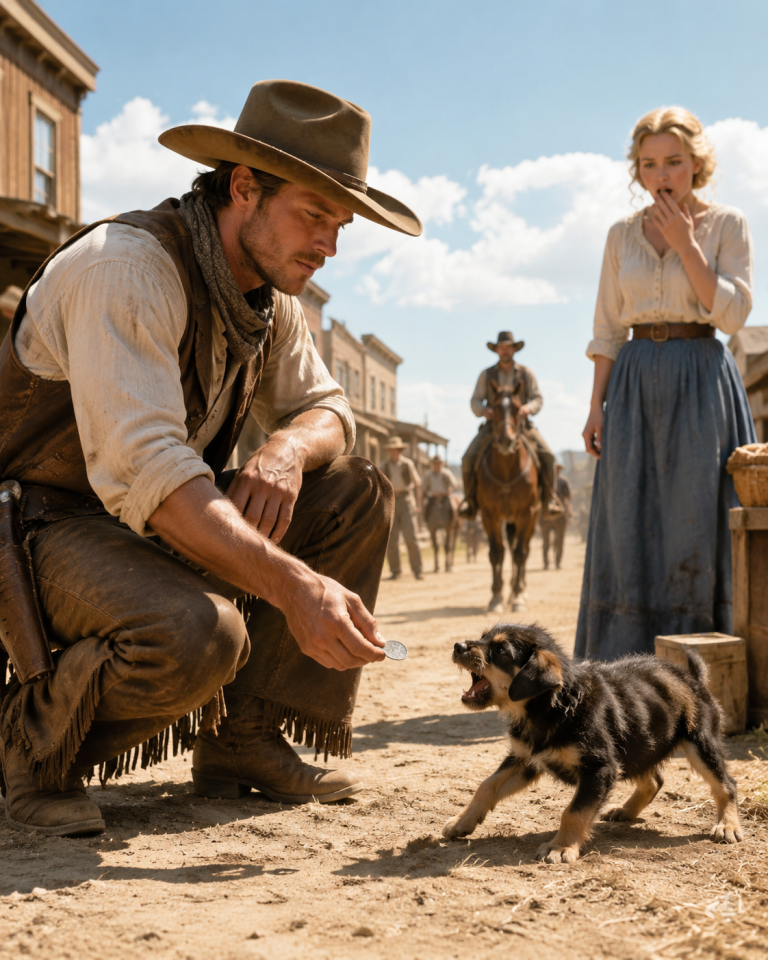
Instead, a gloved hand appeared in the doorway. Crimson kid leather. Fine. Soft. Entirely out of place. Then a foot in a polished heeled boot that had no business within a hundred miles of a Montana road. And then the woman herself stepped down into the pale autumn light, and Wyatt felt his whole understanding of the day tear cleanly in two.
She was elegant — not pretty in any simple, agreeable way, but elegant in the dangerous manner of women raised among chandeliers and sharp company, women used to being watched and knowing exactly how to use it. Her traveling suit was dark green velvet, cut close, trimmed in black lace at collar and cuff. A hat with a pheasant feather sat pinned into dark auburn hair that had come loose under the violence of the ride and now curled free around her face in rich, disobedient strands. Her skin looked almost luminous against the grime of the street. Her cheekbones were sharp, her mouth full and unsmiling, and when she finally lifted her eyes to survey the muddy little scar of a town ahead of her, they were green enough to put Wyatt absurdly in mind of deep summer moss in the high timber.
He stared. Then muttered, to no one and entirely to himself, “That can’t be my bride.”
Her gaze swept the street — past the drifters, the miners, the stationmaster — and settled on him as if she’d recognized him on sight. Perhaps she had. He stood a head above most men there, buckskin and canvas, a Winchester resting easy in the crook of his arm, a face that said he belonged to the mountains more than to any street.
She came straight toward him. “Are you Mr. Wyatt Calloway?”
Boston. Not merely Eastern — refined in a way that practically insulted the air around it.
“I am,” Wyatt said. “And unless you’re lost, ma’am, you’re standing in the wrong town.”
“I am not lost.” Her hands trembled despite the steadiness in her voice. “I’ve come in answer to your letters. I’m your bride.”
Wyatt barked out a short, humorless laugh. “The hell you are. I sent fare to Ruth Bellamy. Farm girl out of Missouri. You look like you stepped straight out of a banker’s parlor.”
“People change, Mr. Calloway.”
The lie was so thin even the wind looked embarrassed carrying it.
He was already forming the words to send her back east on the next coach when movement across the street caught his eye. A man stood in the shadow of the livery — not local, that much was plain immediately. Gray bowler, sack suit, city posture, all wrong for Ironwood Junction. Worse, the way he watched the woman was wrong too. Not curiosity. Not admiration. Professional attention. He drew a folded paper from his coat, glanced between it and her face, and Wyatt saw enough in that single motion to know exactly what he was looking at.
A hunter. Pinkerton, maybe. Private, maybe. Same breed of trouble either way.
Wyatt looked back at the woman and finally saw her clearly — not the velvet and lace, but the terror hiding underneath the elegance. She hadn’t seen the man yet. Her body already knew it was cornered anyway.
He made his decision in the space of one breath.
“Where’s your baggage?” he asked sharply, stepping close enough to block her from the watcher’s line of sight.
**PART 2**
She startled. “What?”
“Your baggage. Now.”
She pointed to a brass-bound trunk being thrown down from the coach roof. “Silas!” Wyatt shouted, tossing a silver dollar to the stationmaster. “Load that in my wagon.”
“Mr. Calloway, what are you doing?” she hissed, trying to pull free of the hand already closed around her elbow.
“Saving your neck,” he said under his breath. “That man across the street’s reading your face off a piece of paper, and if I were you, I’d rather ride out with a stranger than stand here while he decides between a rope and a bullet.”
All the color drained out of her. She didn’t even turn to check. That told him exactly how frightened she already was.
She took his arm with both hands instead and forced a smile so stiff it might have been painted on. Wyatt loaded the trunk and snapped the reins before the bowler-hatted man could cross the street fast enough to matter.
They left Ironwood Junction in a cloud of dust, the stationmaster shouting behind them and the stranger cursing.
Neither spoke for the first hour. The trail into the Copperheads climbed hard and quick, the wagon creaking, the mules — Jasper and Nell — picking their way over washouts with the weary intelligence of animals that knew the road better than either passenger. Cold sank in with the afternoon sun. Beside Wyatt, the woman shivered harder by the mile, her velvet jacket useless against mountain wind, arms wrapped tight around herself, jaw set with pride or determination or both.
Finally, well past town, with the trail narrowed along a ravine deep enough to swallow a wagon whole, he hauled back on the reins.
“Enough,” he said. “Who are you?”
“I told you—”
“Don’t insult me twice.” His voice went flat. “Ruth Bellamy wrote she broke her left arm at twelve and it healed crooked. Yours are straight. She said ten years behind a plow, and you don’t have a callus on either hand. So I’ll ask once more, and I’d advise the truth. Who are you, and what happened to the woman I paid for?”
Her shoulders dropped. With what looked like enormous effort, she pulled the hat from her head and let it fall to the wagon boards.
“My name is Isabelle Fairfax,” she said. “And I didn’t do anything to Ruth Bellamy. I bought your ticket off her — in St. Louis, at the station. She’d changed her mind, wanted to go home to Missouri, but she’d already spent the extra money you sent. I gave her fifty dollars. She gave me your letters and the routing papers.”
“You thought you’d just arrive in Montana and explain that to a stranger expecting a wife?”
“I thought,” she said, voice thinning at the edges, “that if the letters were honest, your cabin would sit far enough from civilization that I could disappear there until spring. I meant to work. Keep house. Earn the cost of my fare and leave when it was safe.”
Wyatt laughed again, with no real humor in it. “Lady, do you know how to light a stove? Pluck a chicken? Dress game? Split wood?”
She avoided his eyes. “I learn quickly.”
“The mountains don’t care how quick.”
Something changed in her face then — not weakness, something older and darker. “I’ve survived worse,” she said quietly, and the sentence landed differently than the rest of her polished Eastern speech. It carried real weight.
“What did you do,” Wyatt asked, “that put a hunter on your trail?”
She closed her eyes. When she opened them again, fear lived there openly.
“I didn’t do what they say I did,” she said. “But if he catches me, I’ll hang for it all the same.”
**PART 3**
Wyatt looked down the trail toward the valley, then up toward the deepening woods. The practical thing — the obvious thing — was to turn around and hand her straight to the sheriff or the man in the bowler and let Eastern trouble finish itself somewhere else.
Instead, he cursed under his breath, reached behind the seat, and dragged out a buffalo robe so heavy and rank with cured hide and campfire smoke it nearly buried her lap when he threw it over her shoulders.
“Wrap up,” he growled, “before you freeze and make me dig in frozen ground.”
She stared at the robe, then at him. “Thank you, Mr. Calloway.”
“Don’t thank me yet, city girl.” He snapped the reins. “Winter’s coming. And you are the least sensible thing to happen to my mountain in ten years.”
By the time they reached the cabin, dusk had fallen and the season’s first storm was already rising in earnest.
That night, with the fire low and the wind quiet outside, Wyatt asked properly. “Elias Thorne,” he said. “Saw him talking to Silas in town. Recognized him off a poster in Missoula. Pinkerton — but not the kind they send after stage robbers. A retriever. Rich men’s hound. So tell me the truth this time, Isabelle. Who’s hunting you?”
The firelight made her look younger and older at once — refinement polished across the surface, suffering carved into the structure underneath.
“My husband was Cornelius Vance,” she said. “Rail freight, out of Boston. My father owed him money. Cornelius offered to clear the debt if I married him. I was eighteen. He was fifty-two.” She kept her eyes on the fire. “He was cruel. That’s the polite word for it.
“For three years I belonged to him. Then one night his business partner — my brother-in-law, Arthur Vance — came to the house. They argued over stolen railroad bonds. Arthur shot Cornelius through the chest.” She paused. “When the servants came running, Arthur put the derringer into my hand.”
Wyatt’s knife stopped moving. “He blamed you.”
She nodded. “He’d already bought half the household — the maid, the guard at the side door, a magistrate in his debt. The trial was theater. I was convicted before the jury even sat.”
“And Thorne?”
“Arthur hired him after I bribed a guard and escaped. He doesn’t want me arrested, Mr. Calloway. He wants me buried somewhere convenient, and then he’ll say I resisted.”
The truth settled between them, heavy as the storm outside had been. She hadn’t used the marriage notice as a scheme or a game. She’d seen a road leading west into obscurity and taken it, because obscurity was the only kind of life left available to her.
That night Wyatt didn’t tell her he believed her. He only said, “Get some sleep.” Then, without quite looking at her: “If Thorne comes up this mountain, he’ll find trouble before he finds you.”
“Wyatt,” she said softly, “if he finds us, I’ll run. I won’t have you die because of me.”
He looked up at that. “Nobody’s dying on my mountain. You paid your fare. You’re under my roof. That makes you mine to protect.”
It wasn’t a lover’s declaration. Not yet. But something shifted in Isabelle’s face all the same — as if a life measured entirely by being owned had just met the first kind of possession that didn’t feel like a threat.
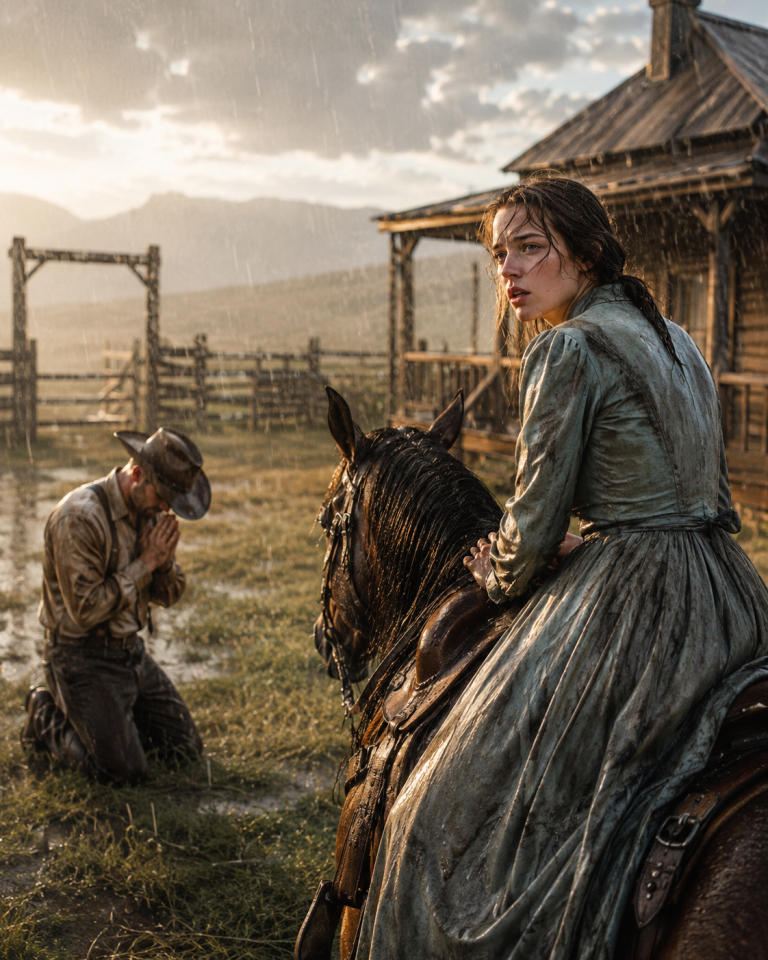
Morning broke sharp and merciless, the storm having stripped the sky to hard blue and buried the mountain in blinding white. Wyatt was on the roof shoveling snow before Isabelle had fully dressed — until the rifle shot split the valley and the shovel handle exploded in his hands.
“Mr. Calloway!” Elias Thorne’s voice carried up through the brittle air from fifty yards out, near the tree line, half-frozen but steady behind his Winchester. “Send the woman out! She’s wanted for murder — five thousand dollars on her head, and I’m taking her back!”
“She ain’t here!” Wyatt shouted down.
“Don’t play me, mountain man. I saw the smoke.” Thorne levered a fresh round. “Send her out or I’ll burn this shack with both of you in it. Three seconds. Two—”
Inside, Isabelle had gone still in the center of the room, hearing every word. Fear rose first, quick and clean. Then something harder settled over it. Her eyes lifted to the double-barreled shotgun hanging above the mantel.
She dragged a chair under it, climbed up, hauled the gun down with both hands, checked the breech the way she’d once watched a stable hand do it outside one of Arthur’s country houses, and threw the door open hard enough to slam it against the outer wall.
“Thorne!” she shouted, standing in the doorway in Wyatt’s oversized flannel shirt, hair loose, face white with cold and fury, the shotgun braced against a shoulder far too slight for it. “Put it down.”
Thorne swung his rifle toward the porch and grinned. “You don’t have the stomach, Mrs. Vance.”
“Isabelle!” Wyatt roared from the roof — but she didn’t look up. She pulled the front trigger.
The blast rocked the mountain. The recoil threw her backward onto the porch boards, one shoulder exploding with pain, smoke swallowing the doorway. The shot went wide but shredded the trunk of a pine just left of Thorne, showering him with bark and ice. He recoiled, arms flying up — and that was all Wyatt needed.
He vaulted off the roof, hit the snow shoulder-first, rolled, came up running for the axe half-buried by the chopping block. Thorne recovered fast, swinging the rifle back toward him — but Wyatt hurled the axe first, and the spinning steel struck the Winchester’s receiver hard enough to snap it clean out of the Pinkerton’s hands.
Then Wyatt hit him. It was not a fight in any civilized sense — force meeting flesh with mountain speed behind it. He drove Thorne into the snow so hard the breath left him in one ugly bark, forearm pinning his throat, hunting knife pressed against his cheek.
“I told you,” Wyatt said, low and terrible. “Nobody kills anybody on my mountain.”
“She’s worth—”
“More than you.” Wyatt leaned harder. “You’re going to walk off this mountain and tell Arthur Vance his little widow died in the snow. Avalanche, fall, wolves — I don’t care what story you use. But if you come back up this trail, I’ll put you so deep under frozen dirt the carrion birds won’t know where to start looking.”
Thorne nodded as much as the forearm allowed. Wyatt stripped his revolver, kicked the ruined Winchester into the drift, and shoved him toward the valley trail. The man stumbled off with blood on his cheek and fear finally winning out over professional pride.
Only then did Wyatt turn back. Isabelle sat on the porch, shotgun beside her, one hand clamped over her shoulder, pale as new paper and fighting not to faint. He crossed the yard in three strides and crouched in front of her.
“You all right?”
She tried to answer, failed, then laughed weakly instead. “I believe he was correct about the collarbone.”
“You ruined my doorframe.”
She glanced past him at the buckshot holes in the wood and somehow managed to look chastened. “I’ll learn to fix it.”
Something broke loose in him then that had nothing to do with anger. He pulled her carefully to her feet and wrapped his canvas coat around her without thinking twice. “I believe you will.”
From that morning on, the mountain changed shape — not the weather, not the brutal fact of altitude and chores that waited on no one’s feelings, but the cabin itself, because there were two people in it now, both trying, badly, not to become essential to one another while doing exactly that with every passing week.
Isabelle learned. Badly at first, then less badly, then with a swift, fierce determination Wyatt had rarely seen in anyone. She learned to bank the stove overnight so the fire held till dawn, which wood split easy and which fought back, how to salt meat and trim tallow and mend hide. She learned to shoot too — badly at first, both eyes shutting at the first pistol report, then steadier, Wyatt’s hands correcting her stance with more care than either of them ever mentioned out loud.
“Don’t fight the kick,” he told her one gray morning in the clearing below the cabin. “Work with it.”
She fired and clipped the edge of the target paper, and her whole face lit up. Wyatt looked away before she could see what the sight did to him.
There was peace in the work. That was the danger of it. He’d spent ten years building a life so pared down nothing unexpected could take root in it, and now Isabelle stood in his oversized coat over a homespun skirt she’d altered herself, hair braided back, asking practical questions about trap lines and winter stores like she’d always meant to stay long enough to matter.
He told himself it was temporary. Spring would come, roads would open, some decision about her future would have to be made, and the world beyond the mountain would return with its courts and its names and its consequences.
But winter has a way of making temporary things feel dangerously permanent.
She spoke more of Boston gradually — a house too large and too cold, a father who loved money more than courage, a marriage sold as rescue and delivered as punishment, Arthur’s careful cruelty always wrapped in plausible concern. Wyatt listened and built, somewhere in himself, a hatred for Eastern men he’d never once laid eyes on.
By midwinter, a freight hauler passing through with furs and salt brought word from Missoula: Isabelle Vance had died in the mountains. Avalanche, most likely. The papers back east carried only a small notice; her brother-in-law had called the matter tragic but concluded.
Isabelle went very still when she heard it. *Free* seemed to pass through her without a sound.
That night she stood outside long after dark, staring across the snowfields. Wyatt came out and stood beside her.
“You all right?”
“No,” she said honestly. “I think I’ve just been handed back my life, and I don’t know what to do with it. I used to think freedom would feel larger.”
“What does it feel like?”
She looked at him. “Like this.” The word covered the mountain, the cold, the rough cabin, the man beside her — the whole improbable, hard-won quiet of the life she’d fallen into.
When he kissed her the first time, spring thaw had already begun, and both of them knew decisions were waiting on the other side of it. She kissed him back with a hunger that had nothing polite in it, and when they finally broke apart, she pressed her forehead to his chest.
“I’m not leaving in the spring,” she whispered.
“Good,” Wyatt said. It was all he trusted himself to say.
Spring came hard and muddy, and with it came choice. Isabelle could have left — Thorne was gone, Boston believed her dead, Arthur had accepted the fiction because it served him too. Instead, a lawyer arrived in a tidy black suit wholly unsuited to valley mud, introducing himself as Mr. Ellery of Helena, acting on behalf of certain Eastern interests tied to the Vance estate.
“There is a matter of inheritance,” he told Wyatt in the yard, “should Mrs. Vance still be living.”
“She ain’t.”
“Yes. That is the public understanding. But rumor travels.” Ellery produced a folded packet. “Should you know where she might be, she could be informed that a private arrangement is possible — compensation, in exchange for a final, documented separation from the estate.”
Wyatt understood then that Thorne’s failure hadn’t ended the danger, only its easiest form. Arthur wanted certainty — Isabelle either truly dead or paid into permanent silence. He took the packet, tore it cleanly in half, then in half again, and let the pieces settle into the mud at Ellery’s feet.
“Tell Arthur Vance this,” Wyatt said. “He sends another man up my mountain, I’ll ride east and finish the conversation myself.”
“You misunderstand. This is a legal courtesy.”
“No,” Wyatt said. “This is a rich man sending word to a woman he already tried to kill, hoping for one more chance to write the ending himself. Tell him there isn’t one.”
Ellery looked from Wyatt’s face to the rifle by the door and made the sensible choice. He left.
Isabelle came out once the buggy had disappeared down the track, standing among the mud-soaked paper scraps. “I have money,” she said quietly. “If I prove I’m alive, I could claim what’s mine. Land. Livestock. A proper house.” She drew a breath. “And if I claim it, Arthur will know exactly where to find me. I don’t care about Boston anymore, or any of it. I only care about what’s here.” She touched the front of his shirt, over his heart. “If you ask me to stay, I’ll stay whether we have five dollars or five thousand.”
Wyatt looked at her the way a starving man looks at bread he’s convinced himself he doesn’t deserve.
“I’m not asking you to stay,” he said finally. “I’m asking you to marry me proper. No advertisements. No misunderstandings. No ticket bought off another woman. You. Me. Here. For real.”
Her eyes filled too fast for her to answer right away. Then she laughed, cried, and kissed him in the same breath. “Yes,” she said against his mouth. “Yes, you impossible mountain man.”
They married in Ironwood Junction three weeks later — not quietly, though Wyatt had hoped for that. By then the town knew enough of the story to turn out in full under the pretense of helping while fully intending to witness every detail. Isabelle wore no velvet, not because she’d lost her taste for beauty but because she’d found another kind — a simple cream wool dress, clean and plain. When the preacher asked if Wyatt would take Isabelle Fairfax, widow, fugitive, survivor, and the most improbable bride the valley had ever seen, to be his wife, he answered like a man stating absolute fact.
“I will.”
Her answer shook at first, then steadied. “I will.”
They returned to the cabin that night as husband and wife, and Isabelle stood in the doorway of the single room that had once felt like a prison and now looked, to both of them, like the beginning of something far larger than its walls.
“It still needs work,” Wyatt said.
“So do we,” Isabelle answered, and he laughed, surprised by it as much as she was.
The months that followed weren’t easy — easy lives rarely are, and are seldom worth trusting anyway. But the labor was shared now, and shared work becomes something else entirely: less burden, more proof of a future. They built onto the cabin before the next winter — a second room, windows that let in more light, shelves for the books she refused to leave in a trunk, curtains Wyatt pretended not to notice and secretly liked, because they made the place look inhabited even from a distance.
By the first snowfall, the cabin no longer looked like a solitary man’s fortress. It looked like a home.
Years later, when people in the valley told the story, they told it larger than life — a Boston beauty who stepped off a stagecoach in velvet and stole the heart of the meanest mountain man in the territory, a man who’d taken on a Pinkerton with an axe and a knife and run him off the mountain like a whipped dog, a woman who’d fired a shotgun she barely knew how to hold and proved that city women could surprise you, if you only stopped talking long enough to actually see them.
All of it was true enough, in pieces. But the thing that mattered most was simpler than any of it.
A man had asked for a sturdy woman and gotten the wrong one entirely. A woman looking for a place to hide had found the first honest shelter of her life. And the winter that might have killed either of them alone became the very season that made them impossible to separate.
One evening near the end of that first full year, they stood together outside the cabin watching sunset burn across the Copperheads in layers of gold and violet, her hand in his.
“Funny thing,” Wyatt said. “I asked for a woman who could survive a Montana winter.”
“And instead?” Isabelle asked, smiling.
He bent and kissed her forehead with a tenderness that would have startled the whole of Ironwood Junction if anyone had been there to see it.
“Instead,” he said, “I got the only woman alive who could survive me.”
She laughed, and the sound carried out over the mountain like something meant to stay there. Then, hand in hand, they went back inside the cabin they’d built together — where the stove burned warm, the doorframe still carried the scars of buckshot, and the life waiting on the other side of the threshold was no longer something either of them had to face alone.