A MAIL-ORDER BRIDE ARRIVED TO FIND HER NEW STEPDAUGHTER’S BELLY SWOLLEN AND HARD — SOMEONE IN THAT HOUSE WAS FEEDING HER SOMETHING NO DOCTOR HAD PRESCRIBED

PART 1
Maggie Doyle’s hands trembled as she pressed them against the child’s swollen belly.
The little girl whimpered in her sleep, and under Maggie’s palms there was something horribly wrong — something far past ordinary sickness. The skin stretched too tight, the flesh beneath it firm in a way that turned Maggie’s own stomach cold. This wasn’t pregnancy, wasn’t a simple fever, wasn’t a passing weakness a child might outgrow with broth and rest. This was something slower. Darker. Deliberate. Something creeping through the little girl’s body day after day while the grown people around her called it care.
And somewhere in that house, Maggie knew with sudden, sick certainty, somebody was feeding it to her on purpose.
But all of that came later.
It began with the stagecoach.
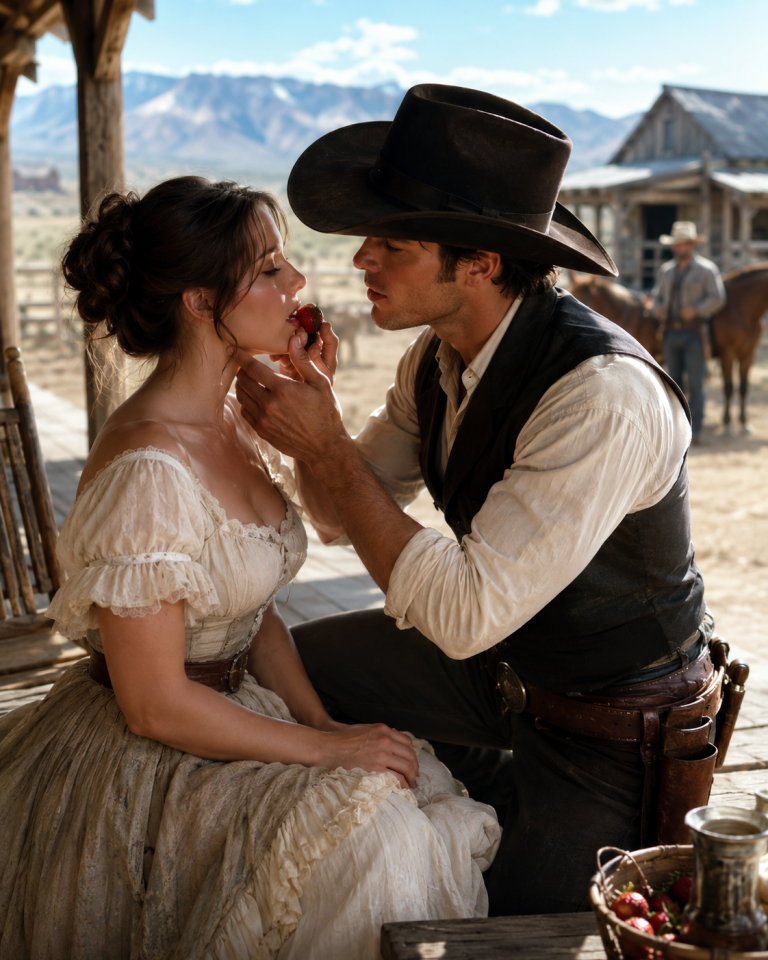
The coach lurched to a stop in a cloud of dust, and Maggie gripped the edge of her seat until her knuckles went pale. For a long second she didn’t move. Through the dusty glass she could see him standing there — a tall figure in a worn hat, shoulders squared against sun and wind like a man bracing for bad weather. Reuben Talmadge. Her husband-to-be. A man she’d never met, never spoken to, never heard laugh, never watched eat or sleep or pray. A stranger whose name had become a command in her father’s mouth.
*You’ll marry him, Margaret. It’s already arranged.*
No say in it. No choice. No appeal.
The driver called out that it was the end of the line, and the words snapped the moment apart. Maggie gathered her single carpetbag — the whole of her remaining life packed into one worn piece of luggage — and stepped down into Wyoming sunlight so harsh it felt like a slap across the face. The land spread out around her in long yellowed distances, too wide and too merciless to feel entirely real. Even the air seemed emptier than back east, like fear simply had more room to grow out here.
Reuben Talmadge didn’t step forward to take her bag. Didn’t smile. Didn’t welcome her. He only watched.
Maggie lifted her chin and walked toward him regardless.
“Mr. Talmadge,” she said, pleased to hear her own voice come out steadier than she felt.
He tipped his hat the smallest fraction. “Miss Doyle.”
That was all.
Silence stretched between them, dry and sharp as barbed wire. Maggie waited for some sign of pleasure, relief, gratitude, or even plain courtesy. She got none of it. Reuben’s jaw stayed tight, his eyes gray and distant beneath the brim of his hat, fixed on some inward place she couldn’t yet name.
“House is this way,” he said flatly, and turned and started walking.
She followed, because what else was there to do.
The ranch grew more desolate the closer they came to it. No flowers. No curtains stirring in any window. No small bright touches of domestic effort anywhere at all. The buildings stood sturdy, useful, weathered — the whole place looking less like a home than a stronghold built by a man interested only in survival, not comfort. Maggie had left behind poverty, pressure, and a father who’d bartered her future off like feed grain. She hadn’t expected luxury. Still, something about the emptiness of the place tightened her chest all the same.
“Ain’t much,” Reuben said without turning around, “but it’s honest work.”
Maggie didn’t answer. No point pretending gratitude or disappointment yet. She hadn’t come here for romance. She’d come because she’d been sent.
He opened the front door and led her into a house that felt darker inside than out. Heavy curtains dimmed the afternoon light. The air smelled stale, closed-up, full of old grief. Maggie took two steps inside and heard it at once — a small, weak sound, a whimper, the unmistakable cry of a child trying hard not to cry.
She stopped. Reuben did too, though only for a second.
“What was that?”
“Nothing.”
But it hadn’t been nothing. She knew what she’d heard, and she knew by the sudden stiffness in his shoulders that he knew it too.
“There’s someone here,” she said.
“I said it’s nothing.” His voice sharpened now — a warning, not an answer.
Maggie narrowed her eyes. Life had already stripped away most of the softness that might once have made her retreat from another person’s temper.
“I heard a child.”
Reuben turned then, and for the first time something cracked through his bleak composure.
Fear. Not anger, not annoyance. Fear, raw and helpless and old.
“You’ll meet her soon enough,” he said quietly. “My daughter, Bess.”
Maggie’s breath caught. “You have a daughter?”
“My late wife’s child.” The words seemed to cost him something to say. “She’s not well.”
Before Maggie could ask anything further, footsteps sounded down the hallway. A woman emerged — tall, sharp-featured, severe, with cold, assessing eyes that traveled over Maggie like a knife measuring cloth.
“So,” the woman said. “This is her.”
Reuben cleared his throat. “Maggie, this is Vera. My late wife’s sister. She’s been helping with Bess since… since Diana passed.”
Vera didn’t offer a hand. Didn’t smile. “I hope you’re not expecting much,” she said coolly. “This ain’t no fairy tale, and Reuben ain’t exactly Prince Charming.”
Maggie met her gaze without lowering her own. “I wasn’t expecting anything, ma’am. I came here to work.”
Something flickered across Vera’s face — annoyance, maybe, or surprise that Maggie hadn’t bothered trying to charm her.
“Girl’s asking for her tonic,” Vera said to Reuben. “I’ll see to her.” She disappeared down the hallway before either of them could answer.
Maggie stood very still. The word *tonic* lingered in her mind, uneasy.
“What condition does Bess have?”
Reuben looked away. “Room off the hall is yours. We’ll wed tomorrow morning. Preacher’s coming at dawn.” He said it like he was naming the weather.
Maggie’s fingers tightened around the handle of her bag. “I want to meet her.”
“What?”
“Your daughter. I want to meet her.”
“Not tonight.”
“She’s crying.”
“She needs rest.”
“So do sick children everywhere, and they’re still allowed to be seen.”
His jaw hardened. “Said not tonight.”
There it was again — that strange mixture of command and panic. Maggie could have argued. Wanted to, even. But she’d been in this house less than an hour. A stranger, not yet even a wife. No rights here, no allies, no ground to stand on except the small dignity she could still hold onto.
“Tomorrow, then,” she said quietly.
He gave a stiff nod and left her alone in the dim room off the main hall.
She slept badly, if at all. Every time she closed her eyes she heard the child’s whimper again, soft and pained, like it was somehow bleeding through the walls themselves. By dawn she’d settled at least one thing in her own mind. Whatever else this marriage turned out to be, she would not ignore that child.
She dressed quickly in her plainest day dress and slipped into the hallway while the house still lay silent. Vera’s door was closed. Reuben nowhere in sight. At the back of the hall she found a door standing slightly open and pushed it inward.
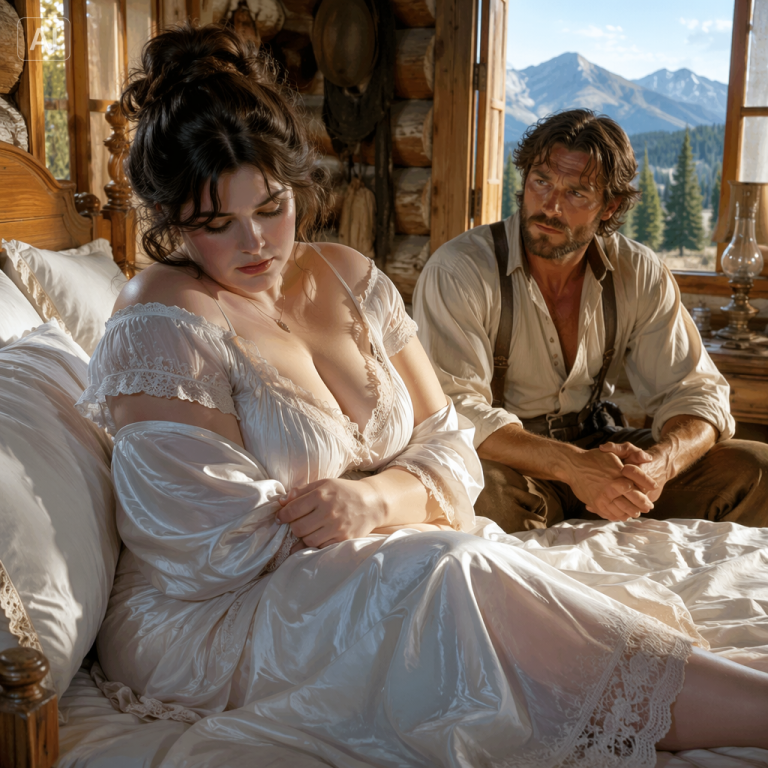
The room beyond sat dim, curtains drawn against the morning. In the narrow bed lay a girl who couldn’t have been more than eight, pale enough to look nearly translucent against the sheets. Bess’s face was too thin, her eyes dull even asleep, her whole small body swallowed up in blankets. But it was her belly that stopped Maggie cold. Swollen. Distended. Wrong.
“Oh, sweet Lord,” Maggie whispered.
Bess’s eyelids fluttered open, and she looked at Maggie with the exhausted blankness of a child grown far too used to pain.
“Who… who are you?”
Maggie moved closer, hands trembling despite herself. “I’m Maggie. I’m… going to be your new mother.”
Bess studied her a long second, then looked away. “Mama’s dead.”
The words came out so simple, so matter-of-fact, that they hit harder than sobbing ever could have.
“I know, sweetheart.” Maggie reached down and took her hand. It was so cold she nearly flinched. “I know. But I’m here now.”
Bess blinked slowly. “Are you gonna give me my tonic too?”
Maggie frowned. “Your tonic?”
“Aunt Vera gives it to me every day. Makes the hurting stop.” The child’s eyes drifted closed again.
“What hurts, Bess? Tell me what hurts.”
But before she could answer, a voice lashed through the room. “What do you think you’re doing?”
Maggie spun around. Vera stood in the doorway, fury written plain across her face.
“Get away from her. Get away from her right now.”
PART 2
Maggie had been on the ranch less than two weeks when she stopped believing the child was dying from illness.
Bess grew weaker after every evening tonic. Stronger on the rare mornings she managed to refuse it. That alone troubled Maggie. What frightened her more was the fear in the little girl’s eyes whenever the small blue bottle came out.
Children rarely feared medicine. They feared whatever came after it.
Maggie waited. Said nothing. Instead she started keeping a notebook — every meal, every fever, every spoonful of tonic, every hour Bess slept, every pain she described. Patterns emerged fast. The swelling in Bess’s belly worsened only after the tonic. Her appetite vanished afterward. Her skin paled by the next morning without fail.
Three days later, Maggie quietly poured one dose into a glass jar instead of Bess’s cup, and hid it beneath a loose floorboard in her own bedroom. That afternoon, Bess smiled — only a little, but it was enough to confirm what Maggie already suspected.
PART 3
Reuben noticed the change almost at once. “What’s different?”
“I don’t know yet,” Maggie answered honestly. “But I intend to find out.”
He wanted badly to believe in his late wife’s sister. Vera had cared for Bess since Diana’s death — cooked, cleaned, sat up with the child through long nights. Everything about her wore the shape of devotion. And yet Reuben came to a realization that shamed him the moment it surfaced: he had never once questioned her. Grief had made obedience so much easier than thinking clearly.
A traveling physician arrived unexpectedly three days later. Dr. Aldous Finch had been thrown from his horse in a sudden storm and gratefully accepted Reuben’s offer of shelter till morning. At supper, Maggie quietly set the hidden jar down beside his plate.
“I need you to smell this.”
The old doctor uncorked it. His expression changed at once. “This isn’t medicine.”
“No?”
“No.” He dipped a silver spoon into the liquid, and the metal darkened almost immediately. “Arsenic.”
Silence swallowed the room whole.
Reuben stared. “You’re certain?”
“I’ve treated mining poisonings the better part of twenty years, Mr. Talmadge. I know the look of it.” The physician’s gaze drifted toward the hallway where Bess lay sleeping. “If she’s been drinking this regularly…” He didn’t finish the sentence. He didn’t need to.
Vera tried to flee before dawn. She nearly made it as far as the stable before Reuben caught her at the gate.
“Why?” His voice came out ragged.
She laughed, bitter and short. “You still don’t understand, do you.”
“Help me understand, then.”
“You inherited everything the day Diana died,” Vera said, and smiled coldly. “But if Bess had died too…” She let the sentence hang until the truth of it landed on its own, cold as a Wyoming winter.
“You inherit the whole ranch,” Reuben whispered, the pieces finally locking into place.
“And when you remarried?” Vera shrugged, like the answer barely needed saying. “You’d have trusted me to just stay on, same as always.” She glanced back toward the house. “I’ve waited three years for this, Reuben. Three years.”
Sheriff Turley arrived before the sun had fully cleared the ridge. Vera was arrested without a struggle, her face gone strangely calm, like some long exhausting performance had finally been allowed to end.
Bess’s recovery came slow. The poison had weakened her body badly, but hadn’t defeated it outright. Fresh milk. Simple food. Rest, and more rest. Months passed before the swelling finally disappeared for good. One bright spring afternoon she ran clean across the pasture chasing butterflies, arms flung wide, laughing loud enough to carry all the way to the porch.
Reuben stood watching in silence. “I’d forgotten what her laugh sounded like.”
Maggie slipped her hand into his. “You were grieving.”
“I was blind.”
“No,” she said gently. “You were broken. There’s a difference, and it isn’t a small one.”
That summer Reuben opened every curtain in the house, and the rooms filled with sunlight for the first time in years. Bess planted wildflowers beneath what had been her mother’s favorite window. Maggie baked bread every Saturday, the smell of it drifting clean out across the yard. Neighbors who’d stopped visiting years back started finding reasons to call again. Slowly, the ranch stopped being a monument to loss and started, instead, becoming a home.
One evening Bess climbed up onto the porch swing between them, settling in with the easy confidence of a child who’d finally stopped bracing for the next bad thing.
“Can I ask you something?”
Reuben smiled. “Always.”
“When did Maggie become my mama?”
He looked over at his wife. She looked back at him. Neither answered right away.
Finally Maggie reached over and brushed a loose curl off Bess’s forehead. “I don’t think it happened all at once.”
Bess frowned, thoughtful. “No?”
“No. I think it happened every single time we chose each other. A little more, every time.”
Bess considered that with the particular seriousness only children seem to manage, then nodded, satisfied. “I like that answer.”
Years later, people around Amber Hollow still remembered the scandal that had once gripped the Talmadge ranch. Some remembered the attempted poisoning. Some remembered the trial that followed, and the fortune Vera Cutter had so nearly stolen out from under a grieving man’s nose. But Bess remembered something else entirely.
She remembered the woman who’d arrived as a total stranger carrying one small worn carpetbag. The woman who’d believed her when nobody else in that house had noticed a thing was wrong. The woman who taught her, slowly and without ever quite saying it outright, that real mothers aren’t only the women who give a child life.
Sometimes they’re the ones who fight hard to make sure that child gets to keep living it.
When visitors admired the thriving ranch in later years and asked Reuben Talmadge just what exactly had saved his family, he never once mentioned luck. He simply looked out toward Maggie and Bess laughing together somewhere out in the garden, and answered the same way every time.
“Love notices what fear overlooks.”
And that, more than any medicine or any fortune, was what finally healed Amber Hollow.
THE END