The Chicago Crime Boss Told His Men He Only Married Her for an Heir — He Never Knew His Pregnant Wife Was Standing in the Doorway

**Part 1**
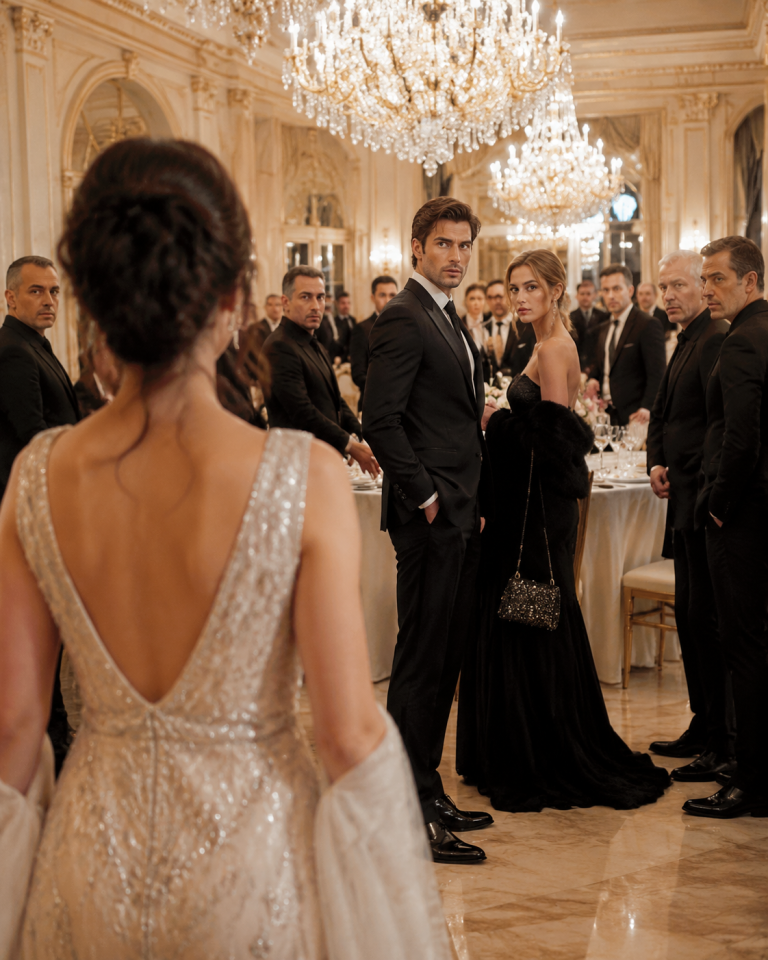
The first time Vivienne Castellan understood her marriage had never been a marriage at all, she was standing outside her husband’s study with a silver tray balanced in her hands and his unborn child hidden beneath her heart.
The penthouse hovered above Lake Shore Drive like something built for men who believed consequences belonged to other people. Thirty floors below, October rain turned the boulevard to black glass. Inside, the air held cigar smoke, expensive scotch, and the cold confidence of old criminal money dressed up as legitimate business.
Vivienne stood six steps from the study door, perfectly still.
Her husband’s voice drifted out, calm and smooth enough to lower the volume of dangerous men.
“Vivienne understands her position,” Julian Castellan said. “She was raised for this. She won’t embarrass me.”
Someone laughed — Theo Callahan, Julian’s oldest friend, the nearest thing he had to a brother. “That’s a polite way of saying she knows when to stay quiet.”
“She does,” Julian answered.
A third voice, older, unfamiliar, added, “Pretty girl. Good bloodline. The Ashcroft name still opens doors with people who pretend not to know what we are.”
“That was the entire point,” Julian said.
Vivienne’s fingers tightened on the tray. The crystal didn’t rattle, because seven months into this marriage she’d already learned how to suffer without making a sound.
“And the heir?” Theo asked. “Still the priority?”
A pause followed. Not a long one. Long enough to make her lungs forget their function.
“I didn’t marry her for love,” Julian said. “I married her for legitimacy and a son. Once she gives me that, the arrangement has done exactly what it was built to do.”
Someone chuckled, as though he’d made a clever joke.
Vivienne did not laugh.
In her coat pocket, folded beneath a handkerchief, sat the pregnancy test she’d taken that morning in a bathroom larger than her old college apartment. Two lines. Certain. Merciless.
She had planned to tell him after dinner. She’d let herself imagine, foolishly, that even a man like Julian might soften at the news — not from love, she’d stopped pretending about that months ago, but because a child was supposed to mean *something*. Because somewhere beneath the tailored suits and surgical discipline, a person might still be reachable.
Now she knew better.
She walked into the study.
Four heads turned. Julian didn’t look guilty, which somehow hurt worse than guilt would have. He simply looked mildly surprised, the way a man notices a lamp has been moved.
“Vivienne,” he said. “You should have sent Renata.”
“I know.”
Her voice came out steady. That astonished her.
She crossed the room, set the tray on the sideboard, poured scotch into four glasses without a single tremor. Theo watched her too closely — maybe he sensed something, the way men like him survived by noticing hairline cracks before they became fault lines.
Julian took his glass without brushing her fingers.
“Thank you,” he said.
There it was. The entire marriage, folded into two words. Polite. Distant. Empty.
Vivienne offered the soft, trained smile her mother had once called graceful and her aunt had called tragic. Then she turned and walked out.
She didn’t run. Didn’t slam a door. Didn’t scream the truth into the marble hallway.
She went to her bedroom, slid off the diamond Julian’s jeweler had chosen without ever asking her opinion, and set it on his side of the bed. Then she pulled one old leather duffel from the back of her closet — not the monogrammed luggage, not the gowns or the jewels or any proof she’d been purchased beautifully. Jeans. Sweaters. Her grandmother’s sapphire ring. The pregnancy test. Her passport. Six weeks of quietly withdrawn cash. A burner phone bought on the day her sadness finally turned practical.
At 12:17 a.m., while Julian still entertained men who discussed her body like a business asset, Vivienne Castellan stepped into the service elevator and disappeared from the life he’d designed for her.
The night doorman looked up as she crossed the lobby.
“Mrs. Castellan?” Oscar frowned. “Everything all right? You need the car?”
**Part 2**
“No, thank you,” she said. “Just getting some air.”
He hesitated. She’d always asked about his daughter, always remembered his mother’s surgery, always treated him like a person and not furniture. Because of that, he let her walk.
Rain hit her face like cold honesty. She cried three blocks later.
By morning she was curled on her aunt Corinne’s Wicker Park sofa, a mug of tea going cold in her hands.
Corinne Ashcroft was sixty-one, silver-haired, allergic to powerful men, and immune to apology. She listened without interrupting while Vivienne told her everything, then set down her own cup.
“You’re pregnant.”
“Yes.”
“Does he know?”
“No.”
“Good.” Corinne’s eyes went hard enough to cut glass. “A man who calls a baby an heir before he calls it a child doesn’t deserve the first announcement.”
“I need somewhere he doesn’t control every door,” Vivienne said.
“Hawthorn Hall.”
The name landed between them like an old spell — twenty-three wooded acres two hours north, stone walls and broken fountains, four generations of Ashcroft ghosts. Julian had suggested selling it twice. *Too isolated. No strategic value.* That had been the first thing she’d ever refused him.
Julian noticed she was gone at 7:42 a.m. — not because he’d missed her beside him, they hadn’t shared a bed in months, but because Renata reported she’d skipped her coffee, and because the ring sat on his nightstand like a verdict.
By evening, Theo confirmed the service elevator footage: she’d left alone, one bag, after midnight.
“You want me to find her?” Theo asked.
“No,” Julian said. Then, quieter, “She overheard something.”
“The study?”
His silence answered.
“You told a room full of men you married her for a son,” Theo said.
“I was speaking strategically.”
“You were speaking cruelly.”
Julian’s hand closed around the ring until the edges bit into his palm.
“Find her,” he said finally.
Theo studied him. “And when we do?”
Julian looked at the empty side of the bed, at the place where her ring had waited.
“I bring her home.”
**Part 3**
Hawthorn Hall looked exactly as Vivienne remembered — beautiful, lonely, half-wild. Ivy climbed the stone. The iron gates groaned. Roses tangled with thorns nobody had cut back in years. It should have looked abandoned. Instead, something in her chest finally loosened. No one here needed her posture perfect. No one here would call her daughter an heir before calling her loved.
She slept in her father’s old room, the one that still smelled faintly of cedar and pipe tobacco even though he’d been gone six years. She ate toast at midnight standing barefoot at the kitchen counter, something she would never have done under Renata’s watchful, well-meaning eye. She walked the ruined garden in rubber boots two sizes too big, borrowed from a closet full of her father’s old things, and told the local handyman, a patient man named Otis who asked no questions, not to answer any questions from anyone wearing an expensive coat.
For the first few days she slept ten, eleven hours at a stretch, the kind of sleep that only comes when a body finally stops bracing for something. Corinne moved into the guest room down the hall without being asked and without ever making it feel like charity. She cooked eggs badly and burned toast cheerfully and never once mentioned Julian’s name unless Vivienne said it first.
Attorney Desmond Frayne visited on the fifth day, seventy years old and dry as parchment, sharp enough to make judges sit straighter in courtrooms three states over. He carried a leather folio that looked older than the house itself and reviewed the prenuptial agreement line by line at the kitchen table, glasses perched low on his nose, before finally setting his pen down.
“There’s nothing in here that requires you to return,” he said. “Nothing that requires you to announce anything, on any timeline but your own.”
“That’s not why I called you,” Vivienne admitted.
“No,” Desmond agreed. “You called me because you needed one person in your life whose only job was to make sure nobody else got to decide for you. Consider it done.” He set the folio aside and folded his hands, watching her with the same careful patience he’d once shown her father across this very table. “Your father would be proud of the woman standing in this kitchen, for what it’s worth. Not the one who left the penthouse. The one who’s decided what happens next.”
Vivienne hadn’t expected that, and it caught in her throat longer than she wanted it to. He removed his glasses.
“Does your husband know about the pregnancy?”
“No.”
“For now?”
“For now.”
“He’ll come,” Desmond said.
“I know.”
“Men like Julian Castellan don’t lose things gracefully.”
“I’m not a thing.”
“No,” Desmond agreed. “Which is exactly why he’ll be worse at losing you.”
Julian found her on the seventeenth day — not through force, but through Oscar, who couldn’t carry the guilt alone and sent word through Corinne.
Those seventeen days had not been idle ones for Julian. He’d had Theo run down every property in three states connected to the Ashcroft name, only to have Desmond block each inquiry with a courtesy so cold it bordered on cruelty. He’d sat through two board meetings without hearing a word said in them. He’d stood in the nursery at 3 a.m. more nights than he could count, running his thumb along the edge of the painted clouds, trying to understand how a man who could read a room full of killers in ten seconds had spent seven months failing to read his own wife. Somewhere around the tenth day, he stopped asking Theo to find her location and started asking him, instead, what he thought Julian had actually done wrong — a question he’d never once posed to anyone in his adult life. Theo’s answer had been short and had cost Julian a sleepless night to fully absorb: *You made her small enough to fit inside your world, and then you were surprised when she left it.*
At sunset on the seventeenth day, a black car stopped outside the rusted gates. Vivienne watched from the upstairs window, her heart betraying her for one foolish second before her mind caught up. He stood in the drive in a dark coat, rain in his hair, her wedding ring hung on a chain around his neck instead of worn — like punishment, or maybe like penance, she couldn’t yet tell the difference.
For a long moment neither of them moved. He didn’t approach the door. He simply stood in the wet gravel and waited, hands loose at his sides, the posture of a man who had decided, for once in his life, not to force an entrance anywhere.
She went downstairs anyway.
“What do you want?” she asked at the door, one hand braced against the frame like she might still need to shut it fast.
“To see you.”
“You’ve seen me.” She started to close it.
“Please.” The word didn’t belong in his mouth, and that alone made her pause with the door half shut, cold air sliding through the gap between them.
“I heard what you said,” she told him. “You said I understood my position. That I was legitimacy. That you married me for a son.”
He flinched — actually flinched. “I was never honest that night. I told them what they expected to hear.”
“Convenient.”
“Cowardly.” He looked up. “I thought if the men in that room believed you meant nothing to me, they couldn’t use you against me. I protected you by breaking you quietly. I know that isn’t the same as protecting you at all.”
“You don’t know,” she said, voice shaking. “You don’t know what it is to sit across from your husband wondering if he’d even notice you were gone. To rehearse your own smile in a mirror before dinner because spontaneity felt like a risk you couldn’t afford. To learn every guest’s allergy and anniversary and dead relative’s name because being useful was the only currency you had left.”
Julian’s jaw worked. “I didn’t know you did that.”
“You never asked what I did all day. You only asked whether I’d embarrassed you.”
“I never once thought you had.”
“You never once said so.”
He absorbed that like a blow he’d chosen not to block. “I noticed.”
“After I left.”
His silence confessed everything.
“I am not coming home,” she said.
“Then let me stay nearby. Let me send security.”
“No demands, Julian. No solutions bought with money.”
Something in his face broke open. “All right. No guards unless you ask. No repairs unless you approve. No home until you choose one.” His hand closed around the ring at his throat. “Because I finally understand I never had a wife. I had a woman waiting to be loved, and I was too proud to admit I didn’t know how.”
He left. That shocked her more than his arrival had.
He came back the next morning, though — not to the door, only the gate. Wildflowers, no card. Then a box of children’s books from her father’s favorite shop, which made her cry on the library floor for twenty minutes. Then, on the fourth day, groceries on the step, because Renata had mentioned she forgot to eat when she was upset.
“Goodbye, Julian,” she said each time.
“Goodbye, Vivienne,” he always answered, and left without arguing.
He called once a night. If she didn’t answer, he left exactly one message, never more. *I ate alone tonight. It tasted like punishment. I deserved it.* *Theo says I’m becoming unbearable. I told him I always was.* She started listening instead of deleting them, though she never told him so.
One message, near the end of the third week, stopped her cold on the library floor. *I walked past the nursery in the penthouse tonight. I don’t know why I had it designed before I ever told you it existed. I think part of me hoped a room could say what I was too afraid to.*
Nursery. He had built a nursery.
She didn’t call that night. She sat with the word until morning, turning it over like a stone worn smooth by water, trying to decide whether it was tenderness or another kind of quiet control — a man buying his way toward forgiveness the only way he knew how. By sunrise she still hadn’t decided. But she’d started, for the first time since October, to want to find out.
It was somewhere in that quiet, unhurried month that Corinne first noticed the sedan.
“It’s been parked past the tree line three evenings running,” her aunt said, watching from the kitchen window with the particular stillness of a woman who’d learned to read danger before she could read anything else. “Not Julian’s car. Different plates each night.”
Vivienne’s stomach dropped. “Could it be Theo? Checking on me without telling Julian?”
“Could be,” Corinne said, though her voice carried no conviction. “Or it could be someone who heard a Castellan wife walked out with a duffel bag and no security, and decided that made her worth watching.”
For three uneasy days, suspicion fell exactly where fear always aims it first — inward, at the people closest to the wound.
“It has to be Theo,” Vivienne said, pacing the kitchen while Corinne watched the tree line. “He’s the only one besides you who knows this address. He’s been distant on the phone, too careful about what he tells me. What if he’s been feeding Julian information the whole time, softening me up for a homecoming Julian ordered?”
“Or feeding someone else entirely,” Corinne said quietly, which was worse, and they both knew it.
Vivienne almost called him that night to accuse him outright. She got as far as dialing before Desmond called first, his dry voice carrying an urgency she’d never heard from him. He’d pulled phone records instead of waiting on instinct, and what he found untangled the wrong thread completely. Theo hadn’t told anyone anything. He’d spent those three weeks doing the opposite — feeding Julian deliberately false locations to buy her peace, claiming she was staying with a college friend in Milwaukee, covering for her so thoroughly that his own loyalty had briefly looked, from the outside, exactly like betrayal.
“He’s been lying to his best friend to protect you,” Desmond said. “That’s not a man selling you out. That’s a man choosing a side and paying for it in trust.”
Vivienne sat with the shame of that suspicion long after she hung up the phone. She thought about calling Theo to apologize outright, then decided against it — some apologies were better delivered in person, once the danger that had prompted the accusation was fully understood. She would learn, later, that Theo had known about her suspicion the entire time and never once mentioned it, choosing instead to keep protecting her the same way he had before, without needing credit for it.
The real answer arrived at midnight, when Julian called and, for the first time since she’d left, his voice had no patience left in it at all.
“The sedan outside Hawthorn,” he said. “It belongs to the Kovalenko family. The older man in my study that night was theirs, sent to test whether I’d shown weakness by loving my wife openly. I performed contempt for you in that room because I already suspected we had a listener, and I have spent seven months making certain no one outside my closest circle knew you mattered to me — because the moment they did, you’d stop being my wife to them and start being leverage.”
Vivienne’s hand pressed to the phone, her mind racing back through seven months of dinners, of careful smiles, of a coldness she’d assumed was simply the shape of him. “All of it,” she said slowly. “Every dinner where you barely looked at me. Every meeting you scheduled instead of a night out. That was for them, not for you?”
“Both,” Julian admitted. “I won’t pretend it started as pure strategy and stayed that way. Somewhere in the performance, I forgot how to stop performing, even alone with you. That’s mine to answer for. But the danger was never invented. I need you to understand that part is true.”
“I let you believe you meant it,” she said. “I let *them* believe it. I never imagined you’d hear it and believe it too.” His breath shook. “But now they know about the pregnancy — a lab result leaked, I don’t yet know how — and a Castellan heir is worth more to Kovalenko as a hostage than a rumor ever was. Vivienne, I need you away from that house tonight.”
He arrived within the hour with four cars and no patience for her door. This time she let him in, and stood in the front hall watching him move through the house the way she’d never once seen him move in seven months of marriage — checking sightlines, counting exits, positioning two of his men at the gate without raising his voice or asking her permission for the one thing that actually mattered.
“I should be angry you’re doing this without asking,” she said.
“You should be,” he agreed. “Be angry tomorrow. Tonight, let me finish.”
Corinne stood in the kitchen doorway watching the two of them with an expression Vivienne hadn’t seen on her aunt’s face before — not approval exactly, something more provisional than that. Corinne had spent forty years watching powerful men promise change and deliver only better excuses. She caught Vivienne’s eye across the room and gave a single, small nod, the kind that said *I’m still watching him, but I see it too.*
“You’ll want to eat something before this gets worse,” Corinne told Julian, in a tone that allowed no argument, and put a plate in front of him he didn’t touch.
The intrusion came at 2 a.m. — a service gate forced, a silent alarm, two men in the tree line who hadn’t accounted for Julian’s own people already stationed there since the sedan’s first appearance. Vivienne heard it from the study: a shout cut short, boots on gravel, the flat crack of something that wasn’t fireworks. It was over in minutes. No shots fired inside the house, no harm done to anyone who mattered, only the cold, clarifying proof that the danger had been real the entire time, not a story Julian told to keep her compliant, not an excuse dressed up as concern.
Theo appeared in the doorway a moment later, breathing hard, a torn sleeve the only mark on him. “Clear,” he said. “Both of them are Kovalenko. We’ll know more by morning.”
Julian didn’t look at him. He was already crossing the room to where Vivienne sat, Corinne’s hand still resting protectively on her shoulder, the two of them frozen in the aftermath of a danger neither had fully believed in until it arrived at the gate. Outside, floodlights swept across the wet lawn, and somewhere beyond the tree line, the sound of a car door closing carried faintly through the glass — the last of it, finally, ending.
“You knew this could happen,” Vivienne said quietly, once Theo had gone. “That night in the study. You knew, and you still chose to make me sound like nothing in front of those men, instead of telling me the truth and letting me decide how afraid to be.”
“I know,” Julian said. “I told myself it was mercy. Keeping you ignorant so you’d sleep at night. I understand now that it was only ever convenience dressed up as care. You deserved the truth and the fear that came with it. You deserved to choose, the way you’re choosing now.”
She studied his face for a long moment — the exhaustion carved into it, the rain still drying in his hair, the ring visible now where his collar had come open in the scramble outside. “Then no more choosing for me. Ever again. Whatever this becomes.”
“Ever again,” he agreed, and for the first time in seven months of marriage, she believed a promise the moment it left his mouth.
Vivienne sat wrapped in a blanket in her father’s study afterward, hands still shaking, and watched Julian kneel in front of her chair instead of standing over it — the first time in seven months of marriage she’d seen him lower himself to her eye level for any reason at all.
“I am so sorry,” he said. “For the words in that room. For letting you believe them long after they’d stopped being a performance and started being true, because somewhere in the last seven months I forgot the difference myself. I don’t know if I can ask you to trust me with your heart tonight. I don’t expect it. But I am asking you to let me earn the right to try, for as long as that takes.”
“I don’t know if I can trust you with our daughter,” she whispered — and only then realized what she’d said.
Julian went very still. “Daughter?”
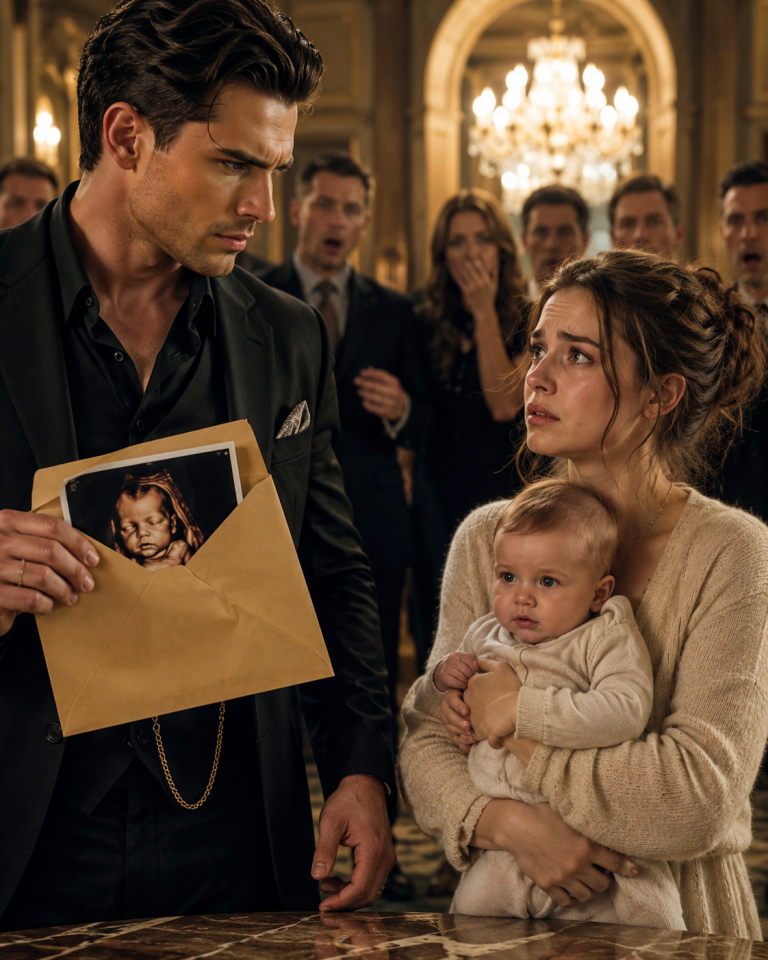
Her hand moved instinctively to her stomach. “I found out yesterday. I hadn’t told anyone yet. Not even Corinne.”
He didn’t reach for the ring at his throat this time. He simply pressed his forehead, very gently, to her hands, and she felt him shaking in a way she’d never once seen from the man who negotiated with senators and buried rivals without raising his voice.
“Not an heir,” he said, voice breaking apart entirely. “Never again an heir. A daughter.”
They sat like that a long time, the house quiet around them, Corinne standing unseen in the hallway with one hand pressed over her mouth, Theo waiting by the door with the particular stillness of a man who understood exactly how much this moment had cost, and how much it might still be worth. Outside, the rain had finally stopped, and somewhere past the tree line, the last of Julian’s men were quietly clearing the gravel drive of anything that might frighten her in the morning light — a small, unglamorous kindness he never mentioned and she never had to ask for.
Spring came slowly to Hawthorn Hall, and so did forgiveness — not as a single decision but as a hundred small ones, repeated daily until they started to feel less like effort and more like habit. Julian fixed nothing without asking. Entered no room without permission. Learned the names of the flowers she planted, not because a gardener briefed him but because he knelt beside her in the dirt on Saturday mornings and asked. He attended every appointment he was invited to and none he wasn’t, sitting in his car outside the clinic on the days she needed to go alone, close enough to matter, far enough not to crowd. He cried the first time he heard the heartbeat through the little handheld monitor, silent tears he didn’t bother wiping away, and Vivienne cried too — not because everything was healed, but because something, finally, had started to be.
He rebuilt trust the way he’d once rebuilt an empire: patiently, methodically, without ever assuming the outcome was guaranteed. He learned to ask instead of arrange. He learned to wait for an answer instead of anticipating one. Theo told her once, over coffee in the Hawthorn kitchen while Julian was out walking the property alone, that in fifteen years of friendship he’d never seen Julian afraid of anything until the week she left — and never seen him work so hard at anything since.
“He used to plan everything three moves ahead,” Theo said, turning his mug slowly on the table. “Meetings, deals, threats, all of it mapped out before he walked in the room. With you, he stopped planning. He just kept showing up and hoping it was enough. I’ve never watched him do anything without a strategy before. It terrified him more than any rival family ever has.”
Vivienne thought about that for a long time after Theo left — the particular courage it must have taken a man who survived by anticipating every outcome to instead simply arrive, again and again, with nothing but flowers and no guarantee of the door opening.
Three months before her due date, she went back to the penthouse — not to stay, only to see the nursery he’d built the day after their wedding and never mentioned once in seven months of marriage. Pale blue and ivory. A painted sky on the ceiling, clouds rendered in careful, unhurried brushstrokes that must have taken the artist days. A rocking chair angled toward the window so whoever sat there could watch the lake. One small pair of yellow socks waiting on the table, exactly where he’d left them eight months earlier.
She walked the room slowly, trailing her fingers along the shelf of books he’d chosen — not generic bestsellers, but titles she recognized from her own childhood, the ones her father used to read aloud in the very study where she’d once stood frozen with a tray in her hands. He’d asked Corinne for the list, she realized. Quietly, without telling anyone why, weeks before Vivienne had ever agreed to speak to him again.
“You bought these the day after the wedding?” she asked, turning the socks over in her hands.
“I wanted a future,” he said, standing in the doorway with his hands in his pockets, afraid to hope. “I just didn’t know how to ask for one out loud. So I built a room instead and told myself it was practical.”
She placed the socks in his hands. “She’ll need these.”
For one stunned second he looked utterly lost. Then he laughed — broken, astonished, entirely unguarded, a sound she’d never once heard from him in seven months of dinners and diplomacy — and sank to his knees to press his forehead to her stomach.
“Our daughter,” he whispered. Not heir. Daughter.
Two years later, Hawthorn Hall was alive again in every direction. The fountains ran clear. The roses behaved themselves along the trellis Otis had finally repaired. A dark-haired girl named Wren chased butterflies across the lawn while her father trailed behind in shirtsleeves, tie discarded somewhere by the back door, carrying a wooden sword and losing every duel on purpose, collapsing dramatically into the grass each time she struck a triumphant blow.
Corinne still lived in the guest room down the hall, officially “just visiting” for three years running, and nobody in the family had the heart to point out the contradiction, least of all Julian, who had long since stopped suggesting she buy her own place nearby. Theo came up most weekends now, teaching Wren card games Julian pretended to disapprove of and secretly funded with a jar of nickels kept behind the kitchen curtain. Desmond sent a card every year on the anniversary of the day Vivienne first called him, never mentioning what the card commemorated, and she never had to ask.
People still feared Julian Castellan. They still lowered their voices around his name in boardrooms three states over, still mistook his quiet for coldness at dinners he no longer bothered attending unless Vivienne wanted to go. What they never saw was the man who knelt on a cold stone step twice in one lifetime — once in apology, once in wonder — and learned, both times, that legacy was never bloodline or power or a name carved into stone above a door.
Legacy was the people you loved well enough to change for, and kept choosing to, long after the choosing stopped being hard.
**THE END**