She Ran From Her Mafia Fiancé After Catching Him With Her Sister — Four Years Later He Found Her With Twins Who Had His Eyes

Part 1
Elena would spend four years trying to forget the exact color of that green leather blotter, and she never quite managed it — the way certain memories refuse to fade no matter how far a person runs, staying sharp and vivid long after everything else has softened into fog.
That evening, she hadn’t gone looking for a reason to leave. She’d gone looking for the right moment to share a secret, an envelope pressed flat against her ribs under her coat like something too fragile to survive the walk down the hallway.
Two small shadows on a sonogram.
Twins, the doctor had said, and Elena had spent the whole afternoon rehearsing how Damian Cole — the most feared man on the Eastern Seaboard, a man who made senators flinch and killers go quiet — might react to news that could actually catch him off guard.
She never got the chance to find out.
The study door was open only a few inches when the smell reached her first — vodka, sweat, and underneath it, the sandalwood cologne she used to press her face into at night. Something in her chest went cold before her eyes even adjusted to the room.
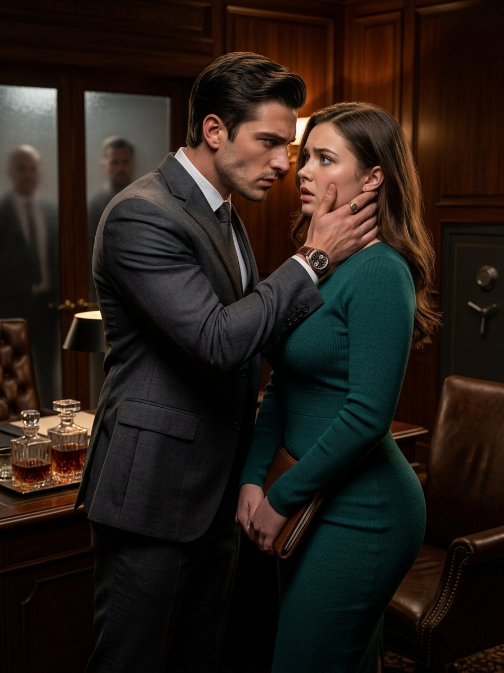
Damian stood with his back to her, shirt half undone, sleeves shoved to his forearms, his shoulders braced over a woman pinned against the edge of his desk.
Blond hair spilled across the leather. A thin silver necklace swung loose at her throat — a small moon charm with one chipped stone, the exact one Elena had bought with her very first paycheck for the sister she’d raised half herself.
Sophie.
The sound that came out of the woman on the desk was breathless, broken. Elena’s mind — cruel, or maybe just protecting her — turned it into a laugh.
She didn’t scream. That was the part that would haunt her later. Betrayal didn’t make her loud. It made her go completely, terrifyingly still.
Her fingers crushed the corner of the envelope. Six weeks of hidden morning sickness rose up her throat all at once.
Those hands on Sophie’s waist had cupped Elena’s face the night before. Those hands had killed men, she knew that, had always known that, and still they’d promised her — in that low voice she only heard in the dark — that nothing in this world would ever touch her while he was breathing.
She stepped back. One inch. Then another. She pulled the door shut so gently the latch didn’t even click.
Neither of them heard.
The hallway stretched in front of her, oil paintings and Persian runners bought with money that never smelled clean no matter how many fresh roses sat in the crystal vases. For one dizzy second she thought she might go down right there on the floor.
Instead she walked — not to their bedroom, not to a bathroom where she could fall apart in private, but straight to the hall closet, where she reached behind coats no one wore anymore and pulled down a canvas duffel she’d packed once, months ago, and hated herself for packing.
A woman who trusted her husband didn’t keep an escape bag ready.
A woman married to Damian Cole did.
Twenty minutes later, Elena Ward — because that was who she’d have to become now — walked out of that house for good. She left the diamonds, the black dresses, every card his people could trace within the hour. She took the cash from behind the bathroom vent, her passport, three pairs of jeans, and the sonogram.
At the door, she stopped.
Behind her the house sat silent. Somewhere down that hallway, her fiancé was still with her sister.
Elena pressed one hand flat against her stomach. “I’m sorry,” she whispered to children who couldn’t hear her yet. “But I won’t raise you where love means someone owns you.”
Then she walked into the rain and didn’t look back.
Part 2
For four years, she simply vanished.
She sold her car for cash outside Reno and bought a station wagon whose heater smelled permanently of scorched dust. She changed her name. She cut her own hair in a motel bathroom outside Tacoma and only cried when the dull kitchen scissors snagged.
The twins came into the world in a county hospital on the Oregon coast, during a storm loud enough to rattle the windows in their frames — no husband gripping her hand, no mother, no sister, nobody who remembered the woman she used to be. Just a night nurse named Loretta who smelled like menthol cigarettes and kept saying, “Breathe, honey, just breathe,” like breath alone could split a person open and put them back together.
The first baby came out screaming. The second came out blue and silent, and for nine unbearable seconds Elena was certain she had outrun Damian only to lose the child anyway.
Then he cried too — furious, rasping, alive.
She named them Micah and Ezra. Micah had her soft brown hair and an anxious little mouth. Ezra had pale gray eyes, cold as winter light, unmistakably his father’s, and every time she looked at him some part of the past breathed down her neck.
But babies didn’t care whose sins they carried. They cared about warmth and milk and a heartbeat close enough to hear.
By the time the boys turned four, they lived above a hardware store in a damp fishing town called Miller’s Cove, in an apartment with a slanted-ceiling second room and mold that came back no matter how much bleach Elena used. She worked doubles at Rosie’s Diner in a mustard-yellow uniform, coffee burnt by noon, vinyl booths sticking to skin in July. Her hands cracked from hot water. Her back ached constantly.
But the boys had library cards. Warm oatmeal most mornings. A plastic bin of crayons and thrift-store dinosaurs missing their tails.
They had her, and she told herself that had to be enough — until the night Damian Cole found her in a grocery store parking lot.
Rain came down hard and cold, the kind that got under collars and settled into bone. Elena pushed a cart with one broken wheel while Micah complained it hurt his ears, and Ezra walked silent beside her, one fist wound into the hem of her coat. Ezra had always been the watcher. Micah felt things; Ezra studied them.
“Mom,” Ezra said, and something in his four-year-old voice made her stop cold. Not fear exactly. Recognition. “There’s a black car.”
A matte SUV idled near their station wagon, headlights off. The cart wheel stopped squealing. The rain filled the silence where her breath should have been.
The door opened. A polished shoe touched the wet asphalt. Then a long charcoal coat.
Then Damian.
Part 3
Four years hadn’t softened him — if anything, time had sharpened whatever danger lived under his stillness. He stood under the orange streetlight, rain sliding through his dark hair, eyes fixed on Elena like a man who’d already buried her once and hadn’t decided yet whether to mourn or punish.
Elena pushed the boys behind her. “Don’t come any closer.”
“Four years,” he said quietly. “Six investigators. Two countries. More money than I’ll admit to.” His jaw tightened. “And you were in Oregon. Wearing a boot with a hole in it.”
“I have nothing to say to you.”
“You disappeared.”
“You betrayed me.”
Something flashed behind his eyes. “No. You saw something you didn’t understand.”
She laughed once, short and humorless. “I understood plenty.”
Then Ezra stepped out from behind her coat, and the change in Damian was so sudden it frightened her more than his anger ever could. All the color left his face. Not rage. Not calculation. Shock, raw enough to make him look almost young.
Ezra stared back with the same ash-gray eyes.
Micah peeked out too, clutching his brother’s sleeve. “Mom, who’s that man?”
Damian reached for the hood of the station wagon like the ground had tilted under him. “Twins,” he said, the word tearing loose from somewhere deep.
Elena wrapped both arms around her sons. “My children.”
“Our children.”
“No. You lost that right the second you touched my sister.”
Something darker than guilt crossed his face. “You still believe that.”
“I saw it.”
“You saw what fear wanted you to see.”
Before she could answer, he lifted one hand. Two more SUVs slid out of the dark behind the store, men in black coats forming a silent wall between Elena and every exit.
“Get in the car.”
“You can’t kidnap us.”
“Call the sheriff,” Damian said, almost gently. “See how fast he remembers who paid off his gambling debt last spring.”
Her stomach turned over. “You’re a monster.”
“Yes. But tonight I’m a monster who found his sons shivering in a parking lot.” His eyes moved to the boys, and something almost like pain passed through him. “I’d prefer their first memory of me not include violence.”
It wasn’t mercy. It was strategy. But Elena knew the difference between a fight worth having and a fight that got children hurt, so she gathered the boys, salvaged the unbroken groceries out of habit, and climbed into the SUV.
The cliffside house above Miller’s Cove was one the locals had gossiped about for years — glass and steel facing the black Pacific, a billionaire’s empty vacation property that had apparently never been empty at all, just waiting. Inside, warm and sterile and silent, Damian pointed her to a guest room and told her to put the boys to bed, then come back.
“I don’t take orders from you.”
“No,” he said. “You run from them.”
That landed harder than it should have. She tucked the boys under a duvet too heavy for their small bodies, and Ezra stayed awake, watching her.
“Is he going to hurt us?”
“No,” she said, surprised to find she believed it.
“What about you?”
She didn’t answer fast enough. Ezra’s eyes narrowed, far too much like his father’s, and she whispered for him to sleep instead.
She found Damian at the marble kitchen island, a glass of bourbon untouched beside his hand, the ocean slamming the cliffs below like something with a grudge.
“What do you want?” she asked.
“My sons.”
“They don’t know you.”
“Whose fault is that?”
Her anger came up hot and fast. “Don’t put this on me. I walked into your study and found you with Sophie on your desk.”
Damian went very still. “She was bleeding.”
The words emptied the room of air.
“What?”
“She was bleeding,” he said again, each word controlled like he was defusing something. “Not laughing. The Delgado crew cornered her behind a club in Queens over twenty grand in pills. They cut her side open to send me a message. She came to the house because she had nowhere else to go. I had her pinned to that desk so she wouldn’t thrash and tear the wound wider. My doctor was six minutes out.”
“No.” Elena’s hands went cold.
“I don’t lie to you, Elena. I do many things. I don’t do that.”
That was the part that hurt worst, because it was true, and she knew it was true even as she fought it. The memory shifted under its own weight — the breathless sound that might have been pain instead of pleasure, the dark stain she’d assumed was shadow, the smell of metal she’d mistaken for something else entirely.
“Where is she now?” Elena whispered.
“Switzerland. Rehab. Again.” He drank. “I’ve paid for every relapse. She asks about you when she’s sober enough to remember she has a sister.”
Elena closed her eyes, and four years of half-explained absences rearranged themselves into a shape she didn’t want to look at. Sophie’s weight loss. The missing cash. The slurred calls at odd hours. Elena had blamed grief, blamed Damian’s world, blamed everything except the truth standing in front of her now with a bourbon glass in his hand.
If Sophie had been falling apart, Elena had missed it. If Damian had been the one holding her together, Elena had run from a crime that had never happened — but that didn’t erase the ones that had.
“You expect me to hand you our children because of one misunderstanding?”
“I expect you to stop pretending poverty was the same thing as safety.”
Her palm cracked across his cheek before she’d decided to move.
Neither of them spoke for a long moment. A red mark rose on his jaw. “You can hate me every morning if it helps,” he said finally. “But we leave for New York tomorrow. The boys come with me.”
“No.”
“Then fight me from inside a house where they’re warm and fed and guarded, instead of over a hot plate in a room with mold on the ceiling.”
He left her with the sound of the ocean and the sick, unbearable possibility that she’d been wrong about one specific night and right about almost everything else.
She woke the next morning to an empty bed and panic, and found the boys in the kitchen, Micah on a stool watching Damian flip bacon in a black sweater that made him look, absurdly, like an ordinary father. Ezra watched him cook with the focus of a small detective.
“You shouldn’t have taken them without me,” she snapped.
“They were hungry. I made breakfast. Children generally eat food.”
Micah giggled despite himself. Then Ezra looked up. “Why are your eyes like mine?”
The kitchen went silent. Damian set down the spatula and lowered himself onto the stool beside his son, careful, like approaching something wild.
“Because I’m your father.”
Ezra processed this without gasping. “Mom said my father was lost.”
“I wasn’t lost. I was looking for you. I couldn’t find you.” Damian’s gaze cut to Elena, fury banked but visible.
“Are you going to yell at her?” Ezra asked.
The question hit Elena square in the ribs.
“No,” Damian said. “I’m not going to yell at your mother.” His voice gentled further. “The man downstairs yelled. He threw a bottle. It broke near our door.”
Shame flared hot through her — she’d hidden the boys in the bathroom that night and told herself they’d slept through it.
Damian’s expression, when he looked at her, wasn’t pity. It was fury on her behalf, which was somehow worse.
“No one will ever throw anything at your door again,” he told Ezra. “I promise you that.”
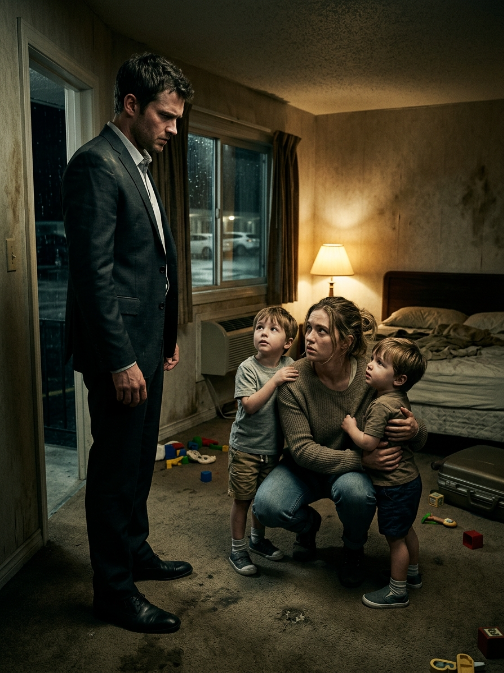
Packing the apartment took twelve minutes. Damian stood in the doorway, too large for the cramped rooms, his eyes moving over the sagging couch, the hot plate, the water stain spreading across the ceiling. When he found the baseball bat under the mattress, its handle wrapped in electrical tape, he lifted it slowly.
“Who was this for?”
“Anyone.”
“You?”
She said nothing, and he set it down with a gentleness she hadn’t expected. “You will never have to swing wood in the dark again.”
“That sounds less like comfort and more like a threat.”
“With me,” he said, “they tend to overlap.”
The Hudson Valley estate sat behind iron gates, limestone dressed up as old money and built like a fortress underneath. Teresa the housekeeper met them in the foyer, eyes widening at the sight of Elena, then dropping to the boys.
“Welcome home, Mr. Cole.”
“West wing nursery,” Damian said. “Prepared tonight.”
“They’re not sleeping across the house from me,” Elena said.
“They’re Coles. They’ll have rooms, guards, structure.”
“They’re four years old.”
Ezra stepped forward before either adult could win. “I want to stay with my mom.”
His voice didn’t shake. Damian’s jaw ticked, and then — astonishingly — he yielded. “Fine. The master suite. Tonight only.”
It wasn’t a victory. It was a crack in stone, and Elena noticed it the way you notice the first warm day after a long winter, distrustful of how good it feels.
That night, once the boys were asleep in the enormous bed, Elena wandered the house because lying still felt impossible. She found the study door open. The room where her old life had broken sat exactly as she remembered — mahogany desk, green blotter, walls of unread books.
Damian sat behind the desk in a white undershirt, staring at something small under the lamp.
“I found this after they took Sophie to the hospital that night,” he said without looking up.
The sonogram lay on the desk, worn soft at the edges from being touched too many times.
“You kept it.”
“Every day.”
She looked at the two small shapes she’d once planned to surprise him with. “I thought it was one baby.”
“I didn’t know their names. I didn’t know if they were alive. I didn’t know if you hated me enough to end them.”
“I would never.”
“I know that now.” He rose slowly, close enough that she could see the scar along his jaw, the exhaustion under his eyes, but stopped with space still between them — the first time in four years he’d let her keep it. “I know why you ran. I understand what this life looks like from the outside looking in. But hear me, Elena — I will burn down every street in this city before I let anyone touch you or those boys again.”
“That’s what terrifies me,” she said. “Your love is a war zone.”
His thumb caught a tear before it fell. “It’s the only kind I ever learned.”
“Then learn another.”
He went still, like she’d asked for something genuinely impossible. Before he could answer, his phone buzzed on the desk. He glanced at the screen, and the father vanished, replaced instantly by the boss.
“What is it?”
“Sophie left the facility in Switzerland two days ago.” His eyes lifted to Elena’s. “She sent a message to an old number. Three words. Delgados know twins.”
The house locked down within minutes — steel shutters sliding over the lower windows, men moving fast through the halls, Teresa hustling the boys into a safe room behind a linen closet. Elena refused to leave until Damian caught her arm.
“They need calm,” he said. “If you look terrified, they’ll remember this forever.”
“They’ll remember it anyway.”
“Then give them a mother who looked brave.”
She hated that he was right. In the safe room, Micah cried into her neck while Ezra stood rigid by the shelves of folded towels.
“Are we trapped again?” he asked.
“No,” she told him, cupping his face. “This time, people are trying to keep the danger out. That’s different.”
“Where are you going?”
“To fix something I should have fixed a long time ago.”
Outside, Damian was waiting. “You’re not part of this.”
“She’s my sister.”
“She may be bait.”
“Then I’ll know it when I see her.”
A distant explosion rocked the west side of the house before he could argue further. Glass shattered somewhere below. Gunfire cracked through the halls — not the clean rhythm of a movie, just deafening, ugly bursts that made Elena’s bones ring. Damian shoved her behind him, gun drawn, smoke already curling under the hallway lights.
“Stay behind me,” he said, and this time she didn’t argue.
The siege lasted eleven minutes, though Elena would later swear it felt closer to an hour. Crouched behind Damian in a hallway that smelled of gun smoke and scorched drywall, she found herself doing the only useful thing she could think to do — counting. Counting breaths, counting the gaps between bursts of gunfire, counting the seconds since she’d last heard either of her sons cry from the safe room three floors up, because silence from that direction had to mean something good, it had to.
Damian’s men had been ready for exactly this since the message came through. The Delgado crew hadn’t come for a negotiation — they’d come for leverage, expecting a house full of easy hostages, and instead found a fortress built by a man who had spent four years imagining every possible way someone might try to take his family from him twice. Two of the attackers were taken alive in the service hallway, disarmed and zip-tied before they’d made it past the second checkpoint. By the time the gunfire finally stopped, the smoke had already begun clearing, and the only blood spilled in that house belonged to men who worked for the other side.
When Damian finally lowered his weapon and turned to check on her, Elena realized her hands hadn’t stopped shaking since the first explosion, though her voice, when she found it, came out steadier than she expected.
“Are they safe? Truly safe, or safe for now?”
“Truly,” Damian said. “I promise you that much.”
For once, she let herself believe an unqualified promise from him, because the alternative — checking every lock in every room herself for the rest of her life — was a kind of exhaustion she’d already spent four years living inside, and she was done with it.
Sophie was found in the back of the second SUV, not a hostage but a passenger, thin and shaking and very much not part of the attack — she’d led the Delgados there hoping, in whatever fractured logic addiction left her with, that turning her sister’s family over might finally clear the debt that had been strangling her for years. When Damian pulled her out of the car himself, she didn’t fight him. She just looked past him, into the house, until she found Elena standing in the doorway.
“I’m sorry,” Sophie said, voice wrecked. “I didn’t think they’d actually — I just wanted it to stop.”
Elena didn’t run to her. She didn’t turn away either. She stood in the doorway with her hand still pressed to the frame and let four years of grief and anger and love that had never actually died settle into something she could finally carry.
“You’re going back to treatment,” she said. “The real kind. Not the kind where you disappear for two years and I find out from a stranger.”
“I don’t know if I can.”
“You can. I did.” Elena’s voice broke on the last word, and for the first time since the night in the study, she let it.
The debt to the Delgados was paid in full within the week, in ways Elena chose not to ask about, and Sophie went into a facility upstate where Damian’s men actually checked in on her, and Elena visited every Sunday whether Sophie wanted her to or not.
The first few visits were unbearable. Sophie sat across a scarred cafeteria table twisting a paper cup into pulp, unable to hold eye contact for more than a few seconds at a time, and Elena spent most of those early Sundays talking about nothing — the boys’ new school, the weather, a leak in the greenhouse roof — because the alternative was silence loud enough to drown in.
It was Ezra, oddly, who broke through first. He’d insisted on coming along one Sunday in March, sitting very straight in the visitors’ chair with a shoebox of hand-drawn dinosaurs he wanted to show his aunt, and Sophie had laughed — a real laugh, rusty and surprised out of her — at a stegosaurus he’d colored entirely purple because, he informed her with great seriousness, purple was a color dinosaurs deserved and never got.
“He’s got your stubbornness,” Sophie told Elena afterward, in the parking lot, the first full sentence she’d managed to get out without her voice shaking.
“He’s got his own,” Elena said. “I just fed him.”
“That’s not nothing.” Sophie looked down at her hands. “You didn’t have to keep coming. After everything.”
“I didn’t do it for you,” Elena admitted. “Not at first. I did it because I couldn’t stand the thought of losing another version of my family to a house I never should have trusted.” She paused. “It turned into doing it for you somewhere around the fourth visit. I didn’t plan that part.”
Sophie’s eyes filled, and for once she didn’t apologize for it.
By the time Elena stood at the tall windows a year later, Sophie had six months clean, a part-time job at a bookstore two towns over, and a standing Sunday dinner invitation she’d started actually accepting instead of finding reasons to cancel. It wasn’t a fixed thing. Damian had been right about that much, months ago in the kitchen — nothing about their family had been fixed so much as it had been rebuilt, slowly, out of pieces that didn’t always match the shape they used to be.
The trial — because there was one, eventually, for the men who’d planned the attack — took most of the following spring, and Elena testified only once, in a gray suit, looking at the jury instead of at Damian, telling them about a parking lot in the rain and a black SUV she’d once been certain meant the end of everything.
It hadn’t been the end. It had been, she came to understand slowly, a beginning she hadn’t wanted and couldn’t have stopped herself from walking into anyway.
Outside the courthouse that day, a reporter caught her on the steps and asked whether she’d go back to using the name Cole now that the boys carried it. Elena thought about the diner uniform folded away in a drawer she couldn’t bring herself to throw out, about Loretta the night nurse who’d never learned her real name, about the woman who’d cut her own hair in a motel bathroom and called it survival.
“I’ll figure out what to call myself,” she said. “I’m not in a hurry anymore.”
It wasn’t the answer the reporter wanted, but it was the truest one she had.
The house changed slowly that first year, the way houses do when children start actually living in them instead of just being kept safe inside them. Crayon marks appeared on a hallway wall Teresa gave up scrubbing after the third attempt. A blue plastic bin of dinosaurs missing their tails migrated from a fishing town above a hardware store to a shelf in the west wing playroom, tails still missing, because Elena had refused to let Damian buy replacements. Micah learned to swim in the pool he’d once been terrified of, and Ezra took to reading everything Damian left lying around, including things he had no business reading yet, which Damian found more amusing than alarming and Elena found the opposite.
Damian was not, in the end, a different man. He still frightened people in rooms Elena never entered. He still made calls at odd hours in a voice that dropped an octave and lost every trace of warmth. But at home, in the specific handful of rooms that belonged to his sons, he learned to leave his other self at the door the way other men left their coats, and that turned out to be the only kind of change Elena had ever actually asked for.
Damian never moved his sons into the west wing. He never assumed the master suite doors were his to open uninvited. He learned, clumsily and without much grace, how to sit on the floor and lose at checkers to a four-year-old who studied every move like a war plan, and how to let Micah fall asleep against his shoulder without flinching at the ordinary weight of it.
There were still hard nights. Ezra sometimes woke from dreams he wouldn’t describe, and the only thing that settled him was checking that both doors of his room were locked from the inside, a habit Elena recognized because she’d carried the same one for four years in a rented apartment above a hardware store. Micah, for his part, went through a stretch that spring where he refused to get in any car that wasn’t the same color as their old station wagon, until a child psychologist Damian flew in from Boston gently explained that some fears needed to be outgrown on their own schedule, not anyone else’s.
Elena learned things too, slower than she would have liked. She learned that Damian’s silences weren’t always calculation — sometimes they were just a man who’d never had anyone worth explaining himself to before. She learned that Teresa had quietly kept the guest room stocked with the specific brand of children’s cough syrup Elena used to buy at a discount pharmacy in Miller’s Cove, because she’d asked around and found out, without being asked to. She learned that forgiveness wasn’t a door that opened once and stayed open — it was a hallway she walked down a little further most days, and some days not at all, and that this was apparently allowed.
A year to the day after the parking lot, Elena stood at the tall windows of the Hudson Valley house, watching the boys chase each other across a lawn that had never once had a bottle thrown near it, and Damian came to stand beside her, close enough to matter, careful enough to leave her the space to step away if she wanted it.
She didn’t.
“I keep waiting to regret this,” she admitted.
“I’m not asking you to stop waiting,” he said. “I’m asking you to let me stand here while you do.”
Outside, Ezra caught his brother in a tackle that sent them both rolling into the grass, laughing loud enough to reach the glass, and Elena Ward — who had once cut her own hair in a motel bathroom and called it survival — reached over and laced her fingers through Damian’s, and let herself, finally, call it home.
Later that evening, after the boys were finally asleep and the house had gone quiet except for the ocean-adjacent hush of the Hudson moving somewhere beyond the tree line, Sophie called from the bookstore, breathless about a first edition someone had brought in, and Elena sat on the porch steps laughing at her sister’s excitement over something so ordinary it felt almost indulgent to enjoy. When she hung up, Damian came out and sat beside her without being asked, and for a long while neither of them said anything at all, because for the first time in five years, there was nothing urgent left that needed saying. Just two people, a porch light, and a family that had survived itself long enough to become, against every reasonable expectation, something worth keeping.