A Barefoot Boy Chased the Cowboy’s Horse, Begging Him Not to Leave — Then the Pocketknife in His Hand Revealed Why the Whole Town Had Lied

PART 1
Hands aching with cold, the boy threw himself across the trail and refused to move.
Wyoming wind tore sideways across the pass. His feet were wrapped in rags, not boots. His mouth had stopped forming words an hour ago, somewhere between begging and freezing. Still he held the bridle of a black gelding ridden by a man who had built his whole life around never stopping for anyone.
“Mister — please.”
Caleb Reyes looked down from the saddle, a man worn thin by years of riding past trouble rather than into it. Past the broken fence line stood three more children, hollow-eyed, one girl swallowed whole inside a coat that had clearly belonged to someone twice her size.
“Where’s your pa?” Caleb asked.
The boy’s face folded in on itself.
“In the ground, sir.”
His name was Jonah Webb. Seven years old, posted at this crossroads since dawn because two riders had already passed him without slowing. His mother, Ruth, lay at home with a fever and cracked ribs, three other children depending on her, a woodpile shrinking by the hour, and cattle dying in the barn. And somewhere in the town of Copper Bend, a man named Magistrate Silas Drum was counting the days until the Webb ranch finally broke.
Jonah’s fingers, shaking with cold, dug into his coat pocket.
He pulled out a bone-handled folding knife, the blade worn thin from years of sharpening.
“This was Pa’s,” he said. “It’s all I got left of him. Take it — just come look at my mama.”
Caleb stared at the knife and felt something old and buried shift in his chest. He didn’t want payment. Didn’t want a family. Didn’t want to remember the daughter he’d lost to a barn fire three winters back, a grief he’d been outrunning on horseback ever since.
But the boy’s hand didn’t waver.
So Caleb swung down from the saddle.
Inside the Webb house, Ruth burned with fever on a narrow cot. Hannah, barely thirteen, had been holding the household together with sheer will. Sam, ten, stood like he was trying on the shape of a grown man. And little Faith whispered that she’d prayed someone would come.
Then Sam said something that dropped the temperature of the room further than the storm outside.
“Magistrate Drum’s riders keep coming round. They want the land.”
And Jonah, dozing fitfully by the hearth, jerked awake from a nightmare and breathed out the name of the man he’d watched the night his father died.
What name did that seven-year-old whisper that told Caleb this wasn’t just a sick widow’s ranch — but a killing dressed up as an accident?
PART 2
Jonah’s eyes were open but he wasn’t fully back in the room.
Hannah gripped his shoulders. “Jonah. You’re home. You’re safe.”
But the boy was staring through her, back on a dark ridge two winters gone.
“He was there,” he murmured.
Caleb went very still.
“Who?” Hannah’s voice cracked.
Jonah swallowed. “Deputy Marsh.”
The name dropped onto the table like a struck match. Eli Marsh rode for Magistrate Drum, the same deputy who showed up at the Webb fence line every few weeks to remind Ruth exactly who owned the sheriff, the courthouse, and most everyone too frightened to say otherwise.
Jonah’s voice thinned but didn’t waver. “I saw him talking to Pa. Then they were shouting. Then Pa was gone. Marsh rode off alone.”
Hannah went the color of bone.
Caleb felt the weight of the pocketknife in his coat and turned toward the locked trunk in the corner — the one Ruth had kept shut for two years.
Inside: survey notes, mineral maps, half-finished letters in a dead man’s hand. By candlelight, Caleb pieced it together. Magistrate Drum had filed a secret mineral claim on Webb land through a Denver holding company. Jonah’s father had found the paperwork. And then he’d died.
By sunrise Caleb had the documents in order. By the week’s end, Ruth — still gray with fever — stood dressed for court, ready to face the man who wanted her land and her children both.
When Deputy Marsh rode out to warn them off, Caleb noticed something the deputy probably didn’t mean to show.
He was more afraid of a stack of paper than he’d ever been of a drawn gun.
PART 3
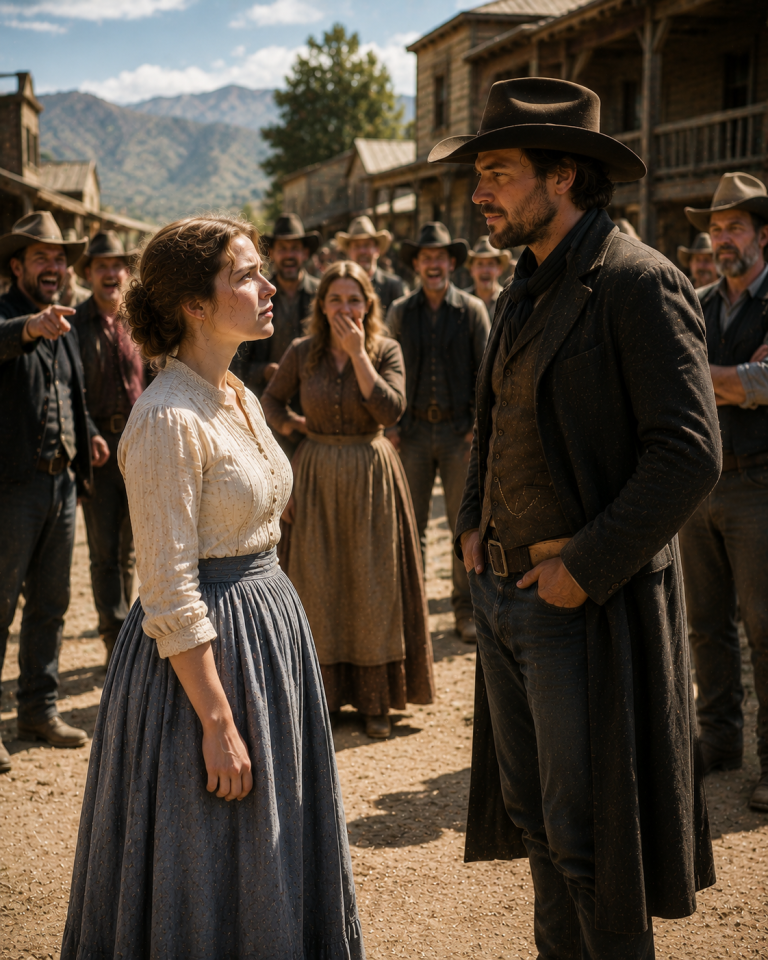
The Copper Bend courthouse smelled of wet wool and old varnish, and every bench was packed with townsfolk pretending they’d come for the law instead of the spectacle.
Ruth Webb stood beside Caleb in a black dress Hannah had pressed before sunrise, pale but upright despite the binding still tight around her ribs. Hannah held Faith’s hand. Sam stood rigid, jaw clenched. And Jonah gripped Caleb’s gloved fingers with both of his own small hands, as though letting go might unravel everything.
At the front of the room sat Magistrate Silas Drum — silver hair combed flat, black wool pressed sharp, looking every inch like law made flesh. Only Caleb, after a night with Thomas Webb’s journals, understood that the robes were a costume. Greed wore the body underneath.
Beside Drum stood Deputy Eli Marsh, sweating despite the cold.
“Mrs. Webb,” the magistrate said smoothly, “I understand you object to the foreclosure.”
“I do,” Ruth said.
“Your late husband defaulted on his loan. Unpaid taxes. Mineral rights legally transferred.” Drum’s smile sharpened. “The law is unfortunate, but plain.”
Caleb stepped forward. “No.”
Heads turned.
“And you are?” Drum asked, cool now.
“Caleb Reyes. Not family. Not counsel.”
“Then by what right do you interrupt my courtroom?”
Caleb dropped a stack of journals onto the table. “By the right of the truth in these pages.”
A murmur ran the room. Drum’s face stayed flat. But Marsh flinched — and Caleb saw it. Not fear of a gun. Fear of paper.
“Survey notes,” Caleb said, opening the first journal. “Mineral maps.” Another. “Filed claims through a Denver company that never expected anyone to find them.”
The crowd erupted at the word *silver* — a word that, in this part of Wyoming, made widows and debts and dead men suddenly very inconvenient to ignore.
Drum slammed his palm on the bench. “Order! You’re making a dangerous accusation.”
“No,” Caleb said. “Thomas Webb made it. Before he died.”
“Thomas Webb died in an accident.”
“That’s the lie.”
Marsh shifted in his boots, too fast, too visible. Half the room noticed.
Caleb reached into his coat and drew out Jonah’s pocketknife. The room went silent.
“Pa’s knife,” Jonah breathed.
Caleb opened the blade. Carved into the worn handle were two sets of initials — *T.W.*, and beneath them, scratched in violently, *E.M.*
Marsh went white as the snow outside.
“This was in Jonah’s pocket,” Caleb said. “His father gave it to him the night he died — like he already knew he wasn’t coming home.” He looked at Marsh. “And he carved your initials into it before he went off that ridge.”
“Circumstantial,” Drum snapped, rising.
“Then let’s hear the witness.”
“He’s seven.”
“He’s alive.”
Caleb crouched to Jonah’s eye level. “Can you tell them what you told me?”
Marsh made the mistake of staring straight at the boy — not blank, but threatening. Jonah froze.
Ruth ignored the screaming pain in her ribs and knelt beside her son. “Look at me, Jonah. Not him. Me.” Her hand found his cheek. “Tell only the truth. Even if it scares them.”
Jonah turned to the room. “I saw Pa on the ridge road. He was talking to Deputy Marsh. They were yelling.” His voice shook but held. “Pa said, *’You tell Drum I won’t sell.’* Then Marsh pushed him. Pa fell.” A breath. “But before he fell — he cut Marsh’s arm.”
“That brat is lying!” Marsh lunged for the boy, gun half-drawn.
Caleb hit him like a falling wall before he’d cleared two steps. They went down together, the courtroom dissolving into screaming and overturned chairs, Ruth pulling Jonah behind her skirts.
“Say it,” Caleb growled, forearm at Marsh’s throat.
Marsh spat blood. “Go to hell.”
“Say it.”
“It was DRUM!” Marsh finally screamed. “He found the silver. Said Webb would ruin everything. Told me to scare him off the land — he fought back — I pushed him — ”
Ruth made a sound Caleb would never forget — not a scream, but the sound of two years of grief finally meeting its answer.
Drum bolted three steps before old Sheriff Garrick Dalton, retired and forgotten in the back row, drew faster than his age should have allowed. “Don’t.”
The room that had once feared Silas Drum now simply watched him, the way men watch something already dying. One by one, voices rose from the benches — the blacksmith, the schoolteacher, the banker — a chorus of *no* that stripped the magistrate of every ounce of power fear had ever lent him.
By sundown, Drum and Marsh both sat behind bars, awaiting federal marshals. Within weeks the Denver shell company collapsed under its own fraud, and the full rot of Copper Bend’s courthouse came up into the daylight.
The Webb ranch stayed Webb land. Mineral rights restored. Back taxes wiped clean. Compensation enough to rebuild everything that had been stolen — though none of that, in the end, was what mattered most to Caleb.
Three weeks later, with the snow falling softer, the Webb kitchen smelled of stew and warm bread. Jonah sat at the table whittling badly at a scrap of pine. Ruth, color returned to her face, set two mugs down and took the seat across from Caleb.
“You meant to leave that day,” she said.
“I did.”
“Jonah wouldn’t let you.”
“No.” Caleb turned his coffee in his hands. “My daughter died in a barn fire. Three years back. She was Jonah’s age.”
Ruth went still, understanding everything in that sentence at once.
“I couldn’t get to her in time,” Caleb said. “I’ve spent three years riding from one town to the next thinking if I never stopped moving, grief couldn’t catch me.” His mouth twitched, almost a smile. “Then a barefoot boy grabbed my horse and wouldn’t let go.”
“He saved us,” Ruth said softly.
Caleb shook his head. “No. He saved me.”
Ruth’s eyes filled. “Are you still leaving?”
Caleb looked at the widow who’d stood in a courthouse with broken ribs and unbreakable nerve, at the children gathered around a table that finally had food on it, at something that felt dangerously like a home.
“No,” he said.
“Why?”
He set Jonah’s pocketknife on the table between them. “Because a boy gave me the last thing his father ever handed him. That kind of trust changes a man.” He met her eyes. “I came because he begged me not to leave. I’m staying because I don’t want to.”
Five years later, the Webb ranch was known across three counties not for tragedy but for its open door — a house where no child went hungry, and no widow stood alone in a courtroom again. Caleb Reyes hung up his saddlebags for good, and Jonah’s father’s knife stayed on the mantel, a reminder that sometimes the smallest hands hold on the tightest, and that’s exactly what saves everyone.
THE END