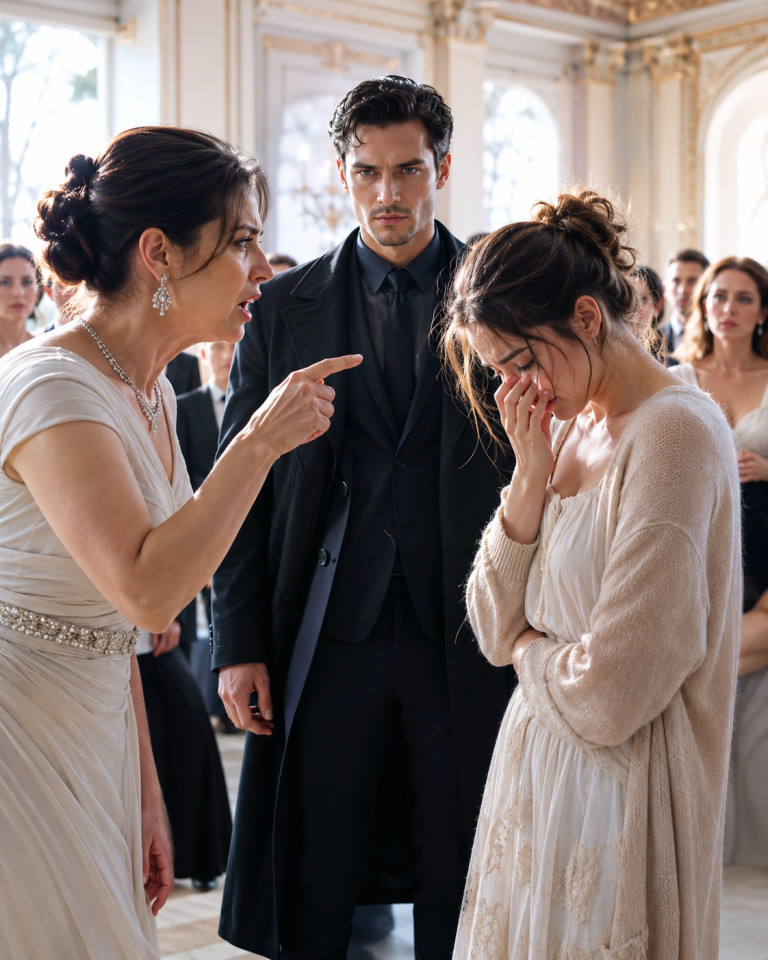
She was the last bride left on the wagon, laughed at by every man in town and one step from being sent back in shame. Then a silent little girl walked through the crowd, took her hand, and whispered a name no child was supposed to know.

## PART 1
Four women came off the wagon at Ridgeline Ranch, and the whole business was watched by a man who had learned to read weather the same way he read people — slowly, without expecting to like what he found.
Caleb Strand stood at the split-rail fence with one hand resting on the top post and watched the team fight its way through the last switchback. He was broad through the chest in the way of a man who had built things rather than been built, with weather and grief written into him at roughly equal proportion. His daughter was nine years old and had stopped sleeping. That was why the women were here. Not loneliness, though he had that too. Clara had been awake in the nights since January, when the lung fever broke and left her technically better and fundamentally different — quieter, more watchful, tuned to frequencies nobody else could hear.
He had written the agency in Omaha with plain language. *Widower. Working cattle ranch. Remote location. Hard winters. Daughter requiring care. Looking for a practical woman. Not delicate. Willing to work.* He had sent the fee, which was not small, and received word that four women had agreed to make the journey.
Three came down from the wagon with the alert, assessing energy of people examining a possible acquisition.
The first, a woman named Celia Marsh, wore a fitted coat and had the manner of someone who organized things by instinct and managed people by preference. She looked at the barn, the roof line, the fencing, and then at Caleb, in that order, and he understood immediately she was doing math.
The second was younger, pink-cheeked, eager in the way of someone who had decided a decision before examining the facts. She looked at the mountains, said, “Oh, how beautiful,” and smiled at him like he was a gift she expected to enjoy.
The third, a woman named Ruth Hale, had strong hands and direct eyes and the practical stillness of someone who understood working land. She asked about the hay stores before she had been on the ground thirty seconds.
The fourth came last.
She descended carefully, bracing before both feet touched the dirt. She was large and plain and visibly tired from however many days in a wagon on bad roads. Her dress was dark and practical. Her hair was pinned without ornament. Her gloved hands were red at the knuckles in the way of a woman accustomed to cold and work.
She did not look at Caleb.
She did not look at the barn, the mountains, the other women, or any of the things a person looked at when arriving somewhere new.
Her eyes went straight to the porch.
—
Clara Strand stood in the shadow of the doorway with one hand on the frame. She was narrow-shouldered and pale in a blue wool dress and she watched the wagon the way certain animals watched open gates: still, ready, deciding.
The fourth woman walked past Caleb as though he were a fence post. Crossed the yard. Stopped in front of Clara. She bent — not with the bright performed gentleness of someone meaning to impress the adults — but just enough to bring herself close to the child’s level.
“Long road,” she said.
Clara looked at her.
The woman waited. Did not rush it. Did not fill the silence with reassurance or pleasantness.
Clara stepped forward and took her hand.
Something moved in Caleb’s chest. He filed it away carefully, the way he filed things that were too complicated to address immediately.
—
Supper was explanatory rather than comfortable.
Caleb laid out the terms: two weeks to assess the situation from all sides, no promises made before that, the women sharing the work and the realities of the ranch with equal access to the judgment at the end of it. If the place wasn’t right for any of them, he’d arrange passage on the next supply wagon. If none of them suited, he’d count the fee and the trouble as a lesson and start over.
Celia asked about winter supply routes and the legal standing of a wife’s property claims.
The young one — her name was Faye — asked about church socials and whether there were dances in town on Saturdays.
Ruth asked about cattle numbers and whether the barn roof had been reinforced.
The fourth woman, who introduced herself as Hanna Alcott, asked nothing.
She listened. She ate at a measured pace. Several times she glanced at Clara, who had positioned herself in the chair nearest Hanna at the table and accepted this arrangement as a fact she had no interest in explaining.
Caleb noticed. He told himself it was simply that Clara was a child who responded to stillness, which was true, which was also not the whole truth.
—
After the lamps went low and the house settled into the particular sounds of old timber in cold, Hanna walked the upstairs hall toward her room.
Clara’s door stood open by two inches.
Hanna should have kept walking.
She looked.
Through the narrow gap she could see Clara on her bed in her nightgown with a cloth bundle in her lap. The child unwrapped it slowly. Letters inside, many of them, worn at the folds from handling. Clara counted them with one finger, then separated one envelope — already opened and resealed — and looked at it for a moment before slipping it beneath the others. She wrapped the bundle and tucked it under the mattress.
Hanna walked on.
But her mind was already asking what a nine-year-old kept hidden under her mattress, and why one letter had been read by someone other than the person who had put it there.
—
By the second morning she had begun to understand the house.
Not its rooms but its patterns. Which shelves were used and which were arranged for display. Which doors got opened and which were passed by. Where the silences were ordinary and where they were deliberate.
The study door had a newer lock than the rest of the house. Celia had looked at it twice before noon.
Faye was warm and easy and genuinely harmless. She also had the particular incapacity of beautiful women who had never been required to be useful — not cruelty, just absence where presence was needed. When Clara showed her a drawing of a horse, she said “that’s lovely” and looked away before the child had lowered the page. It was a small wound, the kind that accumulated.
Ruth could have worked this ranch beside Caleb as an equal from the first week. But she looked at the land the way she looked at a contract — with assessment rather than attachment. She respected the property. She did not appear to notice the child.
Hanna noticed everything.
Clara was beside her at the stove in the morning, on the back steps at noon, near the pantry shelf in the afternoon. Always with some pretext. Always with the air of someone who had made a decision and was not going to be talked out of it.
On the fourth day, Clara collapsed at breakfast.
The cup hit the stone floor hard enough to crack the silence. Caleb came from the yard at a run. Clara lay on her side with her face white and her hands trembling in the fine, sustained way of something inside her that would not stop.
The tremor was not fever. Hanna had seen fever. Fever took the whole body. This was smaller and more specific, a wire plucked somewhere inside and still vibrating.
The doctor came at noon, examined Clara’s lungs and pulse, and announced it was a relapse of last winter’s illness. “Warmth,” he said. “Rest. Tonic. She’ll recover.”
Celia brought Clara broth that afternoon with a tenderness so precisely measured it looked like practice.
Clara drank it.
An hour later, the tremor worsened.
—
## PART 2
That night Hanna lifted the rinsed cup and held it close.
Under the smell of broth, something bitter. Buried but there.
She set it down and went to bed and lay awake doing what she did when the shape of something was becoming clear: she let it finish arriving rather than forcing it early.
By morning she had decided.
She rose before the household and made Clara’s breakfast herself. She used the herbs she brought. She kept her hands between the shelf and anyone else who might reach it. When Celia came into the kitchen and moved toward the jar of dried linden, Hanna turned and stepped aside in a way that covered the shelf without appearing to, all within ordinary kitchen movement.
Celia looked at her.
Hanna looked back.
That was all.
Within a day Clara’s tremor had lessened. Within two it was nearly gone. When Dr. Hartwell returned and found the improvement, he cleared his throat and said Clara was stronger than she appeared.
*No,* Hanna thought. *The poison stopped.*
She said nothing.
Suspicion was not proof. On a mountain, a scrubbed cup and a smile could make evidence vanish. She was a plain widow from Ohio with no standing in this county and no allies except a nine-year-old girl. She understood what Celia had meant when she asked, so composedly, who would believe her.
The answer was: nobody yet.
So she waited. She kept Clara’s food under her own management with the patient immovability of stone taking hold of a hillside, and she watched.
Then Faye left — she was too light for the weight of the place, and when Clara brought her drawing of the horse Faye said “lovely” and turned away, and that evening Caleb arranged her departure with quiet finality.
Ruth left the day after of her own accord. She stood on the porch with her bag and said to Caleb, “Your daughter doesn’t need a ranch partner. She needs someone who’ll be there when you’re in the north field.” Then she looked once at Hanna, once at Clara, and climbed into the supply wagon.
That left two women in the house, and the quiet between them had taken on a bright, particular edge.
Hanna found Celia in the garden at dusk.
She told her plainly. The tremor. The smell. The improvement after Hanna controlled the food. No theater. Just the facts placed down like tools on a bench.
Celia listened without moving. When Hanna finished, Celia’s expression adjusted by one degree — not guilt, not fear, just a recalculation.
“Even if you were right,” Celia said, “who exactly would believe you?”
She wasn’t sneering. The words were worse than sneering. They were a cold appraisal of probability. A capable, groomed, well-referenced woman against a plain widow who rolled her sleeves up and kept her mouth shut. She had done the math and she was correct about the math.
“Clara is getting better,” Hanna said. “That’s enough for tonight.”
—
## PART 3
Celia left before dawn.
She left a note claiming family business. The note was written in a hand that was very steady for someone claiming urgency, and she took the same bag she had arrived with without adding anything, which meant she had kept everything she owned near the door.
Caleb watched the wagon take her down the mountain road. Then he came inside and stood in the kitchen doorway, looking at Hanna at the stove and Clara eating porridge with the focused appetite of a child whose body had decided to trust the world again.
He said nothing.
But his silence had changed shape. The silence of a man who was beginning to understand the dimensions of what he had not seen.
Three days later his older brother arrived from town.
Edison Strand came up the mountain road at midmorning on a good horse, wearing the particular ease of a man accustomed to controlling rooms without appearing to. He was smoother than Caleb, better with people, better with county clerks and church elders and all the machinery by which men arranged things to their advantage while describing it as stewardship. He laid a document on the kitchen table with the grave courtesy of someone doing a favor.
A property amendment, he explained. Filed in their father’s time but still active. According to the clause, if Caleb remarried without his brother’s formal consent, the east pasture of Strand Ranch could be claimed under shared title. Probably unenforceable, Edison said mildly. But these things got messy in court.
He talked to Caleb, but his eyes went once to the hallway where Hanna stood, and once to the kitchen where Clara was, and that told her the document was not primarily legal communication. It was a message.
After Edison left, Hanna stood in the kitchen for a long time, letting the pieces assemble themselves.
Celia asking about legal title at the first supper. Celia at the study door twice before noon. A rider she had seen at the fence line, meeting Celia there for five minutes on the third morning. The opened letter beneath Clara’s mattress, read by someone before Clara hid it. A survey stake visible from the east window of the barn, newly placed.
This had never been a straightforward arrangement.
Edison had likely influenced which candidates the agency offered. Celia had likely been briefed on the property before she arrived. The marriage was never the point. The property transfer that followed a particular marriage was the point, and if one woman stood between that plan and its execution, well — there were ways to create reasons for a woman to leave.
A child who stopped eating would be enough of a crisis.
Then a man arrived at the gate asking for Hanna by name.
She did not recognize him for a full ten seconds. Calvin Alcott, her dead husband’s younger brother. He looked better fed than the last time she had seen him, which was at the settlement of the estate in Columbus, when she had paid every lawful debt and kept the receipts in her traveling case because grief had taught her that paperwork was sometimes the only door between a woman and ruin.
He held a county-stamped debt claim for sixty dollars, claimed to have been transferred from her late husband’s estate.
She had seen this kind of document before. She knew how they were made. You went to the right clerk with the right name and said the right words, and the stamp came down, and the woman you were trying to move had a week to produce sixty dollars she didn’t have.
“You’ve got until Friday,” Calvin said, with the patient ease of a man who expected this to be simple.
As he turned his horse, he added, almost as an afterthought, “Celia said you’d make this complicated.”
That sentence landed differently than the document.
*Celia said.*
So Celia had known who she was before the wagon arrived at Ridgeline. She had known her name, her situation, the debt-of-record possibility that could be manufactured against her. This was not a coincidence of arrival. This was a selection, and she had been selected not as a possible wife but as a possible obstacle — someone who could be watched to see if she uncovered anything, and if she did, removed.
Caleb was on the porch.
He had watched the entire exchange with Calvin.
That night Hanna heard him leave by horse in the dark. He returned before sunup with mud on his boots and something sharpened in his face. In the morning he sat at the kitchen table and waited until she had filled the wash basin.
“The debt is false,” he said.
“Yes.”
“Calvin knows Celia.”
“They planned this together. Or someone above both of them planned it and they’re pieces of it.”
Caleb was quiet for a moment. “My brother.”
She said nothing. She had not said his name. She let him arrive there himself.
He looked at the tabletop. “I want the rest.”
She told him.
Not urgently. Not as a performance. She set the facts down in sequence the way she set jars on a shelf — in order, by weight, without ceremony. Celia’s interest in the study. The bitter smell in the cup. Clara’s tremor improving once Hanna controlled the food. The opened letter. Edison’s amendment. Calvin’s visit. Celia’s foreknowledge of her name.
Caleb listened without interrupting. When she mentioned Clara’s food, his face did the thing that was more frightening than anger — it went absolutely still, the stillness of a man containing something very large. He stood, walked to Clara’s room, and stood in the doorway a long time with his hand on the frame, looking at his daughter sleeping with the first healthy sleep she’d had since January.
When he came back, he said, “What do you need from town?”
“Nothing,” she said. “But the county office will have the original deed your grandfather filed. Not your brother’s copy. The original.”
He rode at first light.
—
What happened over the next week moved with the irreversibility of things that have waited a long time to happen.
The county clerk produced the original deed. The amendment Edison had laid on the kitchen table did not match the filed version in two specific places, and Caleb recognized his own father’s signature absent from places it should have been. The amendment was not merely suspicious. It was forged. Invalid on its face, fraud in ink, and Caleb was at the county office long enough to file the formal challenge and a complaint about Calvin’s debt claim before noon.
He also recorded his formal intention to marry Hanna Alcott at the earliest lawful date.
Edison learned of it before sundown and rode to the ranch with a message from Elder Whitmore about the fitness of the household and the county’s concern for Clara’s welfare under such irregular circumstances, with the not-so-veiled suggestion that the church council and the county judge were in ongoing conversation about the matter.
Hanna heard every word of it from the doorway of her room.
She heard it and she did what she had done her whole life when the ground went uncertain under her: she began to inventory what she could carry, because a woman who knew how to leave quickly was harder to trap. She took her traveling case from under the bed. She folded two dresses, the apron she had broken in over the past two weeks, the tin of salve. Her hands were very steady. They were steady because she had done this before, in a house in Ohio where staying had meant accepting something she would not accept, and leaving had felt like failure and been the right decision anyway.
Then Clara appeared in the doorway.
She was barefoot, in her nightgown, with her hair loose and her eyes very clear.
She saw the open bag. Children who have lived close to loss could read departure in the set of a shoulder, the position of a case. Clara had read it correctly.
She did not cry. She did not plead.
She crossed the room to the writing box on the small desk, opened it, and lifted out a bundle of papers tied with a length of white cord. She held it out with both hands.
“What is this?” Hanna said.
“Letters,” Clara said.
“For who?”
“For you.” A pause. “I wrote them before you came.”
Hanna took the bundle without opening it.
“I wrote them for seven months,” Clara said. Her voice was level with the effort of a child who had decided that feeling things was allowed but that the feeling wouldn’t change what she needed to say. “Every Sunday. I told the agency what I needed. I didn’t know your name yet.” She looked at the bundle in Hanna’s hands. “I told them she didn’t have to be anything particular. She just had to stay.”
The room was very quiet.
“I’ll read these,” Hanna said.
“I know,” Clara said, and went back to bed.
—
Hanna sat in the kitchen until the lamp burned low, reading.
*Dear whoever comes. I am Clara Strand. My father is good but he has to be everywhere before sunrise and I wake up in the night afraid. I need someone who will hear me. Someone who is not scared of the dark or the mountain.*
They were written in a child’s hand, inconsistent in spacing, improving in spelling across the months, but always the same in their central request: *stay, stay, stay.*
*If she is plain, that is all right. I am used to plain things being true while other things are not.*
*I am not asking for someone beautiful. I am asking for someone who is still here in February.*
*Please do not send anyone who is kind to me in front of my father and different when he is in the field. I notice. Children always notice.*
In the twenty-second letter: *Please do not be afraid of me. I know I am strange since the fever. I hear things sometimes that no one else hears. The doctor says I am fine. I think the house still has sounds in it from when my mother was here and I am the only one listening.*
In the last letter, dated three weeks before the wagon arrived: *If you read this after you get here, I want you to know I picked you before I knew your name. I knew there would be someone right if I kept asking long enough. My mother used to say that the right thing hears you when you call it, even if it takes a while to come.*
—
Hanna left the letters on the kitchen table where the lamp fell clearly on the top page.
She did not pack the traveling case.
She went to bed and slept.
In the morning the letters were gone from the table and the door to Caleb’s room had been closed well before dawn, which meant he had come in late and had not put the lamp out quickly. When he came down for breakfast he looked like a man who had not slept but had been otherwise occupied.
He sat at the table. He did not speak for a long time.
“She started writing them in January,” he said finally. “When she was still sick.”
“Yes.”
“Seven months.”
“Yes.”
He put both hands flat on the table. “She sent thirty-one letters to the agency and they kept every one. Filed them. And when four women agreed to come, someone there — the same person who processed my brother’s recommendations, I imagine — didn’t send them on.” His jaw was tight. “Clara wrote to the agency directly asking for confirmation that her letters had been received. I found the reply under her mattress. It said the letters had been received and noted and that the agency would use the information to find appropriate candidates.” He paused. “Celia was never an appropriate candidate.”
“No,” Hanna said.
“She was appropriate for my brother.”
“Yes.”
He looked at her.
She looked back.
“I have been,” he said carefully, “a man who looked at surfaces and called it judgment.”
“You were looking for practical qualities.”
“I was looking at the wrong things.” He picked up his coffee cup and set it down without drinking from it. “Clara was not looking at the wrong things. She has never, as far as I can tell, looked at the wrong things.”
Hanna said nothing.
“I filed the complaint,” he said. “The original deed, the forgery evidence, the challenge to the amendment. Calvin’s claim has been referred back to Ohio. My brother’s connection to Celia’s arrival will be part of the formal record.” He looked at her directly. “The county will know what he tried to do. It won’t be quiet.”
“It shouldn’t be quiet,” Hanna said.
“No,” he agreed. “It shouldn’t.”
He turned his coffee cup once.
“I have a question,” he said.
She waited.
“The letters. Clara wrote them. But she didn’t read them to me. She hid them.” He paused. “She gave them to you.”
“Yes.”
“She was asking you to stay.”
“She was.”
“Were you going to?”
Hanna looked at him. This was not a man who used words as decoration. He asked what he was asking because he needed to know the actual answer.
“I was leaving,” she said. “I had my case open.”
“And?”
“Clara brought me the letters and told me she had already chosen me before she knew my name.” She paused. “That made it considerably harder to leave.”
He looked at the table for a moment.
“Hanna,” he said.
“Yes.”
“If I asked you to stay for reasons that were not Clara’s reasons—” He stopped. Tried again. “If I asked you to stay as my wife in the full sense of it, not as a convenience or a solution—”
“Ask,” she said.
He looked at her.
“Ask plainly,” she said, “and I’ll answer plainly.”
He set down the coffee cup. “Will you marry me and stay here. Not because I need someone practical, though I do. Not because my daughter chose you, though she did. Because I watched you walk into this house and I watched you see things I hadn’t seen and hold them without panicking and act on them without making them about yourself. Because when Celia left I knew I had spent the previous two weeks looking at her the way I looked at cattle prices — with calculation instead of attention.” He paused. “I have been paying attention since the moment you crossed the yard and did not look at me.”
Hanna was quiet for a moment.
“I am not delicate,” she said.
“I said I didn’t want delicate.”
“I am not easy.”
“I asked for practical.”
“I have opinions.”
“I expect so.”
“And I will not be managed,” she said. “I was managed for years before my husband died and I will not live that way again.”
“No one manages this ranch,” he said. “It manages itself, mostly in the direction of more work. I want a partner.” He paused. “Clara wants someone who’ll still be here in February. That’s the same thing, I think.”
“Yes,” Hanna said.
“Which question?”
“All of them,” she said.
—
The marriage was recorded eleven days later in the county office with the clerk as witness and Clara in her Sunday boots, standing very straight, with the expression of a child whose faith has been answered in the shape of fact.
Edison Strand’s forged amendment was formally invalidated within the month. Calvin’s debt claim was returned to the Ohio circuit with a fraud designation. Elder Whitmore delivered several sermons about irregular households and found his audience shrinking by degrees, since the specific mechanisms by which Caleb’s brother had tried to steal property from him became moderately well-known in the county, and people’s estimation of irregular arrangements shifted accordingly.
Celia Marsh was not found. She was presumably somewhere with new references and a fresh plan.
—
Winter came in hard and stayed.
The house met it differently than it had the previous year.
Clara slept through the nights. Not the shallow, startled sleep of a child waiting for something to go wrong, but the deep sleep of someone who had resolved a question that had been keeping her awake. Hanna knew because she listened sometimes from her own room — the room with the repaired step and the new curtain and the shelf that Caleb had added without discussion because there hadn’t been a shelf and she’d clearly needed one.
They developed the rhythms of people who worked well together. Before dawn in the kitchen, the fire coaxed up from coals, porridge in the heavy pot, the particular quiet of a house that was inhabited rather than merely occupied. Clara at the table with her writing box in the evenings, but now the letters she wrote were records rather than prayers — the color of the light on the snow, the complaint of the hens before a storm, the exact sound boots made on frozen boards when the person wearing them was coming home.
Hanna and Caleb talked in the evenings the way people talked when they had stopped performing at each other. About the cattle. About whether the south fence would hold another season. About Clara’s reading, which had improved dramatically now that she was sleeping, and the horse Clara had decided was specifically hers despite having no formal claim to any of the horses. About the spring and whether the kitchen garden could be expanded on the east side if they built up the soil.
Once, in December, Hanna said, “I never thought I’d be here.”
He looked up from the account book. “Montana?”
“A place where the day was mine,” she said.
He considered this. “You had a bad marriage.”
“I had a marriage where I was furniture,” she said. “Necessary, but not consulted.”
He was quiet for a moment. “What did you want to do? Before you married.”
“I wanted to teach,” she said. “I was good at it.”
He put down his pen. “Clara needs more than I can give her,” he said. “In terms of formal learning. I can read and cipher and I’ve taught her what I can, but—” He paused. “There’s a school in town that would take her for the spring term. They have a good teacher, but they also have a boarding arrangement, which I don’t—” He stopped again.
“You don’t want her to board,” Hanna said.
“No.”
“She could go by day if someone drove her.”
“It’s eleven miles.”
“Which is a long drive,” she said, “but possible.”
“Or,” he said carefully, “if she had a teacher here—”
Hanna looked at him.
He looked back. “I’m not asking you to give up anything,” he said. “I’m asking what you want.”
She thought about it. “Both,” she said. “She goes into town on the days when the weather allows and the road is good. On the other days, we work here. That way she has other children and she also has continuity.”
He nodded slowly. “That’s better than what I was thinking.”
“It usually is,” she said.
That surprised a laugh out of him — short and genuine, the laugh of a man who wasn’t used to laughing but wasn’t refusing to.
—
In late November, Clara led Hanna up the mountain path behind the barn to a cedar growing from a shelf of rock.
It was a cold, clear day, the kind where the air tasted of altitude and iron, and the valley below was visible for miles in every direction. They sat on the low branch together and looked down at the smoke rising from the kitchen chimney in a straight blue line.
“My mother used to bring me here,” Clara said.
Hanna looked out at the valley.
“She used to say you could see the whole shape of your life from up here,” Clara said. “I didn’t know what she meant when she was alive.” A pause. “I think I understand it better now.”
Hanna said, “What do you see?”
Clara thought about it. “The house,” she said. “The barn. The road. All the fences.” She paused. “Everything we have to do. Everything we already did.”
“And is that all right?”
Clara considered this with the gravity she applied to real questions. “It’s a lot,” she said. “But it’s ours.” She looked at Hanna. “My mother would have liked you.”
Hanna looked at her.
“Your mother had sense,” she said.
Clara laughed, and the sound went out over the cold air like something long held finally let go.
They sat for a while without speaking. The mountains went on in all directions, patient and enormous, indifferent to the small urgencies of people living in their shadows, which was a useful quality in a landscape and possibly in a person.
On the way back down the path, Clara said, “I was afraid you were going to leave.”
“I know,” Hanna said.
“I’m glad you didn’t.”
“So am I.”
Clara reached out and took her hand the way she had taken it in the yard the first afternoon, without ceremony, because she had decided, and when she decided things she didn’t need to perform them.
They came back down to the house and Caleb was on the porch, not from suspicion but from the new habit of being somewhere they could see him when they returned. He held the door and Clara went through and Hanna followed, and as she crossed the threshold Caleb touched her sleeve once, briefly, the specific touch of a man who did not have many words for tenderness but had that one.
The kitchen was warm. The pot was going on the stove, because he had put it on while they were out, because he had started doing small things like that. Clara’s writing box was on the table. Outside the window the first snow of the season was beginning, fat and soft, settling over the ridge line and the fences and the cedar on the mountain path.
Hanna stood at the window and looked at it coming down.
She had spent years being overlooked. She had been dismissed in rooms where she was the most competent person present. She had been chosen last, spoken to last, included last — not with cruelty, not with intention, just with the casual structural inattention of a world that measured women by surface and found her lacking.
A lonely child on a mountain had written thirty-one letters asking for something different. She had not asked for beauty or charm or social grace. She had asked for presence. Steadiness. Someone who would taste the bitterness in the broth and act on it without making herself the center of the story. Someone who would still be there in February.
Clara had seen something in the yard that first afternoon that the other women hadn’t shown her in the hours before. She had not been looking for what the world told her to look for. She had been looking for what she needed.
And she had been right.
Hanna watched the snow come down on the ranch and listened to the sounds of the house — Clara writing something at the table, the scratch of her pen; Caleb moving something in the next room, the deliberate sounds of someone making space; the stove’s quiet work; the particular silence of walls that had finally stopped being empty and started being full.
She thought about February.
She thought: *I will be here.*
She was.
*THE END*