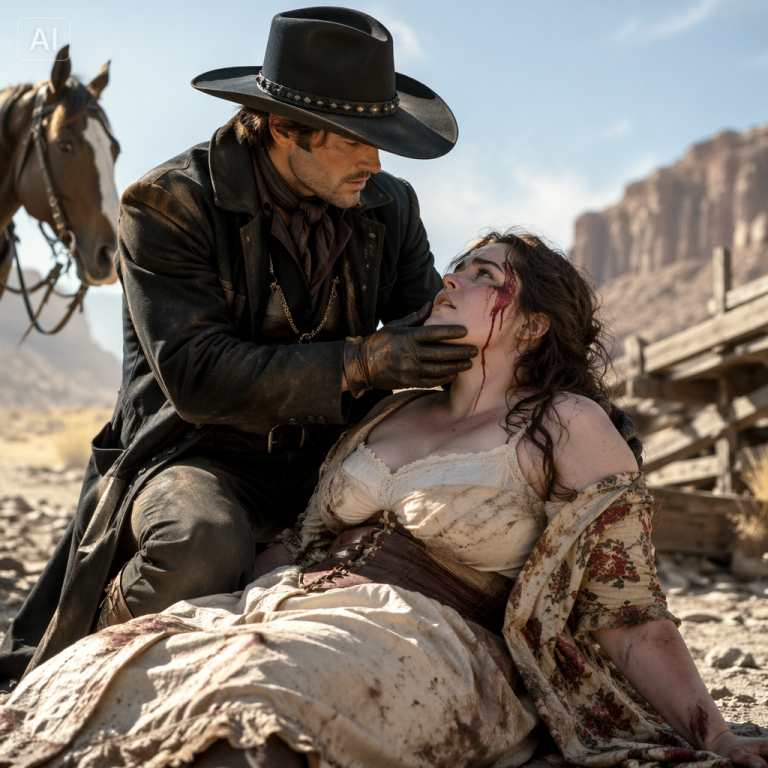
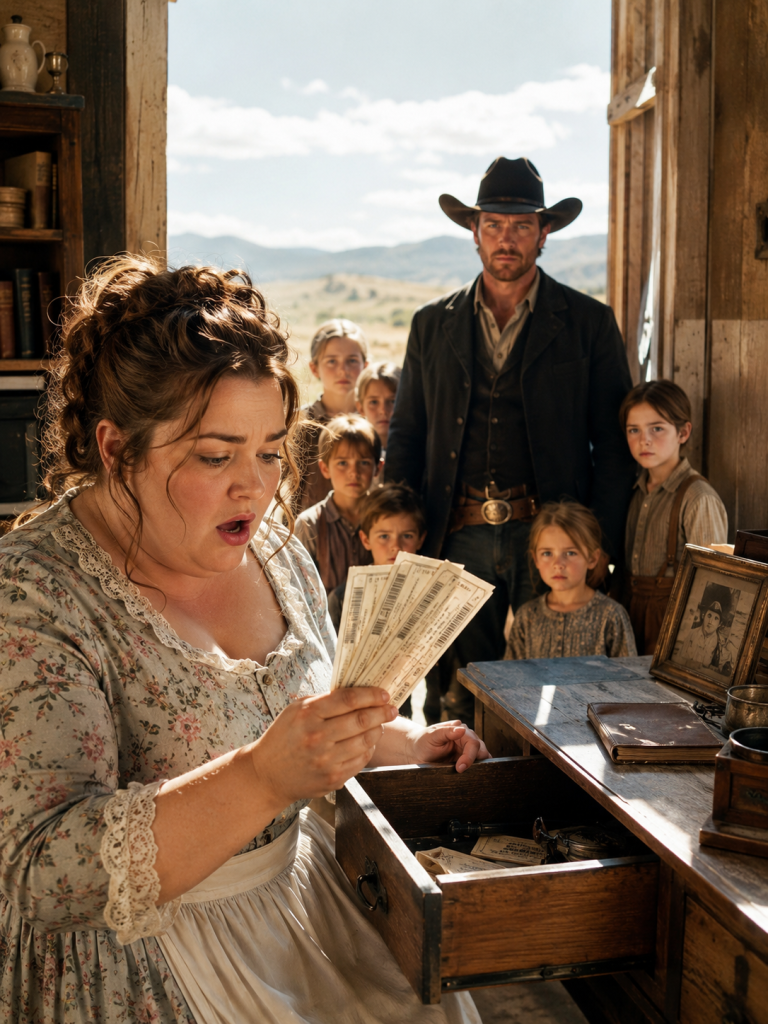
They Sent the Curvy Girl to Clean the Rancher’s Filthy Barn as a Cruel Joke — But When She Found Six Locked Trunks Hidden Under the Hay, the Rancher Grabbed Her Hand and Said, “Don’t Leave.” The moment the town stepped outside, every face went pale.

## PART 1
The joke arrived with the work notice, which was how cruelty usually traveled in Mabel’s Boarding House — disguised as an opportunity.
Agnes Pryor read it aloud from the scrap of paper she’d found tacked above the flour bin, her voice carrying that specific sweetness that meant something wasn’t sweet at all: “Help wanted. Ranch work. Temporary. Fair pay. Dunbar Hollow, Crestfall Ranch.”
Someone near the potatoes said Crestfall Ranch hadn’t had a full crew since the accident that took the foreman’s hand. Someone else said the owner, Lyle Dunbar, was the kind of man who paid late if he paid at all. Agnes smiled at nobody in particular and turned toward the stove, where Willa Reed stood kneading bread dough with the careful attention of someone who had learned that looking busy prevented being targeted.
She already knew where this was heading.
“Willa,” Agnes said.
Willa’s hands kept moving.
“You’ve got nothing on tomorrow.”
It wasn’t a question. Agnes kept track of schedules the way she kept track of insults — usefully, precisely, and always for her own advantage.
Willa set down the dough and wiped her hands on her apron. She was twenty-six years old, heavyset, with a face that people called plain when they were being polite and otherwise when they weren’t, and she had spent the last three years at Mabel’s surviving on the specific skill of making herself inconspicuous in rooms that were always looking for someone to laugh at. She was never going to be the prettiest girl in the house or the most fashionable or the one the men at the front desk asked about by name, and she had made a kind of peace with that the way you made peace with bad weather — not by pretending it wasn’t happening, but by learning which roof held.
“You’ll go,” said Mabel herself from the pantry doorway. Mabel Crayne had run the boarding house for fourteen years and had never once offered a kindness she couldn’t itemize. “Fair pay is fair pay, and Dunbar’s money spends the same as anybody’s.”
Agnes held the notice out with the particular flourish of someone offering a gift they’d already ruined.
The laughter started before Willa had even touched the paper. Soft at first, then louder. Someone said the horses would think she was feed. Someone else said to take a wide broom. Agnes said she hoped the barn doors were big enough, and the room found this very funny indeed, and Willa stood in the middle of it and did what she had learned to do, which was nothing. She kept her face still and her breathing level and waited for the wave to break over her and move on.
She had been doing this since she was twelve years old, since her mother died of fever in the county hospital and nobody came to collect her, and a clerk at the county office had told her with practiced indifference that she would be placed as soon as there was a suitable arrangement, and suitable had taken four years and never been quite right.
She took the notice.
—
She walked to Crestfall Ranch at dawn, carrying a bucket, two good rags, and a piece of bread folded in cloth. The road was cold and the air tasted like iron. By the time the property came into sight the sky had shifted from gray to a thin clear gold that made the whole landscape look like something that had survived longer than expected and wasn’t sure yet whether to be proud of it.
The ranch was larger than the boarding house talk had suggested. The house sat set back from the road, two stories, built from timber that had darkened over decades into something respectable, with a porch that ran its full width and a chimney already working. The barn stood east of the house — a long red structure with recent repairs visible in the newer boards along one wall.
She had just opened the gate when she heard the crash.
The sound came from the barn. A horse screaming — not in fear, in pain. A man’s voice cutting over it, low and urgent.
Willa left the bucket at the gate and ran.
Inside the barn, a gray gelding had gone almost vertical at the end of a lead rope, forefeet clawing at nothing, eyes showing white all the way around. A man was braced against a stall post with the rope wrapped twice around his forearm, keeping himself upright by stubbornness as much as strength. He was tall, built from years of hard work rather than intention, with dark hair that had fallen over his forehead and dried blood tracking from a cut above one eye.
An older man stood against the far wall, one hand pressed to his ribs, saying words that weren’t useful.
The gelding came down hard, slid on the packed earth floor, and crashed one shoulder into the feed bin.
“Get out!” the man with the rope shouted when he saw her.
Willa didn’t move.
Because in the horse’s violence she saw what was underneath it. The hind left leg wasn’t bearing weight. The animal’s breathing came in short, rapid pulls. He was lashing because something hurt, because when the body is in pain it will keep fighting whatever is closest.
She recognized that.
“Let the rope go slack,” she said.
The man stared at her. “He’ll bolt.”
“He’ll throw himself if you don’t. Let it go slack.”
The rope was pulled taut against his palm. His face said he thought she was wrong.
He let it go slack.
Willa moved forward, palms open, no sudden angles. She talked to the horse the way her mother had talked to stray cats in their yard, not asking for anything, just putting a voice into the air that meant something warm and unhurried. The gelding’s ears moved. Still frightened, still hurting, but one degree less certain about the threat.
She saw the problem before she reached him — a raw, deep scrape along his left hip where he’d come into contact with something sharp, possibly the edge of the broken feed bin. Not just abraded. Infected. The skin around it was hot and taut.
“There,” she said, not to the horse, not to the man, just to the fact of it.
The man came around without being asked and looked.
He went very still.
“Can you reach it?” he said.
“If he lets me.”
“He’s been letting nothing for three days.”
“Three days infected,” she said. “That’s why he’s like this.”
She kept her voice at the same pace, the same register, and reached out slowly and laid her palm against the gelding’s neck, not pressing, just present, and the horse trembled and then didn’t.
“Easy,” she said. “I know. I know it hurts.”
She cleaned the wound with what was in her bucket — plain water and a clean rag — and the horse flinched but held, because sometimes what a body needed most was someone willing to acknowledge the damage without being frightened by it.
When she stepped back, the gelding stood with his weight distributed properly for the first time.
The older man at the wall said, very quietly, “I’ll be damned.”
The younger man looked at her.
He had a face that would have been called severe in any room, though not cruel — the face of someone who had spent time in conditions that didn’t reward excess of expression. His eyes were gray and he was looking at her with a quality of attention she had never quite experienced, which was the quality of someone seeing her rather than measuring her.
“Who are you?” he said.
“Willa Reed. Mabel’s boarding house sent me.”
Something crossed his expression. “To clean the barn.”
“Yes.”
“They sent you here as a joke,” he said. Not meanly. Just plainly, the way he seemed to say most things.
Willa felt the heat rise in her face but kept her voice even. “I came for the work.”
The older man lowered himself carefully onto a hay bale. “Rowan. She just put that horse back together with water and good sense. Send her off and I’ll write to the governor about you.”
So this was Rowan Dunbar.
He dragged one hand across his jaw, looking at the gelding, then back at her. “You willing to work?”
“That’s why I’m here.”
“Then work,” he said. “And if you’re going to break down or disappear, say so now.”
“I don’t break down,” Willa said. “And I don’t disappear.”
The older man — whose name turned out to be Clem — laughed from the hay bale. “I like her. Rowan, I like her.”
Rowan did not say he liked her. But one corner of his mouth moved in a way that meant something.
Willa picked up her bucket and went to work.
—
The barn took three days to put in order.
She swept and scrubbed and sorted and catalogued. Old tack went to the repair pile. Feed bins were cleaned of rot and rust. The water troughs came to a shine that surprised her. The loft got organized. The broken bin was cleared away. By the end of the third day the place smelled like cedar and clean air instead of years of inattention.
Rowan watched without hovering. He came through to check things at intervals, not to supervise, just to verify. When he ran his thumb over a clean latch and found it clean, he looked at her briefly with the expression of a man who had been expecting less.
She did not find this insulting.
It was simply honest.
Clem talked through most of it from whatever surface he was resting on, a hay bale or a fence rail or the stall door, which he leaned against with the proprietary ease of a man who had been present through decades of this ranch’s life. He told her about the accident that had cleared the crew the previous fall. He told her about Rowan’s wife, who had died four years ago of something the doctor in town couldn’t name and the doctor in the county seat had named too late. He told her about the ranch’s good years and its bad ones with the unpedantic directness of someone who had seen enough of both to find drama in neither.
Willa listened and worked and did not offer opinions unless asked.
On the fourth afternoon, Agnes Pryor and two other girls from the boarding house arrived at the barn door with the specific quality of people who had come to see a thing that had gone wrong.
“There she is,” Agnes said, looking at Willa from the doorway. “Still standing.”
Willa kept scrubbing.
“We came to see how the joke was going,” Agnes said, aiming the words where she thought they’d land hardest.
One of the other girls said something about the accommodations.
Agnes said something worse.
Willa’s hand stilled on the brush.
Then Rowan’s voice came from behind them.
“Off the property.”
All three girls turned.
He stood in the aisle shadow with a coil of rope over one shoulder and nothing in his expression except certainty.
Agnes tried warmth. “We were only checking on our friend here.”
“She doesn’t look checked on,” Rowan said. “She looks interrupted. Out.”
Agnes looked past him to Willa, probably hoping for something to use. Willa did not provide it.
“Out,” Rowan said again, with the patient quality of a man who did not need to raise his voice to be believed.
They left.
The barn felt different after. Willa stood at the water trough with her back to him, letting her heartbeat settle.
“Thank you,” she said.
“They had no business here.”
“No,” she agreed. “But it’s your barn. You could have let them say what they wanted.”
He came to stand a few feet away and leaned against the stall. “I don’t tolerate meanness on my land,” he said. “There’s enough that can’t be avoided. The optional kind I get rid of.”
She turned to look at him.
He was not looking at her with softness exactly. But there was a directness to his attention that was entirely unlike the way most people looked at her, which was either through her or around her or at the parts of her they had decided to comment on.
This man looked at her.
“You’re good at this work,” he said.
“I like it when things make sense at the end,” she said.
He considered that. “You’ll come back tomorrow?”
It mattered to him. She could hear it underneath the question’s plainness.
“Yes,” she said.
He nodded once. Then went back to whatever he had been doing before she’d been interrupted.
Willa walked back to town that evening with her wages in her pocket and the sense that something had shifted. Not dramatically. Not permanently. Just by one degree, which was how most things shifted when they shifted for real.
—
## PART 2
The weeks at Crestfall Ranch became their own kind of country.
Willa arrived each morning before the light had finished settling, and Clem met her at the barn with coffee that tasted like it had been made by someone who hadn’t decided yet if they wanted it to be an experience or a punishment. The gelding — whose name, she learned, was Jasper — had recovered fully and followed her along the fence with a fond possessiveness that Clem said was more affection than he’d shown anyone in three years.
Rowan worked the way a man worked who had decided that stillness was the luxury of people with shorter task lists. He was up before her each morning and still moving each evening. They developed a comfortable efficiency together: she handled the barn and the household accounts he’d been ignoring for a year, he handled the land and the animals and the hundred decisions a working ranch required before noon. Clem served as commentary and occasional conscience.
It was not a warm situation immediately.
But it was an honest one.
She noticed things. He carried grief in his body the way some men carried old injuries — the shoulder that moved wrong, the breath that came out shorter than it should, the moments when he went very still while looking at something only he could see. She did not comment on these things. She had learned that most people suffering in recognizable ways needed acknowledgment less than they needed someone to behave normally around them.
He noticed things too.
One afternoon she was mending harness straps at the worktable when he came in from the north fence soaked to the skin because a storm had moved faster than the sky had promised. He stood inside the barn door, water streaming off him, and she handed him a dry cloth from the cabinet without making an event of it.
He took it.
Looked at her.
Said nothing.
But the next morning there was a better pair of work gloves on the stall rail where she usually started her day, and they fit, and they were new, and he did not mention them.
The crisis came on a Tuesday, six weeks in.
Rowan’s father — Lyle Dunbar, who had lived across town in a house that suggested he’d stepped back from the ranch but never quite managed to leave it — died on a Monday night, quietly, in his sleep, at the desk where he kept his accounts. Rowan found him before dawn and spent the next fourteen hours handling it alone.
At the funeral, Willa stood in the back with Clem. Half the county came. The other half sent representatives. The murmuring was the specific kind that gathered around loss and looked for something to say about it.
*Poor Rowan. Man’s been alone up there three years already.*
*That girl from the boarding house is still there, I hear.*
*Mabel sent her out as a joke. Now she won’t leave.*
*Maybe she thinks she’s got her hands on something.*
Willa let it move past her.
Afterward, at Rowan’s request, the lawyer — a cautious man named Garrett who wore his suit the way men wore armor — opened a cedar box that Lyle Dunbar had kept locked in his office.
The contents were Rowan’s by right. He read through them at the kitchen table while Willa sat across from him with her hands around a cup of coffee, not looking at the papers, not pretending she wasn’t there.
He got to the last document and stopped.
Then he looked up.
“Willa,” he said.
His voice had a quality she hadn’t heard in it before.
She looked at him.
“Did you know a man named Joseph Reed?”
The floor seemed to tilt.
“He was my grandfather,” she said. “He died before I was born.”
Rowan turned the document toward her slowly.
It was an agreement, old and formal, with two signatures at the bottom. *Joseph Reed. Alton Dunbar.*
Her grandfather’s name. Rowan’s grandfather’s name.
The lawyer cleared his throat. “If I may. It appears to be a private water-rights agreement pertaining to the eastern spring on Crestfall’s south acreage. Dated 1861. Signed and witnessed but never formally recorded in the county ledger.”
Willa read it.
Then read it again.
Because what it said was that the spring and the south acreage had been co-developed between the Reed and Dunbar families under a shared rights agreement. That the agreement transferred to heirs. That it had been written in good faith and sealed by handshake and the two signatures at the bottom and then — based on the letter pinned behind it in Lyle Dunbar’s cramped hand — suppressed by Alton Dunbar after Joseph Reed died with no family yet to claim it.
The letter was from Lyle to Rowan.
*Son. There’s something I didn’t tell you about the south spring, and I am leaving this here because I can’t find the right time to say it while I’m living and I am ashamed to tell you face to face that your grandfather was not the man I told you he was.*
Willa stopped reading aloud.
Rowan took the letter from her gently and read the rest himself.
The barn outside was quiet. Clem had not come in. The house held only the two of them and the weight of two families’ histories deciding not to stay buried.
“He knew,” Rowan said finally. “My father knew.”
“Yes.”
“He sent the work notice to the boarding house himself, didn’t he,” Rowan said. Not a question.
Willa said nothing.
“He knew your name was Reed. He knew the agreement existed. And he—” Rowan stopped. “He waited. He was trying to find a way to make this right without saying it outright. And he ran out of time.”
“Maybe,” Willa said carefully, “he thought it might find its own way.”
Rowan looked at her. “It found you.”
“I walked into a barn because people sent me somewhere they thought would embarrass me,” Willa said. “That’s a strange foundation for a legal claim.”
“That’s true of most things that turn out to matter,” Rowan said.
—
## PART 3
The news reached Mabel’s boarding house before Willa did.
In small towns, word had legs.
Mabel appeared at Crestfall two days later in a hired carriage with Agnes beside her, wearing the expression of a woman who had been looking forward to someone else’s loss and found herself rescheduled.
“Willa,” Mabel said, from the porch steps. “You’ve been turned around by this man and his lawyers. Whatever papers they’ve shown you, you need to speak with your own counsel before—”
“My own counsel,” Willa repeated.
“Someone without a stake in the outcome,” Mabel said reasonably.
“You sent me here,” Willa said. “The specific work notice you handed me. Not Agnes. Not one of the other girls. Me.”
Mabel’s expression did not change. “A lucky accident.”
“There are no lucky accidents with you, Mabel,” Willa said. “You’ve been managing the county banker’s opinion for four years. You knew what the south acreage was worth. You knew the survey had turned up mineral deposits along the ridge. And you knew my grandfather’s name was Reed because you kept my mother’s things when she died and you never gave them back to me.”
The porch went very quiet.
Agnes took a small step backward.
Rowan stood in the doorway, not speaking, letting Willa have the room.
That was a thing she was only beginning to understand about him: he did not need to take up space at someone else’s expense. He just stood where he was, and that was enough.
“Whatever you were hoping I’d come here and sign,” Willa said, “I wasn’t going to sign it. Because I don’t sign things I haven’t read, and I don’t hand over what’s mine because someone tells me I’ve got no standing to hold it.”
Mabel said: “The agreement is old and unrecorded—”
“Which is why Garrett is filing the registration tomorrow morning,” Rowan said, from the doorway. “With full evidentiary support and the original document.”
Mabel looked from Willa to Rowan.
Whatever she had come here expecting, it wasn’t this. The girl she had sent out as a joke and a probe, standing in the same space as the man who was apparently going to stand beside her while she filed a land claim.
“You’ve been turned,” Mabel said, dropping the reasonable voice. “You think this man has your interests—”
“He hasn’t said anything about my interests,” Willa said. “He told me the truth about what his family did to mine and then he stood back and let me decide what to do about it. That’s not the same as managing me.” She looked at Mabel steadily. “You know the difference. You’ve done it for years.”
Agnes made a small, strangled sound.
“This isn’t over,” Mabel said.
“No,” Willa agreed. “It probably isn’t. But it’s over for today. And today is what I have.”
Mabel left with Agnes, and the carriage went down the road, and Willa stood on the porch watching until it was gone.
Then she turned and found Rowan watching her.
“You didn’t need me for any of that,” he said.
“No,” she said. “But you stayed anyway.”
He looked at her.
“I’ve got a policy,” he said. “No cruelty on my land. Optional kind especially.”
“I remember.”
The word sat between them for a moment.
—
The registration took three weeks to formalize.
Garrett filed the documentation, provided supplementary evidence from the original survey markers on the property, and submitted Lyle Dunbar’s letter as testament to the suppression of the agreement. The county clerk was initially reluctant and then, when two independent witnesses confirmed the signature match, formally cooperative.
Mabel made one attempt through the county banker to establish that the agreement had been voided through non-use. The banker withdrew from the conversation when Rowan provided the documentation of his family’s continued use of the spring and the corresponding absence of any legal protest from the Reed family, which would have been necessary for abandonment to be established — since no member of the Reed family had been made aware there was anything to abandon.
Mabel’s influence in Black Hollow did not collapse. It contracted.
There was a difference, and it mattered less than the fact that Willa no longer needed to care about the distinction.
—
On the evening the final registration came through, Rowan found her in the barn.
She was sitting in Jasper’s stall with her back against the wood and her knees drawn up, not doing anything, just being somewhere that had started to feel like somewhere.
He handed her a mug of coffee and sat down in the stall across from her, on the edge of the adjacent stall, elbows on his knees.
“It’s done,” he said.
“I know.” Garrett had sent word that morning. She had been absorbing it all day.
They sat with it for a while.
“My grandfather kept a promise,” she said finally.
“Mine broke it,” he said.
“And your father tried to keep it anyway, in the worst possible way.”
Rowan’s jaw moved. “He should have just told me.”
“People don’t always know how,” Willa said.
He looked at her. “You’re generous about it.”
“I’m practical,” she said. “Being angry at your grandfather doesn’t make the spring mine. The paperwork makes the spring mine. The anger is extra.”
Rowan almost smiled. “You’re the most unsentimental woman in Montana.”
“I’ve had to be.”
A pause.
“Willa.”
The quality of her name in his voice was different than it usually was. Not professional, not careful. Something that acknowledged a thing they had both been not-saying for the past few weeks.
“I was going to tell you something,” he said.
“Tell me.”
He looked at his coffee. “When you walked into the barn that first morning, I thought you’d been sent here to humiliate me. The boarding house girls used to do things like that. Bring someone to see the state the place had gotten into. I was ready to be angry.”
“But you let me in anyway.”
“You were already in. You’d run to the barn before I could close the door.” He looked at her. “And you were talking to the horse.”
“Jasper needed someone to talk to him.”
“He wasn’t the only one,” Rowan said quietly.
The barn was very still.
Jasper shifted and settled. The lantern threw warm angles across the walls.
“I should tell you something too,” Willa said.
“Tell me.”
“I came here expecting to be laughed at. I’d been braced for it for three years, maybe longer. And then you told the boarding house girls to leave and it was—” She stopped. “I wasn’t expecting that.”
“It was nothing.”
“It was everything,” she said. “Not because I couldn’t handle it. But because you didn’t decide I had to.”
He was looking at her with the quality of attention that had disoriented her from the first day, the specific quality of a person making a decision to see rather than assess.
“Willa Reed,” he said, “you calmed a horse that had been unmanageable for three days, reorganized a barn that had been declining for a year, filed a land claim against the most connected woman in this county, and stood on my porch and told her exactly what she was without raising your voice.” He paused. “I’d like you to stay. Not for the spring. Not for the partnership. Although both of those are also true.” He set his mug aside. “For you.”
She looked at him for a long moment.
He was not a comfortable man. He was not easy. He had grief in him that was going to take time to move through, and edges that were going to require patience, and a ranch that still had years of work ahead of it.
But he looked at her when he spoke.
He had told the boarding house girls to leave.
He had sat in a stall across from her and told her the truth about his family and waited for her to decide.
“You know,” she said, “the strangest thing about all of this is that they sent me here as a joke.”
“I know.”
“And the joke was that I was too much. Too large. Too ordinary. Too—”
“Too much for their measure,” he said. “Not too much in general.”
She breathed.
“Yes,” she said.
His mouth curved. “Which question is that answering?”
“The last one you asked,” she said. “And the one you were working up to.”
He gave a short, startled laugh. “You’re not going to let me be elaborate about it.”
“You’re not elaborate,” she said. “You’re direct. Be direct.”
He looked at her steadily. “Will you stay? Partner in the land, partner in the ranch, and in the longer term, partner in the house and the life.”
“Yes,” Willa said. “All of it.”
—
They married the following spring.
Not in the church, because neither of them had a strong relationship with the church. In the barn, because that was where the thing had started, and places where lives changed deserved to be named honestly.
Clem walked her in, complaining loudly that he was too old for ceremonial duties and then performing them with the careful attention of a man who was not too old but was determined to be moved.
She wore a dress the color of a winter sky going pale, because ivory was for other people and she had stopped dressing for other people’s preferences. Her hair was down. Her boots were practical.
Rowan waited at the front in a dark coat he clearly found uncomfortable, with the expression of a man trying not to show how much this mattered and failing completely.
The officiant read the words. Rowan spoke his carefully. Willa spoke hers simply.
When it was done, Clem applauded first and loudest, and then the room followed.
Afterward there was food and laughter and the good kind of noise that came from people who were genuinely happy rather than performing it. Agnes was not there. Mabel was not there. Several people who had laughed at the original joke were there, and they had the decency to be pleased rather than embarrassed, which was the best that could be asked.
Late in the evening, when the guests had drifted home under a clear sky full of more stars than Black Hollow usually bothered to notice, Willa stood on the porch and looked out at the ranch.
It was hers.
Not because she had been rescued. Not because she had been lucky. Because the agreement had been real and she had walked into the right barn at the right time and the truth had been waiting there, patient as the spring under the south ridge, belonging to her family even when no one living had known it.
Rowan came to stand beside her.
“What are you thinking about?” he asked.
“About how they sent me here as a joke,” she said.
“And?”
“And how the joke was really about them,” she said. “They thought sending me somewhere humiliating said something about me. But where I ended up is where my family’s name was written before either of us was born. The joke didn’t go where they aimed it.”
He put his arm around her shoulders. “That’s a very calm way to put a very large thing.”
“I’ve had time to sit with it,” she said. “I sat with it all afternoon. I was going to be much more dramatic, but then Clem started crying during the ceremony and I got distracted.”
“He denies it.”
“He was weeping.”
“He says he had something in his eye.”
“Both eyes, simultaneously,” she said.
Rowan laughed. She felt the warmth of it against her shoulder.
Down in the barn, Jasper moved once and settled. The spring ran beneath the ridge, the way it always had, the way it would keep running. The night air carried the smell of new grass and the cold edge of the mountains beyond.
Willa thought about her mother, who had died before any of this was findable. She thought about Joseph Reed, who had signed an agreement in good faith and then died before it could be honored. She thought about the boarding house, and Mabel’s careful management, and the morning she had walked out of Black Hollow carrying a bucket and a piece of bread, expecting nothing except work.
She had not expected this.
But here was the thing about living through years of being told you were less than: when the truth finally came forward and said otherwise, you did not perform surprise.
You stood on a porch in spring with the man you’d chosen and the land that had always been yours, and you breathed the air of a place that had become home, and you said nothing at all, because some things were not for saying aloud.
They were for keeping.
For building on.
For waking up to every morning and finding still there.
*THE END*