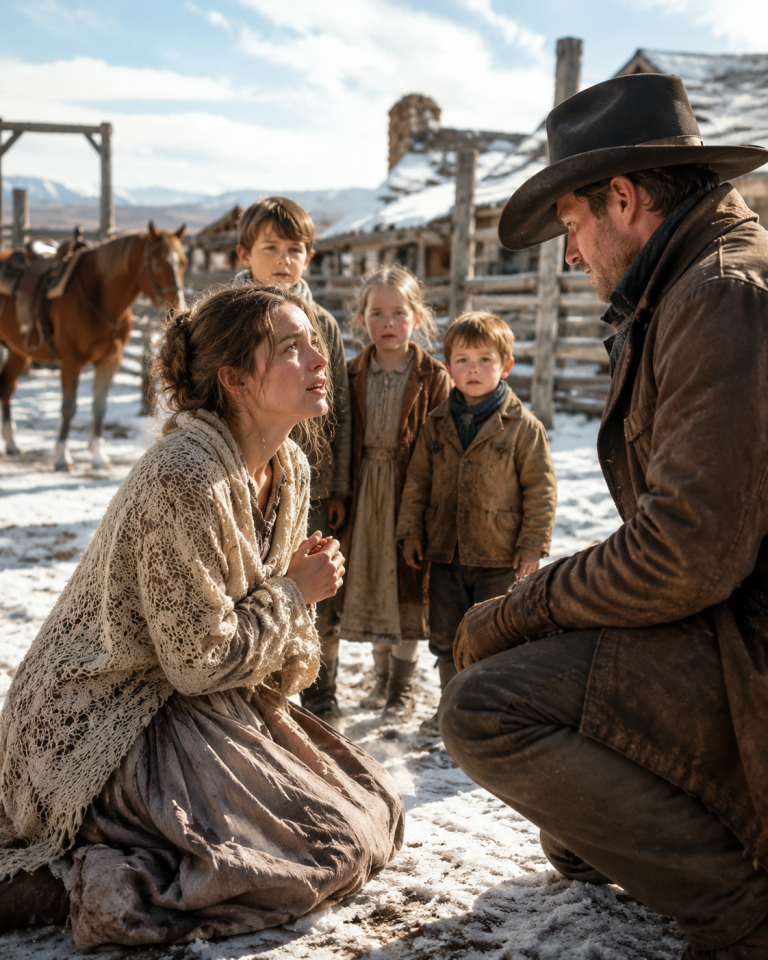
At the auction, everyone laughed when he paid for the bride no man wanted—until midnight, when he told her to remove the veil… and saw the mark the town had been hiding.

## PART 1
“The first thing you need to do,” the mountain man said after he bought me at auction in the town square, “is take off everything.”
I was still standing in his cabin doorway with the rope chafing my wrists and the sound of the crowd’s laughter sitting in my ears like a second heartbeat. My skirt had stiffened with slush during the ride up the mountain pass. My fingers had stopped feeling like my own somewhere around the third mile.
For one airless second I thought the town had been right about everything.
Then I looked at him.
He had crossed to the iron stove. He had not approached me. He was not looking at my face or anywhere else a man would look if this were the thing I feared it was. He was pulling a wool blanket from the chair and stringing it along a rope line that ran across the center of the cabin, dividing the room in two with the deliberateness of someone who had thought this through before he’d gotten here.
Behind the curtain he placed: a folded flannel nightdress. Thick socks. A small tin of salve. A bar of soap.
Then he walked to the door without once looking at me, set a key on the shelf beside the rifle there, and opened the door onto the night and the storm outside.
“Your clothes are half-frozen,” he said, looking at the wall. “Keep them on until morning and you’ll lose skin. That’s all I meant.”
He had one hand on the latch.
“If you don’t trust me,” he said, “lock this behind me. Keep the rifle.”
Then: “Nell, I didn’t buy you to own you.”
He stepped out into the blizzard. The door closed.
I stood there in the quiet of his cabin with the fire going and the snow scratching at the windows and the key sitting on the shelf like a question I did not know how to answer, and I understood that what I was feeling was not relief.
It was something more unsettling than relief.
It was the specific confusion that came from being treated with care by a stranger when every lesson you had ever learned suggested strangers didn’t do that.
—
Let me back up.
My name is Eleanor Marsh, and I had been called Nell since I was small enough to fit the nickname without argument. I was twenty-four years old and I had been on a wagon bed in the Red Creek town square for forty minutes when Elias Crane rode in from the north road.
The man who put me there was Cyrus Dahl.
Dahl held what he called a claim on my family. My father, Leonard Marsh, had borrowed money over several years from several sources and had managed, through the particular diligence of a man devoted to failure, to leave all of those debts unpaid when he died of a burst appendix in February. Dahl held notes on three of them and had spent the two months since my father’s death building an argument that the estate owed more than it had and that I, as the only remaining Marsh, was a reasonable vehicle for settlement.
The sheriff had come with papers. The sheriff always came with papers.
Those papers said I could be bonded into service at Dahl’s discretion to satisfy the claim.
Bonded service was the polite name.
Red Creek, Wyoming, in the winter of 1884 had a population of roughly four hundred, and I had known most of them since childhood. I knew who had been kind and who had pretended to be. I knew which farmers brought their daughters to help with harvest and which brought them for other reasons. I knew that Reverend Marsh, who was no relation to me, had once watched Margaret Holt led away from this same square and had said a prayer so general it might have been about anything.
I also knew what the women said quietly to each other when there was no one official listening, which was that Dahl had done this before. That two girls from the Teller settlement, and one from the Coulter ranch, and one from the widow Fenn’s household, and others, had been processed through what he called a legal mechanism and had ended up in situations that legal documents had described in clean language and clean language had lied.
I knew all of this.
Knowing it did not help me very much while I was standing on the wagon bed with my wrists tied in front of me and the man next to me calling out my description to anyone who cared to pay attention.
“Strong,” Dahl said, which was the word people used for large. “Good worker. Debt obligation clear and legitimate. Four hundred dollars settles the claim and she goes with you.”
Men in the crowd laughed. Women watched from under their hat brims. A boy on a fence post had the particular expression children got when they were watching something they had been told was normal but which made them feel wrong in a way they didn’t yet have words for.
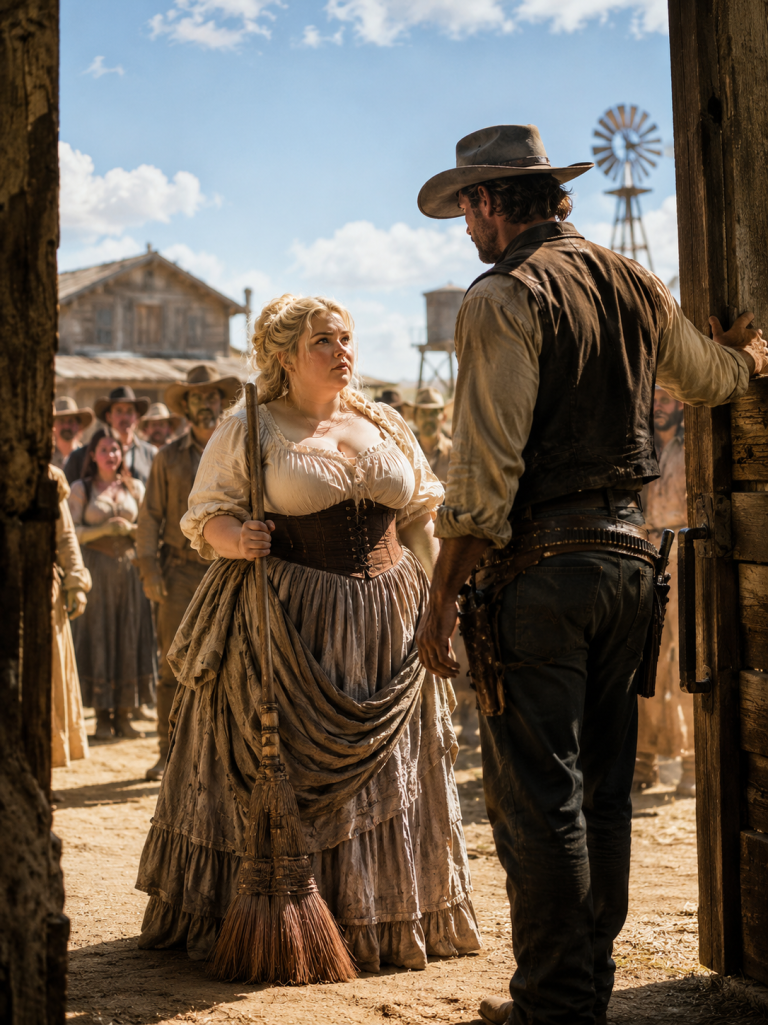
I had stopped trying to be small in public a long time ago. There had been too many years of it. I was a broad-shouldered woman, heavyset, built for the work I had done, and people had spent my whole life pointing at my body with words and without them and waiting for me to flinch. I had decided several years earlier that I was done flinching. I would stand still and let them look and it would not give them what they wanted from it.
So I was standing still.
Then Elias Crane came down from the north road on a dark horse, moving through the crowd the way water moved around rock, and things changed.
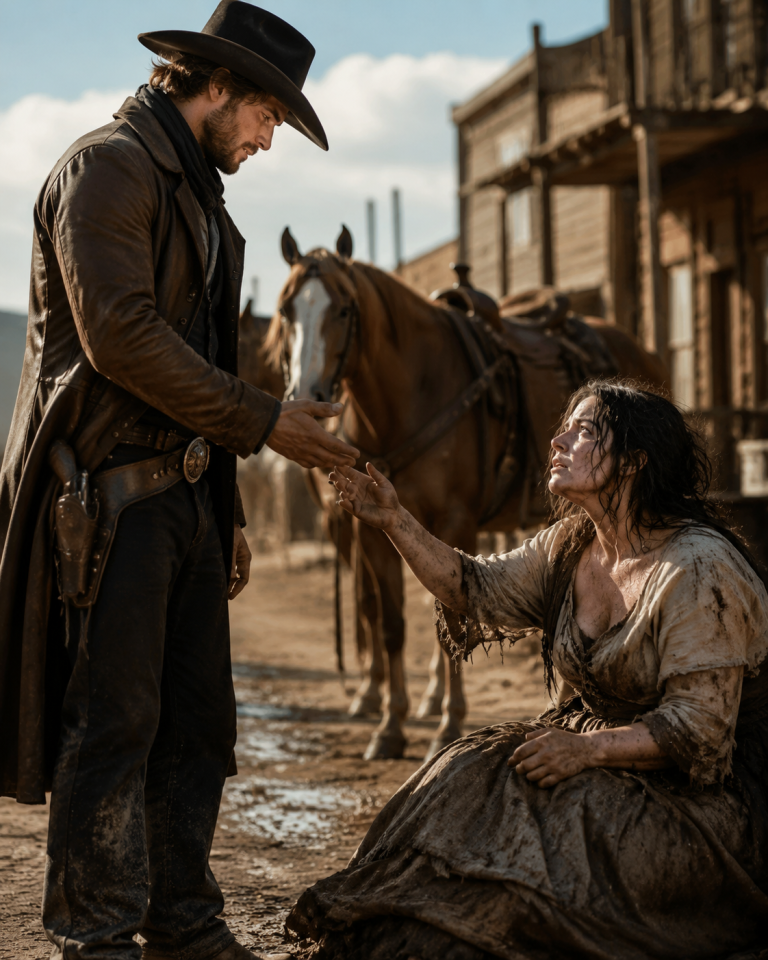
He was not a beautiful man. He was a large one, weathered, with a face that had been outside in hard conditions for a long time. He wore a coat that looked almost black with weather and he walked with the specific economy of motion that belonged to men who had learned that energy was finite and wasting it was a form of idiocy.
He did not speak to anyone. He walked straight to Dahl, reached into his coat, and placed a leather pouch in the man’s hand.
“Four hundred,” he said. “Full amount.”
The crowd had been noisy. It went quiet the way crowds went quiet when an unexpected variable entered a situation.
Dahl opened the pouch. Counted. Looked up.
“You buying, Crane?”
“I already bought.”
Dahl recovered his smile. “Well. The mountain man comes to market. All right then. Step up and take your—”
Elias Crane had already stepped up onto the wagon bed.
He produced a small knife from his belt and cut the rope from my wrists.
It was such a practical gesture, done without any ceremony at all, that for a moment I couldn’t process it. He folded the knife away and held out his gloves.
“Put these on,” he said. “Your fingers are going white.”
I put on the gloves.
“There’s a horse at the post,” he said, and stepped down from the wagon bed.
I followed him.
I did not look at the crowd as I crossed the square. I did not look at Dahl, who was already tucking the money into his coat with the satisfied movement of a man completing a business transaction. I did not look at Reverend Marsh.
I got on the horse he indicated.
He swung up behind me and we rode north into the coming storm.
—
The ride up the mountain took two hours. The snow began in earnest an hour in, and the wind found every gap in clothing. He warned me where the trail narrowed. Once, when the horse stumbled near a steep section of ridge, his hand came to the saddle beside me to prevent a fall, and then it was gone again.
He did not speak otherwise.
At the cabin he helped me down by offering his arm rather than lifting, which was a choice I noticed. He unlocked the door and stood back.
Inside: the fire already burning, because he had banked it before he left that morning. The smell of coffee and pine smoke and the particular dry warmth of a small well-insulated space.
He said what he said about taking off everything, and hung the blanket, and set the things behind it, and left me alone with the key and the rifle.
I stood there for a moment.
Then I locked the door.
Then I went behind the blanket and changed.
The rope marks on my wrists were red and deep. The salve he had left was beeswax and pine resin — not a thing a man kept by accident, but something kept specifically because it was useful for injury. The flannel nightdress was mended at one shoulder with careful small stitches. Someone had mended it who cared about the garment lasting.
I rubbed the salve into my wrists and sat on the edge of the bed and breathed.
I kept the rifle on the floor beside me.
Trust did not arrive in one decent gesture. I knew that. Trust was assembled slowly, and I had spent enough of my life having it taken from me to know I would not give it away again just because a man had walked out into a blizzard to let me undress in private.
But I sat there in the warmth with the salve on my wrists and the fire going and the storm howling outside, and I thought: *No man planning to use me would have thought of salve for rope marks.*
That detail had weight.
I held it carefully while the night came in.
—
## PART 2
He came back when I opened the door.
He had been sitting on an upturned log under the overhang, snow building on his shoulders, a tin cup in his hands. He looked less like a man waiting to be let in and more like a man keeping watch over something he wasn’t sure of yet.
“You warm enough?” he asked.
No one had ever asked me that in a voice that meant only the question.
“I think so,” I said.
He came inside, hung his coat, sat in the chair farthest from the bed, and said: “Eat first. Then I’ll explain.”
On the stove: rabbit stew, rich with white beans and onion. Half a loaf of bread under a cloth.
He had made supper before he ever left for town that morning.
I ate. He waited until I’d finished before he said anything at all, and that small courtesy nearly broke something in me that had been held rigid for a long time.
Then he leaned forward with his elbows on his knees and told me the truth.
Cyrus Dahl had done this before. Not once. Many times. Over years, working a system that wore the costume of law — debt claims, bonded service, official signatures — to move women through situations they had no legal mechanism to refuse. The sheriff was paid. The judges who might have heard appeals were two days’ ride away and not inclined toward cases built on one woman’s word against a man with clean records and town standing.
Elias had been building a case. He had testimony. He had names — women who were willing to come forward. He had statements collected over three years from towns within a hundred miles. He needed one more thing: a piece of Dahl’s own paperwork showing the disparity between actual debts and claimed amounts.
My father’s records might have that.
“Why didn’t you tell me before you—” I stopped.
“Because if I was wrong about the records, I didn’t want to plant hope in you just to watch it die,” he said. “And because even if I was right, I needed it to be your choice to go looking for them. Not mine.”
I sat with that for a moment.
“And the auction?” I said. “Buying me.”
His jaw moved. “Words would have been too slow. Dahl had the papers ready. If I contested them in public he would have pushed it through faster, used the conflict as evidence everything was legal and above board. If I went for the sheriff, Keene would have sided with Dahl before I finished the sentence.” He looked at me directly. “Money was the only thing faster than what he had ready.”
“So you paid four hundred dollars.”
“Yes.”
“And you burned the paper that said I belonged to you.”
He had. I had watched it curl and vanish in the stove before I’d fully understood what I was seeing.
“Yes,” he said.
“Why?”
“Because it was a lie,” he said. “And I don’t keep lies in the house.”
I looked at him for a long moment in the firelight. Then I asked the question I had been carrying up the mountain.
“You have a sister,” I said. “Or you had one.”
The change in his face was very small and very complete.
“How did you know?”
“Because nobody builds a three-year case out of general principle,” I said. “You’re carrying something specific.”
He was quiet.
“Her name was Cora,” he said at last. “She was eighteen. The man who took her called it debt settlement. She ended up in three different houses in eleven months.” His voice stayed even in the way of someone who had said a true and terrible thing so many times that the saying had become separate from the feeling. “I found her by the time it was too late to do anything but bury her.”
The fire made its sounds. Outside the storm made its sounds.
“I’m sorry,” I said. It was not enough. It was what there was.
“I know,” he said. And then: “So am I.”
He stood, crossed to the shelf, and brought back a folded document.
“I need you to know something else,” he said. “Your father’s records. I thought there might be proof there. But I also need you to know—” He stopped. Started again. “If we find what I think we’ll find, it will tell you something about Dahl that you may not want to know. About how far ahead he planned.”
He handed me the document.
I opened it.
At the top of the page, in Dahl’s own handwriting: *Moore girl suitable for kitchen or household service. Better placed before spring if father fails to settle.*
My father had been dead two months.
Dahl had written that note before Christmas.
—
## PART 3
The storm held us for three days.
I did not spend those days in fear. That was the strange thing.
I spent them watching Elias Crane move through solitude the way other people moved through furnished rooms — with the ease of someone who had arranged things to suit himself a long time ago and saw no reason to change the arrangement. He rose before light, split wood, hauled water, mended harness, trapped when the weather allowed. He wasted nothing. Not heat, not food, not words.
On the second day he noticed the chair at the table rocked slightly and pinched at the sides. He said nothing about it. He went to the shed, came back with pine boards, and by evening there was a new chair at the table: wider, straight-backed, cross-braced legs, edges sanded smooth with a worn piece of leather.
He set it at the table and went back to the knife he was sharpening.
“It’s just a chair,” I said.
“No,” he said, not looking up. “It’s the right size.”
People had spent my whole life making pronouncements about my size. The right size was not a phrase I had heard applied to me in any context that was kind.
I sat in the chair.
I ran my hands along the smooth edges.
That night after he went out to bring in wood I sat in that chair and cried without sound, because there was no one to explain it to and nothing to explain it with except that sometimes the ordinary thing is the thing that gets through.
On the fifth night I woke to lamplight moving under the blanket and heard the low murmur of his voice.
Old fear moved fast.
I was up before I’d decided to be, and I looked through the gap where the curtain didn’t quite reach the wall, and I saw him at the table with papers spread before him, talking quietly to himself as he read. Not love letters. Not sale documents. Statements. Testimony. Names in a careful hand — Mary Teller, Judith Fenn, Clara Holt — with dates beside them and accounts of what had happened to them under Dahl’s system.
I saw his sister’s name among them. *Cora Crane, age 18.*
He heard the floorboard creak.
He looked up at the gap in the curtain.
I stepped back too quickly and my hip caught the washstand and the tin rattled.
A moment later he pulled the blanket aside.
I was gripping the bedpost. I had the small kitchen knife from the shelf.
He looked at the knife. Then at my face.
“You thought I was writing to sell you,” he said.
My face went hot. “I didn’t know what I was looking at.”
“No. You wouldn’t.”
He stepped back and held the blanket aside, giving me the space to cross to the table if I chose. He did not move toward me.
I put the knife down. I crossed to the table.
I looked at the names. I looked at his sister’s name.
“How long have you been building this?” I asked.
“Three years.”
“Three years,” I said. “And Dahl kept operating.”
“Yes.” He said it the way people said things that were true and terrible. “And I counted every woman against myself.”
I looked at him.
“You should have,” I said.
He held my gaze.
“Yes,” he said. “I should have.”
I sat down.
Not because I trusted him completely. Trust was not a thing I could hand over in a week. But I sat down and looked at the papers and said: “Tell me what you have and what you still need.”
He told me.
I listened.
Then I said, “My father kept records. He had a ledger he hid in the stable wall when he thought someone might come for it. I haven’t thought about it in years.”
Elias went still.
“Do you think it’s still there?”
“I think it’s worth looking.”
—
We rode down when the pass cleared.
The Moore place sat a mile east of Red Creek in a shallow valley where even good weather found the cracks. By the time I’d come back to it from the poorhouse after my father died, there had been nothing left to save. But the stable was still standing.
I had not been there since the funeral.
Elias did not tell me what to feel about returning. He dismounted and stood back and let me look at it as long as I needed.
“I hated him some days,” I said.
“That’s allowed,” he said.
“I know.” I swallowed. “I loved him too.”
“That’s allowed as well.”
Such a plain answer. Such an exact answer.
Inside the stable, behind the loose plank in the south wall where my father had hidden a poker ledger when I was ten years old, was a tin lockbox with rust around the hinges.
Elias pried it open with his knife.
Inside: notes and receipts and a small ledger bound in cracked brown leather. And tucked between two pages, a folded scrap of paper with my name on the front.
*Nell.*
I looked at it for a long time.
Elias said, “Do you want me to step away?”
“No,” I said. “Stay.”
I unfolded the paper.
My father’s handwriting, unsteady. Written drunk or injured or both, possibly both.
*Nell — if Dahl comes, don’t believe his numbers. The debt is eighty-three dollars, not what he says. He made Keene sign papers so they can take you if I don’t settle. I told him if he touched you I’d kill him. I don’t know if I can. If I don’t wake up tomorrow, take this box and go to someone outside Red Creek. Don’t trust the sheriff. I’m sorry I made this for you. I know it isn’t enough. But I love you and this is the truest thing I’ve put on paper in years.*
*Pa*
The snow around us was very bright.
Elias took the letter gently after I’d read it twice. He read it once.
“He knew,” I said.
“Yes.”
“He knew what Dahl planned to do.”
“He knew.”
I had carried my father as one thing for a long time. A man who had gambled and borrowed and failed and finally disappeared into an unremarkable death, leaving me with his debts and his reputation. Both were true. Everything I had believed about him was true.
And also this: he had known. He had tried, in one last clear hour, to stop it. He had been too late and possibly drunk and not nearly enough. He had also loved me.
I sat down in the snow beside the open box and cried with the letter in my fist because human beings were complicated enough to wreck you even in their failures.
Elias crouched in front of me at a distance that gave me room.
“What if he didn’t just die?” I said when I could speak again. “What if Dahl made sure he didn’t wake up?”
“Then this ledger might be enough to prove more than fraud,” he said.
He opened the book.
On the inner pages, real debt amounts on one side, inflated claims on the other, each marked with initials. *K* for Keene. *C.D.* for Cyrus Dahl. And beside women’s names — names I recognized from Red Creek and towns beyond it — small symbols, notations, amounts. Transfers. Sales in the language of bookkeeping.
Elias pointed to a page without speaking.
At the bottom, in different ink from the rest: *Moore girl suitable for kitchen or household service. Better placed before spring if father fails.*
He closed the book.
“We go to town now,” he said.
—
The ride back was cold and fast.
“You knew,” I said halfway down. “About the records.”
“I suspected.”
“You didn’t tell me.”
“If I was wrong, I didn’t want to plant hope in you just to watch it die.” He paused. “And I needed it to be your choice to open the box. Not something I’d arranged.”
I turned that over.
“And if you were right?” I said.
“Then you needed to find it yourself so you knew it was yours.”
Anger and understanding moved through me in the same breath.
That was the thing about Elias Crane. Even his mistakes had the shape of restraint.
—
Red Creek saw us coming before we reached the square.
Towns moved faster than horses when they smelled a change in the weather.
We rode straight to Dahl’s office. Elias at the door. Me carrying the lockbox.
Inside: Dahl with his boots on the desk. Sheriff Keene tipped back in a chair.
Dahl looked at me the way he had looked at me on the wagon bed, with the specific ownership of a man who had already done the accounting.
“Well,” he said. “Back already.”
I set the lockbox on his desk hard enough to rattle the inkwell.
“My father’s records,” I said.
His smile wavered by a degree.
I laid out the ledger. The promissory notes. My father’s letter. One by one, the way you laid out evidence when you wanted a man to see exactly what you had before he could think of a way to move against it.
Keene’s chair legs hit the floor.
Dahl’s voice went too smooth. “That proves nothing. Interest accumulates.”
“Not three hundred percent,” I said. “Not under territorial law.”
The door opened behind us.
I had not known Elias sent a wire before we left the mountain. He had sent it three days before the storm broke, when we had decided together what we were going to do. The federal marshal from the district office had ridden through the night.
Marshal Jonas Cole stepped in with a badge and a coat still dusty from the road. Behind him: Clara Holt, who had worked for the widow Merritt before she disappeared, with a folder of papers under her arm. And Judith Fenn, who had been sent to a ranch in Sweetwater County under a debt claim that Dahl had filed on her dead husband’s account.
Keene stood up.
His hand went to his holster.
Elias moved.
He caught Keene’s wrist before the gun cleared leather and turned the man’s arm behind his back with the economy of someone who had been in this situation before and had learned what worked. Keene went into the wall. The pistol skittered across the floor.
Dahl grabbed for the ledger.
I caught his arm.
He turned on me with the flat look of a man who had been using women as tools for so long he had forgotten they had opinions about it.
“You stupid, useless—”
Judith Fenn stepped forward and hit him across the mouth with the flat of her hand. She was a small woman and she hit him hard enough to split his lip.
“You sold me to a ranch family in Sweetwater County,” she said. Each word precise and cold. “Say one more word about her.”
Dahl stared at her.
Maybe that was the first time it had occurred to him that women kept accounts too.
Marshal Cole had his revolver out. “Hands up. Both of you.”
I took the ledger back from the desk.
“This isn’t politics,” Dahl said, blood on his teeth. “You have some women and a trapper with a grudge. That’s not a federal case.”
“No,” I said. “Your own handwriting is.”
I turned to the open door, where Red Creek had assembled in the way towns assembled when something irrevocable was happening — not to stop it, but to see it.
I opened the ledger to the page with the women’s names.
I read them aloud.
Every one.
Names the town had folded into rumor. Names that had been explained away as women who ran off, or moved on, or were sent to better situations, or chose difficult lives. Women who had been on this same wagon bed or ones like it, in this town or towns close enough that the same sheriff rode circuit through them.
While I read, Clara Holt walked forward and pointed to her own name in the book.
Judith Fenn pointed to hers.
An older woman in the doorway — Mrs. Calvert, who had run the boardinghouse for fifteen years and who I had once seen refuse to make eye contact with me in the street — said in a voice that shook but kept going: “I saw Keene leave Dahl’s office twice with money I knew wasn’t his wages. I didn’t say anything.”
No one spoke.
Then she said, “I should have said something.”
One by one, other people found things they had seen and not reported, things they had known and not named, things they had suspected and dismissed because suspicion without action cost nothing and action sometimes cost everything.
The undertaker confirmed that my father’s body had bruising that a fall didn’t explain.
A freighter admitted he had carried sealed luggage south for Dahl on three occasions and had not asked what was inside.
A woman named Ruth, who had left Red Creek seven years ago, had ridden twelve hours to be there. She didn’t say much. She just handed her own contract to Marshal Cole and stood where everyone could see her.
Shame changes direction fast once truth gets witnesses.
That was something I had not expected. I had expected the town to resist, to find reasons, to protect what it had allowed. Some of them did. But more of them didn’t, and I think it was because most people who do cowardly things are not committed to cowardice. They are committed to not paying the price of courage, and when the price of courage becomes lower than the price of being seen to have been cowardly, they will pay it.
Dahl lunged when he understood what was happening.
Not for the ledger this time. For me.
Maybe because I was the most visible piece of the case. Maybe because men like him, when they panicked, went for what they understood, which was using a woman as something between themselves and consequence.
He caught my coat and dragged me backward against the desk. My hip caught the edge hard. Pain shot through my side.
“Nell!” Elias said.
Keene used the distraction to drive his elbow into Elias’s ribs.
The room broke into pieces.
Clara Holt kicked Keene’s fallen gun under the iron stove.
Dahl’s fingers dug into my sleeve, pulling me in front of him like a shield.
Old fear rose, fast and deep.
Then something else rose up through it, and I let it.
I had stood on a wagon bed. I had ridden up a mountain not knowing whether I was going to safety or something worse. I had found my father’s last letter in the dark of a stable and read it while snow fell on my shoulders. I had sat at a table with a man who built cases out of grief and told him what I knew and what I had.
I was done being handled.
I threw my head back and caught Dahl across the nose.
Cartilage gave.
He screamed.
I grabbed the ledger with both hands and hit him with it while he was still bent forward, and he went down hard, and I stood over him in Cyrus Dahl’s office in the town of Red Creek, Wyoming, with my heart hammering and the room going still around me.
“This,” I said, “is what my body is for.”
Not your jokes.
Not your market.
Not your papers.
Elias had Keene on the floor. Marshal Cole put the irons on Dahl.
Judith Fenn stood with a fire poker in both hands and the expression of a woman who had been waiting years for something to strike.
Nobody in the doorway laughed.
They were looking at me.
I looked back.
And none of them looked away, which was the thing I had been owed for a long time and was only now collecting.
—
Dahl and Keene were taken south before dark.
More names came forward over the following weeks as the federal investigation opened what Dahl had kept closed. Women who had been sent away, transferred, placed, bonded, settled — all the clean words — came forward or sent statements. Some came from fifty miles away. Some sent letters they had written and not mailed years before, waiting for a moment when it seemed safe to send them.
My father’s death was not proved murder by any court. The undertaker’s statement, the letter, and the inflated ledger amounts were enough to name what Dahl had been doing but not to close the question of what had happened to Bernard Marsh on a specific night in February. I made peace with that the way you made peace with things that were true but would never be finished — by holding both parts at once without needing them to resolve.
He had been a man who failed me steadily and loved me the whole time.
That was not simple.
I was not going to make it simple.
I sold the Moore place in summer. With that money and what the court ordered from Dahl’s seized accounts, I bought a property at the edge of Red Creek where the freight road turned north, and I opened a boarding kitchen.
I named it after my mother, who had sung over bread dough and deserved something in the world to carry her name well.
I bought good tables.
I bought deep bowls.
I bought chairs wide enough for anyone who needed them, which was the detail Red Creek noticed first and remembered longest.
Elias helped me build the counter, the shelves, the porch. He never acted as though helping meant owning. Sometimes he brought venison. Sometimes he fixed a hinge. Sometimes he understood that I was cross from a long supper service and left without coming in, because he had learned that pride managed better when nobody stood watching you manage it.
The whole town could see he loved me before either of us said it.
I could see it too.
He did not rush me.
That was the gentlest thing.
The first time he touched me for no reason except that he wanted to, it was autumn. The aspens on the ridge had gone yellow and the evening light behind Eleanor House was soft and gold and the supper rush was done and I was standing by the back fence with flour still on my apron and he was beside me with pine pitch on his hands from some repair he’d done under the porch.
He looked more uncomfortable than I had ever seen him.
“Nell,” he said. “If I kissed you, would that be welcome?”
I laughed so hard I had to press my hand over my mouth.
Then I said, “Yes. It would.”
So he kissed me.
Not like a man claiming something.
Like a man who had been given entry to a place he intended to be careful with.
—
We married the following spring in the meadow above the cabin, where the snow had already melted from the south-facing slope and bluebells were coming up through the wet earth.
Clara Holt stood with me.
Judith Fenn stood with me.
Reverend Thomas came from the circuit — not the Reverend Marsh from Red Creek, who had said too many prayers over too many disappearing women for me to want him at my wedding. Thomas kept it brief, which suited both of us.
When it came to the vows, Elias took my hands with the same steadiness he had shown the day he cut the rope from my wrists, and he said:
“I can’t promise you an easy life. Only an honest one. And only if that’s what you want.”
“It is,” I told him.
Then: “I want to say something else.”
He looked at me.
“You bought me at auction,” I said. “In a town square. You used the same mechanism that men like Dahl used, even if you used it against him. That was not — it was not clean. You know that.”
“Yes,” he said.
“And I know why. And I know what you had in a week that most men don’t have in a lifetime. And I’m standing here. But I need to say it out loud before we go any further.”
“Yes,” he said again. “You’re right to say it.”
“Good.” I looked at him. “Now I want to say something else.”
He waited.
“You walked out into a blizzard so I could take off my frozen clothes without fear,” I said. “That was the moment. Not the ledger, not the case, not the years of work. That was when I understood who you were. Because you could have stayed. And you left instead.”
His hands tightened around mine.
“I knew,” I said, “that whatever came after, you understood what privacy cost someone who’d had hers taken. And I decided I could trust a man who understood that.”
The meadow was quiet around us.
The aspens would be yellow again in six months.
I said: “I do.”
—
People tell our story wrong sometimes.
They say a trapper bought a poor woman at auction and turned out gentler than expected, and the lesson is that not all hard men are cruel. That version is comfortable because it makes the problem small enough to solve with one decent man.
The real story is larger and harder.
A system ran in Red Creek and towns like it, built on debt and paper and the willingness of people who knew better to say nothing and watch. It ran for years. It took women and called it law. It ruined some and lost others entirely, and it did all of this in daylight while neighbors looked away and sheriffs signed documents and reverends prayed over everything except the specific wickedness in front of them.
Elias Crane did not dismantle it by being a good man. He dismantled it by spending three years building a case, and then by doing the one thing fast enough to matter on a specific afternoon, and then by helping me find what my father had left and making sure the finding was mine.
I helped dismantle it by standing in Dahl’s office with a ledger in my hands and reading names out loud to a town that had chosen not to know them.
Clara Holt helped. Judith Fenn helped. Ruth, who rode twelve hours. Mrs. Calvert, who finally said what she had seen. Every woman who sent a statement. Every person in that doorway who, when truth got witnesses, decided the price of silence was finally too high.
That is not a fairy tale.
That is what happens when enough people refuse to let a thing be buried.
Some nights, when the wind comes hard off the ridge and the shutters rattle the way they did that first night in Elias’s cabin, I remember the sound of the door closing behind him.
He stepped out into the blizzard so I could undress without fear.
I have thought about that gesture many times since. Not because it was grand. Because it was small. Because it cost him nothing except the cold, and he did it anyway, because he understood without being told that a woman who had been put on a platform and priced had a particular need for a closed door.
That was when I first understood what I was dealing with.
Not a hero.
A person who saw what someone needed and gave it without making it into a story about himself.
People called Red Creek a changed place after the trial. In some ways it was. In other ways it was the same town with the same people who had to live with what they’d allowed.
I served them supper at Eleanor House, the same as anyone else, in the chairs that fit. I did not forgive all of them. I forgave some of them. The difference mattered.
And I built something there — not despite what had happened, not after it was fully healed, but right in the middle of it. Tables and shelves and a kitchen that smelled like my mother’s and a man who knocked before entering any room that was mine.
That was enough.
More than enough.
It was a life.
*THE END*