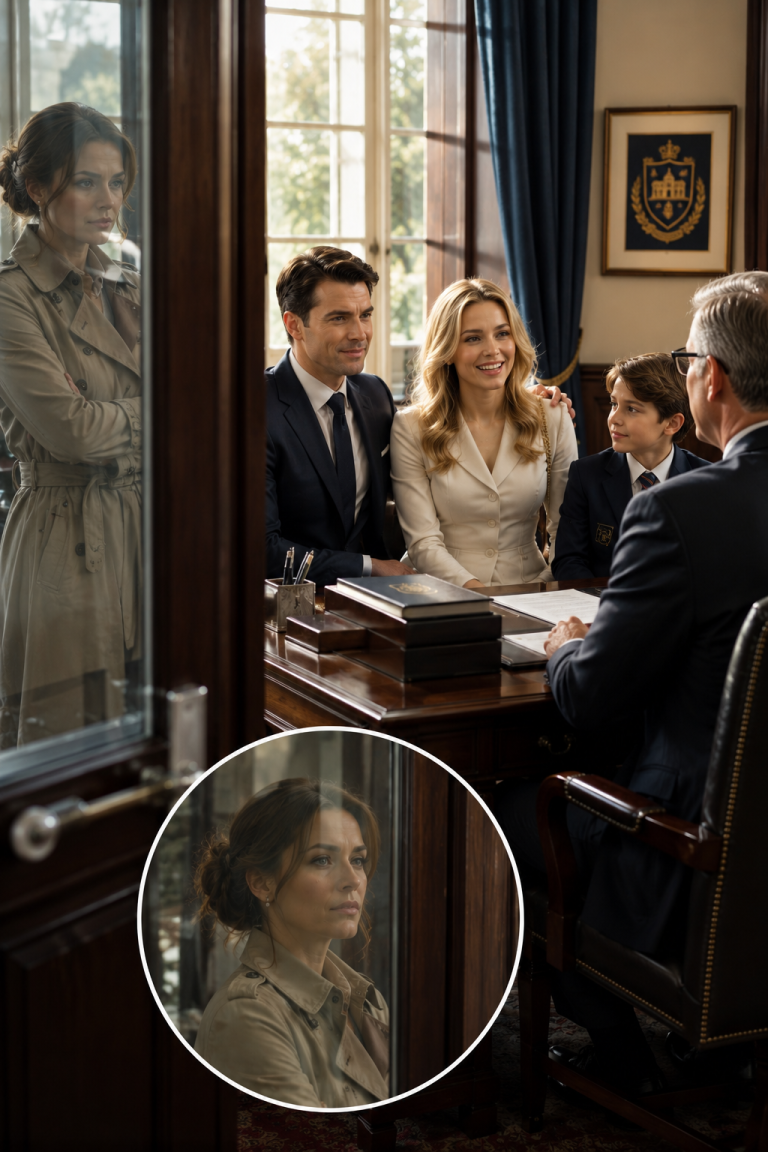
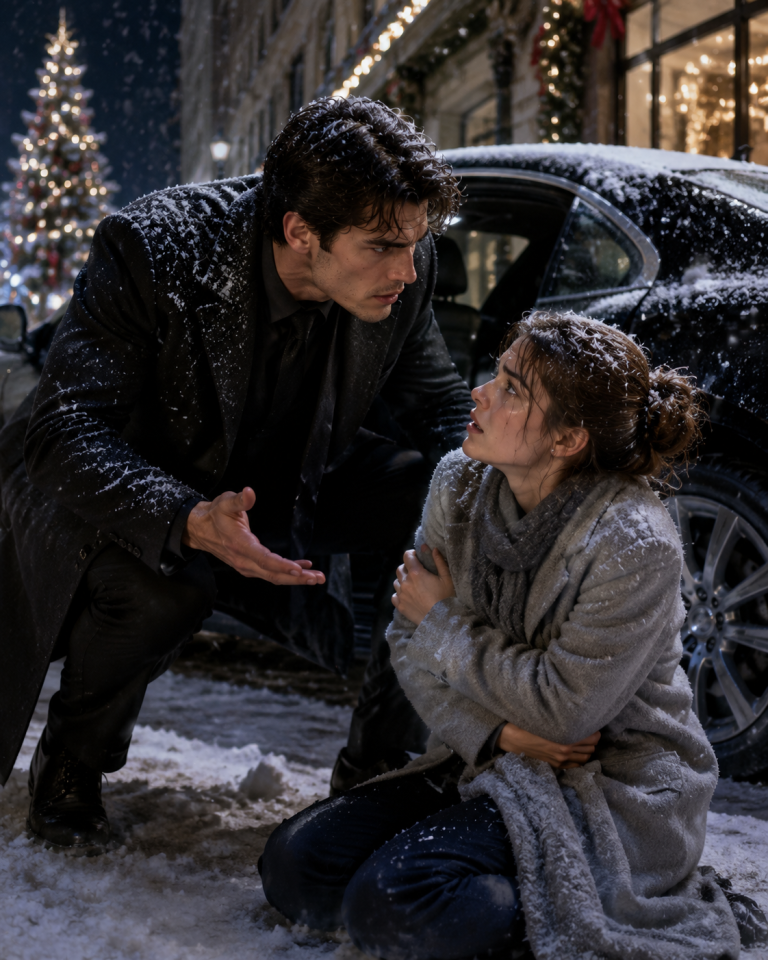
They Told Her to Let the Baby Fade in Silence—But When the Homeless Woman Touched His Hand, the Entire Room Heard Him Scream

## PART 1
The silence was what terrified him.
Not the fever. Not the storm hammering the walls of Harrow Creek Ranch at three in the morning. Not the doctors’ careful voices or the foreman’s steady hand on his shoulder. It was the silence from the nursery down the hall — that complete, cottoned quiet where a baby’s crying used to live — that made Declan Harrow press his back against the wall and close his eyes and try to understand how grief had come to feel like relief.
Four days.
That was how long his son, Eli, had been burning.
Dr. Stuart Calloway — three counties’ most respected physician, cited in two regional medical journals, trusted by every prominent family from Billings to Havre — had confirmed the fever on Monday and prescribed rest, warmth, and sedation when the crying grew too taxing on Eli’s system. That was what he’d called it. *Taxing.* As if a seven-month-old could be expected to manage his own distress more professionally.
Declan had said nothing. He was a rancher, not a doctor. He knew cattle, weather, frostline, breeding season, the exact sound a fence wire made before it snapped in cold. He did not know what to do when his son’s small chest moved like a hummingbird’s wings and then slowed and then moved wrong.
So he had trusted the man with the stethoscope.
He had trusted the man with the gray wool coat, too.
Owen Pearce had managed Harrow Creek for seven years. He had come recommended with three letters and spotless records after Declan’s father died, leaving the ranch in debt and the ledgers in a state that required someone who understood numbers better than Declan ever would. Owen had earned every cent. He was precise, loyal, calm under pressure, and present in every crisis. When Declan’s wife, Mara, disappeared into a snowstorm three weeks ago and did not come home, Owen had been the first person through the door, the last person to leave at night, the steady center of a house that had come unmoored.
Declan trusted him with payroll, supply routes, livestock contracts, the mortgage renegotiation, and both sets of keys to the equipment shed.
Mara had never liked him.
*He smiles like someone who’s already decided how the story ends,* she’d said once, two months before she vanished. *I just can’t figure out whose ending it is.*
Declan had called it grief making her paranoid. Grief from the pregnancy complications. Grief from the isolation of a Montana winter. Grief from too many nights reading medical articles online when she should have been sleeping.
He had been very wrong about that.
The nursery door opened.
Dr. Calloway emerged with his bag. He looked rested, which Declan found offensive. “He’s settled,” the doctor said. “The sedative helped considerably.”
“He was crying an hour ago.”
“Exactly. He’s not crying now. In an infant with compromised respiratory function, silence indicates rest.”
“Or it indicates something else.”
Calloway’s patience thinned visibly. “Mr. Harrow, you are exhausted and frightened. Both are understandable. But second-guessing clinical judgment because an infant has stopped displaying distress symptoms is not helpful.”
“His lips look gray.”
“Cyanosis is temporary with sustained fever. I’ve treated hundreds of cases.”
“Not my son.”
“All sons are the same biologically.”
Declan stared at him.
Behind Calloway, Owen Pearce appeared at the top of the stairs. He moved with his characteristic smoothness, the kind that came from long practice at occupying rooms without being accused of controlling them. “Declan. How is he?”
“Resting,” Calloway said.
Owen nodded at Declan with his particular look of mournful competence. “That’s progress.”
Declan did not answer.
Then the front door below them slammed open so hard that the storm lantern in the foyer swung and the dogs began barking from the mudroom.
All three men turned toward the stairs.
A woman’s voice came up from below, rough and furious and completely without apology.
“Where is the baby? Somebody better answer me right now.”
—
## PART 2
Declan hit the stairs before Owen could move.
The foyer was chaos — wind, snow, a young ranch hand called Jurgens trying to block the door with his body, and a woman who was not accepting being blocked.
She was short. She was heavyset in the way that hard years made people heavy, all density and endurance, not softness. Her coat was a man’s canvas duster, soaked through at the collar. Her hair was dark-brown and gray-streaked under a wool hat she’d pulled to her eyebrows. Her face was windburned and furious and cracked at the lips and entirely unashamed of any of it.
She was looking at Jurgens like he was a door she intended to walk through.
Then she looked up at Declan.
“You’re Harrow.”
“Yes.”
“Your baby is dying because educated fools have been cooking him alive.”
Declan crossed the foyer in four strides. “Get out of my house.”
“No.”
“Lady—”
“Mara sent me.”
The name hit him like a boot to the sternum.
Everything stopped. The wind, the dogs, Jurgens’s protests, Owen’s measured footsteps on the stairs behind him — all of it receded until the only sound left was a Montana blizzard that had already taken everything he loved.
“My wife,” Declan said, “is dead.”
The woman swallowed.
For a single second, the fury on her face cracked — just a hairline fracture — and underneath it was exhaustion so old it had become structure.
“I know,” she said.
“Then who the hell are you?”
She reached into the inner pocket of her ruined coat and pulled out something wrapped in a handkerchief. She placed it on the foyer table between them without ceremony.
He unfolded the cloth.
A ring. Gold. Simple band. Engraved inside: *D + M. Every road home.*
Mara had worn it the day Eli was born. She had worn it the night she rode out of the barn in a storm, kissed Declan on the jaw and said *I have to verify something before I can explain it.* The search team found her horse dead in a gully two days later. Blood on the saddle. No Mara.
Owen said from the stairs, very calm: “Declan. That ring could have come off her body.”
The woman’s eyes went to Owen. A cold, particular recognition.
“You must be Pearce.”
Owen went perfectly still.
She smiled — not warmly. “She said you’d look like the person who should be trusted.”
Calloway stepped forward from the stairs. “This woman is clearly in some form of distress. Mr. Harrow, I strongly advise—”
She walked past all of them.
Declan caught her arm. “You take one more step toward my son and I’ll carry you back out into that storm myself.”
She stopped. Looked down at his hand. Then back up at him. Her eyes were not kind eyes. They were not unkind eyes either. They were the eyes of a person who had been through too many rooms that didn’t want her.
“Your wife rode for four days through the worst November Montana has handed anyone in twenty years to find me,” she said. “She found me behind a truck stop in Great Falls because she’d spent three weeks tracing my name through court records. She said her son was being made sick by men careful enough to call it medicine. She said if I got there too late, the nursery would be quiet.”
Declan’s grip loosened.
“I got here,” she said. “And it’s quiet.”
He let go.
She went up the stairs.
At the nursery door she didn’t pause. She walked in.
The heat was the first assault — the room was blazing, fireplace going full, a portable electric heater in the corner, windows sealed, curtains drawn. The air smelled of sick-sweat and wood smoke and something medicinal that made Declan’s throat close. Eli lay in the crib under three blankets, his little face fire-red, his lips parted, his breathing thin as paper.
Margaret Foss, the nurse Owen had arranged — a sturdy woman in her fifties who had been obeying orders with the face of someone who had stopped trusting those orders three days ago — rose from the rocking chair.
“Who is she?”
The woman went to the crib.
“Do not touch that child,” Calloway said.
She stripped back the first blanket. Then the second. Then the third.
“Stop her,” Owen said.
Declan stepped forward but the woman had already pulled the blankets clear. Eli didn’t stir. He lay in his sleep sack damp with sweat, limp, the color of old brick.
She swore under her breath. “How long sealed like this?”
Calloway said tightly, “The child needs retained warmth—”
“The child needs air.”
“He is febrile—”
“He is suffocating.” She turned on Calloway. “You sedated a seven-month-old for *crying.* Do you understand what you did? You removed the only mechanism he has for self-regulation and then you wrapped him in three blankets and sealed the room and called that treatment.”
Margaret covered her mouth. “I said to him — I said maybe we should crack the window—”
“You said that?” Declan looked at her.
Her eyes filled. “He said the cold air would shock his system.”
The woman glanced at Calloway. “Of course he did.”
She picked Eli up.
Declan made a sound he didn’t recognize — something low and cracked and animal. Eli’s head lolled against the woman’s shoulder like a rag doll.
She moved to the window and opened it. Cold air poured in. Calloway lunged forward. Declan blocked him without thinking.
She held Eli upright against her chest and rubbed his back in firm, slow circles, murmuring against the top of his head. “Come on. Come on, little one. Don’t you dare leave me. I came a very long way and I am very tired and you owe me some noise.”
Nothing.
She wet a cloth in the washbasin, pressed it to Eli’s cheek, his neck, behind his ear.
“That will shock him,” Declan said.
“That’s the idea.”
“You’ll hurt him.”
“He’s already hurt. I’m waking him up.”
“She’ll kill him,” Calloway said sharply. “Declan, this woman is not licensed to—”
“He is already dying *quietly,*” she said, without looking at the doctor, “because that is what someone in this house arranged.”
Eli gasped.
Thin. Broken. The smallest possible intake of air.
She shifted him, kept rubbing. “Again. Again. Come on, sweetheart. Be furious. You have every right.”
He gasped again.
Then his face twisted.
Then Eli Harrow screamed.
It was not a gentle sound. It was raw and outraged and completely, terribly alive — the cry of a baby who had been somewhere too quiet for too long and had finally decided to object. He screamed until his fists curled and his face went redder and the whole nursery filled with the most appalling and beautiful sound Declan had ever heard.
Margaret burst into tears.
Owen, on the stairs, had gone the color of old snow.
Calloway looked like a man reviewing his options.
The woman held Eli close, rocking him, her face wet though she didn’t seem to notice. “There you are,” she said softly. “There you are.”
Declan’s knees nearly failed him.
He gripped the doorframe.
Owen’s voice came smooth and careful from behind him. “Declan. A short improvement is encouraging, but we don’t know the damage this intervention may have caused. This woman’s methods were reckless. We should consider—”
“Stop talking,” Declan said.
Owen stopped.
Declan looked at the woman — this stranger in his nursery, holding his screaming son, wearing a dead woman’s handkerchief — and felt something behind his ribs shift into a shape he didn’t have a name for yet.
“Who are you?” he asked.
She looked at him over the top of Eli’s head.
“Dora Crane,” she said. “And your wife died telling me everything.”
—
## PART 3
They moved to Declan’s study.
Eli’s screaming followed them through the walls. Margaret had taken him under Dora’s brief, sharp instructions: no sedatives, no sealed room, no extra blankets, small amounts of milk every twenty minutes, watch his color, call if anything changed. Calloway had begun to protest. Declan had turned to him with an expression so empty of patience that the doctor went very quiet.
Owen tried to follow them into the study.
“I’ve run this ranch for seven years,” he said.
“Then take the next ten minutes off,” Declan said, and closed the door.
Dora lowered herself into the leather chair across from his desk like a woman who had stopped expecting chairs to welcome her. The chair’s legs creaked and she flinched — automatic, involuntary — the small cringe of someone who had learned to expect mockery from ordinary moments. She covered it by pulling off her wet gloves.
Her hands were broad, cracked, strong.
Declan sat across from her and waited.
She looked at the ring on his desk. “Your wife found me because of a court record. Ten years ago in Wyoming, I was a licensed nurse-midwife. I had a practice, a husband, a daughter, and a standing in my community that I’d spent fifteen years building. Then a wealthy family’s infant died under a physician’s care. I told the family the treatment was wrong. I told them loudly, in front of witnesses. The doctor said I was unstable, jealous, poorly educated. The family needed someone expendable. I was—” she paused, something hard and old moving across her face, “—very easy to discard.”
“They blamed you.”
“I was fat, loud, and female. They called it smothering. Mishandling. Negligence.” Her jaw tightened. “I lost my license. My husband decided shame had too high a price. My daughter got sick the next winter and I couldn’t pay for a doctor who would see me without contempt. She didn’t make it to spring.”
Declan looked at her.
“People will say I became unreliable after that,” she said. “They won’t say what made me unreliable. They never do.”
“And Mara found you.”
“She’d been tracking infant deaths across three states. Same pattern every time — a healthy baby develops sudden fever, symptoms worsen under supervised care, parents are exhausted and isolated, legal documents appear during the grief window, property transfers. She found my name in an Idaho case file. She thought I’d seen something similar. She was right.”
Declan said, very carefully: “Owen.”
“She believed so.”
“Believed?”
Dora reached into her backpack and pulled out a waterproof packet. She placed it on the desk.
Declan opened it.
Medical logs. Calloway’s precise handwriting, neat and professional — dates, symptoms, treatments, responses. Clinical. Thorough. Almost beautiful in its order.
In the margins, penciled notes in different handwriting:
*Increase sedation if crying persists. Reduce external stimulus.*
*Maintain elevated room temperature. Prevent outside examination.*
*If respiratory function declines: document natural failure.*
He had seen that handwriting across seven years of ranch ledgers. He knew the way Owen made his capital *O* like a closed fist, the way he pressed too hard on numbers.
“Why would he want Eli dead?” Declan asked.
“Because Mara found the contingency clause.”
Declan looked up.
“In the management contract Owen renegotiated after your father died,” Dora said, “there’s a provision. If you lose both your wife and your primary heir before the estate clears probate, temporary custodial authority over ranch operations transfers to the current manager of record.”
Declan sat absolutely still.
“Harrow Creek sits on the Yellowstone mineral corridor,” Dora said. “There are men in Denver who’ve been watching this land for twenty years. Owen has investors. The cattle operation is worth twelve cents on the dollar compared to what’s underneath the north pasture.”
The room shifted around Declan like a boat taking water.
He wanted to say it was impossible. He wanted to say Owen had stood beside him in every storm. He wanted to say there had to be another explanation, a misunderstanding, an error in Lauren’s research. He wanted to say his wife must have been wrong.
But Eli was crying down the hall.
And dead babies did not cry.
Dora leaned forward. “Mara knew you trusted him. She knew if she came to you with only suspicion, Owen would call it grief and tighten his grip. She needed someone who knew what false medicine looked like. She was already injured when she found me — cold, frostbite, exhausted. She gave me the ring and said, *If my husband hates you on sight, let him. Just keep my son breathing.*”
Declan pressed his fist to his mouth.
“How did she die?”
Dora’s voice went quiet. “She died angry. She died talking about Eli.”
He sat with that for a long time.
“What do you want?” he asked.
“To keep that baby alive long enough to make your wife’s death mean something.”
“And if everything you’ve told me is wrong?”
She stood. She was not an impressive figure by any measurement the world cared about — short, heavy, worn through, dressed in other people’s discards. But she stood in his study like a woman who had survived the specific cruelty of being repeatedly dismissed and had stopped requiring anyone’s validation to know her own value.
“If I’m wrong,” she said, “Eli improves, Calloway is vindicated, Owen keeps running your ranch, and you throw me back out into the storm. But if I’m right and you waste time protecting what you’re used to believing, they’ll bury your son before sunrise and you’ll spend the rest of your life knowing you chose comfort over him.”
Declan looked toward the hallway.
Eli was still screaming.
It was the most beautiful sound in the world.
“Forty-eight hours,” he said.
Dora nodded. “Then we start with the coward.”
—
Calloway broke before lunch.
Declan found him in the pharmacy room rearranging bottles with hands that wouldn’t hold steady. The doctor had spent the morning constructing a careful professional composure that was failing him now, tile by tile.
“You’re removing something,” Declan said.
Calloway laughed, very poorly. “Taking stock after last night’s disruption.”
“Owen tells you she’s going to take the blame when this falls apart.”
The doctor’s hands went still.
Declan leaned against the doorframe. “You signed the prescriptions. You wrote the logs. Every decision in that nursery has your name on it. Owen’s name is in pencil, in the margins. You think a jury reads margins?”
Calloway gripped the shelf.
“Tell me,” Declan said.
“I was following the treatment plan as outlined.”
“Owen’s treatment plan.”
“I was advised that the infant’s mother had developed an obsession with medical literature and online forums. That she was suggesting irrational interventions and needed to be managed around. That Mr. Harrow was grief-stricken and easily confused. I was told if the fever worsened, to manage it aggressively, document thoroughly, and be prepared for potential inquiry.”
“And the sedatives.”
Calloway’s voice dropped. “Owen said the crying was creating unnecessary drama. He said the child was exhausting himself.”
“Owen said. And you prescribed.”
“He knew about my history.” The words came out ugly and small. “Complaints from residency. A malpractice settlement I’d sealed. He said he only needed help managing the situation. He said it would be fine.”
Declan felt rage move through him like a slow engine turning over.
“Write it down,” he said.
“He’ll—”
“Write every conversation. Every instruction. Every dose. Sign it. Date it.”
Calloway’s eyes watered. “He’ll destroy me.”
“He already has. You’re just late understanding it.”
He left the doctor with a pen and paper and went to find Dora.
She was in Mara’s writing room, moving through the small desk with the practiced efficiency of a woman used to finding things people hid. Declan stood in the doorway and watched her work and thought about the fact that his wife had sat in this room secretly building a case while he sat ten feet away trusting the man she was building it against.
“Here,” Dora said.
Behind the bottom drawer — a false panel he’d never known existed.
A folder.
Inside: clippings, court documents, land transfers, medical statements, and a hand-drawn list of eleven families.
Eight of them had one name circled.
Owen Pearce had worked for or near each family before their infant died.
Declan sat down on the edge of Mara’s chair.
“He’s done this before,” he said.
“He’s made a career from it.” Dora’s voice was careful and flat, the tone of a person managing their own horror. “He enters struggling ranches as a stabilizing presence. If there’s an heir complication or inheritance uncertainty, a fever develops. Doctors are managed. Parents are isolated by grief. Documents appear. Land changes hands. He’s not impulsive. He’s not violent in any way that leaves a mark.”
“He kills like an accountant.”
“Yes.”
“I’m going to kill him.”
“No.” Sharp. Immediate.
Declan looked at her.
“Mara didn’t die so you could satisfy yourself for ten seconds,” Dora said. “She died building something. Don’t turn it into a murder charge.”
Declan breathed through his nose.
A floorboard moved in the hall.
Dora shoved the folder under her coat and picked up a stack of ordinary correspondence from the desk. Declan opened the door.
Owen stood in the hallway. His expression was mild and solicitous and professionally concerned.
“I was worried about you,” he said. “You’ve been in there a while.”
“Looking through Mara’s correspondence.”
Owen’s eyes moved to Dora. Something crossed his face — barely there, gone almost before it arrived. “Finding anything useful?”
Dora held up the ordinary letters she’d grabbed. “Mrs. Harrow kept lovely records. Shame she trusted the wrong people with her time.”
Owen looked at her the way some men looked at large women — with a particular variety of contempt that wore the costume of concern. “You speak candidly for someone sleeping in shelters.”
The color rose in Dora’s face.
Declan stepped between them.
Owen raised both hands in practiced apology. “I’m only saying—”
“I know what you’re saying,” Declan said. “Go check the south fence line.”
Owen looked at him very carefully.
Declan made his face into something Owen recognized — the tired, grief-blurred obedience of a man who had been managing through his foreman for weeks. He made himself look dependent. Grateful. Slightly ashamed.
“You’re the one keeping this ranch together,” Declan said. “I need you to ride out to the south pasture. Three pregnant cows unaccounted for. I’d ask someone else but I trust your judgment.”
Owen studied him for a moment that lasted one second too long.
Then he smiled.
“Of course,” he said. “That’s what I’m here for.”
—
They moved the moment Owen’s horse cleared the ridge.
Margaret wrapped Eli in a single clean layer and strapped him against Dora’s chest. Calloway’s signed confession went into the flour tin Margaret carried personally — *under no circumstances open that pantry lid,* Dora told her. Mara’s folder went into Declan’s coat in a waterproof sleeve.
“You’re staying,” Declan told Margaret.
Her face tightened. “I should—”
“If Owen comes back early, someone needs to say we rode south. Someone needs to buy us time.”
Margaret looked at Dora — a woman she’d met twelve hours ago who had walked into a blizzard uninvited and given her back the use of her own clinical judgment. “Will he live?”
Dora adjusted the sling. “Get him away from this house and he has a real chance.”
Margaret nodded. She started to turn, then stopped and took Dora’s hands. “I should have said something three days ago.”
Dora looked at her. “Most people should have said something sooner. That’s how this works.”
She didn’t forgive her. She didn’t condemn her either. She offered her a way forward, which was the best gift available when forgiveness wasn’t yet possible.
They rode west along the frozen creek line to hide their tracks.
The woman they were looking for was named Clara Holt, in the former mining town of Sable Pass, and her son had died five years ago. Mara had written beside her name: *Angry. Afraid. Kept everything. Trust her.*
Clara opened her door with a rifle.
“Turn around.”
Declan raised his hands. “Mara Harrow sent us.”
The rifle didn’t lower. Then Clara saw Eli against Dora’s chest, wrapped in a wool blanket, fussing weakly. Something terrible moved across the older woman’s face.
“Come in,” she said. “Before the cold finishes what he started.”
—
The cabin was warm and clean and full of careful order — the home of a woman who had been holding herself together for years through organization and stubbornness. Clara read Mara’s documents at the kitchen table while Eli made small sounds against Dora’s collarbone.
“Owen came to us after Jesse broke his leg,” Clara said. Her voice had the quality of a wound that had been reopened many times. “He was helpful. He was *so* helpful. James got sick three weeks after Owen arrived. The doctor said some babies had weak constitutions. After James died, Owen arranged everything — the funeral, the debt restructuring, offered us a loan at very good terms. When we couldn’t pay, he bought the north pasture for next to nothing. Sold it to a mining exploration company six months later for four times what he paid.”
Declan closed his eyes.
“Your wife came here two months ago,” Clara said. “She sat in your chair. She asked questions nobody had asked in five years. I hated her at first. Then I gave her everything I had.”
She stood, lifted a loose floorboard near the stove, and pulled out a metal lockbox.
Inside: every letter, every transfer, every document, every name Owen Pearce had operated under across four states.
Dora let out a slow breath. “It may be enough.”
A horse screamed outside.
Clara grabbed the rifle.
Through the frosted window, shadows moved at the tree line.
Declan drew the pistol from his coat. “How did he—”
“He knew the ranch roads,” Dora said. “He knew you’d come somewhere with copies.”
Owen’s voice came through the dark, measured and calm. “You’ve made this considerably more complicated than it needed to be, Declan.”
He stood at the edge of the porch lantern’s light with two men behind him. Snow turned around him in slow spirals. His hat brim shadowed his face but not his expression, which remained professionally regretful, as though this were a management problem he would have preferred to avoid.
“Calloway is dead,” Owen said. “He left a note expressing guilt over his malpractice. Ellen found him.”
Dora’s face went white.
*He cleaned up the only witness who could confirm his orders.*
“You murdered him,” Declan said.
“I resolved a liability.” Owen’s voice carried no heat. “Miss Crane. Idaho has an outstanding warrant for a woman matching your description. Fraud and falsification of records. The families here—Naomi Reed is a disturbed widow. You’re a disgraced woman. Mr. Harrow’s grief has clearly affected his judgment. All of that is documentable.” He paused. “Send out the documents and the child. I’ll let you leave.”
Clara whispered, “He won’t.”
“I know,” Declan said.
Dora looked at the back door. “Where does that lead?”
“Woodshed. Then the creek trail.”
“Can you get Eli out that way?”
Clara checked the rifle. “Someone has to hold their attention.”
Declan said immediately, “I’ll—”
“No.” Dora’s voice was flat.
He looked at her. “That’s my son.”
“Which is why you’re the one who carries him.” She was already unbuckling the sling. “Owen doesn’t fear me. He’s annoyed by me. Men like him can’t stop watching people they consider beneath them — it offends something in their architecture. I’ll be outside. He’ll watch me. You get Eli to the creek.”
“I won’t leave you in front of him.”
She smiled, and it was the saddest smile he’d seen since Mara’s last photograph. “People have been leaving me in front of men like him for ten years, Declan. I know how to last the first few minutes.”
Eli coughed against his shoulder — thin, weak, impatient.
The sound ended the argument.
Clara took the documents. Declan took Eli. Dora pulled her soaked coat back on and walked to the front door.
He caught her arm.
“Dora.”
She looked at him.
There was nothing sufficient to say, so he said the true thing: “You are not what they called you.”
Her eyes filled before she could stop them.
Then she straightened, opened the door, and walked onto the porch with her hands raised.
—
Owen lowered his pistol slightly. “Sensible.”
“For once,” Dora agreed. She moved two steps to the left — small, deliberate, drawing his eyes. “The documents are inside. The child is with the nurse. You look cold, Owen. You could’ve stayed by the fire and let the fever finish it.”
“I prefer certainty.”
“Yes. Accountants do.”
His expression sharpened. “You think you know what I am.”
“I know what you do with people’s grief. You treat it like a soft spot in a fence line.”
“You were thrown away by people who built things,” Owen said. “I build things. That’s the difference.”
Dora’s face went red. “You built a career from dead children.”
“I built a career from—”
Declan came through the side door and fired.
The shot hit Owen’s gun hand. He shouted, stumbled. Clara fired from the creek line and dropped the rifle from the second man’s grip. The third ran for the trees.
Declan crossed the yard.
Owen tried to rise, bleeding, still managing himself. “You don’t understand the scale of what’s been arranged. The Denver group alone—”
Declan hit him.
They went into the snow together. Owen was quick and desperate and cold-mean. Declan was bigger and had been holding three weeks of the specific fury that came from trusting the wrong man. They rolled across the ice, boots scraping, breath coming out in white bursts, and Owen drove an elbow into his ribs and Declan drove a fist into his jaw.
“My son,” Declan said, hitting him again, “is not a liability.”
Owen laughed through blood. “He was an obstacle. Same as Mara.”
Everything stopped.
Declan grabbed his coat. “What did you say?”
Owen smiled, teeth red. “She rode out in the storm because she’d been in my office. She shouldn’t have gone in my office.”
Declan’s hands found his throat.
“Declan.” Dora’s voice came from the porch, sharp and clear. She was clutching her shoulder — she’d been hit, he realized, blood already darkening the canvas — and she dragged herself down the steps with the expression of a woman who had decided pain was someone else’s problem right now.
“Don’t,” she said.
“He killed her.”
“I know.” Her voice cracked. “And if you end him here in the snow, every man behind him in Denver disappears and his lawyers spend six months explaining why a grieving rancher murdered a respected foreman. Mara built something, Declan. Don’t let it die because you needed five seconds.”
He released Owen and drove him face-down into the snow instead.
From the tree line, Clara emerged carrying Eli, who was screaming thin and furious at the cold and the noise and the general offense of still being alive.
Behind her: lanterns. Horses. Voices calling out from the dark.
Clara laughed — shaky, exhausted, real. “Lauren sent one more letter.”
—
The shape of it came clear slowly.
Mara hadn’t trusted one plan.
She had sent Dora. She had found Clara. She had copied Owen’s files and hidden them in the writing room. And she had mailed a sealed packet to Sheriff Anna Cole in Billings with instructions to ride for Clara Holt’s cabin if Mara Harrow disappeared and did not return contact within thirty days.
The storm had delayed the sheriff. Bad roads had slowed the deputies. But Mara’s last trap had still closed.
Owen’s face, when he saw the riders emerge from the dark, changed completely. The professional composure, the managerial warmth, the careful concern — all of it fell away. What was left was a small, furious man who had run out of story.
Sheriff Cole took him before dawn.
He denied everything, at first, with impressive smoothness — blamed Calloway, blamed Dora, blamed Declan’s grief and Clara’s bitterness and the documented instability of bereaved women. He smiled at deputies. He requested legal counsel. He looked almost comfortable.
Then Sheriff Cole opened Mara’s sealed packet.
Inside it was not only evidence.
Inside it was a letter.
—
*Declan,*
*If you’re reading this, I didn’t make it home. I’m sorry. I need you to know I didn’t leave because I trusted strangers more than you. I left because you trusted Owen, and I knew I needed proof strong enough to break that trust without breaking you first.*
*Eli is not fragile. He is being endangered. Men like Owen don’t use violence first — they use paperwork, exhaustion, isolation, and grief. By the time families realize what’s happening, they’re already inside it.*
*Trust Dora Crane. She will look rough. The world has been cruel to her in the specific way it’s cruel to women who insist on knowing things. Do not be another person who dismisses her because she doesn’t look like the kind of person who saves children. She is exactly that person.*
*If I die, make it useful. Save our son. And then save the next one.*
*Every road home,*
*Mara*
—
Declan read it in Clara’s cabin while Dora’s shoulder was being bandaged and Eli slept in a basket lined with kitchen towels.
He pressed the letter to his chest and did not make a sound.
Dora looked away. She gave him the privacy a person needs to grieve without being watched.
Eli woke and fussed.
Declan wiped his face and went to him.
His son’s skin was warm. Not burning. *Warm.* His eyes tracked to Declan’s face and his fists curled, indignant, hungry, present.
Dora said softly from the chair, “That’s a good complaint.”
—
The trial lasted eight weeks in Billings.
By then, newspapers had given Owen Pearce names that flattened him into something easier to understand than what he actually was. Families came from four states with photographs and blankets and death certificates and land transfer records and the specific grief of people who had spent years blaming themselves for trusting the wrong man.
Calloway’s confession survived because Margaret had hidden it in a flour tin at the back of the pantry. His death was ruled murder staged as suicide. Owen’s injured hand placed him at the cabin shooting. Clara’s records tied him to eleven fraudulent land transfers. Mara’s letters built the timeline.
Dora testified on the fifth day.
Some people in the courtroom knew her from the Wyoming case. Whispering began as she walked to the stand. She wore a dark green dress Clara had altered for her, though it still didn’t fit quite right — fabric pulling at the shoulders, hem slightly uneven — and Dora tugged at the waist with the self-consciousness of a woman who had spent too long being reduced to the space she occupied.
The defense attorney was very smooth.
He asked about her license. Her record. The Idaho allegations. He asked, in language decorated to seem polite, about her weight, her stability, whether her personal history had colored her judgment. He asked if perhaps she had a grudge against well-regarded medical men.
He called her transient. He called her bitter. He said *former* before every credential she’d held.
Dora sat with her broad hands folded and answered each question like a woman laying stones for a foundation.
Finally the attorney said: “Isn’t it true that you came to Harrow Creek Ranch seeking some form of personal vindication?”
Dora looked at Owen Pearce.
“No,” she said. “I came because one baby needed to keep breathing.”
The room went quiet.
When the verdicts came — guilty, guilty, guilty, on so many counts that the clerk’s voice shook — Owen showed nothing. That was, Declan thought, the most accurate portrait of him he’d ever seen.
He felt not triumph but the particular sorrow of justice that arrived too late for the people who deserved it most.
—
Spring was slow returning to Harrow Creek Ranch.
Snow pulled back from the fence lines. The creek swelled with snowmelt. Calves appeared in the south pasture on unsteady legs, surprised by the world. The house opened its windows for the first time in months and let winter out.
Dora stayed.
She said it was temporary. Then Eli refused to be comforted through teething by anyone else. Then word spread through the valley that there was a woman at Harrow Creek who knew things, and women began arriving — quietly, by horse and wagon and truck — some paying cash, some paying flour or eggs or labor. Dora accepted all of it with the suspicion of a person who had learned that generosity sometimes came with hooks.
One evening in May, Declan found her on the porch with Eli in her lap.
The Montana sky was doing something spectacular — all copper and rose above the ridgeline, the kind of sunset that didn’t require commentary.
Eli grabbed a handful of Dora’s hair and she detached his fingers with practiced patience.
“Rude,” she told him.
“He gets that from Mara,” Declan said.
“Good.”
They sat in the quiet for a while.
“The licensing board sent a letter,” Declan said.
Dora went still.
“Sheriff Cole forwarded your testimony and the Wyoming case files. They’re reviewing your suspension.”
“That doesn’t mean anything.”
“It might mean the lie gets corrected.”
She looked toward the pasture. “I stopped needing a certificate to know what I know.”
“That’s true. It would still be nice.”
Her eyes shone. She didn’t answer.
Eli babbled at the sky, delighted by nothing in particular.
“I’ve been thinking about the old equipment barn,” Declan said. “Converting it. Clinic for the valley — for families who can’t make it to town in winter, for mothers who want someone who’ll listen, for babies people think won’t make it.”
Dora turned to look at him.
“I think Mara would’ve built it herself if she’d had time,” he said.
“People will say you’ve let a disgraced woman play nurse.”
“No,” Declan said. “People will say Harrow Creek has a midwife.”
She looked at him for a long time — the particular look of a person deciding whether the world was finally offering something real or something that would cost her more than it gave.
“I’m still scared,” she said.
“Me too.”
“You don’t look it.”
“I’m a rancher. Looking fine while terrified is half the work.”
She laughed. And the laugh was real.
Eli slapped her knee and laughed too, for no reason except that someone he trusted was happy.
—
By autumn, the barn had a new roof, two clean rooms, a woodstove, and a sign Declan carved himself:
*Mara Harrow House for Women and Children.*
Clara Holt came for the opening and stood under the sign for a long time with her hand pressed against the wood. Margaret became the first assistant. Sheriff Cole attended with her sister, who was expecting a baby in February and had already decided she wanted Dora there.
The valley talked, as valleys do.
Some said Declan had lost perspective. Some said Calloway’s death proved that education was no protection against corruption. A few said Mara had been reckless, looking into things that weren’t her business.
Those people learned not to say it near Declan.
But more came than criticized.
Women came because Dora listened.
Men came because their wives told them to stop being proud.
Children came because Dora kept peppermint sticks in a jar by the door.
And babies kept breathing.
—
On the first anniversary of Mara’s disappearance, Declan rode north with Dora and Eli to the pine ridge where the search party had found the blood-stained blanket.
He had placed a stone there in spring.
*Mara Harrow. Beloved. Fierce. She made her death useful.*
Eli, walking now in short determined bursts, toddled to the stone and placed his wooden horse against it with the gravity of someone completing important business.
Declan stood before it for a long time.
“She saved him,” he said finally. “Not me. I got in the way, mostly, until I learned better. She saved him by finding you. By building a case in secret while I sat ten feet away trusting the wrong man. By mailing a letter to a sheriff she’d never met because she understood that one plan wasn’t enough.”
The wind moved through the pines. Below, the valley lay in late afternoon gold.
Dora stood a few feet back. Giving him space.
“He’ll know you,” Declan said to the stone. “He’ll know you didn’t leave him. He’ll know you went ahead into the storm and sent back help. I’ll tell him every year until he can tell himself.”
He picked Eli up.
His son pressed a sticky hand to Declan’s face.
“Are you all right?” Declan asked Dora.
She looked at the stone. “No,” she said. “But better than I was.”
—
They rode home before dark.
That night, after Eli was asleep — cool room, cracked window, single blanket, the silence he made being the silence of peace rather than absence — Declan found Dora at the kitchen table mending a small shirt by lamplight.
She had gained something back in her face over the summer. Not naivety — she would never have that again, and he suspected she didn’t want it. But there was a quality less like bracing and more like inhabiting.
“Do you regret staying?” he asked.
She pushed the needle through cloth. “At Harrow Creek?”
“Here. With all of it.”
She considered the question the way she considered most things — completely, without the armor of a quick answer.
“I regret spending ten years believing what cruel people said about me,” she said. “I regret learning their vocabulary for myself. Too large. Too rough. Too ruined. Too late.”
“You were not too late.”
She glanced toward the ceiling, toward the room where Eli slept. “Not this time.”
The house settled around them.
Outside, wind moved along the ridge. Inside, there was warmth that did not seal and silence that did not frighten and grief that had finally found enough room to coexist with something else.
“Mara told me once,” Declan said, “that courage wasn’t the absence of fear. She said it was being afraid and saddling up anyway.”
Dora smiled in the lamplight. “Smart woman.”
“The smartest.”
They sat together until the lamp burned low, and the Montana dark pressed soft against the windows, and somewhere down the hall a baby slept the deep sleep of a child who had been frightened and cold and had screamed his way back to the world.
—
Years later, people in the valley would still tell the story of the winter when the Harrow baby went quiet and a woman nobody wanted walked out of a blizzard to save him.
Some versions made Dora more acceptable — slimmer, calmer, dressed in something that fit. Stories did that to women. Made them easier to honor by making them easier to look at.
Declan corrected those versions when he heard them.
“No,” he would say. “She was broad and exhausted and half frozen and furious enough to argue with men twice her size. She arrived looking exactly like someone the world had thrown away and kept throwing. Tell it right.”
And Eli, growing up on Harrow Creek with the mountains at his back and the valley below and a brass plaque in the clinic that bore his mother’s name, would hear the story every year on the day he was born:
How his mother loved him enough to follow the truth into a storm.
How a woman the world had discarded carried that truth home in a borrowed coat.
How a father learned that trust, given without questions, could be turned into a weapon against the people trusting it.
How one baby’s scream broke open years of buried crime.
He would not remember the silence.
He would not remember the fever, or the sealed room, or the three blankets, or the terrible softness of almost.
But he would grow up knowing that being saved was not the same as being weak.
And that sometimes the most dangerous thing a powerful man could encounter was a woman who had survived everything he assumed would stop her.
—
*THE END*