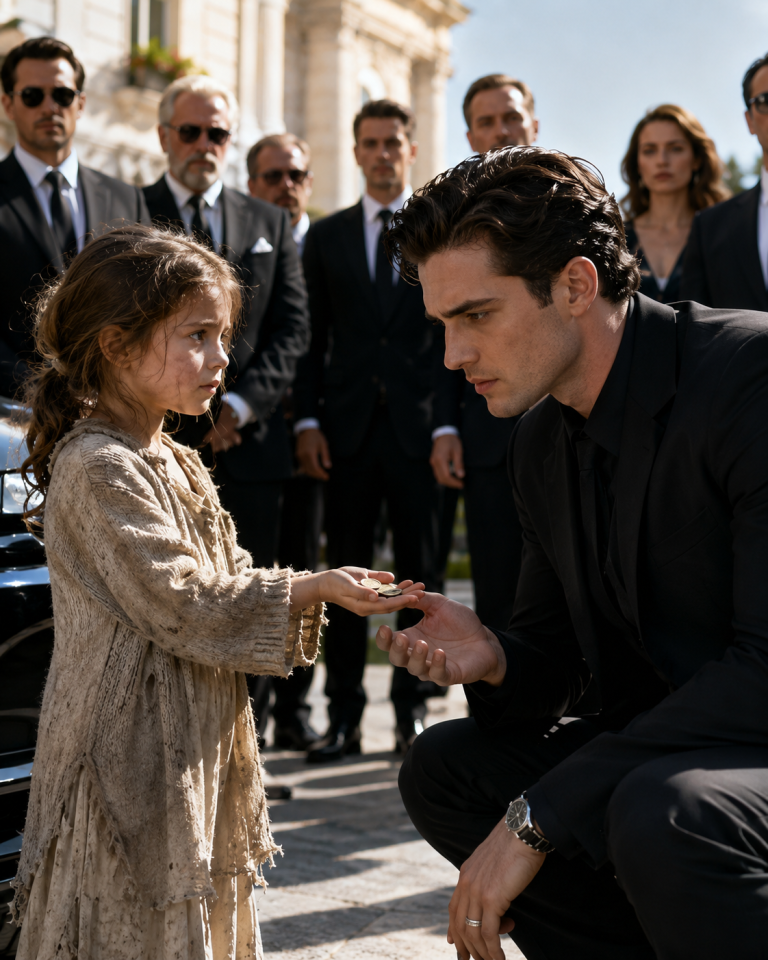
The worst mistake of my life was spending one night with the ruthless mafia billionaire. I vanished with a secret growing inside me — until he found the pregnancy test hidden under my sink… and realized the child he never knew about could destroy his entire empire.

**PART 1**
The warehouse smelled of rust and old water and the specific cold of a place that had given up on being useful.
Lena Voss knelt on the concrete floor with her wrists bound behind her and her knees going numb and her breathing measured in the deliberate way of a woman managing one thing at a time, because managing everything at once was not possible in this room, in this moment, with a gun resting against her temple and the man she hadn’t told pressing his way through the door with blood on his shirt collar.
Between her knees, on the dirty floor, lay a positive pregnancy test.
They had found it in her coat pocket when they searched her. They’d put it there, between them, like evidence of something.
“There he is,” the man with the gun said. He was smiling. He had been smiling since they took her. “Come in, Kieran. We were just discussing what you missed.”
Kieran Voss stood in the doorway with rain behind him and a pistol in his hand and an expression that Lena had never seen on him before. She had seen him cold. She had seen him controlled. She had seen the face he wore in rooms full of men who wanted him dead and wore that wanting openly.
She had never seen him afraid.
His eyes went to the test.
To her.
“Let her go,” he said.
His voice was quiet. The men in the room shifted at that, the way water shifts when something large disturbs it.
The man with the gun laughed. He picked up the test and waved it like a found object, like something amusing. “Your girl was keeping secrets. And you almost missed the whole announcement.”
Lena closed her eyes.
She had imagined telling him a hundred different ways. In daylight. Sitting down. After the appointment with the doctor, after she had the actual number, the actual date, the actual confirmation from someone who was not a drugstore shelf. After she had figured out what she thought about it, and what she was going to do, and whether there was a version of this that didn’t end with her running.
Not like this.
The gun pressed harder.
She thought of the night seven months ago when it had all begun, and how none of it had looked like this from that distance, and how nothing ever does.
—
Lena Voss was thirty-two years old and she had been poor for long enough to stop being surprised by it.
She worked the closing shift at a diner called the Canal Street, which sat beneath the elevated train in the West Loop and smelled of coffee and fryer oil and the particular melancholy of a place that had been given up on slowly. By two in the morning, the customers were cab drivers, nurses getting off the late shift, men who had nowhere specific to be, and occasionally men in very good suits who sat alone in the corner booths and tipped with large bills that made her feel like she’d seen something she wasn’t supposed to.
The night Kieran Voss walked into her alley, Lena had been calculating whether she could push the electric bill one more week without the lights actually going out. Her mother’s cancer treatment had come with a payment plan that described itself as manageable and was not. Lena’s coffee was cold and her feet hurt and the answer to the electric bill question was yes, probably, but only if nothing else happened.
Something else happened.
She heard footsteps behind her in the alley, and then a second man appeared at the alley’s mouth, blocking it, and she understood the shape of the thing before anyone said anything. She had grown up in a city that taught you to read certain shapes.
She didn’t run. Running announced something.
They wanted to know about the upstairs office at the Canal Street. They wanted to know about deliveries, about who came in, about things she’d heard or seen or could plausibly be made to say she’d seen. She understood partway through the asking that the name they kept mentioning — Voss — was the name over the building.
“I don’t know anyone named Voss,” she said.
“Wrong answer.”
The man behind her stepped closer.
“She already did answer.”
The voice came from the far end of the alley, near a black car she hadn’t noticed in the dark. The rain was coming down properly now and the man who stepped into it didn’t have an umbrella and didn’t seem to mind.
He was not the largest man she’d ever seen. He was somehow the most present, which was different. He stood with the complete stillness of someone who had learned a long time ago that stillness was more frightening than movement.
“Mr. Voss,” said the man who’d been blocking the alley.
“You’re in my alley,” the man said, “outside my building, putting hands on someone who works in my kitchen.”
“She’s not yours,” the one behind Lena tried.
He looked at that man.
The courage drained out of the man’s face in real time.
“Apologize to her,” Kieran Voss said.
The apology came fast and badly and then they were gone.
Lena stood in the rain with pepper spray still clenched in her fist and her heart going too fast and said, “You don’t own me because you own the building.”
The man who was supposedly the most dangerous person between Chicago and Cleveland looked at her with something that might have been amusement. “No. I don’t.”
“Good.”
“You’re soaked.”
“Thank you for the update.”
“Let me drive you home.”
“No.”
“The men may come back.”
“Then I’ll scream.”
“They won’t care.”
She hated that he was right. She stood in the alley calculating the risks as the rain ran down her collar, and finally said: “I’m photographing your license plate.”
“Good.”
“And sending it to myself. With the time stamp.”
“Also good.”
“If I get in that car and something happens, there will be a record.”
“Yes,” he said. “There will be.”
She got in the car.
Afterward, she thought about why. She’d told herself it was practical. The rain was real. The risk that the two men were still nearby was real. But she’d also been alone for two years, since her mother got sick and her life had compressed to the shape of hospital rooms and double shifts and bill envelopes, and there was something about a man looking at her with full attention — not the attention of someone assessing a problem, but the attention of someone who had found something interesting in a city that had stopped offering that — that had gotten under her practicality somehow.
He asked questions on the way home that were not small-talk questions.
“How long at the Canal Street?”
“Three years.”
“Night shifts by choice?”
“Seniority.”
“You have medical debt.”
“That’s not a question.”
“No.”
“How do you know that?”
“I didn’t, until you just confirmed it.”
She turned to look at him.
“I’m not a deposition,” she said.
“No,” he agreed. “You’re more interesting than a deposition.”
“People aren’t interesting to men like you. People are useful or they’re not.”
“You were just cornered by two of my enemies in a rain-soaked alley and your first concern was documenting a record of the license plate so that if you disappeared there would be evidence. That’s not useful. That’s interesting.”
She looked out the window.
“My mother died,” she said. “She had lymphoma. Treatment cost more than our insurance was designed to imagine, and she lived eight months longer than they expected, which was wonderful and also meant eight more months of bills. I paid what I could. I borrowed what I couldn’t. She died and the bills didn’t.”
“How much?”
“Forty-seven thousand, not counting what’s accrued.”
“What were you studying before?”
“Social work. I dropped out to take care of her.”
He was quiet for a moment.
When the car stopped outside her building, he held out a card. Heavy stock, embossed.
“I have a proposal,” he said. “Come to this address tomorrow at seven. Hear it.”
“I don’t take proposals from men who have enemies.”
“Everyone has enemies.”
“Most people’s enemies don’t corner waitresses in alleys.”
“That’s fair,” he said. “Come anyway.”
She took the card. She told herself she was taking it to throw it away.
—
The penthouse was on the sixty-second floor and looked out over the river and made the city seem like something that had been organized for viewing rather than surviving. Lena stood in the middle of it in her best interview clothes, which were not quite right for this room, and looked at the man who had taken off his jacket and pushed up his sleeves and looked somehow more dangerous for being less formal.
The proposal was on a contract.
She read it twice before she said anything.
A companion arrangement. Public events. Six months. At the end: her debts cleared, a salary, enough to finish her degree.
The terms were clinical. No intimacy required. Exit clauses. Independent counsel at his expense.
“You had this drafted before last night,” she said.
“I keep it updated.”
“You’ve done this before?”
Something crossed his face. “No.”
“Then why is it updated?”
“Because I’ve considered the need for it before and determined no one suitable until last night.”
She looked back at the contract. “What does suitable mean?”
“Someone who can stand in a room full of my world without becoming part of it. Someone who won’t be manufactured into a bargaining chip by their own ambitions. Someone who’s survived enough to understand what they’re agreeing to.”
“You want someone who can’t be used against you.”
“I want someone who won’t want to use me herself.”
Lena set the contract down.
“If I do this,” she said, “and you hurt me — not physically, but in any of the other ways people like you hurt people — I will find the most inconvenient possible way to make that known.”
He looked at her. “I believe you.”
“Good. Then we understand each other.”
She signed.
—
Within a week, she had paid-in-full notices for every debt with her name on it. She sat on the bathroom floor of her apartment and held the papers and cried until her ribs hurt, and she told herself she was crying about her mother, and she was, but she was also crying about the way relief felt when you’d been carrying something heavy for long enough that putting it down actually hurt.
The role itself was stranger than she expected.
A stylist. A schedule. A car. A phone that Kieran’s assistant Grace handed her with a specific look that said: *this is watched, you understand that, we don’t need to say it out loud.*
At events, she learned that Kieran Voss altered rooms by entering them. Not loudly. Not by announcement. The room’s center of gravity shifted toward wherever he was standing, and people pretended not to notice and reoriented themselves toward him anyway.
She also learned that he was careful with her in a way she hadn’t expected.
He never touched her without making sure she saw his hand move first. He checked before he steered her through crowds. He didn’t claim her publicly in ways that would require her to perform gratitude for the audience.
These were small things.
They were not small.
One night after a political fundraiser, she found him on the balcony alone, looking at the lake in a way that had nothing to do with the view.
“You look like you hate everyone in there,” she said.
“Most of them.”
“Then why host them?”
“Because the alternative is letting them host me.”
She leaned on the railing beside him. The lake was doing that thing it did in autumn, going dark and silver at the same time.
“Why did you build this,” she said, “if it makes you look like that?”
He was quiet for a moment.
“My father owned a repair shop on the South Side,” he said. “He paid protection to men who called it tradition. When he refused to pay more, they came at night with something flammable. He didn’t get out.”
Lena said nothing.
“I was sixteen,” he said. “I understood then that the law arrives after funerals. I decided I would arrive before the next one.”
“So you became the thing.”
“I became the thing those men feared. There’s a difference.”
She thought about it. “Maybe.”
He looked at her. “You don’t agree.”
“I think grief is a very good reason to do almost anything, and also that it’s not the same thing as a good reason.”
Something shifted in his face. Not offense. Something more careful.
“You say things,” he said, “that no one has said to me in a very long time.”
She should have walked inside. Instead, she stayed on the balcony while the lake did its autumn thing below them, and she thought about how danger and loneliness could live in the same person in a way that made them look almost like each other if you weren’t careful.
She was not careful enough.
—
The kiss was in the back of a car, three weeks later, in the rain that Chicago saved specifically for moments that should not be complicated further. His driver pretended very hard to be somewhere else visually.
The first night together was two weeks after that, after a burst pipe drove her out of her apartment and into the guest room of the penthouse “temporarily.” She’d told herself the temporary meant something. Then she’d found herself reading on his couch in one of his shirts, barefoot, and he’d come around the corner and stopped like the sight of her had physically interrupted him.
She lowered the book. “What?”
He didn’t answer right away.
“Say it,” she said.
“You look like you belong here.”
“That’s a very dangerous thing to say.”
“I know.”
“You should be more careful with your dangerous things.”
He crossed the room toward her slowly, the way he did everything — measuring, deliberate, giving her time to make the choice that belonged to her.
She made it.
In the morning, she found his side of the bed empty and a note on his pillow.
*Meeting. Stay if you want. —K*
She stayed.
That was how it went: not announced, not declared, not written into the contract that had started all of this. It simply became the shape of her life in that penthouse, with that man, in a city that continued its complicated business below the sixty-second floor without much interest in what was happening to her.
For a while, she was almost something adjacent to happy.
Then he told her about Eva.
She had asked, finally, after a woman at a gala touched her arm and said, *ask him who he lost*, and Lena had held it for three days before she said, over a very ordinary dinner in his kitchen, “Who was Eva?”
He went very still.
“She was someone I was going to marry,” he said. “Before I became what I am.”
“What happened?”
“She was pregnant.”
Lena’s hands went quiet on the table.
“We hadn’t told anyone,” he said. “Only a few people even knew we were together. Three months in, her car went off the road outside the city. The official story was brake failure. My closest people told me it was a rival crew making a statement.”
“Was it?”
He was quiet for too long.
“I found the man responsible and I handled it,” he said. “That’s all I can tell you.”
She didn’t push.
She should have pushed.
—
Five weeks later, Lena woke before dawn with her body behaving in ways that felt unfamiliar.
She told herself it was stress. She told herself the nausea was the late dinner and the headache was the dry air. She counted days twice on the calendar and sat on the edge of the bathtub for ten minutes thinking about nothing.
The next morning she put on a baseball cap and sunglasses and told the guards she was going to the pharmacy for headache medication. She went to three different pharmacies, one of them in a neighborhood she’d taken the train to specifically, and paid cash for two tests at each.
She took all six.
Five were positive. One was defective and showed nothing, which she decided to attribute to being defective because the math was already very clear.
She sat on the floor of the guest bathroom — Kieran’s bathroom felt too much like a confession booth — and held one of the tests and thought about Eva.
A car. A brake failure. A rival crew.
A pregnant woman and a man who had handled it.
She thought about Kieran saying *people collect weaknesses*. She thought about being seven weeks pregnant in a penthouse that was swept for listening devices weekly. She thought about every reason she had to stay and every reason she had to run and how they were almost exactly equal in weight and completely unequal in urgency.
She put all six tests in tissues, put the tissues in a shoebox, put the shoebox under the guest bathroom sink behind the extra soap, and told herself she would figure it out.
She told herself that for four days.
—
**PART 2**
On the fourth night, she came around the corner of the guest bathroom doorway and found Kieran crouched on the floor with the shoebox open between his feet.
He didn’t hear her at first. He was looking at the tests on the counter, four of them in a row, and his face had no management on it at all.
He heard her in the doorway and looked up.
The penthouse was completely silent.
“How long?” he said.
“Four days.”
He looked back at the counter.
“Since you found out,” he clarified.
“Yes.”
He stood slowly. She had never seen him move slowly before, not like this — the way people move when they’re afraid of what the next step will bring.
“Were you going to run?” he said.
“I don’t know.”
“That’s an answer.”
“It’s the honest one.”
He turned fully to face her, and she saw it — not anger, which she had prepared for, but something worse. The expression of a man looking at a wound he already knew was there.
“Eva,” she said.
His whole body tightened.
“You told me she was pregnant when she died,” Lena said. “You told me only a few people knew. You told me you handled the man responsible.” She held his gaze. “I know what that means and I know what you are, and I thought — if I’m carrying something that makes me the next Eva, then the first thing I do as a mother is put distance between us before anyone else knows I exist in this specific way.”
He said nothing for a long moment.
“And the baby?” he said finally.
“Is already real to me.” She pressed one hand to her stomach, which wasn’t showing anything yet, which was just her hand on ordinary softness. “I know I’ve had four days and you’ve had thirty seconds. But yes. Already.”
He crossed the room.
He didn’t touch her. He stopped a foot away and looked at her face with the specific quality of attention that she had learned, over the past months, was his version of being completely honest.
“I am not going to lose this,” he said.
“You don’t get to decide what you lose.”
“No,” he said. “But I get to decide what I fight for.”
He knelt, not dramatically — just directly, on the bathroom floor, in his expensive suit, so that he was looking up at her rather than down.
“I’m scared,” he said. “Not of what you told me. Of what it means for you if any of my enemies learn it.”
“I know.”
“But I am not sorry.”
She searched his face.
“Not one second of not sorry,” he said. “Whatever this costs, it is not a mistake. *You* are not a mistake. And I am going to need you to believe that even when I can’t make myself say it properly.”
Her eyes filled before she could stop them.
He touched her hand, the first touch, careful and certain.
“Tell me what you need,” he said.
She looked at the tests on the counter.
“I need a doctor,” she said. “Not one of your people. Someone I choose.”
“Yes.”
“And I need you to understand that if something goes wrong — if your world reaches us — I will not wait to be rescued.”
“I know.”
“I mean it.”
“I believe you,” he said. “That’s one of the reasons I’m on this floor.”
—
**PART 3**
They told four people.
The doctor — Dr. Amara Solis, a quiet woman who specialized in high-risk pregnancies and had seen enough powerful men frightened in her examination room to be unimpressed by any of them. Grace, Kieran’s assistant, who had already quietly begun separating the legal operations from the rest with a methodical patience that Lena had not yet understood the purpose of. Kieran’s driver, Marcus, who had been with him for nine years and once sat in a parking lot for four hours rather than drive Kieran to a meeting he’d said felt wrong.
And Daniel Frey.
Daniel was sixty, silver-haired, and had been at Kieran’s side since before Kieran inherited the organization from his father. He brought Lena chamomile tea. He called the pregnancy “a blessing” with wet eyes. He asked careful, gentle questions about how she was feeling and remembered the answers the next time.
She told herself she was imagining the way he looked at her stomach.
She told herself that for three months.
During those months, the world outside tightened. Small things: a dead bird on Marcus’s car hood. A black SUV that took the same route twice behind Lena for six blocks before turning off. A woman at a luncheon who touched Lena’s arm and said, *ask him what happened to Eva*.
She already knew about Eva.
She asked Kieran again, at night, whether he was sure the rival crew story was the truth.
He was quiet for a long time.
“I killed the man I was told was responsible,” he said. “I’ve been less sure, in recent years, that I was told the truth.”
“By who?”
He looked at her.
“Daniel was the one who brought me the information,” he said.
She held that.
“I’m probably wrong,” he said.
“You’re not wrong,” she said. “You’ve never been wrong in this room. You’re just afraid of what being right means.”
He didn’t answer.
They left Chicago the next week. A house in the upper peninsula, private road, three hours from anyone who knew their names. Kieran learned to make eggs tolerably. Lena slept through the night for the first time in months. The baby grew. Dr. Solis drove up every two weeks in a car registered to a name no one would connect to either of them.
One afternoon Lena found Kieran in the nursery with a crib assembly manual in one hand and a pistol on the floor beside him.
“Is the crib armed?”
“The instructions are in three languages and none of them are clear.”
“Maybe the gun is for the instructions.”
“Don’t tempt me.”
She sat on the floor beside him. The baby kicked, which it had taken to doing whenever she sat down, as if it was waiting for stillness to announce something.
“There,” she said, and took his hand and placed it.
He went completely quiet.
She watched his face.
She thought: *this is what it was for, the contract, the alley, the choice to get in the car, all of it.* Not the penthouse. Not the paid bills. This exact moment of a man who had spent his whole life in rooms where feelings were vulnerabilities, going still because something very small had moved inside a person he loved.
For a while, she let herself believe they had escaped.
Then Marcus disappeared.
He’d driven into town for groceries. He didn’t come back. Kieran found his phone on the roadside forty minutes later and a note folded under the car’s windshield wiper.
She read it over his shoulder.
*BRING HER BACK OR WE MAKE SURE YOU HAVE NOTHING TO COME BACK TO.*
Kieran became a different man in the span of three seconds. Not someone she hadn’t seen — someone she’d seen before and had been hoping was retreating into the past.
“Go upstairs,” he said.
“No.”
“Lena.”
“I’m not going upstairs while you make plans I’m not part of. We are in this together or we are not, and if we are not, then you are in it alone and I am leaving because I am not a person to be hidden from the problems she helped create.”
He looked at her.
“You’re going to call Daniel,” she said.
“He’s the most trusted—”
“He’s not,” she said. “You know he’s not. You’ve known for months.”
His jaw tightened.
“You called it grief wearing armor when you told me about your father,” she said. “Daniel built you into the armor. If you become a father yourself, the armor stops working for him.”
He was very still.
“It’s him,” she said. “And Eva.”
He closed his eyes.
She watched that land.
“I know,” he said.
“Then don’t call him.”
“If I don’t, he’ll know we know.”
“He already knows something. He’s already moved.” She stepped close to him. “You spent your whole life being the most dangerous person in the room. I need you to do that now. Without Daniel. Without your old rules. Just the truth about what happened to Eva and what he’s going to do to me.”
He looked at her for a long moment.
Then he picked up the phone and called someone who was not Daniel Frey.
—
They found her anyway.
She didn’t understand until later exactly how — a guard who had reported to Daniel longer than to Kieran, a phone Kieran hadn’t known was compromised. She was in the nursery looking at the half-assembled crib when she heard the floor behind her and turned and found Daniel in the doorway with a gun and Marcus behind him, pale and bleeding from the forehead, held up by two men she’d never seen.
“I’m sorry, sweetheart,” Daniel said.
She wasn’t surprised. That was the thing — she wasn’t surprised, and she thought: *I’ve known for months, I just hoped I was wrong.*
“You did this to Eva,” she said.
His face changed.
“She was going to make him into something soft,” he said. “I kept him useful.”
“She was pregnant,” Lena said.
“Weakness multiplies.”
She backed toward the crib frame. Her hands found it behind her — the half-assembled piece, the metal crossbar, the weight of it. She kept her face still.
“You killed her,” she said. “To keep him yours.”
“I preserved him.”
“You took everything from him and called it protection.” She kept him talking because she was calculating. The angle between her and the door. The position of the two men with Marcus. The distance between Daniel and the crossbar. “And now he’s about to become something you can’t control again.”
Daniel smiled. “That’s why we’re here.”
“To make sure I end like Eva.”
“To give him a choice,” Daniel said. “Give me everything — accounts, contacts, the full operation — and you go somewhere quiet and raise your child without him. Or he refuses, and neither of you goes anywhere.”
Lena looked at Marcus.
Marcus, despite the blood on his temple and the men on either side of him, was looking at her. He lifted his eyes very slightly toward the door, then down at his right hand, where she could just see his fingers: two tapped together. Twice.
She understood. *Two minutes.*
“He won’t give you anything,” she said. “Because he already gave it to someone else.”
Daniel tilted his head.
“Grace,” she said. “She’s been working with federal investigators for four months. That’s what all those late nights in the legal offices were. She wasn’t protecting his assets. She was documenting them.”
She didn’t know if this was true.
She said it like she knew.
She needed thirty more seconds.
“You’re lying,” Daniel said.
“He told you he was going to give everything up to be with me. You thought he meant walking away. He meant something else.” She looked at Daniel directly. “He meant giving it to people who would use it to take down the men who burned his father’s shop. The men you told him were rivals but were actually yours.”
Something shifted in Daniel’s expression.
“That’s not—”
“You set up his father’s death,” she said. “Because his father was going to talk to investigators about protection payments. You made sure Kieran thought it was a rival crew. You gave him something to fight so he’d stop looking at the people already in the room.”
She was making parts of this up.
But the parts she was making up were landing true.
The front door of the house came apart.
Not loudly — that was the thing she hadn’t expected. She’d expected loud. Instead, there was a controlled sound, a series of voices overlapping, and then men in tactical vests were through the nursery door and Daniel was facing a different calculus than the one he’d been running three seconds ago.
He turned toward her.
She swung the crossbar.
—
Afterward, in the ambulance, Kieran sat beside her with one hand over hers and his other hand pressed to his ribs where Daniel, going down, had managed to land something sharp. The EMT told him twice that he needed to hold still. He held still only when Lena put her other hand over his.
“The baby?” he said.
“They checked. She’s fine.”
He exhaled.
“She?” he said.
“That’s what I’ve been calling her,” Lena said. “In my head. I don’t actually know.”
“She’s okay.”
“She’s okay.”
He was quiet for a moment. “Daniel.”
“Alive,” she said. “Arrested.”
“Eva.”
She looked at him. His eyes were closed.
“We’ll know more when they finish going through his records,” she said carefully. “But I think you’ll find what you’ve been afraid to look for.”
He nodded, once, slowly.
“I knew,” he said. “Some part of me always—”
“I know,” she said. “That’s not the same as deserving what he did.”
He turned his head to look at her.
“You’re not afraid,” he said. It sounded like an observation rather than a question.
“I was terrified for the past four hours,” she said.
“And now?”
“Now you’re in an ambulance being told to hold still, and I’m here holding your hand, and the baby is fine.” She looked at him. “That’s enough for right now.”
—
Their daughter was born in February.
Kieran was in the delivery room because his testimony schedule had been rearranged by a prosecutor who had apparently decided that the cooperation of a man who had handed over the entirety of his criminal empire’s documentation in exchange for reduced charges was worth some logistical accommodation.
The baby came into the world making her opinion of the whole situation very clear.
She had Kieran’s dark eyes and Lena’s tendency to furrow her brow at problems.
He held her for twenty minutes without speaking. Then he said, very quietly, to the baby: “I’m going to spend the rest of your life becoming someone you can be honest with about all of it.”
Lena, exhausted and crying, said: “That’s an excellent goal. Also, she needs to eat, so.”
He laughed. The baby startled at the sound and then seemed to decide it was acceptable.
They named her Eva June Voss.
Because the first Eva deserved to be remembered as more than a thing that had been done to her.
—
Kieran served fourteen months.
Not because the prosecution was lenient — it wasn’t. But because the documentation Grace had compiled, with months of quiet work and a federal investigator she’d cultivated over two years without telling anyone except her own conscience, had implicated men far more dangerous and far less cooperative than Kieran. The calculus worked out in a specific direction. He cooperated fully. He testified. He said the names.
Some of those names had been in his organization for decades.
Some of them had been building toward Daniel Frey for years.
Lena finished her degree while he was away. She and the baby lived in a rented house outside Milwaukee that smelled like old wood and the neighbor’s cooking and the specific cleanness of a life that was hers. Marcus came twice a month to help with things that were too heavy or too high, and stayed for dinner each time because Eva had decided he was specifically her person and communicated this by sitting on his feet.
Grace converted several former Voss properties into legal community organizations with funding that Kieran had signed away before his sentencing, in writing, in front of witnesses, with no contingency that would allow him to reclaim it. He had insisted on that. No contingency. No option to take it back.
Lena had watched him sign it and understood, for the first time fully, what it meant when someone set down the thing they thought they were.
—
He came home on a Thursday morning in March.
Old truck. Jeans. A coat she’d seen him wear exactly once, years ago, at the lake house, when he’d stopped trying to look like the man people expected.
She was on the porch with Eva on her hip.
He stopped at the bottom of the steps.
Eva looked at him.
He looked at Eva.
Eva looked at Lena.
“Yes,” Lena said to her daughter. “I know.”
Eva reached for him.
He took the three steps and held out his hands and she leaned into him, the specific full-body lean of a small person who has decided something and is acting on it, and he held her with the same expression she’d seen on his face in the nursery a year and a half ago, when a movement under her hand had made him go completely still.
“Hi,” he said. His voice came out thinner than she’d heard it.
Eva patted his face.
“She does that when she’s assessing,” Lena said.
“What does she assess for?”
“She knows what she’s looking for,” Lena said. “Ask her.”
Eva patted his face again. Then she put her head against his chest.
Kieran looked up at Lena.
She let him have a moment with it. He needed it.
“I don’t know how to do this,” he said.
“This specifically, or—”
“Any of it. The ordinary version of any of it.”
She came down the steps and stood in front of him. “We’re not ordinary. You built an empire. I inherited fifty thousand in debt. We met in an alley. Our daughter is named after someone who died because a man who called himself loyal murdered her.” She touched his face. “We’re not starting from ordinary. We’re starting from true.”
He closed his eyes.
“True is harder,” he said.
“Yes.”
“I’m better at power.”
“I know. But power is what you learned because no one showed you what else you had.” She looked at him. “You’re also good at paying attention to what’s actually in front of you, once you decide to look at it.”
He opened his eyes.
Eva patted his face a third time, apparently satisfied with her findings, and pointed at the house with the authority of a person who has places to be.
Lena almost laughed.
He did laugh. She felt it through his chest.
“She wants inside,” Lena said.
“I gathered.”
“She’s been trying to get those porch boards up for three days. You can be useful about that.”
“I can probably fix porch boards.”
“The first one’s been loose since October.”
“I’ll look at it.”
“Tomorrow,” Lena said. “Today just come inside.”
He came inside.
—
That night, after Eva was down and the house was quiet, Lena was at the table with lesson plans when she heard him in the kitchen. She watched him through the open doorway. He was washing the baby’s bottles with the focused concentration of a man who had run a criminal empire and was now learning to manage the angles of a narrow sink.
He looked up and found her watching.
“What?” he said.
“Nothing.”
“Tell me.”
“I’m thinking about the pregnancy test,” she said. “The one I hid under the sink.”
He was quiet.
“I was so sure it would break everything,” she said. “I thought hiding it was protecting us.”
He dried his hands and came to sit across from her.
“It did break something,” he said.
She looked at him.
“It broke the version of me that was going to raise Eva the same way Daniel raised me,” he said. “It broke the thing that had been making excuses for seventeen years about what my world was and what I owed it.”
“That’s generous.”
“It’s accurate.” He looked at his hands. “A plastic stick in a shoebox was the most disruptive thing anyone has ever put in my house.”
She laughed.
“I’m serious,” he said. “Federal investigators were less destabilizing.”
“To be fair, I was also afraid the federal investigators would find the tests.”
He looked at her.
“In my defense,” she said, “I had a lot of concerns that week.”
He shook his head. Then he reached across the table.
She put her hand in his.
Outside, the March wind was doing something seasonal against the windows. Inside, the baby monitor was making the small sounds of a sleeping child. The lesson plans on the table needed two more hours of work. The loose porch board needed attention in the morning. The ordinary weight of an ordinary life moved through the rooms of the rented house and didn’t feel ordinary at all.
It felt like something that had been paid for.
That didn’t make it a burden. It made it real.
“Ask me if it was worth it,” he said.
“I don’t need to.”
“Ask anyway.”
“Was it worth it?” she said.
He looked at her, then at the monitor, then back at her.
“I lost an empire,” he said. “I lost the name I spent twenty years building. I lost the fear people gave me, which I used to think was respect.” He held her hand. “I gained a woman who hid the most important thing that ever happened to me under the bathroom sink because she was afraid, which was also the most honest thing anyone has ever done in my presence. And a daughter who assessed me for forty seconds and then put her head on my chest.”
“That’s a long answer,” she said.
“You asked.”
She smiled.
“Yes,” he said. “Worth it. Every single day of it.”
She believed him.
Not because she had no doubt — she had specific, calibrated doubts, the kind that came from knowing exactly who he’d been and having no illusions about how long becoming something else would take. She believed him because she had watched him hand over an empire with no contingency clause, and because the first thing he’d done in fourteen months of absence was record bedtime stories on a phone Grace mailed to her, and because he had come home in an old truck and stopped at the bottom of three porch steps and waited for a fourteen-month-old to make her assessment.
Men who were still the dangerous thing didn’t wait at the bottom of steps.
They were still building the rest of it. That was honest.
But they were building it. That was enough.
Outside, March continued its business. The house settled into the night sounds of a house that was occupied and warm.
And on the kitchen table, beside the lesson plans, beside the baby monitor, beside the hand of the man who was learning what she’d always known about strength — that carrying weight and throwing it at people were two completely different things — her father’s coffee mug sat with a pen in it, and the pen was hers, and the plans were hers, and the life was theirs.
That was enough.
More than enough.
It was, in fact, everything.