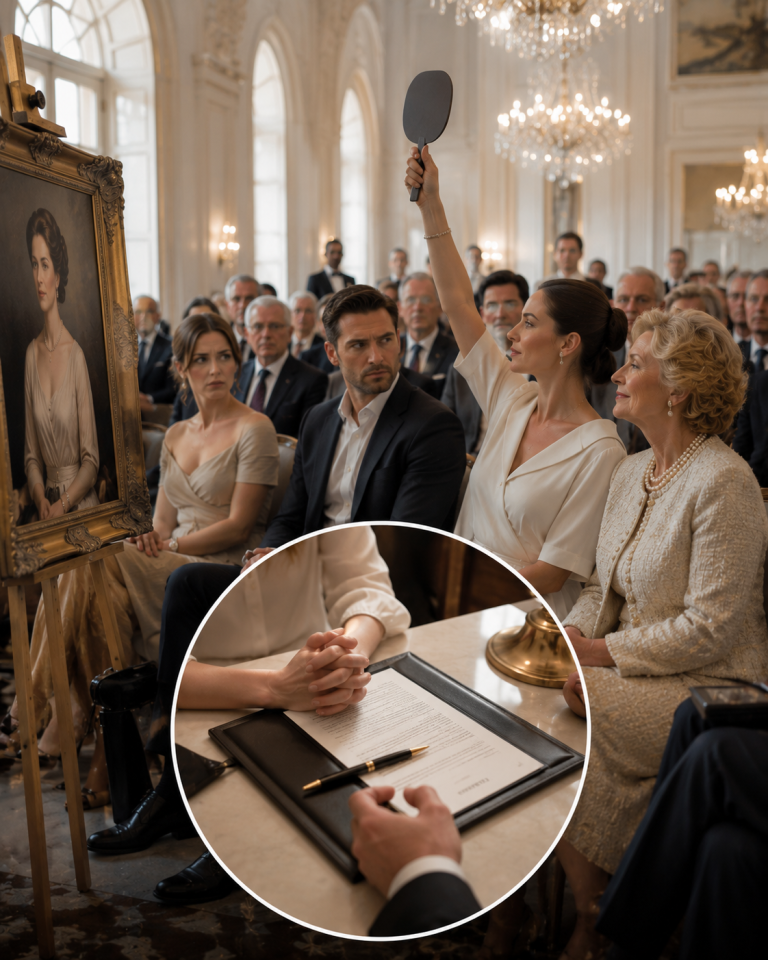
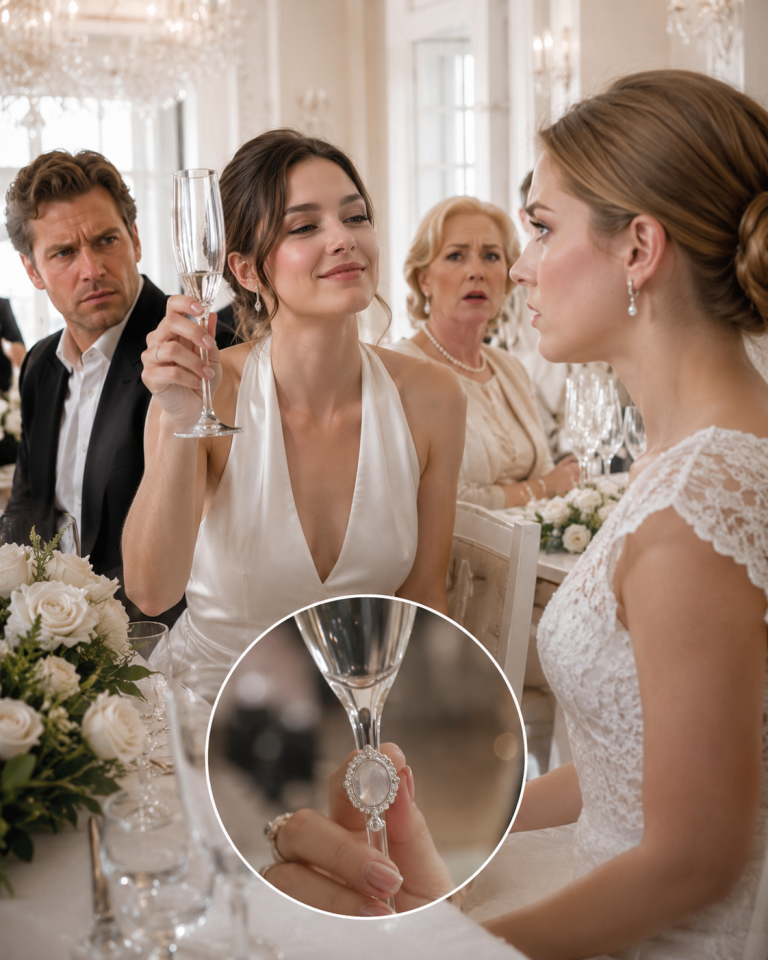
At the worst moment of his wedding, the mafia boss discovered the bride’s betrayal—because a trembling florist found a hidden note in the bouquet… and what he did next silenced the entire church.

**PART 1**
The bride was laughing.
Not the soft, nervous laughter of a woman three days from her wedding. The kind that comes when cruelty relaxes in a room it believes is empty. Clara Reed pressed herself against the garden wall with a tray of ranunculus stems going warm in her hands and understood, with the particular clarity of someone who has been overlooked their entire life, that she was about to hear something she could not unhear.
“He actually believes it,” the bride said.
Laughter from a second voice.
“Men like that always do.”
Clara did not move.
Behind the hedge wall of the Voss estate, two women stood in the private pergola, unaware that the florist adjusting the climbing roses on the other side of the stone partition had gone completely still.
“Three more days,” the bride said. “Then the accounts open and we disappear.”
Clara’s grip tightened on the stems.
A thorn she hadn’t noticed pressed into her palm.
She did not flinch.
—
Six weeks earlier, Clara Reed had been sitting in her flower shop trying to calculate which invoice to ignore long enough to survive the month.
The shop was called Petal & Thread, which she had always found slightly embarrassing as a name, though her aunt had chosen it and her aunt had left her the lease and the pruning shears and the belief that flowers were the most honest language humans had ever borrowed from the world. The sign above the door was hand-painted. The floor near the back cooler had developed a lean. The refrigeration unit made a sound on Tuesdays that Clara had named Gerald and tried not to think about too hard.
It was hers.
That had always mattered more than the lean or Gerald or the invoices.
She had inherited more than the space. She had inherited the philosophy. Her aunt believed flowers carried what words were too frightened to. Peonies for grief softened by time. White tulips for honesty that arrives too late. Ranunculus for the love that is quiet and consistent and doesn’t announce itself at parties. Clara had grown up learning this language the way other children learned piano — imperfectly, then fluently, then with the kind of instinct that makes the technical invisible.
She was twenty-eight and exhausted and good at her work and slowly running out of room to be both.
When the phone rang that Tuesday and a woman named Irina introduced herself as the event director for the Voss family, Clara assumed she’d misheard.
Nikolai Voss.
The name moved through certain New York rooms the way weather moves through old buildings — felt before it arrived, present in everything, impossible to argue with. To the financial press, he was a shipping and logistics billionaire with controlling interests in three port authorities and a philanthropic record that had earned him a university building and two hospital wings. To the people who spoke quietly in particular restaurants, he was also the functioning center of the Voss network, a structure so embedded in the city’s infrastructure that dismantling it would mean rebuilding half the waterfront from scratch.
“Your portfolio was reviewed,” Irina said. “Mr. Voss is interested in your aesthetic for the ceremony installation.”
Clara looked at Gerald, who chose that moment to make his sound.
“I’m sorry,” she said. “Nikolai Voss?”
“Yes.”
She took the meeting.
She spent four days preparing for it. Sourced samples she couldn’t afford to keep if the contract fell through. Designed three concept boards on her kitchen table at midnight. Ironed her black dress twice, though it still had the slight pull across the shoulder that made her tug at it when she thought people were looking, which they always were, because she was the kind of woman who had been taught since adolescence that her body was a problem requiring management.
“You have such a pretty face” was a sentence that had followed her through twenty-eight years like a particularly persistent dog.
She had learned to smile at it.
She had learned to dress carefully. Dark colors. Strategic layers. The particular art of making yourself appear comfortable in rooms that were designed to remind you that you weren’t.
Voss Tower had been designed for exactly that.
Clara set up her samples in a conference room that overlooked the East River and tried to pretend her hands weren’t shaking. Ivory garden roses. Cascading sweet peas. Silvery eucalyptus. A centerpiece built around the idea of a held breath — lush but restrained, romantic but unsentimental, with one deliberate thread of something slightly wild in the composition.
Nikolai entered seven minutes late with three men behind him and the quality of attention that made everyone else in the room stop performing and start existing.
He was tall, dark-suited, with a face built from controlled planes and the kind of stillness that reads as danger until it reads as precision. He didn’t scan the room. He read it.
He didn’t look at Clara’s proposal folders.
He looked at the flowers.
“Who designed the centerpiece?”
“I did.” Her voice was steadier than she expected.
His gaze moved to her.
Clara felt the full weight of what she always tried to avoid in rooms like this: the awareness of how she looked versus how the room was designed to make her feel. The soft line of her jaw. The way the pull at her shoulder suddenly felt enormous. The specific torture of being looked at by someone whose attention costs something.
Then Nikolai Voss said, “Everyone else in this category brought me theater. This is different.”
He looked back at the arrangement.
“What is it?”
Clara found her voice. “A breath before dawn. The moment before something happens when you’re not sure yet whether it will be wonderful or terrible.”
He was quiet for five seconds.
“Yes,” he said. “That.”
She got the contract.
She went home and cried briefly into a bunch of dying stock flowers she’d been meaning to compost, and then she got to work.
For six weeks, Petal & Thread became a machine. Clara hired two assistants. Ordered flowers she had previously only looked at in catalogs. Ranunculus from Japan. Sweet peas from California. Roses from Colombia, flown with cold monitors attached. She created thirty-seven arrangement diagrams. Color-coded the installation schedule. Slept four hours on the nights when she slept at all.
She also watched.
Florists learn to watch because nobody watches them back. They crouch near aisles adjusting centerpieces while families rehearse grief and joy and resentment in the same room. They stand beside walls while bridesmaids say things to each other that they’d never say to faces. They become expert in the texture of rooms — what a glance costs, what a silence carries, what a smile is covering.
The bride’s name was Sasha Lund.
She was blond, precise, and extraordinarily beautiful in the way of women who have spent serious time with the project of themselves. Tall. Controlled. The kind of posture that suggests the world around her has always been arranged to match.
Clara tried not to judge her.
Brides were difficult by nature. Rich brides were more so. Sasha changed her mind about the floral palette four times and the ceremony height three times and asked twice whether Clara had “considered the sight lines from the social media positions,” which was a sentence Clara had to process twice before answering.
She handled it.
She had handled worse.
But something was wrong.
Clara recognized it the way you recognize a smell before you identify the source. Sasha Lund was not nervous beneath the demands. She was not emotional. Not sentimental. She approached the wedding with the flat affect of someone managing a transaction. She never touched the flowers. Never asked what anything meant. Never looked at the ceremony site with the particular softness that even the most demanding brides usually showed at some point.
But when Nikolai appeared, she transformed.
Her posture warmed. Her smile became something that looked like tenderness. She moved toward him as if compelled. She said the right things at the right moments and made them sound unrehearsed.
And Nikolai believed her.
Clara wished she hadn’t noticed that part.
Three days before the wedding, Clara arrived at dawn to supervise the installation of the main ceremony arch. The Voss estate smelled of river water and cut grass and the faint mechanical scent of dozens of vehicles moving through the gates. Staff crossed the lawn with the coordinated urgency of people who know exactly how much everything costs.
Clara stood before the completed arch and let herself have one minute of pride.
She had built this.
From the calendar on the kitchen table, from the four-hour nights, from the cold-monitor roses and the Japanese ranunculus and the careful, obsessive love of the work.
Then she picked up a tray of ranunculus stems to add to the secondary pergola arrangement, walked through the garden, rounded the hedge wall, and heard the bride’s laughter.
“He actually believes it.”
Clara stood very still.
“Men like that always do.”
She should have left.
Her feet didn’t move.
Sasha’s voice continued, unhurried. Relaxed in the way people relax when they believe themselves completely alone.
“The timing is everything. After the ceremony, the trust instruments activate. From there it’s forty-eight hours before the transfers complete.”
Clara’s throat closed.
“And him?” the friend asked.
A pause.
“He’ll be managing the public damage,” Sasha said. “We’ll be somewhere without extradition.”
The laughter again.
Easy.
Empty.
Clara backed away from the hedge on feet that felt disconnected from her body.
The tray of ranunculus tilted.
She steadied it.
She walked back to the main installation tent, set the tray down on a folding table, and stood among thousands of flowers she had spent six weeks building for a wedding that had never been what it appeared.
The day continued around her like weather.
Deliveries. Adjustments. Celeste the coordinator asking about the boutonnière timeline. Assistants refreshing water tubes. The particular organized chaos of a major event grinding forward.
Clara worked through it.
She smiled at the right moments.
She answered questions.
She pretended her hands weren’t cold.
That evening, Nikolai found her near the entrance columns, adjusting a cluster of sweet peas that didn’t need adjusting.
He had come from a meeting — she could tell from the particular contained energy of someone who has just finished performing control for other people and briefly let it rest.
He stopped beside her.
“These are better than I expected,” he said.
“You had high expectations.”
“I had high standards. Those aren’t the same thing.”
Clara turned to look at him, which was a mistake because at close distance she could see that he was tired in a way that the controlled expression almost hid.
“You look like you haven’t slept,” she said before she could stop herself.
“Florists notice things.”
“It’s an occupational hazard.”
He almost smiled.
“What else do you notice?”
The question landed wrong.
Or right.
Clara looked at the sweet peas.
“That most people who want beautiful things don’t understand what goes into them.”
“And?”
“And you were the exception.” She paused. “You looked at the flowers first. Before the proposal. Before the budget. You looked at the flowers the way someone looks at something they actually want to understand.”
Nikolai was quiet for a moment.
“My mother grew them,” he said finally. “Roses, mostly. She said they forgave you for neglect as long as you came back.”
Clara’s chest tightened.
She nearly told him then.
The truth was right there, sitting behind her teeth, pressing forward with the particular urgency of something that has waited too long.
Then one of his men appeared at the edge of the lawn.
“Mr. Voss. The attorneys are ready.”
Nikolai straightened.
Looked at Clara one more moment.
“Thank you. For the work. It’s remarkable.”
He left.
Clara stood alone under the sweet peas and understood that she had run out of time to convince herself this wasn’t her problem.
—
**PART 2**
She did not sleep.
Four hours in the dark, then her eyes open, the ceiling gray above her, Sasha Lund’s laughter playing on a loop she couldn’t switch off. *Forty-eight hours. Somewhere without extradition.* Clara stared at the crack in her ceiling plaster and tried to locate the precise place where silence stopped being neutral and became complicit.
She had found it by two in the morning.
By three, she had a plan.
By five, she was back at the estate.
Wedding day was controlled chaos given a dress code. Luxury cars collecting in the drive. Celeste managing seventeen things simultaneously and looking dangerously calm. Chefs, sound crews, florists, security — all moving through each other like schools of expensive fish. The ceremony was six hours away. Then four. Then three.
Nikolai was never alone.
Clara tried twice. Blocked both times by the particular wall of dark-suited men whose job was to ensure their principal didn’t have unscheduled conversations with wedding vendors carrying bad news.
At eleven, she made a wrong turn looking for the supply closet.
Found the right hallway instead.
Sasha’s voice, sharp this time, from behind a half-open door.
“If security pulls those accounts tonight, everything collapses. Tell them nothing has changed.”
Clara pressed against the wall.
A man’s voice — not Nikolai, someone she didn’t recognize — answered: “The timing window is tight.”
“It was always tight,” Sasha said. “That’s why we needed two years.”
Two years.
Clara closed her eyes.
Two years of patience. Two years of performance. A relationship built from scratch as a delivery mechanism for financial access.
She needed proof.
The opportunity arrived accidentally, in the form of a coordinator handing her a decorative memory box for the bridal suite.
“Just leave it on the console table,” the coordinator said, already moving away. “I need to be three places at once.”
Clara carried the box down the hall.
The bridal suite was empty.
She put the box on the console table.
She turned to leave.
The laptop on the vanity desk was open.
She stopped.
Walked toward it.
Financial documents. Shell company structures. A transfer schedule laid out in columns with timestamps and account numbers and a folder at the bottom of the screen labeled simply: *After.*
Clara pulled out her phone.
Photographed everything.
Screen-recorded the folder contents.
Got close-ups of the timestamps, the account names, the draft communications prepared for release.
Footsteps in the hallway.
She stepped into the narrow closet behind the garment rack.
Held her breath.
Sasha entered. Moved to the vanity. Paused.
“Did someone move my things?”
The friend’s voice from behind her: “Probably staff.”
“Find out who came in here.”
Clara was already moving through the service door at the back of the closet, down the corridor, out through the side kitchen, across the east lawn, and into the florist supply tent where her phone, now burning in her hand, contained enough to either save Nikolai Voss or destroy what was left of her life.
She was still shaking when she heard his voice.
“Miss Reed.”
She turned.
Not security.
Nikolai himself.
Standing at the tent entrance in his wedding suit, alone for the first time all day, with an expression that said he had been looking for her specifically.
—
**PART 3**
He already knew something was wrong.
That was the first thing Clara understood when she saw his face. Not everything. Not the shape of it. But the way he looked at her had the quality of a man arriving at a conversation he’s been circling for two days, waiting for someone else to start it.
“There have been irregularities,” he said. “My security chief flagged financial movement last night that should not have been possible before the ceremony.”
Clara felt the phone in her hand like a live thing.
She held it out.
“I have more.”
He took the phone.
She watched him look at photographs she had taken of his bride’s financial plans while hiding in a closet on his wedding day. She watched his face do what controlled faces do when something hits the layer beneath the control — nothing dramatic, nothing telegraphed. A stillness that was different from his ordinary stillness. The kind that means the person has stopped performing and started actually feeling.
He handed the phone to the man who appeared at his shoulder — a compact, silver-haired man named Dario, who looked at the screen, looked at Nikolai, and left without being asked.
Nikolai turned to Clara.
“Tell me what you heard.”
She told him everything. The pergola conversation. The hallway. The laptop. The timestamps. The folder called *After.* She told him without softening it, without the careful qualifications she had rehearsed at four in the morning. She told him the way you tell someone a truth that will hurt them: directly, quickly, without making them watch you work up to it.
Nikolai listened the same way he had listened to her talk about the flowers.
Completely.
When she finished, the silence was short.
“The wedding continues,” he said.
Clara stared.
“I’m sorry?”
“If I cancel now, she lawyers up within the hour and the financial trail gets cleaned before federal authorization clears.” He was already thinking past the conversation, the way people think when the decision is made and the execution is the only thing left. “But if we let the ceremony proceed—”
“She walks into it herself.” Clara understood. “In front of two hundred witnesses.”
“The reception screens are already set for the video montage.”
Clara thought of the screens. The massive projection panels running along three walls of the reception tent, currently loaded with a curated slideshow of engagement photographs.
“You’re going to put the documents on the screens.”
“At the point when she would have released her version,” Nikolai said.
Clara looked at her hands.
“She’ll blame me. When it falls apart, she’ll point at whoever she can find.”
“Yes.”
“You’re telling me that, not warning me away.”
“I’m telling you so you can leave if you want to.” He met her eyes. “You’ve already done more than anyone could have asked.”
Clara looked through the tent flap at the estate grounds. The white chairs in their perfect rows. The arch she had built over six weeks of four-hour nights. Sweet peas and garden roses and the ranunculus she’d had to order twice because the first shipment came in the wrong shade of blush.
She thought about what it meant to spend six weeks building something beautiful for a purpose that was rotten at the core.
She thought about Nikolai standing in the conference room looking at the centerpiece before he looked at anything else.
“I’ll stay,” she said.
Something in his expression shifted.
Not gratitude exactly. Something quieter and more specific.
“Stay near Dario,” he said. “If anyone approaches you—”
“I know.”
“You don’t, actually. My world is not safe when it moves.”
“I noticed that two days ago and I’m still here.”
He looked at her for a moment.
Then he straightened his jacket and walked back toward the house.
The ceremony began at three o’clock under a sky so perfectly clear it seemed complicit.
Guests settled into white chairs. Violins. Champagne passed on silver trays. The Hudson glittered beyond the estate perimeter. Everything Nikolai Voss touched looked expensive even when it was natural, even when it was light, even when it was wind moving through flowers that a woman from Brooklyn had grown and cut and wired and arranged into something that deserved better than this day.
Clara stood at the back of the aisle beside a column of garden roses, hands clasped, watching.
Sasha came down the aisle in a gown that belonged in a museum. Architectural. Precise. White silk trained behind her, blond hair swept into something that took a professional three hours to make appear effortless. She smiled at the guests the way women smile when they know they’re the most beautiful thing in the room and have decided this is their most important attribute.
She reached Nikolai at the altar.
Placed her hand in his with practiced tenderness.
Clara felt sick.
The officiant spoke. Sacred language about union and fidelity and the choice to build a life beside another person. Sasha said her vows beautifully. Her voice caught at exactly the right syllable. Several guests pressed hands to their mouths.
Then Nikolai spoke.
He talked about trust as a decision, not a feeling. About loyalty as something you demonstrate in small moments before you’re ever asked to demonstrate it in large ones. About the difference between a person and the performance of a person, and how it sometimes takes a catastrophe to see which one you’ve been standing next to.
Sasha’s smile flickered. Just once. Just for a moment.
The officiant reached the final question.
The polite pause opened.
Nikolai said: “I object.”
The estate went quiet in a way that made the river sound loud.
Sasha turned toward him with an expression that hadn’t decided yet what it was.
“What are you doing?”
Nikolai looked past her at Dario, who stood near the reception tent entrance with a tablet and an expression that suggested this was the part he’d been waiting for.
The screens came on.
First the gasps were confused — guests expecting the engagement slideshow getting documents instead. Then the confusion resolved into understanding as people began to read. Financial transfer schedules. Shell company diagrams. Emails between Sasha and her co-conspirators. A timeline labeled *Post-Ceremony*, in Sasha’s own formatting, describing exactly what was supposed to happen in the forty-eight hours after the wedding.
The guest section began to rearrange itself the way crowds do when shock arrives — leaning forward, then back, then toward the person beside them, then toward the exit.
Sasha’s face was white beneath the perfect makeup.
“This is fabricated.”
“The timestamps predate this morning by eleven months,” Nikolai said. “The server records will confirm.”
Her friend Petra stood from the third row, looking for an exit. Security was already positioned at every gap.
Then Sasha turned.
Her eyes moved through the crowd with the speed of someone looking for a target.
Found Clara at the back of the aisle.
The finger came out.
“Her. The florist. She broke into my suite and stole documents and fabricated—”
The crowd turned.
Two hundred faces.
Clara felt the attention the way you feel a change in air pressure. Her body responded before her mind caught up: the pull at her shoulder, the awareness of her own edges, the familiar impulse to make herself smaller in a room that was now enormous and entirely focused on her.
Then Nikolai stepped off the altar.
He walked the full length of the aisle — past every guest, past the white chairs and the river light and the roses — and stopped in front of Clara. He turned so that his body was between her and the crowd.
“She told me the truth,” he said.
His voice carried through the ceremony space without effort.
“While everyone in this room was watching a performance, she brought me evidence at personal risk to herself. She had every reason to stay silent and one reason not to.” He paused. “The right one.”
Sasha’s voice rose. “She is nobody. A vendor. She broke into—”
“She didn’t break anything,” Dario said from the side. “The suite key log shows a seven-second entry during a scheduled delivery window. Every touch point captured.” He glanced at Clara. “You left the tray aligned with the console edge. Very neat.”
Clara hadn’t realized she’d done that.
Old habit.
Nikolai looked at her and for a moment the ceremony, the crowd, the financial plot, and the logistics of its unraveling all receded, and it was just him looking at her the way he’d looked at the centerpiece in the conference room.
Like something real had interrupted the performance.
“Thank you,” he said quietly.
Clara swallowed. “I just heard something I couldn’t unhear.”
“Most people would have found a way.”
She had nothing to answer that with.
Federal agents entered through the estate gate, which Clara noted with surreal calm had been left open when every other entrance remained secured. They moved with the practiced ease of people who had been briefed and positioned before the ceremony started.
Sasha was escorted off the altar grounds while the guests watched in the specific stunned silence of people who attended a wedding and are now reconsidering the entire category of large public events.
Petra was intercepted at the east fence.
Two of Sasha’s financial contacts — men Clara had seen hovering near the estate office for three days, whom she’d assumed were family — were walked off the property by men who made no noise.
By the time the estate was contained, it was four-thirty and the sun was dropping toward the Hudson.
Clara sat on the stone steps of the main garden with a bottle of water Dario had handed her without comment and tried to locate some feeling that made sense. She felt wrung out in a way that went past tired. Her hands had stopped shaking. The flowers were still standing, all of them, unmoved by any of it.
That still felt unfair.
Nikolai found her there twenty minutes later.
He had removed his jacket. His wedding suit in the late afternoon light looked wrong in a different way now — not false, just misapplied, like formal wear worn to the wrong kind of ceremony.
He sat on the step beside her.
Neither of them said anything for a moment.
“She spent two years,” Clara said finally.
“Yes.”
“Building something from nothing.”
“Not nothing. She was very skilled.”
Clara looked at him. “Does that make it worse?”
He thought about it. “It makes it more interesting to grieve. You don’t mourn the real person. You mourn the one you understood her to be. And you’re aware, while mourning, that the one you’re mourning never existed.” He was quiet. “It’s a peculiar loss.”
Clara looked at the river.
“I’m sorry.”
“Don’t be.”
“I am anyway.”
He turned to look at her.
“You found out on your third day here.”
“Second, technically. But I convinced myself I’d misunderstood.”
“How long before you stopped convincing yourself?”
Clara thought of the second conversation. The open laptop. The folder called *After.* “Two days. I’m not fast.”
“You’re honest,” Nikolai said. “That’s rarer.”
She didn’t know what to do with that.
She looked at her hands.
“I need to go home.”
“I’ll have someone drive you.”
“I have my van.”
He looked at her. “The one with the hand-painted sign?”
“You researched my business.”
“I research vendors.”
“All of them, or just the ones who—”
“Just you.”
The admission landed without drama.
Clara felt it anyway.
She stood up.
Nikolai stood too.
“Dinner,” he said. “When you’re ready.”
“You almost got married today.”
“I didn’t.”
“That’s not my point.”
“I know.” He paused. “My point is that the person who showed me the truth is someone I would like to know better. The timing is unfortunate. I’m asking anyway.”
Clara looked at the arch she had built.
The sweet peas had begun to soften in the afternoon warmth, just slightly, the first stage of a beautiful wilt.
“I’ll think about it,” she said.
Nikolai nodded.
“That’s honest.”
She walked to the florist van.
Sat in the driver’s seat.
Pressed her forehead against the steering wheel for thirty seconds.
Then drove home through the New York evening with her hands steady and her chest full of something she didn’t have a flower for yet.
—
Six weeks later, Nikolai came to Petal & Thread on a Tuesday evening.
No car. No Dario. Just him in a coat that cost what Clara made in four months and a reservation at a restaurant two blocks away where the owner, Marco, would later claim he hadn’t panicked when Nikolai Voss walked in.
Marco had panicked.
Clara had been warned.
The first ten minutes of dinner were stilted in the way of two people who have met under significant pressure and are now attempting to locate the version of each other that exists outside of crisis.
Then Nikolai asked what flowers she couldn’t stand.
“Baby’s breath,” Clara said.
He looked surprised. “Why?”
“It’s always a filler. Nobody chooses it for itself. It only exists to make other things look better.”
“That’s a harsh reading.”
“It’s an honest one.”
Nikolai considered this. “I have the same problem with ornamental kale.”
Clara stared at him.
“Ornamental kale?”
“It is trying,” he said, “very hard, to be taken seriously.”
She laughed before she could control it.
He watched it happen with the expression she’d started to recognize — the one that meant something had made it through the layer of control and he wasn’t entirely unhappy about it.
They talked for three hours.
He told her things she hadn’t expected: that he’d grown up working in his grandfather’s shipping office before he’d grown up working anywhere else, that he’d developed his interest in philanthropy not from conscience but from rage, that he’d built most of his public reputation as a deliberate decoy to protect the private machinery of what he actually ran.
She told him things she hadn’t expected to say: that the body comments had started at eleven and never really stopped, that she’d spent years arranging herself to take up less space in rooms that didn’t deserve her accommodation, that she’d learned to feel proud of her work privately because public pride in a woman built like her always attracted opinions.
Nikolai was quiet when she said that last part.
“That’s theft,” he said.
She blinked. “What?”
“Taking someone’s right to occupy a room fully. It’s theft.” He said it without performance, without the quality of a man searching for the correct liberal thing. He said it like a man who had thought about theft from every angle and knew it when he saw it.
Clara looked at her wine glass.
“Most people call it a compliment.”
“Most people are wrong.”
She looked up.
“You’re very certain about other people’s wrongness.”
“In that area, yes.”
She felt something shift.
Not dramatically.
Just the small structural realignment of a belief you’ve carried so long you’ve stopped noticing the weight.
—
The investigation unraveled Sasha Lund’s operation over six months.
It was larger than Clara had heard through the hedge wall. Sasha’s family had constructed a multi-year campaign — financial exposure through her access to Nikolai’s trust instruments, coordinated short positions through a network of affiliated funds, a media operation designed to time maximum coverage to the financial transfers. They had recruited her for this purpose before she met Nikolai and had spent two years preparing her for the performance.
She was very good at her job.
She had also made the error of documenting everything on a laptop she left open in a room she believed was empty.
The legal process was long and public and eventually quiet in the way of processes that end in convictions rather than drama. Clara was deposed twice. She answered every question the same way she’d done everything else — directly, without embellishment, without fear of how she sounded to people who would judge her for existing in a room she hadn’t been invited to.
Petal & Thread expanded in ways that had nothing to do with the scandal.
Clara refused all interview requests that mentioned Nikolai. She accepted three that asked about the design of the Voss estate installation, which led to a commission for a hotel lobby, which led to a contract with an arts foundation, which led to a client list that could now support four employees and a second refrigeration unit that did not make sounds with names.
She also started teaching.
On Saturday mornings, she ran a workshop for teenage girls from her neighborhood — first six of them, then twelve, then a waitlist. She taught them to cut stems at an angle. To rescue drooping heads. To understand that the difference between a flower that lasts and one that doesn’t is usually just where you make the cut.
She also told them that arrangements which look effortless are never effortless. That the wildness that looks unplanned in a good composition is actually the most carefully placed element. That the flowers that appear to be holding themselves up are held up by a structure underneath them that you’ve built and tested and rebuilt.
She did not tell them this as a metaphor.
She told it as craft.
They seemed to understand it both ways.
—
Nikolai came to her shop often enough that Marco from the restaurant stopped acting surprised and started holding a corner table.
He learned her rhythms. Appeared on Tuesdays, which she’d told him were her difficult days — supplier deliveries, invoice reconciliation, the general administrative weight of being a small business owner who had not gotten into this work for the administrative weight. He brought coffee once and was told the shop had its own machine. He brought food once and was told she ate at unpredictable hours. He came back without bringing anything and was given a stool near the worktable and handed stems to strip because idle people in a working flower shop were a hazard.
He stripped stems for forty minutes in a three-thousand-dollar coat and did not mention it.
Clara didn’t mention it either.
She found she could work when he was there. That was not something she had expected. She had assumed that the presence of someone like Nikolai Voss would compress a room — that she would spend the time managing awareness of him rather than managing flowers. Instead, he had the quality that only certain people have: of being present without demanding to be performed for.
They argued sometimes.
About opacity — he was constitutionally private, she was constitutionally direct, and the intersection was occasionally difficult. She told him that withholding information from the people around him because he had decided to protect them from it was a form of control, not care. He told her she had a journalist’s assumption that transparency was inherently virtuous. She told him that was a strange accusation from a man whose wedding she’d saved with a phone full of photographs. He conceded the point with the particular reluctant quality of someone who has realized they’ve lost an argument to someone smaller than them.
He conceded well.
That mattered.
She learned not to smooth herself away when he looked at her. Not right away. Not all at once. Insecurities as old as hers had established root systems, and root systems don’t shift quickly. But Nikolai never fed them — not with comparisons, not with suggestions, not with the specific exhausting kindness of men who think your body is a problem they’re being generous about.
He spoke about her like someone who found her interesting. He looked at her like someone who found her capable. He touched her, when they eventually got there, like someone who had been paying attention to what she actually wanted rather than what he’d decided she should.
Once, at a gallery opening she’d designed the florals for, a woman made a comment — public, brightly smiling, the kind wrapped in such apparent warmth it took a moment to locate the knife. Something about how “refreshing” it was to see someone confident with their figure on the arm of someone like Nikolai.
Clara responded in the way she had practiced for years, sharpened in the Saturday workshops, refined in the specific crucible of being a woman who had decided she was done making herself less.
The woman left looking smaller than when she’d arrived.
Nikolai said nothing until they were in the car.
“You didn’t need me for that.”
“No.”
“Good.”
She looked at him.
“Most people would have jumped in.”
“I know.” He looked out at the street. “I’ve learned the difference between helping and replacing.”
Clara was quiet.
Then: “Who taught you that?”
He glanced at her.
“You did.”
—
One year after the wedding that wasn’t, Nikolai brought Clara back to the estate.
She went because she was curious whether the place still felt like it did in her memory — the particular airless quality of those three days, the roses she’d arranged for purposes she’d been lied to about.
It didn’t.
The estate in autumn was different. Smaller somehow, or more honestly proportioned. The ceremony lawn had been re-landscaped — the river view was the same, but the formal arrangement of the chairs, the altar site, the specific geometry of a prepared ceremony had been replaced by something that looked more like a garden people actually used.
Nikolai walked her through it.
At the far end, past a row of maples that had gone amber and gold, was a structure she hadn’t seen in the estate plans.
A greenhouse.
Iron and glass, modest in the grand scale of the estate but enormous by any reasonable measure. Warm light through the panels. Inside, she could see worktables. Irrigation channels. Shelving. Seedling trays. And flowers — rare ones, some she recognized from catalogs she’d bookmarked and never ordered, some she identified only by shape and guessed at by context.
Clara stopped.
“What is this?”
“A proposition,” Nikolai said. “Not a demand.”
She turned to look at him.
“The estate grounds need a proper horticultural program,” he said, in the voice of someone who has prepared an argument and is delivering it carefully. “Seasonal installation. Cutting garden. Educational use for the foundation programs. I need someone to design and oversee it.” He paused. “I would like that person to be you, if you want the work. The structure is already yours regardless. The deed is in Petal & Thread’s name.”
Clara stared at the greenhouse.
“You put a building in my company’s name.”
“It’s smaller than it looks.”
“Nikolai.”
“The foundation has tax considerations that made it straightforward—”
“Stop.”
He stopped.
She looked at him.
He was doing the thing he did when he was uncertain: the stillness that was different from his ordinary stillness, the one that meant he was waiting for information rather than processing it.
“You built me a greenhouse,” she said.
“Yes.”
“Because you needed horticultural programming.”
“That part is also true.”
“But not the only reason.”
He was quiet for a moment.
“No.”
Clara looked back through the glass at the flowers.
She thought of the hedge wall and the ranunculus going warm in her hands and the phone that could have stayed in her pocket.
She thought of the long months between then and now: the depositions and the expansion and the Saturday workshops and the Tuesday coffees and the arguments about opacity that ended in concessions from both of them.
She thought about what it cost to stop making yourself smaller and whether it ever stopped costing something or whether it just became a price you paid willingly instead of one that was extracted.
She kissed him before the thought finished.
He made a small surprised sound, and then his hands came to her waist with the careful quality she had come to understand was not hesitation but attention — the gesture of someone who understood that touch is also a form of listening.
When she pulled back, the greenhouse light was warm on both of them.
“The horticultural program,” she said.
“Yes.”
“I’ll need full creative control.”
“Agreed.”
“And a dedicated budget line that doesn’t require approval from anyone named Dario.”
“He’ll be disappointed.”
“He’ll survive.”
Nikolai’s mouth curved.
“Is that a yes?”
Clara looked at the flowers behind the glass.
Thought about all the rooms she’d arranged them in without being quite allowed to belong.
Thought about the hedge wall.
Thought about the phone in her hand and the choice she’d made with it and what it had cost and what it had returned.
“Yes,” she said. “To the greenhouse.”
She looked at him.
“We’ll discuss the rest.”
He nodded.
“I can work with that.”
—
Two years later, the Saturday workshops had a waitlist and a small nonprofit structure that Clara ran from the Petal & Thread flagship studio in Brooklyn, which still had the original brass register and a window that still let in slightly too much afternoon light, which Clara had decided was perfect rather than a flaw.
She taught the same things her aunt had taught her.
Flowers are honest.
They are temporary on purpose.
The wildness in a good arrangement is the most carefully considered element.
She also taught the girls something her aunt hadn’t had the language for, or maybe had expressed differently, in a different time.
She told them: when you find yourself in a room built to make you invisible, the most radical thing you can do is stay and be seen anyway.
She told them: truth is heavy, but the alternative is heavier.
She told them: sometimes the most important thing you will ever do is refuse to leave a room that has asked you to make yourself small.
She did not tell them it would be easy.
She told them it would be worth it.
One of the girls — thirteen, round-faced, with the particular posture of a person who has been told too many times that she takes up too much space — asked Clara once how you knew when to speak up.
Clara thought about the hedge wall.
About the ranunculus going warm.
About Nikolai standing between her and the crowd saying *she saved me* as if the truth of it required no decoration.
“You know,” Clara said, “when staying silent starts to feel like lying.”
The girl nodded slowly.
“And then what?”
“And then you say it. Even if your hands shake.” Clara looked at the stems she was cutting. “Especially then.”
Outside the workshop window, Brooklyn moved with its particular Tuesday energy — delivery trucks, voices, someone’s music from a second floor, the smell of coffee and exhaust and cut grass from the park.
Inside, flowers in every stage: blooming, wilting, just cut, just arranged, just beginning.
The most honest language Clara knew.
And when Nikolai proposed — not with fanfare, not with ceremony, but in the back of the Brooklyn shop on a rainy Wednesday with a single garden rose that had one petal bruised at the edge — she said yes before he finished asking.
Because the bruised petal was the point.
He had known that when he chose it.
She had known he would know.
That, in the end, was its own kind of proof.