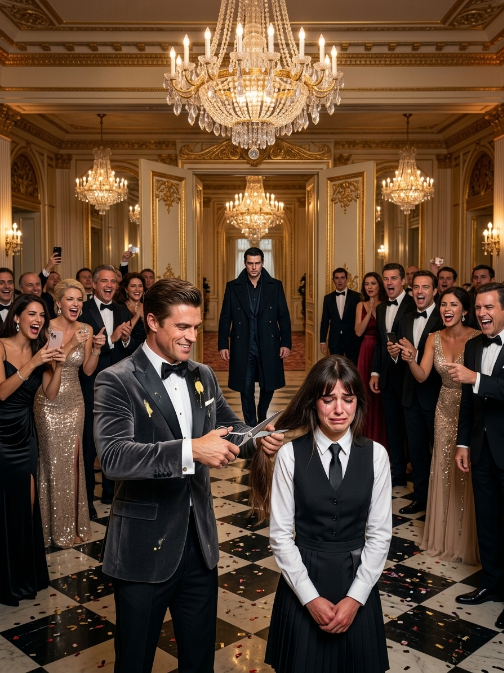
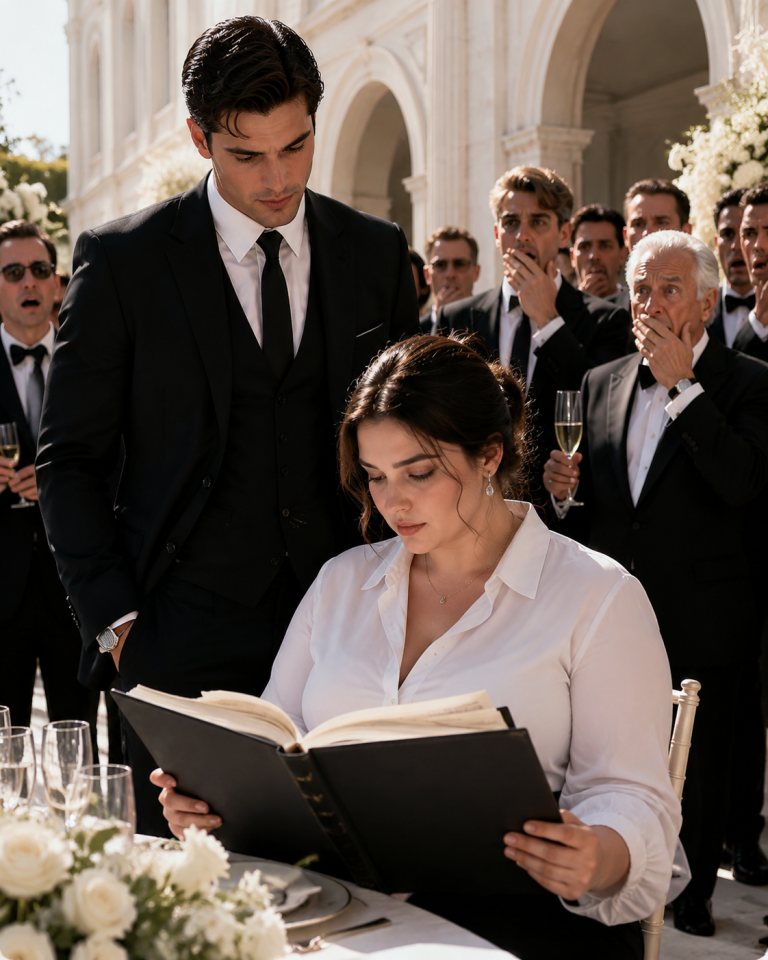
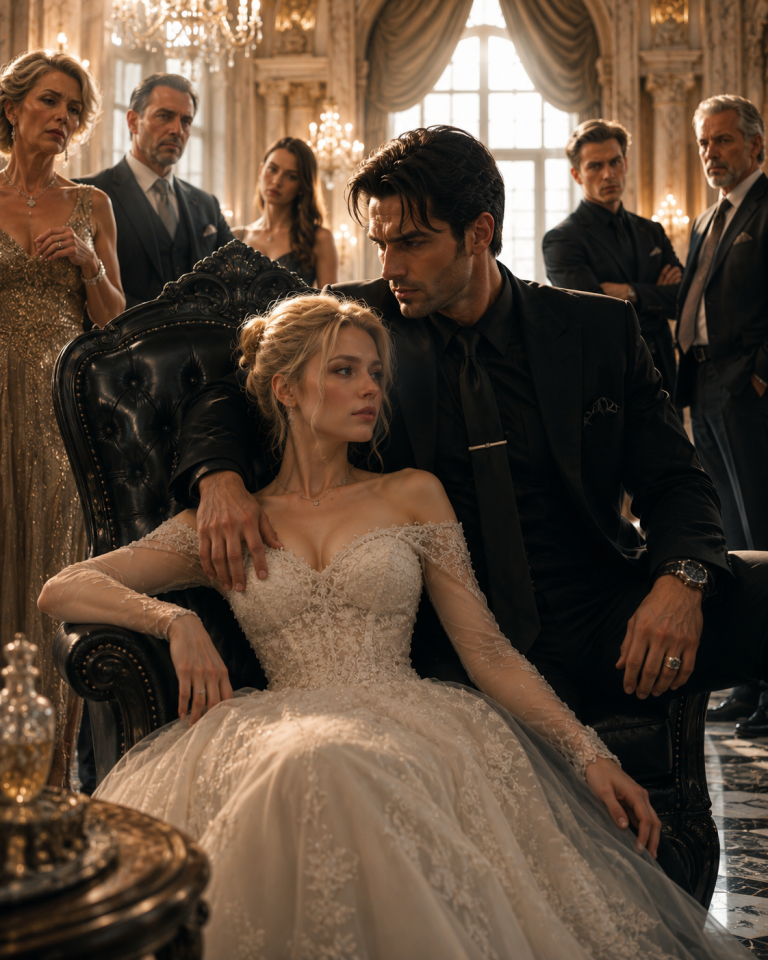
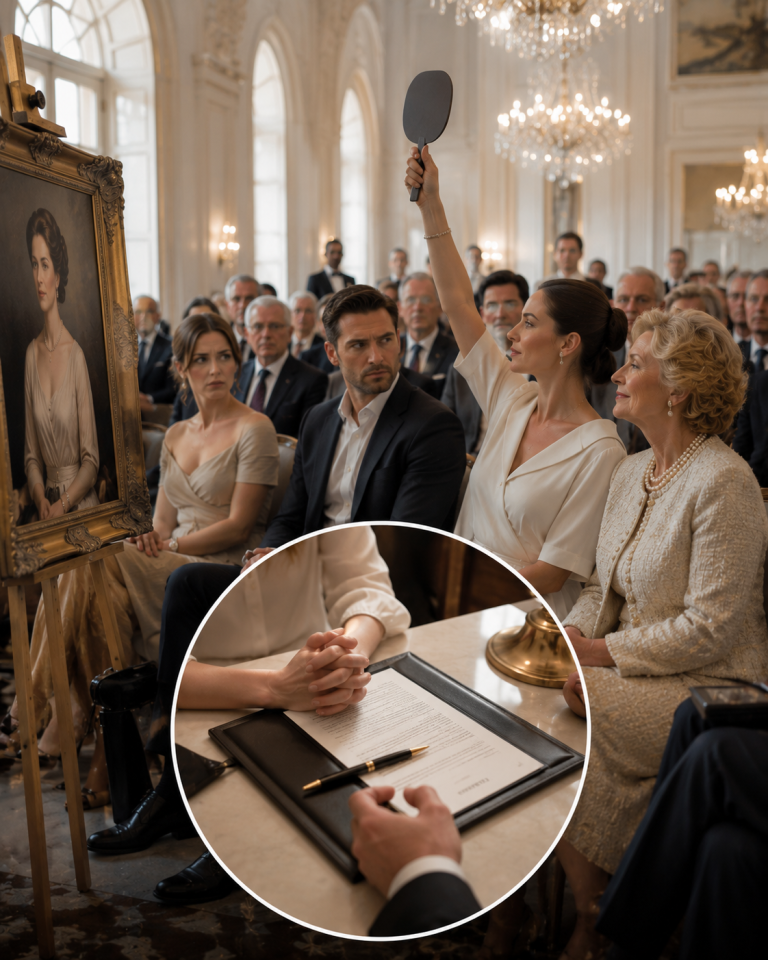
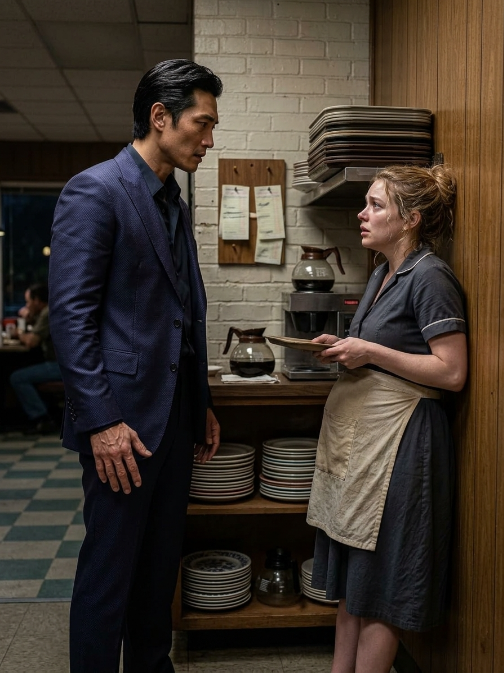
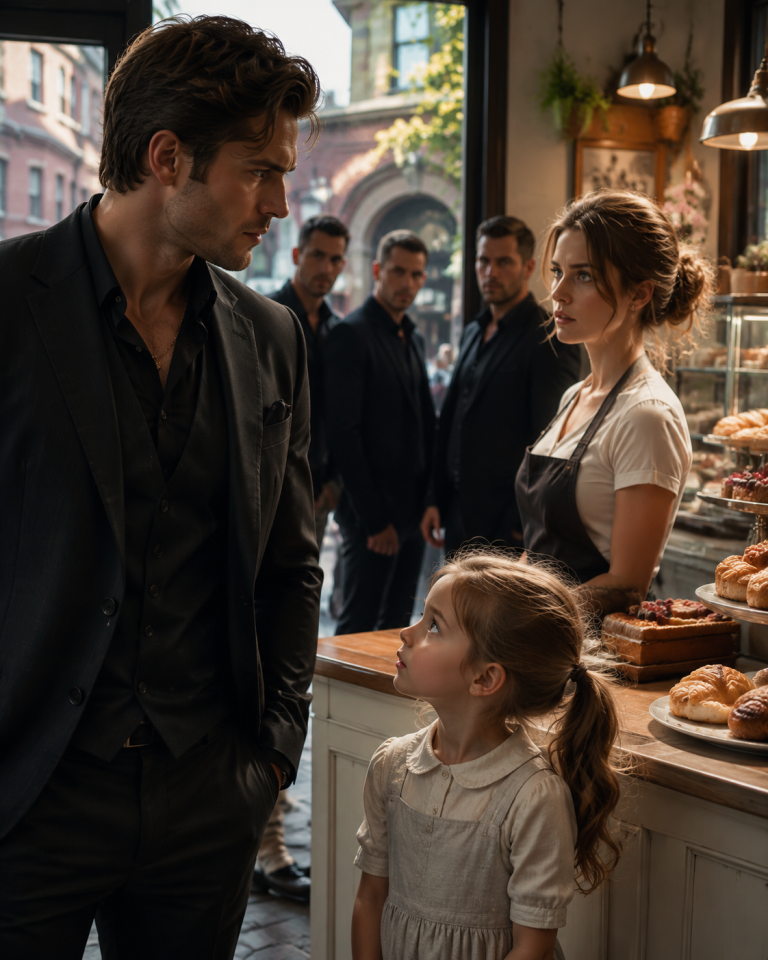
Left to freeze on the coldest night of the year, she thought no one would hear her cries… until a black car stopped beside her, and the mafia boss stepped out holding the one thing she had lost forever.

**PART 1**
The eggs were nearly done when Nate’s phone buzzed on the counter.
Sera had been reaching for the pepper. Her hand stopped.
The screen was face-up. She saw it without trying to.
*Can’t stop thinking about last night. Same time tomorrow?*
No name. Just a number she didn’t recognize. And a string of messages above it, cascading upward, that she didn’t need to read to understand — because she did read them, all of them, hands going cold around the phone while the eggs burned in the pan and morning light came gray through the kitchen window and the world she’d been living in for two years quietly closed up behind her like a door she’d never find again.
She was nine weeks pregnant.
She’d found out three weeks ago. She’d told Nate over takeout on a Sunday night, watching his face, and what she’d seen there — the way he’d set down his chopsticks, the way he’d said *okay, we’ll figure it out* — she’d read as fear mixed with willingness, which felt honest, which felt like enough.
She had built a future on that face.
She put the phone down on the counter.
She heard the shower stop.
The bathroom door opened.
Nate came out in a towel, saw her standing at the counter with his phone in front of her, and his face did the thing she had spent months not letting herself notice it could do: it went somewhere she didn’t recognize.
“Sera.”
“Who is that?”
“A friend.”
“Friends don’t—”
“It’s complicated.”
She’d always hated that word. She hated it now with a precision that cleared her head like cold water.
“I’m pregnant,” she said. Not because he’d forgotten. Because she needed to hear herself say it in this room, with this version of him in front of her.
“I know.”
“You said you wanted this.”
Something shifted in his face. The version of him she didn’t recognize got more comfortable.
“I thought I could do it. I can’t.” He picked up the phone. “I should have said something earlier. But I kept thinking—”
“Don’t.”
“Sera.”
“Don’t explain it to me like a scheduling conflict.”
He exhaled through his nose. Patient. Tired. As if she were the one creating the problem.
“I need you to go.”
“Go where?” Her voice didn’t sound like hers. Too flat. Too controlled.
“I don’t know. Tonight I have—”
“Tonight you have her.”
He didn’t answer.
That was its own answer.
She went to the bedroom. She didn’t pack. Packing would have meant believing there was somewhere to pack for. She put on her coat — the good one, the one she’d bought for last winter and hadn’t replaced because she hadn’t needed to — and she picked up her keys and her phone and her wallet and she walked out of the apartment that had his name on the lease, past two years of her own things arranged in his space, and out into the February air.
Her car was four blocks down. Billings in February is not a city you walk through without meaning to. She had tears on her face by the time she reached it, which she couldn’t feel because her cheeks had gone numb.
She sat behind the wheel.
She should have called someone. Her best friend Dani, who would have driven across the city in her pajamas. Her college roommate who lived in Missoula. A hotel, a motel, a gas station, anything with light and heat and other people.
She drove instead.
The city fell away behind her. The road opened. Snow began to come down, first light and then not light, the kind that fills headlights and makes the road ahead disappear in increments. She kept driving because stopping meant sitting with it, and sitting with it meant hearing Nate’s voice on a loop in her own head, patient and tired, explaining away two years and a child like he was canceling a subscription.
She didn’t see the deer until she hit the brake.
The road was ice.
The car didn’t stop. It spun — one full slow revolution that lasted a geological age — and then there was the guardrail, and then there was the pine tree twenty feet off the road, and then there was darkness.
She came back to cold.
The particular cold of a car with no heat and a broken window, snow blowing in through the gap where the glass had been. Her seatbelt held her sideways. Her forehead was wet. Her wrist screamed where it had caught the door.
Her hand went to her belly.
*Please,* she thought. Not a prayer to anyone in particular. Just the word, repeated, the only word she had. *Please please please.*
She got the seatbelt open. She found the window and got through it by degrees. Outside: white, dark, silent. The highway was close enough to see and felt like a mile away.
She walked toward it. Her legs didn’t work properly. The cold was serious now, the kind that makes the ground seem soft, the kind that makes lying down seem reasonable.
She made it to the shoulder of the road and her knees gave out.
She pressed her hand against her belly and turned her face into the snow.
*Eight weeks,* she thought. *Too small to know anything yet. Too small to survive this. Already the most important thing I’ve ever had.*
Then headlights.
She thought it was her vision failing. She’d heard that about hypothermia — the body gets confused, starts producing warmth that isn’t there. But the lights kept coming. An engine slowed. A door opened.
Footsteps on snow.
“I see her.” A voice — not the one that stopped beside her, another voice, further back. “Boss, we’re exposed out here.”
“There’s a woman in the road.” Flat. Final. The tone of someone who has already made the decision.
The man who crouched beside her was dark-eyed, sharp-featured, with a scar cutting through his left eyebrow that made the whole face look like it had survived something serious. He wore a coat that cost more than her car and he put his hands on her with the brisk efficiency of someone trained to assess damage.
“Can you hear me?”
“Yes.” Barely.
“You were in an accident. We’re going to get you warm. Is there anything I should know before I move you?”
“Pregnant,” she said. “Nine weeks.”
He was still for one second.
“How do you feel? Any pain in your abdomen?”
“I don’t — I can’t tell. The cold—”
“Okay.” He made a decision behind his eyes that she was not privy to. “I’m going to carry you. Tell me if anything gets worse.”
He lifted her like she was something worth protecting.
“The nearest hospital is Billings General,” the other man said. He had a square face and watchful eyes, and he was standing near an idling black SUV. “Forty minutes back the way we came.”
“We just came from Verciani’s meeting,” the first man said, quiet. “If anyone runs our plates in the hospital parking lot tonight, it creates a problem.”
A pause.
“My house is fifteen minutes.”
“There’s a doctor there.”
“Call him.”
The other man looked at her, then at his boss, and took out his phone.
She wanted to say something about hospitals. About doctors with machines that could tell her whether the baby was all right. But the darkness was closing in at the edges and his coat was blocking the wind and the warmth of his arms was the first warmth she’d felt in what seemed like years.
She let it take her.
—
She woke up in a room that was wrong in all the right ways.
High ceiling. Fireplace going on the far wall. An IV in her arm she didn’t remember agreeing to. Bandages on her hands. Outside the tall windows, snow.
A man with kind eyes and a medical bag was checking her pulse.
“There she is,” he said. “Don’t rush. You’ve been asleep for about four hours.”
“The baby.”
“Stable. Heartbeat is good. You have a concussion, moderate hypothermia, a sprained wrist, and lacerations on your palms and forehead. But the pregnancy is intact.”
She put both hands over her face and cried. Not loudly. Just the pressure releasing, finally.
“I know,” the doctor said, in the voice of a man who had been present for a lot of the worst moments of people’s lives. “Take your time.”
His name was Ferraro. He was the Castellano family physician, he said, and had been for thirty years. She was at the Castellano estate outside Billings. The man who found her was Marco Castellano.
She knew the name.
She didn’t know it in the way that would have made sense — no specific story she could point to, no news article she’d read. She knew it in the way you know certain things in a state like Montana, where the landscape is large and certain names shape it the way rivers do, invisibly but permanently. The Castellano name was attached to buildings and to silence and to the particular way people in some parts of the city changed topics when it came up.
She was trying to think through the implications of this when the woman appeared.
She came in without knocking, which suggested the room was hers by some definition, and she was exactly the kind of woman who could pull off not knocking — dark-haired, precise, wearing clothes that fit the way clothes only fit when someone has thought about it.
“You’re awake,” she said. “Good. I’m Elena Castellano. Marco is my brother.”
“He saved my life.”
“He does that sometimes.” Elena sat in the chair beside the bed with the ease of someone settling into a familiar role. “He also wanted me to tell you that you are under no obligation to stay here, and that we can have someone drive you wherever you’d like to go as soon as Dr. Ferraro clears you.”
“Where would I go?”
The question came out before she could stop it.
Elena looked at her.
“That’s a separate problem,” she said. “One thing at a time. What’s your name?”
“Sera. Sera Voss.”
“Sera. How are you feeling right now, physically, on a scale of one to ten?”
“Four. Maybe five.”
“That’s honest.” Elena stood. “Rest. I’ll have someone bring food when you’re ready. And Sera — your phone has been charging on the nightstand. You might want to call someone who’s wondering where you are.”
She left.
Sera looked at the phone.
Fourteen missed calls. Half from Nate, which she dismissed without opening. Half from Dani, which she opened.
She typed: *I’m okay. Had an accident. Staying somewhere safe. I’ll call tomorrow.*
Then she turned toward the window and watched the snow come down over a yard she didn’t recognize, in a house she didn’t belong to, carrying a baby she was already fiercely and unreasonably committed to protecting, and thought about what *somewhere safe* actually meant.
—
Marco came to see her on the second evening.
Dr. Ferraro had cleared her to sit up. She was in the window chair with borrowed socks and a cup of tea when he knocked — actually knocked, which she noted — and came in at her word.
He looked different without the storm. Less like an emergency. More like a man who was accustomed to making decisions in difficult conditions and had simply added her to the list.
“How are you feeling?”
“Better than last night. Worse than I’d like.” She watched him. “Thank you. For stopping.”
“The road was empty.” He said it like it explained things.
“Most people would have called 911 and kept moving.”
He considered this. “I know what it is to need someone to stay.”
She wasn’t sure what to do with that.
He sat in the other chair — the one further from the bed, the distance deliberate, she thought.
“Ferraro says another day, maybe two, before you should travel.”
“Travel to where.”
He looked at her steadily.
She’d said it out loud again. She needed to stop doing that.
“There’s work here, if you want it,” he said. “Elena mentioned you translate. We have correspondence in four languages that’s been sitting for a month.”
“You’re offering me a job.”
“I’m telling you there’s something useful you could do while you decide what comes next.”
“That’s—” She paused. “That’s oddly generous from someone I met in a blizzard twelve hours ago.”
“You’re pregnant and alone and your car is somewhere off Highway 12 around a pine tree. Generosity seems proportionate.”
She looked at him.
There was something in the way he said things — direct, without the social softening she was used to, like he’d stopped performing patience at some point and just opted for clarity — that she found both unsettling and easier than the alternative.
“What do you actually do?” she asked.
“Import and trade. Legal distribution.” A beat. “And some other things.”
“What other things.”
“The kind that explain why my house has reinforced doors and why I couldn’t take you to Billings General last night.”
The room got quieter.
“Are you telling me I’m in danger?”
“No. I’m telling you I’m honest about what this place is, and what it is is complicated, and you deserve to know that before you decide anything.”
“Complicated meaning criminal.”
He held her gaze.
“In parts.”
She put the tea down.
“My baby’s father told me last night that he wasn’t sure the baby was his. He said it because he needed an exit. He knew it wasn’t true.” She looked at her hands. “I’ve had enough of people who use vagueness to avoid accountability. So I’ll ask you directly: is staying here safe?”
“For now, yes.”
“And if that changes?”
“I’ll tell you immediately, and we’ll get you out.”
“Your word.”
“Yes.”
She thought about it for longer than she expected to. Not because she trusted him — she didn’t know him. But because he’d looked her in the face and said *in parts* instead of manufacturing a cleaner answer, and that small honesty was doing something disproportionate to her after a week of lies.
“One day at a time,” she said finally.
He nodded.
“One day.”
—
**PART 2**
She stayed for reasons that became, over three weeks, harder to isolate.
The work was part of it. The translation was real — shipping contracts, supplier correspondence, legal reviews — and she was good at it, and being good at something felt like solid ground after the previous weeks had removed every other surface she’d been standing on.
Elena was part of it. She came every morning with something — coffee, a book she’d finished, a question about Sera’s preferences for the nursery she’d casually mentioned converting, as if that were a normal conversation to have. Elena moved through the world with the efficiency of someone who had never had the luxury of uncertainty and had made peace with that. Sera found her easier to be around than she’d expected.
Marco was part of it in a way she didn’t examine too closely.
He came by in the evenings. Not every evening. But often enough that she started noticing the ones where he didn’t. He had a habit of asking one real question and leaving the social performance out entirely — not *how are you* but *is the wrist improving* or *Ferraro said the vertigo is better, is that accurate*. He listened to the answers without the particular inattentiveness of men who ask questions as a courtesy.
He also had a stopped watch.
She noticed it early. Old, heavy-cased, clearly not running — worn on his wrist anyway with the deliberateness of a choice rather than an oversight.
“Does it work?” she asked, one evening when they’d somehow ended up in the library, her with a translation and him with what appeared to be genuinely terrible paperwork.
He glanced at it.
“No.”
“Then why wear it?”
“My father’s.” He turned it once on his wrist. “He died when I was seventeen. My grandfather had it repaired after the funeral and gave it to me and said: *a man who knows what time it is knows what matters.* The watch stopped working six months later. I kept wearing it.”
“As a reminder?”
“As a question.” He looked back at his papers. “Whether I actually know what matters.”
She thought about that for a long time.
The explosion came on a Thursday morning, two days later.
Not close enough to break the windows. Close enough to rattle them. Close enough that she was on her feet before she’d consciously decided to stand, both hands over her stomach, facing the door.
Elena came through it fast.
“Come with me. Now. Don’t stop for anything.”
The safe room was behind a section of bookcase in the east hall — she almost laughed at how literal it was, and then she didn’t, because the door was several inches of reinforced steel and the room beyond it held communications equipment and medical supplies and the specific atmosphere of a place designed in the expectation of the worst.
Elena locked it behind them.
On the radio, Marco’s voice: *Status on Elena and the guest.*
*Secure.*
*Stay there. I’ll call when it’s clear.*
Sera sat on the bench along the wall and breathed. Elena sat beside her and did not pretend.
“Tell me what’s happening,” Sera said.
Elena looked at the radio. Then at her.
“There’s a man named Verciani. His organization has been trying to establish routes through this region for two years. Marco has blocked him. Verciani escalated yesterday — there was a meeting, Marco refused a final offer, and apparently Verciani decided to send a response.”
“To your house.”
“To our house.”
“Why this way? Why not— I don’t know, legally—”
Elena’s expression answered that before she spoke. “Men like Verciani don’t use legal systems. They use pressure. He wanted Marco to understand what resisting would look like.”
“And what does Marco do now?”
“Whatever he decides to do.” Elena’s voice was steady. “He always does. That’s why Verciani is angry.”
An hour later, Marco came through the door.
He had a cut along his jaw. His coat was damaged. He looked at Elena first, then at Sera, and she watched something in his face shift when he confirmed they were both unharmed.
“How bad?” Elena asked.
“Controlled. Perimeter only. They wanted to measure response time.” He sat down on the opposite bench. “They know she’s here now.”
Everyone in the room understood what that meant.
Sera said it out loud anyway.
“I’m a variable they’ll try to use.”
Marco looked at her.
“Yes.”
“Then I should leave.”
“Possibly.”
“*Possibly?*”
“Leaving now creates movement. Movement is trackable. You’re safer in a fixed, secured location than in transit.” He met her eyes. “That’s operational logic, not manipulation. If you want to leave, I will make it as safe as possible and it is your decision. But I want to give you the honest calculation.”
She pressed her hands together.
“If I stay and something happens—”
“I will get you out.”
“Your word.”
“Yes.”
She looked at Elena.
Elena said: “He keeps it. When he gives it.”
Sera sat with that.
“What happened to Verciani?” she asked. “What does Marco do next?”
The two siblings exchanged a look she wasn’t meant to fully read.
“He ends it,” Elena said.
—
**PART 3**
She learned the Castellano family in pieces, the way you learn anyone worth knowing.
She learned Marco in the way she hadn’t meant to.
It happened in increments she couldn’t have marked on a calendar. The evenings in the library, where she worked and he read, and the silences between them were more comfortable than conversations with most people. The morning she’d woken to find a stack of books outside her room — translation theory, Italian literature, a novel in Portuguese she’d mentioned once — with no note, which was somehow more disarming than if there had been one. The afternoon he’d found her in the garden in her coat, just standing in the cold, and sat down on the stone bench beside her without asking what was wrong and without filling the silence, and she’d eventually told him everything about Nate, beginning to end, and he’d listened without performing the appropriate reactions, just listened, and when she finished he’d said: *I think the person he chose to be with after you will have a worse version of the same experience, and I think that’s a specific kind of justice.*
She hadn’t expected that.
She’d started expecting, by then, that he would say things she hadn’t expected.
Dani came to visit five weeks in.
Dani, who had driven from Missoula in her ancient Subaru, who stood in the driveway looking at the gate and the grounds and the security camera and then looked at Sera with an expression that contained approximately forty follow-up questions.
Inside, Sera told her the short version. The accident. The family. The work. The current situation.
Dani sat on the edge of the guest room bed and thought about it.
“He’s a crime boss,” she said finally.
“His family runs an organization, yes.”
“In the *crime* sense.”
“In parts.”
“You sound like him when you say that.”
Sera paused.
“Do I?”
Dani looked at her with the attention of someone who has been her best friend for eleven years and is currently performing a rapid assessment.
“You like him,” she said.
“I’m grateful to him.”
“Sera. I’ve known you since before you knew how to lie. You like him.”
Sera didn’t answer.
Dani didn’t push. That was one of the things Sera had always loved about her — she made her point and then let you live with it.
At dinner, Dani watched Marco the way she watched everyone she was evaluating: through apparently casual conversation, through the questions she asked and the ones she didn’t, through what she noticed he didn’t say.
At the end of the meal, she turned to him and said: “What happens to Sera if she wants to leave?”
The table went quiet.
Marco looked at Dani without apparent surprise.
“She leaves. We make sure she’s safe. We provide what resources she’s willing to accept.”
“And if you want her to stay?”
“What I want doesn’t determine what she does.” Something in his face, careful and precise. “It’s not structured that way.”
Dani looked at Sera.
Sera looked at her soup.
Later, Dani pulled her into her room and said, “He means it.”
“I know.”
“That’s actually rarer than it sounds.”
“I know.”
“Be careful anyway.”
“I know that too.”
The crisis with Verciani came to its resolution the way Marco had said it would, which was quietly and with finality and in ways Sera didn’t ask for the details of. One morning he came to breakfast and said, *it’s over,* and the air in the house changed in a way she hadn’t realized was constrained until it stopped being.
He found her in the library that afternoon.
She was at the window.
“It’s done?” she asked.
“Yes.”
“He’s gone?”
“His operation here is gone. He’s—” A pause. “Gone.”
She turned.
He was standing in the middle of the room with his hands in his pockets, and he looked tired in a way the previous weeks hadn’t shown — the specific tiredness of someone who has done something necessary and knows the cost of it.
“Does it bother you?” she asked. “What you do. The parts that are — the parts that aren’t import contracts.”
He considered it honestly.
“Yes,” he said. “The rules I keep are because of what it feels like when they’re broken. I’ve seen what the other kind looks like.” He turned the stopped watch. “I made a choice, a long time ago, about what my family’s name would mean going forward. I haven’t finished paying the cost of that choice. But I’m paying it.”
“Your grandfather built the original organization.”
“Yes.”
“And you’re trying to dismantle it.”
“Transition it. Which is slower and harder and more expensive and the only option that doesn’t leave a power vacuum that someone worse fills.”
She sat down.
He waited.
“I’ve been thinking,” she said, “about what happens next.”
“You have options now.”
“I do.” She looked at her hands. The wrist had mostly healed. The cuts were fading. “Dani offered her spare room. I have money saved. I could get an apartment, find local work, figure out the pregnancy from there.” She looked up. “Those are real options. Not pity options.”
“I know.”
“And I’m not going to take them.”
He was very still.
“Not yet,” she added. “I want to stay here. I want to keep working. I want—” She stopped. Restarted. “I don’t have a clean way to say this.”
“Say it uncleanly.”
“When I think about leaving, I feel like I’m leaving something I haven’t finished. And I don’t think I mean the contracts.”
The library was quiet.
“If you stay,” Marco said, careful, “I want to be clear about what that means. It doesn’t create an obligation. You can still leave at any point, for any reason. I will not make your life harder if you decide the honest version of me is too much.”
“The honest version of you is the only version I trust,” she said.
“Then tell me what you want.”
She thought about Nate and his carefully vague face and his patient sighs. She thought about a woman alone in the snow thinking *this is how I die.* She thought about headlights coming through a blizzard, and arms that were strong and warm and did not put her down until she was safe.
“I want to stay,” she said. “And I want you to stop pretending you’re only offering me a room.”
His face did something she hadn’t seen it do before.
All the control stayed. But something under it surfaced — fierce and careful and long-kept.
“I love you,” he said. Not dramatically. Just accurately. “You’ve been honest with me from the first night, and it required something I wasn’t expecting. And I have been trying to give you time and distance and options because I knew you’d been hurt by someone who made choices for you. But yes. I love you. That is what I was not saying.”
She crossed to him.
He held still, the way he’d always held still, giving her the last step.
She took it.
He kissed her the way people kiss when they’ve both been careful for a long time — with the accumulated weight of weeks of almost.
When she pulled back, she was crying, which surprised her.
“Sorry,” she said.
“Don’t apologize.”
“I just—” She pressed her forehead to his jaw. “I thought I was going to die in the snow. I thought the baby was going to — I thought it was over.”
His arms came around her.
“It wasn’t.”
“I know. But sometimes I feel it again.”
“Tell me when you do.” His voice was quiet against her hair. “I’ll stay.”
—
The months that followed were not a fairytale.
The transition plan Marco had been building for three years accelerated. There were meetings, legal filings, a conversation with a federal contact that Elena managed and that Sera was not present for and did not ask about specifically. There were former employees who needed legitimate work and got it, through a construction company Marco incorporated, through the expanded restaurant supply business Elena had been quietly building for eight months, through a security consulting firm that hired people who were very good at keeping things safe.
There were hard nights.
Months where Marco went somewhere in himself that she couldn’t reach and she learned to sit outside the door of it without demanding entry.
Months where her body changed and frightened her and Dr. Ferraro was always there, which was a specific luxury she couldn’t pretend not to be grateful for.
Months where she woke from nightmares about the accident and Marco was always awake too, not because he’d heard her, but because he didn’t sleep well anyway, and he’d sit on the edge of the bed and talk to her about something ordinary — a supplier problem, a book he was reading, something ridiculous Elena had said — until the nightmare lost its weight.
She went back to school for her certification. She finished what she’d deferred. Marco rearranged nothing to make this happen and supported everything, which was the distinction she’d asked for at the beginning and which he maintained.
When her belly grew round and heavy and she moved through the house slowly, he moved with her pace.
When she cried about the nursery color — which was a real event that she still found embarrassing — he listened until she was done and then said, *tell me what you want,* and meant it, and she said *green, I think green,* and the room was green within a week.
He attended every appointment. He asked the questions she’d forgotten to ask. He argued politely but firmly with Dr. Ferraro about fetal development timelines, which Ferraro found either charming or infuriating depending on the day.
One afternoon in the fall, on the estate’s east porch with the Billings valley spread out below them golden and late, she turned to him and said: “I love you.”
She’d been meaning to say it for a month.
He looked at her.
“I know,” he said.
“That was either arrogant or very perceptive.”
“I could tell.”
“How?”
“The same way I could tell when you first decided to trust me. There’s a particular way you look at things you’ve decided to believe in.”
She turned back to the valley.
“Marry me,” she said.
He was quiet.
She looked at him.
He was looking at her with the expression she’d come to know as the one underneath everything else — the one that wasn’t strategic or controlled or tired.
“I had a plan,” he said. “A proper question. In Italy. I was going to take you to Italy.”
“You can still take me to Italy.”
“After the baby.”
“Yes. But marry me now.”
“Sera.”
“Marco. I was dying in the snow nine months ago. I have a limited appetite for waiting on things that matter.”
He took her hand.
His thumb moved over her knuckles.
“Yes,” he said. “Obviously yes.”
They were married in the estate garden in November.
She was eight months pregnant and wore a dress Elena had found that accommodated this without sacrificing any dignity, which was the kind of logistical problem Elena considered beneath comment.
Dani cried starting at the top of the aisle and didn’t stop.
Dr. Ferraro walked Sera down the path and muttered that he was too old for ceremonies while being visibly moved.
Marco’s second — whose name was Gio, and who had been beside him in the snow that night — stood as his witness with the expression of a man who took all assignments seriously including this one.
When Marco said his vows, he said: *I promise to tell you the truth about what I am, and to keep choosing, every day, to be someone the truth is worth having.*
She had written hers in three languages and then thrown them away and said instead: *You stopped in the snow. You could have called someone else. You stayed. I intend to stay too.*
She had never meant anything more completely.
The daughter arrived six weeks later.
Nineteen hours. Pain that was the most serious thing Sera had ever experienced and more serious than she’d adequately prepared for. Marco’s hand in hers through all of it, jaw set, not flinching, eyes on her face.
Elena outside the door alternating between pacing and pretending she wasn’t pacing.
Ferraro calm as a harbor in a way that suggested he had been here many times and trusted the process.
Then a sound: high and furious and alive.
*A girl,* Ferraro said.
They put her on Sera’s chest.
She was dark-haired and loud and had both fists clenched and was looking at the room as if she had opinions about it that she was preparing to share at length.
Marco made a sound she had never heard from him before — something that came from a place beneath all his languages.
“Hey,” Sera whispered to the baby. “I know. It’s a lot out here.”
The baby considered this and screamed.
“She’s going to be like you,” Marco said, and his voice was destroyed.
“That’s a terrifying thought.”
“I mean it as a compliment.”
“I know.”
She looked at him.
He was looking at the baby with the expression of a man discovering something he hadn’t known he was missing.
“What should her name be?” she asked.
He looked up.
“Whatever you want.”
“I want to name her after your grandfather. Vittoria.” She’d been thinking about it for weeks. “She was born from a family that’s trying to become something better. She should have a name that means winning.”
His throat moved.
“Vittoria.”
“Yes.”
He put his hand over hers on the baby’s head.
“Thank you,” he said quietly.
“For what?”
“For staying. For all the days you could have left and didn’t. For this.”
She thought about the highway. The snow. The deer in the headlights and the long spin and the cold that had started to feel like sleep.
She thought about headlights in a blizzard.
“You stopped,” she said.
“You were worth stopping for.”
“I didn’t know that then.”
“I did.” He touched her face, careful as always, giving her the choice of it. “I’ve known since you looked up at me from the snow and were clearly terrified and didn’t pretend you weren’t.”
Vittoria made a sound.
Both of them looked at her.
She’d gotten her fist to her mouth and seemed satisfied with this.
“She’s incredible,” Sera said.
“She is.”
“She looks like you.”
“She has your expression.”
“What expression?”
Marco almost smiled.
“The one that means you’ve already decided something and you’re giving me time to arrive at the same conclusion.”
Sera laughed — the first real one since the labor started, loose and uncontrolled, the kind that meant the fear had finally let go.
Outside the window, snow was beginning to fall.
Soft. Steady.
The same snow that had nearly ended everything.
The same snow that had been falling when headlights appeared on an empty highway and a man with a stopped watch and dangerous eyes stepped out into the cold because leaving someone there was not who he was.
Some things that begin badly become the best things you have.
Some losses, at the bottom, turn out to have been doors.
Some nights you survive because someone stopped.
Years later, when people asked Sera how she and Marco had met, she told them the short version: *a car accident in February, he found me on the road.*
When they pressed, when they wanted the full story, she told them about the eggs and the phone and the apartment that had never really been hers and the highway in a blizzard and the snow that was the kind of cold that becomes quiet, and a man who stepped out of a black car and lifted her up and made a decision she hadn’t been in a position to make for herself.
“He saved your life,” people said.
“He stopped,” she said. “I saved my own life. He just gave me somewhere to do it from.”
Then she would go find him — in the kitchen, probably, arguing with Ferraro about something, or in the library with Vittoria asleep on his chest, or in the garden watching the mountains — and she would remember every version of the woman who had walked out of an apartment with her keys and her phone and nothing else, and she would think:
*She got out in time.*
*She made it to the road.*
*And when the lights came, she looked toward them.*
That was the whole story.
Everything else was the life that came after.