The Night He Came to Destroy Her, the Cruel Mafia Boss Found a Pregnant Janitor Scrubbing Blood From His Bar—Then Her Wedding Ring Made Him Stop Breathing.

**PART 1**
The Meridian Club didn’t advertise itself.
No sign above the entrance. No rope line. No music that leaked into the alley behind it on West Division Street, where February turned the gutters into gray ice and the kind of men who frequented the place arrived in vehicles with tinted glass and left with nothing written down. It was a room for private understandings. A room for debts and deals that couldn’t survive daylight.
Tonight the room belonged to one man.
Declan Mercer sat at the back table with a whiskey he hadn’t touched in twenty minutes and the particular stillness of a man who had run out of things to feel. He was thirty-five. Dark-haired. Square-jawed in a way that might have been handsome if his eyes hadn’t looked like they’d burned through everything soft inside him long ago. He wore his grief the way he wore his suits — cut sharp, worn cold, letting no one close enough to check the lining.
His wife had been dead for six months.
Or so Chicago believed.
Mercer had believed it too. He had stood on the curb of Lake Shore Drive while the wreckage of Vivienne’s car still leaked smoke into February air, held back by his own men because he’d been screaming her name and they were afraid he’d walk into the flame. He had sat through the funeral. He had read the medical examiner’s report himself, dental records and all, and he had made the Orellano family pay for it in the slow, methodical way of a man who no longer cared whether he survived the accounting.
Six months of that.
Six months of blood and silence and a bedroom he hadn’t slept in since November.
“Boss.” Riordan appeared at the edge of the table. Sean Riordan — blond, affable, lying face built for charity galas and confession booths. He’d been Declan’s closest friend since they were sixteen and stealing cars behind Sacred Heart. He was now Declan’s second, which meant he was the most dangerous man in the room after Declan himself.
“Miami is stalled,” Riordan said. “The port inspector is asking questions.”
“Port inspectors don’t ask questions unless someone taught them to.”
“Nerves, probably. After the Orellanos—”
“Fix it.” Declan set down the glass. “Or explain to me why you can’t.”
The men at the surrounding tables went very still. Riordan’s jaw tightened. He had a habit of softening his face when the room turned sharp — it usually worked.
It didn’t work tonight.
“Declan,” he said quietly, “you haven’t slept in four days. You’re running on old whiskey and older rage. Vivienne wouldn’t want—”
The glass left Declan’s hand before the sentence finished.
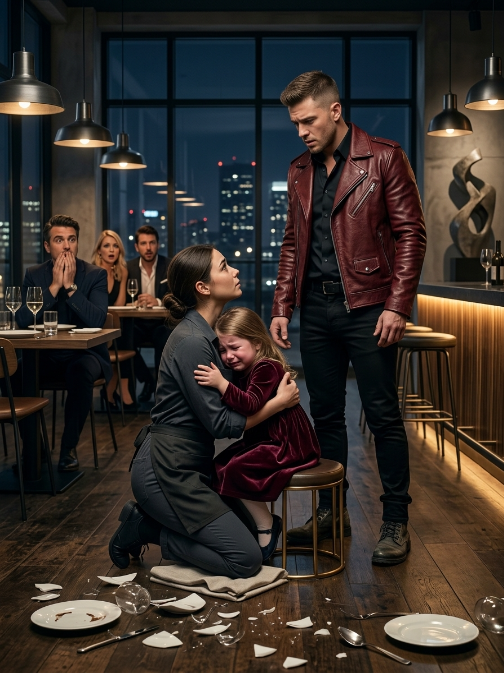
It crossed the room and detonated against the exposed brick wall above the service corridor. Crystal burst across the hardwood in a wide silver arc. Liquor bled down the brick. The sound was enormous in the quiet.
Every person in the room stopped breathing.
Declan stood.
“Say her name to manage me again,” he said, “and I will give you something to actually mourn.”
Near the service corridor, behind a wheeled mop bucket and a stack of folded linen, a woman flinched so hard her knuckle struck the metal frame of the shelving unit.
She pressed her wrist to her mouth. Breathed through it.
Her name — for now, for lack of anything better — was Nora.
St. Bridget’s Women’s Shelter on Ashland had given it to her. The intake coordinator had needed something to write, and Nora had woken up five months earlier in a charity medical center in Gary with no identification, a hairline skull fracture, a broken left arm, and no history at all. The clinic nurse who first spoke to her had been a woman named Elena who crouched at eye level and whispered, *Don’t ask questions yet. Not in front of anyone who comes to check on you.*
Nora had obeyed.
Two weeks later a pregnancy test had answered a question no one had asked her directly.
Now the baby sat low and heavy beneath the gray janitor’s jumpsuit. Her back had been aching since ten. Her ankles had swollen past the point where the donated sneakers fastened properly. She worked the Meridian Club on Tuesdays and Thursdays through a cleaning agency that asked nothing about gaps in employment history, and she kept her head down in rooms full of men who paid good money for their privacy.
Tonight she needed to clean up the broken glass before the man who threw it decided to notice her.
Marguerite, the club’s floor manager, materialized at her shoulder. Dark-haired woman, fifty-something, with the wide eyes of someone perpetually one second ahead of disaster.
“Now,” Marguerite breathed. “Dustpan. Quiet. Do not look at him.”
Nora took the dustpan and the broom.
Each step across the floor felt like crossing ice she couldn’t see the depth of. Men in tailored coats watched her with the lazy attention of people accustomed to surveilling rooms. She didn’t meet their eyes. She reached the brick wall and lowered herself to her knees with the particular care of a woman seven months along — slow, deliberate, one hand finding the floor first.
She began to sweep.
At the back table, Declan turned to reach for the bottle.
Then he stopped.
It wasn’t the sound of the broom. It wasn’t the hunched gray figure near the wall, or the visible swell of pregnancy beneath the uniform. It was something he couldn’t have named if anyone had thought to ask him — a thread of scent so faint it should have dissolved against cigar smoke and spilled whiskey.
Vanilla. Cedarwood. Something bright underneath, like orange peel dried in winter sun.
Declan’s hand went still above the bottle.
Vivienne had worn that combination every day of the eight years he’d known her. Not a department store perfume — a small blender on Lincoln Avenue made it custom because conventional fragrances gave Vivienne headaches. The woman who made it had retired eighteen months ago, which meant the formula existed in exactly one place on earth.
Declan’s lungs had stopped working.
The match he’d struck for his cigar burned down to his fingers. He didn’t notice.
He looked at the woman kneeling by the wall.
She swept without raising her head. A few loose strands of hair clung to the back of her neck where she’d sweated through the work. The slope of her shoulders — the particular angle of them, the way her left hand pressed against the underside of her belly as she moved — hit him somewhere beneath language.
He was across the room before the match had finished burning.
“Boss—” Riordan said behind him.
Nora heard the footsteps stop directly above her. Every muscle in her body locked.
The glass shard slipped. The edge opened a line across her index finger.
She gasped — a small, involuntary sound, barely audible.
Declan made a noise like something had torn loose inside him.
Nora went still on her knees, bleeding onto the dustpan, heart running itself ragged.
“Look at me.” His voice came from far above her. Low. Fractured.
“I’m sorry, sir. I’ll finish and go. I’m—”
“*Look at me.*”
The second time it wasn’t a command. It was the sound a man makes when he’s been underwater for six months and can see light but can’t yet trust the direction.
She raised her face.
The chandelier above the back wall threw amber light across her cheekbones. His eyes moved across her — the crescent scar above her left eyebrow she’d woken with, the scattered freckles across her nose, the hazel irises she’d once catalogued in a shelter mirror trying to find herself.
Declan dropped to his knees on the liquor-soaked floor.
He didn’t appear to notice that he’d ruined three thousand dollars of suit.
“Vivienne,” he said. Just that. Like a man reading his own name off a headstone.
Nora recoiled.
“I don’t know you.” Her voice came out cracked, terrified. “My name is Nora. I don’t know who Vivienne is.”
He reached for her face.
She scrambled backward on her palms.
“Don’t.” The word came out ragged. “Please don’t touch me.”
His hand hung in the air between them.
His eyes searched hers with an intensity that was almost worse than rage — because it was grief stripped naked, and grief that large had no consideration for what it ran through.
Then his gaze dropped to her stomach.
The full, unmistakable shape of her.
Nora watched something happen in his face that she didn’t have words for. Joy arriving and immediately breaking against something darker. A man who had burned through an entire city doing the math in real time.
“She has amnesia,” Marguerite said from somewhere behind him, voice shaking. “She came from a shelter. She has no memory before the clinic.”
The word *amnesia* moved through the room like a change in air pressure.
Declan’s grip — which had closed, gently, around Nora’s wrist — loosened.
She pulled free and pressed both hands to her belly, crying in short pulses she couldn’t control.
Declan stayed on his knees.
Riordan appeared at his side. “Arthur, listen to me. This is a setup. We had dental records. We had the examiner’s report. Someone is running a play on you and you’re giving them exactly what they want—”
Declan looked up at him.
It was a very quiet look.
Riordan went silent.
“Who handled Dr. Farrell after the blast?” Declan asked.
Riordan blinked. “What?”
“The medical examiner. Who spoke to him.”
Riordan’s face did something almost imperceptible. A fraction of a second where the affability slipped and the calculation showed through.
“I did,” he said. “You were in no state.”
Declan held the look for three seconds. Then he turned back to Nora.
She was breathing in small rapid pulls, one hand pressed hard beneath her ribs.
“I can’t—” she managed. “I can’t catch it—”
Her eyes rolled back.
He caught her before she reached the floor.
The room erupted. Men moved. Riordan reached. Marguerite cried out. Declan lifted Nora against his chest with a carefulness that silenced every person in the building more completely than the thrown glass had.
Her head settled against his shoulder.
The scent rose from her hair.
He closed his eyes.
“Lock the doors,” he said.
“Declan—” Riordan started.
“If you try to stop me leaving with her,” Declan said, “you won’t leave at all.”
He carried her out through the back entrance. Snow moved in the alley. His black SUV waited with the engine running.
He settled her across the rear seat and fastened the belt carefully beneath the curve of her stomach. For a moment he crouched beside her in the cold and looked at her face — thinner than he remembered, older in the way grief ages people even when they don’t know they’re grieving.
He wanted to touch her cheek.
He didn’t.
Behind him, in the light of the club’s back entrance, Riordan stood watching.
His expression was calibrated to worry.
It was too exact.
Declan had survived this long by noticing the precision of performances.
He got into the front seat.
As the car pulled into the Chicago dark, he understood — with the cold clarity that had replaced every other emotion he used to possess — what the evening had told him.
His wife had not come back from the dead.
She had been placed inside a dead woman’s life by someone who needed her buried.
And that someone had been standing close enough, for long enough, to know exactly which strings to pull.
—
**PART 2**
The Mercer estate in Glencoe sat at the edge of the water like a house that had decided never to apologize for what it was — all glass and stone and institutional light, surrounded by winter trees stripped down to their architecture.
Nora woke as they carried her inside and immediately tried to leave.
She made it as far as the foyer before her legs disagreed with her intentions.
Declan caught her. Set her on the sofa in the front room. Stepped back two full paces.
“The doctor is coming,” he said.
“I want to go back—”
“I know.”
“You can’t just—”
“I know,” he said again.
It was the quietest she’d heard him. It didn’t feel like softness. It felt like a man holding something breakable with his entire body because his hands had forgotten how.
Dr. Hendricks arrived in twenty minutes — a private physician with the particular competence of someone whose career had become entangled with people who required discretion. He examined Nora in the sitting room while Declan stood in the hallway with his forehead pressed against the wall.
He could hear the fetal monitor through the door.
Fast. Steady. Ferociously alive.
It did what six months of vengeance had failed to do. It reduced him.
Afterward, Hendricks stepped into the hall and said the baby was stable, the mother’s blood pressure was concerning, and the worst thing Declan could do for either of them was remain a source of fear.
Then he said: “Whoever she was before that clinic, this woman built an identity from nothing because the truth was either gone or unbearable. If you tear at the wall, you may collapse what it’s holding up.”
Declan stared at him.
“Can it come back on its own?”
“With safety. Familiarity. Time. Not force.”
Downstairs, in the room that didn’t appear on any public blueprint — where the servers and the archived evidence and the locked filing systems lived — Declan’s head of security, a former Marine named Holt, laid three folders on the steel table.
Dr. Farrell, the medical examiner, had fled his apartment forty minutes after Nora was carried out of the Meridian Club. Not dead. Running. He had a prepared bag hidden behind a false panel in his laundry room.
A man surprised by the revelation of a living woman didn’t run in forty minutes.
A man who already knew didn’t have the luxury of surprise.
Holt opened the second folder.
Bank transfers. Shell accounts registered to a dead man’s Social Security number. Two and a half million moved in three tranches, the first arriving within forty-eight hours of the bombing.
The authorization key traced to a company called Callahan-Riordan Logistics.
Riordan’s company.
Declan stood very still.
He had stood up in Riordan’s wedding. He had sat beside Riordan’s hospital bed when Riordan’s father died. He had trusted Riordan with his wife’s security detail.
He looked at the folder until the numbers blurred.
Then Holt placed down the third file.
Gary clinic intake records. Unknown female. Amnesia. Head trauma. Pregnancy confirmed at six weeks. Brought by an anonymous male caller. Patient presented agitated, fearful of uniformed personnel.
And at the bottom, a nurse’s handwritten note.
*Patient repeated in initial exam: “Don’t let Riordan know where I am.”*
Declan’s phone lit up.
Unknown number.
A photograph. Vivienne at a charity gala three years ago, head thrown back laughing, Declan’s hand at her waist.
Below it: five words.
*If she remembers, she dies.*
—
**PART 3**
Morning arrived without softness.
Nora sat at the long breakfast table with Marguerite on her left and Dr. Hendricks pretending to read something across from her and Declan standing at the windows with untouched coffee. No one called her Vivienne. She noticed that the way you notice a gap where a tooth used to be — constantly, and with the particular awareness of something missing.
“I want to go back to St. Bridget’s,” she said.
Declan turned.
Marguerite placed a hand over Nora’s wrist. Not to restrain her. Only to steady.
“I’ll send guards,” Declan said.
“No.”
His jaw moved.
Nora lifted her chin. “You said I wasn’t a prisoner.”
“You’re not.”
“Then stop deciding for me.”
The room held its breath.
Declan nodded once.
“You can go back. Marguerite goes with you. A man named Holt will follow at a distance — you won’t see him unless something happens.”
“You said no guards.”
“I said at a distance.”
Nora pushed back from the table.
“You don’t own me,” she said.
Something crossed Declan’s face. Fast, and complicated, and too genuine to be performance.
“No,” he said. “I don’t.”
She left before the honesty in that could cost her anything.
—
By noon she was on her narrow cot at St. Bridget’s, back aching, baby pressing hard beneath her ribs, watching a black SUV park half a block down the street.
She didn’t tell the other women who it was.
She wasn’t sure she knew.
At three o’clock a volunteer came to say there was a man in the front office asking for her. Legal aid clinic, he said.
Nora looked through the office window.
Sean Riordan.
Charcoal coat. Sad eyes built from practice. A manila folder tucked under his arm.
She hadn’t met him. She didn’t know his name. But her body knew something her mind didn’t, because every muscle along her spine went rigid before the thought arrived.
Marguerite stepped in front of her like a door.
“You leave,” she said.
Riordan’s smile didn’t move. “Marguerite. I’m not here for trouble.”
“You are trouble wearing a good coat.”
He looked past her to Nora. “I know Declan frightened you. He’s not well. He lost his wife and his mind followed shortly after. You look enough like her that his grief invented the rest.”
Nora’s fingers tightened on the edge of the cot.
Riordan placed the folder on the nearest table.
“I brought documentation,” he said. “Your clinic records. A police report. Proof that your identity is still legally unknown. If you don’t protect yourself, Mercer will build you a life whether or not it’s yours.”
Nora looked at the folder.
“What do you want?” she asked.
Riordan’s eyes dropped to her stomach. “To make sure you survive this.”
*Survive.*
Something in that word.
Her vision blurred at the edges.
A night road. Cold air. The sound of tires and then nothing — no, not nothing. Voices. A man’s voice above her, furious and clipped: *Riordan said neither of them makes it back.*
Nora swayed.
Marguerite grabbed her arm.
Before Riordan could step forward, the shelter’s front door opened.
Declan walked in without hurrying. No weapon visible. No raised voice. The room changed anyway, the way rooms change when a low-pressure system arrives — invisibly, but in the body.
His eyes found Riordan.
Riordan sighed like a disappointed uncle. “See, this is exactly what I warned the captains about.”
Declan said nothing.
Riordan spread his hands. “You followed a frightened pregnant woman into a women’s shelter, Declan. Think about how this looks.”
“You have ten seconds to leave.”
“I’m here as a representative of the organization.”
“My organization,” Declan said. “Which you are no longer part of.”
The affability cracked.
Just for a second.
Riordan looked at Nora. His voice dropped to something almost gentle, the register of a man who had learned that intimacy was useful.
“Ask him why Vivienne was near a car bomb in the first place,” he said. “Ask what kind of man brings his enemies close enough to burn his pregnant wife.”
Declan’s face went white.
But he didn’t move.
Nora saw it. The held stillness. The breath taken to a count. The beast that sat back down because something in him had learned the cost of letting it out.
That restraint — that *learned* restraint — was more unsettling to her than any violence.
“Nora,” Declan said. Low. “Please come with Marguerite.”
*Please.*
Riordan opened the folder.
Inside was a newspaper photograph. Vivienne Mercer at a museum gala. Elegant woman in navy silk, laughing at something just outside the frame. Alive in a world that looked nothing like this one.
Beside it, a crash scene. Steel folded. Asphalt charred in a radius.
Nora’s hand flew to her mouth.
She wasn’t looking at the photograph anymore.
She was in it.
Or under it. On the road. Cold pressing through her jacket because she’d stepped out to find the earring she’d heard roll beneath the seat — she’d been *laughing* about it, it was a pearl earring and she’d been laughing because she could hear his voice in her earpiece saying *leave it, Viv, it’s just jewelry* and she’d said *it was your grandmother’s, it is absolutely not just jewelry* and then—
Nora screamed.
The shelter lights strobed in her vision.
Marguerite caught her. Declan moved toward her — and Nora lurched back, both hands up, because the past and the present had briefly become the same room and she couldn’t locate the exit.
Riordan closed the folder.
“She needs medical care,” he said pleasantly. “Not a man obsessed with a ghost.”
Nora ran.
She ran through the side corridor and out the back into the alley before she understood where her legs were taking her. Cold hit her face. Rosa shouted. Declan came through the door behind her — and then Riordan was there too, at the alley mouth, and Nora was caught between them both.
A sedan materialized at the end of the alley.
The back door opened.
The woman inside looked at her with the eyes of someone deeply ashamed of what they’d agreed to do.
Elena.
The clinic nurse.
“Get in,” Elena said. “Quickly. Before they finish what they started.”
Nora looked back.
Riordan stood behind Declan, and he was smiling the smile of a man watching a door close on schedule.
She got into the car.
The sedan pulled away. The city swallowed them.
Behind them, on the sidewalk, Declan stood in the snow with Riordan’s voice at his back.
“Ghosts don’t stay,” Riordan said.
Declan’s phone rang.
Holt.
“We found Farrell.”
A pause.
“Dead. And the footage shows your car at the scene, boss. Someone built the frame before we even left the club.”
Declan stared down the empty street where the taillights had dissolved.
Riordan had buried Vivienne once with fire.
Now he was trying to bury Declan with her.
—
The sedan smelled like antiseptic and old fear.
Nora sat in the back watching the city blur and tried to assemble the fragments her mind kept throwing out — pavement, cold, a pearl rolling in a wheel well, men in paramedic jackets who moved wrong — while Elena drove too fast through yellow lights and said very little.
“You were at the clinic,” Nora said.
“Yes.”
“You told me not to ask questions.”
“Because the men who brought you in weren’t paramedics.” Elena’s voice was flat, scraped clean of feeling. “They were Riordan’s people. One of them kept saying *Riordan wants this finished tonight.* I had two kids. I chose wrong. I’ve been choosing wrong for five months and now I’m choosing wrong in a different direction.”
Nora pressed both hands to her belly.
“Where are we going?”
Elena didn’t answer.
The sedan turned off the main road into an industrial district. Warehouses rose on either side, windows black.
Nora looked at the locks on the door.
“This isn’t a hospital.”
Elena began to cry.
The locks clicked.
The car stopped.
The door opened from outside.
Sean Riordan leaned in, handsome and calm and sorry-looking in a way that meant nothing.
“I’d hoped to do this gently,” he said.
Nora kicked him in the wrist.
He caught her ankle, sighed, and pulled her from the car with the practiced efficiency of a man who had prepared for resistance.
She fought until a pain opened across her lower belly — sharp and wrong and different from the normal late-pregnancy pressure — and the gasp it produced made the men holding her ease their grip.
Not out of mercy.
Out of calculation.
Riordan crouched in front of her in the snow.
“I don’t enjoy this,” he said. “I genuinely don’t. But you have been problematic since November.”
“I don’t know anything.”
“That’s the risk.” He studied her. “You might.”
A warehouse door rolled up.
Inside: fluorescent lights buzzing over a cot, a steel tray, cabinets stocked with the wrong things.
Elena drove away.
Nora watched the taillights vanish and felt, beneath the fear and the pain, a thread of something small and clear and furious.
She had been moved from place to place by people who spoke of her as a liability. A body. A memory to be managed.
Her hand spread over her belly.
No.
Riordan removed his gloves.
“The plan was clean,” he said. “Vivienne was soft. She made Declan soft. Men who’d been watching for years saw the opportunity and started applying pressure. I gave him back his edge — the version that ran Chicago like it was meant to be run.”
“You tried to murder his wife.”
“I tried to protect a structure worth thirty years of work.”
Nora looked at him.
“You tried to protect your position inside it.”
His eyes cooled.
She felt the shift. Questions aimed correctly could wound men like Riordan. Not physically. But in the place where their self-constructed story lived.
“What did Vivienne know?” she asked.
His pause was a fraction too long.
“She knew enough to be inconvenient.”
The warehouse doors exploded inward with light.
Not explosions. Headlights. Three vehicles pulling through the cargo entrance at speed, spilling men into the space before Riordan’s people could respond.
Declan walked in last.
He didn’t hurry.
He had the stillness of a man who had already decided everything.
Red laser sights appeared across Riordan’s chest.
“Let her go,” Declan said.
Riordan smiled. “You brought an army for one woman.”
Declan’s eyes went to Nora.
She stood in the grip of two men, split lip, hair fallen loose, arms wrapped around her stomach.
“For my wife,” he said.
The words entered the warehouse and didn’t echo. They settled.
Nora felt them land somewhere she didn’t have a name for yet.
Riordan laughed. “She doesn’t know she’s your wife.”
“She doesn’t have to.” Declan’s voice was even. “It doesn’t change what she is.”
Holt stepped forward with a tablet. Footage appeared on the screen — a traffic camera, timestamped, showing one of Riordan’s men entering Dr. Farrell’s building. Then a second clip, a gas station camera at the cross street, showing Riordan’s own car six minutes after.
“You killed Farrell and framed me badly,” Declan said.
Riordan’s jaw worked.
“Evidence can be—”
“It’s already sent. To every captain. Three federal offices. Two civil attorneys who have been waiting years for an actionable reason to take Callahan-Riordan apart.”
Riordan’s smile disappeared.
“You gave intelligence to the *government*?”
“I gave leverage to men who don’t need you anymore.”
Riordan’s hand moved.
Not toward a weapon.
Toward a remote in his coat pocket.
The lights went out.
The warehouse became chaos — shouting, a single gunshot, boots on concrete, the scream of a vehicle trying to reverse. Nora dropped to the floor as she’d been trained to by some reflex that still lived below memory, curled around her belly, hands over her head.
A body landed beside her. Warm hands.
“I have you,” Declan said.
He dragged a steel worktable in front of them as cover.
In the dark, two inches apart, she heard him breathing.
“Clara,” he said.
She didn’t correct him.
Something small struck her palm.
She closed her fingers around it.
Round. Smooth. Familiar in a way that bypassed language entirely.
Emergency lighting came up red.
She opened her hand.
Pearl earring.
The world narrowed.
A bedroom. Morning light. Her own reflection putting in the earring while a man appeared behind her in the mirror, standing close, warm, pressing his lips against the top of her shoulder. His hands came around her waist and she had said, laughing, *don’t, I’ll drop it, I always drop this one* and he’d said *then I’ll find it* and she’d said *you always say that and you never do* and he’d said *I always will* and she had believed him.
She had believed him.
“Declan,” she said.
His breath caught.
She hadn’t called him anything yet. Not once.
“Declan,” she said again, because the name was in her mouth now and refusing to leave, “something is wrong.”
He was already reaching for her.
The first contraction hit like a door closing.
—
They named him William.
Declan had told her once — she remembered it now, in the fractured way she was remembering things, pieces arriving like photographs delivered out of order — that if they ever had a son he’d want to name him for his father, because his father had been a man worth inheriting from, which was not a thing Declan could say about every man who’d shaped him.
William arrived at the estate before dawn, in the room where Vivienne had once chosen cream-colored curtains because she said the heavy drapes made the space feel like evidence.
Nora remembered choosing those curtains.
She remembered the argument about them, actually, because Declan had wanted dark wood and she had wanted light, and she had won, which she now understood was not always a given.
The labor was long and hard and Declan sat beside her for all of it, one hand available if she wanted it, neither demanding nor withdrawing. When she gripped it during contractions she felt him take the force of it without flinching, jaw tight, eyes on her face.
Dr. Hendricks worked at the foot of the bed.
Marguerite prayed in Spanish in the corner.
The storm moved off around three in the morning and the windows went quiet.
William’s first sound was violent and indignant and perfect.
Declan covered his mouth with one hand.
When they placed the baby on her chest, Nora laughed and cried simultaneously in a way that felt like two broken wires finally touching. The baby was dark-haired and furious, fists clenched, looking at the world with the aggressive confusion of someone who had opinions and was forming more.
“Hi,” she said. “I know. It’s a lot.”
Declan sat in the chair beside the bed. She could see what the sound of the baby had done to him — how it had moved through him like a structural event.
“William,” she said.
He looked at her.
“After your father.” She touched the tiny fist. “Because you told me a child should inherit the best part of the family. Not the worst.”
His eyes closed briefly.
“You remember that.”
“Not everything,” she said. “But more every hour.”
He reached — slowly, waiting for her to pull away — and touched the back of her hand.
She didn’t pull away.
Then Holt knocked and entered and the stillness ended.
Riordan had escaped during the warehouse transfer. Two escorts dead. He’d had men inside Declan’s own team. He’d left a message.
*Tell Clara that if she’s building a new family, I’ll finish what I started with the old one.*
Declan stood.
Nora watched him.
Marguerite watched him.
The room watched him go still the way a building goes still before it collapses inward.
“Declan,” Nora said.
He stopped.
She held William against her chest and looked at her husband — at the man she was still remembering, still reconstructing from the surviving evidence of what they’d been — and understood something Riordan had never managed to.
Riordan wanted the monster back.
An enraged Declan was an *easy* Declan. Predictable. Propelled by grief and velocity, making the mistakes that speed creates.
“Don’t become what he’s expecting,” she said.
Declan’s face changed.
Not softened. Sharpened — but in a different direction.
“What do you want me to do?”
Nora looked at her son.
“End it,” she said. “But in a way he can’t inherit.”
—
Riordan expected a convoy.
He expected Declan arriving with every man he owned, chest-forward and murderous, because that was the version of Declan he’d built his plan around.
Instead, at dawn, Callahan-Riordan Logistics froze.
Accounts suspended. Shipments impounded at three ports simultaneously. Insurance contracts voided. Warehouses sealed pending federal review. By eight in the morning, lawyers who had taken Riordan’s calls for years were not picking up. By noon, the captains who’d hedged toward Riordan the night before were publicly distancing. By three in the afternoon, the federal warrants had arrived at two office buildings.
Declan didn’t come for Riordan.
He removed every surface Riordan could stand on.
Riordan ended up in a decommissioned church on the South Side — Sacred Heart, where they’d both attended school, because men like Riordan believed symbolism was a form of leverage. He was unshaven and alone and he held his ground on the church steps like a man who’d decided dignity was the only currency he had left.
Declan arrived on foot, two blocks from the convoy, with Nora beside him.
She had argued for it. Hendricks had argued against it. Marguerite had called them both unreasonable and then packed a medical kit into the second car.
Nora wore a black wool coat over the clothes she’d managed to put on with one hand. She walked slowly. Declan matched her pace exactly.
Riordan looked at her from the steps with something she’d last seen in the warehouse — the expression of a man confronted with evidence that contradicts his preferred reality.
“You brought her,” he said to Declan. “That’s sentiment, not strategy.”
“She decided to come,” Declan said.
Riordan’s mouth flattened. “There it is. The sickness.”
Nora held the green leather notebook she’d found in the box Declan had brought her — the box full of the evidence of a life she was reclaiming piece by piece. She opened it to the page she’d marked.
“October 3rd,” she said. “My handwriting.” She held it up briefly so he could see. “Sean is the most dangerous thing in Declan’s world, not because of his enemies but because of how much Declan trusts him. Loyalty that only holds when the structure benefits it is not loyalty. It is an extended negotiation.”
Riordan went very still.
She turned a page.
“October 19th. I need to find something Declan can’t ignore. Sean met with Farrell twice last month. He is working a long game and I think I know what it costs.”
Riordan took one step down.
Every weapon in the street shifted toward him.
He stopped.
He laughed — or produced the sound that usually served the function.
“You think you won,” he said. “Because you’re alive? Look at the cost. Look at what he surrendered to the government. The alliances he severed. Men will come for him for years. Men will come for *you*. I wasn’t the poison in this organization, Vivienne. I was the antidote.”
Nora closed the notebook.
“You were the person who decided someone else’s life was an acceptable loss,” she said. “And then built a story where that made you necessary.”
Riordan’s face went to hate.
Clean and unambiguous, finally free of the performance.
He looked at Declan.
“You should have let the car burn.”
Declan moved.
Nora touched his sleeve.
One hand. Light pressure.
He stopped.
Riordan stared at that.
At the small grip and the immediate stillness it produced.
“Twenty years,” he said. His voice had changed — the control beneath the voice was failing. “Twenty years I watched you. Every time you hesitated, every time you pulled the punch, every time you let something personal get in the way of a decision — I cleaned it up. I was the reason you lasted. And you gave that away for a woman who spent five months mopping floors and still doesn’t know your whole name.”
Declan looked at him for a long moment.
“She knows enough of it.”
The sirens arrived.
Federal agents from the far end of the street. Holt’s people sealing the other exits. Vincent Carne, the oldest of the independent captains, standing with his hands in his coat pockets at the church corner — not intervening, which was itself a kind of verdict.
Riordan looked around.
“So Declan Mercer lets the government do his work for him.”
“Declan Mercer stops wasting men on people who aren’t worth the bullet,” Declan said.
They took Riordan in three-quarters of the way down the church steps.
He fought. Not strategically. With the fury of a man who’d spent twenty years certain he was the most important person in every room and had just discovered the room had already moved on without him.
It lasted thirty seconds.
When they had him on the ground, his eyes found Nora.
“You’ll dream about the road,” he said. “You’ll hear the car every night.”
Nora stepped forward until she was just past arm’s reach.
“I already do,” she said. “And every morning I’m still here.”
They took him away under a sky the color of February ash.
—
Riordan did not receive a dramatic end.
That would have made him significant.
He lived. He lived through hearings and depositions and the public unraveling of Callahan-Riordan Logistics in the federal business press. He lived to hear Dr. Farrell’s recovered audio files played in court — the dead man had been paranoid enough to keep insurance. He lived to watch men who’d called him *brother* decline to recognize his handshake at the defendant’s table.
The city learned fractions of what had happened. Enough to be salacious. Not enough to be accurate. A crime family’s underboss had framed a woman’s death, hidden a surviving wife, and tried to manage an empire through manufactured grief.
Newspapers called it a conspiracy.
Declan called it a debt.
He spent a year paying it.
He sold the Meridian Club.
Not because Nora asked. Because one morning in the estate nursery, with William asleep against his shoulder and dawn making the windows gold, he understood that he did not want his son to grow up knowing the specific coordinates of where his father had been at his lowest and most ferocious. The space deserved to become something else.
He signed the building to a foundation Vivienne — Nora — had incorporated two years earlier and promptly forgotten. The renovation took eight months. The ground floor, where a glass had once shattered against brick while a pregnant woman knelt on the floor, became a counseling center. The private back room became a legal aid office. Marguerite ran the intake desk and cried every morning for a month and then stopped.
The first time Nora walked through the finished space, she stood for a long time near the entrance.
There was a small square of preserved brick near the door. No plaque. No inscription.
Just the wall.
“Rosa kept it,” Marguerite said.
“I know.” Nora touched it. “It’s where I was on my knees when he found me.”
Behind her, Declan stood with William in his arms. The baby had grown into a serious, round-cheeked person with a great deal of opinion about the world and a laugh that arrived without warning and ended conversations.
“That’s where I understood I’d been wrong about every theory I’d built for six months,” Declan said.
Nora turned to look at him.
“Wrong about what?”
“That grief was the same as truth.” He looked at the brick. “I believed what the evidence told me to believe because someone built the evidence for an audience of one.”
Memory returned in its own order, on its own schedule, indifferent to what Nora wanted it to prioritize.
Some days she woke knowing the name of the restaurant where Declan had proposed — a small place on the North Shore with too much ambient light and not enough ambient sound and a server who had tried three times to interrupt the moment and been waved off with increasing firmness. Other days she woke not knowing his voice for ten seconds, and those ten seconds were long.
Declan did not demand consistency from her.
He introduced himself when she needed him to.
*Declan. Your husband. William’s father. Can’t garden. Working on it.*
The first time she laughed at that, he looked at her the way a man looks at light when he’s been underground long enough to forget its color.
Spring came slowly.
The lake changed from iron to blue. The estate garden, which Vivienne had planted before November, turned out to have survived the winter in parts. The lavender was nearly intact. The roses needed work.
On an April afternoon Nora stood in the garden directing Declan’s attempts at rose pruning with the patience of someone who had discovered she had no patience for anyone damaging a plant she’d apparently spent three years cultivating.
“Not there,” she said.
He moved the pruning shears.
“*Still* not there.”
He looked up. “I outrank you.”
“Not in this garden.”
“I negotiated this city for ten years.”
“The rose doesn’t know that.”
He stared at the rose.
“It’s being uncooperative on purpose.”
Nora laughed.
The sound moved through him visibly, the way strong light moves through glass. She watched him notice it — the surprised expression he still wore when happiness arrived, as if some part of him kept expecting joy to be a mistake.
She knelt beside him in the dirt.
“I remember the wedding,” she said.
He went still.
“Not completely. The chapel. Your face when I came around the corner.” She picked up a handful of soil and let it fall. “You were gripping the ring too hard.”
“I wasn’t.”
“Father Michael told you to stop.”
His mouth moved. Almost a smile.
“He was exaggerating.”
“You cried.”
Declan looked away.
“I remember thinking,” she said, “that you looked like someone who’d been handed something irreplaceable and had just understood what that meant.”
He turned back.
His eyes were bright.
She threaded her fingers through his.
“I’m not only Vivienne,” she said.
“I know.”
“I’ll never be only Vivienne.”
“Good,” he said. “She was extraordinary. But she’d never scrubbed anyone’s floors.”
Nora laughed.
“She might have. You didn’t know everything.”
“No,” he said. “I didn’t.”
He looked at her with the steady attention of a man who had learned the difference between possession and presence.
She leaned forward and kissed him.
Not because the memory had returned.
Because she’d chosen to.
William chose that moment to wake in the stroller and announce his dissatisfaction at a volume entirely out of proportion to his size.
Declan stood too fast and stepped directly into the rose bush.
The language that followed was not appropriate for a garden, and William screamed louder in apparent agreement.
Nora sat in the dirt laughing while her husband extracted himself from the shrubbery, and the afternoon light moved across the estate grounds, and the lake glittered at the far edge of the trees, and somewhere in the city they had both paid for in different ways, a life they were still building waited with the patience that only new things possess.
That evening she opened the green notebook to the last clean page.
In steady ink, below everything Clara Vivienne Mercer had written before November, she wrote:
*I came back without my name. I came back without my past. I came back without the certainty that any of it would hold.*
*I came back anyway.*
*That is the thing they could not bury.*
*Not the love. Not the marriage. Not the memory.*
*The choice to keep coming back.*
She closed the notebook.
Downstairs, Declan was singing something unidentifiable and William was responding with sounds of cheerful criticism.
Nora walked down toward them.
At the bottom of the stairs Declan looked up. William had both hands wrapped in his father’s collar with the proprietary grip of a person who has decided ownership is a two-way arrangement.
“Everything all right?” Declan asked.
Nora touched the ring on her finger.
She’d moved it off the chain two weeks ago without ceremony or announcement. It had felt less like a decision and more like an acknowledgment.
“Yes,” she said.
He smiled.
She remembered that smile.
She remembered why she had decided, years ago in a different life, that it was worth the risk.
More importantly, she knew why she would decide it again.
The city still spoke Declan Mercer’s name in the specific tone reserved for men who controlled rooms and consequences.
Inside the house, a child slept in his father’s arms and a woman stood at the bottom of the stairs, whole in the place where she had once been unmade.
Not the same as before.
Not less than before.
Something new.
Something that fire had tried to end and only succeeded in forging.