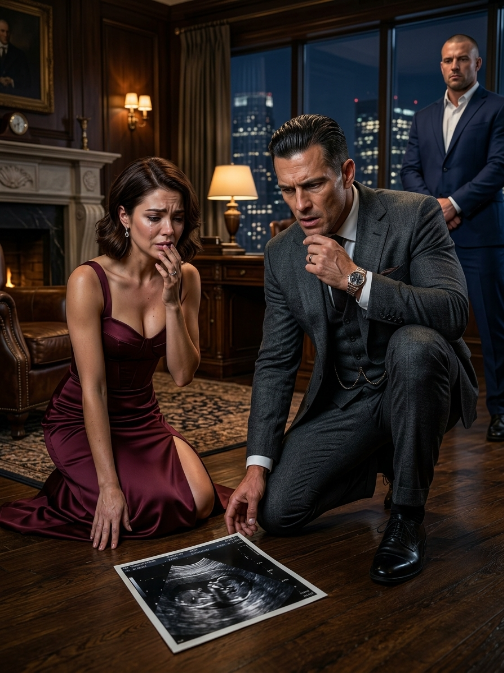
Her Father Sold Her for Being Barren—Broken and Cast Aside, She Never Expected the Mafia Widower to Look at Her… Then He Said, “You’re the Only Mother My Four Children Will Ever Need.”

## PART 1
The doctor said the words as if he were reading the weather.
“Severe endometriosis,” he said, looking at the chart instead of at Selin’s face. “Complicated by a congenital uterine anomaly. I’m sorry, Miss Ferraro, but natural conception is not medically possible.”
The white walls of the clinic seemed to brighten until they became painful.
Selin sat on the edge of the examination table with paper crinkling beneath her thighs, her hands folded so tightly in her lap that her knuckles had gone bloodless. Somewhere outside the closed door, a receptionist laughed softly into a phone. A printer hummed. A woman in the hallway asked whether her husband could come back for the ultrasound.
Selin stared at the doctor’s mouth.
It kept moving.
There were options, he said. There were ways to build a family, he said. Counselors, specialists, support groups, reproductive alternatives, adoption resources.
He was kind enough.
That almost made it worse.
In another life, in another family, in another world, the diagnosis would have been devastating but survivable. A grief. A wound. A private sorrow that belonged to her body and her future.
In Selin Ferraro’s world, it was a sentence.
She was twenty-three years old, the only daughter of Anton Ferraro, a Queens capo with expensive suits, ugly instincts, and a talent for making cruelty sound like family duty. From childhood, Selin had known what she was being raised to become. Not a lawyer. Not an architect, which was the quiet dream she kept hidden like contraband — a studio apartment someday, drafting tables, natural light, buildings that stood because she understood what made them hold.
She was an alliance.
A womb with a last name.
A pretty face trained to smile beside a powerful man and produce sons who would carry bloodlines and territory into the next generation.
Her engagement to Cosimo Bellanti had been arranged when she was seventeen.
Cosimo was not gentle. He was not particularly intelligent. But he belonged to a family Anton needed, and in Anton Ferraro’s ledger of human value, that made him suitable.
Cosimo wanted sons.
At least three, he had once said at dinner, speaking across Selin as if she were an estate he had not yet inspected.
Anton had laughed.
“My girl comes from strong women,” he said. “She’ll give you what you need.”
Selin had lowered her eyes to the tablecloth and said nothing.
That was what she had been trained to do.
Say nothing.
Smile later.
Survive quietly.
The car ride back to the Ferraro estate in New Jersey took forty-one minutes.
Selin counted them because counting was better than crying.
She did not call Anton. She did not call her mother, Rosa. The clinic had asked whether she wanted someone notified, and Selin had said no.
That had been foolish.
By the time the iron gates opened, Anton already knew.
He was waiting in his study.
The study smelled of cigar smoke, leather, old whiskey, and the masculine version of decay — expensive things used to cover rot. Her father stood near the fireplace with the medical report in one hand and a glass of scotch in the other. Her mother stood by the window with her arms folded, pearls at her throat, face controlled into the cold neutrality Selin had learned to fear more than anger.
Anton hurled the scotch glass into the fireplace.
Crystal exploded against brick.
Selin did not flinch.
That angered him more.
“Worthless,” he said.
The word hit harder because he did not shout it.
He spat it like a conclusion.
“Twenty-three years,” Anton continued. “Twenty-three years feeding you, protecting you, keeping you clean enough for a good family, and you can’t do the one thing you were born to do.”
Selin stood in front of his desk, coat still damp from the rain.
Her mother looked away.
Not in grief.
In embarrassment.
“Cosimo’s people called,” Anton said. “Wedding’s off. He said he doesn’t buy broken merchandise.”
Selin’s throat tightened.
She wanted to say something to her mother. Some small final plea. Some daughter’s question that still hoped there might be a mother beneath the pearls.
Rosa’s eyes returned to her.
Empty of defense.
“You should have told us sooner,” her mother said.
“I found out today,” Selin whispered.
Rosa’s mouth pressed into a thin line.
“It hardly matters now.”
That was the first death.
Not the diagnosis.
Not Cosimo canceling.
Not Anton’s disgust.
Her mother’s sentence.
*It hardly matters now.*
For two weeks, Selin became a ghost inside the house where she had grown up.
Her allowance disappeared first. Then the driver stopped taking her calls. Then her jewelry was removed from her dresser for safekeeping.
At dinner, her place was moved halfway down the table beside an empty chair. She sat listening to men discuss territory, debts, shipments, court dates, while no one looked at her unless they needed to be reminded of Anton Ferraro’s humiliation.
She learned how quickly a daughter could become a liability.
On the fifteenth night, Anton summoned her.
Not to the study.
To the front hall.
That told her everything.
A black dress had been laid across her bed. Simple. No jewelry. No coat except a thin wool one.
Anton waited by the door.
Rosa was not there.
The drive into Queens happened under cold rain. No one spoke. Selin sat beside her father watching streetlights smear across wet windows. The city became uglier as they moved east — warehouses, chain-link fences, loading docks, rusted signs, men standing beneath overhangs with their hands in their pockets.
The car stopped outside an old shipping warehouse converted into an underground cigar lounge.
Inside, the air was thick with smoke, beer, and danger.
Men turned as Anton walked in. Some nodded. Some smirked. All of them looked at Selin.
She kept her eyes on the floor. Not because she was weak. Because some rooms became more dangerous when a woman’s fear fed them.
At the back, a man sat behind a rusted steel table.
Rade Vukovic.
Large. Scarred. Cold eyes. He did not stand when Anton approached.
His gaze moved over Selin slowly.
She felt skinned by it.
“She’s quiet,” Rade said.
Anton forced a laugh. “She knows her place.”
Selin did not look at him.
She had spent years thinking her father could not disappoint her more than he already had.
Children were optimistic that way, even after they learned better.
Rade reached across the table and touched her chin.
His fingers were rough.
Selin’s stomach turned, but she did not pull back.
“Pretty enough,” he said. “But not what I was promised.”
“She doesn’t need to produce heirs for you,” Anton said quickly. “You wanted leverage. Possession. A house ornament.”
The room blurred around Selin.
Not visually.
Emotionally.
Her mind stepped back as if distance could protect it.
Anton slid a document across the table.
Debt transfer. Settlement of two point seven million dollars. Collateral accepted. Selin Ferraro.
Her name looked wrong in the contract.
Too neat. Too legal. Too small for a life.
Rade smiled.
“A barren girl for almost three million,” he said. “Not a proud bargain, Anton.”
Anton’s jaw flexed.
“You want the debt cleared or not?”
Rade opened a leather folder and pulled out signed IOUs.
“The debt is clear when she leaves with me.”
Selin closed her eyes.
The world became sound.
Smoke roughening throats.
Rain hitting the warehouse roof.
Her own heartbeat, steady and astonished, as if her body could not yet accept what her family had done.
Then the warehouse doors opened.
The sound was not loud.
But every man heard it.
Conversations stopped.
A chair scraped backward.
The temperature in the room changed.
Footsteps crossed the concrete.
Slow.
Measured.
Certain.
Marco Conti walked into the dim light.
He was thirty-seven years old and already spoken of in New York like weather people prayed would pass over their house. The head of the Conti organization. Widower. Father. He had broad shoulders, dark hair, an unreadable face, and a charcoal suit that looked too clean for the room.
Behind him stood two men.
No performance.
No shouting.
Only presence.
That was enough.
Anton turned pale.
Rade stood too quickly, buttoning his jacket with clumsy fingers.
“Don Conti,” he said. “We did not expect you tonight.”
Marco did not answer him.
His eyes were on Selin.
She looked back.
Not pleading.
Not hoping.
That seemed to catch him more than tears would have.
She had the face of someone standing at the edge of a cliff who had already stopped expecting anyone to pull her back.
Marco approached the table.
“Anton,” he said.
His voice was low, controlled.
“I hear you are settling a debt.”
Anton swallowed. “A private family matter.”
Marco looked at the contract.
Then at Selin.
Then back to Anton.
“Not anymore.”
Rade’s pride made one final mistake.
“With respect, Conti, a deal was struck.”
Marco turned his head.
The look he gave Rade held no anger.
Only information.
“I was not making a bid.”
The room went silent.
“I was stating a fact.”
Rade’s confidence vanished behind pressed lips.
Marco placed one hand on the back of the chair beside Selin.
“The girl leaves with me.”
Anton made a strangled sound. “Don Conti, she’s—”
Marco’s eyes cut to him.
Anton stopped.
“She is what?” Marco asked softly.
No one moved.
Anton’s mouth opened, then closed.
Marco picked up the contract and read the first page. Then he tore it once down the center. The sound was small but absolute.
“Your debt to Rade is cleared,” Marco said. “He has his paper back.”
Rade’s face darkened, but he did not argue.
“Anton,” Marco continued, “now you owe me two point seven million dollars.”
Anton’s knees seemed to weaken.
“And I do not accept daughters as payment.”
For the first time that night, something moved inside Selin’s chest.
Not hope.
Hope was too large.
Something smaller.
A breath.
Marco removed his jacket and placed it around her shoulders.
It was warm. Heavy. It smelled of cedar and rain.
He did not touch her skin.
“Walk,” he said.
Not gentle, exactly.
But clean.
It offered movement.
So Selin walked.
Out of the smoke.
Past Anton’s white face.
Past Rade’s bruised pride.
Past men who had watched her be valued, discounted, traded, and reclaimed without once asking what she wanted.
She walked into the rain.
—
In the armored car, the divider rose.
The warehouse disappeared behind them.
For ten minutes, they moved through wet Queens in silence.
Finally, Selin spoke.
“My father told you what I am.”
Marco turned slightly.
“He told me what he thinks you are.”
“I can’t have children.”
“I know.”
“If you took me for leverage or some bloodline bargain, you wasted nearly three million dollars.”
Marco looked out at the wet city lights.
“I did not buy you.”
The words settled between them.
“I interrupted a transaction.”
“Is there a difference?”
“Yes,” he said. “You can leave when it is safe.”
She laughed once.
A broken sound.
“Safe from whom? My father? Rade? You?”
His jaw tightened.
“Fair question.”
He reached for the console and poured water into a glass. He handed it to her carefully.
She took it because her throat hurt.
“I do not need heirs,” Marco said.
Selin’s fingers stilled around the glass.
“I already have four children.”
She knew that too.
Everyone knew.
Camille Conti had died two years earlier. After that, Marco stopped appearing at public events except when necessary. Stories spread. The children were wild. The Romano estate had become a guarded mausoleum.
“Four children,” he continued, “who lost their mother and then lost every adult who tried to replace her. The nannies quit. The tutors request transfers. The women in my circle approach the house like it is an inheritance to claim.”
Selin heard the exhaustion under the power.
The first human thing in his voice.
“They want to marry me,” Marco said. “Not because they love me. Not because they love my children. Because they want to bear the next heir and secure themselves beside the name.”
He looked at her then.
“I do not need a woman who wants a child of her own and will push Camille’s children to the edge.”
Selin’s breathing slowed.
“I need someone who looks at my four children and knows they are not obstacles. Not competition. Not temporary burdens before real motherhood begins.”
His voice dropped.
“Your father called you defective. I call you impossible to corrupt in the one way I most fear.”
Selin stared at him.
“You want me because I can’t have children.”
“I want you because no one can tempt you to replace mine.”
Not romance.
Not tenderness.
Not yet.
A practical truth brutal enough to be honest and strange enough to save her life.
“What are you offering?” she asked.
“My protection. My name if you choose it. A home. Respect from everyone who fears me, which is everyone useful.”
“And in return?”
“You help my children heal.”
Selin looked at her hands.
Hours ago, a doctor had told her one future was impossible.
Her father had turned that impossibility into condemnation.
Rade had turned it into price.
Marco had turned it into purpose.
That did not make him kind.
It did not make him safe.
But it made him the first man that day who saw something other than waste.
“I do not know how to be a mother,” she said.
Marco leaned back.
“No one in my house knows how to be a child anymore. You will learn together.”
The answer was not soft.
But it was true.
And for the first time since the clinic, Selin Ferraro allowed herself to wonder whether broken things could still belong somewhere.
—
## PART 2
The Conti estate did not look like a home.
It looked like wealth protecting grief.
Iron gates. A long driveway. A limestone house overlooking the Sound, its windows glowing like watchful eyes. No toys in the entry. No school drawings on the walls. No family pictures on the console tables. No smell of cooking or crayons or spilled juice.
Only polish.
Space.
Echo.
Marco led her to a guest suite across from a hallway of smaller bedrooms.
“This is yours.”
“When do I meet the children?”
His expression shifted for the first time since the warehouse.
Something close to fear.
“Morning. They are not easy.”
“No child who has lost a mother should be easy.”
He looked away.
“The staff calls this wing a war zone,” he said. “Behind my back.”
“Then the staff is honest.”
“They may try to make you leave.”
Selin set his jacket on the chair.
“Professional caregivers are paid to tolerate difficult children,” she said. “I have nowhere else to go. I can afford to be patient.”
Marco stood in the doorway a moment longer.
Then: “Good night, Selin.”
“Good night, Don Conti.”
“My name is Marco.”
“Not yet,” she said.
His eyes held hers.
Something like respect passed between them.
Then he left.
—
At seven the next morning, the children entered the dining room.
Nico came first.
Twelve years old. Dark-haired, blue-eyed, already carrying the anger of men twice his age. He looked painfully like Marco but without the practiced control. His grief had no suit to wear.
Behind him came Thomas.
Nine. Smaller. Shoulders hunched. Gaze fixed on the floor. His hand held Elena’s.
Elena was six, pale, with deep shadows beneath her eyes. She clutched a soft blanket and stared at Selin as if trying to determine whether she was real or another temporary adult who would vanish before learning where the nightmares lived.
Last came Pia.
Four years old. Round cheeks. Wild curls. A ragged stuffed rabbit held by one ear. She stared with open curiosity.
Nico spoke first.
“Who are you?”
Selin folded her hands on the table.
“My name is Selin.”
“Are you another babysitter?”
“No.”
“A tutor?”
“No.”
“One of my father’s women?”
The nanny behind them gasped softly.
Marco’s head turned.
Selin raised one hand slightly, stopping whatever command might be forming.
“No,” she said calmly. “I am not one of your father’s women.”
Nico’s eyes narrowed.
“Then why are you here?”
“Because your father asked me to make sure you are safe, fed, and protected.”
“We don’t need you.”
“I didn’t say you did.”
That surprised him.
He had expected argument.
“I am not here to replace your mother,” Selin continued. “I am not here to be your best friend. You can yell, break things, refuse breakfast, and tell me every day that I don’t belong here. That’s your choice.”
She leaned forward slightly.
“My choice is to stay.”
Nico stared.
For the first time, his rage tripped over something.
Honesty.
Adults had lied to him for two years.
*Everything will be fine. Your mother is watching over you. Your father is doing his best.*
This woman had offered none of those useless cushions.
“You’ll leave,” he said.
“Maybe one day,” Selin replied. “But not because you scare me.”
He kicked the leg of a chair, then dropped into it.
Thomas followed silently.
Elena climbed into her chair with careful movements.
Pia pointed at Selin’s sweater.
“You look like milk.”
The table went silent.
Then Selin laughed.
“That may be the strangest compliment I’ve ever received.”
Pia considered.
“I like milk.”
“Then thank you.”
Marco turned toward the window before anyone could see too much of his face.
—
The first weeks were war without weapons.
Nico tested boundaries like a boy trying to prove the house still had walls. He broke a porcelain vase in the hall and waited for Selin to scream.
She appeared in the doorway, looked at the shattered pieces, and said, “Get a broom.”
He blinked.
“What?”
“You broke it. You clean it.”
“That vase was worth more than your life.”
Selin held his gaze.
“No object in this house is worth more than a person. Get a broom.”
He did.
Badly.
But he did.
Thomas refused to speak. Not one word.
Selin did not force him. She placed paper and pencils beside him in the conservatory. He ignored them for three days. On the fourth, he drew a black square. On the fifth, a smaller black square inside the first.
“May I sit here?” Selin asked.
He shrugged.
She sat at the opposite end of the table and drew a yellow circle on her own paper.
Thomas looked at it.
Then away.
The next day, he drew a door.
Elena had night terrors.
No one had told Selin how bad they were. A child screaming at midnight had become, in that terrible way grief normalized itself, part of the house’s weather.
On the sixth night, a thunderstorm shook the windows.
A scream tore through the hall.
Selin was out of bed before she thought.
Elena’s door was open. The night nurse stood inside, helpless, one hand at her throat while the little girl thrashed in her sheets, eyes open but unseeing, screaming for a mother who could not answer.
Selin pushed past the nurse.
She climbed onto the bed and gathered Elena carefully but firmly against her chest.
Elena kicked. Scratched. Fought.
Selin held on.
“I’ve got you,” she whispered. “I’ve got you, sweetheart. You are safe. The monsters cannot cross this bed while I am holding you.”
Elena sobbed.
Her small fists gripped Selin’s sweater.
Selin began to hum.
An old lullaby her grandmother had sung before the Ferraro house became too cold for music. Low. Repetitive. Soft enough to enter the spaces panic had opened.
Elena’s breathing changed first.
Then her hands loosened.
Then her face turned into Selin’s neck and she wept like someone who had been waiting two years to collapse where she would not be dropped.
Marco stood in the doorway.
Selin saw him only after Elena slept.
He looked undone.
Not dramatically. Marco did not have the luxury of dramatic collapse. But something in his face had cracked open.
“You can go,” Selin told the nurse quietly.
The woman left.
Marco entered slowly.
“Who held her after Camille died?” Selin asked.
He looked away.
“She would not let anyone touch her at first.”
“That wasn’t my question.”
A long silence.
Then: “No one consistently.”
Selin nodded.
No judgment.
That made it worse for him.
“I was hunting the men who killed my wife,” he said.
“And your children were here.”
“Yes.”
The word cost him.
“Grief does not excuse absence,” Selin said. “It only explains it.”
Marco looked at her.
No one spoke to him like that.
Not anymore.
“You think I failed them.”
“I think you were wounded and powerful enough that everyone around you pretended the wound was leadership.”
His eyes darkened.
But he did not strike back.
He only said, “And you?”
“What about me?”
“You were wounded tonight too.”
She looked at Elena’s sleeping face.
“For the first time in weeks, the wound was useful.”
—
The house changed in small ways.
Not pretty ways.
Real ways.
Breakfast moved to a smaller table.
Selin ordered framed photographs of Camille from storage and placed them in the children’s hallway. Marco found her doing it and stopped as if she had opened a grave.
“They need to see her,” Selin said before he could object. “Not as a ghost. As their mother.”
His voice was rough.
“I thought it would hurt them.”
“It already hurts. At least give the hurt a face.”
He stood beside her as she hung the largest photograph.
Camille laughing in the garden, Pia a baby in her arms, Nico leaning against her side pretending not to like being held.
Marco touched the frame once.
Then lowered his hand.
“Thank you.”
The first time he said it without sounding like a command.
Pia began following Selin everywhere.
Into the breakfast room.
Into the conservatory.
Into the laundry room, where Selin discovered the children’s staff had been sending everything out because no one in the house liked ordinary domestic tasks.
Selin did not love laundry.
But children needed to see care happen in small visible ways.
Pia sat on the floor with her rabbit and watched Selin fold socks.
“My mama folded like that,” she said one afternoon.
Selin’s hands paused.
“Did she?”
“She sang.”
“What did she sing?”
Pia’s little face tightened with effort.
“I forgot.”
Selin sat on the floor beside her.
“That’s all right. We can learn new songs and keep looking for the old ones.”
Pia climbed into her lap without asking.
Selin froze.
Then slowly wrapped one arm around her.
From the doorway, Nico saw.
He said nothing.
But he did not leave.
Thomas spoke first in the conservatory.
It was raining.
Selin painted badly. Thomas drew with painful precision. He had drawn the same door for six days. Each time smaller. Each time darker.
On the seventh day, Selin placed a yellow circle beside his page.
He stared at it.
“What is that?”
His voice was so soft she almost thought she imagined it.
“A sun.”
“Suns don’t go indoors.”
“No. But drawings don’t have to follow rules.”
He looked at her.
Then drew a small line beneath the door.
“A crack,” he said.
She nodded.
“Light gets in that way.”
After that, he did not speak much.
But sometimes, when he wanted Selin to sit with him, he placed a pencil beside her chair.
Nico resisted the longest.
Because Nico remembered the most.
Camille’s perfume. The exact sound of her laugh. The night men came to the house and his father returned with blood on his cuffs and no mother behind him.
He remembered deciding that if he became cruel enough, no one would again mistake him for a child who could be abandoned.
Selin never tried to soften him by force.
She gave him responsibility.
He hated that.
Then needed it.
One morning, he refused to attend tutoring.
Selin found him in the old gym throwing punches at a bag too heavy for his wrists.
“You’re angry,” she said.
He struck the bag again. “No kidding.”
“Good. Anger means something in you still knows you deserved better.”
His fist stopped.
She tossed him a towel.
“But if you keep punching without knowing where to put the anger, it will start using you instead.”
He glared. “You sound like a therapist.”
“I’ve never been allowed to see one, so that’s impressive.”
He snorted despite himself.
Almost laughter.
Almost.
Marco watched from distances at first.
Doorways. Hallways. The far side of rooms.
A man accustomed to commanding everything and belonging nowhere in his own house.
Selin began forcing him back in.
Not with speeches.
With logistics.
“Pia wants pancakes. You’re making them.”
“I don’t cook.”
“Then she will learn that powerful men can fail at pancakes and survive.”
He burned the first batch.
Pia declared them “dragon pancakes” and ate one anyway.
Elena giggled for the first time in months.
Marco stood beside the stove holding a spatula like a weapon he did not understand.
Selin turned away so he could keep whatever dignity he needed.
But she smiled.
That was the danger.
Not the smile.
The warmth behind it.
—
Anton called on the twenty-ninth day.
Marco took the call in his study.
Selin happened to be outside with folded laundry for Elena’s room. She did not intend to listen. But houses built for secrets carried sound strangely.
“I need more time,” Anton said through the speaker.
“No.”
“Marco, nearly three million—”
“You should have considered that before trading your daughter.”
“She was mine to arrange.”
The silence that followed was worse than shouting.
When Marco spoke again, his voice was deadly calm.
“Do not say that again.”
Anton laughed nervously. “You think she’s yours now?”
“No,” Marco said. “That is the difference between us.”
Selin went still.
“She belongs to herself. Which is why men like you have never known what to do with her.”
She stood there for a long time after the call ended.
*She belongs to herself.*
No one had ever said that about her before.
—
## PART 3
The kidnapping attempt came on a bright Friday afternoon, which made the violence of it feel even more obscene.
Selin had insisted on joining the school pickup.
Marco’s security team objected. Marco objected. Nico objected loudest.
“You don’t have to come,” he said that morning, shoving books into his bag. “I’m not a baby.”
“No,” Selin replied, placing a wrapped pastry in the side pocket. “You’re a twelve-year-old pretending not to want someone to show up for you.”
His face flushed. “I don’t care.”
“Good. Then my presence won’t bother you.”
He rolled his eyes.
But when he left, he did not remove the pastry.
The armored Range Rover waited near the school gate at dismissal. Children spilled from the oak doors in navy uniforms and backpacks.
Nico emerged, scanning without meaning to.
He saw her.
For one second, his expression changed.
Not quite a smile.
A tiny wave.
Selin lifted her hand.
Then a delivery van slammed into the trailing security car.
The sound cracked the afternoon open.
Gregory, the driver, shouted.
A black sedan blocked the Range Rover.
Men in dark masks rushed toward the sidewalk.
Nico froze.
He was twelve.
For all his anger and all the hardness he had built around himself, he was twelve.
Selin moved before fear finished forming.
She opened the door and ran.
She heard Gregory shouting.
A car horn.
Children screaming.
The world blurred into motion, but Nico remained clear.
A masked man reached for his jacket.
Selin threw herself between them and slammed into Nico hard enough to knock him behind the brick entrance column. Pain flashed across her shoulder. She did not know how badly she was hurt. She did not care.
She covered Nico with her body.
His breath was hot and panicked against her neck.
“I’ve got you,” she said. “Nico, listen to me. I’ve got you.”
“Selin—”
“Don’t look. Breathe against my shoulder. Count with me.”
“I can’t—”
“Yes, you can. One.”
His fingers dug into her arm.
“One,” he gasped.
“Two.”
“Two.”
The entire attack lasted less than a minute.
Security responded.
Sirens approached.
The attackers fled.
But inside those seconds, Nico’s world changed.
Not because someone tried to take him.
Because someone chose to stand between him and the danger.
When the noise faded, Nico looked up.
Selin’s face had gone pale.
“Nico,” he whispered. “You’re hurt.”
She tried to answer.
The sky above him tilted.
“Are you safe?” she asked.
He began crying then.
Not quietly.
Like a child.
“Yes,” he sobbed.
Selin smiled faintly.
“Good.”
Then the world disappeared.
—
Marco arrived at the hospital like a storm given a body.
Doors opened. Men moved aside. Every person in the corridor understood in the span of thirty seconds that Marco Conti’s calm was control so tight it looked like stillness.
“Where is she?”
The surgeon met him outside a private recovery room.
“Stable. The injury was serious but not life-threatening. She was fortunate.”
Marco looked through the glass.
Selin lay unconscious under white blankets, one shoulder heavily bandaged, face bloodless against the pillow.
*Fortunate.*
The word felt obscene.
Nico sat in a chair outside the room with dried tears on his cheeks and Selin’s blood on his school shirt.
Marco knelt before his son.
He had not knelt in front of Nico in two years.
“Are you hurt?”
Nico shook his head.
“Tell me.”
“I’m not hurt.”
Marco checked him himself, hands careful, jaw tight.
Nico’s face crumpled.
“She covered me,” he whispered.
“I know.”
“They tried to grab me, and she covered me.”
Marco closed his eyes.
Just once.
When he opened them, beneath the old violence was something deeper.
Terror.
A father’s terror.
“I froze,” Nico said.
“You survived.”
“I froze.”
“You are a child.”
“I should have—”
Marco gripped his shoulders.
“You are a child,” he repeated, voice rougher now. “The adults were supposed to protect you. Selin did. That is not your shame.”
Nico stared.
Then collapsed forward into his father’s arms.
Marco held him.
Awkwardly at first.
Then fiercely.
—
Selin woke six hours later.
The room was dim. Machines beeped softly. Rain tapped the window.
She turned her head and saw Marco.
He sat beside the bed, sleeves rolled, tie gone, face carved by exhaustion.
“Nico,” she rasped.
Marco took her hand.
“He is safe.”
Her eyes closed.
“Good.”
His grip tightened.
“Do not ever do that again.”
She opened one eye.
“Save your son?”
“Run into an attack without armor.”
“I didn’t have time to accessorize.”
His face changed.
Not laughter.
Pain wearing the shape of fury.
“You could have died.”
“So could he.”
Silence.
She looked at him fully.
“If you want someone to mother your children, Marco, you cannot ask her to value her own safety above theirs.”
His jaw worked.
“I asked you to help them heal. Not bleed for it.”
“Sometimes those are not separate things.”
He looked away.
For once, Marco Conti had no answer.
The door opened quietly.
Nico stood there.
His eyes were red.
He looked smaller than he had that morning, as if the attack had stripped away the costume he had been wearing over his grief.
Marco stood, but Selin squeezed his hand.
“Let him.”
Nico came to the bed slowly.
“I brought the pastry,” he said.
His voice cracked.
Selin blinked.
He held up the crushed little box from his backpack.
“It got smashed.”
She looked at it.
Then at him.
“Well,” she whispered, “I’ve eaten worse.”
That did it.
Nico covered his face.
“I’m sorry.”
“Nico—”
“I said I didn’t care if you came. I was mean. I broke things. I wanted you to leave. And you—”
He could not finish.
Selin lifted her good hand.
He took it immediately.
“You were angry,” she said. “Angry children do angry things.”
“You took the hit for me.”
“I chose to protect you.”
“Why?”
The question was naked.
Not because he did not understand protection.
Because he did not understand why protection stayed after rejection.
“Because you are worth protecting,” Selin said, “even when you’re angry. Even when you’re difficult. Even when you don’t know how to ask.”
Nico stared at her.
Then whispered the word that changed the room.
“Thank you, Mom.”
Marco turned away.
Too late.
Selin saw his face break.
Her own tears came fast. She had spent weeks being told what kind of mother she could never be. She had sat under white clinic lights and listened to her body become evidence against her. She had stood in her father’s study and heard her worth destroyed in one word.
*Worthless.*
Now a twelve-year-old boy with his mother’s grief and his father’s eyes had given her a different name.
*Mom.*
Not because she birthed him.
Because she stayed.
Selin pulled Nico carefully toward her good side.
He leaned down and sobbed against the blanket.
Marco stood by the window, one hand over his mouth, trying and failing to remain the kind of man no one saw shaken.
By evening, the entire household had arrived.
Thomas brought a drawing.
A door with yellow light spilling through it.
Elena climbed into the bed despite three adults and fell asleep against Selin’s uninjured side.
Pia asked whether the bandage was a superhero patch and kissed the edge of it before Marco could stop her.
The hospital room became crowded.
Messy.
Warm.
Alive.
For the first time since Camille’s death, Marco saw his children gathered around an adult without fear of being left.
Not a nanny.
Not a tutor.
Not a woman calculating her future place beside him.
Selin.
His decision in a warehouse had been strategic.
Desperate.
Cold in the way men became cold when they could not afford hope.
But what had grown from it was not strategy.
It was family.
—
The consequences outside the hospital unfolded quickly.
Security footage proved the ambush had been arranged through Anton Ferraro’s old contacts and Rade Vukovic’s network. The school route information had come from Anton. Phone records tied both men to the planning.
Marco could have handled it the old way.
Once, he might have.
But Selin’s words followed him out of the recovery room.
*If you want someone to mother your children, you cannot ask her to value her own safety above theirs.*
A mother deserved a world where her children did not inherit every violence of their fathers.
So Marco did something more devastating than rage.
He made the evidence public enough to destroy them socially, financially, and legally within the world they valued.
The Commission received the files first.
Not rumors.
Files.
Debt ledgers. Recordings. Route leaks. Proof that Anton Ferraro had sold his daughter, failed to pay his obligation, then conspired to kidnap a child under another leader’s protection.
Old men who had tolerated much did not tolerate weakness dressed as betrayal.
Anton was stripped of position before sunrise.
His accounts were frozen by men who had once toasted him.
His house was emptied of loyal faces by noon.
Rosa called Selin once.
Marco asked if she wanted to answer.
Selin looked at her mother’s name on the screen.
“No.”
Marco silenced it.
Rade Vukovic’s network scattered when his protection evaporated. Law enforcement moved with unusual speed after evidence found its way through careful channels. By the end of the week, the men who had treated Selin’s life like negotiable paper discovered that paper could cut back.
No speeches.
No bodies displayed.
No legends required.
Just doors closing.
Accounts disappearing.
Men who had laughed in a warehouse learning that consequences could arrive quietly and still take everything.
—
Selin recovered slowly.
She hated needing help with her hair. Hated the careful way everyone hovered. Hated that Marco looked at her bandage with guilt so heavy it entered the room before he did.
One night, she found him in the hospital chapel.
Not praying.
Sitting.
Small. Dim. A blue glass window casting muted color across the floor. Marco sat in the back pew with his elbows on his knees, head bowed.
“You look uncomfortable,” Selin said from the doorway.
He stood immediately.
“You should be in bed.”
“And you should be sleeping, yet here we are.”
He crossed to her, then stopped short of reaching for her.
He had learned that.
She noticed.
“I failed them,” he said.
“Which them?”
“My children. Camille. You.”
Selin leaned against the doorframe.
“You are taking responsibility from the guilty because guilt feels familiar to you,” she said. “Anton and Rade put danger near Nico. Not you.”
His eyes lifted.
She walked toward him carefully and sat in the pew.
He sat beside her.
After a while, Marco reached into his jacket and withdrew a small velvet box.
Selin looked at it.
“If that is another contract, I’m throwing it at you.”
A rough laugh escaped him.
“No contract.”
He opened the box.
A diamond ring. Old. Elegant. Not flashy. A family piece with history.
Selin’s breath caught despite herself.
“Our arrangement was practical,” Marco said. “Necessary. I offered protection and asked for your help. You gave my children something I did not know how to give them.”
His voice shifted.
“You gave them mornings. Songs. Rules. Photographs of their mother. Someone to run toward them instead of away.”
He looked at her.
“I will not say you completed the house. You are not furniture. You are not medicine. You are not a solution I purchased.”
Selin’s eyes filled slowly.
“You are a woman I respect,” he said. “A woman my children love. A woman with more courage than every man in that warehouse combined.”
He paused.
“And I love you.”
The words entered the chapel without drama.
That made them heavier.
“I do not want a marriage of convenience anymore,” Marco said. “I want a real one, if you want it too. Not because you owe me. Not because you need my name. Not because my children called you Mom and now everyone expects an ending.”
He set the box gently on the pew between them.
“Only if you choose me.”
Selin looked at the ring.
Then at the man who had taken her from a transaction and, against all odds, learned not to make himself another owner.
“I’m scared,” she said.
“Good.”
“That’s your response?”
“If you weren’t scared, you wouldn’t understand what this means.”
A tear slipped down her face.
“I will never give you a biological heir.”
“I have heirs.”
“I may grieve that sometimes.”
“Then I will sit with you when you do.”
“I may resent the world for making me feel grateful for the thing that hurt me.”
“Then resent it.”
“I am not Camille.”
His face softened.
“No. Camille was their first mother. You are not replacing her.”
“Then what am I?”
Marco reached for her hand, slow enough for her to refuse.
She did not.
“You are Selin,” he said. “That has become enough for all of us.”
She cried then.
Not like she did in private, silently, ashamed of the sound.
She cried openly in the small blue chapel while Marco held her hand and did not rush her answer.
Finally, she whispered, “Yes.”
His fingers tightened.
“But Marco?”
“Anything.”
“I will not be hidden as your wounded wife. If I become a Conti, I become one standing up.”
His eyes held hers.
“Beside me,” he said.
“No.”
He paused.
Then understood.
“With me.”
Selin smiled through tears.
“With me.”
—
The wedding took place three months later in the garden.
Not a cathedral.
Not a spectacle for old men.
A garden.
Camille’s photograph stood on a table beneath an olive tree because Selin insisted the children should never feel love required erasure. Elena placed flowers beside it. Pia placed her ragged rabbit there too and then took it back after two minutes because grief was one thing, but boundaries were another.
Nico walked Selin halfway down the aisle.
Marco met her in the middle with Thomas at his side.
That was Selin’s idea.
“No one gives me away,” she told them. “But someone can walk with me.”
Nico liked that.
He pretended not to.
When the officiant spoke of family, Pia whispered loudly, “We already are one.”
Everyone heard.
Everyone smiled.
Even Thomas.
At the reception, Selin danced carefully because her shoulder still ached in cold weather. Marco held her with a gentleness that would have shocked the men who feared him. Nico asked for one dance and stepped on her foot twice. Elena fell asleep in her chair before cake. Pia ate frosting with her fingers and blamed the rabbit.
Imperfect.
Beautifully.
Mercifully.
—
Years later, Selin found Nico in the garden.
He was fourteen. Taller. Still angry sometimes, but no longer ruled by it. He stood before Camille’s photograph, which they brought out on important days, and shifted awkwardly when Selin approached.
“I was just—”
“I know.”
He looked at the picture.
“Do you think she’d hate that I call you Mom?”
Selin’s heart squeezed.
“No,” she said carefully. “I think she would be grateful you have someone to call when you need one.”
He wiped at his face quickly.
“She was my mother first.”
“She always will be.”
“And you’re—”
Selin waited.
He looked at her.
“You’re my mother now too.”
The words were simple.
No hospital adrenaline.
No near loss making truth urgent.
Just a boy standing in a garden choosing language with care.
Selin touched his cheek.
“I’m honored.”
He rolled his eyes.
“Don’t make it weird.”
She laughed.
“Go inside before Pia eats all the cannoli.”
He ran.
Not away from pain.
Toward home.
Selin stayed in the garden a little longer.
The air smelled of lemon leaves and salt from the Sound. The house behind her rang with noise — Pia shouting, Elena singing off-key, Thomas asking where his sketchbook was, Marco’s low voice pretending to restore order and failing completely.
She placed one hand over her abdomen.
The old grief was still there.
It always would be.
Some losses did not vanish because other loves grew around them.
But grief was no longer the only thing her body meant.
Her body had carried Nico behind a stone column. Held Elena through nightmares. Rocked Pia through fevers. Sat beside Thomas through silence. Stood beside Marco while he learned how to be both powerful and present.
Her body had not failed at love.
Only at one version of biology.
That difference had saved her.
Marco found her beneath the olive tree.
He did not ask what she was thinking.
He had learned that sometimes silence was not absence.
He stood beside her.
After a while, she said, “My father called me worthless.”
Marco’s jaw tightened.
“Sometimes I still hear it.”
“I know.”
“But it is quieter now.”
Inside, Pia screamed with laughter.
A plate crashed.
Marco closed his eyes.
“Was that my mother’s serving platter?”
“Probably.”
“Worthless?” Selin asked softly.
He opened his eyes.
“No,” he said. “Never.”
She smiled.
The sun lowered over the water, gilding the windows of the house that had once felt like a guarded museum and now looked, at last, lived in.
There were fingerprints on the glass.
Toys near the terrace.
A crooked drawing taped inside one window.
A family inside making too much noise.
Selin Ferraro had been taken to a warehouse because men believed an empty womb made her empty.
They were wrong.
She was not empty.
She was waiting for a life large enough to receive all the love no one had allowed her to give.
And when Marco reached for her hand, she took it — not because he had rescued her, not because his name protected her, not because the world had finally decided she was useful.
She took it because she had chosen this.
The house.
The children.
The man.
The grief.
The laughter.
The complicated, imperfect, fiercely living family that had grown from the darkest night of her life.
Behind them, Pia shouted: “Mom!”
Selin turned.
All four children were at the terrace doors.
Nico pretending he had not called.
Thomas holding a sketchbook.
Elena waving both hands.
Pia bouncing on her toes.
Marco squeezed Selin’s fingers once.
“Go,” he said.
Selin walked toward them.
Not as defective goods.
Not as a debt.
Not as a substitute for a dead woman or a convenience for a grieving man.
As herself.
As their mother.
As the woman who had been told she could never create life and then built a home where four children learned how to live again.
And long after the sun disappeared behind Long Island Sound, the lights of the Conti estate stayed warm against the dark — no longer a fortress guarding sorrow, but a house full of proof that blood was not the only thing that made a family.
Sometimes love arrived wounded.
Sometimes it arrived unwanted.
Sometimes it arrived in a black dress, shaking under another man’s jacket after the worst night of its life.
But if it stayed — if it chose, if it kept showing up when fear screamed and doors slammed and old grief rose from the floorboards — then love became something stronger than blood.
It became home.
—
*THE END*