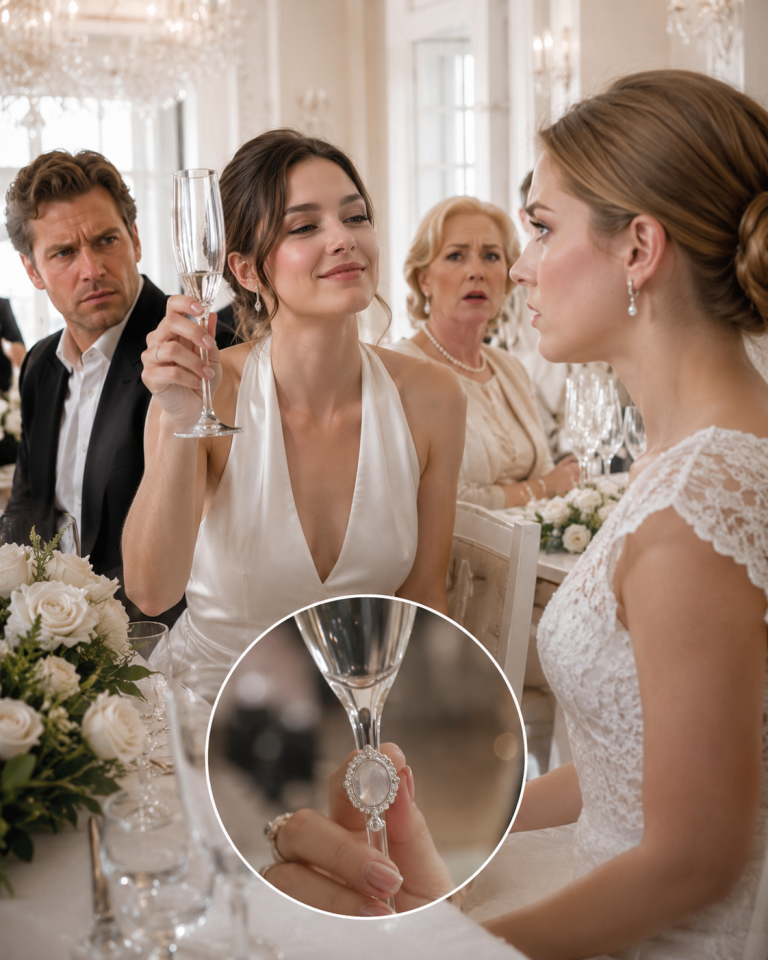
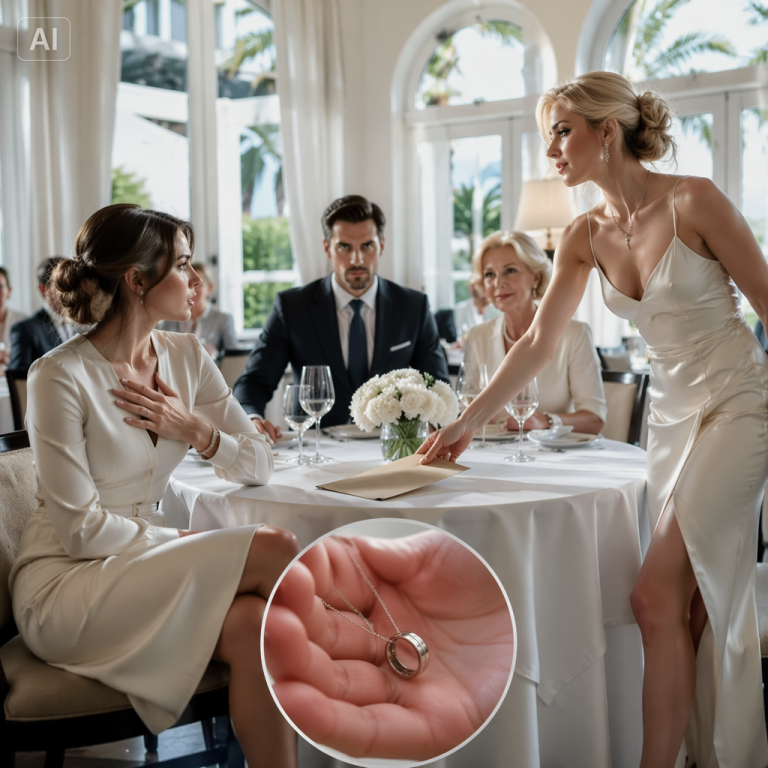
The Billionaire Paid His Quiet Assistant to Pretend She Loved Him for One Week—But When His Mother Saw Her Face, She Went Pale… And Exposed the Secret She’d Been Hiding for Two Years

## PART 1
The phone moved across the bathroom shelf like something alive.
Nadia had shampoo in her hair and steam on the mirror and approximately four seconds before the call went to voicemail. She rinsed one hand, grabbed the phone, and answered before she had finished thinking about whether she should.
“Mr. Voss.”
“Nadia.” His voice was the particular version of controlled that meant something had already gone wrong. “I need you in my office.”
The line ended.
She stood with the phone in her wet hand for a moment, looking at her reflection in the steam.
*Marco never calls at eleven forty-five on a Friday.*
She corrected herself automatically.
*Luca never calls at eleven forty-five on a Friday.*
It had been two years. She was still doing this — calling him the wrong name in her own head. Using the name she had first known him by, the one that had been on the temporary assignment sheet before she understood the scope of what she was walking into.
She rinsed her hair in forty-five seconds flat and was downstairs in twenty-two minutes, in jeans and a gray pullover because panic apparently disabled the wardrobe centers of her brain. She had put on lip balm in the elevator and immediately hated herself for it.
—
Luca Voss filled the doorway of his penthouse office the way certain people filled rooms — not through effort, just through presence. Six foot three, dark shirt open at the collar, sleeves rolled back, the posture of a man who had been awake for a long time dealing with things he was not going to explain.
“Come in.”
She came in.
The office had the full Manhattan view — cold, glittering, unapologetic. The city suited him. He owned enough of it to know its actual mechanics: the restaurants, the import operations, the real estate holdings that appeared in clean corporate filings and the other holdings that didn’t appear anywhere at all.
No court had ever substantiated anything about Luca Voss.
No journalist who had tried to substantiate something had seemed eager to try twice.
Nadia had worked for him for two years and had built up a specific, careful understanding of what this meant. She knew what people said about him. She also knew he sent his driver home early rather than ask him to wait through a dinner that ran long. She knew he had walked out of a nine-million-dollar deal because the other man had been rude to a hotel clerk. She knew he paid for his assistant’s parking even though she had not asked, and had never mentioned that he did.
These were not the qualities of a simple person.
She had made peace with that a long time ago. Or told herself she had.
She sat in the chair across from his desk without being asked, folded her hands in her lap, and waited.
Luca didn’t go behind the desk. He leaned against the front of it, close enough that she could see the particular quality of exhaustion in his face that meant he had been running calculations all night on something with no clean answer.
“I have a problem,” he said. “And I need your help solving it.”
“All right.”
The answer came out too easily. She had been saying *all right* to this man for two years and it still came out before she had finished deciding.
He told her about his mother’s birthday.
Seventy years old. The family’s estate in the Hamptons. A full week. Every relative, every cousin, his two sisters and their families, and Rosa Voss herself — who had, according to Luca’s account, been conducting a sustained single-topic interrogation since approximately his thirty-fourth birthday.
*Marco, when are you bringing someone home. Marco, the apartment is too quiet for one person. Marco, a successful man does not look less lonely because he stays busy.*
“She calls you Marco,” Nadia said.
“She named me after my grandfather. She earned it.”
Nadia had handled enough of his family calls to know this was accurate. Rosa called every Sunday and Luca took the calls regardless of what was happening in the office.
“Last month,” he said, “I told her I was seeing someone.”
Nadia looked at his desk.
She had seen the photographs. The charity gala. The dinner at Cipriani with a woman whose dress had probably cost more than Nadia’s monthly rent. The product of a life that moved at his altitude.
“Do you want me to arrange something?” she asked. “For whoever—”
“I need you to come.”
She looked up.
“To the Hamptons.”
“Yes.”
“As your—”
“As my girlfriend.” He said it without any particular ceremony. “For the week. In front of my family.”
She stared at him.
“I know how it sounds,” he said.
“I don’t think you do, actually.”
Something at the corner of his mouth almost moved. “Possibly not.”
“Why me?”
He turned toward the window and then back, the restless movement of a man who had been pacing this floor all night.
“Because you know me. My schedule, my family, what I’m like when things are going wrong. You can read a room faster than most people I trust with significant money. My mother already knows your name from the calls you handle.” He paused. “And because I trust you not to make this into something it isn’t.”
The sentence landed with the specific quiet of something that knew exactly what it was doing.
*Something it isn’t.*
She was safe. She was useful. She was the person who knew exactly which problems to solve before he noticed them and would therefore never be someone he needed to worry about.
“What would it involve?” she said.
“Behaving as though we’ve been together for six months. Holding hands at dinner. Letting me put an arm around you when the situation calls for it. Laughing when my cousins tell stories about me that are mostly true.” His eyes held hers. “There would be some physical affection. Nothing beyond what you’re comfortable with. Tell me where the lines are and I’ll stay inside them.”
She should have felt reassured.
She felt something else entirely, which she was going to need to manage carefully.
“I’d pay you,” he said. “Sixty thousand. Half now.”
The number went into her like a key turning.
Her sister’s specialist had given them a timeline last month. The treatment was not optional. The payment plan was not achievable on her current salary, which was good for a single person in Queens and insufficient for a single person in Queens with a sister who needed pulmonary care.
She had been doing arithmetic on this problem for eight weeks.
Sixty thousand dollars was not a solution.
It was enough of one.
“Why did you lie to her?” she asked. “Your mother. Why tell her you were seeing someone if you weren’t?”
He looked at the floor for a moment.
“She worries about me,” he said. “She has worried about me since my father died. The worry has a shape — it always comes back to the same place. Whether I’m alone in a way that matters.”
“Are you?”
He looked at her.
The question had come out before she decided to ask it.
“Yes,” he said.
One word. No performance attached to it.
“I told her what she needed to hear,” he continued, “and then I realized I had to produce evidence, and then I started to think about who I would trust with my family for a week and not regret it in either direction.”
“Either direction.”
“Someone who would be good with them,” he said. “And someone who could leave afterward without it being complicated.”
There it was.
Clean lines. Controlled outcome. The thing that made her the right choice, stated plainly and without any apparent awareness of what it meant to the person he was saying it to.
She looked at her hands in her lap.
Sixty thousand dollars.
Her sister Cass’s specialist.
The treatment timeline.
The eight weeks of arithmetic.
“I’ll do it,” she said.
He nodded once.
“Boundaries,” he said. “Tell me now.”
“Nothing I’m not comfortable with. You said that already.”
“I want you to be specific.”
She thought about it.
“Don’t touch me without warning,” she said. “Just — a moment. A look. Something. I don’t need much.”
“All right.”
“And don’t tell your family afterward that it wasn’t real. Let them think it ended naturally. They don’t need the other version.”
He looked at her with the specific attention he used when he was revising a prior assumption.
“That’s generous to them,” he said.
“It’s generous to you,” she said. “Your mother doesn’t need to spend the next decade worrying you paid someone to be at your birthday party.”
His jaw tightened slightly.
Not offense. Something else.
“All right,” he said again.
He pulled an envelope from the desk and held it out.
She stood to take it.
Their fingers did not touch.
She was very careful about that.
—
## PART 2
The Hamptons estate was large in the way that suggested someone had decided to stop caring about scale some generations back.
Nadia had seen it in photographs — Luca kept documentation of the property for insurance purposes and she had filed it twice — but photographs did not prepare you for the presence of a place where the hedgerows had been maintained in the same configuration for sixty years and the front door was heavy enough that it seemed to be making a statement.
Rosa Voss was waiting at the top of the entry steps.
She was seventy years old in two days, silver-haired, small, and moving toward them before the car had fully stopped.
Nadia had spoken to this woman perhaps thirty times on the phone over two years. She had managed Rosa’s calls with the same efficiency she managed everything else — gracefully, invisibly, trying not to develop an opinion. She had developed one anyway.
Rosa Voss saw everything.
That was the opinion.
“*Finalmente*,” she said, reaching them. She took Nadia’s face in both hands before she took her son’s.
She looked at Nadia for a long moment.
Not assessing. Something more serious than assessing.
Then she said, in Italian and then immediately in English: “Two years.”
“Mama—” Luca began.
“Two years she has been answering your phone and sending your flowers and knowing when you need silence.” Rosa’s hands were still holding Nadia’s face. “You think I don’t know the difference between a voice that works for someone and a voice that worries about them?”
Nadia went completely still.
“Mama,” Luca said again, differently.
Rosa released her and turned to her son.
“I don’t want flowers,” she said. “I want you to stop hiding from me.”
She went inside.
Luca stood beside Nadia on the front steps in the afternoon light.
The week stretched ahead of them.
“She knows,” Nadia said.
“She suspects,” Luca said. “She always suspects. It doesn’t mean she knows what to do with it.”
“Doesn’t it?”
He looked at the door his mother had just walked through.
“Come on,” he said. “Dinner’s at seven.”
—
The family was exactly what she had expected and nothing she had prepared for.
Luca’s sister Sofia immediately took Nadia’s side at dinner and began providing information about Luca that he clearly would have preferred she withhold. His cousin Enzo shook her hand with the specific warmth of someone who had been waiting for this person to arrive. His other sister Mara watched Nadia with an expression that oscillated between approval and suspicion and which Nadia found, privately, entirely reasonable.
She held her own.
She had two years of knowing exactly how Luca moved through professional situations and the practiced ease of someone who had learned, early, to belong to rooms that weren’t made for her. She laughed at the right moments. She asked the right questions. When Luca put his hand on the back of her chair she did not visibly react, which took more effort than anything else she had done that week.
He was careful. He had been careful in the car, on the steps, at the table. The warning glances he had promised — brief, almost imperceptible — were there every time.
She was grateful for them.
She was also, quietly, going to pieces.
On the third night, she was in the kitchen at midnight when Rosa appeared.
Nadia had come down for water. She did not sleep well in unfamiliar beds, or in beds in houses where she was performing something, or in beds in houses where the man she had been in love with for two years was three doors down the hall.
Rosa sat at the kitchen table as if she had been expecting this.
“Sit,” she said.
Nadia sat.
Rosa poured two glasses of something amber from a bottle on the counter.
“How long?” she said.
Nadia looked at the glass.
“Since about six months after I started working for him.”
“And he doesn’t know.”
“No.”
“Why not?”
Nadia turned the glass in her hands.
“Because he values what we have,” she said. “And I don’t want to be the reason it becomes something that has to be managed.” She looked at the table. “He trusts me not to make things complicated.”
Rosa made a sound that was not agreement.
“He trusts you with everything,” she said. “He does not trust himself with you.”
Nadia looked at her.
“There is a difference,” Rosa said. “The first is cowardice dressed as consideration. My son is not a coward in most things. But he has been one about this.”
“He doesn’t feel that way about me.”
“He watches you when you’re not looking,” Rosa said. “He has done this since the first time he brought you to Sunday dinner on the phone. I hear it in his voice when he mentions your name. I am seventy years old and I have raised two sons and I know what a man sounds like when he is trying not to want something.”
Nadia was very still.
“He hired me to do this,” she said. “For the week. He is paying me.”
Rosa absorbed this without particular surprise.
“I know,” she said.
“He told you?”
“No.” Rosa drank from her glass. “I told you — I know the difference between a voice that works for someone and a voice that worries about them. I know the difference between a woman being paid to hold a man’s hand and a woman trying to survive holding it.”
Nadia pressed her fingers briefly to her eyes.
“Rosa—”
“This is not an interrogation,” Rosa said, more gently. “I am not going to do anything with this information tonight.”
She reached across the table and put her hand over Nadia’s.
“I want you to listen to me,” she said. “You are in my house. You are real. Whatever arrangement you made to arrive here, you are real.” Her hand tightened slightly. “Don’t let him file you away because it’s easier for him. You understand?”
Nadia’s throat ached.
“He’s made his position clear,” she said.
“He has made his *fear* clear,” Rosa said. “Those are not the same thing.”
She stood, took her glass, and walked to the doorway.
“Sleep,” she said. “Tomorrow you’re helping me with the cake and I need you functional.”
She disappeared down the hall.
Nadia sat in the kitchen for a long time.
—
## PART 3
On Saturday — Rosa’s birthday, the last full day — something shifted in the afternoon.
It was a small thing.
They had been in the garden, the whole family assembled for photographs that Luca’s cousin Enzo had appointed himself to take. Sofia had arranged everyone with the authority of a woman who had been managing family photographs for decades. There was arguing about positioning. Rosa was laughing.
Luca had been standing beside Nadia for the photographs, close enough that she was aware of every inch between them.
Afterward, as the family dispersed toward the terrace, he stayed.
“You’ve been quiet today,” he said.
“It’s been a full week.”
“Yes.”
He looked at the garden — the hedgerows, the afternoon light, the estate his family had used for three generations.
“My mother talked to you,” he said.
She went still.
“She mentioned it this morning,” he said. “Not the content. Just — she said she’d spoken with you.”
“We had a late-night kitchen conversation,” Nadia said.
“She has those with people she takes seriously.”
“She takes everyone seriously.”
“Not like this.”
He turned to look at her.
She waited.
“Why did you say yes?” he said. “To the week. The real reason.”
“My sister needs a treatment,” she said. “That was the real reason.”
“Was there another reason?”
She looked at the hedgerows.
“Don’t ask me things you don’t want the answer to,” she said.
“I’m asking,” he said. “Because I want it.”
She turned to look at him.
His face was doing the thing it did when he had finished calculating and arrived at something he was no longer going to avoid.
“Nadia,” he said.
“Don’t,” she said. “Don’t do this because your mother—”
“I’m doing it because I’ve been doing the wrong arithmetic for two years,” he said. “I hired you because you were efficient and discreet and I thought those were the qualities I needed. And then you became—” He stopped.
“Careful,” she said.
“Necessary,” he said.
The word went into her like the sixty thousand dollars had — a key turning.
“I told you I trusted you not to make it into something it wasn’t,” he said. “That wasn’t consideration. My mother made me understand what it was.”
“What was it?”
“Fear,” he said. “That if I named it, I would lose what I had. And what I had was already too much to risk.”
She looked at him.
“You were going to pay me and send me home,” she said.
“Yes.”
“And go back to Sunday calls with your mother and pretending the problem was that you were too busy.”
“Yes.”
“And I was going to let you,” she said. “Because you trusted me not to complicate things.”
“I know.”
“That’s a terrible system,” she said.
“Yes,” he said. “It is.”
The garden held them in the afternoon quiet.
“The sixty thousand dollars,” she said.
“Is yours. That was separate.”
“Luca.”
“Cass needs the treatment,” he said. “That doesn’t change because this does.”
She looked at him for a long moment.
The week had been exactly what he’d described — his hand at the small of her back during photographs, his voice near her ear at dinner when a cousin said something that required a shared moment, the careful warning glances she had come to depend on. A performance of something.
Or the shape of something, waiting to be inhabited.
“You need to say it directly,” she said. “Not as a consequence of something your mother said. Not as a calculation about what you might lose. Directly.”
He looked at her.
“I have been in love with you for approximately fourteen months,” he said. “I have been a coward about it. I would like to not be a coward about it anymore.”
She exhaled.
“You should have just said that.”
“Yes,” he said. “I should have.”
“Fourteen months ago.”
“At minimum.”
She looked at the house, where she could hear the family beginning to move toward the terrace for the birthday dinner. Rosa’s voice, somewhere inside, directing the placement of something.
“This is going to be complicated,” she said.
“I know.”
“I still work for you. That’s a real problem.”
“We’ll make it less of one.”
“On what timeline?”
“Whatever you need.”
She thought about her sister’s specialist. The treatment timeline. The eight weeks of arithmetic that had led her here.
She thought about Rosa’s hands on her face at the front door.
*Two years.*
“I want to talk to your mother first,” she said.
He raised an eyebrow.
“She already knows,” Nadia said. “She should hear it from me that it worked out. She earned that.”
Something in his face changed — a softening she had seen before, usually when someone did something that surprised him by being more generous than he had expected.
“All right,” he said.
“And Luca?”
“Yes?”
“I’m still going to tell you when you’re wrong about things. That doesn’t change.”
“I’m counting on it,” he said.
They walked toward the house.
Inside, Rosa was in the kitchen arguing with Sofia about the best placement of the birthday cake. She looked up when they came in — at Luca first, then at Nadia, with the quick accurate assessment of a woman who had spent seventy years understanding rooms.
She nodded once.
The argument about the cake continued.
Nadia took her place in the kitchen and reached for the serving plates.
The birthday dinner was loud and long and full of the specific warmth of a family that had been gathering in this house for generations. Rosa laughed. Enzo told a story that had clearly been exaggerated over years into something better than its origins. Sofia won an argument about dessert that she had clearly been planning to win since morning.
Luca sat beside Nadia through all of it.
His hand, under the table, found hers.
She did not need a warning glance for this one.
She turned her palm and held on.
Across the table, Rosa caught her eye.
And smiled.
—
*THE END*