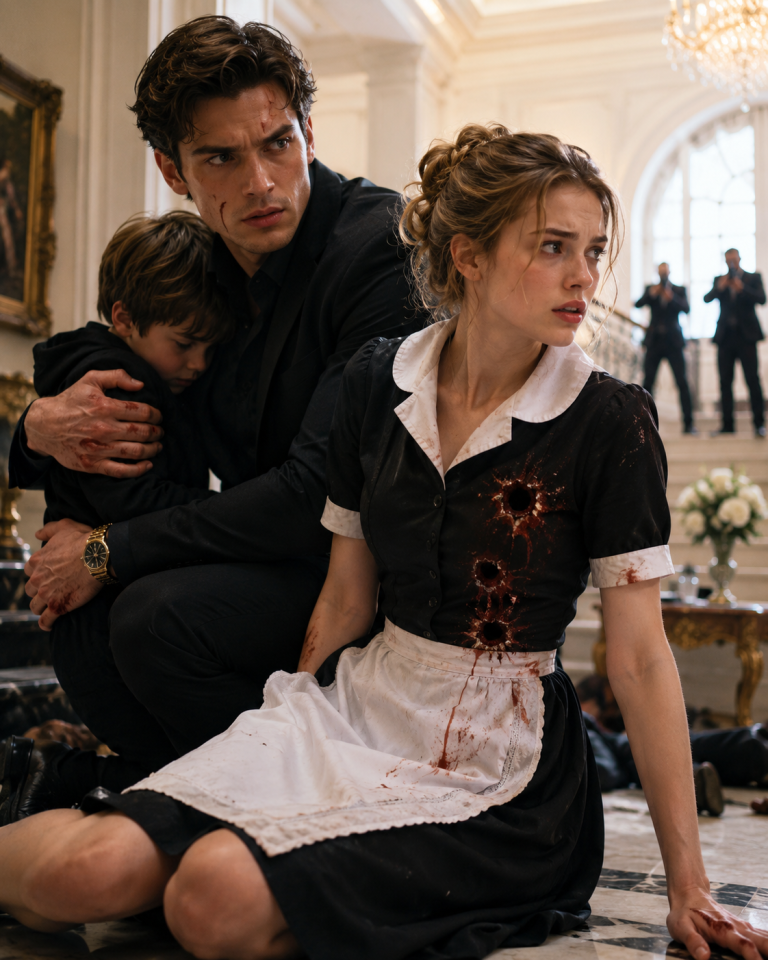
Pregnant and alone, I sat in my mafia husband’s chair during the ball. Then his mistress opened a small box… and one horrifying secret changed everything.

PART 1
He came home after midnight smelling of someone else’s perfume.
Not guilt. Perfume.
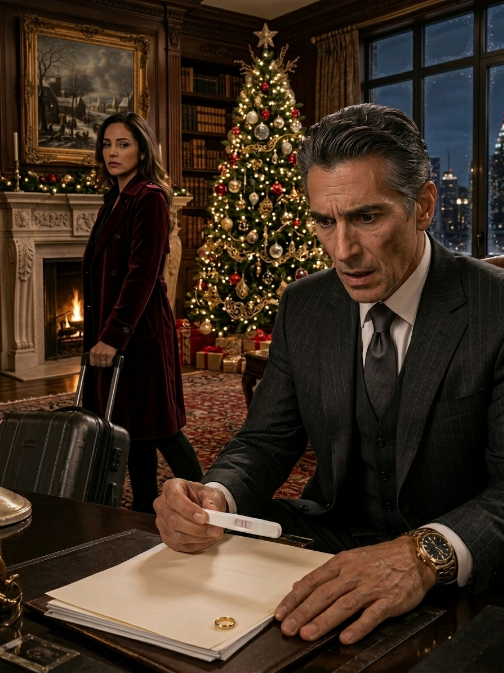
He expected the house to be dark. It was not. He found me in his study, behind his desk, one hand resting over my pregnant belly and a folder open under the lamp. The folder contained six documents. He didn’t know which six yet.
Victor Moretti stopped in the doorway.
“Sit down,” I said.
He almost laughed. I saw it cross his face — the beginning of a laugh, the version that would have said *this is my desk, this is my house, this is not how this works*. He swallowed it.
He sat down.
Not because he was afraid of me. Because six years of underestimating me had made him incurious, and incurious men sat down when confronted because they expected to have the conversation over quickly and then return to whatever they were doing.
“I know about the perfume,” I said. “But that’s not what this is.”
He looked at the folder.
I turned it toward him.
He read the first page.
His face changed.
Not the dramatic change of a man betrayed — a smaller, more specific change, the one that happened when a person encountered something they hadn’t predicted and had to revise their operating assumptions in real time.
“These are asset transfer documents,” he said.
“Yes.”
“These accounts—”
“Are now in a trust,” I said. “For the child. Structured so that they’re inaccessible to you and to me both, until the child is twenty-five, at which point they transfer directly.”
He looked up.
“How did you know these accounts existed.”
I looked at him.
“Victor,” I said. “I have lived inside your organization for six years. I attend the dinners. I sit at the tables. I smile at the men you need me to smile at. I listen to what people say when they think the woman in the room isn’t listening.” I paused. “I know where everything is.”
He was very still.
“Why are you doing this,” he said.
“Because I’m pregnant,” I said, “and I need the child to have something that doesn’t depend on your goodwill, which has been inconsistent.”
He didn’t argue with that.
“There’s a second matter,” I said.
I turned to the second document.
He looked at it.
I watched him read.
The document concerned a woman named Luna Vale, who was not named Luna Vale, who had ties to the Volkov family that predated by approximately two years her introduction into our social circle through a mutual acquaintance who had subsequently left the city under circumstances I had investigated and found non-coincidental.
I had been building this file for four months.
Not because I had known immediately. Because I had noticed something that didn’t fit — the specific way she positioned herself at events, the questions she asked that were slightly too informed, the relationship she cultivated with Victor that moved too quickly toward proximity to sensitive conversations. I had been careful and I had been patient and I had done this myself, without involving anyone from his organization who might have interests I didn’t fully understand.
Victor read the document.
When he finished, he looked at me.
“She’s Volkov,” he said.
“Her name is Svetlana Volkov,” I said. “She’s the youngest daughter. She was reported dead in a car accident seven years ago, which she was not. The death was useful to the family for reasons that are in the third document.”
He opened the third document.
I watched him read.
He read it twice.
When he looked up the second time, his expression had moved through several stages and arrived somewhere that was not the expression of a man who thought he was in a conversation with his wife.
“You’ve been investigating her for four months,” he said.
“Yes.”
“While pregnant.”
“Pregnancy doesn’t prevent information gathering,” I said. “It limits some physical activity. I was careful.”
He looked at me across his desk.
“Why didn’t you come to me,” he said.
“Because I needed to know the full picture before I handed it to someone who might make a decision about it before the picture was complete,” I said. “And because if you had ended things with her immediately, she might have moved differently. I wanted her to believe nothing had changed until we knew what she was actually doing.”
He absorbed this.
“What is she actually doing,” he said.
“The file is organized chronologically,” I said. “Start at page four.”
—
We attended the Castellano charity gala the following evening.
This was Victor’s decision and I did not object to it. His reasoning was that disappearing from public events after a development of this kind sent signals, and he was right that it did. My reasoning was different and I did not share it with him.
The Castellano gala was the event where Svetlana Volkov — who attended as Luna Vale, who had been building her position in this social world for two years — would expect to make a specific kind of move. I had found documentation in the file suggesting that a particular timeline had been set. Victor’s organization was facing contract negotiations with two other families, and the gala was the moment when those relationships would be visible and accessible.
I had also found something else in the file.
Something she was planning to use against me specifically.
I had not told Victor about this part. Not because I didn’t trust him with it, but because I needed him to react to it in the room rather than before it, and a man who knew what was coming sometimes had reactions that told the people watching too much about what he knew.
The gala was held at the Meridian, which had a ballroom designed for the specific purpose of displaying money to people who had money, which meant it was full of light and crystal and the particular density of expensively dressed people performing their relationships to each other.
Victor and I arrived together.
We were civil and photogenic, which was the version of us that public events required, and I was practiced at it. My dress was dark blue and the waistline had been let out because I was six months pregnant and I had decided not to conceal this, which meant the room knew we were expecting, which was information I preferred they have before the evening got complicated.
I saw her forty minutes after we arrived.
Red dress. Good posture. The specific ease of someone who had been preparing for an event for a long time and was now in it and moving with the confidence of a person who believed the ground was solid under them.
I watched her work the room.
I watched her move toward the people she needed to move toward.
I watched the box arrive.
—
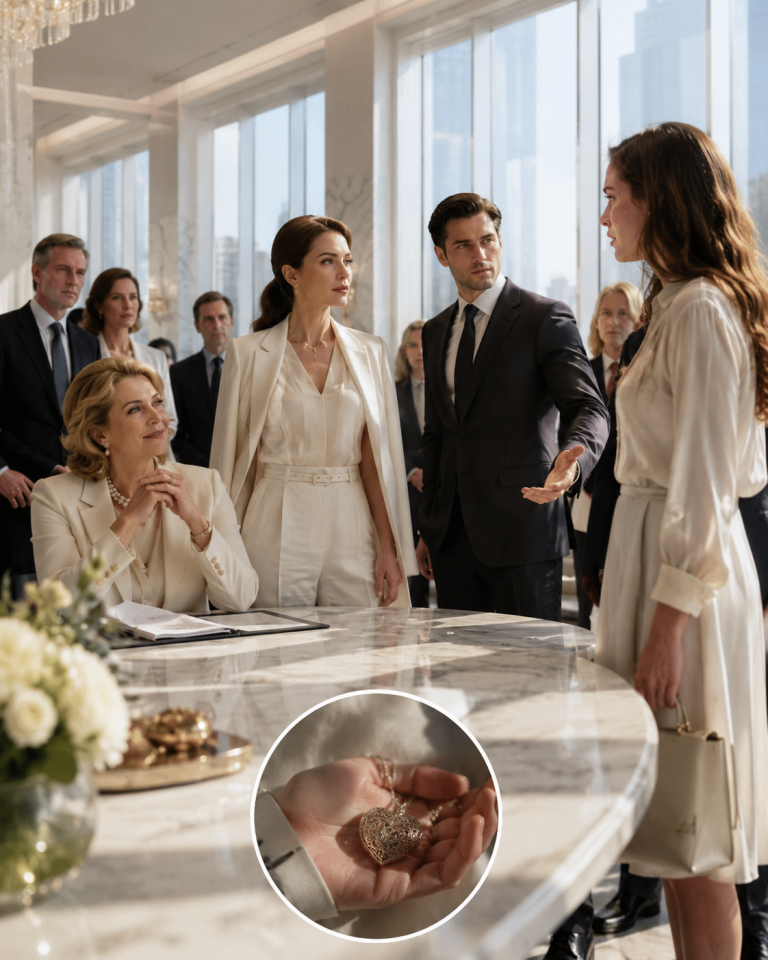
It was delivered to the event coordinator’s table during the dinner portion of the evening, which was when the room had settled and everyone was present and the attention that could be directed at something was focused.
The event coordinator — a professional who had worked these events for fifteen years and who had been given specific instructions by someone, which I was confident was not the Castellano family — brought the box to the small stage at the front of the room.
Luna Vale stepped forward at the same moment.
The room did what rooms did when something unexpected happened at a Castellano charity gala: it went very quiet in a specific way, the silence of people who understood that what they were about to watch might matter.
She said the box contained a DNA test kit.
She said the note attached to it raised questions about the child I was carrying.
She said it clearly enough that the room heard it.
I felt Victor go still beside me.
I felt the room shift, which was the shift of people calculating and re-calculating their positions relative to information they had just received.
I felt Victor turn toward me.
That was the part that hurt.
Not Luna’s voice. Not the box on the stage. The half-second in which my husband turned toward me with the face of someone who was going to need an answer before he needed the truth.
That was the cruelest moment.
And then it passed, because I had been preparing for this evening for four months and the preparation was the thing I had.
I looked at Victor.
“Watch her face,” I said.
Then I looked at the woman in the red dress on the edge of the stage.
“Svetlana,” I said.
The room heard it.
She heard it.
Her face lost color in the specific way of someone encountering a variable they had calculated as nonexistent.
—
PART 2
I spoke to the room.
Not because I needed to perform — because the room was the instrument, and what happened in the next three minutes would travel through every relationship represented in it, and that travel would do the work that I needed done.
“The woman who just made an accusation about my child,” I said, “has been operating in this city under a false name for two years. Her name is Svetlana Volkov. She is the youngest daughter of the Volkov family, who have been attempting to establish a position in this city’s operations for approximately four years.”
The room was very quiet.
“She was reported dead in a car accident seven years ago,” I said. “She was not dead. The false death was useful to her family because it allowed her to operate without the attention that her name would have attracted.”
I opened my bag.
I removed the file.
Not the whole file — a specific section of it, which I had organized for this purpose, printed on paper that was not dramatic but was legible from a distance to anyone who chose to come close enough.
“The documentation concerns her activities over the last twenty-four months,” I said. “It includes her family ties, the method by which she was introduced into this social circle, the specific conversations she has sought to be present for, and the communications she has been maintaining.”
Luna — Svetlana — had not moved.
This was interesting.
The people who had been watching her watch me had not missed it.
I set the file on the table in front of me.
“The DNA test kit is a fabrication designed to shift attention away from the questions that matter,” I said. “The questions that matter are about who introduced her to this environment, what information she has transmitted, and what the Volkov family’s plan requires next.”
Victor stepped forward beside me.
Not to speak. To stand beside me.
I noted this.
“I’m prepared to provide a copy of this documentation to any party represented in this room who wishes to review it,” I said. “The relevant information is verifiable through your own channels.”
I looked at Svetlana Volkov.
“The box,” I said, “was a distraction.”
She looked at me.
She was good — she had been doing this for two years and she was skilled and composed. But there was a specific quality to someone who encountered the thing they had not expected that no amount of skill could fully conceal.
One step back.
Just one.
The room saw it.
—
What happened after that was not dramatic, in the way that important things often were not dramatic. There were conversations. Specific conversations, between specific people, that I was present for some of and not for others. Victor managed several of them with the efficiency of a man who had just received significant intelligence and was in the process of redistributing it through the relationships that mattered.
Svetlana Volkov was escorted out of the gala by two men who were not Castellano people and were not Victor’s people, which told me something about the Castellano family’s existing awareness of the situation that I filed for later.
The DNA kit remained on the stage.
Nobody touched it.
Victor came to me during the coffee service.
He looked at me.
“The file,” he said.
“Yes.”
“You built it yourself.”
“Yes.”
“Without involving my people.”
“Yes.”
He was quiet.
“Why,” he said.
“Several reasons,” I said. “Your people have relationships I don’t fully understand. Someone introduced her to this environment. I didn’t know who, and I wasn’t going to give the file to someone who might have had a reason to see it disappear.”
“You didn’t trust my organization.”
“I didn’t trust the parts of it I couldn’t verify,” I said. “That’s different.”
He looked at me for a long time.
“And now?” he said.
“Now the file is distributed,” I said. “Multiple copies, multiple parties. What happens to it is no longer something one person can determine.”
He understood what this meant.
“You protected it,” he said.
“I protected the child,” I said. “The file was the mechanism.”
He looked at the room.
People were watching us, the way people watched events at the Castellano gala when the events had been significant. The specific attention of individuals who were revising their assessments.
“You laughed,” he said. “When she brought the box out.”
“Yes.”
“Why.”
I thought about how to say it.
“Because the box was the proof that she had been watching me for two months and still didn’t understand what she was looking at,” I said. “She saw a pregnant wife she thought could be humiliated publicly. She didn’t see the person I had been building for six years.”
Victor was quiet.
“What person,” he said.
“The person who knew where everything was,” I said.
—
PART 3
The Volkov situation resolved over the following weeks in the way that these situations resolved — through a combination of the file I had distributed, the information that Victor’s organization had already been accumulating, and the specific responses of the various parties who had now been forced to make visible positions on something they had preferred to leave ambiguous.
I was not present for most of this.
I was six months pregnant and I had made a calculation about my involvement levels that placed me in the category of things I monitored rather than things I participated in actively. This was a deliberate choice. The file had been the thing I could contribute that no one else could. The subsequent activity was the thing Victor and his organization were structured to handle.
I reviewed the information as it came in.
I made notes.
On two occasions, I flagged something I had seen that the people managing the situation had not, which resulted in adjustments. Victor told me, after the second one, that he had begun routing certain documents through me as a matter of course.
I said: “You should have been doing that from the beginning.”
He said: “I know that now.”
This was the closest we had come, in six years, to an honest conversation about what the marriage had been.
—
The asset transfer documents remained in place.
This had been Victor’s first question when we sat down to discuss the situation the morning after the gala — not the Volkov situation, the asset question. I had expected this. I had also expected the approach he would take, which was to treat the transfer as something that could be negotiated now that the circumstances had changed.
I told him it was not negotiable.
He said he understood my concern, but—
I told him it was not negotiable.
He looked at me.
“The child needs something that doesn’t depend on your decisions,” I said. “You have made decisions in the last six years that I have lived inside of. I am not going to structure our child’s security on the assumption that your future decisions will be different.”
“Things have changed,” he said.
“Yes,” I said. “I hope that’s true. The trust structure will still protect the child.”
He was quiet.
“You don’t trust me,” he said.
“I trust that you are doing what you believe is right,” I said. “I have seen what you believe is right look like. The transfer stands.”
This was the conversation where the marriage was renegotiated, not in its legal form but in its actual form. I was not interested in dissolving it. I was interested in what it would need to look like from this point forward to be something I could inhabit honestly.
Victor was, to his credit, someone who responded to directness. He had married me, I think, partly because I had not been direct with him, and had spent six years benefiting from my indirectness, and was now encountering the version of me that had learned what happened when I relied on silence as a strategy.
The renegotiation was not a single conversation. It was several, over several weeks, with specific outcomes that were documented in the same kind of careful language as the asset transfer documents because I had learned that verbal agreements in Victor’s world had a half-life.
The child was born in February.
A girl.
Victor named her in consultation with me, which was also new, and the name we chose was not from either of our families, which was a deliberate departure we agreed on for specific reasons.
He was in the room.
He held her immediately.
The expression on his face was the same expression that had crossed his face in his study the night he read the asset transfer documents — the revision of operating assumptions, the recalibration of what mattered.
I watched him hold her.
I thought about the six years.
I thought about the specific choice I had made to build quietly, to watch and learn and document and prepare, to become the person who knew where everything was without announcing this until the moment it was necessary.
There were things about that choice I would make differently. I had waited too long because I had confused patience with passivity, and the wait had cost something. The perfume on his collar the night I showed him the file was not the first time. It was not the twentieth time.
But what I had built in the waiting was real, and it had done what I had needed it to do, and our daughter was in her father’s arms in a hospital room where no one was pretending anything.
That was where we were starting from.
It was not where I had expected to start, six years ago.
It was more honest than anything that had come before it.
—
The man who had introduced Svetlana Volkov to our social circle was identified three weeks after the gala.
He was a business associate of Victor’s who had been operating a side relationship with the Volkov family for approximately eighteen months. The specific mechanism was financial — the Volvoks had been providing capital through a chain of shell entities for a venture that required discretion, and the venture had created leverage.
Victor handled this.
I learned about it after.
Victor had asked me, before he handled it, whether I had known about this specific connection.
I told him no — I had known the introduction was suspicious, but I had not been able to trace the origin. I showed him the section of my file where I had noted the gap and what I had done to try to close it.
He looked at the gap.
He looked at what I had tried.
“You came close,” he said.
“Not close enough.”
“You did this alone.”
“Yes.”
He was quiet.
“You shouldn’t have had to do it alone,” he said.
This was also different from things he had said in the six years before.
I noted it.
—
The distribution of the file produced several secondary effects that played out over the following months.
Two contracts that had been pending were resolved in Victor’s favor, because the parties involved had been waiting to see how the Volkov situation resolved before committing. The resolution made the committing easier.
One relationship was ended — a long-standing alliance with a family that had been aware of Svetlana Volkov’s real identity and had chosen not to share this, which was a choice that had consequences.
The Volkov family withdrew from their city initiative, which the file made significantly less viable. This was not permanent — families like that did not abandon ambitions because one attempt failed — but it was a meaningful setback.
I was asked to be present for two conversations about these outcomes. Not to speak, the first time. The second time, I was asked to speak, and I did.
After the second meeting, one of Victor’s senior associates approached me in the corridor.
He said he had underestimated me.
I said: “Most people did.”
He said: “Is that something you cultivated.”
I thought about this.
“I cultivated the quiet,” I said. “The underestimating was a choice other people made. I didn’t correct it because correction would have cost more than it was worth.”
He looked at me for a moment.
“And now?” he said.
“Now it costs less to be correctly estimated,” I said.
He nodded.
He left.
I went home to my daughter.
She was three weeks old and had Victor’s eyes and a quality of attention I recognized in myself — the specific focus of someone taking in information and organizing it, even in the particular way of newborns.
I sat with her and thought about the desk in the study and the folder under the lamp and the night I told my husband to sit down.
I had been building toward that night for two years.
I did not regret the building.
I did not regret the silence that had preceded it.
What I intended to regret less, in the years that followed, was the silence that hadn’t needed to be silence — the things I had swallowed because swallowing them had been easier than the conversation, not because the conversation was actually dangerous but because I had confused dangerous with difficult.
My daughter put her hand on my finger.
She had very strong hands for someone three weeks old.
I held on.
I told her, because she could not understand it yet and it was important to say anyway: you will know where everything is, and you will not wait to use it.
That was what I had learned.
That was what I was going to give her.