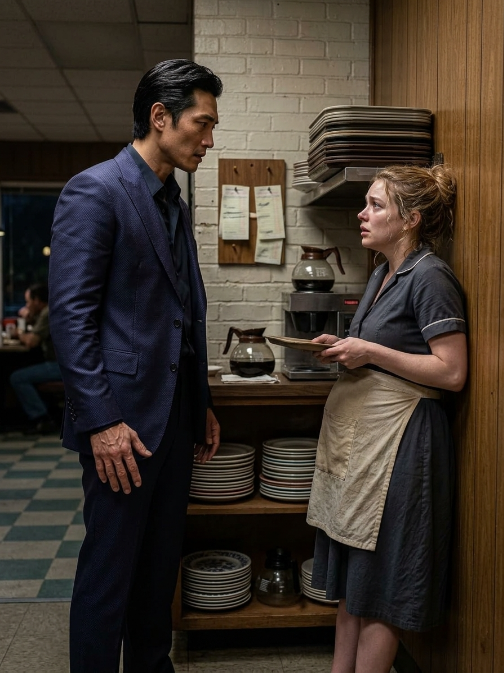
She Believed He Was Only the Bartender—Until the Mafia Boss Revealed the Truth About Their Kiss

## PART 1:
Vera Novak took the job because her landlord didn’t accept good intentions.
That was the whole story. No ambition, no adventure — just a lease renewal notice and a gap in her bank account that her tutoring work wasn’t going to close in time. The Meridian was the kind of place that paid well precisely because it asked you to smile at people you’d otherwise cross the street to avoid. Upscale, dark-lit, the sort of bar where the cocktail menu used words like *artisanal* and the ice was imported.
She had been there nine days.
Her feet had hurt for eight of them.
“Table four is waiting.” Dev, the floor manager, appeared at her shoulder with the particular energy of a man who considered standing still a personal failing. “And table nine wants the check.”
“I’m getting table four’s order now.”
“You were at the bar five minutes ago.”
“The bar was backed up.”
Dev gave her the look he reserved for new staff and departed without further comment.
Vera picked up her tray and turned.
The bar wasn’t backed up anymore.
She’d left it three deep. Now it was quiet, and the reason it was quiet was standing behind it.
She noticed the space first.
In a crowded bar on a Friday night, everyone compresses — staff, customers, everyone negotiating for room. But the people nearest this end of the bar had, without appearing to decide to, given him approximately two extra feet in every direction.
He was mixing something. Moving with the economy of someone who’d done it ten thousand times, which should have looked like a bartender — which was clearly what he was meant to look like — but didn’t quite, because bartenders generally don’t carry themselves like the room is something they own.
Dark hair. Late thirties at most. A black button-down with the sleeves pushed to the forearms. No watch, which she noticed because men who look like that usually wear watches they want you to notice.
He looked up before she reached the bar.
That was the first thing. She was still ten feet away when his eyes found her — dark, direct, and carrying that particular quality of attention that made her feel simultaneously seen and assessed.
“What do you need?” His voice was low, calibrated for the noise level without effort.
“Table four. Two old fashioneds, a sparkling water, and whatever the non-alcoholic option is tonight.”
He began pulling glasses without checking with anyone or consulting anything. “Seedlip and tonic. House garnish.”
“That works.”
She set her tray on the bar and watched him work, mostly because she was waiting and didn’t have anywhere useful to look. He moved cleanly. No wasted motion. The kind of competence that’s so complete it becomes its own kind of stillness.
“You’re not usually on this end,” she said.
He glanced up briefly. “No.”
“Stefan works this end.”
“Stefan went home.” A pause that didn’t feel like a pause so much as a punctuation mark. “I’m filling in.”
Something about the way he said *filling in* — not wrong exactly, but slightly misaligned, the way a sentence sounds when the person saying it has never actually done the thing the sentence describes — made her look at him a beat too long.
“New?” he asked.
“Nine days.”
“Still deciding?”
“Deciding what?”
“Whether to stay.” He set the first old fashioned on her tray. “Everyone at nine days is still deciding.”
Vera watched him reach for the second glass. Around them, the bar noise continued its Friday rhythm — ice, laughter, the percussion of a hundred simultaneous conversations. But this small section of counter felt oddly separate from it.
“I’m staying,” she said. “I need the money.”
“Most honest answer I’ve heard tonight.”
“Most people aren’t honest with bartenders?”
“Most people perform for bartenders.” He set the second drink down. “They want to seem like the kind of person who belongs in a place like this.”
“And I don’t perform?”
He looked at her directly then — not the brief functional eye contact of someone taking an order, but actually looked, with an attention that should have felt intrusive and instead felt, inexplicably, like being accurately described.
“Not yet,” he said.
The seedlip arrived. The sparkling water. He aligned them on her tray with a precision that was either professional habit or something else entirely.
“I’m Vera,” she said, because the conversation had reached the point where not saying it would have been strange.
He didn’t fill in the blank.
She noticed.
“Table four is waiting,” he said instead. His mouth carried the suggestion of something — not a smile, not exactly. Something more considered than a smile.
She took her tray.
She was four steps away when she heard him:
“Vera.”
She turned.
He had already looked back down at the bar.
“Your section manager is going to ask where you’ve been. Tell him the bar was backed up. He won’t check.”
She stood there for one second.
“How do you know he won’t check?”
He picked up the next order ticket.
“Because he won’t,” he said simply, and the conversation was over.
She asked Dev about him on her break.
Dev’s expression did the thing where it tried to be neutral and didn’t quite get there.
“Where did you see him?”
“Behind the bar. East end. He said he was filling in for Stefan.”
Dev looked at the east end of the bar. The man was gone — Stefan was back, looking slightly rumpled and grateful in the way of someone who’d been given an unexpected reprieve.
“That’s not—” Dev stopped. Recalibrated. “Don’t worry about it.”
“I’m not worried, I’m just asking who—”
“Vera.” Dev’s voice had changed register slightly. Lower. The voice he used when he wanted to be sure she understood. “Drop it.”
She dropped it.
But she kept thinking about the two extra feet of space. The way the security staff near the entrance had straightened incrementally when he’d moved through the room earlier — she’d clocked it at the time without knowing what she was clocking.
The way he’d said *he won’t check* without any doubt at all.
She was thinking about it at 1:15 a.m. when the last call rush finally thinned and she was clearing the high-tops near the window, stacking glasses, when someone stopped beside her.
She knew before she looked up.
“You asked about me.” Not accusatory. Observational.
“Dev has a very loud whisper.” She kept stacking.
“What did you want to know?”
“Your name would be a start.” She straightened. “Since you know mine.”
He looked at her with that same calibrated attention. Like he was making a decision about something.
“Nico,” he said.
“Just Nico.”
“For now.”
She picked up her tray. “That’s not an answer.”
“No.” Something shifted in his expression — not the almost-smile from earlier. Something quieter, and more careful. “It’s a beginning.”
He reached past her to collect a glass she’d missed on the far end of the table, set it on her tray, and walked toward the back corridor.
Vera stood in the thinning crowd and looked down at her tray.
Tucked under the last glass, folded once: a card.
No logo. No title. A phone number, and beneath it, five words in handwriting that was clean and exact:
*Don’t walk home tonight. Please.*
She looked up.
The corridor was empty.
She thought about the twenty-block walk she took every Friday. The stretch of Hanover Street after the underpass where the lights were always out. The way she’d been cataloguing it for nine days as *fine, probably fine, definitely fine.*
She thought about the word *please*.
She didn’t know anything about this man. She didn’t know his last name, or why the staff gave him space, or why Dev’s voice had dropped when she asked about him.
But she’d been reading people her whole life, the way you do when you grow up in rooms where reading people wrong has consequences.
And something in her — not instinct, something quieter and more inconvenient than instinct — said that the *please* was real.
She took out her phone.
She typed: *Who are you actually.*
Three minutes passed. She cleared two more tables.
Her phone buzzed.
*Someone who noticed you nine days ago. Someone who should have stayed unnoticed. I’ll explain if you’ll let me. But not tonight — tonight, take the cab.*
She stared at the screen.
Then, against every practical, sensible objection she could generate:
*Why did you notice me?*
The response came in under a minute.
*Because you don’t perform. And in a room full of people performing, that’s either very brave or very dangerous.*
A pause. Then:
*I haven’t decided which yet. Neither have you.*
Vera Novak put her phone in her apron pocket, finished her section, and at 2:10 a.m. took a cab home for the first time in nine days.
She didn’t know yet that Nico had watched it pull away from the curb.
Or that the two men who’d been stationed outside the Meridian’s east exit since midnight had watched it too — and reported back that the girl had left safely.
Or that the person they’d reported back to was him.
—
## PART 2:
She googled him on Saturday morning.
*Nico* returned nothing useful, which she’d expected. She tried the Meridian — found the standard front, the artisanal cocktail menu online, a Yelp page with 4.2 stars and complaints about the parking. The registered owner was a holding company called Verano Capital Group.
She searched Verano Capital Group.
The results were sparse in the specific way of entities that have resources and prefer not to appear in search results. A business registration. A brief mention in a real estate filing from four years ago. One profile on a financial news site that described it as a hospitality investment group with interests in venues across the northeast corridor.
No names attached. No faces.
She put her phone down and went for a run, which she did when she needed to think without looking like she was thinking. By the time she got back she had decided two things: she was going to her Saturday shift, and she was going to ask Nico directly.
He wasn’t there Saturday.
Or Sunday.
By Monday she had almost convinced herself the card and the texts and the please had been some kind of elaborate misdirection by a man who found it entertaining to unsettle new staff, except that she couldn’t explain the two men Dev had also pointedly not explained, or the way the security team still moved differently when they passed the east end of the bar where Nico had stood for forty-five minutes on Friday.
On Tuesday, a regular at table six told her she was excellent at this.
She smiled and said thank you and thought: I have a master’s degree in comparative literature and I’m excellent at carrying drinks.
On Wednesday, she found an envelope in her locker.
Her name on the outside. The same clean, exact handwriting.
Inside: a single index card.
*Thursday. 4pm. Coffee place on Aldrich, corner of 7th. I owe you an explanation. — N*
And underneath, almost as an afterthought:
*You’re still taking cabs, I hope.*
She was, in fact, still taking cabs. She hadn’t fully decided why.
She went on Thursday.
The coffee place was small and neighborhood-specific in a way that suggested he’d chosen it because it wasn’t the kind of place that had security cameras on every wall. He was already there when she arrived — same black shirt, different day, sleeves pushed to the forearms the same way. A coffee in front of him he hadn’t touched.
She sat down.
“You own the Meridian,” she said.
He looked at her.
“Verano Capital Group,” she said. “It took me twenty minutes and some creative search terms but I got there.”
Something shifted in his expression. Not surprise — more like the recalibration of someone who has been measuring how fast a person thinks and has just revised the estimate upward.
“Yes,” he said.
“So when you said you were filling in for Stefan—”
“I was filling in for Stefan.” He picked up his coffee. “I also own the building Stefan works in. Both things are true.”
“And the two men outside.”
“Mine.”
“And Dev not explaining anything.”
“He was following instructions.”
She looked at him across the table. In the daylight, in a small neighborhood coffee shop without the particular atmosphere of the Meridian pressing down on everything, he was — not less, exactly. Differently legible. She could see the tiredness around his eyes that the bar lighting had hidden, and something else underneath the controlled stillness that she hadn’t caught before. Something that had been there long enough to become structural.
“Why were your men outside,” she said. “Specifically. Friday night.”
He set his cup down.
“There’s a man who has been coming into the Meridian,” he said. “Four times in the last ten days. He sits at the bar or near it, orders two drinks over two hours, and watches the floor.” He held her gaze. “He doesn’t watch the bar. He doesn’t watch the other customers. He watches the waitstaff section you work.”
The coffee shop noise continued around them — milk steamer, conversation, the door opening and closing with its small bell.
“He’s watching me,” she said.
“Yes.”
“Do you know who he is?”
Nico was quiet for a moment. The kind of quiet that means *yes, and the answer is complicated.*
“His name is Gregor Feles,” he said. “He works for a man named Casimir Roth, who runs a private lending operation out of three businesses on the south side. Not a bank. Not anything with licensing or oversight.” He paused. “The kind of lending that works through personal relationships and consequences rather than paperwork.”
Vera looked at her own hands on the table.
“Roth’s operation,” Nico said, carefully, “is one of several that I’ve been tracking through the Meridian for the past two years. The bar is — a position. A place where a certain kind of business gets conducted in a certain kind of atmosphere. I watch who comes in and what they’re doing.” He held her gaze. “Feles has never been here for business. He comes in and watches your section.”
The milk steamer hissed. The door bell rang.
She said nothing.
“Do you know why someone connected to Casimir Roth would be watching you?” Nico asked.
She looked at the table.
She thought about her brother Tomáš, who was twenty-three and bad at saying no to things that seemed like solutions and were actually the beginning of different problems. Who had called her in August — not to tell her he was in trouble, Tomáš never called to tell her things directly, he called to *talk* in the way that meant he needed someone to understand the situation without being told the situation outright.
She had understood.
She hadn’t asked directly because asking directly with Tomáš produced denial, and denial produced distance, and distance was the thing she couldn’t afford with him. So she’d sent money in September and told herself it was rent and not thought too carefully about whether it was.
She had taken the job at the Meridian to send more in November.
“Vera.” Nico’s voice was quiet and even, the way it had been across the bar, calibrated without effort. “Whatever it is — I’m not asking so I can use it. I’m asking because Feles is going to escalate from watching to contact. That’s the pattern.” A pause. “And I’d rather you’re not surprised when it happens.”
She looked up.
He was watching her with the attention she’d first noticed — not cataloguing now, not assessing. Something more direct than that. Something that had given up the professional distance and hadn’t replaced it with anything except whatever was actually there.
“My brother,” she said, “has a debt.”
—
## PART 3:
She told him the shape of it.
Not everything — she didn’t know everything, and the parts she knew she’d assembled from what Tomáš hadn’t said in August and what he’d semi-confirmed in October when she pushed harder and what she’d inferred from the specific amount she’d sent in September, which had been enough to cover rent with forty dollars left over but not enough to cover the kind of number that produced a man watching your sister’s section at an upscale bar for ten days.
The shape: Tomáš had borrowed. Not from a bank. From someone in the orbit of people who didn’t send collection letters.
The number: she didn’t know exactly. Enough.
The timeline: the September payment had bought time, not resolution. She had understood this and pretended not to, because the alternative was naming it out loud and once she named it she’d have to do something about it and she hadn’t known what to do yet.
Nico listened without interrupting.
When she stopped, he was quiet for a moment.
“The forty dollars left over from September,” he said.
She looked at him.
“You said you took the Meridian job because of a gap in your bank account. You have a master’s degree — you tutor on the side. The math only works if you sent a significant amount of your own money to your brother and it didn’t close what he owes.” He held her gaze. “You’ve been supplementing someone else’s debt for months.”
“I’ve been helping my brother.”
“Yes,” he said, without contradiction. “That’s what I said.”
She wrapped both hands around her coffee cup.
“How bad is the actual number,” she said. “Based on what you know about Roth’s operation. What sending someone to watch me for ten days means about what Tomáš owes.”
Nico considered her for a moment.
“They don’t watch family for small amounts,” he said. “They watch family when the principal is significant enough that the person who owes it has become a flight risk or an avoidance risk, and the operation wants to identify alternative pressure points.” He paused. “I’d estimate five figures minimum. Possibly higher depending on how long it’s been accumulating.”
Five figures.
She had sent eleven hundred dollars.
She set her cup down.
“The thing about Roth’s operation,” Nico said, “is that it’s documented. Two years of watching the Meridian — who comes in, what gets discussed, what moves through the back channels — and Roth’s lending structure is part of what I’ve been building a picture of. The leverage he uses, the pressure methods, the relationships between his operation and three or four others that intersect through the same networks.” He looked at her steadily. “What I have isn’t complete. But it’s enough that Roth has significant legal exposure, if the right people see it.”
“Are you describing blackmail,” she said.
“I’m describing leverage,” he said. “Which is different.”
“How.”
“Blackmail is personal. This is structural. I don’t want Roth’s money. I want Roth’s operation to stop, and the most effective way to stop it is to make continuing more expensive than stopping.” He held her gaze. “That calculation changes if Roth knows someone has been watching him the way he watches everyone else.”
“You haven’t moved because moving exposes you.”
“I haven’t moved because moving exposes me and because until now I didn’t have a specific human cost to put next to the abstract picture.” He said it plainly, without apology. “Feles watching your section is a specific human cost.”
The coffee shop was quieter now — the morning rush had thinned to two people on laptops and a man near the window reading a physical newspaper. The door bell hadn’t rung in several minutes.
“What do you need from me,” she said.
“Nothing you haven’t already done,” he said. “You told me about your brother. That’s — that’s all I needed.” He paused. “The rest of it I can move on myself. Roth’s exposure, Feles, the documentation — I have what I need to make the approach.” He looked at her. “What I don’t have is the ability to make the call that matters most.”
She knew which call he meant before he said it.
“Tomáš needs to know that Roth’s people have escalated to his family,” Nico said. “He needs to know that someone else knows his situation — that it’s not a private problem he can manage alone. That’s the thing that usually breaks the isolation.” He paused. “But that call has to come from you. Not from me, not from anyone connected to what I’m doing. From you.”
She looked at the table.
She thought about August. Tomáš calling to *talk* in the way that meant he needed her to understand without being told. The specific fear in his voice underneath the casualness — she had heard it and she had understood it and she had not said *I know what this is* because saying it would have meant he had to confirm it.
She had protected him from having to say it.
She had been protecting him from having to say it for four months, which meant she had also been protecting herself from having to hear it.
“If I call him,” she said slowly, “and I tell him I know — he’s going to think he’s put me in danger by association. He’s going to try to deal with it himself. That’s what he does.”
“Yes,” Nico said. “And you’re going to tell him that it’s already dealt with. That he doesn’t need to do anything except stay where he is and wait.” He held her gaze. “Which will be true. By the time you call him, I’ll have made the approach to Roth. The watching will stop.”
“You’re moving on Roth today.”
“I was going to move on Roth today regardless,” he said. “Feles escalating was the thing that told me I couldn’t wait for a cleaner moment.” Something shifted in his expression. “I moved the timeline up when I found out it was your section he was watching.”
The information sat between them.
She thought about Friday night. The note under the glass. The word *please*. Two years of watching the Meridian, and he had moved his timeline for a waitress he’d known for nine days because someone was watching her section.
She thought about what that meant and then she stopped thinking about it, because what it meant was something she didn’t have room for yet, and there was a call to make first.
“Give me a minute,” she said.
She took her phone and went to the back of the coffee shop, near the hallway to the bathrooms, where it was quieter.
She found Tomáš in her contacts. His contact photo was three years old — a photo from her mother’s birthday dinner, him laughing at something she’d said, the particular laugh he had that was more surprised than amused, like he never quite expected things to be funny.
She called.
He answered on the second ring, which meant he’d been waiting for something. He always answered fast when he was waiting for something.
“Věra.” Her name in his voice, the Czech shape of it, the way only her family said it.
“Tomáš.” She pressed her back against the wall. “I know about Roth.”
Silence.
“Don’t say you don’t know what I’m talking about,” she said. “I know. I’ve known since August. I’ve been trying to give you room to tell me yourself and I’m done waiting for that.” She closed her eyes briefly. “I need you to listen. You’re not in danger right now. There’s someone handling the pressure on Roth’s end. You don’t need to do anything except stay put and pick up your phone when I call you in two hours.”
“Věra, how did you—”
“Two hours,” she said. “I’ll explain everything. Right now I just need you to say you understand.”
A pause. She heard him breathe.
“I understand,” he said.
“Are you okay.”
Another pause. Longer.
“I’m—” He stopped. “I will be. I think I will be.” His voice had the specific quality of someone who has been carrying something alone and has just been told they don’t have to keep carrying it without help.
She knew that quality. She had been its source, for him, since they were small.
“I know,” she said. “Two hours.”
She ended the call.
She stood in the back hallway of the coffee shop for thirty seconds. Doing nothing. Just standing there.
Then she went back to the table.
Nico looked at her when she sat down.
“He answered,” she said.
“Good.”
She picked up her coffee. It had gone cold. She drank it anyway.
“The Meridian,” she said. “When this is done — Feles and Roth and whatever the approach looks like. What happens to the Meridian.”
He looked at her. A question in that.
“I need to know if I still have a job,” she said. “I have a lease renewal.”
Something moved in his expression — not the recalibration, not the almost-smile. Something that had been underneath both of those and hadn’t been visible until now, when the controlled stillness had worn down to something with more texture.
“You have a job,” he said.
“Dev’s going to ask where I’ve been this morning.”
“Tell him the coffee line was long. He won’t check.”
She looked at him.
He looked back.
“How do you know he won’t check,” she said.
“Because he won’t,” he said. Simple. Final. The same way he’d said it Friday night across the bar.
She picked up her jacket.
“I’ll be in by five,” she said.
She walked out of the coffee shop into the November cold. The street was doing its ordinary Thursday morning things — delivery trucks, a woman pushing a stroller, the particular light of a city that had been overcast so long it had stopped expecting sun.
She had a call to make in two hours.
She had a shift at five.
She had a brother who’d answered on the second ring.
She walked toward the subway and didn’t look back, which was different from not thinking about what was behind her. She was thinking about it. She was just doing it while moving forward, which she had learned early was the only way to do it without stopping.
Her phone buzzed in her pocket.
She took it out.
A text from an unsaved number she recognized.
*Thank you for the call. He’ll be all right.*
She put the phone back without responding, because she hadn’t decided yet what to say, and she had learned long enough ago to know the difference between things that needed immediate answers and things that needed time to become whatever they were going to be.
The subway entrance was half a block ahead.
She went down the stairs.
—
Three weeks later, on a Friday, she walked home.
Not the full twenty blocks — the four that made sense, the ones between the subway and her door, the ones she’d walked a hundred times before she started taking cabs and had been cataloguing ever since as *fine, probably fine, definitely fine.*
The lights on Hanover were on.
All of them. Including the three after the underpass that had been out for as long as she’d been taking this route.
She walked through them and didn’t think about it until she was on her own block and then she stood on the sidewalk for a moment and thought about it.
Then she went upstairs and made tea and called Tomáš, who answered on the first ring this time, which was different.
He sounded lighter. The specific lightness of a weight that has been redistributed rather than removed — still there, but differently distributed, which is sometimes all lightness is.
They talked for forty minutes. About their mother’s upcoming visit, about a book he was reading, about the small ordinary things that had been harder to talk about when the other thing was in the way.
When they hung up she sat in her kitchen for a while.
She thought about nine days and what you can know about a room in nine days if you pay attention. She thought about a word — *please* — folded under a glass. She thought about her brother’s voice in August, trying not to ask for help, and her own voice in October, trying not to make him ask.
She thought about the difference between protecting someone and letting someone be protected.
She picked up her phone.
She added the unsaved number to her contacts.
She typed: *The lights on Hanover are on.*
She put her phone face-down on the table.
She finished her tea.
The response came six minutes later, when she’d already started washing up.
She left it there for a little while before she looked at it.
*I know. They’ve been on for three weeks.*
She stood at the sink and looked at that for a moment.
Then she put her phone in her pocket and went to bed, and she didn’t figure out what to do about any of the rest of it that night.
But she left her phone on the nightstand instead of the desk across the room, which was different from where she usually put it.
Small things. She had learned to pay attention to small things.
She was still paying attention.
—
**THE END**