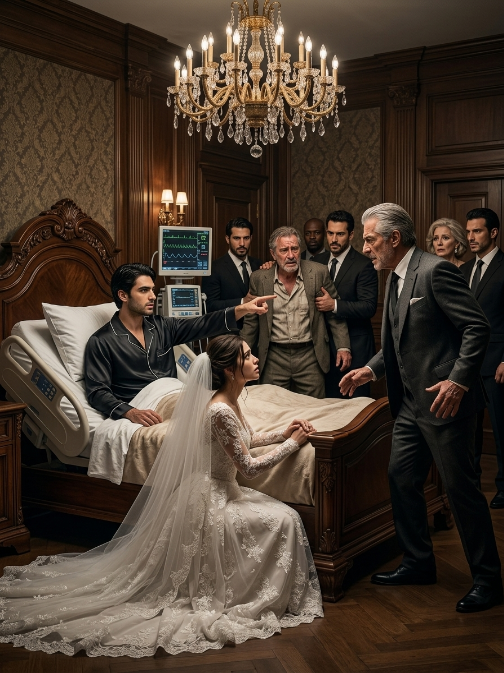
A Hospital Administrator Humiliated a Single Mom—Then a Mafia Boss Exposed Her 15-Month Secret

## PART 1:
My son’s name is Eli.
He has his father’s mouth — that stubborn, beautiful set to his jaw — and my eyes, which is the cruelest joke the universe ever played on me, because every morning I look at him and see both the best thing that ever happened to me and the reason I had to disappear.
Eli is eight months old. He has never met his father. Until last Thursday night, I intended to keep it that way.
Then his fever hit 104 and my intentions stopped mattering.
My name is Nora Callahan. Fourteen months ago I walked away from Aleksander Voss — quietly, deliberately, while he was in Prague for ten days and couldn’t stop me. I took two suitcases, my cat, and a secret I didn’t yet know I was carrying.
The world knows Aleksander as a shipping magnate. The kind of man who appears at charity galas and has his photograph taken shaking hands with senators. The kind of man whose name opens doors that were never meant to open.
What the world doesn’t know is the other half of his life. The phone calls he took in rooms he locked first. The men who came and went from the Chicago estate at hours that had no innocent explanation. The things I saw that I was never supposed to see and couldn’t un-see once I had.
Aleksander always said the same thing about love: it creates leverage. He said it analytically, like a structural observation. Like he was describing a bridge, not a feeling.
When I found out I was pregnant, alone in a Portland drugstore four weeks after leaving, I sat in my car for two hours and thought about what leverage does to the thing it’s attached to.
Then I drove to a new city and started over.
Thursday night, Eli wouldn’t stop crying.
By seven o’clock his temperature was climbing. By nine it had passed 103. His little body was wrong in a way I couldn’t name — too still between cries, too heavy, not right. I had the diaper bag packed before the thermometer finished beeping.
Providence Memorial’s emergency entrance was bright and cold and smelled like antiseptic and old coffee. The triage nurse took Eli immediately, which should have reassured me. Instead it made everything worse, because immediate response in an ER means they’re worried too.
I was filling out intake forms at the counter when the woman arrived.
Her badge said D. Marsh — Patient Services Coordinator. She had the precise, organized energy of someone who had decided long ago that paperwork was more important than the people it described.
“Father’s information.” She tapped the form.
“It’s just me.” I kept writing.
“We need both parents documented.”
“I’m the sole guardian. I have the legal paperwork.”
She looked at me the way certain people look at single mothers — not with hostility exactly, but with a particular kind of assessment. Taking inventory. My dark coat, which was nice but not expensive. The diaper bag with the broken zipper I kept meaning to replace. The absence of a ring.
“If the father is not in the picture—”
“I didn’t say that.”
“Is he reachable?”
I looked toward the pediatric bay where they’d taken Eli. “My son is in there.”
“And this form needs to be complete before—”
“Before what?” I turned to face her fully. “Before you treat him?”
A small audience had assembled the way audiences do in waiting rooms — pretending not to listen, listening completely.
“I’m doing my job, Ms.—”
“Callahan.”
“Ms. Callahan. We require accurate information for the patient file. If the father is unknown or unavailable, we document that, but we need it stated clearly.”
*Unknown.*
The word landed with a particular weight.
I heard someone near the vending machine shift. I felt the temperature of the room change the way it does when people decide what story they’re watching.
I turned back to the form.
Dr. Reyes found me twenty minutes later. Young, dark-eyed, with the specific exhaustion of someone who had been on shift too long and still hadn’t stopped paying attention.
“Ms. Callahan. I want to update you on Eli.” She sat across from me in one of the plastic chairs, which I noticed — she sat, didn’t stand. “He’s stable right now, but we’re running tests. Bacterial meningitis is on the differential.”
The word hit me somewhere below my sternum.
“We need family medical history. Both sides.” She paused. “Is there any way to reach the father?”
Fourteen months of carefully maintained distance.
Fourteen months of a new city, a new number, a name left out of every document I could legally leave it out of.
I thought about Eli in that bay, small and too quiet.
“I can reach him,” I said.
D. Marsh had reappeared at the periphery. “If there are concerns about the father’s involvement, social services can be—”
“There are no concerns.” My voice came out steadier than I had any right to. “His father is Aleksander Voss.”
A beat.
D. Marsh’s expression didn’t change. But something behind it did. A small, involuntary recalibration.
Dr. Reyes simply nodded. “Can you contact him?”
“I deleted his number.” Fourteen months ago, deliberately, the same afternoon I left.
“Is there another way?”
I called my former attorney from the hallway. She answered on the second ring, asked no questions — bless her — and texted me a number four minutes later.
I stood by the window overlooking the parking structure and dialed before I could think about it.
Two rings.
“Ja.” Then, when I didn’t speak immediately, in English: “Who is this.”
Not a question. A command.
I closed my eyes. “Aleksander. It’s Nora.”
Silence.
Then my name, in his voice, with an entire fourteen months compressed into three syllables.
“Nora.”
“I need your medical history. Family history — cardiac, neurological, anything hereditary.”
“Why.”
I pressed my hand flat against the cold glass.
“Because we have a son. His name is Eli. He’s eight months old and he’s in Providence Memorial and the doctors think it might be meningitis.”
Silence so complete I checked the call hadn’t dropped.
Then: “What did you say.”
“Eli. Eight months. He—”
“I heard you.”
Two more seconds of silence.
“Send me the address.”
The line went dead.
I gave Dr. Reyes everything Aleksander had provided — thorough, immediate, accurate — and tried not to think about the phone call. Tried not to think about his voice. Tried to focus on Eli and the monitors and the specific task of staying calm.
I was doing reasonably well at this until, fifty minutes after the call, the windows shook.
A low, rhythmic percussion from above. Growing louder.
Someone in the waiting room looked up. “Is that—”
“Helicopter,” a nurse confirmed, frowning. “We don’t have anything scheduled.”
My heart dropped through the floor.
Because I knew.
I knew the way you know a voice on a phone after two years of knowing someone. Aleksander Voss did not send representatives.
When the rooftop access door opened, he came through it ahead of three men I didn’t recognize, wearing a dark coat still damp with cold air, and the emergency room did what rooms do when he enters them — it reorganized itself around him without anyone deciding to.
He found me in four seconds.
He crossed the room and stopped two feet away and looked at me — just looked, for one long moment — with an expression I couldn’t read and wasn’t sure I wanted to.
Then he turned.
D. Marsh was still at her station.
“You’re the one who questioned her documentation.” His voice was very quiet. “In front of a waiting room full of strangers. While her son was in triage.”
It was not a question.
Marsh opened her mouth.
Nothing came out.
Aleksander reached into his coat and removed a folded document. He handed it not to Marsh but to Dr. Reyes, who had appeared beside me.
I watched Dr. Reyes open it. Watched her read. Watched her expression shift through something I couldn’t immediately name — recognition, surprise, and then a careful stillness.
She looked up at Aleksander.
“This facility,” she said slowly, “is in your foundation’s network.”
“It is.”
“Since when?”
“Since six months ago.” He glanced toward the pediatric bay. “I’d like to see my son.”
Dr. Reyes nodded and turned to lead him back.
I stood very still.
Six months ago. While I was here in Portland. While I thought I was invisible.
Aleksander paused without turning around.
“We’ll talk,” he said quietly. “After.”
He walked through the doors.
And I realized, standing in the fluorescent light of a waiting room that smelled like antiseptic and bad decisions, that the document he’d handed Dr. Reyes wasn’t just about the foundation.
He had known which city I was in.
Maybe for longer than six months.
—
## PART 2:
Eli’s test results came back at 2 a.m.
Not meningitis. A severe viral infection — treatable, manageable, the kind of thing that looks terrifying at 104 degrees and becomes ordinary once they know what it is. Dr. Reyes delivered the news with the specific relief of someone who has had to deliver the other kind too many times. I thanked her and sat down and put my hands in my lap and breathed.
I was still doing that when Aleksander came through the bay doors.
He stopped in the doorway. He had been in there for over an hour — longer than I’d expected, longer than the medical review would have required. I had been aware of him in the room with Eli the entire time in the specific way you are aware of something you can’t see but can’t stop thinking about either.
“He’s sleeping,” Aleksander said.
“I know.”
“He looks like you.”
“He has your mouth.”
He looked at me. Not cataloguing — I knew his cataloguing look. This was different. Something without the professional distance.
“You need to sit down,” I said. It was that kind of look. “There’s a chair.”
He sat.
For a moment neither of us said anything. The waiting room had thinned to three other people and the low hum of the overhead lights. His three men had positioned themselves in the lobby with the unobtrusive precision of people doing exactly what they were paid to do.
“The hospital,” I said. “Six months ago.”
He looked at his hands.
“Yes.”
“You knew I was here.”
“Yes.”
I waited. He owed me the rest of it without prompting, and he knew it.
“I found out through the maternity clinic,” he said. “Dr. Anand’s practice on Morrison. You registered there when you were eleven weeks.” A pause. “I fund the clinic’s equipment replacement program. I don’t audit patient records — I have no access to them — but I was at a board meeting four months ago and your name was mentioned. Not the pregnancy. Just — someone recognized you. Made a connection.” He looked at the floor. “I don’t know how to explain this in a way that doesn’t sound like surveillance.”
“Because it sounds like surveillance.”
“Yes.”
I sat with that.
“You’ve known for four months,” I said. “That I was here. That I existed, specifically, fourteen blocks from a clinic you fund.” I looked at him. “And you didn’t come.”
“No.”
“Why.”
He was quiet for long enough that I started to believe he wouldn’t answer. Then:
“Because I wasn’t finished.”
Something in my chest went carefully still.
“Finished with what,” I said.
He reached into his coat and set a second document on the plastic chair between us. Not handing it to me. Just setting it there.
I picked it up.
It was a federal cooperation agreement. The kind with redactions and case numbers and language that had been reviewed by more than one attorney. The kind that had a signature line at the bottom with a name I recognized.
Aleksander Voss.
Dated eleven months ago.
Three months after I left.
—
## PART 3
I read it twice.
I had six years of legal work behind me — not criminal, not federal, but enough to understand the shape of what I was holding. This was not a preliminary document. This was not someone exploring options. This was a finalized cooperation agreement with a federal prosecution unit, signed, dated, with exhibits attached that I did not have the clearance to read.
“The men who came and went,” I said. “At the estate.”
“Some of them are currently facing charges.” He said it without satisfaction. “The ones who aren’t yet will be.”
“You were involved.”
“I was embedded.” He said it precisely. Not a confession and not an excuse. A description. “The nature of the shipping business — the specific nature of mine, which I inherited from my father — made it structurally useful to people I should have refused earlier. I understood that too late and then I spent three years trying to understand how to get out without becoming a casualty of the exit.” He looked at the document. “The cooperation agreement was the exit.”
“That’s why the locked rooms,” I said. “The calls I wasn’t supposed to hear.”
“Yes. The last year and a half before you left — those calls were with federal handlers. Not with the people you thought.” He paused. “I couldn’t tell you. The operational security requirements were not negotiable and I was not yet far enough in to make promises I could keep about what came after.”
I thought about the drugstore in Portland. The test. The two hours in my car.
I thought about what I had decided, alone, about leverage and the things it does to the people attached to it.
“I left because of what you said,” I told him. “About love. About leverage.” I looked at him steadily. “I decided I didn’t want to be the structural weakness in your life.”
Something crossed his face.
“I know,” he said.
“You said it analytically. Like it was just how things worked.”
“I know how it sounded.” He held my gaze. “I was describing what other people do with love. The people around me. What I had watched men use as a tool my entire career.” A pause. “I was trying to tell you that I understood why it was dangerous. I was trying to say that you were the only thing I had ever had that I was not willing to use that way.” He stopped. “I said it badly.”
The fluorescent light hummed.
I thought about two years of knowing someone — the specific texture of it, the specific knowledge of when a person was performing and when they weren’t. I thought about what I had known about Aleksander and what I had believed about Aleksander and whether those had ever fully been the same thing.
“The foundation,” I said. “The clinic on Morrison. This hospital.”
“I have been building things here,” he said. “Without announcing it. Eleven months of — building a version of what comes after.” He looked at his hands. “I was not ready to find you until I was something you could actually look at.”
It was possibly the most honest thing I had ever heard him say.
It landed in me the way honest things do — not comfortably.
“You should have told me about the cooperation,” I said. “Before I left. I understand the operational security. I understand why you couldn’t. And it still would have been better if you had.”
“Yes.”
“I spent fourteen months believing a specific thing about who you were.”
“I know.”
“Eli grew eight months without you because of that.”
He went very still.
“Yes,” he said. “I know that too.”
The chair between us had the document on it. The cooperation agreement with the case numbers and the redactions and the signature from eleven months ago. I thought about what it had cost — not financially, I had no idea about that — but in the specific currency of risk, of patience, of building something out of a situation that had no clean exit.
I thought about the man who had locked himself in rooms to take calls he couldn’t explain.
I thought about the man who had found out he had a son an hour and a half ago and had been sitting in a pediatric bay since then, in the specific quiet of someone becoming something they had never been before.
“What do you want,” I said. Not hostile. A real question. The kind that deserves an answer before anything else can be decided.
He looked at the bay doors.
“I want to know him,” he said. “That’s the only thing I am certain of right now. Everything else—” He stopped. “Everything else, I will not ask for. I will not create conditions. I will not leverage anything.” He looked at me. “I want you to decide what this looks like. I want you to set the terms. I am asking for the chance to show you that I mean that.”
I sat with that for a long time.
The thing about knowing someone for two years is that you know when they are telling the truth. Not because people don’t lie to people they love — they do, constantly, in large and small ways — but because you accumulate enough data points over enough time that you learn the specific texture of their honesty. It has a different weight than their performance. It sounds different in their chest.
He was telling the truth.
That didn’t mean everything was resolved. It didn’t mean fourteen months of a specific kind of fear dissolved because a federal document existed and a man said the right thing in a hospital waiting room at two in the morning.
It meant one thing: that I had been making decisions based on a story that was not entirely the story.
What I did with that was still mine to decide.
—
Dr. Reyes let me back into the bay at two-forty.
Eli was asleep in the hospital crib, the fever down to something manageable, his face finally relaxed the way it wasn’t when he was sick — round and open and belonging entirely to himself. I stood at the rail and watched him breathe, which is something I had done many times in eight months and never once gotten tired of.
I heard the door behind me.
I didn’t turn around. “You can come in.”
Aleksander came to stand at the other side of the crib.
He looked at Eli for a long time without saying anything. I watched him look — the specific quality of his attention, which I knew, and the specific quality of what was underneath it, which I was learning. Something new. Something that had not existed in his face before tonight and was not going to leave.
“Eli,” he said quietly. Just the name. Not to me.
Eli slept.
“He’ll want to know you,” I said. “When he’s old enough to want things. He already wants everything — he wants the cat’s tail and the corner of every book and the specific spoon, not the other spoon.” I looked at my son. “He’s going to want his father.”
Aleksander said nothing.
“I’m not going to make that easy or hard,” I said. “I’m going to make it real. Which means it’s going to be slow and it’s going to be on my terms and yours are going to have to wait.” I finally looked at him across the crib. “That’s what I need you to understand before anything else.”
“I understand,” he said.
“And if at any point something about your situation puts him at risk — any part of the life that isn’t settled yet—”
“It will be settled before I ask for anything more than this.” He held my gaze. “You have my word.”
I turned back to Eli.
His word. I knew what his word was worth — both the times it had meant nothing and the times it had meant more than I’d expected. Fourteen months ago I would have said they averaged out to nothing. Standing here tonight, I wasn’t sure that math was as clean as I’d believed.
I reached through the crib rail and put my hand on Eli’s back. Felt him breathe.
Behind me, I heard Aleksander settle into the second chair. Not leaving. Not asking for anything else. Just present — the specific, deliberate presence of a person who has decided that presence itself is what’s being offered and it will have to be enough.
It wasn’t forgiveness. It wasn’t resolution.
It was the specific, smaller thing that has to come before either of those: a decision to stay in the room.
I stayed in the room.
—
At four in the morning, a nurse came in to check Eli’s vitals and found the three of us in the same positions we’d been in for an hour — Eli asleep, me in the chair beside the crib, Aleksander in the chair by the wall. She did her work with the efficient quiet of a professional and left without comment.
At four-twenty, Eli woke up.
He blinked. He looked at the ceiling. He looked at me, and his face did the thing it does — the specific brightening that I will spend the rest of my life not taking for granted.
Then he looked at the man in the chair by the wall.
He stared at him with the focused, unself-conscious attention of a person who has not yet learned to pretend he isn’t looking.
Aleksander looked back.
“Hi,” Aleksander said. Quiet. Careful. A single syllable with nothing extra in it.
Eli stared at him for another three seconds.
Then he made a sound — not a word, he didn’t have words yet — something between a question and a declaration, the kind of sound that means *I am deciding what I think about this.*
He reached through the crib rail.
Not toward me.
Toward Aleksander’s hand, which was resting on his knee, close enough to the crib that it was simply there — not offered, not withdrawn. Just present.
Eli grabbed his index finger.
Held it with the concentrated grip of someone taking something seriously.
Aleksander went very still. The stillness I knew — the one that meant something was happening that he did not want to disturb.
I watched them look at each other.
I thought about eight months of mornings. My eyes in Eli’s face. The best thing and the difficult thing, inseparable, the joke the universe told that turned out not to be a joke at all.
I thought about the word *leverage* and what I had done with it — the conclusion I had drawn, alone in a car, that had been logical and reasonable and had also, it turned out, been working from incomplete information.
I didn’t know what came next. That was the truth of it — not a comfortable truth but an accurate one. I didn’t know what the cooperation agreement settled or what it didn’t. I didn’t know what Aleksander’s version of *building something* looked like when it was finished. I didn’t know what I was going to feel about all of this in six months, in a year, in whatever came after tonight.
What I knew was what I could see.
Eli had my eyes. He had his father’s mouth.
He had, apparently, his father’s way of deciding — quickly, completely, with total unselfconscious certainty — that a thing was worth holding onto.
I watched him hold on.
In the morning, I would make phone calls. I would talk to my attorney. I would set terms, slowly, carefully, the way you build something that has to last — not because I had decided to trust Aleksander entirely, but because I had decided to stop making decisions based on the version of events I’d had access to in a drugstore parking lot fourteen months ago.
The morning was still a few hours away.
For now: Eli held his father’s finger. The monitors beeped their quiet confirmation. Outside the window, Portland was doing the specific thing cities do before dawn — not sleeping, not yet waking, something in between.
I reached over and fixed the blanket around Eli’s feet, which had worked loose the way they always did.
He didn’t let go of Aleksander’s finger.
I didn’t ask him to.
—
**THE END**