The Little Girl Screamed “Don’t Marry Her!” at the Mafia Boss’s Wedding—Then One Photo Destroyed Everything

## PART 1
The white shoes were scuffed.
That detail would matter later, when federal agents reviewed security footage and tried to piece together how a child had breached perimeter security at what was supposed to be the most protected wedding on the Eastern Seaboard. But in that moment, as Sophia Bennett stood at the center of three hundred armed guests, nobody cared about her shoes. They cared about the guns rising in unison.
Thirty-two men in tailored tuxedos moved as a single organism—jackets opening, hands moving to holsters, barrels lifting toward the impossible target of a seven-year-old girl in a pale blue dress.
She didn’t scream.
She didn’t run.
She stood there in the amber light beneath the silk canopy and looked directly at the altar, where Lorenzo Duca waited with an emerald-cut diamond hidden in his palm.
“Don’t marry her,” Sophia said, her child’s voice somehow carrying across the garden like she had rehearsed this in front of mirrors, in front of empty rooms, in front of the memory of her father’s voice on the phone before he died. “Please, Mr. Duca. Don’t marry her.”
The string quartet stopped with such abruptness that the final note seemed to hang in the evening air—a warning nobody wanted to hear.
Lorenzo stood motionless at the altar.
Behind him, Donna Isabella Duca rose from the front row with the deliberate grace of a woman who had survived worse horrors than a child’s interruption. Sixty-eight years old, dressed in black silk like she had been anticipating this moment, she lifted one hand.
The guns lowered. Not completely. Just enough to indicate something had shifted in the room’s understanding.
At the end of the aisle, Vivian Moretti wore ivory silk and the careful smile of a woman whose entire existence had been constructed around this single moment. The veil drifted behind her like silk spun from lies. Her hand trembled only slightly as she stepped down toward the child.
“Who is this?” Vivian asked, her voice tight enough to break.
Sophia turned to face her directly.
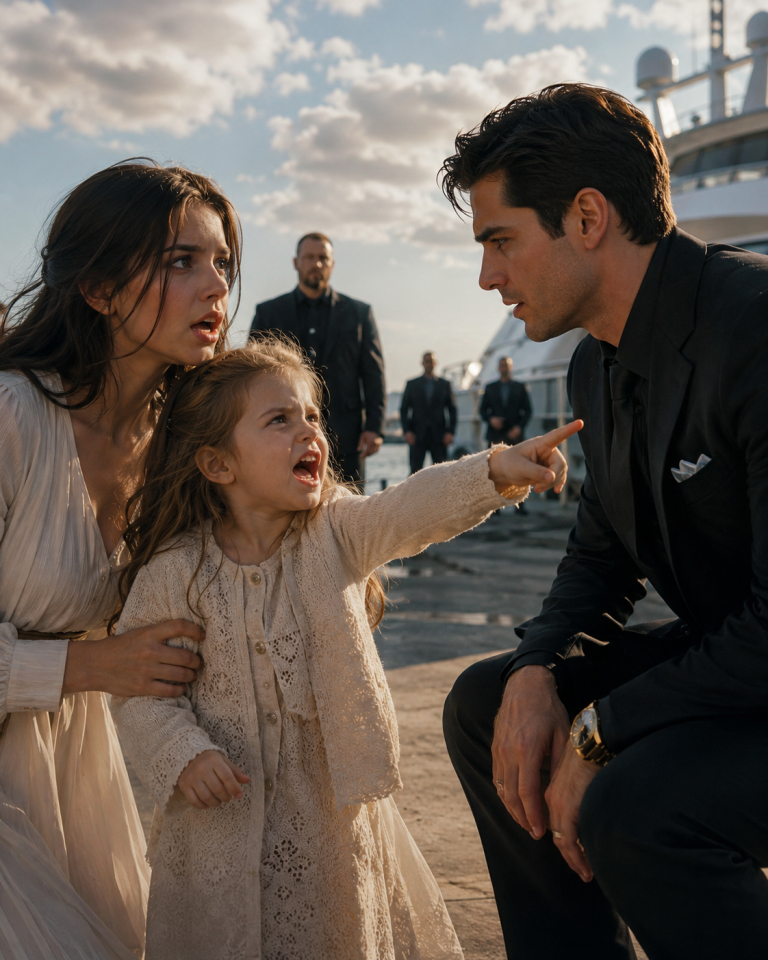
The little girl’s pointing finger was small and steady. “You killed my daddy,” she whispered. “You took his money. You took everything. Then he was dead.”
The words landed like stones dropped into still water.
Vincent Russo, consigliere to the Duca family for three decades, felt the precise moment when the wedding became a battlefield. His eyes moved to Vivian’s face and caught something—a single breath held too long, a flush that drained too fast, the micro-expression of someone whose cover had just been torn away by a child in patent leather shoes.
From her chair, a woman in the third row began to cry silently. She was Elena Bennett, thirty-two years old, and she had spent the last four years grieving a husband while working in this house’s kitchens without anyone knowing the connection.
Lorenzo stepped down from the altar.
He walked the white runner in the wrong direction, moving toward the child instead of away from the threat, and lowered himself onto one knee in front of Sophia. Three hundred people watched a mafia boss kneel before a seven-year-old girl.
“What’s your name?” he asked, his voice transformed into something gentle and careful.
“Sophia.”
“Sophia,” he repeated, studying her face like it was written in a language only he could read. “Do you have something to show me?”
She nodded and opened a cloth purse that looked ancient, worn soft from constant handling. Inside was a Polaroid photograph, the edges yellowed, the corners folded from being gripped too tightly by small hands that didn’t understand how to preserve anything except by holding on.
The photograph showed two people in a parking lot.
A brown-haired man. A woman with familiar cheekbones, but younger, softer, with longer hair and a smile that seemed rehearsed even in the faded image.
The woman was unmistakably Vivian.
Lorenzo’s fingers closed around the photograph as understanding moved through him like a electric current.
Behind the altar, Vivian’s composed expression fractured.
“This is absurd,” she said, her voice sharpening into something desperate. “Lorenzo, you cannot possibly believe this. She is a stranger. This could be anyone—”
He did not look at her.
“Vivian,” Lorenzo said quietly, and the sound of her speaking her own false name seemed to make everything real. “Tell me about Marcus Bennett.”
—
## PART 2
The confession came faster than anyone expected.
Vivian abandoned the performance entirely, her voice dropping into something colder and far more dangerous. She had been trained for this—for the moment when the lie finally cracked. She had prepared speeches for interrogation rooms and secret meetings, but not for a child’s testimony to undo nine months of careful work.
She explained it almost like she was proud.
Four months of appearing by accident.
Seven months of seeming reluctant.
The investment opportunity whispered between kisses.
The warehouse sold. The house mortgaged. The money transferred to an account that stopped existing.
Marcus Bennett’s final phone call to his daughter before men from Providence came looking.
“Your husband believed in loyalty,” Vivian said coldly, “even when loyalty was the worst choice he could have made.”
Vincent moved silently to the left, processing the implications. This wasn’t one con artist or one hired killer. This was a pattern. He began counting in his head—Boston. Philadelphia. Miami. Three dead men. Three vanished women. Three territories that had gradually begun reporting to people who operated from Europe.
Tommy Castellano, standing among the capos, shifted his weight.
It was small movement. Nothing. But Vincent had spent thirty years learning how to read the smallest tells. Tommy’s hand moved toward his chest, then stopped. His eyes flickered toward the perimeter.
In that moment, Vincent understood: the wedding had not been interrupted by chance.
It had been invaded by truth, and truth had a way of exposing what had been rotten underneath all along.
Lorenzo stood, still holding the Polaroid of a dead man and his destroyer.
“How long has he been planning this?” Lorenzo asked, his voice shifting into something that made the temperature drop around him.
“Five years,” Vivian said, and there was something almost admiring in her tone. “Since before you took the seat. You were supposed to be the prize, Lorenzo. The biggest one.”
She looked directly at him.
“He’s already here.”
The first explosion came from the north gate.
The second tore through the hedges.
And as the evening erupted into chaos, Elena grabbed Sophia’s hand and ran, understanding at last that the worst part of losing Marcus wasn’t his death.
It was learning that his death had only been the beginning.
—
## PART 3
The safe room was poured concrete and silence.
Elena sat beside her daughter in the panic space beneath the Duca estate, watching monitors that showed nothing but smoke and violence. Sophia clutched her gray bear and asked questions Elena could not answer: Where was Mr. Renzo? Would the bad people find them? Could Daddy hear her from where he was?
Upstairs, Lorenzo was already moving.
He spent ninety seconds understanding what had happened. Vivian was gone—someone had unlocked her from the inside. The security footage revealed Tommy Castellano producing a key, stepping aside, opening a door that should have been locked from outside only.
Thirty years of loyalty. Thirty years of careful planning. And Tommy, the Wolf, had sold him to a ghost from Catania named Salvatore Vieieri.
Lorenzo’s response was not anger. It was something colder and more efficient.
By 8 PM, the estate was a fortress.
By 9 PM, the dead were being counted.
Eight attackers. Three Duca soldiers. Two wounded. Tommy Castellano, who had moved too slowly when the moment finally came.
Vincent sat with the security footage playing on loop, watching Tommy’s betrayal on screen again and again, understanding that trust was the luxury of men who had never built empires.
The cemetery came next.
Greenwood was ancient and sprawling, a country of stones where fortunes had been buried for two hundred years. The Duca mausoleum sat like a temple, and when Salvatore Vieieri arrived at nine o’clock, he believed he was walking into a succession.
He did not know that Lorenzo was already waiting inside the casket.
The man from Catania was exactly as Sophia had drawn him. Silver-tempered at the edges. Long coat. A scar that ran down his cheek like a pale accusation. He moved like someone who had orchestrated enough deaths to believe himself invincible.
He was not.
Floodlights turned the cemetery into day.
Thirty guns emerged from buildings and behind marble crosses. Vincent stepped from shadow with a carbine, his old hands perfectly steady. Lorenzo rose from the casket like a ghost becoming flesh.
“You came to hunt,” Lorenzo said quietly. “But you came to the wrong ground.”
Vieieri reached for his pistol.
Tommy Castellano, bleeding from a shoulder wound sustained in the estate assault, made one final move. He fired three times toward Lorenzo and missed.
Vincent did not miss.
Tommy dropped across a grave marker, and the Wolf died on concrete meant to hold the dead.
Salvatore Vieieri tried to escape between headstones.
He made it forty meters before Lorenzo caught him in the narrow space behind the mausoleum. Two men. No weapons for Vieieri anymore. Just the American justice system waiting with 412 counts of indictment.
Lorenzo did not kill him.
That would have been the fast way, and the fast way was for men who still belonged to the world Vieieri represented. Instead, Lorenzo fired one round into Vieieri’s shoulder and made a phone call.
“Agent Howerin,” he said, his voice steady as stone. “It is time. Greenwood Cemetery. I am holding your gift. He is alive. He will require medical attention and a very comprehensive indictment.”
The blue lights that came next meant the end of something and the beginning of something else entirely.
The newspapers called it the trial of the century.
Federal agents brought news helicopters to photograph the moment that Salvatore Vieieri—the European ghost they had chased for nineteen years—was arrested beside a Brooklyn mausoleum. The indictment ran to 412 counts. Vivian Moretti’s real name was Victoria Esposito. She was identified at the morgue, and her death was classified as accidental—a shootout in Greenwood Cemetery where a lot of people had assumed she was not even present.
Tommy died a traitor.
Three capos took plea agreements before their fingerprints dried.
By morning, the city had reorganized itself.
By afternoon, Lorenzo had begun dismantling everything his family had built through shadow and fear.
He called Donna Isabella to the study where the Polariad of Marcus Bennett still rested beneath the green-shaded lamp.
Vincent stood at the window.
Donna Isabella sat in the wingback chair and waited for the words she had been hoping to hear since her grandson was eight years old.
“I want to leave,” Lorenzo said simply. “Not the family. Just the world. The honest parts stay. The rest goes.”
Donna Isabella smiled for the first time in days.
“Your grandfather would recognize the man you have chosen to be.”
Within six months, the transformation was complete.
Hotels replaced card rooms. Legitimate trucking interests replaced cigarette routes. A foundation in Marcus Bennett’s name funded scholarships. The bakery on Mulberry stayed open. The vending routes kept operating. Everything that could be built in daylight remained.
Everything else was erased.
Elena and Sophia did not leave the estate.
Elena became something more than a kitchen worker—she became the reason the estate felt like a home instead of a compound. A carriage house with a garden was given to them, and on Sophia’s eighth birthday, she stood in her new kitchen watching Lorenzo teach her to make pasta from scratch.
The nightmares stopped by Christmas.
By February, her laugh came back—a real laugh, not the careful, practiced sound of a child who had learned too early how to be small and silent.
Vincent retired from half his life and opened restaurants instead.
Donna Isabella hosted a private dinner that was only a dinner—no business in the napkins, no codes in the seating chart. Six people at a table. Caruso playing in the next room. Sophia in pale green, her gray bear sitting like an honored guest in the chair beside her.
Lorenzo stood at the end of the meal and raised his glass.
“To truth,” he said. “To the courage of a child who refused to let the world stay broken. And to family—the kind you build after you stop being afraid.”
Glasses touched.
The old clock that had not been wound in two years began ticking again.
And inside the Duca estate, for the first time in living memory, there was only the sound of people who loved each other, laughing.
It had taken a seven-year-old girl in scuffed white shoes, running toward guns, to teach the most powerful man in the Five Families that the strongest thing you could do was walk away from power.
Sometimes salvation comes from the last person you expect.
Sometimes it wears patent leather and holds a gray bear and refuses to let the darkness win.
Sometimes all it takes is one child who believes the truth matters more than her own survival—and one man finally brave enough to listen.