Her Sister Humiliated Her at the Gala, Saying No One Wanted a Chubby Woman—Then the Mafia Boss Chose Her

## PART 1
There is a specific skill that comes from spending your childhood in a house where the danger is not obvious.
Not a slammed door or a raised voice. Something quieter: the tone of a laugh that had a target in it. The way a room shifted when you walked in, the slight adjustment, the turning of attention that felt like being watched and like being dismissed at exactly the same time. You learned to read it fast. You had to.
I had been reading rooms since I was nine years old. By twenty-eight, I could walk into a ballroom and tell you in four minutes which marriages were over, which business relationships were theater, and which men were afraid of something they hadn’t named yet.
The Caldwell Group charity event at the Ashford Hotel on a Tuesday evening in March was a room that told me many things at once.
It told me the woman near the front bar was counting her drinks in a way that suggested she was pacing herself against something she already knew was coming. It told me the pair near the east window were holding hands for the cameras specifically. It told me the man in the deep blue suit near the entrance kept touching his inside jacket pocket every time the main doors opened, which meant he was either expecting someone or had something on him he didn’t want discovered.
What the room told me, in the first three minutes, was that everyone in it was performing.
Including my sister.
Lila Vance moved through expensive rooms the way water moves through open spaces — finding every available surface, filling it, glittering under the light. She was beautiful. She had always been beautiful. She wore it like a credential, which it was in the rooms she cared about.
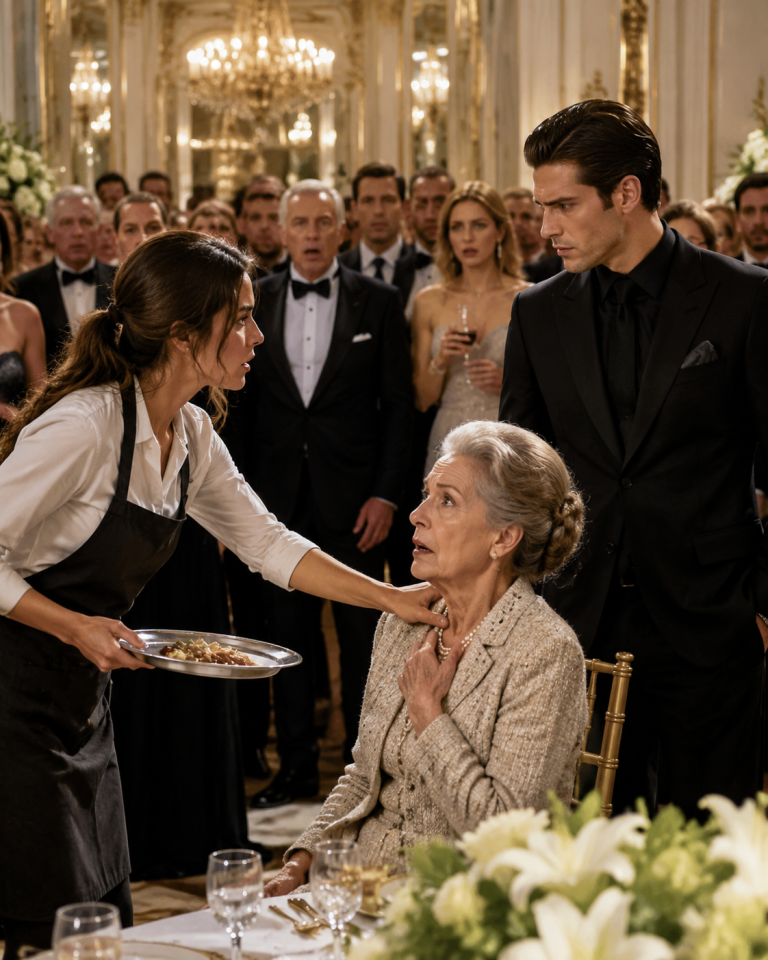
I was standing near the dessert table in a dress I had bought on purpose because it fit me exactly as I was — deep burgundy, structured at the shoulders, nothing I needed to apologize for — when Lila’s voice reached a volume that was not accidental.
“My sister is the brilliant one,” she said to the small orbit of acquaintances gathered around her. “Has to be, doesn’t she? Because let’s face it, nobody’s sitting across the table from a woman that size thinking about forever.”
She smiled when she said it.
Lila’s cruelties always came gift-wrapped.
“She reads books,” she added, lightly, as though this were the punchline and not the subject change. “Very smart. Very well-read. Very available.”
Her friends laughed first. Then a few nearby people joined, the polite suppressed kind, the kind that meant they had heard something that troubled them but not enough to make themselves a target by objecting.
I breathed in through my nose.
The ballroom did not shrink. That had stopped happening years ago.
“Books are cheaper than the alternative,” I said evenly, “and they don’t make promises they can’t keep.”
A low laugh came from somewhere behind me. Real amusement, not performance.
Lila’s smile sharpened at the corners.
“Enjoy the desserts, Nor,” she said sweetly. “At least someone at this table is glad to see you.”
She drifted away in a cloud of expensive perfume and self-satisfaction.
I turned back toward the room.
Watched.
The man in the blue suit had moved to the far side of the hall. He was now positioned at an angle to the main doors that gave him a clear sightline to two exits. His laugh was louder than before, which meant he was working harder at appearing relaxed.
In the center of the room, where the crowd was thickest, a man stood in a charcoal suit.
Not circulating. Not performing.
Just still.
Marcus Vale.
You did not have to be told who Marcus Vale was. The room arranged itself around him in ways that were barely visible but absolutely consistent: the slight widening of space where he stood, the adjusted trajectories of people who might otherwise have walked closer. Chicago called him a property developer in newspapers and something that required lower voices at dinner parties. He owned construction, logistics, private security, and the kind of influence that did not need to announce itself.
He was looking at me.
Not at Lila. Not at the women in backless gowns who had spent the last hour drifting past him at calculated angles.
At me.
Standing at a dessert table with a drink I hadn’t touched and the expression I always wore when I was reading a room, which was apparently the one that had caught his attention.
A minute passed.
He crossed the ballroom.
I felt the room register it before I saw it — a slight contraction of conversation nearby, Lila’s laugh cutting off mid-sentence somewhere to my left. Marcus Vale walked past every woman who had made herself available to be noticed and stopped beside the one who had been trying to be invisible.
“You’ve been watching that corner near the bar for seven minutes,” he said.
His voice was low. Quiet enough that it was only meant for me.
I looked at him.
“I wasn’t aware I was being observed myself.”
“You weren’t being observed,” he said. “You were being noticed. The difference matters.”
I should have taken a step back. The sensible thing was to murmur something polite and disappear into the crowd. Men with Marcus Vale’s reputation did not cross full ballrooms for charming conversation.
“And what exactly did you notice?” I asked.
“That most people in this room are manufacturing reasons to be seen,” he said. “You’re the only one who seems to be here because you find the room interesting.”
It was the most accurate thing anyone had said to me in months.
He nodded toward the man in the blue suit.
“Patrick Oren. I’m deciding whether to bring him into a project. I’ve had three people tell me he’s solid. Tell me what you see.”
I almost laughed.
“Is this how you evaluate business partners? By asking strangers at dessert tables?”
Something moved at the corner of his mouth. “Only the interesting ones.”
I looked at Patrick Oren.
The laugh. The gesture. The watch. The way his body angled slightly toward exit points. The way his hand moved toward his chest every twelve to fifteen seconds and then stopped short.
“He’s frightened,” I said. “Not of you, specifically. Of something arriving. He keeps reaching for something in his jacket and pulling back, which means there’s something he’s decided he shouldn’t look at in public. Men who are genuinely confident about their position don’t spend that much energy managing exits.”
I paused.
“Whatever he’s about to tell you, there’s something larger he’s not including.”
Marcus was quiet for three seconds.
“I had four people investigate Patrick Oren over three weeks. They gave him a clean report. This morning, I found out he’s been concealing a debt large enough to compromise any partnership.”
I kept my expression level.
“Lucky timing.”
“That was sixty seconds and a dessert table,” he said.
He reached into his jacket and produced a card.
“I’m hosting a private retreat next week. Lake Geneva. Senior staff. Sensitive discussions. I have a problem that hasn’t responded to investigation, and I believe it requires a different kind of attention.”
I looked at the card.
Across the room, Lila had stopped talking.
“What kind of problem?” I asked.
“The kind that costs money every quarter and should be impossible.”
“That sounds like a leak.”
“That depends who’s listening.”
I should have left the card on the table. Every sensible voice in me said to put it down and go home to my apartment and my books and the quiet life I had built around the knowledge that rooms like this one did not end well for women like me.
Lila was watching.
So were the people who had laughed.
And for the first time since I had walked through the hotel doors, nobody in the room was looking through me.
“Two days,” I said. “What’s the rate?”
His eyes held mine. “Name it.”
I named a number that should have been insulting for a first engagement.
He didn’t flinch.
“Two days,” he said. “Starting Sunday.”
I took the card.
The drive to Lake Geneva took two hours on a Sunday morning with the last of the winter still in the air, and I spent most of it wondering what exactly I had agreed to.
Marcus met me at the front steps of a stone lodge on the water — the kind of place with tall windows and a private dock and staff who appeared and disappeared without being noticed, which I found professionally interesting.
“You came,” he said.
“I said two days.”
“You also said it sounded inadvisable.”
“Both remain true.”
Inside, the lodge smelled of cedar and fresh coffee and the particular kind of quiet that expensive properties cultivated deliberately.
“Someone inside my organization has been selling information,” Marcus said as we walked. “Private deals before announcement. Numbers that only a handful of people see. It’s been happening for close to a year.”
He stopped at the base of the staircase, where voices from the conference room were audible through the closed door — the warm, practiced sound of professionals being at ease.
“There are six senior people here this weekend. One of them has been lying to me. My investigators have had eleven months and no result.”
I looked toward the conference room.
“What do you want from me?”
“Watch,” Marcus said. “Tell me what they’re not saying.”
I spent the first day watching.
Not taking notes immediately. Just being in rooms, asking no direct questions, occupying the corner spaces that made me invisible and gave me a clear view.
Keith, operations director: direct, comfortable with silence, not afraid of hard topics. Ananya, sharp and methodical, who wrote things down with the energy of someone who understood that records were protection. Bernard, quiet and unhurried, with the loyalty of a person who had decided long ago where he stood. Owen, the finance director, was sweating in a way that had nothing to do with the room temperature. Claire was distracted in a way that felt private rather than professional. And Thomas Wray — warm, attentive, charming without being showy. He remembered coffee orders. He laughed at the right moments. He asked questions about projects that were technically outside his scope.
That last one.
That was the tell.
People who wanted to seem trustworthy sometimes gave themselves away by caring too visibly about things they shouldn’t need to care about.
By the end of dinner, my notebook had four pages of observations.
The next morning at breakfast, someone mentioned a meetings run in Phoenix.
Thomas laughed. “I remember that week. The venue had terrible parking and nobody warned us.”
Twenty minutes later, Ananya corrected someone’s timeline about something unrelated and mentioned, in passing, that the Phoenix meeting had been converted to a video call. Nobody had traveled.
Nobody reacted to the discrepancy.
I wrote the time and the phrase in my notebook.
That evening, Marcus found me at the end of the dock.
The lake was still and the sky had gone the color of pewter.
“Keith, Ananya, and Bernard are straightforward,” I said. “Owen is scared, but his fear is about his job, not about a crime. Claire’s attention is pulled somewhere personal — my guess is a family situation.”
Marcus waited.
“Thomas described a trip that didn’t happen,” I said. “He talked about parking at a venue for a meeting that never took place in person. People who construct false details usually do it to establish presence somewhere or to fill a gap in a story they’re maintaining.”
Marcus’s expression didn’t change on the surface.
Something underneath it did.
“I’ve known Thomas for seven years,” he said.
“I’m not asking you to decide tonight,” I said. “I’m telling you what I saw.”
We stood in silence long enough for the first lights to come on across the water.
“My investigators have spent a year on this,” he said.
“Investigators look for evidence,” I said. “I look at behavior.”
He turned toward me then, and I caught something in his face that I hadn’t expected to find in a man who used his reputation as armor.
It looked like being tired of not being able to trust the people around him.
“That sounds like an isolating skill,” he said.
“It came from an isolated place,” I said.
Then his phone rang and we walked back to the lodge, and neither of us said what had accumulated on that dock.
A week later, Marcus called to tell me Thomas Wray had gone quiet and they were still building a case.
And then he said there was a second problem.
Minneapolis. A regional office. An audit had found what looked like a clean case against a manager named Gerald Ames.
He said the word *too* before *clean* without seeming to realize he’d said it.
I was on a flight by morning.
—
## PART 2
The Minneapolis regional office smelled like burned coffee and the particular anxiety of people who don’t know who to trust anymore.
The audit lead, Karen Blaine, slid a folder across the conference table like she was presenting a gift.
“Gerald Ames,” she said. “Nineteen years. Access to every file that was compromised. System logins timed to the leaks. Payments into an account with layered structure. It’s thorough.”
I opened the folder.
It was thorough.
That was the problem.
Real evidence of guilt was uneven. It had gaps. People who leaked information did it imperfectly — they forgot timestamps, contradicted themselves, left one thread pulled tight while another went loose. This folder had none of that. Every piece connected cleanly to every other piece. It read less like a trail someone had left and more like a document someone had assembled for an audience.
The next morning, I met Gerald Ames.
Fifties. Soft-spoken. A framed drawing from a grandchild on one corner of his desk and reading glasses pushed up on his forehead. He looked like a man who had gone to bed last Monday as a person and woken up as an accusation.
“I didn’t do it,” he said before I asked him anything. “I know that’s what you’d expect me to say. But I have nineteen years here, and I cannot understand how any of this happened.”
I watched him.
People who are protecting a lie become careful near the truth. They hedge. They qualify. They choose words with the slight delay of someone monitoring output.
Gerald was not doing any of that.
He was confused in the way of someone who has been handed a story about themselves that doesn’t match anything they know.
“Walk me through the Thursday the system says you logged in at three-fifteen,” I said.
He pulled up his calendar. “That was the day my granddaughter had her school—” He stopped. “Wait. No. I left at noon. Karen was angry about me missing the afternoon call. I was not in this building after noon.”
“The log shows you were.”
He looked at the screen with the expression of a man who has just discovered a forged signature and can’t understand whose hand made it.
By that evening, the shape was clear.
Gerald’s password had been written in a desk drawer he didn’t lock because nineteen years of working in the same office had made him comfortable. The payments had started two months ago, but the leaks stretched back nearly a year — which meant whoever built this frame had been planning it longer than Gerald’s alleged wrongdoing. The login came from inside the building at a time Gerald wasn’t there.
Everything pointed at him.
Which meant someone had arranged for everything to point at him.
I called Marcus from my hotel room with the river below the window frozen at the edges.
“It’s not Gerald,” I said.
“The file says—”
“The file is built,” I said. “Too neatly. Real guilt is messier. This looks like someone gave you the answer because they wanted you to stop looking for the real one.”
A pause.
“Gerald is the decoy,” I said. “You were getting close to something, and someone needed you to feel like you’d found it.”
Marcus was quiet.
Then: “So Thomas may not be working alone.”
“I don’t think he’s working alone,” I said. “And I don’t think he’s the center.”
I looked at the frozen river.
“I think we’ve been looking at the wrong man.”
—
## PART 3
Denver was where the scale of it became undeniable.
The industry conference filled two convention floors with two thousand people in lanyards and the specific brand of professional warmth that conferences produced. Marcus handed me a coffee at the entrance on the first morning and said I looked like I was already in pain.
“Crowds like this are too loud to think in,” I said.
“Then listen for what’s underneath the noise.”
I spent the first day drowning in noise.
By the second afternoon, the pattern found me.
I was near a coffee station between sessions when a man from a logistics firm said something about *consolidating around western routes* with a cadence that sounded practiced rather than original. An hour later, across the building, a woman from an investment group used the same phrase with the same emphasis. Not approximately the same. Identical.
By dinner, I had heard it a third time from someone with no visible connection to either of them.
I stopped eating.
For the rest of the evening and through the next morning, I moved through the conference tracking repeated phrases. Not similar — repeated. Specific predictions. Private-sounding numbers. Quiet assumptions about deals not yet public, described with the comfortable confidence of genuine insight.
Different people. Different firms. Same information.
On the third morning, I pulled Marcus into a service corridor between sessions.
“It’s not just your company,” I said.
His expression sharpened.
I showed him the notebook.
“The information is moving through social conversations. Someone plants a specific piece at a dinner — framed as an opinion, an instinct, a read on the market. The person who hears it repeats it the next day as their own insight. Three or four handoffs later, the original source is invisible and the information has been laundered into what looks like collective market wisdom.”
Marcus looked through the glass at the crowded hall.
“So there’s no obvious transmission,” he said.
“No back channels. No emails. The secrets walk out the front door in friendly conversations, and by the time they’re valuable to someone, nobody can remember where they started.”
“Can you trace it to a source?”
“If I hear enough of the chain,” I said. “Every rumor has a first mouth. The source has to appear somewhere.”
That night, he decided on Nashville.
Eight hours in a plain black SUV through dark Tennessee interstates because there was a man there — Earl Briggs, warehouse networks across the mid-south — who collected information the way other men collected watches, and who wouldn’t talk on a phone.
Long drives with nowhere to be did things to people who had spent years being careful.
Somewhere past the second hour, Nora asked him: “Why me? You have people who would do things I’m not willing to do, for considerably less.”
He kept his eyes on the road.
“Because everyone around me wants something. A promotion. Protection. A share of the thing they help maintain. After enough years, you can’t tell who’s loyal from who’s simply patient.”
“And I didn’t want anything?”
“You looked annoyed that I offered.”
I had, in fact, been annoyed. That was accurate.
“That’s what made me believe you,” he said. “You weren’t trying to tell me what I wanted to hear.”
“That’s a specific way to live.”
“It’s what the position costs.”
But his voice said it had cost more than he’d planned on.
“Thomas came to my mother’s funeral,” he said, without changing his tone. “Stood with me. If he’d already been doing this then—”
He didn’t finish.
I understood what the unfinished sentence held. Not the money. Not the breach. The specific betrayal of someone who had stood beside you in the worst moment and known even then that they were using you.
At a diner outside the state line, over food neither of us had been hungry for, he asked the question back.
“You were standing at the edge of a ballroom trying not to be seen,” he said. “With everything you notice, how did you get there?”
I turned my water glass between my hands.
“When being noticed mostly meant being made into the joke,” I said, “you learn that the edge is safer. You learn to watch because watching is the only kind of power available to someone who everyone’s decided isn’t worth the attention.”
“Your sister.”
“Lila was practicing on me for rooms like that one. She needed the laugh before she could breathe in a room full of people who might otherwise see through her.” I paused. “I spent years being angry about it. Now I mostly just see the fear underneath it. It must be exhausting, needing that.”
He was quiet.
“You read her the same way you read everyone else,” he said.
“I learned to read everyone by reading her first,” I said. “You learn where the strike is going to come from. Then one day you realize you can’t stop doing it, even when it’s not necessary anymore.”
The waitress refilled our coffee.
The silence between us was not uncomfortable.
That was the thing I noticed without meaning to. I was used to silences that felt like waiting for damage. This one felt like room.
Earl Briggs ran his operation from a cluttered office above a warehouse on the south side of Nashville, where the walls were covered in regional road maps and the desk held three competing coffee mugs and photographs of fishing trips in chronological order.
He looked at me when we walked in and said, “She’s been reading me since you came through the door.”
“Since the parking lot,” I said.
Earl laughed and decided to trust me.
For two hours, he talked about shipments that moved strangely, partners who knew things they shouldn’t, casual remarks at regional dinners that contained information that had only been said aloud in private meetings. Every thread he offered matched a thread from Denver.
By the time we left, I had confirmed the shape of something I hadn’t wanted to be confirmed.
This was not one leak.
It was a system.
That evening, Marcus walked me to the hotel elevator in a corridor that was quiet except for the hum of the ice machine at the far end.
“Thank you,” he said.
“For Nashville?”
“For the car.”
I looked down at the carpet.
“I haven’t talked like that in a long time,” I said. “To someone who wasn’t waiting for me to say something useful.”
He nodded slowly, as if deciding whether to say more.
“Good night, Nora,” he said.
I closed the door and stood with my back against it for a moment longer than necessary.
I had spent my whole life reading the angle in people.
I was trying very hard not to find one in him.
And somehow the not finding was the most frightening thing.
Austin was where the wall of paper told the truth.
Marcus arranged a workspace with a borrowed office and access to metadata: not message content, but the who-contacted-whom and when-and-where of communication logs, event schedules, and travel records across eighteen months. I worked for three days until the room disappeared behind timelines and string and handwritten notes.
The first thing I found was the rhythm.
Every confirmed leak happened within a week of a structured social event. A private dinner. A strategic retreat. A conference reception. A charity evening. Never randomly. Never on an ordinary work afternoon.
The second thing I found was harder.
No single person had attended every event.
That was why investigation had failed for a year. They had been looking for one person.
I grouped names differently. Which combinations overlapped at every leak? Which company outsiders kept appearing at the edges of different chains? Which people always had clean reasons to be in the room where the information had moved?
The cluster that emerged was six people across four firms. Not a hierarchy. A mesh. Each one carried a fragment small enough to look like normal professional conversation. Together, the fragments completed a picture that no single person had to see in full.
The strings on my wall all converged on one point.
One name.
The person who had *organized* the events.
Not attended them. Built them. Created the occasions where information could walk out of private rooms through friendly social exchanges that no one would think to trace.
I had been wrong about Thomas Wray.
He was a piece.
The person who had built the board and placed the pieces was Davis Holt.
Marcus’s right hand for fifteen years.
The man who scheduled retreats and managed guest lists and arranged dinners and coordinated speakers and knew — because his job required him to know — every event where every senior person would be, and who else would be there with them, and what conversations could happen in which corners of which rooms.
Davis hadn’t needed to steal information.
He had designed the rooms where information moved on its own, through people who thought they were just talking.
When Marcus came in that evening and I turned the laptop toward him, he went still.
Not the controlled stillness I was used to from him.
The stillness of a person who has just felt something they were prepared for and still weren’t ready for.
“No,” he said.
“I checked it five times.”
He sat down.
I laid it out carefully. Not as an accusation. As architecture. The events Davis had organized. The overlapping attendance. The timing of each leak against the diary of occasions Davis had built. The thread from Denver that started at a dinner Davis had arranged. Minneapolis: the audit team had been recommended by Davis.
The frame for Gerald Ames had been designed by the same person who had built all the rooms where the original leaks moved.
“He organized Lake Geneva,” Marcus said.
“Yes.”
“He chose who was invited.”
“He chose everyone who was invited to everything,” I said. “And he made sure the right conversations happened in the right rooms with the right people present. He didn’t need to be the one to say the thing. He just needed to arrange the conditions.”
Marcus was quiet for a long time.
Then: “He stood with me at my mother’s—”
“I know,” I said.
“Fifteen years.”
“I know.”
He looked at the wall of paper.
At the strings that converged.
“How do you stop something like this?” he asked.
I thought about the Denver conference. The information moving through handshakes and coffee conversations, cleaned through repetition until nobody could find the first mouth.
“You don’t stop it by going after the network,” I said. “You go after the architect. And you don’t need criminal proof right now. You need the machine to stop moving.”
“The summit in New York,” Marcus said.
I had read the briefing.
Every major industry player in one room. Davis had spent weeks arranging it — the guest list, the program, the private dinners on the evening before. A strategic alliance was scheduled to be announced. On paper, it looked like a legitimate consolidation of partnerships. In reality, it was Davis formalizing the network into a structure with legal cover, using the year’s stolen information as the foundation that made the alliance commercially compelling.
If they signed, the stolen knowledge became embedded in legitimate contracts.
“If we let it happen,” Marcus said, “the whole machine goes legal.”
“Then we don’t let it happen,” I said.
“With what? A wall of paper in an Austin office and your word?”
“No,” I said. “With every honest person in that room seeing the same pattern at the same time.”
He looked at me.
“Accusation requires proof,” I said. “But recognition doesn’t. I’m not going to stand up and claim crime. I’m going to make every person in that room see what they’ve been carrying — and decide for themselves whether they want their name on the document that legitimizes it.”
“That’s a dangerous position,” he said.
“So was crossing the ballroom,” I said.
Something moved through his expression. Something he put away quickly.
“I’ll get you into the room,” he said.
The summit at a Midtown Manhattan hotel was exactly the kind of event Davis built beautifully: grand hall, round tables, modern lighting, a program that moved from welcome remarks through panel sessions to the main address and, finally, the alliance signing.
I sat near the back in a dark dress.
Invisible.
Watching.
Davis took the stage in the afternoon. He was exactly what he had always appeared to be: polished, generous, the kind of man rooms relaxed around. He presented the alliance as an industry milestone. A new era of collaboration.
When he opened the floor for questions, I stood.
The room turned.
Davis’s smile held.
“I have a question about the foundation of this agreement,” I said. My voice was clear and even and carried without effort. “Specifically about the information on which several of these partnerships appear to rest.”
The room was quiet in the way of rooms that sense weather.
I didn’t accuse. I didn’t shout. I laid it out the way I had laid it out on the wall in Austin — piece by piece, carefully, in sequence. The phrases that had moved through Denver. The predictions from unconnected firms that matched word for word. The pattern of private information appearing after specific structured events. The way a piece of intelligence could travel through six friendly conversations and arrive looking like collective market wisdom.
I did not name Davis.
I did not have to.
Because every person in that room who had been in Denver, or at a dinner on the prior evening, or at a reception last spring, was now doing the math on their own contribution to the chain.
“Before anyone signs today,” I said, “I would ask one question. If your own confidential information had moved through these same channels — and some of it has — would you call this an alliance?”
I paused.
“Or would you call it what it actually is?”
The room held itself very still.
Then a woman at the front table leaned to her legal adviser and said something too low for me to hear. A man near the stage checked his phone and went pale. An executive two rows back stood without announcing himself and walked toward the exit.
He was followed by a second person.
Then a third.
Davis, still at the podium, tried to recover.
“This is speculation without basis,” he said. His voice was still warm. Still professional. “A single person’s interpretation of coincidence.”
“That may be,” I said. “So ask yourself whether you want to take the risk.”
I sat down.
The partnerships dissolved without a single legal filing, without shouting, without a single criminal charge that morning. The people in that room made the only calculation that mattered: the cost of association now outweighed the benefit.
Davis could not survive being seen.
That was always going to be true.
Marcus found me in the hall afterward.
“You did it,” he said.
“We did it.”
“No.” He shook his head slightly. “I spent a year too close to it to see it. You came in from the outside and named what everyone else decided not to.”
The investigation moved after that.
Marcus’s legal team, now with a coherent architecture to work from, subpoenaed the event records and communication metadata and built the case that courts required. Davis was served six weeks later. Thomas Wray cooperated with investigators in exchange for terms that his attorney described, diplomatically, as a significant motivation.
Gerald Ames received a formal apology in writing and a settlement that acknowledged nineteen years of service and the specific harm of a false accusation.
I sat in my apartment in Chicago the day I learned that and felt something unclench in my chest that I hadn’t realized was still held tight.
Nora Vance Consulting opened its doors three months after the Manhattan summit, and the irony was that Lila’s ballroom performance had been more effective advertising than any campaign I could have designed. The woman the room had laughed at had dismantled a corporate espionage ring in six months, and somehow — through industry channels and whispered professional recommendations and one well-placed article in a business publication — the people who needed exactly what I did had started calling.
Marcus’s company stabilized. With Davis gone and the ring exposed, the leaks stopped. Partners who had pulled back returned. The empire people had predicted would collapse grew quieter and stronger, the way structures do when the rot is finally removed rather than managed around.
Lila came to a talk I gave downtown four months later.
She sat in the back, quiet and slightly stiff, looking like someone who had decided something and then arrived before she finished deciding.
When the room cleared, she stayed.
“I’ve been thinking about something you said,” she told me. Not about the ballroom. About something I’d said in passing at Christmas six years ago, about people who performed confidence and people who felt it.
“I think I’ve been performing it,” she said, “for a very long time.”
It was not a full apology.
I didn’t need it to be.
“I know,” I said. And then I hugged her, because she looked like someone standing at the beginning of a long road who needed someone to acknowledge that beginning.
The Chicago evening in early summer was warm in the way spring resisted giving up to — lingering, apologetic, better than what came before. The river caught the last of the light the way rivers always did, turning ordinary water into something worth looking at.
Marcus walked beside me on the riverwalk.
We had seen each other often since Manhattan. Dinners that began as debrief and forgot to stay professional. Calls that ran past the thing they had been placed for. Evenings where neither of us had anywhere to be and neither of us found a reason to leave.
Neither of us had named what was growing between us. We were both, apparently, more comfortable with complex truths than with obvious ones.
“I owe you more than I know how to calculate,” he said.
“You keep saying that.”
“It keeps being true.”
“I noticed a thing that everyone around you had decided not to notice,” I said. “That’s the whole of it.”
“That’s what you keep getting wrong,” he said. “Everyone around me noticed something and chose the easier version. You noticed the same thing and chose to say it to my face.”
I watched the water.
“The night of the gala,” I said. “When you crossed the ballroom. I spent the first week waiting to understand the angle.”
“There wasn’t one.”
“I know. That was the most alarming part.”
He stopped walking.
I stopped too.
“For most of my life,” I said, “I’ve been reading danger in people’s faces. Kindness that had a cost to it. Attention that was the beginning of something that would hurt. When I couldn’t find the angle in you, I didn’t know what to do with that.”
He turned toward me.
“There isn’t one,” he said again. Simple. Direct.
“I know,” I said.
“Do you believe it?”
I looked at him — at the feared man, the careful man, the man who had spent fifteen years surrounded by people whose loyalty had conditions and had stopped being able to tell the loyal from the patient. The man who had stood at a ballroom edge scanning for exits and walked toward the one person who was doing the same thing for entirely different reasons.
“I don’t want to be only your consultant,” I said.
His expression changed into something unguarded.
“I was hoping you’d say that.”
“It’s terrible professional practice.”
“It’s the best decision I’ve made this year.”
I laughed.
The sound surprised me — it came out full and real and without any of the management I usually applied to myself in public spaces. Not the small careful laughter of someone monitoring their own reaction. Just laughter.
He looked at me when I laughed.
Like it was something he wanted to keep looking at.
We walked on through the warm Chicago evening, the river catching light beside us, the city doing its patient enormous thing all around us.
Behind us was a ballroom where someone had tried to use my size and my silence and my presence at a dessert table as proof that I was small enough to dismiss.
Behind us was a year of stolen information and a machine built by someone who had understood that the best place to hide a theft was inside a friendship.
Behind us were all the rooms where I had trained myself to disappear.
Ahead of us was something that didn’t require performance.
Not the most beautiful version of either of us.
Not the cleanest or the most uncomplicated.
Just honesty.
Just attention.
Two people who had spent different versions of the same years being unseen — one by choice, one by loneliness — finally, carefully, choosing to see each other clearly.
And that, I thought, as the river turned the last of the evening light into something worth looking at, was enough.
More than enough.
It was exactly what I had never thought to ask for.