The Mafia Boss Watched His Injured Son Carried Through a Storm by a Maid—By Morning, Everything Changed

## PART 1
There is a specific kind of exhaustion that comes from being invisible for long enough.
Not the exhaustion of work, though I knew that too — the ache of marble floors at two in the morning, the way expensive silence settles into your joints after eight hours of moving through other people’s rooms without being seen. That exhaustion was familiar. Almost comfortable by the time I was twenty-four, in the way that only truly terrible things become familiar.
I mean the other kind.
The exhaustion of compressing yourself. Of folding whatever you are — whatever you were once training to become — into the shape a job requires. Of meeting the eyes of men who look through you and deciding, again, that looking back is not worth the cost.
I had been doing that for eight months at the Ferrante estate in the Catskills.
Eight months since nursing school ended.
Not because I failed. Because my mother got sick and the bills came in the way bills come when you are poor and a parent is dying — not one catastrophic wave but a slow, endless tide, each invoice arriving before the last one was handled, and eventually you do the math that no amount of hope changes: you cannot study and pay what you owe. You cannot do both. You choose.
I chose her.
After she died, I chose survival.
The Ferrante estate was survival.
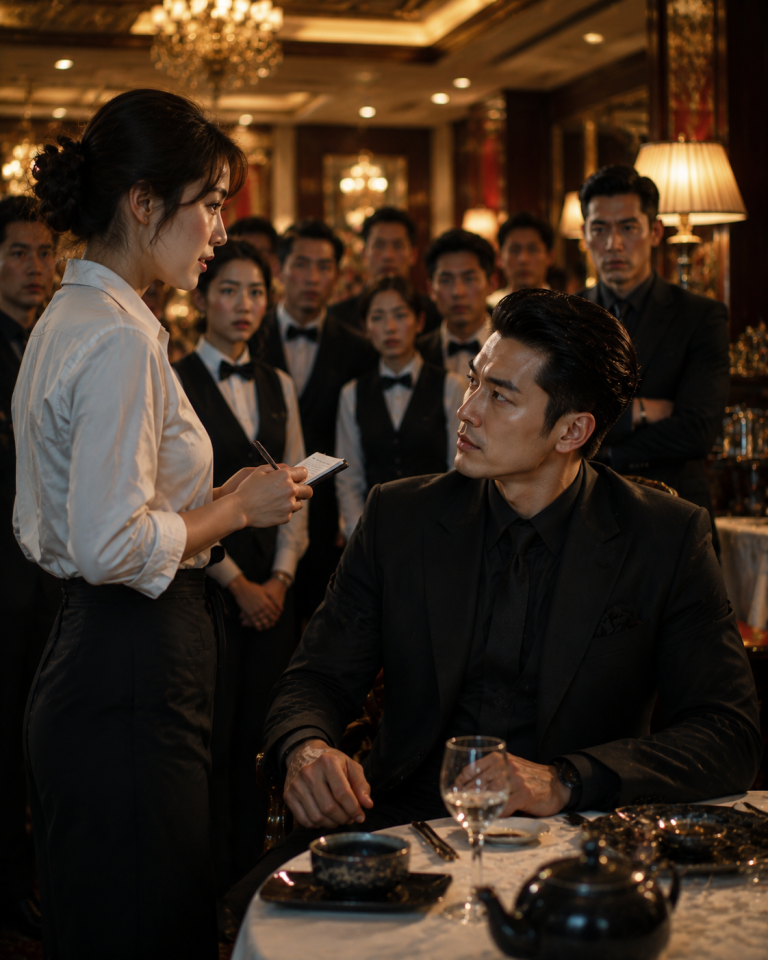
Officially, Aldo Ferrante was a logistics magnate — shipping contracts, warehouse networks, import infrastructure up and down the East Coast. Unofficially, everyone on the domestic staff understood the shape of the real business within about two weeks. The guards didn’t carry clipboards. The men who arrived without appointments never used surnames. The private dining room acquired a particular smell of closed conversation whenever staff approached.
My job was to not understand any of it.
Polish the imported stone floors.
Fold the napkins into their specific geometry.
Dust the library twice a week.
Become furniture that breathed.
I was good at it. Too good. And on the night of the January blizzard, that particular skill — making myself invisible, knowing every service passage, every back stair, every hidden corridor — was the only reason either of us survived.
I was not supposed to be working that shift.
That is the detail I would remember later, when memory organized itself around what almost happened instead of what did. A coworker’s sick child. A supervisor who had learned that Nora Vail did not say no to extra hours, because Nora Vail had debts that did not take nights off. One additional shift at an estate I had already memorized from basement to attic.
The storm hit the Catskills with the specific violence of a nor’easter that has been building patience over open water. By eleven p.m. the roads were impassable. By eleven-thirty, the estate was an island in white. The windows rattled in their frames like something outside was asking to be let in.
At 11:47 p.m., the power grid failed.
The mansion dropped into absolute dark.
For three seconds there was only the sound of the storm and my own breathing.
Then the backup generators came online and the hallways filled with amber — not light exactly, more like the memory of light, enough to see by if you already knew where you were going.
Then the sound.
Not loud.
That was what made it worse.
Suppressed, rhythmic. Coming from the West Wing. The controlled sound of weapons handled professionally, not in panic. Followed by voices in clipped bursts, boots on stone, the dense impact of bodies against floors I had cleaned that morning.
I was in the library on the east corridor.
A dust cloth in my hand.
My brain and my body disagreed for approximately four seconds about what was happening, and then both of them agreed it was the kind of thing you did not stay near.
I moved toward the hidden servants’ passage behind the tapestry on the north wall. My hand found the brass latch by feel — I had opened it a hundred times, knew the slight resistance before it gave. Beyond it was the back stairwell, the service corridor, the basement, the kitchen door, and past that, a chance.
Then something heavy hit the reading table at the center of the room.
A body.
Followed by a low sound — not quite a groan, more the involuntary noise a person makes when pain has moved past the point of dignity.
Everything in me that was still a nurse stopped moving.
Not a choice.
A reflex.
I turned.
Through the amber generator light, slumped against the far side of the reading table, was the man the estate’s entire staff had spent eight months not looking directly at.
Matteo Ferrante.
Aldo Ferrante’s eldest son. The heir. The man rooms reorganized around when he entered. Twenty-seven, maybe twenty-eight, with a face that combined controlled beauty and barely-concealed danger in proportions that made people uneasy before he said a word. He rarely needed to say more than one.
Right now he was saying nothing.
Because he was bleeding out through his shirt.
The jacket was torn open at the abdomen. The white linen beneath it had gone dark in a wide, spreading stain. One hand was pressed against the wound with the pressure of someone who understood anatomy and knew it wasn’t enough. His face, normally unreadable, had gone the gray-white of blood loss.
The library doors shook in their frame.
Thirty seconds.
Maybe less.
I dropped to my knees beside him.
“Hey.” Not a whisper — I needed him conscious. “Look at me.”
His eyes opened.
Gray-blue. Clouded. But tracking.
His hand caught my wrist with a grip that should not have existed in someone that far gone.
“Who—”
“Nora. Domestic staff.” I was already pressing my apron into the wound with both hands, feeling warmth saturate the fabric instantly. “You’ve been shot. We have to move now.”
“Leave.” Barely audible. “They’ll—”
“I know what they’ll do,” I said. “Help me or don’t, but I’m not leaving you here to finish the job for them.”
The brass handles of the library doors began to turn.
There was no more time for anything except what happened next.
I grabbed the heavy Persian runner beneath him and pulled with everything I had. The rug bunched around his torso. I got my arms under his and began to drag — across polished stone, toward the tapestry, toward the passage behind it — and the doors burst open at exactly the moment the tapestry swung shut behind us.
Darkness.
Narrow walls.
The sound of men spreading into the library on the other side of the fabric.
I dragged Matteo Ferrante into the dark and did not stop.
The back stairwell was a descent made of controlled disaster — each step a calculated impact, each landing a chance to check his pulse, adjust the grip, confirm he was still breathing. His weight was enormous. My back locked after the third floor. My knees slid on the stone.
I kept going.
At the basement level, I propped him against the concrete wall near the commercial kitchen. He was unconscious. Head forward, dark lashes against pale skin, breathing shallow but present.
The service door stood twenty feet away.
Beyond it: the estate grounds, white and violent with storm.
Beyond that: the old groundskeeper’s cabin, nearly a mile into the wooded acreage, abandoned for two seasons, off every security grid.
I grabbed a winter coat from the staff hook near the door — the chef’s heavy parka, two sizes too large. I found a canvas laundry tarp and rolled Matteo onto it with shaking hands. Then I checked his pulse one more time.
Still there.
Still losing ground.
I gripped the tarp grommets.
Kicked open the service door.
The blizzard entered the doorway like a living thing — wind stealing the air directly from my mouth, snow hitting my face with the force of thrown gravel, cold cutting through my uniform pants in the first second as if the fabric weren’t there at all.
I stepped into it.
One step.
Then another.
The groundskeeper’s cabin was approximately nine hundred meters through open snow that had already drifted to my knees and was still rising. I had one kerosene lantern somewhere in that structure, probably half empty. I had whatever was in a first aid kit that hadn’t been restocked since the last decade.
I had Matteo Ferrante on a tarp behind me, leaving a dark trail the snow was already working to erase.
I had the muscle memory of two years of nursing coursework that I had left behind in a classroom when the bills outran the dream.
And I had the particular stubbornness of a woman who has spent years being told she was the kind of person things happened *to* rather than the kind who made decisions.
I pulled.
I did not stop.
—
## PART 2
The cabin door gave on the third kick.
Inside: gasoline, old canvas, cold that had been building since October, and darkness so complete it had weight.
I lowered Matteo to the floorboards and gave myself exactly ten counted breaths before the training took over.
Stop the bleeding. Maintain temperature. Keep airway clear. Prevent shock.
Four matches before the kerosene lantern caught. Dim yellow light filled the space — rusted shelves, a broken chair, moth-eaten wool blankets in a chest, a first aid kit older than my nursing education, and on the workbench, a bottle of high-proof whiskey the old groundskeeper had clearly considered essential equipment.
I tore Matteo’s shirt open.
Two wounds, lower abdomen.
Bad.
Not yet hopeless.
I used what I had — the whiskey as antiseptic, gauze packing, torn blanket strips bound tight, checked pulse every three minutes. When the alcohol hit the open tissue, Matteo came back from unconscious with a full-body arch and a sound that would have carried outside the cabin if I hadn’t thrown myself across his chest.
“Quiet,” I said into the dark. “I’m packing the wounds. I need you to hold still.”
His eyes cleared. He looked at the ceiling. Then at me. Then at the rusted lantern swinging slightly in a draft from the floorboards.
He understood where he was.
“Do it,” he said.
So I did.
When the bleeding slowed, I dragged him onto the old mattress in the corner and layered every blanket I could find over both of us. Body heat was the remaining option.
The storm screamed outside.
Inside: our breathing, the creak of old timber, the faint hiss of the lantern.
Then Matteo’s voice, rough and quiet in the dark:
“Why didn’t you run?”
I kept my hands against his chest, monitoring.
“I was in nursing school before my mother got sick.”
“That’s not an answer.”
“It’s the only one I have.”
He was quiet for a moment.
Then: “Those men tonight didn’t come from a rival family.”
I waited.
“The West Wing biometric scanners require a twelve-digit code that changes every forty-eight hours. Four people have current access.”
I felt the shape of what he was saying before he said it.
“My father is in Philadelphia. My brother is overseas.” His jaw tightened against a wave of pain. “Which leaves my uncle.”
Victor Ferrante.
I knew the name the way all estate staff knew it — warmly, almost fondly. The approachable Ferrante. The one who remembered staff birthdays and shook hands at Christmas and made donations to children’s hospitals with a smile that reached his eyes. The one you forgot to be careful around because he had spent years making sure you forgot.
“He sold the family out,” Matteo said. “Staged the attack. By morning he’ll be the grieving brother holding the empire together while my father flies home to a version of events Victor has already written.”
I absorbed this.
“And if he finds out you’re alive?”
Matteo’s eyes moved to mine in the dim light.
“He’ll search every structure on this property.”
A pause that held everything it needed to.
“And anyone found with me becomes part of the evidence he needs to disappear.”
I lay in the dark beside a man I had known for eight hours, in a cabin that would be searched by men following orders to leave no witnesses, and felt the particular clarity that comes when there is no longer any version of this that is not serious.
“Then we make sure you’re alive at sunrise,” I said.
We were.
But sunrise brought worse.
Through the frost-grimed window in the gray morning light, I counted four snowmobiles moving in formation along the estate trails below. Behind them, a dark SUV tracking the main road. Tactical gear. Goggles. Organized search pattern.
Matteo tried to sit up and nearly tipped off the mattress from weakness.
“They found the drag trail,” I said.
“They’ll clear every outbuilding.”
He reached for the compact pistol at his waist with a hand shaking too badly to be useful.
I looked at the blood still seeping through the outer bandage.
Looked at the trail we’d left in the snow.
Looked at a man who was burning with early infection and had approximately forty minutes of useful consciousness left if I was wrong about the antibiotics.
“Can you walk?”
“No.”
“Then I’ll carry you,” I said. “But we’re leaving.”
I found a truck key on a hook near the equipment shelf — the old Ford the groundskeeper had left for landscaping work, parked in a maintenance shed near the eastern property gate. My father had been a mechanic in the Bronx. I had grown up in a garage that smelled of engine oil and honest work.
I knew how to start a reluctant engine.
I helped Matteo to his feet.
We had reached the back door when the radio on the workbench crackled to life.
A voice I recognized immediately — warm, polished, the voice of a man who had always known how to use a room:
*”Target was in the cabin. Blood trail indicates the maid is with him. All units: the domestic worker, Nora Vail, is to be considered an armed federal informant who coordinated tonight’s action. She is to be shot on sight. Bring me Matteo alive.”*
Static.
Then silence.
I stood at the door with my hand on the latch.
He had not called me collateral damage.
He had not called me a witness.
He had named me the architect.
By this morning, every channel Victor Ferrante controlled would carry a story in which Nora Vail — housekeeper, dropout, debt-carrier, a woman nobody had ever bothered to remember — had orchestrated a hit on the family she worked for.
The lie was already moving.
While I was in the woods dragging his nephew through the snow, Victor had been building a paper trail with my name on it.
Matteo looked at me.
“You heard.”
“Yes.”
“You understand what that means.”
I unlatched the door.
“It means we move faster,” I said.
—
## PART 3
We reached the maintenance shed in eighteen minutes that felt like a different kind of time entirely — not hours and seconds but the pure, contracting present of a body that has committed to the next step and the next and nothing beyond.
Matteo leaned on me with most of his weight. Every third step he made a sound I felt rather than heard, a vibration through his ribs against my shoulder. The snow came to my thighs in the open stretches between the tree line and the shed. I chose the tree line whenever I could. Slower, but covered.
We were fifty meters from the shed when a man came around the far corner of an equipment cluster.
He saw us.
There was a fraction of a second in which he assessed the situation — injured man, woman in a chef’s parka — and reached for his radio.
I did not think.
I moved.
Not from courage. From the absolute, crystalline understanding that hesitation was a luxury neither of us could afford.
I grabbed a survey stake half-buried at the shed edge and closed the distance before he got the radio to his mouth. He went down hard into the snow. His weapon slid away under the surface.
I stood there breathing.
My hands were shaking — not from the cold.
“Keys,” Matteo said, from behind me.
I snapped back into sequence. Took the guard’s radio and keys, got Matteo the last stretch to the shed, and found the old Ford with its orange paint chipped down to gray primer and its engine cold as the floor it sat on.
I turned the key.
The engine coughed.
Caught.
The shed doors barely cleared the cab as I reversed into the white morning.
Back roads.
Memory and instinct in equal parts, filling the space where GPS would have been. Matteo drifted between consciousness and fever, muttering in Italian — numbers, names, a phrase I heard repeated three times that I did not recognize. I drove with both hands and did not speak because there was nothing left to say and the city was still hours away.
By the time the Manhattan skyline appeared through gray winter light, Matteo had been unconscious for forty minutes.
“Name,” I said. “A doctor. Right now.”
He surfaced.
“Reyes. Lower East Side. Tell him the wolf is bleeding.”
The clinic was behind a laundromat with no sign and a steel door in a parking structure that smelled of bleach and decades of discretion. Dr. Colt Reyes was a former trauma surgeon with steady hands and a ruined reputation and exactly the kind of moral flexibility that made him useful in Matteo’s world. He took one look at Matteo, then at me — standing there in blood-soaked fabric, hair wet with melted snow, both hands scraped raw from rope and cold — and said:
“What happened?”
“Two lower abdominal wounds,” I said, walking beside the gurney without being asked. “Severe hemorrhage, field-packed approximately twelve hours ago. Signs of early peritoneal infection. He needs IV access, blood typing, broad-spectrum antibiotics, and surgery to evaluate the wound track.”
Reyes stopped.
Looked at me.
“Who are you?”
I looked back at him.
“The reason he’s still breathing. Do your job.”
He did.
I sat in the windowless waiting room for four hours with my hands in my lap and the radio I had taken from the guard on the table in front of me. I listened. Every thirty minutes, Victor’s channel broadcast an update. The story was consistent. Detailed. Nora Vail, domestic staff, thirty days’ employment at the Ferrante estate, identified as a paid federal informant who had provided tactical information to a rival organization. Considered armed. Should be treated as a principal actor.
He had my employment records.
My photograph.
My home address in Queens.
He had built this the way you build something that is meant to last — not in the chaos of the attack but in advance, in the calm before, with the patience of someone who had understood from the beginning that surviving a coup required having an explanation ready for the morning after.
I was the explanation.
The adrenaline was completely gone.
In its place came something quieter and more useful: the cold, clear recognition that I had exactly two choices. I could take the exit that would be offered — money, documents, disappear — and spend the rest of my life as a woman whose name was attached to a lie she hadn’t committed in a story that was now official record. Or I could make the lie unsustainable.
Not by fighting the Ferrante organization.
By feeding it something more accurate than Victor’s version.
The clinic door opened.
Matteo crossed the room slowly, one hand on a rolling IV stand, moving with the careful deliberateness of a man who is alive by recent margin. The fever flush was gone. His eyes were clear. He looked, for the first time since the library, like a man who would survive this.
He sat across from me and placed a thick envelope on the table.
“There’s money. Documents. A Lisbon apartment, already paid. Your debts are cleared.”
I looked at the envelope.
Clean slate.
Safety.
Everything I would have prayed for eight months ago, sitting at my mother’s bedside doing math I couldn’t make work.
I thought about the guard’s radio on the table.
About Victor’s voice on it this morning, warm and precise, building a case against a woman he had never spoken to directly.
About the estate staff who were still up in the Catskills, waking to a version of last night in which I had killed their colleagues.
About the dead men in the mansion, whose families would be told whatever story Victor found most convenient.
About every time in my life I had accepted the shape of a room instead of changing it.
I rested my hand on the envelope.
“What happens to Victor?”
Matteo’s expression sharpened.
“My father has been reached. Loyalists are moving.”
“Moving how?”
He did not answer.
I pushed the envelope back.
“No.”
He watched me.
“Violence erases Victor as a person,” I said. “It doesn’t erase the story he told this morning. The federal informant file. The employment records. My photograph on twelve channels. You can remove him and his version of last night still stands.” I looked at him directly. “You need the lie dismantled. Not him. The lie.”
Matteo said nothing.
“I know the service corridors he sent men through,” I said. “I know which biometric points were bypassed and from which direction. I know the timeline. I know the sequence of the sounds I heard before I reached you. I have the radio I took from the guard. I have my uniform. I have your wounds with their documented time of treatment.” I did not look away from him. “And I know that Victor named me as a federal informant before any official report existed, which means he created the file before the attack — which means it’s not a cover story. It’s a conspiracy document with a timestamp that predates the event it claims to describe.”
The room was very quiet.
“Give me access to what you can access,” I said. “Generator logs. Estate camera backups before the system was cut. Access code records. Bank records if you have them. Whatever the precinct captain in that county left on his desk before he remembered who paid him. And I will build you something that doesn’t require a single bullet to dismantle Victor Ferrante’s version of last night.”
Matteo looked at me for a long time.
The way, I thought, he had never looked at anyone in a household uniform.
Then he reached across the table and pulled the envelope back toward himself. He removed the cash and left the documents.
“Your way,” he said.
“Not just first,” I said. “Only.”
He stared at me.
Then, quietly, he laughed.
Not a performance. Something genuine, broken slightly by the pull of his wounds. The sound of a man who had spent years being obeyed and had just been corrected by a housekeeper.
“The maid is gone,” he said.
I looked down at my uniform. At the plastic name tag still pinned crookedly to the lapel, the font too small for the job title, the whole object designed to tell people which part of the estate hierarchy to place me in.
NORA V. — HOUSEKEEPING
I unpinned it.
Set it on the table.
Then I picked up the guard’s radio, the evidence folder Matteo slid toward me, and walked to the window.
Manhattan below, gray and dense and full of ongoing business.
The life I had been managing — the debts, the double shifts, the careful invisibility — still existed somewhere in the city. My Queens apartment. My supervisor’s unanswered calls. My mother’s name on a headstone in a cemetery off the BQE.
I held the radio in one hand and the folder in the other and looked at the skyline.
“Where do we start?” I asked.
We started with records.
The work that followed was not cinematic. It was the opposite of the blizzard — it was documentation, patient and incremental, the kind of evidence-building that happens in rooms that smell of coffee and secure lines and the quiet anxiety of men who are learning what it costs to underestimate the wrong person.
Estate camera footage showed the West Wing access door opening from inside, eleven minutes before the attack began. Generator logs confirmed the backup system had been manually delayed at a maintenance panel with keycard access — the same panel Victor Ferrante had personally approved a code update for, three days before the attack. The radio recovered from the guard outside the cabin carried thirty minutes of recorded conversation, including the timestamp of Victor’s order to label me an armed informant — a timestamp predating the first official incident report by two hours and forty minutes.
The precinct captain in that county did not wait for a formal request. He resigned by evening and drove to a federal building in White Plains with a lawyer and a prepared statement, because men like him understand the moment the math stops working in their favor.
Bank records required Matteo’s access, which he gave without discussion — three transfers from a Victor Ferrante shell charity to an account connected to the attack’s lead contractor, the first of which had been made six weeks before the attack.
By the third day, there was no version of Victor’s story that could be told without producing evidence that destroyed it.
Aldo Ferrante returned from Philadelphia under heavy guard and walked into the Manhattan penthouse where I was standing beside his son with a folder in my hands. He was a man in his sixties who carried authority the way architecture carries load — not loudly, but structurally, in every proportion. He looked at me the way powerful people look at unexpected things: measuring first, reacting second.
“You dragged my son through a blizzard,” he said.
I did not lower my eyes.
“I kept a patient alive through the available means,” I said. “Then I came here and did the same thing with different tools.”
Aldo Ferrante was quiet for a moment.
Then he looked at the folder.
“Show me.”
I showed him.
Victor’s collapse was not a single dramatic event. It was a sequence of small ones, each more quiet than the last. Allies stopped taking calls. Accounts flagged by an institution whose discretion Victor had counted on. A key contact in the shipping network declined to confirm a prior arrangement. The channels that had broadcast my name as a federal informant went silent, then reversed, then disappeared.
By the end of the week, Victor Ferrante was in federal custody on conspiracy charges that predated any Ferrante cooperation — the evidence had built itself into a structure that did not require a family to press charges. It only required the records to be read by people whose job it was to read them.
Which is what happens when lies are documented before the events they describe.
Patience, correctly applied, is the most devastating weapon available to anyone who has nothing to lose.
Months later, standing in a Manhattan office that had been reassigned to me — not formally, not with a title yet, but in the way spaces get reassigned when everyone in the building understands who belongs in them — I thought about the girl who had polished marble floors in the dark of January and decided her job was to not understand things.
That girl was not gone.
She was still there in the muscle memory, in the instinct to make herself small before powerful people, in the faint reflex to lower her eyes before she remembered she had stopped.
But she had learned something in a blizzard with a dying man on a tarp.
Not that she was fearless.
Fear had been everywhere that night — in her throat, in her frozen hands, in every step through knee-deep snow with armed men behind her and nothing ahead but darkness and a locked cabin and the chance that none of it would work.
She had been afraid every minute.
And she had moved anyway.
That was the thing the world had mistaken for smallness.
Not absence of fear.
Refusal to let it be the last word.
She had been told she was a dropout. A maid. A woman whose name appeared on other people’s payroll files and nowhere else. She had been told, in the thousand quiet ways institutions tell people, that the rooms she entered were not built for her to stay in.
But in the dark of an estate under attack, the woman who knew every service passage had saved the man who owned every room.
And in the aftermath, the woman nobody had bothered to remember became the only person whose testimony could not be discredited, because she had thought to collect the evidence before anyone thought to stop her.
The name tag stayed on the clinic table.
Not as rejection.
As record.
What she had been.
What she had brought with her into every room she had ever entered without being seen.
It turned out invisible was only ever another word for *watching*.
And she had been watching for a very long time.
Matteo found her at the window one evening, looking at the city.
“You could leave now,” he said. “The threat is gone. Your name is clear.”
She looked at the skyline.
At the grid of lights below — every window a room, every room a version of power organized around the idea that certain people belonged inside and certain people served it.
“I know,” she said.
That was the difference.
A year ago, *you could leave* would have meant: *nothing is holding you here, and nothing was ever yours.*
Now it meant: *the door is open and you are choosing.*
She turned from the window.
Opened the folder on the desk.
And went back to work.
Not because she owed anyone anything.
Because she had decided this was where she was going to be.
That was the whole transformation.
Not the blizzard.
Not the moment she dragged a man across marble toward a hidden passage while soldiers searched the rooms.
Not the truck, or the cabin, or the guard in the snow, or the evidence file, or the testimony that had brought Victor Ferrante’s careful lies apart seam by seam.
All of those were the proof.
The transformation was the decision underneath each one.
To move instead of freeze.
To look instead of avert.
To stay instead of accept the exit.
To say *not first* — *correctly* — to a man who had been obeyed his entire life.
Nora Vail had always been the most dangerous person in any room she entered.
She had simply been too tired, for too long, to know it.
The storm had fixed that.
And the men who had once looked through her name tag were learning, one corrected record at a time, that invisible was not the same as absent.
She had been there.
She had seen everything.
And she had written it all down.