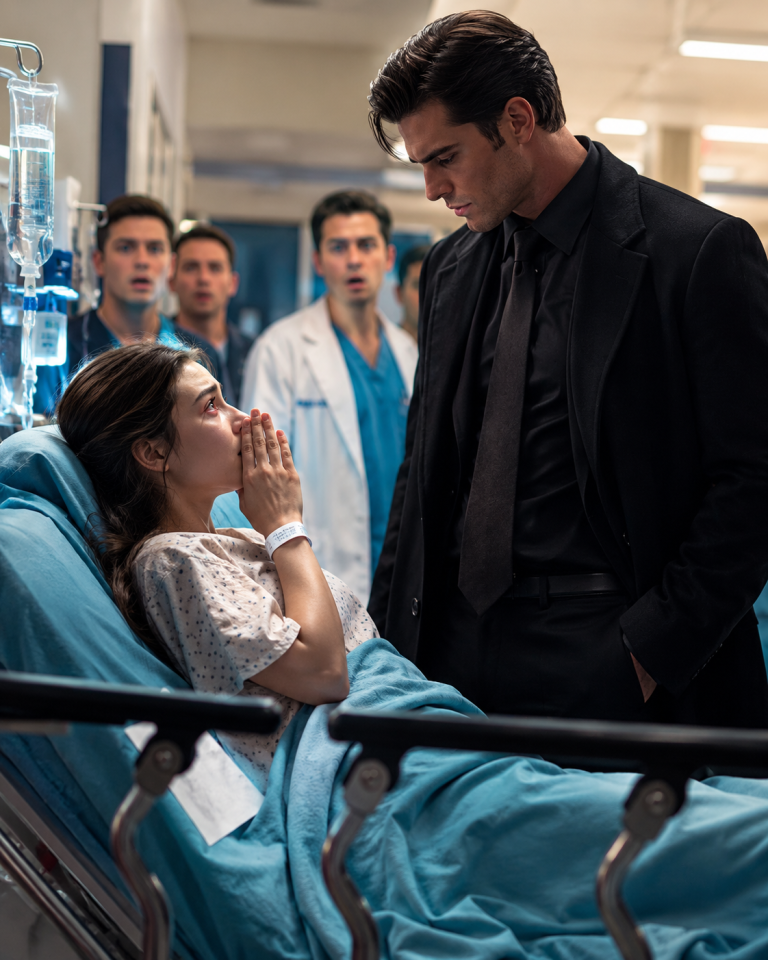
The Rookie Waitress Dropped a Fork in Front of the Mafia Boss—Then Stunned Everyone by Taking Down a 7-Foot Assassin

PART 1
Nobody told you, when they trained you for undercover work, that the hardest part was the performance of incompetence.
Mara Voss had been many things in service of federal operations. She had been a paralegal, a personal trainer, a customs broker’s administrative assistant, and once, memorably, a yacht crew member in the Gulf of Mexico for eleven weeks. She had learned, over nine years, that the roles that required active skill were easier than the ones that required you to systematically suppress it.
Being a bad waitress was, objectively, the most exhausting assignment she had taken.
Every dropped fork had to be calculated. Every trembling tray required conscious muscular effort to produce. Every apology had to hit the precise register of mortified sincerity. And every time Enzo Barone corrected her — in the flat, contemptuous tone of a man who regarded incompetence as a personal insult delivered directly to him — she had to absorb it without allowing her expression to do what it wanted to do.
He had corrected her twice tonight already.
Wine goes center. Food goes left. She knew. She had placed things wrong deliberately, watched his jaw tighten, apologized in the voice of someone very close to tears.
“How long have you been here?”
“Four weeks, sir.”
“Four weeks,” he repeated it like a verdict.
Around the table, men who had moved narcotics through six American port cities stared into their appetizers.
Mara let her eyes fill.
She was very good at this part.
“I’m trying my best,” she said.
Barone looked at her the way he looked at things he was deciding whether to discard. “When I come to Obsidian, I expect a certain standard. This room has made decisions worth more than you’ll earn in your lifetime. If you cannot maintain it, find somewhere more appropriate to your abilities.”
“Yes, sir. I’m sorry.”
She backed away.
Through the kitchen doors, she exhaled and checked the recording device beneath her wristwatch. Still transmitting. Six weeks of evidence, including tonight’s conversation about the Calumet Avenue warehouse, was building into something that would matter.
She had four more weeks.
Four more weeks of wrong forks and wrong wine and the particular expression she had practiced in the mirror — frightened, eager, slightly stupid — and then she would hand it off and disappear before anyone connected Mara Voss to the federal task force that officially did not have a name on any organizational chart.
She picked up the next tray.
She pushed the kitchen door open.
And the front doors of Obsidian came apart.
Not opened. Apart. Like something enormous had decided the architecture was optional. Both panels of the hand-carved walnut entrance flew inward simultaneously, and the blast of displaced air hit Mara in the face before she had processed what she was seeing.
Krüger came through the opening.
She had been briefed on him. Once, four months ago, in a secure room with no windows, her handler Petra had placed a file on the table with the specific caution of someone who knew its contents would be unpleasant. Former military contractor. Former participant in an enhancement program that no government was currently acknowledging. Six feet eight, approximately three hundred and forty pounds, and whatever cocktail he was running through his system currently meant that the normal biological limits on pain response and physical capability no longer applied in the conventional way.
Reading the file and watching him walk through what had been a door were not the same experience.
He destroyed two of Barone’s men in the time it took Mara to set the tray down.
The third — a young guy, couldn’t have been more than twenty-three, who moved with the eagerness of someone trying to prove something — Krüger simply redirected into the bar. The sound was bad enough that a man in a three-thousand-dollar suit began quietly weeping under a table.
Barone sat at table six.
He had not moved.
Mara had watched him operate for four weeks. She knew his tells — the slight angle of his chin when he was calculating, the stillness of his hands when he was afraid. His hands were very still now. His chin was down.
For the first time, Enzo Barone looked like what he actually was: a sixty-year-old man who had spent so long at the top of a violent food chain that he had forgotten the chain could reach him.
Krüger’s eyes found table six.
The whole room reorganized itself around that moment.
And Mara put down the tray.
The pins came out first. Her hair fell. She rolled her shoulders once — twice — and the woman who had been dropping forks for four weeks left without ceremony.
What remained moved toward the danger.
“Hey.”
Her voice wasn’t loud. It didn’t need to be. In a room that had gone almost entirely silent except for the sound of injured men breathing, it was the only voice.
Krüger turned.
He was close enough that she could see the specific quality of his eyes — the particular glaze that the enhancement compounds produced, the way consciousness was present but slightly behind the glass, like a pilot flying through cloud cover.
“Step away,” Mara said.
He laughed. The sound was wrong, like something the chemicals were producing on his behalf.
“Last chance,” she said, because it genuinely was.
Krüger charged.
She went under his first swing — a diagonal cut with the combat knife that would have ended things if it had landed — and her heel caught behind his knee as she rose. His own momentum became a liability. One hundred kilograms of enhanced muscle lost its geometry, and in the half-second before he recovered, she went up.
One foot, his bent knee. Two, his thigh.
Then she was above him, and her legs closed around his neck, and she torqued.
Krüger left the ground.
The marble floor received him.
The chandelier above them moved in sympathy.
For a moment, no one in Obsidian made a sound.
Then a voice came through the speaker system — calm, male, the particular confidence of someone who had designed the situation and was simply awaiting its conclusion.
“Mara Voss. Former Special Operations asset. Call sign Wren. We know your face. We know your history. We know you’re in this room.”
Mara stood slowly.
The thin line of blood on her forearm, where the knife had touched her in passing, she noted and set aside.
“We don’t want Barone,” the voice continued. “He’s incidental. We want you. Come out, and the civilians in the back room walk out breathing. Make us come in, and they don’t.”
A pause.
“Sixty seconds.”
Barone’s voice came from behind her, very quiet.
“This is because of you.”
“Yes,” Mara said.
“Who are you?”
She looked at the room — eight black-armored figures visible through the ruined entrance, the acoustic pattern suggesting more in the corridor to the left, Krüger already trying to reorient on the floor.
“I was your waitress,” she said. “Forty-five seconds ago that was still true.”
“Forty-five seconds,” the voice confirmed.
She grabbed Barone by the arm.
“Behind the bar,” she said. “Now.”
“I’m not going to—”
“You’ll argue with me or you’ll live,” Mara said. “Choose.”
He chose.
They moved.
—
PART 2
The bar was marble, three inches thick, Italian stone that Mara had once overheard Barone describe to a senator as imported at considerable inconvenience. It would stop a rifle round. She positioned Barone behind it, flipped the service station onto its side for additional cover, and assessed.
Eight visible. Three already down from Krüger’s entrance and now not a factor on either side. Krüger himself, rising from the floor in the way of something that did not entirely understand it was supposed to stay down.
Barone’s hand found her arm.
“How much?” he said.
She turned.
He had his phone out — cracked screen, shaking hands, but his eyes were direct and doing the calculation she had watched him run on other people for four weeks.
“What?”
“What are they paying for you. I have offshore accounts. I have crypto. Whatever the number is, I’ll match it.”
Mara stared at him.
For a moment, she was genuinely without words.
“That’s not what’s happening here,” she said.
“Everything has a price.”
“Not this.”
“Why?” His voice cracked slightly, the armor of thirty years doing something unusual. “You could have been behind that bar alone when the lights went out. They said they don’t want me. So why aren’t you gone?”
“Thirty seconds,” the voice said overhead.
Mara looked at the room. Counted entry angles. Counted the distance to the kitchen.
“I spent years being very good at a job,” she said, “that required me to measure whether a person was worth saving before I moved. And I watched what that did to the people around me, and to me.” She checked the angle on the far shooter. “I’m not leaving you because you’re worth saving. I’m leaving with you because leaving you isn’t something I’m willing to be.”
“Twenty seconds.”
Barone was quiet.
Krüger had found the knife.
Mara found the emergency breaker panel behind the bar — she had located it on day three, during the routine of a woman cleaning up after her shift, moving through the room without anyone watching because no one watched the waitress.
“When I kill the lights,” she said, “you move when I move. You don’t think. You don’t stop. You don’t try to negotiate with anyone.”
Barone looked at the bar, the room, her.
“You actually know what you’re doing,” he said.
“I’ve always known what I was doing,” Mara said. “That was the whole point.”
“Ten seconds.”
She killed the lights.
—
The kitchen smelled of abandoned stock and burning oil, the particular smell of a room that had been running at full capacity and then suddenly wasn’t. Emergency strips along the baseboard provided the only light — red-tinted, enough to see by if you already knew the space.
Mara knew the space.
She had mapped it in the first week, during the three-minute window between the dinner service’s first course and the second, moving through the kitchen on a pretextual errand while the cooks were plating and nobody was watching the layout she was memorizing.
Krüger found them anyway.
He came through the kitchen doors with the specific certainty of a man following a signal rather than a trail, and under the fluorescent lights that flickered back on, he looked worse than he had in the dining room. The chemistry was breaking him down. One side of his neck had begun to swell. His left eye had developed a rhythmic twitch. His mouth was wrong.
He held a meat cleaver that looked, in his hand, approximately the size of a normal knife.
Mara took a chef’s blade from the magnetic strip on the wall.
She felt Barone watching her grip.
“Kitchen’s the wrong terrain for you,” Krüger said. His voice had taken on a wet quality that hadn’t been there before.
“Wrong terrain for both of us,” Mara said. “But I’ve been working here for four weeks.”
She moved first.
He was faster than she’d accounted for. The cleaver came down hard and she slipped the angle but caught the backswing across the forearm she’d already cut — new pain stacking on existing pain, which she noted and deprioritized. Her countercut took his left Achilles, shallow but significant, and for three seconds he was uncertain on that foot.
Then he backhanded her with his right arm and she went sideways into the wire shelving.
Metal and ceramic came down around her.
She hit the tile on one knee.
Barone, behind the stove line, had gone very still.
Krüger turned toward her.
She was thinking about the gas line — she’d seen the valve placement, knew what it would mean, knew what it would cost to use it — when Barone moved.
He was not graceful. He was sixty-two years old with cracked ribs from the fall when the tables turned and he moved like someone who understood that speed was no longer an option and had decided commitment was the substitute.
He grabbed the culinary torch from the pastry station.
“Hey!”
His voice cracked, but it was loud, and Krüger turned.
One second.
Mara used it.
She reached the industrial spray hose, opened it full across the active burners, and the steam that erupted was thick enough and fast enough that for six seconds the kitchen became white noise and blind confusion.
She had Barone’s wrist.
They ran.
The walk-in freezer door sealed behind them.
Cold hit immediately, the specific cold of a space that kept things from rotting, and Mara leaned against a stainless shelf and let herself breathe twice, full breaths, before she started thinking again.
Barone slid down the wall across from her.
His face, in the cold blue light of the freezer interior, looked older than it had all evening.
“Who are you,” he said. Not *what are you*, not *who sent you*. The specific question of a man trying to understand a person.
“Mara Voss,” she said. “That’s real. The rest was the assignment.”
“You’re FBI.”
“Technically, I’m burned. My cover’s gone. The operation I was running is over.” She pressed her arm against her side to manage the bleeding. “When we get out of here, there will be charges. Evidence I’ve collected for six weeks. You’ll be arrested, you’ll be tried, and you’ll spend the rest of your life in federal custody.”
Barone looked at her.
“And you’re still here.”
“Yes.”
“Why.”
Outside, something heavy struck the freezer door. The frame shuddered.
Mara looked at the door.
“Six years ago,” she said, “I was on an extraction in Medellín. A nineteen-year-old informant who had helped us map a trafficking route. Bad intel, compromised position, and I had to choose between my team and getting him out.”
Barone waited.
“I tried to save both,” she said. “Three of my people died. He died in my arms anyway.” She looked at the hanging sides of beef, the stacked boxes, the organized inventory of a restaurant that was currently being destroyed on the other side of the wall. “My superiors asked me to justify the math afterward. Why I’d risked trained assets for one informant.”
“What did you say?”
“I told them the day I stopped counting a human life as worth saving was the day I became the thing I was supposed to be stopping.”
Silence.
Krüger hit the door again.
“You’re going to testify against me,” Barone said.
“Yes.”
“Everything I’ve built.”
“Yes.”
He stared at the floor.
“You know what you are,” she said. “I’m not going to tell you. You know what moved through those ports and what it cost and who paid. You’ve always known.” She met his eyes. “I’m not saving you because you’re a good man. I’m saving you because the coat check attendant and the busboy and the women in the back room didn’t sign up for this, and I won’t let them be the price of something I could prevent.”
The door began to bend inward at the frame.
Mara stood.
Barone’s phone was in his hand.
He was looking at a message from a contact labeled LENA.
*Dad are you okay someone said there was an incident at Obsidian please call me*
His daughter.
Living in Portland under her married name. Pretending her father was a retired businessman with complicated rumors behind him.
Barone looked at the message for a long moment.
Then he looked up at Mara.
“What do you need me to do?” he said.
She told him.
The freezer door came apart three seconds later.
—
PART 3
They got out through the service corridor while Krüger was still trying to understand what the CO2 extinguisher had done to his vision.
The kitchen was on fire in three places, controlled burns that Mara had set deliberately and precisely during the eight seconds she’d had before the tactical team recovered from the steam, and the sprinkler system that had activated on the eastern half of the dining room had bought enough confusion that the shooters had lost their formation.
It was not a clean escape.
It was a messy, burning, painful exit through a building that had sustained significant structural damage, guided by a woman with two cuts and a man with three cracked ribs who had discovered, somewhere between the freezer and the service corridor, that he was willing to be led.
The alley behind Obsidian was cold and full of exhaust from the police vehicles arriving on both ends.
Mara raised her hands.
“Agent Voss!” Someone in a federal jacket was running toward her.
“Barone’s with me,” she called. “Tactical team inside, eight at entry, minimum three more in the north corridor. Enhanced combatant contained in the kitchen — he’s in bad shape, send medics with the tactical. Hostages in the coat room, three civilians, all ambulatory.”
The federal agent stared at her.
Then at Barone.
Then at the state of both of them.
Barone, to his credit, had his hands up before anyone asked.
Mara’s knees decided, at that particular moment, that they were done.
Barone caught her.
It was instinct, she thought — the automatic response of a body reaching for something falling nearby. There was nothing noble about it. But his hands were solid under her arms and he held her upright until the federal agents reached them, and she was grateful for the practicality of it.
“Don’t make it sentimental,” she said.
“Too late,” he said. “You’re bleeding on my shirt.”
“You’ll have worse problems shortly.”
“Yes,” he said. “I know.”
They took him into custody with professional efficiency.
He went without resistance.
—
Mara woke in a hospital room with seventeen stitches, two cracked ribs that she hadn’t known about, a concussion that explained several things about the last hour, and Petra sitting in the corner eating almonds from a paper bag.
“The hostages?” Mara said.
“Alive. The busboy has a broken wrist. He’s already talking about a lawsuit.”
“Good for him.”
“Krüger is in federal medical custody. They’re not entirely sure what he was running through his system, but he’s alive and will be for some time, unfortunately.”
Mara stared at the ceiling.
“Barone?”
Petra was quiet for a moment.
“Talking,” she said.
Mara turned her head.
Petra nodded. “Not a little. Not carefully. He started yesterday morning and hasn’t stopped. Judges. Port inspectors. Political consultants. A shell network running through three logistics companies and a funeral home chain in Indiana.”
“He’ll negotiate reduced charges.”
“He’s not negotiating.” Petra looked at the almond in her hand. “His lawyer keeps trying to stop him. He keeps starting again.”
Mara was quiet.
“There’s something else,” Petra said.
The particular tone she used for things that were going to require a separate conversation.
“The team that came for you,” Petra said. “Whoever sold your identity. We couldn’t trace it through the Barone organization because it didn’t come from the Barone organization.”
Mara sat up slightly, which her ribs immediately objected to.
“Barone gave us the name of the consultant who brokered the contract,” Petra said. “A man named Aldric Vale. We ran Vale backward through the financial records, and three of the payments came through an account that belongs to someone inside the task force.”
The room was very quiet.
“Someone in our program,” Mara said.
“Yes.”
“Someone who knew I was Wren.”
“Yes.”
Mara lay back against the pillow and looked at the ceiling for a long time.
“Barone gave you that,” she said.
“Unprompted. He said—” Petra checked her notes. “‘She told me the truth about who she was when she could have let me die. I owed her the truth about who tried to kill her.'”
Outside the hospital window, Chicago was doing what it always did — continuing, indifferent to the specific ways its people destroyed and saved each other, the skyline unchanged, the lake sending cold air off its surface and into the streets.
Mara closed her eyes.
The operation was over. Her cover was finished. The six weeks of recordings from Obsidian would be part of a federal case that would take two years to prosecute and would eventually produce thirty-one indictments, the dismantling of four shell companies, the closure of a shipping lane that had moved product into six states, and the testimony of a man who had decided, in a walk-in freezer at two in the morning, that he was tired of measuring other people’s lives.
It would not undo what he had built.
Nothing would.
But truth, Mara had learned — late, imperfect, arrived at through fear and necessity rather than nobility — was still better than its absence. It gave investigators things to stand on. It gave families names. It gave prosecutors cases they could close.
The name of the person who had burned her was now on a federal warrant.
That had come from Enzo Barone.
She thought about this for a while.
Then she thought about the Medellín boy. About the math her superiors had wanted her to justify. About the version of herself that had been slowly trained, over nine years, to run the calculation before moving.
She had moved without running it.
She had done it in a restaurant in Chicago while wearing an apron that didn’t fit, and it had cost her an operation and a cover identity and seventeen stitches and two cracked ribs and produced, improbably, the one lead her own organization had failed to find.
Petra set down the almonds.
“You died for forty-one seconds in the ambulance,” she said.
Mara looked at her.
“I know,” Petra said. “I’m just saying.”
“I know you’re just saying.”
“Are you—”
“I’m fine,” Mara said. “I’m sore and unemployed and my cover name is never going to be usable again, but I’m fine.”
Petra smiled, though her eyes were not entirely doing the same thing.
“New assignment,” she said. “When you’re ready.”
“How long?”
“Whenever you want.”
Mara looked at the window.
“A while,” she said.
—
Enzo Barone’s sentencing happened on a gray Thursday in March.
He walked into the federal courthouse in a dark suit without a watch, which was the only jewelry he had worn for thirty years, and he looked like what he was: a man who had run out of performances and was now simply present.
His daughter Lena was in the gallery.
She had flown in from Portland. She sat in the third row with her arms crossed and her face doing the complicated work of a person who loves someone they are also furious at, which is the specific expression of people who have decided not to look away from something difficult.
Barone addressed the court before the sentence was delivered.
He stood without notes.
“I spent thirty years,” he said, “believing that the people who feared me respected me, and that the people who obeyed me were loyal to me, and that the money I had made meant I had built something. I was wrong about all three.” He was quiet for a moment. “I am not here to ask for mercy. I’m here because a woman I treated with contempt saved my life and told me the exact truth about myself in a walk-in freezer, and it was the most honest conversation I’d had in thirty years, and I thought I owed the court the same courtesy.”
Life without parole.
The marshals moved him out.
He saw Mara as he passed.
His mouth opened slightly.
She gave him a small nod.
It was not forgiveness.
It was something more useful: the acknowledgment that the truth had arrived, even late, even at cost, and that it had mattered.
—
Outside the courthouse, Petra was waiting with coffee.
Across the street, Tommy — the busboy from Obsidian, his wrist healed and in the company of a woman who appeared to be his girlfriend — was laughing at something she’d said. Not performing for anyone. Just laughing because something was funny.
Life continuing, as it did, regardless.
“New assignment’s ready,” Petra said.
Mara took the coffee.
“Still?” she said.
“The world doesn’t stop being a problem because you had a difficult quarter.”
Mara looked at Tommy across the street.
At the ordinary persistence of people who had been inside a dangerous room and come out and were now just living.
“Give me the brief,” she said.
Petra handed her a folder.
Mara opened it and read while she drank her coffee.
She was tired. Scarred. Her cover was burned and her ribs still ached in cold weather and she had spent three weeks in a debriefing room explaining decisions she had made in under a second that had taken four hundred pages of analysis to understand afterward.
None of that had changed who she was.
That was the part that mattered.
She finished the coffee, handed the cup to Petra, and turned the second page of the brief.
Still herself.
That was the only victory that couldn’t be taken away.