The Mafia Boss Found His Feverish Son Soaked in Rain—Carried by a Stranger He Never Expected to Trust

## PART 1
The number my grandmother wrote in the margin of her medical release form was 847.
Not a room number. Not a date. The exact dollar amount left in the account after we paid the pharmacy that month, circled twice in pencil so I would understand it wasn’t a complaint. It was an accounting. Her version of saying: *this is the shape of what we’re managing.*
I memorized it the way I memorized everything she gave me — the way she folded dish towels, the particular pitch of her voice when she was hiding pain, the number 847 in the margin of a form I still carried in my apron pocket as if it were a charm instead of an emergency.
I thought about it while I ran for the 11:40 bus on a Thursday in October.
I missed it by the distance between a red light and a green one.
The rain hit my uniform in cold sheets. My shoes had been leaking since August. I had twenty-three dollars in tips from a double shift and a dead phone and the kind of exhaustion that came from being twenty-four years old and already behind on everything a person was supposed to be ahead of.
The long route home was fifty-five minutes.
The shortcut through Lark Street was twelve.
I had taken it twice before, always with a knot in my chest the whole way through, always arriving home telling myself I wouldn’t do it again. Tonight the knot was there, but the twenty-three dollars was also there, and I was nursing student in my second year, and I needed to be awake by six, and sometimes poverty made the decision before your better judgment could organize a rebuttal.
I turned into Lark Street.
The rain was louder here, hitting metal fire escapes in irregular patterns, filling the gutters with black water. No one else was walking. A produce crate lay sideways near a drainage pipe. Somewhere above me, a window shutter banged once and went still.
Then I heard the sound.
Not a cat. I had heard cats in alleys before. This was softer. Interrupted. The sound of something trying not to make a sound.
I stopped.
My hand went into my pocket and found the pepper spray I kept there out of optimism more than confidence. Every rational instinct I had said *keep moving*. Two years of caring for my grandmother after her first stroke had rewired a different instinct — the one that recognized the specific acoustics of someone trying not to ask for help because they had already decided no one would come.
I said, “Hello?”
The sound stopped.
I moved toward the stacked delivery pallets near the alley wall.
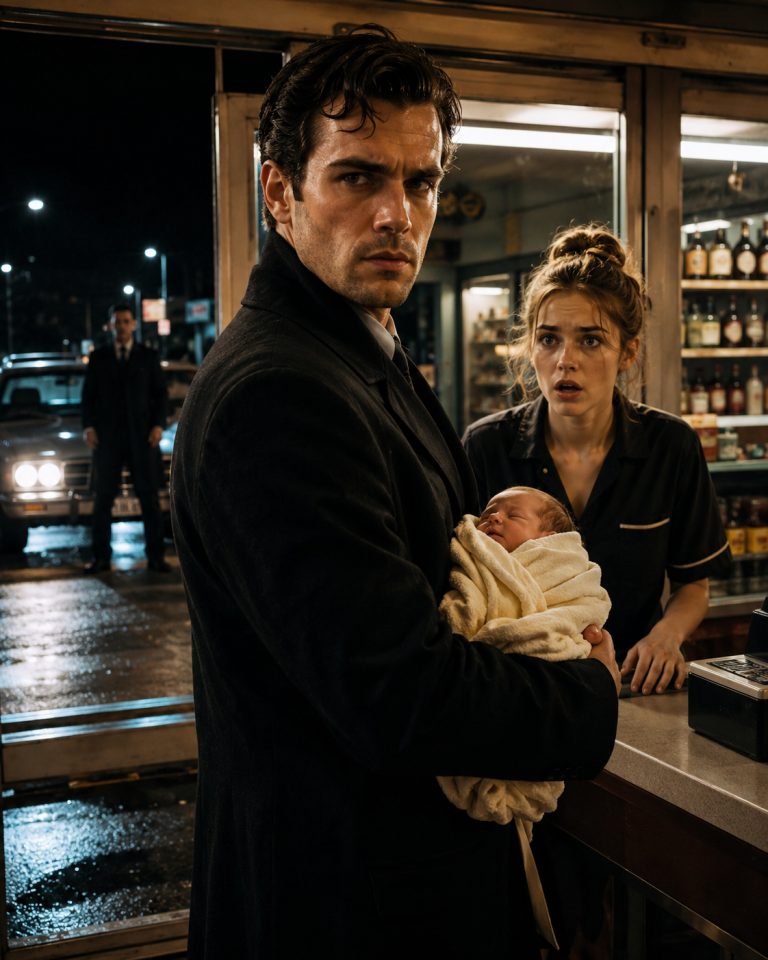
He was behind the second stack, pressed flat against the brick, arms wrapped around his own chest. Six or seven years old. Dark hair wet against his forehead, skin the color of wax paper. He wore a sweater that cost more than my monthly grocery budget and Italian leather shoes I had once seen in a department store under glass. His lips had gone faintly blue. His eyes, when they found me, were enormous with fever and the specific terror of a child who had been warned not to make noise by someone with the authority to make that warning count.
I dropped to my knees.
“I’m not going to hurt you,” I said. “My name is Mia.”
He did not speak.
He was shaking so hard I could hear his teeth.
I pressed the back of my fingers to his cheek and the heat hit me like opening an oven door.
I did not have a phone. I did not have a taxi. The nearest hospital was over a mile from where we sat in the rain. The boy’s fever was climbing — I could feel it in the quality of the heat, the way it radiated differently from fever-heat than exertion-heat, the way my grandmother’s had felt the night I sat on the bathroom floor with her and counted her breaths until morning.
I made the decision the way I made most decisions in that period of my life: quickly, on incomplete information, because waiting for certainty was a luxury people with backup plans could afford.
I took off my jacket and wrapped it around him.
He was light. Terrifyingly light. I carried him against my chest with one arm under his knees and the other across his back, and I walked.
By the time I reached my building, my arms shook and my vision had narrowed to the rectangle of light around my front door. I got the keys out, got inside, got him onto the sofa, and found the children’s fever reducer I kept for the upstairs neighbor’s daughter under the bathroom cabinet.
The thermometer read 104.2.
My own pulse went somewhere unpleasant.
I worked through the night in the way I had learned to work — methodically, without panic, because panic was expensive. Cool cloths. Medication crushed into apple juice. Pulse checks every thirty minutes. Counting his breaths and willing them to stay even.
At some point past three in the morning, his eyes opened.
“They said not to make noise,” he whispered. “They said Papa would get hurt.”
My chest went cold.
“Who said that?” I asked.
“The men from the other car.”
I looked at his face. The fever had broken slightly, but fear still lived in it underneath the exhaustion, the practiced stillness of a child who had been told that staying quiet was the price of keeping someone safe.
“What’s your name?” I asked gently.
“Marco.” He blinked slowly. “What’s yours?”
“Mia. You told me, but—” He almost smiled. “The alley Mia.”
I laughed despite everything. “That’s me.”
He fell back asleep before I could ask anything else.
By six in the morning, the fever had dropped to 101 and Marco’s color had returned to something closer to human. I stood at the window with a cold cup of coffee, watching the street below turn from gray to pale gold.
Three black SUVs turned the corner at exactly the same moment.
They parked in formation, blocking the street in both directions. Men in dark suits stepped out with the coordinated unhurry of people who had rehearsed this before. And then the last door opened and a man stepped out who was not wearing tactical gear or carrying visible weapons — only a dark suit, and a face that had reorganized every feature around the effort of staying controlled, and eyes scanning upward toward my window with an urgency so contained it had become something else entirely.
Not anger.
Fear.
The fear of a man who had been searching all night and was not yet certain he had found anything good.
Marco stirred behind me.
“That’s my papa,” he said.
The knock came four seconds later.
Precise. Unhurried. Three sounds that made my one-room apartment feel very small.
I opened the door.
The man from the street filled the frame. Behind him stood two others who had the stillness of people paid specifically for their stillness. His eyes moved past me to Marco on the sofa, and everything in his face — the control, the fury, the eight hours of terror — cracked for one second before he walked past me.
He dropped to one knee beside his son.
“Marco.”
The word came out broken at both ends.
Marco’s arms went around his father’s neck, and the man held him with the particular desperation of someone who has had a very specific fear confirmed and then immediately removed, and is still shaking from the first part.
When he turned to look at me, the crack had sealed.
“You took my son,” he said.
His voice was quiet.
I had spent a full night being terrified for a child I did not know, and I was still running on no sleep and cold coffee, and the words hit me like cold water.
“I found your son,” I said. “Behind pallets in Lark Street Alley at midnight. He had a 104-degree fever, blue lips, and he told me men from another car had warned him not to make noise so his father wouldn’t get hurt.” I kept my voice steady. “My phone was dead. No cab would come to Lark Street at midnight. He needed warmth and medication immediately. So I brought him here.”
The man looked at the sofa. At the damp cloths folded on the edge of the coffee table. At the medicine bottle and the thermometer and the nursing textbook I had opened at two in the morning to check the section on pediatric fever management.
“She sang when I was scared,” Marco said. “And she stayed the whole night.”
A pause moved through the room.
The man looked at me again with an expression I could not entirely parse — not softness, not trust, but something that required more than a single word.
“Nicolás Reyes,” he said.
The name landed in my chest the way certain names did in this city — not because I had met anyone who knew him personally, but because his name occupied a specific category of whispered knowledge. Reyes. Restaurants, shipping, private security. And beneath all of that, a kind of gravity that made people choose their words carefully when they said it.
“What else did he tell you?” Nicolás asked.
“Not much. He was in and out of consciousness.”
Marco’s hand appeared at his father’s sleeve. “She’s a nurse, Papa. Almost.”
“Nursing student,” I said.
Nicolás looked at me with an attention that felt like being read.
“The people who took Marco,” he said, “now know that someone helped him.”
The words arrived calmly.
What they carried was not calm.
“They will find out who,” he said.
I looked at the door, then at Marco, then back at the man whose enemies had just learned my building number.
“One month,” Nicolás said. “Private care for Marco while he recovers. Room and board. Five thousand dollars a week.”
The number moved through me like a sound at the wrong frequency.
Five thousand a week was my grandmother’s treatment. It was my tuition. It was the number 847 in pencil in a margin, finally having a real answer.
It was also Nicolás Reyes.
His world. His enemies. The men who had taken a child from a car and warned him to stay silent.
Marco looked at me from the sofa with the fever-bright eyes of a boy who had already decided.
“If I say no?” I said.
“Then I thank you,” Nicolás said. “And I make certain no one uses tonight against you.”
It was not a threat dressed as an offer.
It was something stranger: a powerful man leaving a door open.
I looked at my grandmother’s photo on the shelf. Then at Marco. Then at the number 847 I could feel through the fabric of my pocket.
“All right,” I said. “One month.”
Nicolás stood, Marco already against his shoulder.
He paused at the door. “You should know something before you come to my home.”
I waited.
“The men who took Marco,” he said, “are not finished.”
He looked at me directly.
“And now that you helped him, they will know your name.”
—
## PART 2
The estate rose from morning fog like a building that had decided to become a statement.
Iron gates. Cameras at every angle. Men with earpieces moving along the perimeter with the practiced invisibility of people who had been taught that their primary function was to not be noticed until they were necessary. Mia sat in the back of the center SUV with Marco asleep against her arm, and she watched the architecture of controlled power roll past the tinted windows and tried to locate her fear in the correct category: not *this is dangerous* but *this is permanent.*
Inside: marble, silk, silence designed by money. A housekeeper named Señora Rosa who had the face of someone who had seen everything and chosen warmth anyway. A doctor who confirmed what Mia had already known — exposure, fever, sedation in trace amounts that explained why Marco’s eyes had been slower than they should.
Nicolás listened to the medical report without expression.
She saw the moment rage entered him. It did not explode. It settled.
That was worse.
Later, when Marco slept in a room that had been assembled by someone who understood what a child needed — dinosaur curtains, a lamp shaped like a moon, shelves low enough for small hands — Nicolás appeared in the doorway and stood there a long time before he spoke.
“You can still leave,” he said.
Mia turned from the window. “Is that a warning?”
“Yes.”
“Who decorated this room?”
The question landed sideways.
“His mother,” Nicolás said.
He said it flatly, the way someone said things they had learned to carry the weight of without stumbling.
Mia nodded once and did not ask the next question.
Three days passed. Marco improved and proved to be exactly the kind of child she had expected: precise, careful, affectionate in the controlled way of a boy who had learned to calibrate trust. He showed her his plastic stegosaurus, General Rex, with the gravity of someone making an introduction. He asked her to read until she was hoarse, then announced he was not tired.
On the fourth day, she overheard two of Nicolás’s men in the east corridor. Spanish, fast and low.
*Traitor. Inside. Cruz.*
Mia stood very still with Marco’s medication in her hand and filed the name.
That evening, Nicolás called her to the study and placed a photograph on the desk. She looked at it for a moment before she understood what she was seeing: herself, in the garden with Marco, laughing while General Rex was held aloft in triumph. A normal afternoon. A photograph that should not have existed.
Then she saw the red point of light against Marco’s chest.
A scope.
From outside the walls.
“They were positioned across the street,” Nicolás said.
“The specialist appointment,” Mia said.
“Tomorrow. It cannot move.”
“And Marco wants me there.”
Nicolás looked at her with the expression of a man who had already had this argument with himself and lost.
“My security team says—”
“I know what your security team says.” Mia looked at the photograph. “And I know what Marco will do if he gets into that car without me.”
Nicolás’s jaw moved.
“Tell me what I need to do,” she said.
Something shifted in his face — small, almost imperceptible, but she had been watching him for four days and she was beginning to understand the specific vocabulary of his expressions.
He was afraid.
Not for his empire. Not for his operation.
For her.
And Dante, his head of operations, had told her that morning — quietly, while she prepped Marco’s morning medications — that Cruz, the missing guard, had pulled her background file three days *after* she arrived at the estate. Not before. Not to vet her.
After.
She hadn’t understood why yet.
She was starting to.
—
## PART 3
The medical building sat on a block that looked aggressively ordinary — glass front, directory beside the elevator bank, a café on the ground level that sold acceptable coffee and unremarkable sandwiches. Mia had been in enough hospitals and clinics to know that danger preferred ordinary settings. It was harder to see clearly in rooms that looked like they belonged to regular life.
Marco pressed against her side in the elevator.
“Will Dr. Santos use the big needle?” he asked.
“Probably a small one.” She adjusted the strap of his backpack. “And you can hold my hand the whole time.”
“What if I cry?”
“Then you cry. Crying doesn’t mean it wasn’t brave.”
He thought about this carefully, with the expression he used when he was deciding whether an adult had told him something true or something convenient.
“Does my papa cry?”
Mia looked toward the front of the elevator, where Nicolás stood beside Dante, his back to them. She knew he could hear.
“I think your father feels things very deeply,” she said. “He just learned to hold them somewhere that doesn’t show easily.”
Nicolás did not turn around.
But she saw his shoulders change.
At the clinic, she kept to the plan and exceeded it. She identified the man in the waiting area who had been there when they arrived and was still there twenty minutes later, looking at his phone with the concentration of someone looking at something else. She identified the woman by the vending machine who had not purchased anything. She felt, rather than saw, that the delivery entrance downstairs had acquired a vehicle it had not had when they entered.
She pressed the silent alert device Nicolás had given her once, hard, and went back to telling Marco that General Rex’s bravery was genetic and therefore unavoidable.
Dr. Santos was thorough and gentle. Marco bore the blood draw with clenched jaw and dignity.
“I didn’t cry,” he said afterward.
“You were incredible,” Mia said.
He grinned, crooked and real.
The door opened.
A woman in scrubs entered with a tray and a smile that was correct in every detail except the quality of her attention. It was too wide. Too fixed. Aimed specifically at Marco in a way that reminded Mia of something she had learned from Señora Rosa on the second day: that the estate hired kindness and trained it, and real kindness looked different because it included everything around the child, not only the child.
The woman’s eyes were wrong.
Mia moved.
She drove her shoulder into the woman’s arm, sending the tray sideways across the tile. A syringe skidded under the exam table. Dr. Santos shouted. Marco scrambled off the chair.
“Under the table,” Mia said. “Now.”
The attacker’s elbow connected with her jaw and her vision went white and then came back in time for her to see Nicolás come through the door like a decision that had been building for several seconds and finally arrived.
Behind him: Dante, and two others, and the particular controlled chaos of a plan in execution.
The attacker pivoted toward the exam table.
Mia threw herself sideways and took the kick in her ribs instead.
Pain obliterated everything for two seconds.
When she came back, she was on the floor. Dante had the woman down. Nicolás had Marco. The room was full of voices.
Nicolás’s face appeared above her, stripped of every performance.
“Marco?” she managed.
“Safe.” His hand went to her cheek, then stopped at the boundary between what he wanted to do and what he had permitted himself. “You’re bleeding.”
“Did she have another syringe?”
His eyes darkened. “Do not move.”
“That’s not what I asked.”
A pause.
“No,” he said. “She did not reach him.”
Mia closed her eyes.
At the estate, Dr. Vargas confirmed what she had already done the arithmetic on: three bruised ribs, probable mild concussion, split lip, significant jaw bruising. She argued that she could return to Marco’s room by evening.
Marco arrived to this argument in his pajamas, General Rex in hand, and announced with the authority of a seven-year-old who had decided: “You saved me twice. That means you have to rest. General Rex will guard you.”
He placed the stegosaurus on her bedside table with ceremonial seriousness.
“That’s a significant post,” Mia said.
“He’s the best.” Marco’s voice went smaller. “I was really scared.”
“Being scared doesn’t take away the brave part.”
He looked at his hands. “When Mama died, Papa said I had to be strong now.”
The room shifted.
She felt Nicolás go still in the doorway.
Marco seemed to realize what he had said and pulled inward, mumbling something about dinner, and Señora Rosa appeared and gently redirected him, and Mia was left alone with Nicolás and the grief he wore like a second suit.
He walked to the window.
Beyond the garden, roses climbed the perimeter walls as if practicing beauty for its own sake, unrelated to what was required of them.
“Her name was Valentina,” he said.
Mia did not fill the silence.
“She hated this house. Not the rooms. What the rooms required. She said I had built walls and called them protection.” He looked at his own reflection in the darkening glass. “She tried to leave. She wanted forty-eight hours — just me and Marco, somewhere without the guards, without the operation. I told her it wasn’t safe. That I needed more time to deal with the leak I suspected.”
“She didn’t wait.”
“No.”
The single word held five years.
“I found the traitor after her car went off the bridge,” Nicolás said. “Which meant I had protected the operation and lost the person the operation was supposed to protect.”
Mia looked at the stegosaurus on her table.
“What happened to the man who sold her?”
Nicolás’s reflection did not change.
“He is no longer a problem.”
She accepted this the way she accepted many things about Nicolás Reyes — as information, not absolution.
“You became harder after,” she said.
“I became useful to Marco,” he said. “Harder is a side effect.”
“No. Harder was the choice. Useful to Marco was the reason.”
He turned from the window.
“You should leave when you can walk without pain,” he said.
“Is that what you want?”
“No.”
The word came too fast. He looked away from it.
“Then why say it?” Mia asked.
“Because wanting has ruined everyone I’ve been responsible for.”
The room was very quiet.
Mia looked at her hands, wrapped around the edge of the blanket. “You think keeping people at a distance protects them.”
“It does.”
“No,” she said. “It just means they’re afraid of the wrong things for longer.”
His gaze sharpened. “You have been in my house one week.”
“And in that week, I watched you keep your son’s door open every night because the darkness frightens him. I watched you argue with Dante about whether the clinic schedule needed to move and then ask Marco three separate times whether he felt ready. I watched you eat half of Señora Rosa’s soup because she looked like she needed to see it eaten.” She held his eyes. “You are not the version of yourself you think you are.”
He looked as though the words had reached somewhere he had sealed.
Then Dante knocked and entered.
“Forgive me,” he said, looking at Mia briefly before settling on Nicolás. “Cruz. We found him.”
Nicolás straightened.
“Missing for three days,” Dante continued. “He accessed Señorita Tran’s file on day four of her arrival at the estate. Not to vet her. To package it.”
Mia frowned. “Package it for who?”
Dante looked at Nicolás.
Nicolás had gone very still.
“For Serrano,” Dante said. “Cruz sold Serrano the information that you—” A pause. “That Miss Tran had become important to you. That Marco trusted her completely. That your exposure had changed.”
The room rearranged itself.
Mia understood.
Not immediately. In pieces, the way real understanding arrived — not in a single flash but in successive clarifications.
She had not been used as bait.
She had become a target because Nicolás’s enemies had recognized, before he had admitted it to himself, that she mattered to him.
Cruz had not pulled her file to give Serrano leverage over *her.*
He had pulled it to give Serrano leverage over *Nicolás.*
She sat with that knowledge for a moment.
Then she looked at Nicolás, who was looking at the floor with the expression of a man who had just heard something proven about himself that he had been trying to prevent from being true.
“They saw it,” she said.
He didn’t answer.
“Your enemies saw it before you did.”
His jaw moved. “Yes.”
“That’s not a small thing.”
“No.”
Dante excused himself quietly.
Mia pushed back the blanket.
“My grandmother,” she said.
Nicolás was already ahead of her. “Two of Dante’s people are at the facility.”
“She doesn’t know anything about any of this.”
“She will be moved to a secure wing by morning.”
“She’ll be terrified.”
“She’ll be alive,” he said. “And then we’ll explain.”
Mia looked at him.
“We,” she repeated.
Nicolás met her eyes. “You are not alone in this.”
The words were not grand. They were very specific.
That was what made them matter.
They were in the SUV within ten minutes — Nicolás beside her this time rather than in front, close enough that she could feel the warmth coming off him without either of them addressing it. The city moved past in night-lit strips of neon and ordinary light.
Her grandmother, Lan Tran, was sitting up in bed when Mia arrived, silver hair pinned back, hands folded with the patience of a woman who had survived many cities across many decades and had learned not to assume she knew which direction trouble would arrive from.
She looked at Mia’s bruised face.
She looked at Nicolás.
“This is not hospital fall,” she said.
Mia sat beside her. “No, Bà Nội.”
Lan’s eyes moved to Nicolás with the assessment of someone who had been evaluating people for seven decades.
“You are the employer.”
“Nicolás Reyes.”
“My granddaughter is hurt.”
“Yes.”
“You say yes too fast.”
“It is true.”
Lan’s chin lifted slightly. “Truth is not apology.”
“No,” Nicolás said. “It is not.”
A silence opened. Lan used it the way she used most silences — as a tool, letting it collect information without cost.
“You care for her,” she said finally.
Mia closed her eyes.
Lan’s voice did not waver. “Old women see this. We have little else to watch.”
“Bà Nội,” Mia said quietly.
Her grandmother squeezed her hand once, then looked at Nicolás. “Do not use her soft heart because your house is empty.”
Nicolás’s voice, when it came, was lower than she had heard it. “I would rather lose everything I have built.”
Lan studied him. Then she nodded — a single, economical movement that said: *first test passed. There are others.*
The threat to Lan turned out to be a photograph, delivered to the nurses’ station before Dante’s people arrived. Mia, walking in the garden with Marco, General Rex held overhead. A line on the back: *She is not family. She can be moved.*
Mia read it twice in Nicolás’s study later, rain on the windows, and felt the meaning behind it.
“They’re telling you to let me go,” she said.
“Yes.”
“And if you don’t?”
“They will try to remove you as leverage.” He looked at her steadily. “Which is why I am asking, not telling, whether you want to stay.”
“And if I leave?”
“Then Dante arranges protection. Your grandmother’s care continues. Your tuition is handled. You walk out of this with the month’s compensation and no debt to anyone.”
Mia looked at the window.
“That’s a real offer,” she said.
“Yes.”
“Most powerful men don’t make those.”
“I have been informed of my deficiencies. I am attempting a different approach.”
She laughed once, surprised.
He did not smile exactly. But something near his eyes shifted.
“Nicolás,” she said.
“Yes.”
“I’m not leaving because Serrano sent a photograph.”
His breath moved differently.
“I’m also not staying because I don’t have anywhere else to go,” she continued. “I need you to understand those are different things.”
“I understand.”
“Do you? Because men who’ve been afraid long enough sometimes mistake gratitude for devotion and devotion for possession, and I need you to—”
“I know,” he said. “I did that with Valentina. I will not do it again.”
The room was very quiet.
“She didn’t leave you because she stopped loving you,” Mia said.
“I know.”
“She left because love without safety isn’t love. It’s a promise with a hole in it.”
Nicolás looked at his hands. They were clasped on the desk in front of him, knuckles white.
“No more holes,” he said.
It was not a polished declaration.
It was the sound of a decision.
Three days later, the night before Serrano’s ultimatum deadline, chaos arrived in the form of a seven-year-old in pajamas.
Mia woke to silence, which was wrong. Marco had been making some noise in his sleep for the past week — small sounds, the standard inventory of a child working through too much. Silence was not his norm.
She found Señora Rosa weeping quietly in the hall.
Marco’s room was empty.
General Rex was gone.
The security footage on Dante’s tablet showed Marco, at 5:17 a.m., walking out the east service gate with a woman in a dark coat. The woman’s face turned once toward a camera at the wrong angle.
Camila.
Valentina’s sister.
The family resemblance was evident even in the security footage. Mia had met her once, briefly — a woman with beautiful posture and a grief she had converted entirely into bitterness over the years.
Nicolás looked at the screen once.
She watched something settle in his face that was not rage. It was more frightening than rage because it was patient.
“Cruz was the east gate guard,” Dante said.
Mia’s hand found the doorframe.
“Camila thinks she’s rescuing him,” she said.
“Or she’s aligned with Serrano,” Dante said.
“No.” Mia looked at Nicolás. “She believes what she believes. Someone told her what she needed to hear, and she believed it because she needed to, not because she’s evil.” She paused. “Marco trusts her. He would have gone willingly.”
Nicolás looked at her.
“He’ll be frightened when he realizes what the situation actually is,” she said. “He’ll want a face that doesn’t look like war.”
“The last time I agreed to bring you somewhere dangerous—”
“You got me there safely,” Mia said. “And I got us both out.”
A pause stretched between them.
“You stay in the vehicle unless I authorize otherwise,” he said.
They both knew this was optimistic.
San Cristóbal Church had been closed for eleven years. It occupied a corner of the old warehouse district with the particular dignity of a building that had outlasted its purpose and refused to apologize for it. The rain had thinned to a mist that caught the streetlights in small, intermittent halos. Three of Nicolás’s vehicles staged at the north and east perimeters. Dante took the roof access.
Mia stayed in the SUV for six minutes.
Then she saw a pale face at the boarded side window — Marco, small and still, looking outward.
She opened the door.
The interior of the church smelled of closed air and old candle smoke and the specific silence of stone rooms that had once been filled with sound and now held only its absence. Broken pews in crooked rows. A cracked cross at the front wall.
Camila stood near the altar with Marco, one arm around his shoulders. Her face was wet from either rain or tears or both. Across the nave stood Serrano — older than Mia had imagined, silver-haired, with the still eyes of a man who had decided a long time ago that other people’s reactions to him were simply information.
Two guards beside him. Cruz near a side door, refusing to look at anything.
Nicolás entered from the main aisle.
“Let him go,” he said.
Marco’s eyes found Mia in the shadows.
“Emmy!” The word came out broken with relief.
Every gun in the church shifted direction at once.
Mia stepped into the open.
“Hi, sweetheart,” she said, keeping her voice steady. “Are you hurt?”
He shook his head.
Camila’s grip on him loosened slightly — not releasing, but uncertain now, her confidence eroding under the reality of what she had walked into.
Serrano’s voice was conversational. “The woman who found the boy in the alley. I wondered when we’d meet.”
“I doubt it,” Mia said.
He almost smiled. “You’ve become very important to a very important man. That makes you interesting to me.”
“I’m a nursing student who works double shifts,” she said. “You’ve made a significant miscalculation about what I am.”
“No,” Serrano said. “I’ve made an accurate calculation about what you mean.”
He glanced toward Nicolás.
Nicolás’s face had closed completely.
Serrano continued, “Men like Reyes are very simple to weaken once you find the right place to apply pressure. His son. Obviously. But a man who has already survived losing his son once—” He gestured toward Marco. “We needed something new. Something he wasn’t prepared to lose.”
Camila looked at Serrano.
“You said you wanted to get Marco away from him,” she said. “You said he wasn’t safe.”
“And now you’ve delivered him exactly to the man you were afraid of,” Serrano said, without looking at her. “You’ve been useful, Mrs. Salcedo.”
Camila’s face changed.
“Papa,” Marco said. “I didn’t know.”
Nicolás crossed the floor toward his son, and Camila stepped aside — not pushed, not ordered, simply no longer able to maintain the geography of her plan against the reality of what she had actually done.
Marco broke from Camila’s loosened hold and ran.
Nicolás caught him and held him in the specific way he held him — with the full force of a man who had spent years learning to manage fear and had finally stopped managing it.
Serrano’s voice came over the sound of father and son.
“This is moving, truly. Unfortunately, sentiment doesn’t resolve outstanding agreements.”
He lifted one hand.
Cruz moved.
Not toward Nicolás.
Away from Serrano.
“No,” Cruz said. His voice shook. “You told me my sister would get the treatment. The clinic was real. You said—”
“I said many things,” Serrano said.
“She died this morning.” Cruz’s voice broke. “The clinic didn’t exist. The medication was never arranged.”
For a fraction of a second, Serrano looked genuinely surprised.
Dante moved from the balcony.
The church erupted.
Mia pulled Marco down behind the nearest intact pew as Nicolás covered them both, his body between them and the center of the nave. Gunfire cracked through the old stone and came back as echoes twice as loud. Wood splintered. A window board gave way. Marco buried his face in Mia’s shoulder and screamed once, then went silent with the stillness of a child who understood instinctively that stillness was survival.
Mia pressed her hand against the back of his head and counted his breaths.
Cruz tackled one of Serrano’s guards and took a bullet in the shoulder for it, which Mia noted clinically and filed for later.
Camila was behind the altar, arms over her head, crying her sister’s name.
Serrano moved toward the sacristy.
Nicolás rose.
He went after him with the economy of a man who had been making this kind of decision for twenty years and had stopped requiring the permission of hesitation.
Mia looked at the injured guard who was still conscious and still reaching for his weapon.
General Rex was in Marco’s pocket.
She grabbed it and threw it.
The plastic stegosaurus struck the man’s temple at the wrong angle for damage and the right angle for surprise. His shot went sideways. Dante fired once, clean and final.
Mia looked at the stegosaurus on the floor.
Marco lifted his head. “General Rex saved someone.”
“He did,” Mia said.
“He’s very brave.”
“He learned from you.”
At the sacristy door, Nicolás had caught Serrano.
Mia could not hear what passed between them. She could see Nicolás’s back, the line of his shoulders, the particular stillness of a man holding a decision in both hands and deciding which part of himself would make it.
“Papa!” Marco called. “Don’t!”
Nicolás turned.
Across the destroyed interior of San Cristóbal, his eyes found Mia first.
She didn’t speak. She didn’t need to. They had learned enough of each other’s vocabulary by now that the look was sufficient: *this is the choice. Not between power and weakness. Between who you were before and who he is watching you become.*
Nicolás lowered his weapon.
Dante took Serrano alive and handled the rest.
Camila sat on the front steps in the rain when it was over, arms around her knees, face devastated with the specific expression of someone who has just understood the full scope of what they were manipulated into doing.
Mia sat beside her.
“You thought you were protecting him,” she said.
Camila looked at her. “I was so angry.”
“I know.”
“He let her die.”
“He thought he was keeping her safe.” Mia looked at the wet street. “That’s not the same as not loving her. But it caused the same harm.”
“Do you think he’s changed?”
Mia thought of a man matching her pace in a parking garage so no one would notice she was leaning. Of soup eaten because Señora Rosa needed to see it. Of a study door opened and then closed again without a word. Of a background file accessed too late to be about vetting and too specific to be about anything except leverage on a man who had started, quietly and without announcing it, to love someone.
“I think he’s trying to,” Mia said.
Camila covered her face.
“I’ll tell Marco,” she whispered. “Someday. That it wasn’t his fault.”
“He already knows,” Mia said. “But he’d be glad to hear it from you.”
That night, all three of them slept on the floor of Marco’s room because Marco had declared it the only acceptable arrangement and General Rex endorsed the decision by being placed ceremonially between them all.
Nicolás’s back was against the bed. Marco slept against his side with the boneless depth of a child who had completely exhausted every resource. Mia sat nearby in a blanket, ribs aching, the events of the night settling into the various compartments where the body stored difficult things for processing later.
Near midnight, Marco’s voice came out small and clear.
“Is Mia family?”
Mia’s heart stopped.
She felt Nicolás go very still.
“Family is people who stay,” Marco said. “Not just blood.”
“Yes,” Nicolás said. His voice was rough from the edges. “That’s true.”
“So is she?”
A pause.
“That’s a question for Mia,” Nicolás said.
Marco turned and looked at her with the direct patience of a child who had decided the answer mattered too much to let adults handle it evasively.
“Would you like to be?” he said.
Mia looked at him. At his father. At General Rex stationed between them on the carpet.
“Yes,” she said. “Very much.”
Marco exhaled with the satisfaction of someone who has corrected a problem that adults had been slow to address, and went back to sleep.
Nicolás looked at Mia across his son’s head.
She looked back.
That was sufficient.
The months after were neither easy nor dramatic.
Serrano’s network fractured the way networks did when the person organizing the fear at the center was removed — not all at once, but in pieces, each piece pulling others until the whole architecture became unsound. Dante managed the operational side. A federal investigation opened based on information that arrived through channels nobody needed to examine too closely. Cruz survived and testified. Camila entered a private arrangement with Nicolás that did not involve forgiveness — forgiveness was a longer project — but involved Marco, who visited her twice a month with General Rex and once brought her a painted rock from the estate garden because he had decided she was sad.
Lan Tran inspected the estate kitchen with the thoroughness of a woman who understood that how someone maintained their pantry told you about their character. She told Nicolás he was too thin in a way that was somehow more accurate than a medical assessment. She made soup. He ate it. She told Señora Rosa that the coriander proportion in the broth was adequate but could improve. Señora Rosa took notes.
Mia finished her nursing degree.
She walked across the stage on a Saturday morning in May with her grandmother in the front row crying in the specific way she cried when she was proud — silently, with complete dignity, tears running straight down without any concession to the social pressure to be subtle about them. Nicolás stood in the fourth row with Marco on his shoulders, both of them applauding with a total commitment that caused people around them to look over and then smile despite themselves.
That evening, Nicolás drove her back to Lark Street.
Not to frighten her. Not to perform something. The city had installed new lighting through a community safety program that bore no name she could verify, and he wanted her to see it.
The alley looked ordinary. Lit, and therefore ordinary.
“I was so tired that night,” she said.
“Yes.”
“I almost didn’t turn.”
His hand found hers in the dark. “But you did.”
She looked at the spot where she had found Marco. The pallets were gone. The wall was the same brick.
“What would have happened if I hadn’t?”
“I don’t know.” His voice was very quiet. “I have thought about it. I have no answer that I can hold still.”
She looked at him.
He reached into his coat.
The ring was simple — old, fine-set, a sapphire the color of rain-light through clean glass. She had never seen it before, and she could tell by the way he held it that it was not a purchase but an inheritance.
He said, “It was Valentina’s grandmother’s. Camila gave it to Marco last month. She said he should give it to the woman who made the family whole again. Marco gave it to me and told me to stop taking so long.”
Mia laughed.
Nicolás lowered himself to one knee on the wet pavement of Lark Street, in the alley where the story had started, in the light that had not been there when it did.
“I cannot offer you a life without difficulty,” he said. “I cannot promise the world will be polite about who I am or what I am becoming. I can promise that every door in my house opens from the inside. That I will tell you the truth when it costs me something. That Marco and I are better with you than we were before you, and that I understand now that the distance I kept between myself and the things I loved was not protection — it was just loneliness with good security.”
Mia’s eyes were already full.
“I am asking,” he said, “because you walked through an alley in the rain and chose the more difficult version of yourself, and that choice brought you to us, and I would like you to keep making that choice for the rest of your life.”
She looked down at him.
At the man who had built walls and called them protection and was now kneeling on wet pavement, asking.
“Yes,” she said.
His eyes closed briefly.
“Yes,” she said again, clearer.
He rose and slid the ring onto her finger with hands that were steady in the disciplined way of someone who had made them be.
Then a car door burst open down the street and Marco tumbled out in pajamas and sneakers — Dante emerging behind him with the expression of someone who had been overruled by a seven-year-old — and ran down the alley toward them.
“Did she say yes?” he shouted.
Mia held up her hand.
Marco’s cheer echoed between the buildings and sent a pigeon off a fire escape above them.
Nicolás caught his son with one arm and kept the other around Mia, and the three of them stood in the lit alley where she had found a feverish child in the rain eight months earlier and the whole impossible chain of it pressed against her chest all at once.
Not without difficulty.
Not without history.
But together.
Years later, the city would notice certain changes in how Nicolás Reyes conducted his affairs — certain businesses transferred, certain agreements terminated, certain young men from the old network appearing as anonymous recipients of educational funding that arrived through channels nobody examined. No press releases. No statements.
Just a man who had started making different calculations.
Marco turned nine and declared himself the official guardian of both General Rex and a new addition, Admiral Fin, a shark figurine he received from Lan Tran because she had noted his interest in marine biology with the precise attention she gave to everything.
Mia worked mornings at the children’s clinic. The estate library had become hers in every practical sense — nursing journals, development texts, a coffee machine that Señora Rosa resupplied without being asked. She came home at five most days to a house that was less like a fortress every month.
Lan Tran visited every Sunday and told Nicolás something he was doing incorrectly. He accepted this as the price of family and paid it without complaint.
On the anniversary of the night she had found Marco, Mia stood at the alley entrance while the October rain came down light and specific, and she thought about the number 847 in the margin of a hospital form, and the dead phone, and the twenty-three dollars, and the particular arithmetic of desperation that had sent her down the shortcut instead of the long way home.
She had missed the bus by thirty seconds.
She thought about that sometimes.
Not with nostalgia. Not with the sentiment that simplified difficult things into good ones.
But with the understanding that the worst moments did not only take things from you. Sometimes they rearranged your route. Sometimes they led you to a pallet stack in the rain, and a boy’s enormous eyes, and a future that would cost you things you hadn’t budgeted for, and give you back things you hadn’t known you’d lost.
Marco had come for her at a run last week when she got home, General Rex and Admiral Fin both in hand, to inform her that he had learned about photosynthesis and believed plants were conducting covert operations.
She had told him he might be right.
Nicolás had appeared in the hallway with a look that said: *you have encouraged this.*
She had looked at him with a look that said: *obviously.*
He had almost smiled.
That was the vocabulary they had built. Not simple. Not seamless. A language made of history and honesty and the ongoing choice to stay inside the difficulty rather than manage it from a safe distance.
The alley behind her filled with rain sound and ordinary city noise.
Mia turned and walked back toward the car, toward the life she had chosen and was still choosing, toward a man who had learned that love was not a synonym for control, and a boy who named his stegosaurus General Rex and would someday understand that what had saved him most was not the people with power, but the person who had turned left instead of right on a cold October night and decided that a small, frightened sound behind a stack of pallets was worth stopping for.
Some things were.
Some things still were.