“Who Are You?” Mafia Boss Froze When He Found a Woman in His Bathroom Wrapped in a Towel

## PART 1
The last time I felt safe, I was twenty-two years old, standing in my parents’ kitchen while snow fell outside and my mother hummed something I couldn’t name off-key.
That was six years ago.
I didn’t understand until this week — lying flat on the bathroom floor of someone else’s penthouse with my knees pulled to my chest and my heart doing something medical in my ribcage — how much of my adult life had been the project of getting back to that feeling without understanding I had lost it on purpose. Not lost. Surrendered. One small concession at a time, across two years, until I had traded the kitchen and the snow and the hum for an apartment in Lincoln Park where the locks opened only from the outside.
Derek Hale had called that love.
I had believed him long enough to matter.
Three days earlier, on a Tuesday morning while rain came down in vertical sheets against the window above the kitchen sink, I had broken a ceramic soap dish against the edge of the bathtub and used the largest piece to work through the window latch he had nailed shut six months before and told me was for safety.
He was at work.
He had left protein bars on the counter and a note that said *when you’re ready to be reasonable* in handwriting I had once found elegant.
I wrapped my bleeding palm in a hand towel, climbed onto the fire escape in socks, and went down four flights of iron grating while the rain soaked through my sweater and filled my shoes.
I had no phone. No wallet. No keys.
I had a bleeding hand and the particular clarity that comes to a person who has finally run out of reasons to stay.
Bianca Conti’s apartment was twelve blocks away.
She opened the door at ten in the morning, looked at my wrist — where the marks from Tuesday had gone from red to a specific yellow-green that photographed like evidence — and said only: “Get inside. Now.”
She fed me. She photographed the bruises without asking permission, in the brisk efficient way she did everything. She made two calls I was not meant to overhear and three I was. By eleven-thirty she was driving me north in the rain to a glass tower on the lakefront where the doorman wore an earpiece and the elevator required a thumbprint.
“Matteo is in New York until Friday,” she said as the elevator rose. “He will not mind.”
I looked at the bruise climbing my forearm and said, “He seems like the kind of man who minds everything.”
Bianca laughed once, tired and real. “He does. But he protects what’s under his roof.”
I did not know yet what that meant.
The penthouse was on the forty-first floor. No decorative softness anywhere. Black and steel and floor-to-ceiling windows showing the lake in full gray winter fury. Abstract paintings on the walls — one of them rough and gold and moving in a way that made me stand in front of it too long. Hidden cameras at three angles. A locked office door. The kind of silence money purchased deliberately.
Bianca gave me the guest room code, a change of clothes from the closet she kept there, and a spare phone loaded with only her number.
“Don’t answer anything else,” she said. “Sleep. I’ll check on you tomorrow.”
After she left I stood in the guest room for a long time.
I looked at the lock.
It opened from the inside.
I pressed my thumb against it just to confirm, just to feel the small mechanical give of it, and something in my chest broke open that I hadn’t known was still intact.
I did not sleep well. I slept, which was different.
I woke to the sound of the front door.
The sound of a key.
The sound of someone who had every right to be where they were.
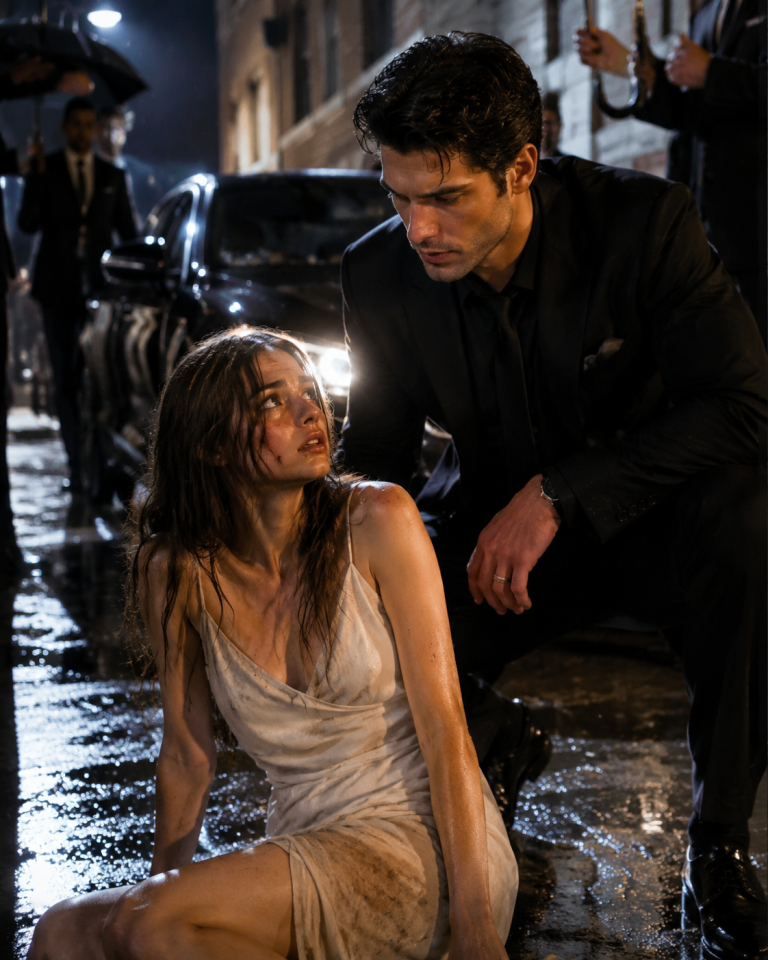
I was in the bathroom, wrapped in a towel, hair wet, when the door opened and a man filled the frame.
Dark suit creased from travel. Jaw that needed a shave. Eyes the specific color of lake water in January — not cold exactly, but capable of it. He was holding a phone in one hand and looking at me with the particular stillness of someone running a rapid threat assessment.
He was also holding a gun.
I screamed.
He did not move.
That was the part that cut through the fear into something worse: the fact that he was completely still. Not startled. Not apologetic. Just watching, cataloguing, the way someone watched a variable that had appeared without being entered.
“Who are you?” he said.
His voice was quiet. That made it worse.
“Clara.” My throat had gone raw. “Clara Voss. Bianca gave me the code. She said you were in New York until Friday.”
His expression did not change.
“Bianca gave you my home.”
“She said you wouldn’t—”
“Mind.” He said the word with a very specific flatness. “Yes. She’s used that phrase before.”
He lowered the gun.
Not entirely. By degrees.
“Proof,” he said.
My phone sat on the counter beside a toothbrush and the drugstore bandage I had put over my palm. I unlocked it and showed him Bianca’s messages. He read them without expression, handed the phone back.
“Get dressed,” he said. “I’ll be in the living room.”
He turned and walked out and closed the door behind him, and I stood in the steam and the lavender smell of someone else’s bath products and shook until I could stop.
His name was Matteo Conti.
I knew the name the way people who grew up in Chicago knew certain names: not from meeting, but from the city itself, from the particular register in which people said it, from the way conversations paused around it like water around something fixed.
I came out in Bianca’s sweatpants and a hoodie that hid my wrists.
He was in the living room in the chair farthest from me, one ankle crossed over his knee, a glass of water on the table beside him that he had not touched. He looked like he had not considered sleeping yet and had already made a decision about it.
“Start from the beginning,” he said. “Leave nothing out.”
Something in his tone — not soft, but level, requiring nothing from me in terms of performance — made the words easier to find.
I told him about Derek. About the escalation that was never dramatic, just steady. About the phone he’d swapped for one connected to his account. The job he’d made me leave. The friends who had slowly stopped calling because I was always unavailable in ways I couldn’t explain. The tracking software I’d found on my laptop that he’d explained away three times before I stopped asking. The locks. The two days on protein bars in a sealed apartment, and then the fire escape.
I told him about Nora.
My younger sister. Twenty-four. Nursing program at Loyola. The only family I had left.
Derek had referenced her once. Only once. Softly, with nothing explicit attached — just an awareness, a coordinates-in-hand implication that made me understand she was a variable in a calculation that did not include her consent.
Matteo’s expression had not changed through most of it.
On Nora, it changed.
Not dramatically. Something in the jaw. Something behind the eyes that recalculated.
“Where does she live?” he asked.
“Why?”
“Because men who use sisters continue using them.”
I looked at him for a long moment.
“Loyola. North campus. Dorm 4C.”
He picked up his phone and typed.
I stood. “Stop. You don’t have permission to involve her without telling me.”
He looked up. For one second, something moved in his expression. Not irritation. Acknowledgment of a correction.
“You’re right,” he said.
I had not prepared for that.
“I acted on instinct,” he continued. “Speed mattered and she’s at risk. But she is your sister. You decide.”
I stood very still.
Derek had never said that sentence. Not in two years. Not one version of it.
I sat back down. “Yes. Put someone on her building. But I tell her first.”
“Tonight, if you want.”
“Tonight.”
He nodded once and returned to his phone.
I looked at the painting on the far wall — the gold and burgundy one, moving inside its frame like a fist unclenching — and tried to remember the last time someone had asked me what I decided.
It took a while to come up with an answer.
That should have been the end of something.
Instead it was the beginning of something I didn’t have a name for yet.
But when I went to bed that night in the guest room with the lock that opened from the inside, I realized with a clarity that arrived like cold water:
The man hunting me had just introduced himself to someone who was not afraid of him.
And I had no idea yet what that was going to cost either of us.
—
## PART 2
Morning came through the east windows like a statement.
Chicago in December did that — no apologies, just light on steel and water and the city going about its business regardless.
Matteo was already in the kitchen when I emerged. White shirt, sleeves rolled, a tie hung over the back of a stool like he’d removed it in transit. He was making eggs with the concentration of a man who had decided practical tasks were the correct management strategy for complicated situations.
He did not say good morning.
He said, “You need to eat.”
Something about that — the bluntness, the absence of theater — made my eyes sting unexpectedly. Derek had told me when to eat too. But Derek’s version came with a subtext that catalogued my choices back to me as evidence of something wrong. This was different. This was a body required fuel and the time was now.
I sat at the island. He set a plate down and kept the counter between us, which I understood was a rule he had made for himself.
“I need to say something,” I said.
He poured coffee and waited.
“Bianca called you after I fell asleep.”
“Yes.”
“What did she say?”
He set down the pot. “She said she drove her best friend to my building at midnight with bruises on her wrist and nowhere else to go. And that if I made her regret that decision, she would make my life difficult in ways I was not equipped to handle.”
I looked at the eggs. “That sounds like her.”
“It is entirely her.”
“And?”
“And I told her this was my home and she had exceeded her authority and she should have called me.” He picked up his coffee. “And she said she tried and I didn’t answer.”
“Did she?”
“Yes.” A pause. “I was in a negotiation.”
Something in his tone made the word land like an honest admission of misplaced priority. I was not accustomed to that from men who ran things.
“My sister,” I said.
“Awake. In class. Leo is in position across the street. She doesn’t know unless she needs to.”
“She needs to know today.”
“Your call.”
He said it simply, like it had always been my call, which was the most destabilizing thing he had done yet.
I called Nora from the secure phone he had arranged — logged under a corporate account, nothing traceable in either direction. She picked up on the second ring, and when I said *listen before you say anything*, the particular shift in her voice told me she had already been scanning.
She’d noticed the man outside.
The one who never opened a book in the campus library.
“Who are you with?” she asked.
I looked at Matteo standing in the kitchen doorway.
“People Derek can’t reach,” I said. “I promise I’ll explain everything. But today, if he comes near you—”
“I call campus security and then the number you’re about to give me.”
“Yes.”
A pause.
“Lauren.”
She still sometimes used my middle name when she was frightened. A childhood reflex. “I’m okay, Nora.”
“I know.” Her voice had gone very steady, the way it had at our parents’ funeral when she was eighteen and I was twenty and we had stood together in the rain and decided without words that we would not fall apart in front of people. “But come home when you can.”
“I will.”
After I hung up, Matteo appeared in the doorway again. “She’s good?”
“She’s Nora. She’s always good.” I set the phone down. “What do you know about Derek that you haven’t told me yet?”
He went very still.
That stillness answered the question before his words did.
“His company,” he said carefully. “Halcyon Freight. They move container shipments through three Great Lakes ports.”
“I know. He talked about it constantly.”
“Some of those shipments are connected to parties under federal watch.”
Something cold moved through my chest.
“He told me it was international logistics.”
“It is. Among other things.”
“And you — how do you know this?”
“I have interests at some of the same ports.”
I looked at him. “Competing interests?”
“Adjacent ones.”
“That is not the same as unrelated.”
He held my gaze. “No. It isn’t.”
“So when you say you want to help me—”
“Helping you and knowing about Derek’s business are separate things.”
“People say that before they show you otherwise.”
“Yes,” he said. “They do.”
He walked to the desk and came back with a folder. He placed it in front of me without ceremony. “This is what we have on Derek’s surveillance of you. Battery records. Monitoring software purchase invoices. Your resigned call from the gallery where you used to work — the administrative recording confirms you said yes with someone’s hand on your wrist.”
I stared at the folder. “I don’t remember the gallery recording calls.”
“They do. Required by insurance after a 2019 liability claim.”
I pressed one hand flat on the closed folder and breathed.
“His company’s federal exposure,” I said. “Is that separate from my case?”
“Entirely. My attorney files your case with the district today. The federal aspect is its own track.” He paused. “But when both tracks open simultaneously, men like Derek stop having the organizational bandwidth to hunt individual people.”
Something about the precision of that made me laugh once, hard and short. “You’re very good at making leverage sound administrative.”
“I prefer efficient.”
“I know you do.”
He almost smiled.
Then his phone lit up, and the almost-smile ended.
He read something. Went still in the other way — the weight-bearing kind.
“What?” I said.
He turned the phone toward me.
Derek had filed a police report.
Theft. Fifteen thousand dollars. *Emotionally unstable* girlfriend. My photograph. Nora’s name. A wellness concern about my sister, worded so carefully it could be read as loving or threatening depending on who was reading.
The room went bright and narrow the way rooms did when the body understood something before the mind did.
“He went to the police first,” I said.
“He did.”
“He locked me in an apartment for two days and he filed a police report about me.”
“Yes.”
The fury that arrived was clean in a way I was not used to. Not the muddy, self-doubting anger that Derek had spent two years convincing me was instability. Clean. With a spine.
“Tell me what we do with that,” I said.
Matteo’s expression settled into something I had not seen on him before — not warm, not cold. Resolved.
“We answer it,” he said. “Every document. Every timestamp. Every recording and photograph and banking record and message he sent after midnight when his judgment failed and his real vocabulary came through.” He closed the folder. “We build the version of events that existed before he built his.”
“When?”
“My attorney is already moving.” He picked up his phone. “But I need to tell you something first.”
He said it differently than he had said anything else. With a weight that suggested he had been deciding the timing for a while.
“Tell me,” I said.
“Two weeks before Bianca brought you here, I ran a standard background check on a new freight broker. Derek Hale came up as a secondary connection.” He held my gaze. “I flagged his name in my files as a potential risk to my port interests. I did not yet know he was connected to you.”
I sat with that for a moment.
“So when I arrived—”
“Your name was not in my records. His was.”
“And that meant bringing me here was a risk to you.”
He did not look away. “Yes.”
“And you let me stay anyway.”
A pause that was its own kind of answer. “Bianca asked.”
“Bianca has asked you things before that you’ve refused.”
He looked at the window. “I know.”
The city moved below us, enormous and indifferent, full of people in the middle of ordinary days.
“So why?” I said.
He was quiet long enough that I understood it wasn’t deflection. He was being careful with the truth.
“Because she came to me,” he said finally. “Not to the police, not to a shelter, not to any structure that Derek had already thought through and accounted for. She came to the one place he couldn’t plan for. And I thought — whatever the risk to me, that was the correct instinct.” He turned back. “I do not punish correct instincts.”
I looked at him.
At the man who had absorbed risk on my behalf before he knew my name, and was only telling me now because I had asked directly.
“You should have told me this at the beginning,” I said.
“Yes.”
“I needed to know I wasn’t being kept here for your reasons.”
“I know. I should have told you.”
I stood. Walked to the window. Looked at the lake.
After a moment he said, “Do you want to leave?”
I turned. “Is that a real question?”
“Yes.”
“Would you try to stop me?”
“No.”
I looked at the lake a moment longer.
Then I walked back to the table and opened the folder.
“Tell me everything Adele needs to make this case airtight,” I said.
He sat.
And we began.
—
## PART 3
The conference room where the meeting happened was on the fourteenth floor of a building in the Loop — beige walls, fluorescent lights, a water pitcher no one touched, two cameras in opposite corners. Not dramatic. Not cinematic. Just a room with enough formality to make lies expensive.
Adele Farro arrived with two rolling briefcases and the specific contained energy of someone who had been looking forward to this.
Detective Reyes sat across from us with a detective’s partner whose name I had already forgotten and Agent Tran from federal, who had been briefed separately and whose presence said more about Derek’s other activities than anything Adele had said directly.
Derek arrived with his father and an attorney in a blue pinstripe who had the aggressively calm face of a man billing by the second.
Walter Hale wore a camel coat and the expression of someone who believed the room was a formality.
Derek wore charcoal. He had shaved. He looked like a man who had spent a great deal of time calibrating exactly how much concern to perform.
He saw Matteo first, and something broke in his composure for a fraction of a second.
Then he saw me.
The concern reassembled. The relief arrived on schedule. His face became a memo: *grateful, worried, committed to de-escalation.*
“Clara.” He started toward me.
Matteo took one step forward.
Nothing else. Just a step.
Derek stopped.
He did not look at Matteo.
He kept his eyes on me.
That was when I understood he had decided not to be afraid of the room. That was his strategy — perform the love story loud enough to drown out the evidence.
He sat down across from me.
“You’re okay,” he said.
I looked at him.
For the first time since the fire escape, I looked at him without urgency or dread or the old reflex of managing my expression for his mood.
Just looked.
He had the same face. He had always had a good face. That had been part of it.
“I know,” I said.
He blinked.
Adele placed the first document on the table.
Derek’s police report.
Then my bank statements showing the account he had access to without my knowledge.
Then the monitoring software invoice — emailed confirmation of purchase, his name, my laptop’s device ID.
Then the gallery resignation recording.
I had forgotten about that recording until two days ago when Adele had played it for me in Matteo’s living room and I had needed to stand up and face the window because the sound of my own voice saying *yes* while a hand I could not see pressed against my wrist underneath a table was the most precise evidence of two years I had ever heard.
Then photographs. My wrist. My forearm. My side, where the bruising had bloomed across three ribs.
Then Nora’s campus security logs. Derek’s face. The dorm building. The timestamp.
Then recovered messages — the ones he’d sent after midnight, when the careful language failed and the real vocabulary appeared.
Derek watched each document arrive without speaking.
The attorney spoke for him. Raised objections. Questioned chain of custody. Used words like *alleged* and *context* and *pattern of instability.*
Adele answered each one with timestamps.
She did not raise her voice.
She did not need to.
Walter Hale leaned over to the attorney. The attorney said something back. Walter’s face shifted from confidence into the specific expression of a man recalibrating whether the situation still served him.
Then Adele placed a different folder on the table.
Halcyon Freight.
Manifests. Container logs. Weight discrepancies. A federal flag on three port contacts.
Agent Tran uncapped his pen.
Derek’s attorney said, very quietly, “My client will not answer questions regarding business operations without separate counsel present.”
“Of course,” Agent Tran said pleasantly.
Derek looked at Matteo.
“You did this,” he said. It came out lower than he intended.
Matteo said nothing.
“You took her and you built a case—”
“You filed the report,” Matteo said. Calm. Final. “We answered it.”
Detective Reyes closed the folder in front of him.
“Mr. Hale,” he said, “this meeting has produced documentation relevant to a false report filing, unlawful surveillance, a violation of harassment statute, and a federal shipping inquiry already in progress. I’d recommend you speak with your attorney.”
Walter Hale stood. “This is a misunderstanding between two people in a relationship—”
“The relationship ended when she climbed out a window,” I said.
The room went quiet.
I had not planned to speak. But it was accurate and the room required accuracy.
Walter looked at me with the expression of a man who had decided I was a problem that could be managed with a check.
“My son has resources—”
“So does she,” Matteo said.
The word *she* landed differently than anything else that had been said.
Derek’s face went through several expressions in quick succession. Then it settled, finally, into the one he had never let me see in two years. Not rage. Not calculation.
Disbelief.
He still didn’t understand how I had left a room he had made inescapable.
He still thought the locks were the problem.
He didn’t understand that I had finally stopped being afraid of the distance between the window and the fire escape.
The meeting ended without ceremony.
Derek was advised not to leave Illinois. His attorney said something about cooperation. Agent Tran collected the freight documents with the unhurried efficiency of someone who already had everything he needed and was just verifying the paperwork.
Walter Hale walked out of the room without looking at anyone.
In the hallway, I sat on a bench against the wall while Adele finalized something with Detective Reyes and Matteo spoke quietly into his phone near the elevator.
Nora appeared on the other side of the bench.
She had driven downtown from campus with Leo, who had explained only that her sister needed her. She sat down beside me without asking anything, which was the thing she did when she understood that questions were coming but the moment required silence first.
After a while she put her head on my shoulder, which she had not done since we were teenagers.
“He’s going to lose, isn’t he?” she said.
“Yes.”
“Good.” She said it the way she said everything that mattered — matter-of-factly, like the sentiment was obvious and only the phrasing had been uncertain.
“I’m sorry I didn’t tell you sooner,” I said.
“I know you were protecting me.”
“I was also ashamed.”
She was quiet for a moment.
“Of what?”
I looked at my hands.
“Of not leaving faster.”
Nora sat up and looked at me directly. She had our mother’s eyes. She always had. “You left,” she said. “That’s the part.”
The charges moved through the system across the following months with the slowness of processes that required precision rather than speed. Derek pled to unlawful surveillance and aggravated harassment under a negotiated arrangement that Adele called favorable for someone who had initially tried to use the police as a hunting instrument. The Halcyon investigation was its own separate track — federal, slower, involving men and accounts Derek had bragged about while I sat beside him at dinners and learned to photograph well.
Walter Hale lost two board seats when donors began asking questions.
The attorney withdrew.
The private investigator Derek had used filed a complaint that was not resolved in his favor.
Consequences arrived in paperwork. In hearings. In doors that stopped opening for people who had believed they were permitted everywhere.
I moved out of the penthouse ten weeks after I arrived.
Not because Matteo asked. He hadn’t.
Because safety needed to be mine. Not borrowed. Not housed in someone else’s address, however generously offered.
The apartment was on the third floor of a building in Wicker Park — old floors, a kitchen window with a sticky latch, a radiator that expressed opinions at two in the morning. The bathroom had a lock I checked once. Then stopped checking.
I went back to teaching.
Not immediately.
There were weeks first of what my therapist called the recalibration period, which felt like too clinical a word for the experience of learning to be in a room without measuring who else’s mood was in it. But she was precise in ways I had come to value, and the word was probably accurate even if I resented it.
The first day back in the studio classroom, I opened the supply cabinet and my hands shook. One of my students — a seven-year-old named Marcus who was obsessed with painting mountains even when the assignment was something else entirely — looked at my hands and said, “My mom’s hands do that sometimes.”
“What does she do about it?” I asked.
He considered this seriously. “She squeezes something. She has a little blue ball.”
That evening I bought a blue ball.
It helped, which was embarrassing and also fine.
Bianca came every Thursday with food and commentary on my curtains. She was wrong about the curtains. I told her that regularly and she remained wrong at volume.
Nora came on Sundays.
She would spread her nursing textbooks across my kitchen table and eat everything in the refrigerator and tell me about her professors with the running editorial judgment of someone who had decided the entire academic establishment needed improvement. I let her talk and drank coffee and felt, in those hours, something I had forgotten had a specific texture.
Ordinary.
Mine.
Matteo learned to knock.
He was not graceful about learning. He had spent too long in rooms where his arrival organized everything around him to immediately understand that arriving at my door required something different. But he tried, which was the part I could work with.
The first time he came to the apartment — not to assess the security, not with Adele or Leo or anything operational — he stood in the doorway with coffee in two cups and said, “I don’t know how to be in someone’s life without managing the perimeter.”
I stepped aside to let him in. “That’s because you’ve confused safety with control.”
He came inside and looked at the apartment. The mismatched chairs. The art supplies near the window. The blue ball on the counter.
“Yes,” he said.
Not defensive. Not explained.
Just yes.
“The painting,” I said. “The one in your hallway. The burgundy one.”
He looked at me.
“Your mother?”
A pause. “Before she got sick.”
“She painted like she was arguing with the canvas.”
Something shifted in his face. “My father said she argued with everything.”
“Was that a complaint?”
“I think he meant it as a compliment.” He looked at the art supplies. “She died when I was fifteen. A year later, my father was killed in a deal that went wrong. I became what the situation required.”
I put down my coffee cup. “How much of what the situation required was actually what you wanted?”
He was quiet long enough for the question to fully occupy the room.
“I’ve been thinking about that more lately,” he said.
“Good.”
We sat at my kitchen table and drank the coffee he had brought and did not solve anything that afternoon. But we talked in a way that didn’t require management of each other, which felt different from anything I’d learned to expect from people with power in their hands.
The last confrontation with Derek came nine months later, not in person but in a courtroom.
A final appeal filing. Language about miscommunication. About mutual patterns. About rehabilitation.
Nora testified.
I had not asked her to. She had decided.
She sat at the witness table in a dark blazer she had borrowed from my closet and spoke in the direct, no-revision voice she used for things that required precision.
“My sister did not leave a difficult relationship,” she said. “She escaped a room she had not consented to enter.”
The judge made a note.
The appeal was denied.
Afterwards, in the marble hallway outside the courtroom, Nora found me and said nothing. She just put her arm through mine the way she had at our parents’ funeral, and we walked out into the cold December air, and the city moved around us with the total indifference it extended to everyone, and it felt like relief.
One year after the fire escape, I rented a studio above a bookstore in Andersonville.
Tall windows. Paint smell. The particular resonance of a room that had once been used for something else and was learning to hold a new purpose.
I taught mornings.
I painted afternoons.
I drank coffee no one commented on.
The first piece I finished was gray-blue, wide and almost unresolved at the edges, a horizon line that refused to stay in place. I called it *The Decision*. Not because it depicted one. Because I had made it while painting it, standing in that specific light, in that specific silence, realizing I had gone from the fire escape to this room without stopping, and the whole thing had been a single continuous act of choosing.
A small gallery in Wicker Park showed three pieces in March.
My name on the card beside them said: Clara Voss. Artist. Teacher.
Nothing else.
Nothing qualified.
Not *missing*. Not *unstable*. Not *Ryan’s girlfriend* — not any version of a label Derek had applied.
Just my name, doing the work of being sufficient.
Matteo came late to the opening, which I had expected.
He stood in front of *The Decision* for a long time.
“What do you see?” I asked.
“A line that refused to stop moving,” he said.
“Close.”
He looked at me. “What is it?”
“Someone deciding what to do with the distance between a window and the ground.”
He was quiet for a moment. Then he said, “You’re going to be in a gallery somewhere significant within three years.”
“Is that a prediction or a threat?”
“An observation.”
He bought a different piece. The gray one. Almost unfinished.
When I asked why, he said, “It looks like a beginning that hasn’t decided its shape yet.”
I let him keep it.
Not because I owed him anything.
Because it was accurate, and I had started choosing the people I let into my spaces based on whether they could see clearly.
He could.
That mattered.
The thing about loving someone who was built from controlled silences and managed perimeters was that it required both of us to learn something.
He had to learn that protecting me without asking was the same mechanism, at a different intensity, as what Derek had called love.
I had to learn that needing help was not a doorway to losing myself.
We were slow about it.
We argued.
Once, badly, about a security camera he had arranged near my building without telling me, and the argument lasted two days and ended with him saying, “I understand why I was wrong and I’m going to need you to believe that before I figure out the rest,” which was the most specific form of accountability I had ever received from another person and which I was still processing six months later.
We got better.
Not perfect. Better.
The word Bianca used for it was *operational*, which she said in the most affectionate voice she owned, which was only slightly warmer than room temperature.
A year and a half after the penthouse bathroom, on a Sunday in early spring with the lake doing what it did when winter finally gave up, I walked to the corner store alone.
Left my phone on the counter.
Didn’t tell anyone where I was going.
Walked eight blocks in the cold light, bought coffee and two tulips and a sketchbook, and walked home slowly.
No one tracked me.
No one called before I reached the next block.
No one was waiting to ask where I’d been or how long I’d taken.
The air smelled like the lake and something thawing.
I stood on the sidewalk in front of my building and held the tulips and the sketchbook and the coffee and thought about a woman I used to be who had learned to measure her own footsteps in someone else’s unit of measurement.
And then I went inside.
Because I wanted to.
That was the whole of it.
Not a revelation. Not a cinematic moment. Just the ordinary fact of a choice made freely, in a body that had learned to trust itself again, on a street that did not report back to anyone.
Derek had believed that control was the same as possession.
Matteo had believed, for a while, that protection was the same as permission.
Bianca had known something better than both of them from the beginning: that what a person needed when they ran out of options was not a better arrangement.
It was a door.
One that opened from the inside.
I had one now.
Two, if you counted the studio.
Three, if you counted Nora’s Sunday visits and the way she still used my middle name when she was frightened, and how much less frequently she needed to.
It was enough.
More than enough.
It was mine.