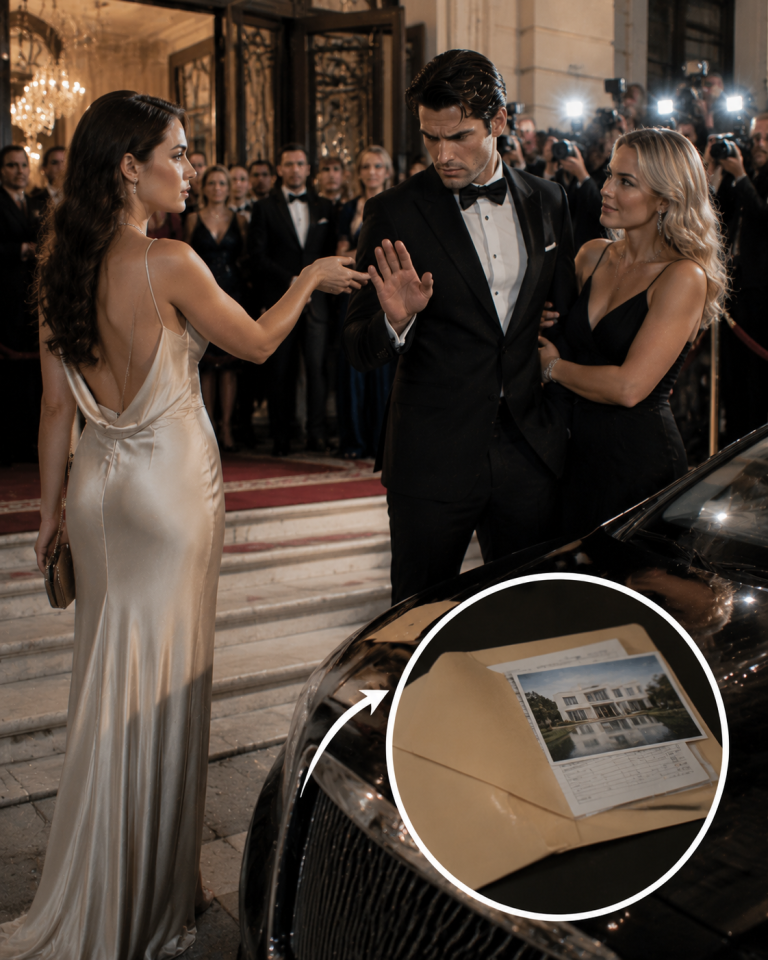
Her Mother Sold Her to a Mafia Boss to Pay a Debt—But His Reaction Changed Everything

## PART 1
The zip tie went on in the garage.
Nadia Holt had time to register three things before her wrists were bound: the chemical smell of concrete and motor oil, the particular deliberate softness with which the man cinched the plastic — not cruel, just efficient — and the sound of her mother’s heels on the stairs above, already walking away.
She did not call out. There was no version of Vivienne Holt who would have come back.
The sedan waiting outside was spotless in the way expensive things were spotless when someone else cleaned them. Dark interior, climate-controlled, the vague mineral scent of a car that had been detailed that afternoon. The man who put Nadia inside it wore a plain jacket and said nothing. The one driving had eyes only for the road. Neither of them looked at her with cruelty. They looked at her the way people looked at packages they were responsible for delivering intact.
That, Nadia thought as Chicago began moving past the rain-blurred windows, was the part that would stay with her longest. Not the zip ties. Not her mother’s voice from the upstairs hall an hour earlier, saying *I need her recognizable for at least another day.* The part that would stay was the sheer logistics of it. The sedan arranged in advance. The men who knew her weight and height and whether she would be difficult. The policy number written in black ink on a cream envelope she’d seen on the kitchen island. Not her name. Not her mother’s. Just a number, and two million dollars attached to it.
Vivienne had been planning this for months.
The city outside moved in amber and red and the blue neon of storefronts whose names Nadia knew from years of navigating a life smaller than it should have been. The library where she’d sheltered between shifts. The pharmacy where she bought concealer and always paid cash. The urgent care clinic she’d told three separate intake nurses was her own clumsiness. The coffee shop near the bus line where she’d sometimes sat for two hours over one drink because it was warm and no one looked at her too carefully.
She had thought those small freedoms were hers. She understood now that Vivienne had permitted them, the way zookeepers permitted the walk to the water dish.
The driver turned south into a corridor of low industrial buildings where streetlights grew sparse and the rain seemed to fall harder. They stopped before a warehouse that looked derelict from the outside and revealed, once the gate opened and they pulled through, an entirely different interior: warm stone floors, low architectural lighting, the smell of cedar and something faintly metallic and very controlled. Security cameras at every angle. Men stationed without appearing stationed. Wealth that had learned to look like discretion.
Nadia was walked down a corridor lined with photographs she had no attention to spare for yet. She was thinking about her ribs, which still hurt from last Tuesday when Vivienne had shoved her into the edge of the bathroom counter for taking too long getting ready for the charity board dinner. She was thinking about the fact that she had not eaten since yesterday afternoon. She was thinking about the useless inventory of a person taking stock of what she had left: no phone, no wallet, no coat they’d left on her, no one who would look for her before morning, and by morning Vivienne would have already built the narrative of concern.
The corridor ended at a pair of dark wood doors.
Inside was a room that smelled of old books and firelight.
At the desk sat a man younger than she expected. Lean, dark-haired, the collar of a gray suit open at the throat as if he had been working for hours and the formality had begun to cost him something. He looked up when Nadia was brought in, and the first thing that struck her was not the power in the room or the money embedded in every surface. It was that he looked at her the way people looked at things they were genuinely trying to understand. Not as a delivery. Not as a liability. With a kind of focused, unsettled attention.
He said one word to the men behind her: “Out.”
The doors closed.
Fire moved in the hearth on the far wall. The city beyond the floor-to-ceiling windows was a wash of rain and running light. Nadia stood on a pale rug in a dress she’d been made to put on three hours ago for a meeting she now understood had been for display, and she was shaking, and she was not going to pretend she wasn’t.
He rose from behind the desk and walked toward her. Not fast. Giving her time to catalogue the threat, which was the gesture of a man who understood how bodies read approach. He stopped six feet away. His gaze moved once across her face — the split at her lip, the shadow at her cheekbone, the way she was holding her left side — and then went still.
“Who did this?” he asked.
She had prepared for many things on the drive over. Fear, violence, the specific ugliness of being treated as an object of transaction. She had not prepared for a question asked in that particular register — level and genuinely wanting to know.
“My mother,” she said.
A silence followed that felt structural, like weight shifting.
He took one step closer, slowly, hand slightly raised so she could see it coming. She flinched anyway. Old instinct, faster than thought. Something crossed his face — not pity, not contempt. Something more precise and colder than either.
He stopped. Let his hand fall. “I’m not going to touch you.”
Nadia was breathing in shallow increments because of the ribs and the fear and the adrenaline cycling through her with nowhere to go. She looked at the floor between them, at the thick pale fibers of an expensive rug, at a small scuff mark near the corner.
“What do you want from me?” she asked.
He did not answer immediately, which was more alarming than an answer would have been.
“I want to know,” he said finally, “why Charlotte Vivienne Holt thought she could use my name to cover a murder.”
Nadia looked up.
His expression had sharpened. Behind the composed surface was something that had clearly been running hot since before she arrived. Not anger at her. Something much more impersonal and much more dangerous.
“Sit down,” he said. “Tell me everything.”
—
## PART 2
His name was Adrian Kessler. She learned that later.
For the first hour she only knew him as the man across the desk, the one who poured two fingers of whiskey and placed the glass in front of her without handing it to her — a small, deliberate distance — and who listened to everything she said without interrupting.
She told him the parts that mattered. The debt Vivienne had been managing poorly for three years, private money owed to people with short patience. The insurance policy dated four months earlier. The beatings that had graduated from impulsive to systematic, injuries placed where clothes could cover them, a story being assembled around her body with the same patience Vivienne brought to her charity’s annual reports. The way isolation had been built across years — a friendship dissolved here, an employer turned against her there, until Nadia had become a rumor even in her own life.
Adrian’s expression did not change while she spoke. That was more unsettling than any reaction.
When she finished, the room held.
“Do you want to live?” he asked.
The question was so direct it felt like an impact.
She looked at him for a long time before she answered, because the truth was complicated in ways she had no energy to perform around. She was twenty-six years old and had spent fourteen of those years learning to make herself small enough to survive someone who had never once considered what Nadia might actually need. She had imagined disappearing before, in the abstract way desperate people did. Never like this. Never with a number.
“Yes,” she said. It surprised her slightly. “Yes.”
He nodded once. Something in his posture eased by a degree she almost missed.
“Then,” he said, reaching past the desk to press a call button, “we begin there.”
A woman appeared almost immediately — forties, dark hair, the organized intelligence of someone who ran things rather than reported on them. Margot. She looked at Nadia in one comprehensive sweep that managed not to feel like an inspection and asked no unnecessary questions.
“Guest suite on seven,” Adrian said. “Dr. Voss at eight. Food.”
Margot nodded once and looked at Nadia. “Come on.”
Nadia stood. Her knees took a second to cooperate. She was at the door when Adrian said her name — actually her name, not “the girl” or “the Whitmore woman,” just *Nadia* — and she stopped.
“Your mother believed,” he said, “that I would see you the way she did.”
She turned.
He held her gaze. “She was wrong.”
It should have reassured her. It almost did. But there was something else in the room too, something she couldn’t quite locate — a tension that felt like information not yet shared, like a door standing behind the conversation that neither of them had opened yet.
She told herself it was trauma. Fear reading threat into ordinary air.
She would not know until morning how wrong she was.
—
## PART 3
Dr. Petra Voss arrived at eight with a medical bag and the no-nonsense warmth of someone who had made a practice of helping people in rooms like this. She asked permission before every touch. She documented methodically, her voice clinical and kind in equal parts, calling injuries by their proper names — *contusion, fracture, chronic soft-tissue damage* — as if precision itself were a form of respect.
“Two cracked ribs,” she said when she finished. “Dehydration. Signs of chronic stress response. Under-eating.”
Nadia stared at the ceiling. “That sounds like a report.”
“It is one.” Dr. Voss folded her equipment back. “A documented one.”
Margot brought food afterward — soup, bread, something with rice and fresh herbs. The care that had gone into it was so ordinary and so foreign that Nadia had to look away before she could eat. Her room was a blue-gray space with warm lamplight and a window that looked over the city’s rain-soaked angles. Clean sheets. A bathroom stocked with things she hadn’t had to ask for. Clothes in the closet in her size, plain and functional, chosen by someone who understood that a person emerging from crisis did not need to be stylish. They needed to feel like themselves.
She did not sleep at first. She sat in the chair by the window and let the city replace silence while her body learned, incrementally, that nothing here was waiting to happen to her.
She passed out somewhere after two.
Morning arrived as thin winter light and the smell of coffee coming under the door. Margot brought a tray and the information that Nadia was expected, when ready, in a smaller room off the main floor.
Nadia dressed slowly in borrowed clothes, braided her hair badly, undid it, left it loose. Walked into a room that was nothing like the office from the night before. Books on every surface. Sunlight on dark wood. Adrian seated with a newspaper folded and untouched, coffee already poured for her when she sat.
He stood when she entered. She had not expected that. It rattled her more than the zip ties had.
“How are the ribs?”
“The same as last night.”
“Eat first,” he said. “Then talk.”
She ate because she was hungry and because it was easier than performing composure on an empty stomach. The coffee was hot and right in a way that made her close her eyes briefly.
“You asked me last night,” she said without looking up, “whether I wanted to live.”
“I remember.”
“I want to know why. Men like you don’t usually bother with that question.”
“Men like me,” he repeated. Not offended. Thoughtful.
“You know what I mean.”
“I do.” He held her gaze. “The answer is that your mother made a significant error in judgment that now falls into my field. Sending a woman she intended to kill through my operation without my knowledge creates an exposure problem. That’s the structural reason.”
“And the other reason?”
He looked out the window for a moment. “I know what it is to survive someone who decided your life had a price.”
He said it without elaboration and did not offer more. She did not push.
He slid a folder across the table. Inside were bank records, transfer statements, photocopies from the charity accounts Vivienne ran, expense reimbursements flagged in yellow. The insurance policy with Vivienne’s signature at the bottom. Nadia had seen enough of her mother’s paperwork over the years — signed at kitchen counters, witnessed by lawyers who never asked the right questions — to know this was real.
She stared at the coverage amount. The date it was issued.
“The year I moved back in,” she said. “After the apartment.”
“Yes.”
“She told me rent was too high. That I should come home. Save money.”
Adrian said nothing. He did not need to.
Nadia set the policy down. “How did you get all this overnight?”
“I made calls.”
“That fast.”
“I have particular resources.”
She looked at the papers, then back at him. “This is enough to go to the police.”
“Possibly.” He tapped the folder. “Police investigations take time. Vivienne has a lawyer on retainer who is very good at time. She has a publicist who is better. By the time any formal investigation reached her, she would have had three months to reshape the story. Vulnerable daughter. Criminal manipulation. Maternal grief weaponized by a man with a record.” He paused. “She is already planning that narrative. As of this morning she has reported you missing.”
Nadia’s chest tightened. “Of course she has.”
“She will be sympathetic within the hour on three local broadcasts.”
Nadia stood and went to the window. Below, a delivery truck was unloading at the service entrance of the building next door. Someone walked past with an umbrella. An ordinary Chicago morning, completely indifferent to the fact that her mother was currently performing devastation in front of cameras.
“She’ll win,” Nadia said. “She always wins the public version.”
“Not this time.”
She turned. There was a calm in his voice that felt different from confidence. Older than confidence. Like a man who had already seen the end of the calculation and was simply waiting for the variables to arrive there.
She sat back down. “Tell me.”
He told her about the gala. Not immediately — first he told her about the week ahead, about Dr. Voss and a therapist named Petra in an office across town, about a woman named Carmen who ran the gym on the fifth floor and had no patience for women who’d been trained to make themselves small. He told her she was free to leave. New identity, cash, a clean exit. Or she could stay and they could take apart what Vivienne had built, piece by piece, in full public view.
“You’d do that,” Nadia said. “Take her apart publicly.”
“I would facilitate the conditions for her to do it to herself.”
She looked at him carefully. “Why? Because she insulted you?”
“Among other reasons.”
She was quiet. Outside, the delivery truck finished and moved on. The street returned to its ordinary self.
“There’s something else,” Nadia said. “I can feel it.”
He didn’t answer immediately, which confirmed it.
“Tell me.”
Adrian reached into the desk and produced a second folder, different from the first. This one was thicker. Its tab was dated six months ago. He placed it in front of her without explanation.
Nadia opened it.
The first page was a photograph of Vivienne taken outside the foundation offices on a Tuesday afternoon in late summer. A surveillance image — discreet, professional. Beneath it was a timeline, handwritten annotations, notes in a shorthand she didn’t fully recognize. Transfer records. Charity accounts. A name she didn’t know circled at the top of a page of phone records.
She looked up. “What is this?”
Adrian’s expression was measured. “Six months before you arrived here, one of the charity’s former finance managers contacted me. He had worked for your mother for four years. He discovered irregularities in how donor funds were being used — money meant for children’s programs routed through shell structures and into accounts he couldn’t trace to any legitimate program. He was afraid to go to the authorities directly. He came to me instead.”
Nadia stared at the folder.
“I began an investigation in September,” Adrian said. “Quietly. The fraud is significant enough that eventually it would have reached law enforcement regardless. I was in the process of determining how best to make that happen without the case being buried by her lawyers when—”
“When she sent me,” Nadia said.
The room went completely still.
She looked at the tab again. September. Fourteen weeks before Vivienne had arranged to have her delivered. Her mother had been using children’s donation money. Stolen from the same women and families she photographed at galas and fundraisers and press events while writing speeches about dignity.
“You were already building a case against her,” Nadia said slowly.
“Yes.”
“Before I arrived.”
“Yes.”
She turned the pages carefully. Her hands were not shaking this time. Something colder and more structural had replaced the panic. “So I wasn’t your leverage against her.”
“No.”
“You weren’t waiting for a reason to move against her.”
“I had reasons. I was moving carefully.”
She looked at him directly. “Then why didn’t you tell me this last night?”
“Because last night you were in shock, in pain, and making decisions about whether you wanted to live.” He held her gaze. “I didn’t want your trust built on gratitude for something you hadn’t yet had the chance to understand.”
Nadia closed the folder.
She sat with what she’d heard for a long time. Outside, snow had begun, finally, tentative and thin, settling on the window ledge and melting before it could accumulate. The first snow of the season always came like that — uncertain of its own right to stay.
“She stole from children,” Nadia said.
“Yes.”
“Using the same charity she built her public identity on.”
“Yes.”
“And you have six months of evidence.”
“Yes.”
She exhaled slowly. “Then we don’t just expose what she did to me.”
“No,” Adrian said. “We expose all of it.”
The plan built itself across the following days with the particular momentum of something that had been waiting for permission to exist. Carmen worked with Nadia every afternoon in the gym on the fifth floor, teaching her to stand with weight in her heels rather than the balls of her feet — the posture of someone ready rather than someone braced. “You apologize when you miss a strike,” Carmen said on the third day, flat and unimpressed. “Stop that.”
“Force of habit.”
“Habits are just choices made so many times they feel involuntary.” Carmen held up the pad. “Again.”
Dr. Voss confirmed the rib fractures healed to the degree that Nadia stopped unconsciously protecting her left side. Petra Voss met with her every other morning in a quiet office with weighted blankets and dimmable light and the patience of someone who understood that trauma did not follow a schedule. She never pushed for more than Nadia could give in a session. What she gave Nadia instead was language — precise, non-moralistic words for what her body was doing and why, which turned out to be the most liberating thing anyone had ever offered.
“Your nervous system learned that visibility was dangerous,” Petra said one morning. “Being seen meant being corrected. So you learned to be invisible.”
Nadia looked at the peppermints in the bowl on the table. “I was told I was being difficult.”
“Difficult is what people call children who resist erasure.”
The statement landed so simply it almost didn’t register. Then it did.
Vivienne moved exactly as Adrian had predicted. Missing daughter, terrified mother, dangerous man, fragile girl. She gave three interviews in six days. She wore pale colors and understated jewelry and produced tears at the correct moments with the proficiency of a woman who had been performing grief at charity events for twenty years. By the end of the first week she had the sympathy of enough of the city’s donor class that Nadia could feel it from inside the building like a barometric shift.
She watched one clip on Adrian’s tablet one evening and set it face-down on the table before it ended.
“She’ll win,” Nadia said again.
Adrian poured coffee and did not argue the point immediately. He was learning, she noticed, that she did not want to be managed around hard things. She wanted them named.
“She’ll win this particular field,” he said. “So we change the field.”
The Harrington Gala was held every December at the Meridian Hotel downtown — five floors of marble and glass and the particular expensive warmth of five hundred people in black tie performing generosity. Vivienne’s foundation was the annual headline beneficiary. New scholarship announcements. Partnership launches. The year’s most photogenic presentation of compassion.
Adrian slid her the embossed card without ceremony.
Nadia looked at it. “You want me there.”
“I want her to look across that room and see what didn’t disappear.”
She was quiet.
He opened the folder between them — not the charity fraud file this time, but a new one. Edited footage his team had assembled from the charity account records, security photographs, the insurance policy, the transfer chains, the shell companies. Three minutes and forty seconds of everything Vivienne had built her public life on top of, rendered in unavoidable images on a screen no amount of makeup could survive.
At the back of the folder was a blank page.
Nadia looked at it. “For a statement.”
“If you want one. The evidence stands alone.”
She touched the blank page. Thought about standing in her mother’s kitchen in a dress she hadn’t chosen, listening to a conversation she wasn’t supposed to hear, realizing in real time that the number on the envelope was her. Thought about every medical form she’d signed alone. Every friend who had stopped calling. Every version of her own life that had been narrated by someone else to people who had no reason to ask a different question.
“I want to write it myself,” she said.
They filmed in his office two days later.
She wore dark gray and no jewelry and sat facing a camera while Adrian remained behind the lens line, arms folded, present but not performing direction. She had written the statement longhand the night before and revised it twice. She had read it aloud to Petra, who had said only: “You are not explaining yourself. You are stating facts. That’s the correct register.”
Nadia looked into the lens.
The old reflexes surged immediately. Soften. Edit. Don’t frighten them. Don’t sound angry. Sound credible. Sound like someone they can understand without having to feel anything uncomfortable.
She let the impulses move through and leave.
“My name is Nadia Holt,” she said. “You know my mother as Vivienne Holt, the founder of the Children’s Horizon Foundation. She is the woman who has been stealing from that foundation for three years. She is also the woman who put a two-million-dollar life insurance policy on my life and arranged to have me delivered to a man she expected would make my death look untraceable. Everything I am about to say is documented. I am speaking for myself. And I am no longer available to be quietly erased.”
The technician looked away when the camera stopped. Something in the intimacy of witnessing truth embarrassed him. Nadia understood that. She had embarrassed people for years by existing too visibly inside pain they preferred not to see.
Adrian’s voice, when it came, was rough at the edge. “Exactly right.”
The night before the gala she barely slept.
At two in the morning she went to the kitchen, and Adrian was already there, glass of water in hand, looking out at the wet streets below with the expression of a man too accustomed to late nights for them to feel like insomnia anymore.
“Tell me what you’re afraid of,” he said, before she could pretend she was just thirsty.
She sat on the kitchen counter because she was tired of performing composed verticality. “I’m afraid she looks at me across that room and I vanish. That all of this — Carmen, Petra, the evidence, the statement — just collapses into that one moment when she uses my name the way she does, and I’m twelve again in the kitchen and nothing I’ve learned comes with me.”
He turned toward her. “And if that happens?”
“Then I lose.”
“No.” He came and leaned against the counter beside her, close enough that she could feel the warmth from his shoulder without it touching hers. “Then you remember that Carmen is five feet away. Margot is on the other side of the room. I am twelve feet from you at all times.”
She looked at him. “You sound very precise about the twelve feet.”
“I measured.”
She stared. Then she laughed — sudden and sharp and completely genuine, the kind that escaped before she could decide whether it was appropriate.
His mouth curved slightly. “Borrow regulation if you need to. That’s all it means.”
She fell asleep that night with the memory of that laugh still somewhere in her chest, which felt like something she hadn’t had permission to keep before.
The Meridian Hotel was all winter splendor. Nadia wore the dress Margot had chosen — midnight silk, clean lines, nothing apologetic about its architecture. Her hair was back. Her bruises had faded from evidence into history. She stood in the lobby before the doors and breathed twice, deliberately, and thought: she wanted this. Not for anyone else’s story. For hers.
Adrian offered his arm. She took it.
The room noticed them the second they appeared at the entrance. It moved through the crowd in the visible way all social weather moved through rooms like this — the turn of a head, the interruption of mid-sentence, the sudden recalibration of where to look. Five hundred people processing information.
Across the room, in ivory silk with diamonds at her throat, Vivienne saw them.
For one raw, unguarded second, she looked like what she was: a person whose plan had come back.
Then the performance reassembled. The arms opened slightly. The smile rebuilt. She moved toward them through the parting crowd with the practiced momentum of a woman who had never once in twenty years let public ground slip away from her without a fight.
“Nadia.” The voice was warm as architecture — beautiful, load-bearing, designed to hold a narrative. “Thank God. We’ve been terrified.”
“No,” Nadia said.
One word. Let it stand.
Vivienne kept moving, reaching now. “Sweetheart, this isn’t the night for—”
“I didn’t say anything you need to respond to.” Nadia held her ground. Felt Adrian’s hand steady at the small of her back — not possessive, not controlling. A reference point. “I said no.”
Several guests had stopped breathing.
The lights shifted.
On every screen mounted around the ballroom, Vivienne’s face appeared. Not flattering images. Spreadsheets. Transfer records. The policy declaration with her signature circled in black ink. Photos from charity events beside account statements showing where the donated money had not gone. Wire transfers to accounts in three different names.
Then Nadia’s filmed face, calm and clear, filling every screen in the room.
*My name is Nadia Holt…*
The room became the kind of quiet that only catastrophe produced.
Vivienne’s face had gone the color of old chalk. She turned in a slow, unwilling circle as the evidence moved through its three minutes and forty seconds of public accounting. The foundation board member nearest her took one visible step back. The lead donor — a silver-haired man Nadia had been photographed beside at three separate galas — was already on his phone.
When the screens faded, Vivienne turned back to Nadia with the last weapon available: maternal grief, stripped now of its better production values.
“Everything in that video is manufactured,” she said, too loud. Her voice had cracked at the center. “She has been manipulated by a man who—”
“He had a file on you that predates my arrival by six months,” Nadia said.
Vivienne stopped.
“The investigation into your foundation started before you arranged to have me delivered. Before he ever heard my name.” Nadia kept her voice level because level was the register that could not be edited for sentiment. “You didn’t connect me to him. You walked me into the middle of something that was already ending for you.”
The air in the room went crystalline.
Vivienne’s publicist appeared from somewhere on the left. A board member’s wife whispered something to her husband. A woman Nadia didn’t recognize burst into tears near the bar and was not sure yet whether she was crying for the children or for herself.
Vivienne made one final calculation that was also her last coherent mistake. She looked at the cameras, looked at Nadia, looked at the circle of faces closing around her performance, and spoke from the place where desperation abandoned self-preservation.
“You ungrateful little—”
Into a live microphone.
Into recording devices belonging to eleven journalists.
Into the permanent archive of the evening.
The word landed and detonated and could not be recalled.
Her publicist lunged. Too late. A board member said her name, sharp and final. Two men in dark suits Nadia recognized as Adrian’s appeared at the exits with the controlled patience of people who were not there to make a scene because the scene had already made itself.
And three detectives who had been waiting, as Adrian had told Nadia they would be, in a room off the service corridor, walked into the ballroom with their badges visible.
The older one said, “Ms. Holt. A word outside.”
Vivienne’s chin lifted. Her posture, to the last, was impeccable.
“The board will hear from my attorneys in the morning,” she said.
“I’m sure they will,” the detective answered, without inflection. “Come with us, please.”
Nadia stood still and watched her mother walk through the parting crowd toward the exit. Vivienne did not look back. That told Nadia everything — not courage, not dignity, just the refusal to give her daughter the weight of being the last thing she saw.
It was all right. Nadia did not need to be that for her anymore.
Adrian appeared at her shoulder. “Ready?”
Her knees felt like someone had removed the structural material from them without telling her. “Define ready.”
“Can you walk to the service corridor?”
“Yes.”
“Then we’re ready.”
They left through the back as a wave of journalist questions rolled in behind them, cameras blinking, voices layering over each other, the organized chaos of a public story gaining momentum it would carry through morning broadcasts and evening news cycles and investigative follow-up pieces for months.
Nadia sat on a padded bench in the service corridor and put her head down for a moment. The air smelled of coffee grounds and silver polish and the leftover warmth of the kitchen. Adrian sat beside her. He did not rush her. He did not check his phone.
After a while she said, “The thing that I keep coming back to.”
He waited.
“She did it to children. Children who will never know how much of what they were promised was redirected.” Nadia pressed her fingers against her knees. “Not just to me. She did it systematically to people who had no way to see it happening.”
Adrian was quiet for a moment. “Yes.”
“That makes it bigger than my story.”
“It does.”
“So what comes next has to be bigger than my revenge.”
He looked at her steadily. “What does that mean to you?”
Nadia stared at the wall opposite — bare service-grade plasterwork, a fire extinguisher bracket, a clipboard hanging on a nail. The unbeautiful back of the beautiful world.
“It means,” she said slowly, “that I want to make sure the money that should have gone to those children — the programs, the scholarships, the services — actually gets there. All of it. Redirected through something that can’t be touched by someone like her.”
“That’s organizational work,” he said. “Years of it.”
“I know.” She looked at him. “Is that insane?”
He considered. “No. It’s infrastructure.”
She sat with that word.
The aftermath was not dramatic. The aftermath was paperwork.
The foundation suspended Vivienne that night. The board called an emergency session by morning. Donors — the same ones who had reshared Vivienne’s missing-daughter posts and wept at her gala speeches — spent three days deciding whether they were more embarrassed by having been deceived or by not having asked harder questions, and then redirected that embarrassment into very public displays of accountability.
Vivienne’s lawyers tried four different approaches in two weeks. Each one collapsed under the weight of six months of evidence assembled before Nadia had even arrived. The currency of pre-existing investigation, it turned out, was the one thing her mother’s publicist had no counter-narrative for. Vivienne had not been framed by a grieving daughter seeking leverage. She had been caught by an investigation she had never known to worry about.
She signed a settlement under civil terms on a Tuesday in January, in a law office with too much light and too little warmth, with Nadia seated at one end of the table and Vivienne at the other and enough lawyers between them to staff a small firm. The confession was complete. Every theft. Every injury that could be documented. The insurance scheme. Full cooperation with restitution to the foundation, to programs she had starved, to families she had borrowed from with no intention of repayment.
A restraining order.
No prison. Nadia made that choice with clear eyes and told Petra afterward, who nodded once without sentiment.
“You chose what costs you least going forward,” Petra said. “That’s not softness. That’s survival strategy.”
“She doesn’t deserve—”
“This isn’t about what she deserves. It’s about what the next chapter of your life requires from you.” Petra met her eyes. “You are allowed to be done.”
Nadia looked at the window of Petra’s office, at bare winter trees, at the particular dead-leaf gray of a Chicago January.
“I am done,” she said. And felt it.
The building came through the asset review.
A warehouse on the South Side that had been used for foundation storage and written off poorly in the first financial disclosure review. It was large, drafty, and derelict in the specific way of a space that had once held something functional and had been abandoned before it could be replaced. It smelled of damp concrete and old metal and the particular silence of a place waiting to become something else.
Nadia walked through it one afternoon in February with her coat zipped to the throat, following the cold seam of the wind through cracked windows, and stopped in the center of the main floor.
She had been carrying the image for weeks. She didn’t tell Margot or Carmen or Petra. Not yet. She turned it slowly in her head the way you turned a stone — checking whether it was real or whether it was wishful, whether the weight of it was substance or sentiment.
A place for women leaving violence.
Not a charity with brochures and a gala. Not a service provider with a waiting list and a funding cycle and six-week stays measured against housing availability. A place that understood the specific geometry of surviving a person who had occupied all your decisions. Private rooms. Therapy that didn’t ask you to perform gratitude for access. Legal help without seven intake appointments. Children who could run and sleep and be noisy. Security designed by someone who knew the difference between feeling protected and feeling watched. A kitchen where no one controlled what you ate. A garden.
She mentioned it to Adrian last, which was the reverse of how she did most things now, but felt correct for this one.
He found her in the warehouse on a Thursday evening, the sky turning the particular violet of late February dusk beyond the high broken windows. He came in from the service entrance and stood a few feet away while she finished whatever she was calculating in the middle distance.
“Margot said you’d been here three times this week,” he said.
“Margot keeps excellent tabs on me.”
“It’s her area of expertise.”
She turned. In the dimming light, with the cold and the dust and the stripped concrete around them, he looked like a man at the end of something. Or the beginning. She had learned, over these months, that with Adrian those two things often occupied the same expression.
“I want to build something here,” she said. “For women.”
She told him the whole image. The rooms, the garden, the therapy suite, the kitchen without rationing. The legal clinic. The security parameters Carmen had informally outlined after Nadia mentioned the idea in the gym. The thing that was not charity but consequence — a direct material response to what it cost people to survive the kind of control she had grown up under.
When she finished, the warehouse was very quiet.
“The restitution money,” Adrian said.
“Yes.”
“Vivienne’s charitable interest forfeiture.”
“And donor reparations, if we can frame it correctly.” Nadia looked at him. “I want to build it with her money. Not as punishment. Because it’s appropriate.”
He was quiet for a long moment. “You’re not asking my permission.”
“No.” She paused. “But I’m asking if you think it can work.”
He looked around the warehouse — the high ceilings, the structural bones that were sound under the neglect, the windows that could be replaced, the floor that could be refinished, the shape of a space that had survived being abandoned and could survive being repurposed.
“Yes,” he said. “I think it can work.”
She didn’t kiss him then. But something shifted in the warehouse air the way it shifted when a room understood a decision had been made.
Construction began in spring.
Nadia learned permits the same way she had learned everything that mattered: by necessity and repeated error and the particular dignity of asking for help without apologizing for needing it. Architects who understood trauma-informed design. Contractors who showed up on schedule. Arguments about window placement and acoustic separation and whether the security cameras made the entrance feel monitored or protected. Carmen designed the self-defense space and then overdesigned it and then let Nadia talk her back to what was actually needed. Margot managed suppliers and hiring with the efficiency of someone who did not distinguish between running a household and running an institution.
Adrian helped when asked, and sometimes before. He introduced the right contractor, connected the legal team, consulted on the security architecture, and did not take over. That last point was more significant than the others. She told him so once, directly, and he looked briefly startled, then said, “I know what it feels like to have someone manage your capacity instead of support it.”
“Good,” she said. “Keep knowing that.”
Their first fight happened in September over the front entrance security design. Adrian wanted a system that would stop a motivated man with a grudge. Nadia wanted women to arrive without feeling like they were entering a fortified checkpoint. They went three rounds and then she said, “You’re solving for the threat without asking what the arrival feels like from inside fear,” and something in his posture changed.
“Explain that,” he said.
She did. He listened. They redesigned it together.
After that they had fewer arguments and better disagreements.
The first time she kissed him was in October, in the nearly-finished kitchen, the evening after they’d argued about paint colors for twenty minutes and he had somehow, inexplicably, been right about the blue. She had been holding the argument and the rightness of him and the year of accumulated evidence that he was, at his center, a person who had decided to become better than what he’d been handed, and when he turned from the window with the paint swatch in his hand and looked at her, she simply crossed the space and did it.
He went still for exactly one second — processing, adjusting — and then returned the kiss with the careful certainty of a man who had been waiting for something to be offered rather than taken.
When they separated, both breathing differently, he said, “I should tell you something.”
“If it’s that you’re stepping back from the business, I know.”
He blinked.
“Margot told Carmen who told me three weeks ago.” She held his gaze. “Why didn’t you say something?”
“Because I didn’t want you to feel responsible.”
“I don’t feel responsible.” She let the truth sit between them. “I feel like it matters. There’s a difference.”
He looked at her for a long time. “I know.”
Horizon House — she named it herself, because she liked the word’s refusal to specify what was on the other side — opened on a cold clear morning in November with four staff, twelve rooms, a garden still waiting for spring, and two residents who arrived on the first day with the specific expression Nadia recognized from her own first night in Adrian’s building.
The disbelief of safety.
The first was a woman named Rosa, thirty-one, with a daughter named Camila who was four and clutched a stuffed bear by one ear and watched Nadia with enormous dark eyes while the intake coordinator showed Rosa around.
When Rosa paused in the common room doorway, not quite entering, Nadia said: “You can stay as long as you need. No one here reports anything to anyone you left.”
Rosa’s eyes filled. She nodded. She could not speak.
Nadia understood that completely.
That evening, after the staff went home and the building settled into its first night, she found Adrian in the kitchen washing mugs. She stood in the doorway and watched him, this man who had organized her rescue at midnight from a garage floor and had not, not once in eleven months, tried to own what he helped save.
“Day one,” she said.
He turned. “How was it?”
“The best day I’ve ever had at work.” She leaned against the doorframe. “Camila told me my braid was good but she could do it better.”
He smiled. “Could she?”
“Probably.” She pushed off the door and came into the kitchen. “I keep thinking about what you said. About infrastructure.”
“What about it?”
“You were right. It lasts.” She stopped beside him. “So does the other kind.”
“What other kind?”
She reached for his hand where it rested on the counter. He turned it over and folded his fingers around hers.
“The kind we’re building,” she said. “Between us.”
He looked at their joined hands for a moment. She watched his expression do the thing it did when something had breached the composure — not crumbling it, just moving through it, the way light moved through a curtain and changed the quality of the room.
“I love you,” he said.
The fact of it landed, clean and specific, without performance.
“I know,” she said. “I love you too.”
“Good,” he said, rough at the edge.
Outside, winter was beginning its particular arithmetic of early dark and cold that settled against windows and made the warmth inside a thing you noticed instead of assumed. Camila was asleep in room four with her bear. Rosa was reading in the common room, a real book, the first one in months she’d told the intake coordinator. Two of the staff were still in the building finishing paperwork. Carmen had left a signed card on the self-defense room door.
Nadia stood in the kitchen of the place she’d built, with the man she had chosen with both eyes open, and felt the full strange weight of being here. Not arriving. Not surviving. Here. Present inside the life she had made from the wreckage of the one she’d almost been erased inside.
Her mother had decided she was worth two million dead.
She had built something worth considerably more alive.
The months that followed did not become easy. They became inhabited.
Rosa got a job in March. Camila started school and insisted on wearing two different-colored socks because a girl at Horizon House had told her it was bold and she’d decided bold was good. Three more residents arrived in February, two more in March. Nadia hired a second therapist, a legal aid coordinator, a part-time children’s counselor who brought animal puppets to sessions and had a waiting list within two months.
Vivienne remained in the city in a diminished way. Her lawyers’ letters arrived quarterly, testing the perimeter of the civil agreement, finding it consistently fortified. She had not attempted contact directly. Nadia did not track her. She had a file that would activate if necessary, maintained by people whose attention Vivienne had learned not to attract.
Once, at a city council hearing about women’s services funding, a board member introduced Nadia as “a survivor.” She thanked him and said, “I prefer ‘someone who stopped accepting the story I was given.'” The hearing room went quiet for a moment, then someone laughed, and then several people did, and somehow the laugh was better than applause.
Petra noted in a session that Nadia was increasingly comfortable occupying her own authority.
“I’m comfortable disagreeing with people,” Nadia corrected.
“That’s what I said,” Petra replied.
One year after Horizon House opened, Nadia and Adrian went back to the South Side warehouse.
Not the building they had made. The block around it. They walked it in the early dark of a November evening, collars up against the cold, the kind of walking two people did when they had enough history to be comfortable in the forward parts of a conversation and the pauses between them.
The block had changed. A coffee shop had opened on the corner. A community garden was going in three lots down. The warehouse beside theirs had been bought by a cooperative. Tentative, early — the particular uncertain green of something deciding to grow.
“You think this is what you started?” Adrian asked.
“I think it’s part of the same thing.” Nadia stopped and looked at the building. From outside, at night, with light in the windows on each floor, it looked exactly like what it was: a place people lived. “I think trauma that gets addressed instead of hidden doesn’t just end. It turns into something else.”
“What does it turn into?”
She looked at him. “Sometimes something like this.”
He put his arm around her and she leaned in and they stood in the street in the cold while the city moved around them in its perpetual, indifferent, generous way, carrying ten thousand private reckonings through traffic and weather and the ordinary work of being alive.
Nadia thought about the garage floor. The zip tie. Her mother’s heels on the stairs going away.
Then she thought about Camila choosing bold socks. Rosa reading in the common room. Carmen’s card on the door. The kitchen with the right shade of blue. Adrian’s hand steady against her back in a ballroom.
The math of what she had survived was still in her. It would always be in her — not as wound but as calibration, a precise understanding of what coercion looked like in expensive clothing, what safety felt like when it wasn’t contingent on performance, what love meant when it had never once asked her to make herself smaller.
She had not been rescued.
She had been believed, given space, and left to make her own decisions.
That was different. That was everything.
When they started walking again, she took his hand, and they went back to the building where twelve women were sleeping without fear, and fourteen rooms were waiting to become someone’s first safe night, and a kitchen needed its lights turned off.
Alive in the most complete sense.
Finally, entirely her own.