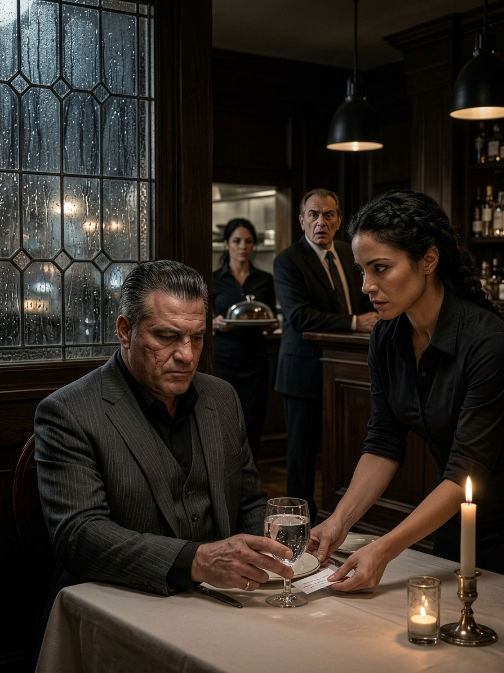
The Mafia Boss Faced 30 Enemies—Then a Waitress Changed the Game in One Instant

## PART 1
Nina Voss had been wiping down the same stretch of counter for twenty minutes when she heard the street go quiet.
That was the thing people who had not been trained the way she had been trained did not notice — not the sound of danger arriving, but the sound of ordinary things stopping. The taxis. The ambient noise of a Tuesday night in Chicago. The particular frequency of a city that ran all hours suddenly finding a reason to hold its breath.
She set the rag down.
She did not look at the door.
She looked at the man sitting three stools down from the register.
Caruso Vale had been coming into the Blue Rail Diner for as long as Nina had worked here. He came late, always alone, always sat with his back to the wall and his eyes on the entrance. He drank his coffee too strong and left tips that made the other waitresses fight over his section. He never asked her name until the third month, and when she told him it was Nina, he had nodded once, the way people nodded when they were filing something important.
He was the most dangerous man in Chicago, which she knew before she took the job and which was, in fact, precisely why she had taken it.
She had been watching him for eight months.
She had also, somewhere in the middle of those eight months, started watching for him the way you watched for things that meant the night was going to be survivable.
“Nina,” he said, without looking up from his coffee.
“I know,” she said.
She did not reach for the panic button under the counter. Pete’s silent alarm went directly to a precinct that Luka Petyr owned three of the desk officers in. She did not reach for her phone. She reached for the industrial coffee carafe on the rear burner — the one that had been sitting over heat for two hours, the one that weighed four pounds empty and held six when full.
The bell above the door didn’t ring this time. The door simply came open under too much pressure, and then the men were inside.
Nina counted fast the way her father had taught her: not by scanning, which took time, but by using peripheral awareness the way a person used it in the dark. The number she arrived at was thirty-one.
Thirty-one men wearing the insignia of the Petyr organization — a coiled snake in red thread on the upper jacket — spreading through the diner with the practiced efficiency of people who had rehearsed this specific room.
At their center, Luka Petyr.
Nina had never seen him in person. She had seen photographs. She had studied his face from every available angle for a decade, the way you studied the face of something you intended to find. He was smaller than she had imagined, rat-faced, with a silver tooth that caught the fluorescent light when his mouth moved. The gap between the man she had built in her memory and the man standing in front of her right now sent a specific electrical charge through her body that she identified, accurately, as the sensation of arriving at a destination after a very long journey.
She had not planned this.
She had not planned any of it.
But Luka Petyr had just walked into a room she was already in, and her father had not raised a person who let that kind of moment pass.
Caruso had not stood up. He had not put his coffee down. He swiveled on his stool with the specific unhurriedness of a man who had decided that the quality of his last moment, if this was going to be his last moment, was worth preserving.
“Luka,” he said. “You brought the whole team. I hope Pete knows you’re here — the kitchen can’t seat more than twelve at once.”
“No one is sitting,” Petyr said. “And Pete isn’t going to be taking any more orders.”
Thirty-one weapons came up.
Nina looked at Caruso.
She thought: if he draws, he gets three of them. Maybe four. And the other twenty-seven end the night.
She thought: the breaker box is four feet behind Petyr’s left shoulder.
She thought: my father would have seen this the moment they walked in.
She took the carafe off the burner.
“Hey.”
The word came out sharper than she expected — the specific crack of a voice that has been kept quiet for too long suddenly releasing. Petyr’s eyes darted to her for exactly one second, the involuntary blink of a man who had not accounted for the woman behind the counter.
That was the moment.
Nina swung the carafe in a hard arc and let it go.
It did not hit Petyr.
It hit the panel behind him — the breaker box Pete had been meaning to have properly sealed for the past year and a half, with its exposed fuses and its age-cracked housing and its complete architectural willingness to fail spectacularly when hit by four pounds of superheated metal and glass.
The impact was a crack, a hiss, a shower of sparks like the Fourth of July, and then the Blue Rail Diner went dark in the way of places where the power has not merely gone out but has been actively removed from the situation.
Thirty-one armed men who had walked into a room with a layout they’d memorized were now blind in that room.
Caruso Vale was not blind.
He had been sitting in this diner on Tuesday nights for three years. He knew the distance from his stool to the reach of the counter. He knew the angle of the door. He knew, because he was the kind of man who knew these things, where every shadow fell when the only light source was the street-facing neon sign that had been on a separate circuit since Pete’s nephew rewired the front half for the holiday display two Christmases ago.
Nina was already moving.
She came around the counter without sound — rubber soles on linoleum, muscle memory rather than conscious navigation — and found his shoulder in the dark the way you found things you had been cataloguing without admitting it.
“Down,” she said, her mouth an inch from his ear.
He dropped.
The first burst of automatic fire tore through the air where his head had been.
Under the counter, in the specific pocket of safety created by three inches of genuine granite countertop that Pete had installed in 1987 because he’d gotten a good deal from a construction contact, Nina reached for the second thing she had located on her first week working here: Pete’s insurance policy, a Mossberg 500 secured under the register with two brackets and a combination padlock whose combination Pete had given her the second month because she was, as he’d said, *the kind of person who should have it.*
She racked the slide.
In the dark, the sound carried.
She could hear Petyr screaming at his men to hold their fire before they hit each other.
Good.
She pressed the shotgun into Caruso’s hands and put her mouth at his ear.
“East wall. I know the layout. Follow my calls.”
He looked at her.
She couldn’t see his expression. She heard something in his breathing — the specific recalibration of a man who has been surprised in a direction he did not anticipate.
“Who are you?” he said.
“Later,” she said. “We have twenty-seven problems right now.”
And she went.
—
## PART 2
The dark had always been friendlier to Nina than to most people.
Her father had started with games — hide-and-seek in a house where the lights were deliberately off, navigating by sound and muscle memory and the specific way cold air moved differently near windows than near walls. By the time she was twelve it wasn’t a game. By the time she was sixteen it was the only skill she had left.
She came through the kitchen pass-through low and fast, and she had already catalogued the layout on her first shift — the magnetic knife strip on the north wall, the cast-iron skillet rack to the left of the grill, the swing door weight that made it arrive at exactly sixty degrees before it started coming back.
A Petyr man was flanking the counter from the east side. She heard his boots on the shattered glass — the cadence of someone who was not used to moving through debris in the dark, trying to stay quiet and failing at the intervals. She timed it. She came through the swing door at the moment he was mid-step and brought the skillet across in a short, efficient arc that connected with the side of his head at the temple.
The sound was wrong in the way of sounds that meant a person was not getting up quickly.
She caught his weapon on the way down. Checked the action by feel. Standard magazine. No suppressor.
“Three moving to your nine,” she called toward Caruso.
She heard the shotgun answer. She heard something fall.
“How do you know where they are?” His voice was compressed, controlled, moving.
“Boots on the tile,” she said. “Heavier men walk heel-first when they’re anxious. Listen for the pattern.”
She did not wait for a response. She moved to the far booth, got low, and fired twice in the direction of the muzzle flash she’d been tracking from the east wall. Two sounds confirmed.
The fight was faster than it should have been.
Not because they were lucky, but because Caruso Vale moved like someone who understood instinctively that violence, done correctly, was a matter of economy — minimum motion, maximum result — and Nina Voss moved like someone who had been waiting ten years for a room where her specific skills were no longer something she had to pretend she didn’t have.
When the last of Petyr’s men were down or retreating, she heard Petyr himself scrambling toward the front.
She raised her weapon.
“Let him go,” Caruso said.
“He’ll regroup—”
“He’ll also call every precinct in a six-block radius if we keep this going. We need to move.”
She lowered the weapon.
Outside, in the first thirty seconds of silence, the full weight of the night arrived in her body all at once — the shaking in her hands, the cold sweat at the back of her neck, the specific physical aftermath of adrenaline deciding it had done its job and was now leaving without notice.
She looked at the counter.
At the place where the carafe had been.
At the diner she had spent eight months working in, which was now going to have a police report filed in the next thirty minutes.
Caruso took her arm.
Not harshly. Just with the particular grip of a man who understood that she needed to move and that asking twice was going to cost them time they didn’t have.
“My car’s out back,” he said. “You can’t be here when Chicago PD arrives. Petyr has people in that department.”
Nina looked at the apron hanging on its hook beside the kitchen door. She had worn it for eight months. It was the longest she had stayed anywhere since she was sixteen.
She left it where it was.
In the Audi, doing seventy down the industrial corridor toward the river district, Caruso said nothing for four full minutes. He drove the way she’d imagined he drove — clean, precise, the car an extension of whatever calculation was running behind his eyes.
“Your driver,” she said.
“What about him?”
“I saw his car on the street when they came in. The windshield. He didn’t drive you here tonight.”
Caruso’s jaw shifted.
“Someone told Petyr you’d be alone tonight,” Nina said. “Someone who knew you didn’t bring security to the Blue Rail. Someone who knew the back exit is welded shut because Pete lost the key three weeks ago.”
Silence.
“How do you know about the back exit?”
“Because I work there. Worked there.” She paused. “Someone on the inside sold you, Caruso. Someone who had access to your schedule and your habits.”
He was quiet for so long the only sound was tires on wet asphalt.
“Three people knew I was going to the diner tonight,” he said. “My driver. My consigliere. And my brother Marco, who is supposedly in Toronto closing a supply agreement.”
“Your driver is dead,” Nina said. “That leaves two.”
Another long silence.
“You heard something,” Caruso said.
It wasn’t a question.
She had. Three weeks earlier, a Thursday, past close. The older man who came in occasionally with Caruso, the one who walked with a slight drag in his left foot and ordered black coffee and never spoke to anyone, had been on his phone in the booth near the bathroom. He had thought the dining room was empty. She had been in the storage alcove restocking the paper goods.
She had heard two words clearly before he switched to English.
She had not known, then, what they meant to Caruso.
She knew now.
“Renard,” she said.
Caruso went very still.
“He was speaking Russian,” she said. “Three weeks ago. Two words: *Zavtra v nochi.* Tomorrow night.”
The car swerved slightly before Caruso corrected it.
“He doesn’t speak Russian,” Caruso said.
“He does,” Nina said.
The silence that followed had a different weight than the ones before it. Not the silence of a man processing information, but the silence of a man understanding that the information has already done its damage and there is no undoing the knowing of it.
Then his phone buzzed.
He looked at the screen.
She saw his face change.
“What is it?” she said.
He handed her the phone without speaking.
The message was from an unknown number. Four words.
*Petyr has your brother.*
—
## PART 3
The safe house was a loft above an old textile warehouse on the river, accessed through a parking garage that smelled of diesel and river damp. Caruso keyed them in with the specific muscle memory of a man who had prepared for nights exactly like this one and hoped he would never need to use the preparation.
The loft was cold, functional, barely lived-in. Exposed brick. Steel beams. A wet bar with the serious liquor that people kept for situations where the ordinary liquor would feel ironic. Caruso poured two fingers of something amber and handed her a glass before she’d made it three steps inside.
She took it. She needed it. Her hands had mostly stopped shaking but her body still felt like it was running at a frequency slightly too high for normal conversation.
Caruso poured his own glass, set it on the counter, and did not drink it.
He stood with both hands flat on the surface and looked at the city through the rain-streaked glass, and she watched him do the thing she imagined he did rarely — process something he had not prepared for.
“Tell me who you are,” he said. “The real version.”
She sat on the edge of a steel stool and decided, for the first time in ten years, that lying was no longer efficient.
“My name is Nina Voss,” she said. “That part is real. But I haven’t been Nina Voss in public since I was sixteen. I’ve used eleven other names since then.”
“Why?”
“Because the man who killed my father came looking for me afterward.” She set the glass on the counter. “My father worked private security. International. He did things for people that required the kind of trust that came from never talking, and then he saw something he should have looked away from, and he didn’t look away from it. They came to our house when I was sixteen. He had enough warning to get me out of it before they finished.”
Caruso turned to look at her. “Where were you?”
“Crawl space,” she said. “He had built an access point from my closet. He’d told me never to use it unless I heard him say a specific word.” A pause. “He said the word.”
Caruso’s face held the kind of stillness that came from a man recognizing a specific kind of grief because he had his own version of it.
“The man who ordered it,” he said.
She nodded once.
“Was in your diner tonight,” she said. “Is that what you’re going to ask?”
“Yes.”
“Yes,” she said. “Luka Petyr contracted the team that killed my father. It took me six years to confirm it and four more to find out he was operating primarily in Chicago. I took the job at the Blue Rail because the Blue Rail was the kind of place a man like Petyr might eventually walk into, given that it was your territory and the two of you had been circling each other for two years.” She held his gaze. “I waited eight months.”
Caruso looked at her for a long moment.
“You used me,” he said.
“I used the situation,” she said. “There’s a difference. I wasn’t going to let Petyr’s men kill you and then walk up to him in the chaos. I needed them neutralized first.”
“And if I’d died?”
“Then the situation would have been different and I would have adapted.” She paused. “But I didn’t let you die.”
“No,” he said. “You didn’t.”
He picked up his drink finally and crossed to the window. Below, the river moved in the dark, indifferent.
“My brother is at the docks,” he said. “Petyr has him. There’s a message — I’m to surrender by 3 AM or Marco doesn’t make it through the night.” He turned. “Petyr knows I survived. He’s panicking. Panicking men use leverage.”
“Panicking men make mistakes,” Nina said.
“Which is what I’m counting on.” He looked at her. “Warehouse Four. It’s a kill box. One access point, snipers in the upper structure. He’ll have forty men after tonight.”
“Then you need someone outside,” Nina said.
“I need a sniper outside,” he corrected. “Someone who can take the elevated positions before I walk in the door.”
Nina thought about the canvas bag she had transferred to the trunk of the Audi six weeks ago, when she had started to believe the situation might come to this. She had carried it in her car for a decade, moving from city to city, job to job, like a fire extinguisher she hoped she would never need and refused to be without.
“You need to deal with Renard first,” she said.
Caruso looked at her.
“If he knows you’re alive, he’ll warn Petyr about the timeline. Give them time to adjust. You walk in at 3 AM thinking they’re in position A and they’re in position B.” She paused. “Renard has to be handled before we go to the docks.”
“I know,” Caruso said.
The word *we* had entered the conversation without either of them marking the moment. She noticed it the way you noticed a shift in weather — not dramatically, but with the specific awareness of something that had changed the conditions of everything that followed.
They drove to the Gold Coast in silence. Renard’s brownstone was exactly as she’d imagined it — old money, good taste, the kind of building that smelled like beeswax and old paper when you stood near enough to the entry. No visible security at the gate.
Which meant he was confident.
Which meant he had already made his calls.
They came in through the garden, over the east wall, moving with the specific kind of silence that came from two people who had learned independently not to make noise and had discovered, tonight, that their versions of that training were compatible. She tracked left. He tracked right. Neither of them had to say so.
In the study, the fire was going.
Renard was in a leather chair, brandy in hand, phone to his ear. He was talking to Petyr. She could hear the tinny voice through the speaker — celebrating something.
Caruso stepped out of the shadow.
Renard froze.
The phone slipped from his fingers and landed on the Persian rug, Petyr’s voice still coming through, small and self-congratulatory.
“Renard,” Caruso said. He did not raise his voice. “Put the glass down.”
Renard set the brandy on the side table with the trembling care of a man trying to buy seconds in which to think of a sentence that might salvage something. He found none.
“You were like a son to me,” Renard said. “That’s why I could see what your father couldn’t — that you were going to lose this city if you kept trying to turn it into something it wasn’t built to be.”
“So you sold me to a man who skins his enemies alive,” Caruso said.
“Petyr understands power. You wanted a board of directors. A legitimate portfolio. A legacy.” Renard’s voice gained its old authority, the sound of a man who had been right too many times to stop believing in his own conclusions. “You can’t build legitimacy on a foundation like ours, Caruso. I tried to save the foundation.”
“You tried to save yourself,” Caruso said. “And you dressed it up in language about legacy because you’ve been doing that your whole life.”
Renard looked at him. Then at Nina.
“The waitress,” he said. “After everything tonight, you brought the waitress to deal with me.”
“She’s here,” Caruso said, “because she saved my life and I trust her more than anyone else I know right now.”
Renard looked at Nina for a moment with the evaluating expression of a man who had underestimated her once and was still not fully understanding the scope of that error.
“I know what I did,” Renard said finally, addressing Caruso rather than her. “I know there’s nothing I can offer that changes it. But listen to me — Petyr’s position tonight is not as strong as he believes. His organization is structured around his personal authority. Remove Petyr and the entire operation collapses within forty-eight hours. His lieutenants don’t have the loyalty architecture to hold it together.”
“I know,” Caruso said.
He raised his weapon.
Renard’s eyes closed briefly.
“Wait,” Nina said.
Both men looked at her.
She crossed the room and picked the fallen phone up from the rug. Petyr’s voice was still there, talking to empty air.
She put it on speaker.
“Luka,” she said.
The voice stopped.
A pause.
“Who is this?”
“Someone who used to have a name you’d recognize,” Nina said. “My father was Emil Voss. He worked private security out of Berlin and Prague. Twelve years ago he worked a job for a logistics firm in Gdansk. He saw something he wasn’t supposed to see.”
The silence on the other end was the specific silence of recognition.
“I’ve been looking for you for ten years,” Nina said. “I know where you are tonight. I know what you’re planning. And I need you to know that the man you’re planning to kill is alive, and I’m going to be on a roof above your warehouse in three hours.”
She set the phone on the arm of Renard’s chair.
“Let him come to us,” she said to Caruso. “Let him come with everything he has and we take it on our terms, not his.”
Caruso looked at her.
Then he looked at Renard.
“Alive,” Nina said quietly. “Until we’ve verified what he’s said about the organizational structure. Then you decide.”
Caruso looked at Renard for a long moment. The fire cracked. The city went about its night outside the leaded windows.
“Get up,” Caruso said. “We’re taking you with us. If what you said about the collapse timeline is accurate, you’ll live long enough to see it happen.”
Renard rose from the chair. He moved like a man who understood he was no longer in any position he had once occupied.
They went to the docks.
—
The fog off Lake Michigan had turned the warehouse district into a study in negative space — shapes without definition, light without source, the kind of visibility that required a different kind of seeing. Nina had climbed the gantry crane in twelve minutes, four faster than she’d estimated, because the rain had stopped an hour earlier and the rungs were only wet rather than running.
Sixty feet up, Chicago spread in every direction like a circuit board, all light and dark and the implied geometry of things built in straight lines over a very long time.
She assembled the rifle from muscle memory. The Remington 700 she had carried in its canvas bag for a decade had outlasted every identity she’d worn over it. Her father had chosen it for her the way people chose things they intended to be permanent.
“I’m in position,” she said into the tactical earpiece.
“Copy,” Caruso said.
“Three snipers in the upper south structure. Two more at the northeast corner of the roof. Give me four minutes before you walk in.”
She heard him exhale.
She spent the four minutes doing what her father had taught her: breathing, measuring, letting the distance between her and the targets become geometric rather than personal. Distance without detachment was the amateur’s version. Her father had explained the difference when she was fourteen and she had not fully understood it until she was twenty-two.
Now she understood it completely.
At 2:58 AM, she began.
The first shot took the primary sniper in the upper structure at two hundred meters, which was inside her comfort range. The second took the northeast position at two-eighty. She worked through the remaining elevated threats methodically, the rifle making the specific sound of something extremely precise doing exactly what it was designed for.
Below, she heard the warehouse doors open.
She heard Caruso walk in.
“You’re hard to kill, Moretti,” Petyr’s voice carried upward through the corrugated iron roof. The old family name. He knew whose blood he’d been trying to spill.
“And you’re predictable, Luka,” Caruso’s voice came back, entirely unhurried. “Forty men. Same as the diner, just more of them. You’ve never understood that numbers aren’t strategy.”
She tracked down through a skylight, adjusting for angle.
“Drop your weapon,” Petyr said. “Or your brother doesn’t survive the next ten seconds.”
“My brother,” Caruso said, “is the only reason I’m walking in the front door instead of burning this building down.”
She heard the specific sound of a man with a hostage running out of arguments — the sharp, panicked quality of someone whose leverage is being treated as if it doesn’t exist.
“I have him positioned,” she said into the earpiece.
“Can you take the shot?”
Through the scope: Petyr behind Marco, weapon pressed to the back of Marco’s neck, Marco’s face battered but his expression clear — the expression of a man who had already accepted what was coming and had stopped being afraid of it.
“Not yet,” she said. “The angle is blocked. Marco is too low.”
“How far off are you?”
“If he moves four inches left—”
“Can you make him move?” Caruso said.
She understood what he meant.
“Steam line,” she said. “Left exterior wall, runs horizontal at shoulder height. Red housing.”
“I see it.”
“If I rupture it from up here, the pressure release goes directly into the corridor where Petyr is standing. Scalding vapor. His hands will go to his face instinctively.”
A pause.
“That’s four inches of movement.”
“Yes.”
“If it misses him and hits Marco—”
“It won’t hit Marco,” she said. “The line runs above Petyr’s shoulder height. Marco is lower. The release angle is upward.”
She heard Caruso breathing.
“Do it,” he said.
She shifted aim. The steam line housing was forty meters away at a steep downward angle. She accounted for the drop, the wind that had come back off the lake in the last twenty minutes, the specific thermal behavior of pressurized steam against metal in near-freezing air.
She fired.
The housing ruptured exactly as the physics said it would — a hard horizontal burst of superheated vapor directly into Petyr’s face and chest. The sound was enormous, the kind that took a room by surprise before anyone had time to decide how to respond.
Petyr’s hands went to his face.
The weapon moved three inches from Marco’s neck. Then four. Then five.
She was already tracking.
The shot was clean.
The silence that followed was the specific silence of an operation that had finished.
She heard Caruso say his brother’s name.
She heard Marco’s response — rough, weak, but present.
She closed her eyes for three seconds.
Then she began breaking the rifle down.
—
By the time she descended from the crane, the warehouse had the specific quality of a place that had been many things in rapid succession and was now, finally, just a building. Caruso’s people — the ones he’d been able to reach through the secure line Renard had not known about — had arrived in the preceding hour. They moved through the space with the professional quietness of people who understood that their efficiency was the most important thing they were offering right now.
Marco was on the ground near the center of the warehouse floor, his back against a support column, holding a field dressing to the cut above his eye. He looked at Nina when she came through the loading bay doors.
“You’re the waitress,” he said.
“I was,” she said.
“Dante said you saved his life at the diner.”
“I leveled a playing field,” she said. “He did the rest.”
Marco looked at her with the slightly unfocused intensity of a person running on pain medication and processed adrenaline. “He also said you knew about Renard before tonight. That you overheard something.”
“Three weeks ago.”
“And you waited.”
“I was waiting for Petyr,” she said. “Renard was part of the situation.”
Marco leaned his head back against the column. “He said something else,” he said. “He said you’re the reason he’s alive and the reason Petyr is dead, and that the two of those things together are not something he knows how to calculate a response to.”
She looked across the floor to where Caruso was standing with one of his senior men, going through what appeared to be a logistics conversation — the kind of conversation that had to happen immediately after something like this and required a person who was still functional enough to hold decisions in their head.
He looked up.
Their eyes met across the distance.
She looked away first.
She was not going to spend the rest of this night with her face doing things she hadn’t decided to do.
She sat on a wooden crate near the door and waited.
He came to her when the operational conversation was finished. He sat on the crate beside her — not at a professional distance, not at the distance of a man who was managing the situation, but beside her, the way two people sat when they had been through something together and the something had burned away the categories they were operating in before.
“Renard gave us the collapse timeline,” he said. “The eastern operation, the supply network — it holds together entirely on Petyr’s authority. Forty-eight hours after news of his death circulates, the organization fragments. His lieutenants don’t trust each other enough to consolidate.”
“Good,” she said.
“The Chicago territory stabilizes.” He paused. “For whatever that’s worth.”
“It’s worth something,” she said.
He looked at her.
“You used me,” he said.
“Yes,” she said. “I was already there. The situation arrived. I used what was available.”
“And if I hadn’t survived the diner?”
“Then I would have found another approach.”
“But you made sure I survived.”
“I made sure Petyr’s men didn’t have a clear shot,” she said. “You survived because you know how to survive.”
He was quiet for a moment.
“Why tell me now?” he said. “About your father. About Petyr. You could have let me believe you were just someone with an unusual skill set who happened to be working a counter job.”
She looked at her hands. The cut on her left knuckle from the crane rung had stopped bleeding. It was going to leave a mark.
“Because I’m tired of being someone who happened to be somewhere,” she said. “I’ve spent ten years happening to be places. Taking jobs that put me near people I was tracking. Watching. Waiting. Being whatever shape was useful.”
“And now?”
She looked at him.
“Now Petyr is dead,” she said. “And I’m not sure what comes after that. I planned the ten years before it. I didn’t plan anything after.”
Caruso looked at the warehouse ceiling — the high dark rafters, the skylights through which the first gray suggestion of pre-dawn was beginning to filter.
“I’m going to need someone I can trust,” he said. “Renard was my intelligence structure. Everything he built is compromised now. I have to rebuild it from nothing.”
“I’m not a consigliere,” she said.
“No,” he agreed. “What you are is someone who spent a decade tracking a target across eleven cities and eight identities and still managed to be in the right room at the right time.” He looked at her. “I’m not offering you a title. I’m offering you a function. An actual one. Resources. A structure where your specific skills have a legitimate use.”
She thought about the canvas bag. The rifle broken down to its components. The eleven names. The eight cities.
“I’d want to know the full scope of what I’d be operating inside,” she said.
“I’ll show you everything.”
“Including the parts you’d rather I didn’t see.”
He looked at her for a moment.
“Including those,” he said.
She sat with that.
“I’ll need time to think about it,” she said.
“How much time?”
“A week.”
“Take two,” he said. “Take three.”
She looked at him.
“Don’t be generous,” she said. “It makes you look uncertain.”
His mouth moved in something that was not quite a smile and was much more interesting for it.
—
Six months later, Chicago had the specific quality of a city that had shifted on its axis without anyone outside it fully understanding what had changed. The Petyr operation had collapsed exactly as Renard had described, within forty-eight hours of the news circulating, the eastern supply network fragmenting into competing subfactions that spent most of their energy fighting each other. The vacuum had been filled efficiently and without visible violence, which was the kind of outcome that got discussed in certain rooms as a model for how these things should be managed.
Nina Voss had kept her name.
She had also kept the loft — not the safe house loft, but a different one, in a building she had chosen herself, with windows that faced east and a kitchen that functioned as an actual kitchen rather than an afterthought.
She had a function in the Caruso organization that did not have an official title, which was exactly how she wanted it. She handled intelligence — specifically, the kind of intelligence that required reading situations rather than data, tracking patterns across cities, identifying threats before they organized into something that required the kind of response she was trying to help them avoid.
It was work she was good at.
It was work she was less tired afterward.
On a Tuesday night in November, it rained.
Not the same Tuesday. A different November, a year forward.
She walked into the Blue Rail Diner at 11:40. Pete had repaired the breaker box, replaced the shattered glass, and touched up the paint on the walls. To the regular customers — the ones who came in after midnight, the ones who knew the sugar packets were restocked from the right and not the left — it was the same diner it had always been. They knew something had happened here. They preferred to let it stay in the category of things understood without being discussed.
She hung her coat on the rack.
She sat at the counter.
Three stools down from the register.
Pete brought coffee without being asked.
She was three sips in when the bell above the door chimed.
Caruso walked in wearing his charcoal coat, still damp at the shoulders from the rain. He looked, as he usually looked, like a man who had just come from somewhere significant and was going somewhere else equally significant, and had chosen this room as the place between those two things.
He sat beside her.
Not three stools down. Beside.
“You’re early,” she said.
“Traffic was light.”
Pete refilled her cup and produced a second one without being asked, which meant Pete paid attention to things, which was why Pete’s diner had survived Tuesday nights that would have closed other places.
“Renard’s network,” Nina said. “The financial structure he had in the northern accounts. Owen’s audit came back this afternoon.”
“I know. I read it.”
“The transfers from the eighteen-month period before he turned — some of them don’t align with the operational calendar. There are dates where money moved but nothing moved that would explain the movement.”
Caruso wrapped his hands around the mug.
“What are you thinking?”
“I’m thinking Renard had a second arrangement that predated Petyr,” she said. “Someone he was feeding information to before he made the move to Petyr’s network. Someone who might have known about the arrangement before we did.”
“That would mean someone else was positioned—”
“Yes,” she said. “Ahead of the situation.”
He was quiet for a moment.
“How long do you need?”
“Two weeks,” she said. “Maybe three. I want to trace the transfers manually rather than through Owen’s algorithm. Algorithms miss contextual patterns.”
“Take whatever you need.”
She picked up her mug.
The coffee was terrible.
It had always been terrible.
She had grown quietly attached to it.
“You know,” Caruso said, “there are approximately forty restaurants in this city that we own a controlling interest in and that could produce a cup of coffee significantly better than this.”
“I know,” she said.
“And yet.”
“The coffee isn’t the point,” she said.
He looked at her.
“Why do we keep coming here, Nina?”
She looked around the diner — the patched drywall, the replaced glass, the counter that had taken three bullets and three inches of granite between her and a room full of people who had intended something specific to happen to the man now sitting beside her.
“Because this is where it started,” she said. “And it’s good to know where things started.”
He was quiet for a moment.
“Is that the only reason?”
She looked at him.
“It’s good coffee,” she said.
He looked at her for a beat.
“It’s objectively terrible coffee,” he said.
“Yes,” she said. “It is.”
Pete refilled both their cups without being asked.
Outside, the rain intensified against the windows, the way Chicago rain did when it had something to prove. Inside the Blue Rail, the night held its ordinary shape — a man and a woman drinking bad coffee in a diner that smelled of bacon grease and lemon polish, both of them carrying things that had been earned rather than inherited, both of them, for the first time in longer than either had tracked, in exactly the place they intended to be.
The waitress was gone.
In her place: a woman who had stopped hiding the things she was built to do, in a city that had learned to make space for her.
The city would be the better for it.
She intended to make sure of that.