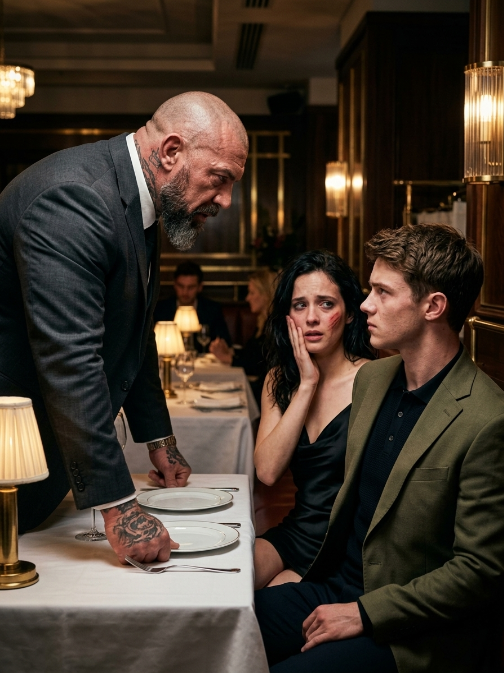
The Mafia Boss Forbidden the Red Dress—Then Uncovered the Secret I’d Hidden for Years

## PART 1
The thing about putting on a red dress after two years of gray and beige and clothes chosen specifically not to be noticed is that it feels like a door you’ve been holding shut finally swinging open.
I stood in the staff bathroom on the third floor of Ronan Voss’s Chicago townhouse for four minutes before I could look at myself in the mirror.
The dress had cost me three months of careful saving. Not because it was expensive — it wasn’t, not by the standards of this house, where the throw pillows alone cost more than my rent — but because I had made a rule two years ago about what I was and was not allowed to want, and a red dress sat firmly on the wrong side of that rule. Red dresses said: *notice me.* Red dresses said: *I’m here.* For two years, being unnoticed and invisible had been the point.
Tonight was different.
Tonight had its own reasons, which I was trying not to think about too precisely.
I had put on the dress. I had let my hair down for the first time in as long as I could remember — long enough that I had forgotten it had natural wave in it, that it fell past my shoulder blades, that it did not look like the person who wore it worked for anyone. I had left the plain-glass frames in my purse. Without them my face was different. Not better or worse. Just mine again. The one I had before.
The one I had before Callum Dray.
The house smelled the way it always smelled — leather, lemon oil, the faint mineral edge of a very good HVAC system, money present not as a scent but as an absence of everything that made most spaces smell human. I had been house manager here for twenty-two months. I knew the creak in the fourth stair. I knew which chandelier ran warm. I knew that Ronan Voss drank his coffee too slowly when he hadn’t slept, and too fast when he was pretending he was fine, and I had learned all of this from the safe side of a clipboard while he walked past me seven hundred times without truly seeing me.
That was the arrangement.
That was the arrangement I had chosen.
I came down the main staircase at 7:54 PM.
I had the clutch in one hand — cheap black, the kind that doesn’t pretend to be anything. My phone was inside it. So was the folded envelope I had been carrying for two years, the one I should probably have thrown away except that I didn’t trust my own memory to stay accurate without it. Memory softened things. Memory made the thing in the hallway seem less than it was. The envelope didn’t soften anything. The envelope had dates and times and the one sentence I had made myself write down while it was still fresh because I knew that if I didn’t write it I would find a reason to doubt it later.
I reached the bottom of the stairs.
The hallway was empty.
I had checked the schedule. Ronan was in London until Thursday. His driver had confirmed a Wednesday return. The house was mine for the evening, which was the first thing I had checked before I let myself put the dress on at all.
I was halfway to the front door when I heard him.
“You weren’t supposed to be here.”
His voice came from the doorway of the study at the end of the hall, and it stopped me the way a hand on a shoulder stopped you — not the sound of it but the source. I turned slowly, already recalibrating, already moving the expression on my face toward the one I wore at work.
Ronan Voss stood at the far end of the hallway in a charcoal suit with his tie loosened and his sleeves rolled to his forearms. He had not turned the study lights on. He stood in the shadow of the doorway in the light that spilled from the foyer chandelier, and he was looking at me with the specific expression of a person who has walked into a room and found it rearranged.
“Mr. Voss,” I said. “You weren’t supposed to be home.”
“Flight changed,” he said.
“I was just leaving.”
“I can see that.”
His gaze moved over the dress. I had braced for it to feel the way I remembered looks feeling — the ugly kind, the kind that made you understand you were being assessed as a thing rather than a person. It didn’t feel like that. It felt like someone looking at something they had not understood was there.
I hated that it felt like that. I had spent two years not wanting to know the difference.
“I have somewhere to be,” I said.
“Where?”
“That’s—” I stopped. “That isn’t a work question.”
He looked at me for a long moment. “No,” he said. “It isn’t.”
The acknowledgment of it — that he understood he didn’t have the right to ask — did something unexpected to the inside of my chest. I filed it away in the category of things I was not going to think about tonight because tonight had a specific purpose and I needed to stay on that.
“I’m meeting someone,” I said.
Something shifted in his face. Quick. Almost invisible. I had been watching this man’s face from the safe side of a clipboard for twenty-two months. I knew what his jaw looked like when it tightened. I knew the difference between his controlled expression and his slightly less controlled one, which most people probably couldn’t see.
This was the less controlled one.
“A date?” he said.
“A meeting.”
“You said someone.”
“I said I have somewhere to be.”
He took one step toward me. Not threatening — I knew what threatening steps looked like, the weight of them, the particular way air changed when someone moved toward you with bad intentions. This was not that. This was a man who had said something he didn’t have the right to say and was now not sure how to unsay it.
“You look—” he started.
He stopped.
I waited.
“Different,” he said. Then, like the word had been taken from him before he could reconsider: “Beautiful.”
I had specifically not wanted to feel that.
Beauty had not been a safe word in my old life. In my old life, beauty had been the reason a man named Callum Dray had called me into his office at 9 PM on a Thursday and locked the door. The HR intake form used clean language: *inappropriate contact, dispute, voluntary resignation.* None of those words were accurate. None of them were what happened. But they were the words I was left with after the security log showed my badge exiting the building at 9:43 and the incident summary used the word *voluntary* as if I had chosen any part of it.
I had left because I broke a desk lamp across his face.
After that, I changed everything I could change without disappearing from the world entirely. Bigger clothes. Fake glasses. Hair up tight enough to hurt. A job managing a household where the man of the house barely registered me as a person. Not because I hated myself. Because I was tired of being registered.
It had worked.
Until tonight.
“I need to get past you,” I said.
Ronan moved. Not all the way — but enough.
I passed close enough to feel the warmth from him through the suit fabric, and his hand shifted at his side, and he did not touch me, and that restraint mattered more than I wanted it to.
My phone buzzed in my clutch.
One new message.
I already knew who it was from. The man I was meeting downtown had already sent me the address twice and a photo of a corner booth with a paper coffee cup and one line that had been turning my stomach cold since I’d read it at six o’clock:
*Wear the red dress. He’ll recognize it.*
Ronan’s eyes moved to the clutch like he’d felt the vibration through leather.
“Maren,” he said.
My name in his voice was different from my name in my own head. I didn’t know why. I didn’t want to examine why.
I turned back.
He was standing under the chandelier light now, hands at his sides, looking at me with the specific confusion of a man who has just realized he has been looking past something significant for a very long time.
“Who are you meeting?” he said.
My fingers were around the clutch and something shifted inside it — the envelope, the one I’d been carrying for two years, the one with the date and the time and the sentence I had written for myself — and the clasp gave without my meaning it to.
The envelope slid out.
I reached for it.
Ronan was faster.
Not dramatically — just one controlled movement, one bend, and then the envelope was in his hand and he was turning it over and I said his name once, sharp enough to stop most people.
He didn’t stop.
He opened it.
The photograph was not what he expected. I could tell because of what happened to his face. Not a reaction, exactly. An absence of one. The specific stillness of a person whose brain is working very fast on something that hasn’t resolved yet.
It was a photograph from two years ago. A hotel opening in the Gold Coast, flashbulbs and smiles and two men standing in front of a media wall. Ronan Voss on the right. Callum Dray on the left. Both of them looking toward the camera like men who owned the room they were in.
And in the background, half-hidden behind a champagne tray, slightly out of focus, the edge of a woman in a red dress.
The original red dress.
The one that was no longer in existence because I had thrown it away the morning after.
On the back of the photograph, in my handwriting, from two years ago when I was still afraid my memory would protect me from what had actually happened:
*The man who hurt me was standing beside you.*
My phone buzzed again.
Ronan’s eyes dropped to the clutch.
The preview text glowed between us before I could turn the screen over:
*8:09 PM — If Voss starts asking the right questions, remind yourself what the footage shows.*
And I understood, for the first time, that I had not been called downtown tonight because Callum Dray was afraid of what I knew.
I had been called downtown because Callum Dray was afraid of what Ronan Voss was about to find out.
—
## PART 2
Ronan read the message preview.
He read it twice, the way he read things he intended to act on rather than simply understand.
Then he looked at the photograph. Then at me. The calculation in his expression was the same one I had watched him apply to problems that had not gone the way he’d planned them, but there was something underneath it now that was not usually there: the look of a man who is trying to determine the extent of his own blind spot.
“Callum Dray,” he said.
Not a question.
“He was in your building,” I said. “Two years ago. Before I came here. He had an office on the fourteenth floor of the Meridian complex, and the event security shared systems with your company’s floor.”
Ronan was still holding the photograph.
“He has footage,” I said. “Or he says he does. I don’t know how much. I don’t know what angle.”
“Of what happened.”
“Of after. After I got out.” I kept my voice level. The way I had kept it level for two years, in job interviews and references and once in a conversation with a lawyer I could not afford to keep. “He kept access to the building’s security cameras after everyone else had gone home. I don’t know if he planned it that way or if it was opportunistic. But he has me in that building at the wrong time, and he can make it look like whatever story serves him.”
“What is the message saying he wants?”
“He didn’t say directly.” I looked at the screen. “Tonight’s meeting isn’t a date. He found out I work for you. He wants me to come and — I think he wants to give me instructions. About what not to say. About what version of things I’m supposed to remember if anyone asks.”
Ronan set the photograph on the foyer table.
He looked at it for one more second.
“You’ve been working in my house for twenty-two months,” he said, “knowing he was connected to me.”
“Yes.”
“Why didn’t you leave?”
I looked at him. “Because I had nowhere else to go that he couldn’t follow. And because—” I stopped.
“Because?”
“Because the people he was afraid of were the people who had leverage over him. And the only person in Chicago with that kind of leverage was you.” I paused. “I chose your house because I thought proximity to your name might be the only protection available to me. I never intended to use it. I was just — in the vicinity of safety.”
Ronan looked at me for a long time.
His expression went through something I couldn’t fully read, which was unusual. I had been reading this man from a distance for almost two years.
“You should not have had to do that,” he said.
“No,” I said. “I shouldn’t have.”
He picked up his phone.
He made a call that lasted forty-five seconds. I heard the name of a man I didn’t know, an instruction about a server backup, and the words *tonight, all of it, everything that runs through Dray’s access credentials.* He hung up.
“The footage exists,” he said. “We’ll have a copy before he thinks to delete his version.”
I stared at him.
“It won’t show what he’s claiming it shows,” Ronan said. “Because building security systems timestamp everything by system clock, and I know what time you left that building, and I know what time Dray’s access badge was last used on that floor.”
I felt the floor under me shift slightly.
“How do you know when I left?”
He looked at me steadily.
“Because his company came to me three months after you started here,” he said. “Asking if I’d had any contact with a former employee named Maren Cole. Wanting to know if you had said anything. I told them I didn’t know anyone by that name.”
“You lied.”
“I deflected,” he said. “There’s a difference.”
“Why?”
“Because the nature of the question told me everything I needed to know about why they were asking it.” He was quiet for a moment. “I didn’t understand what had happened. I should have asked. I didn’t because I thought — I thought if you needed me to know, you would tell me.”
My phone buzzed again.
The message said: *8:17 PM. Don’t keep me waiting.*
Ronan looked at the screen.
“Don’t go,” he said.
“If I don’t go, he escalates,” I said.
“Let him escalate,” Ronan said. “Tonight he escalates into the middle of a conversation my legal team is already preparing to have with him.” He met my eyes. “You have been managing this alone for two years. You don’t have to manage it alone anymore.”
—
## PART 3
I did not go downtown.
I sat instead in the chair across from Ronan’s desk in the study where he had first appeared in the doorway, while he made calls I was only partially present for, and tried to understand what it felt like when the thing you had been bracing against for two years finally stopped being something you were bracing against alone.
It felt like the moment after a very long held breath.
Not relief exactly. Not yet. More like the body remembering that exhaling was possible.
The calls took forty minutes. I heard enough to understand the shape of what was happening: a lawyer I hadn’t met, a digital forensics person whose name I didn’t catch, and two conversations with men Ronan addressed by last name only, who answered with the speed of people who understood that when this particular phone rang after eight in the evening, the matter was not routine.
I sat in the chair and did not look at the photograph on the foyer table, which was visible from where I sat through the open study door. I had not looked at it in two years. I had kept it because I didn’t trust myself not to rewrite what had happened, and I had been right not to trust myself — I had already started softening it by month six, filling in the worst parts with fog, and the photograph and the note on the back were the only things that held the accurate version in place.
*The man who hurt me was standing beside you.*
Not an accusation. Just a fact I needed to keep somewhere outside my own memory.
When Ronan ended the last call, he sat down across from me.
“Tell me what happened,” he said. “From the beginning. From whatever the beginning was.”
I had told this story twice. Once to the HR intake coordinator, who had been professionally kind and whose job required clean language that didn’t fully match the event. Once to the lawyer I couldn’t afford, who had told me the case was viable but the cost of pursuing it was not.
I had not told it to someone who was going to do something about it.
I told it now.
I started with the afternoon the event was announced — the hotel opening, the company-wide invitation, the detail that seemed innocuous at the time that Callum Dray had personally confirmed my attendance to the organizers before asking me. I told it through the evening, through the champagne and the photographers and the way he had positioned himself throughout the night to be near enough to me that by the end I had believed this was coincidence rather than pattern. I told it through the moment he suggested, reasonably, that we review the event budget in his office before the night closed, and through the moment I understood that the suggestion was not reasonable at all and that the door was already locked.
I told it through the desk lamp.
I did not use clean language. I used the words that matched what had actually happened.
Ronan listened.
He listened the way the good lawyer had listened — with his hands still and his face directed at me rather than away from me — but without the careful professional neutrality. His face was not neutral. About halfway through, his jaw had tightened enough that I could see the muscle in it, and at the end, when I was quiet, he was quiet too for a long time.
“I’m sorry,” he said. Not the apology people offered when they needed to fill the space after a difficult thing. The apology of a man who understood he was saying it because it was specifically true and specifically owed.
“You didn’t know,” I said.
“I should have asked better questions when they called about you.”
“You didn’t know what questions to ask.”
“No,” he said. “But I knew enough to know the questions were worth asking, and I chose not to push because it was easier.” He looked at his hands. “That is a different kind of failure and I’m not going to pretend it isn’t.”
I looked at him for a moment.
“The footage he’s threatening with,” I said. “Your person — they can actually get it?”
“The forensics team is pulling everything with Dray’s credentials from the Meridian complex’s archived system. It goes back four years. Everything he accessed. Everything the cameras on that floor captured, timestamped and unedited.” He looked at me. “If he has a version he’s edited or claims to have edited, we’ll have the original. And if the original shows what I believe it shows — you leaving that building under your own power, alone, at a time that contradicts whatever story he’s been preparing — then whatever leverage he thinks he has disappears.”
“And if it shows something worse,” I said.
“Then it is evidence,” Ronan said. “Not leverage. Evidence. For you, not against you.”
I sat with that.
“He said to wear the red dress,” I said. “In the message. He said *he’ll recognize it.* Like there was someone waiting downtown who already knew what I looked like in it.” I looked at Ronan. “I don’t think tonight was just about shutting me up. I think someone was going to take a photograph. Of me arriving at that location, in that dress, to meet him. Willingly.” A pause. “The kind of photograph that looks like something other than what it was.”
Ronan was still for a moment.
Then he picked up his phone again.
The call this time was to someone named Garrett, and the instruction was specific: the location downtown, the corner booth, anyone with camera equipment in a two-block radius, the license plates of cars that had been parked there for more than forty minutes.
He was thorough.
I had known he would be thorough. I had chosen this house, two years ago, partly because I had watched him operate from a safe distance and understood that the thing he was best at was not the visible part of power — the rooms he owned, the names that opened doors — but the specific combination of patience and precision that made his opponents understand they had been outmaneuvered before they had finished explaining why they couldn’t be.
I had chosen this house because I thought his shadow might be protection.
I had not expected him to actually be there.
“Where are you staying tonight?” he said, after the call.
“I have an apartment in Bucktown.”
“Dray knows that address.”
I looked at him.
“He knew your employment history when he contacted my office,” Ronan said. “He knew you worked here. If he knows that much, he knows where you live.”
“I’ve been there for two years.”
“Yes,” Ronan said. “Which means he’s had two years to decide whether to use it.”
I thought about the meeting. The message about the red dress. The careful setup of a photograph that would look like something other than coercion.
“He’s decided,” I said.
“Yes.”
“Tonight.”
“I think so.”
I looked at the foyer through the open door. The photograph was still on the table. The black clutch beside it. The hallway that smelled of leather and money and the absence of anything that could reach me if I stayed inside it.
“I’m not afraid of him,” I said. “I want you to understand that. I haven’t been afraid of him in a long time. What I’ve been is — careful. Managing exposure. Controlling what he could use.”
“I know.”
“I’m telling you that because I don’t want tonight to look like I needed rescuing.”
Ronan looked at me.
“Tonight looks like two people who should have been having this conversation twenty-two months ago,” he said. “And one of them is going to spend the next several months correcting his failure to notice what was in front of him.”
I looked at him for a long time.
“You walked past me for seven hundred mornings,” I said.
“Yes.”
“And you never—”
“No,” he said. “I didn’t.”
“Why?”
He was quiet for a moment.
“Because you made it very clear you didn’t want to be seen,” he said. “And I thought respecting that was the right thing to do.” He paused. “I was wrong in the sense that I respected the surface of it without asking what it was protecting.”
I thought about the big clothes and the fake frames and the hair pulled back tight enough to leave a headache at the end of the day. The armor I had assembled not because I was ashamed but because I was tired. Because I had decided that the cost of being noticed was higher than the cost of disappearing.
“I was protecting something worth protecting,” I said.
“Yes,” he said. “I understand that now.”
We sat with that for a while.
The calls Ronan had made produced results in the order of fastest to most complex. The camera footage from the Meridian complex was secured by ten o’clock — not in our possession yet, but locked against deletion, which the forensics team described as the more important step. The address downtown had, as Ronan’s contact confirmed, a man with a professional camera in a car parked on the adjacent side street who had left, with some urgency, within twenty minutes of Garrett’s people arriving in the vicinity.
Callum Dray sent two more messages to my phone that evening. The first at 8:31, asking where I was. The second at 9:07, which said nothing but a time and a question mark.
I did not respond to either.
By eleven, Ronan’s attorney — a woman named Frances who had the energy of someone who had been in adversarial rooms for so long she had stopped finding them tiring — was on a video call, reviewing what we had, asking me the questions I had answered twice before and finding, I thought, that the answers were more complete this time, more specific, less shaped by the need to make the person listening comfortable.
Frances took notes with the focused attention of someone building something rather than recording something.
After the call, Ronan brought me tea I hadn’t asked for. He set it on the desk without comment and sat back down.
“There’s a guest room,” he said. “Third floor. It’s not used. You can stay tonight and go to your apartment in the morning with someone from my security team if you want to, or not go at all.”
“I’ll need clothes,” I said.
“We can handle that.”
“And I’ll need to be at work on Monday.”
He looked at me. “You do work here.”
“I mean I need things to be — normal. I need the structure. I don’t want to be handled.”
“You won’t be handled,” he said. “You’ll be employed. Same as always, with the addition of some additional security arrangements that will be invisible to anyone who isn’t looking for them.”
I wrapped my hands around the tea mug.
“The dress,” I said. “The red one. I bought it for a reason tonight. Not the meeting — the meeting came later. I bought it because—” I stopped.
“You don’t have to explain it.”
“I want to.” I looked at him. “I bought it because I was tired of managing what I was allowed to want. And I put it on tonight because I decided that two years was long enough to let one person’s choices determine what I was permitted to be.” I paused. “I didn’t plan the rest of the night. I didn’t plan any of this.”
“I know,” he said.
“I planned to go to a party. With friends I’ve been rebuilding for six months. I planned to come home by midnight and take the dress off and decide if it felt like something I could do again sometime.”
“And now?” he said.
I looked at the window. Chicago beyond it, doing its indifferent thing — the lights, the lake-dark sky, the sound of a city that did not stop for anyone’s crisis or recovery or the specific moment when two years of careful management finally became something else.
“Now I’m drinking tea in my boss’s study at eleven o’clock,” I said.
“Yes,” he said.
“And you know something about me that I’ve kept from everyone I’ve met in two years.”
“Yes.”
“That changes things,” I said. “I don’t know yet how.”
He looked at me.
“It doesn’t have to change what you don’t want it to change,” he said. “Tonight doesn’t obligate you to anything. Not toward me and not toward the process — Frances will move at whatever pace you’re comfortable with, and you can stop it at any point if you decide that’s what you want.”
I considered that.
“What do you want?” I said.
He looked slightly surprised. Not many people, I suspected, asked him that directly.
“I want Callum Dray to be unable to do this to anyone else,” he said. “And I want—” He stopped.
“What?”
“I want to know you,” he said. “Not the person who manages my house from a careful distance. The one who saved three months for a red dress and decided one night that it was time to stop disappearing.”
I looked at the dress.
Still on me. Red against the study’s dark furniture, slightly wrinkled from sitting, the hem not quite touching the floor.
“That person,” I said, “has not been around in a while.”
“She came back tonight,” he said.
“She came back tonight,” I agreed.
—
The legal process moved the way legal processes moved when the person initiating them had the specific combination of resources and intention that Ronan Voss applied to things he decided mattered.
Frances had, within the first week, a preliminary brief that ran to forty pages. The Meridian footage, once accessed in full, showed exactly what Ronan had expected: timestamps that contradicted Callum Dray’s version of events, camera angles that documented the locked door and the timestamp of my exit and the timestamp of his exit twenty-two minutes after mine, in which he straightened his jacket in the elevator mirror with the composure of a man who did not believe there would be consequences.
There were consequences.
The process took eight months, which Frances described as fast and which felt, from the inside, like the longest eight months of my life and also somehow like less time than I had imagined. There were depositions. There were conversations I had in small rooms with people who asked questions, and I learned, across those eight months, that I was better at answering difficult questions than I had been two years ago — not because the questions had gotten easier but because I had stopped trying to answer them in a way that protected the person listening.
Callum Dray hired two firms. Both of them spent time arguing about the footage before Frances made clear that we had the original, unaltered archive and the question of what the footage showed was not going to be the productive area of focus they seemed to be imagining. They pivoted to character questions. Frances was ready for those too.
The settlement terms, when they came, were the terms Frances had outlined in the preliminary brief, which told me something about how the opposition had assessed their position once the footage was gone as a weapon.
I was not at the signing.
I was at a bakery in Logan Square, at a corner table with three friends I had been rebuilding for eight months, eating an extremely good almond croissant and letting Mia tell me about a man she’d met at a ceramics class and watching Joss describe the entirety of the previous week in hand gestures and thinking about how long it had been since I had been in a room with people who knew the full version of who I was and found it unremarkable.
Frances texted me at noon: *Done. Call when you’re ready.*
I texted back: *Later. I’m busy.*
Mia looked at my phone and raised her eyebrows.
“Everything okay?” she said.
“Yes,” I said, and meant it.
—
The guest room on the third floor had become, by November, my room.
Not officially. Not permanently in any declared way. But the guest room was where I had slept the first night, and then the second because it seemed unnecessary to go back to the Bucktown apartment for clothes when Ronan had already arranged for them to be brought here, and then the third because the security arrangements were still being established and it made sense to stay.
At some point the logic of staying had simply been ongoing.
Ronan and I had dinner together most evenings. Not as employer and employee — that line had blurred past the point of usefulness sometime in the second week. As people who had decided they were interested in each other and were taking the time, carefully and without hurrying, to understand what that meant.
He knew things about me now that I had not told anyone in two years. I knew things about him I had observed from a safe distance and now understood from a much closer one — that he trusted very few people and felt the limitation of that more acutely than he let on; that he had been raised to understand power as something that flowed outward rather than inward, and had spent his adult life trying to use it in directions he could stand behind; that he was, underneath the precision and the control, a person who needed to be told when he was wrong and had very few people willing to do it.
I was willing to do it.
He seemed to find this more of a relief than an inconvenience.
On a Friday in December, I wore the red dress again.
Not to go anywhere. Just on a Friday evening, because it was mine and I had been wearing it in my head for two years and I had decided I was done quarantining it. Ronan came home from his office and stopped in the kitchen doorway and looked at me with the same expression he’d had in the hallway in October — the one that had startled me because it wasn’t the ugly kind.
“You wore it,” he said.
“It’s mine,” I said. “I should be able to wear it when I want.”
“Yes,” he said. “You should.”
I finished the tea I’d been making and handed him a second mug and he took it and leaned against the counter and we stood in the kitchen together in the particular easy quiet of people who had arrived somewhere they had not planned to arrive and found it was good.
“I have an appointment tomorrow,” I said. “A job interview.”
He looked at me.
“Not for a position in this house,” I said. “A company. Arts nonprofit, fundraising director. It’s the kind of work I was doing before.” I paused. “Before Callum Dray.”
Ronan was quiet for a moment.
“Will you take it?” he said.
“I don’t know yet. I haven’t had the interview.”
“What would happen to the house management role?”
“You’d hire someone,” I said. “Someone who wants to be a house manager and hasn’t been using the position as somewhere to be invisible for two years.”
He looked at his mug.
“I would rather you stayed,” he said. “Not as house manager. As — the person you actually are.”
“That person is going to need her own career,” I said. “That was true before. It’s still true.”
“I know.”
“It doesn’t change the other parts.”
“I know that too,” he said.
I looked at him.
“I put the dress on tonight,” I said, “because I wanted to. Not for any reason other than that.” A pause. “That’s what I’ve been trying to get back to. Doing things because I want them. Not because they’re safe. Not because they’re strategic. Just because they’re mine.”
Ronan looked at me across the kitchen counter.
“How does it feel?” he said.
I thought about the woman in the staff bathroom two months ago, four minutes in front of a mirror. The woman who had let her hair down for the first time in two years and found, slightly to her surprise, that she recognized the person looking back at her.
“Like something that was closed is open,” I said.
He nodded.
“Good,” he said.
We stood in the kitchen with our tea while Chicago did its winter thing outside the windows — cold pressing against the glass, the lake a dark presence somewhere east, the city’s particular beautiful indifference to individual stories.
I was inside a specific story.
I was no longer invisible in it.
That was the whole difference, and it was enormous, and I had the dress to prove it.