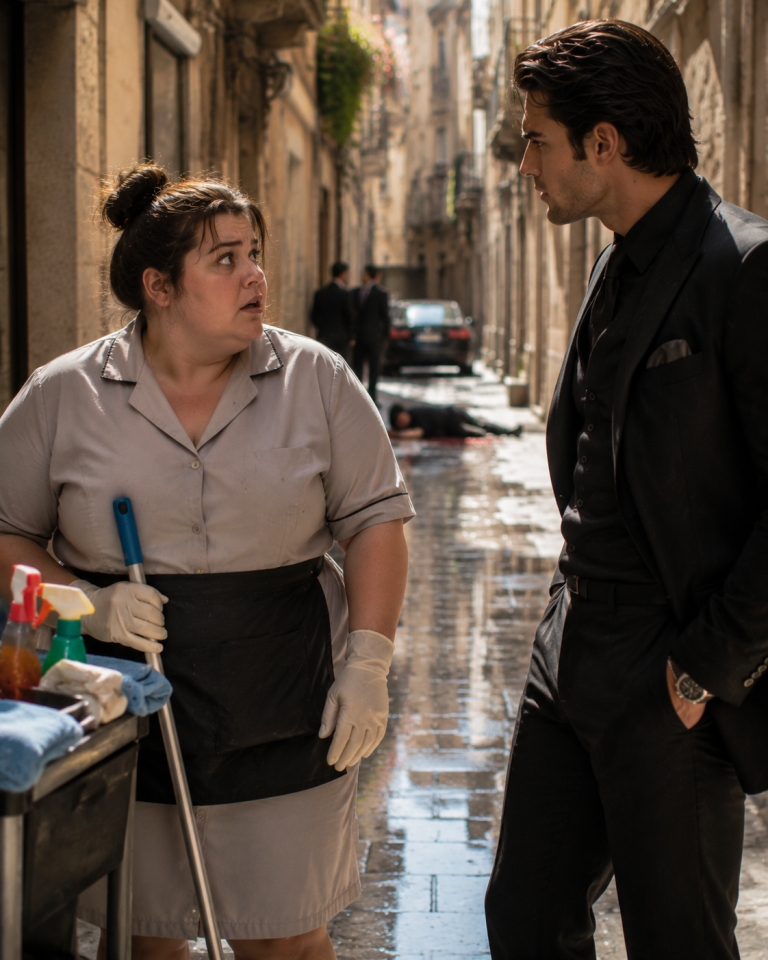
She Took the Slap Meant for the Mafia Boss’s Disabled Mother—Then His Revenge Exposed a Shocking Family Secret

PART 1
The tray hit the marble before she understood what she was doing.
One second it was in her hands. The next, champagne flutes were scattered across the floor of the Meridian’s east ballroom, the crash slicing through the string quartet and the murmured deal-making and the carefully sustained noise of six hundred people pretending they didn’t already know everything about each other.
Everyone turned.
And Lena Cruz, still moving, didn’t slow down.
She had been a server at the Meridian for three years. She knew how to carry a tray, how to disappear between bodies, how to smile when people snapped at her and say *of course* when they said things that weren’t questions. She knew how to make herself small enough to survive a room like this one — all chandelier light and old money and the particular kind of cruelty that had learned to dress itself in perfect manners.
She knew all of that.
She did it anyway.
The woman in the silver gown had her arm raised.
Below it, in the wheelchair near the orchestra stage, an older woman sat with her hands pressed flat against the armrests and her chin lifted in the specific way of someone who had decided not to show fear and was paying the cost of that decision in every visible muscle of her face.
Lena caught the silver-gowned woman’s wrist.
Two hands. Hard.
The slap stopped midair.
The silence that followed was the kind that happened before thunder — pressurized, total, the sound of two hundred people deciding what they had just witnessed.
Lena held on for one second.
Two.
The silver-gowned woman stared at her the way someone stared at an object that had developed a personality without permission.
Lena let go.
She stepped between the two women and crouched beside the wheelchair.
“Are you all right?”
The older woman looked at her.
She had silver hair and dark eyes and the quality of a person who was accustomed to rooms like this one — rooms that had not been kind to her recently and that she had decided to reenter anyway. There was nothing frail in her expression. Something tired, yes, and something very awake.
“I think so,” she said.
Then she looked at the woman still standing above them, and her voice was level: “Thank you.”
Lena straightened.
The silver-gowned woman — whose name was Margaux Ellet, whose family owned three buildings on Park Avenue, whose husband sat on city council, whose reputation for cruelty was the kind that passed itself off as standards — looked at Lena with the pale fury of someone recalculating.
“Do you have any idea who I am.”
Lena’s fingers were trembling against the sides of her legs. She pressed them still.
“You were about to hit a woman in a wheelchair,” Lena said. “That’s all I needed to know.”
Margaux stepped closer.
“You are a server,” she said, with the precision of someone placing a pin through something. “You are nothing.”
The words landed in the exact place they were aimed.
All the overdue bills.
Her mother’s hospital transfers.
Her brother Tomás pretending at sixteen that he wasn’t afraid of the numbers on the kitchen table.
All the *of course, ma’am* and *so sorry* and the practiced smallness that kept her employed and the rent paid, most months.
You are nothing.
Maybe.
But Lena was still standing here.
So she met Margaux Ellet’s eyes and said, quietly: “Maybe. But I’m still standing in front of her.”
From across the ballroom — from the place near the far column where the shadows were thicker and a man had been watching everything with the stillness of someone who had not needed to move in a long time — the air changed.
Lena felt it before she saw it.
The way the room adjusted. The way conversations stopped mid-sentence. The way people shifted without looking like they were shifting, creating space for something they recognized and were careful around.
He moved without hurrying.
He never needed to hurry.
The crowd parted the way crowds parted for things they had decided were inevitable.
Lena had seen wealthy men before. She had carried drinks for politicians and investors and the kind of businessmen whose names were on buildings she walked past every day. She knew what powerful looked like up close.
This was different.
He was in his late thirties, dark suit, dark hair, a face that had been built for coldness and had learned to live in it. His eyes were the color of ice over deep water — pale gray, completely still, the kind of eyes that made people choose their next words very carefully.
He stopped in front of Margaux Ellet.
“Margaux,” he said.
Just her name.
Just that.
And Margaux Ellet, whose family owned three buildings on Park Avenue, who could make a restaurant close or a career end with the right phone call, went white.
“I didn’t realize she was—” Margaux started.
He looked at her until she stopped.
Then he looked at the woman in the wheelchair.
His entire bearing changed.
Not softer. But different — the specific quality of someone dropping a particular kind of defense.
“Are you hurt?” he asked.
The woman in the wheelchair — his mother, that was clear now, unmistakable in the lines of their faces and the way they existed near each other — shook her head slightly.
“I’m fine,” she said. “Thanks to her.”
He turned.
He looked at Lena for the first time.
Really looked.
Not the way guests looked at servers — cataloguing the uniform, deciding how much attention to allocate. He looked at her the way a person looked at a genuine surprise, working out what category it belonged to.
“What is your name?” he asked.
“Lena Cruz,” she said.
He nodded once. The way someone confirmed something they intended to remember.
Then he took out his phone.
He made three calls.
He spoke quietly enough that no one else could hear.
When he put the phone away, Margaux Ellet was trembling in her expensive shoes.
“Leave,” he said to her.
She opened her mouth.
He looked at her.
She left.
The orchestra began playing again, tentatively, and the room exhaled and reconfigured itself around the new reality of what had just happened. Nobody spoke loudly for a while. Everyone found somewhere else to look.
The man stayed near his mother, crouching beside her wheelchair, their voices low.
Lena picked up her tray from the floor.
She started collecting the broken glass.
She was still on her hands and knees when she heard him behind her.
“Stand up.”
She looked up.
“I have to clean—”
“Someone else will clean it.”
She stood.
He was closer than she expected, and the directness of his attention was disconcerting in a way she couldn’t entirely account for.
“I want to offer you a position,” he said.
The words didn’t arrange themselves into meaning for a moment.
“Full-time care for my mother. Private residence. Your family’s medical costs paid in full. A salary that will handle whatever you’re carrying.” He paused. “And protection. For as long as you need it.”
Lena stared at him.
“Why,” she said.
He seemed almost surprised that the first thing she said was *why*.
He looked around the ballroom.
At the people still arranged in their careful configurations, at the politicians and donors and powerful families who had stood two feet away while Margaux Ellet raised her hand against a woman who couldn’t walk away.
“In a room full of people who looked away,” he said, “you didn’t.”
Lena thought of her mother.
Tomás pretending not to be scared.
The second job she’d been about to take.
The way the month always ran out before the money did.
She looked at the woman in the wheelchair, who was watching her with quiet attention and no pity whatsoever.
That mattered.
“Okay,” Lena said. “Yes.”
He nodded.
And somewhere across the ballroom, near the service entrance, a man in a gray suit watched the exchange, took out his phone, and typed three words to someone she had never heard of.
She didn’t know that yet.
—
PART 2
By morning, Margaux Ellet’s social calendar had begun to develop holes.
A benefit board she’d chaired for nine years requested her resignation. A lunch reservation she’d held for a decade was suddenly unavailable. Three calls went unreturned. The governor’s office asked her assistant to follow up through different channels.
None of this was announced.
None of it needed to be.
The man’s name was Nikolai Voss.
Lena had found this out the way she found most things — by paying attention. The staff file was on a secure system, but his name was on the lease and the business registration and the license for the vehicles, and Lena had been learning to read rooms for three years.
Nikolai Voss’s name, when mentioned in certain contexts, produced the same effect his presence did in the ballroom: a careful silence, a recalibration of volume.
Lena had heard the phrase *private investor* used to describe men whose actual business interests existed in a different category of documentation.
She had not asked.
She had taken the job anyway.
His mother, Irina Voss, was sixty-three. Four years ago, she had been the kind of woman who walked into rooms and made them rearrange. Then a car had struck her outside a private clinic in a manner the police report described as accidental and Nikolai’s expression described as something else entirely. The injury had taken her ability to walk without assistance. It had left her right side weakened, her spine compromised, her independence reduced to the dimensions of rooms that others controlled.
It had not touched her mind.
Or her temper.
“You’re late,” Irina said, on Lena’s second morning.
“By four minutes.”
“Four minutes is four minutes.”
“I stopped to get the physical therapy schedule adjusted. Your doctor had scheduled the wrong sequence.”
Irina looked at her.
“How do you know the wrong sequence?”
“Because I read your file last night.”
A pause.
“All of it?”
“Three years of it, yes.”
Irina looked at Lena the way she had looked at her in the ballroom — completely awake.
“Sit down,” she said. “Tell me what needs changing.”
Lena sat.
She had been invisible for so long that being looked at directly still felt like standing in a beam of something she hadn’t earned.
She told Irina everything she had found in the file.
Irina listened without interrupting.
By the end of the first week, Lena had reorganized the therapy schedule, argued with a specialist about three medication interactions, and discovered that Irina’s previous caregivers had been managing her in ways designed for compliance rather than recovery.
Irina, it turned out, wanted to walk again.
Everyone around her had been acting like that desire was something to be managed rather than pursued.
Lena did not manage it.
She met it where it was.
Every morning, before the physical therapist arrived, they went through an additional thirty minutes in the garden. Irina working her right arm in the movements the PT had mapped but never quite pushed. Lena spotting her with the matter-of-fact steadiness of someone for whom other people’s effort was worth being present for.
They didn’t talk much during those sessions.
But they talked during everything else.
Irina asked about Tomás. About Lena’s mother, Carmen. About the diner where Lena had worked before the hotel, and the community college courses she’d taken and stopped taking when the schedule became impossible.
And Lena, for reasons she couldn’t explain to herself, answered.
Not carefully.
Actually.
She told Irina about the kind of tired that lived in your joints after years of double shifts. She told her about sitting on bathroom floors at midnight because that was the only room with a lock. She told her about the specific indignity of being skilled at invisible work and being paid invisible money for it.
Irina listened the way a person listened when they understood what exhaustion actually cost.
Nikolai was rarely in the house during the day.
When he was, Lena treated him the way she treated the presence of weather — something you accounted for and moved around, not something you ignored but not something you performed for, either.
One evening he came through the kitchen while she was heating soup, and he said, “You should sleep,” and she said, “So should you,” and he stopped.
People did not say that kind of thing to Nikolai Voss.
She could tell by the pause.
“She worries when you don’t come home,” Lena said.
“She shouldn’t.”
“She does anyway. Telling her not to doesn’t change it.”
She turned from the stove.
He was looking at her with the specific attention he gave things he hadn’t fully calculated.
“You speak very directly for someone in this house,” he said.
“You hired me to care for your mother,” she said. “Not to be afraid of you.”
Something shifted in his expression.
She held his gaze.
Then his phone rang, and the room returned to what it normally was, and Lena went back to the soup.
But she noticed, after that, that he came home earlier.
She noticed other things too.
The file she found in the estate office on a Tuesday afternoon.
She had been sent to retrieve medical records.
She had found them.
She had also found the folder behind them, marked only by a date from four years ago.
Police reports.
Private investigation summaries.
Photographs of a vehicle.
Names.
The family that had arranged the car that struck Irina outside the clinic had not done so by accident or proximity or any of the other words that appeared in official documentation. They had done it deliberately and carefully and they had not finished.
The Parrish family.
Lena put the folder back exactly where she found it.
She told no one.
But from that day, she paid attention to different things.
Which doors had reinforced frames.
Where the service exits went.
Which windows overlooked which approaches.
The house was a fortress. She was learning the architecture of it, the way she had learned ballrooms and kitchens and hospital corridors — not because anyone asked her to, but because understanding the space you were in was how you survived it.
Two months passed.
Carmen’s medical situation improved.
Tomás stopped looking at the kitchen table the way he looked at things he was afraid of.
Lena found a coat outside her door one cold morning.
No note.
A week later, a book she had mentioned to Irina in passing.
Then a print of cherry trees in bloom, the ones her mother loved, taped carefully inside a plain frame and left on her bedside table.
None of it with a note.
All of it in the register of someone who was learning a different language and trying it quietly, without asking to be credited for the attempt.
The first warning came from Tomás.
He called from school, trying to sound casual.
A man outside the gate had asked about her.
Wanted to know if she was happy in her new position.
Lena called Nikolai before her next breath.
—
PART 3
The attack happened on a Thursday evening when the sky had just gone dark.
Lena was in the therapy room with Irina, working through the exercises that had become the center of the day — Irina’s right arm extended, trembling, the movement coming from somewhere deeper than muscle. Four months of this, every morning and sometimes evenings, and the progress was real enough that the physical therapist had started using the word *remarkable* without irony.
“Again,” Lena said.
“You are the most merciless person I have ever employed,” Irina said.
“You’ve said that three times this week.”
“I keep hoping it will land.”
The first explosion hit the east perimeter.
Not the rolling boom of film explosions.
A concussion — the physical kind, the kind that sat in the chest rather than the ears. The lights swayed. The window seals shivered.
Irina’s hand came down from the exercise position and gripped the armrest.
The alarms came half a second later.
Lena was already on her feet.
She had been preparing for this without telling anyone she was preparing for it, and there was something almost clarifying about the moment of transition from preparation to event. Her mind went very still. Very focused.
“We’re moving,” she said.
Irina did not argue.
She reached for the wheelchair with the specific readiness of a woman who had decided, months ago, that she would not be afraid of the things that came for her.
Lena pushed fast through the bedroom and into the service corridor she had memorized in the first three weeks. Behind the main walls, the emergency lighting was red and low and adequate. She knew where it led. She had walked it twice on quiet afternoons when she’d told the staff she was familiarizing herself with the house.
They were halfway to the lower passage when a figure stepped from the side corridor.
One of the security team. A man who had been with Nikolai for years, whose face Lena had seen at every entrance and every rotation, whose name was Dmitri and who had always nodded to her with the professional acknowledgment of someone who had decided she was part of the house.
He stood in front of them now.
With three men Lena had never seen.
Irina’s hands tightened on the armrests.
“Dmitri,” she said.
Something crossed his face that might have been shame, if it hadn’t been outweighed by something else.
“Mrs. Voss,” he said. “I’m sorry.”
“Are you,” Irina said.
Her voice was flat in a way that contained a great deal.
Lena was already assessing: the distance to the corridor behind them, the positions of the three unknown men, the weight distribution of the wheelchair, the fact that the man nearest the wall had positioned himself to watch the back entrance and not the door in front of them.
He was watching for Nikolai.
Not for two women.
That was their mistake.
The same mistake every person who had ever underestimated the things in front of them had made.
Lena had spent three years being invisible.
Invisibility, it turned out, had its uses.
“Mrs. Voss,” she said quietly, “do you remember the movement from Tuesday’s session? The right arm?”
Irina went very still.
Then she said, so quietly only Lena could hear: “I remember.”
One of the three men stepped forward.
He reached for the wheelchair.
Irina’s right arm came up.
Not smoothly. Not powerfully. But with the force of four months of work and the fury of a woman who had spent four years being treated as something to be managed, and it caught the man’s extended arm at the wrist with enough precision to throw his balance.
Lena moved at the same instant.
She hit the second man’s shoulder with hers, driving him sideways into the wall, her hand closing around the radio on his belt and ripping it free. She brought it down against the metal door frame once, twice, hard enough to break the casing and interrupt the signal.
Dmitri lunged toward her.
The door at the end of the corridor hit the wall like a period at the end of a sentence.
Nikolai came through it with the controlled precision of someone who had spent years learning exactly how much force was necessary and exactly when to use it.
He had not come in time to prevent the breach.
He had come in time for what mattered.
The corridor was very loud for about forty-five seconds and then very quiet.
The man who had arranged the attack — a man named Harlan Parrish, whose family had spent four years believing they had won by crippling Irina and who had revised upward when they realized Nikolai’s household had acquired a new variable they hadn’t accounted for — was removed from the house in the company of people whose professionalism Lena understood was a different kind of professionalism than the hotel’s.
Dmitri cooperated.
Nikolai did not speak about what happened to him afterward.
Lena did not ask.
She was in Irina’s room, sitting beside the bed, when Irina finally looked at her.
“You planned for that,” Irina said.
“I hoped I wouldn’t need to.”
“But you planned for it.”
“The file in the estate office,” Lena said. “The Parrish folder.”
Irina was quiet.
“I thought that was secured.”
“It was. I found it anyway.” Lena looked at her hands. “I didn’t say anything because I didn’t want you to know I’d read it. I just wanted to understand the shape of what we were inside.”
Irina reached for her hand.
For a moment, neither of them spoke.
Then Irina said, very quietly: “More therapy tomorrow.”
Lena laughed.
Short and genuine and tired.
“More therapy tomorrow,” she agreed.
—
Nikolai found her in the garden the following evening.
She was on the bench under the bare trees, wrapped in the coat he had left at her door two months ago, watching the city skyline go dark by degrees.
He sat beside her.
She had noticed that he had stopped asking permission to be in her proximity. Not because he assumed — but because at some point the question had answered itself and they had both tacitly agreed not to revisit it.
“The Parrish operation is finished,” he said.
“All of it?”
“Enough that it’s finished.”
She nodded.
They watched the city.
“You knew,” he said. “About the file.”
“Yes.”
“You said nothing.”
“You’d have moved things around me if I had. Changed the house. Added protocols. Made it harder to be in the space I needed to be in.” She turned to look at him. “I knew what I needed to know. That was enough.”
He studied her.
“You should have told me.”
“I’m telling you now.”
The edge of his mouth moved.
Barely.
“Irina used her right arm,” he said.
“She’s been working on it every morning for four months.”
“I didn’t know.”
“You were never in the garden at that hour.”
His jaw tightened, not at her — at himself, at the calculus of someone who had spent years believing that caring for the people around him meant maintaining enough distance to control the variables that threatened them.
“She laughs more now,” he said.
Lena looked at the city.
“She was hungry,” she said. “For her own life. Everyone around her was managing that hunger instead of meeting it.”
“And you met it.”
“I recognized it.”
The silence between them was the kind that had depth in it now, rather than absence.
Nikolai reached into his jacket.
He placed something on the bench between them.
A single sheet of paper, folded once.
She recognized it before she opened it.
Her employment contract.
He had torn it in half.
Lena looked at the two pieces.
“What is this.”
“It’s a contract I’m canceling,” he said. “Not because your position is ending. Because I don’t want you here on those terms.”
She looked at him.
“The alternative,” he said carefully, “is that you stay because you choose to. As yourself. Not as something I’m compensating. Not as a variable I’m managing.” He held her gaze. “As a partner. In whatever form that takes time to become.”
“You’re not good at this,” she said.
“No,” he agreed. “I’m better at other things.”
“Frighteningly so.”
“Yes.”
The corner of her mouth moved.
She picked up both halves of the contract.
She turned them over in her hands.
Then she said: “My mother. Tomás.”
“Already protected. Not because of this conversation — because they are yours and that was sufficient reason.”
She held his gaze.
“I’m not going to become quiet because your life is complicated.”
“I know.”
“I’m not going to stop being who I am.”
“Lena.” His voice lowered slightly. “That is the reason I’m asking.”
She looked at the torn contract.
She looked at the city, where her mother was in a better hospital room and her brother was sleeping without the particular fear she had watched live in his face for two years, and where the woman who had called her *mija* by accident that afternoon was sleeping in the room above them.
“Yes,” she said.
“Yes to which part.”
“All of it,” she said. “The parts I understand now and the parts that will take time.”
His exhale was not quite a breath.
Not quite a sound.
Just the specific release of something that had been held in place for a long time.
He reached across the bench.
She took his hand.
—
One year later, the Meridian Annual Gala ran again.
The chandeliers were identical.
The white roses.
The gold-rimmed plates.
The six hundred people who moved through the space with their practiced certainty that the room was theirs.
Lena arrived in navy.
Her hair was down.
No tray.
No apron.
She walked through the ballroom the way she had learned to walk through any room where someone was watching — with the complete conviction that she had earned the right to be there, which was different from requiring permission.
Irina walked beside her.
With a cane.
With effort.
With Nikolai on her other side.
Slowly, deliberately, one deliberate step at a time, Irina Voss crossed the marble floor of the ballroom where she had been humiliated in her wheelchair a year ago.
She wore the same burgundy dress.
Deliberately.
The room understood what it was seeing.
The guests who had watched a socialite raise her hand against a woman who couldn’t walk and done nothing — they watched now as that same woman moved across their floor on her own feet, unhurried, and they understood that the room had reorganized itself around a different gravity.
Margaux Ellet was not there.
No one mentioned her name.
At some point in the evening, Lena found herself at the edge of the ballroom where she had stood a year ago with a tray in her hands and her heart hammering.
The hotel director materialized beside her with a smile that carried the specific quality of a man who remembered everything and hoped she didn’t.
“Miss Cruz,” he said. “It’s wonderful to have you here as a guest.”
Lena looked at him.
She remembered him standing twenty feet away while Margaux Ellet’s hand rose. She remembered his particular brand of stillness — not frozen, but calculating. Not afraid, but unwilling to absorb any cost.
“Is it,” she said.
He went slightly pale.
Nikolai, appearing at her side without announcing himself, looked at the director with the specific quality of a man who had no need for the director’s discomfort to be visible.
“Your waitstaff were exceptional this evening,” he said pleasantly.
The director exhaled.
“Thank you, Mr. Voss.”
“Particularly the woman on the east service floor. Make sure her manager knows she’s exceptional.”
The director looked between them, adjusted his understanding of the evening, and found somewhere else to be.
Lena looked at Nikolai.
“That was almost polite.”
“I’m working on it.”
Irina, passing with her cane and the kind of posture that came from years of refusing to make herself smaller, caught Lena’s eye and smiled.
Not the performed warmth of wealthy women at galas.
The real thing.
Tomás was at a study table in the estate library, working through an application essay for a pre-law program, when Lena called to check in.
“How’s the gala?” he asked.
“Fine.”
“You’re wearing the navy thing?”
“Yes.”
“Does it look good?”
“Tomás.”
“I’m just asking.”
She laughed.
And the sound of it rose in the marble ballroom, warm and real and hers, and not a single person in that room could have told you what a waitress sounded like when she laughed, because they had never thought to notice.
Six months later, Lena started the Cruz Foundation.
A small office. Two staff. A phone that rang more than expected from the first week.
Its purpose was to do exactly what its name suggested it would do: provide emergency support for families surviving on the invisible labor that kept everyone else’s lives running, families whose bills arrived faster than their wages, whose members worked themselves into floors of expensive hotels and wept quietly in bathrooms and were called *nothing* by people who had never considered that the word could be wrong.
Irina joined the board at the first meeting.
Tomás took notes.
Carmen, who was well enough to attend, sat in the front row and cried quietly into a handkerchief, which she denied afterward.
Nikolai funded the first year without announcing it.
When Lena found the transfer records and walked into his office and confronted him about it, he said: “It was yours. I didn’t want it to become mine by being the obvious source.”
She kissed him.
He was still learning how to be held.
She was still learning how to be seen.
They were patient with each other about both.
—
The second gala came on a clear November night.
Colder this year. The city hard and brilliant beyond the windows.
They stood together at the east wall — the same wall where, a year ago, Lena had moved without understanding why.
She understood now.
She had not stepped between an old woman and a raised hand because of bravery.
She had done it because she recognized the posture — the shoulders braced, the chin lifted, the decision not to show fear that lived in the exact muscles it cost the most to hold.
She had seen it on her mother’s face.
She had felt it in her own body.
And some things were simply not things you watched happen when you could stop them.
“You know what I’ve been thinking about,” Nikolai said.
“Tell me.”
He was quiet for a moment.
“I have spent a long time in rooms full of people who wanted things from me or feared me or both,” he said. “And I came to understand that kind of attention as the total of what I was.”
Lena waited.
“And then in this room, one year ago, the only person in the space who had nothing to gain from moving — the only person who could have been fired, blacklisted, removed without consequence — was the only one who did.”
He looked at her.
“You did not just help my mother that night,” he said. “You gave back something I had decided I’d lost.”
The orchestra began something slow.
She turned toward him.
He took her hand, not for the room’s benefit — Nikolai Voss did not perform things for rooms.
“The thing about being invisible,” Lena said, “is that you see everything. Every person who looks through you. Every door that doesn’t open. Every room that tells you what you are by how it treats you when no one important is watching.”
She met his eyes.
“And you also see the ones who are worth seeing back.”
He was quiet.
Then he said, “I want to ask you something.”
The words were careful.
Coming from a man who had learned to be cautious with important things.
She waited.
He reached into his jacket.
He produced a ring — not flashy, not performative, an older piece, platinum with a deep green stone that caught the chandelier light and held it.
“This was my grandmother’s,” he said. “My father said she kept it for the day the family could build something that didn’t need to be hidden.”
Lena looked at the ring.
Then at him.
“That’s more than a proposal,” she said.
“Yes.”
“It’s a statement about what we’re building.”
“Yes.”
“And your Aunt Renata will pretend to be supportive while clearly reconsidering everything.”
Something moved in his expression that was almost, almost, a full smile.
“Also yes.”
She looked at the ring.
She looked at the woman across the room, moving with her cane through a crowd that now stepped aside with genuine respect rather than the performed variety.
She thought of Tomás at the study table.
Carmen in the front row.
The Cruz Foundation phone ringing on its first week.
All of it grown from a moment on a ballroom floor when she had dropped a tray and moved without planning to.
“Yes,” she said.
He put the ring on her finger.
It fit as if it had been waiting.
The orchestra continued.
The city glittered.
And Lena Cruz, who had carried trays through rooms full of people who looked past her, who had learned to make herself small enough to survive, who had sat on bathroom floors at midnight because that was the only room with a lock — stood in the center of the most powerful ballroom in New York and was completely, fully, unhidably herself.
That was the real ending.
Not the ring.
Not the foundation.
Not even the woman in burgundy walking on her own feet across the floor.
The ending was this: a woman who had been called *nothing* deciding, in a single unplanned moment, that some things were worth standing in front of.
And discovering, in the year that followed, exactly how much she was worth standing for.
Across the room, Irina raised her glass.
Lena raised hers.
And then Nikolai’s phone buzzed once.
He looked at the screen.
And the expression on his face — controlled, still, the careful flatness of a man receiving information he had not anticipated — made Lena’s chest tighten.
She looked over his arm.
A photograph.
Taken tonight.
Irina at her table, laughing.
Tomás beside her, head bent over his notebook.
And at the edge of the frame, almost out of shot, Lena’s mother Carmen — who wasn’t supposed to be here, who no one outside their household would have known to look for.
Beneath the photograph, seven words.
*The Parrish family was only a messenger.*
Lena looked up.
Across the ballroom, near the service entrance, a man in a charcoal suit watched them.
He smiled.
Then turned and disappeared into the crowd before she could fix his face in her memory.
Nikolai’s hand closed around hers.
Not to comfort.
To anchor.
“Stay close,” he said quietly.
And she did.
Because she had not come this far to be afraid.
She had come this far to know the difference between danger and the people worth facing it with.
She stayed.