She Wrote “HELP” on a Napkin—The Mafia Boss at Table 12 Saw It Before Anyone Else

## PART 1
The third face was the one that kept her up.
Not Michelle Torres, who had a mother who sent Sunday texts about brunch and a couch she had been saving up for. Not Yesenia Park, whose vintage camera sat on a shelf beside a half-finished community college application. The third face — Dana Wells, twenty-six, moved restaurants four times in as many months — was the one that looked most like someone who already knew she was being followed and had not yet found the words to say it.
Women did not change jobs that many times because they were careless.
Sometimes they were trying to stay ahead of something that moved faster than they could.
Mira Calloway had been sitting with this case for nineteen days. The kitchen table in her Hoboken apartment was not a desk, but it had become one: three open laptops between unpaid cable bills and a cold mug of coffee that had been hot two hours ago, printouts pinned to the wall with painter’s tape because thumbtacks left marks the landlord would charge for, a map of the Jersey City waterfront annotated in three colors.
Her editor at the *Metro Dispatch* had warned her twice.
“When a story about organized crime has a body count attached,” Thomas Okafor had said, “it stops being journalism and starts being a location.”
She had told him she understood.
That was true.
She had also kept working.
What Thomas did not understand — could not understand, because he had never been the kind of woman who watched a missing persons case get filed under *probable runaway* on a Tuesday and closed by Friday — was that understanding the risk was not the same as agreeing to stop. The three women the Port Authority had quietly handed off to a detective who specialized in paperwork had families who still called their phones. Michelle’s mother had shown Mira a screenshot of a text thread from the day before the disappearance. *Sunday brunch?* Michelle had written. *I found a place near my new apartment.* She had attached a photo of the restaurant menu and a string of heart emojis.
Runaways did not plan brunch.
Yesenia’s roommate had stood in the doorway of Yesenia’s bedroom with both hands pressed together and said, very quietly: “She would not have left the camera.” The camera was a Minolta, bought used from a retirement sale, carried everywhere in a leather case Yesenia had sewn herself. It sat on the shelf as evidence of an absence that had not been chosen.
Dana Wells was harder to trace. The restaurants she had worked had different managers, different owners on paper, different vibes. But the surveillance grid at the port had holes that showed up in the maintenance logs at predictable intervals — two hours, sometimes three, carved out of the camera rotation like missing teeth. Those windows lined up with the shift schedules of all three women in the weeks before they vanished.
Mira had laid this out for Thomas.
He had given her a port authority contact and told her to be careful.
That was as close as he ever got to encouragement.
The contact provided manifests, gate logs, maintenance requests, and a name that appeared twice in the scheduling records for external security firms: Sartori & Associates, registered in Delaware, operating contact listed as a post office box in Queens.
Mira had not heard of Sartori & Associates.
She had heard of the Sartori family.
On Thursday evening, rain moved through the city in silver curtains and turned the restaurant windows into soft mirrors. Marino’s occupied the ground floor of a converted warehouse on the edge of the Heights district — warm brick, low light, the smell of wood smoke and garlic drifting out to the sidewalk. The kind of restaurant that suggested the city was still worth trusting.
Mira arrived at eight-forty and took the small table near the window.
Across the room, a man in a dark suit occupied the corner table alone. He had ordered wine and was doing nothing in particular — not looking at a phone, not reading, not watching the door. Just sitting with the patience of someone who had learned that waiting was a form of attention.
She did not notice him yet.
She was watching the kitchen entrance.
At eight-fifty-two, Dana Wells came out.
She looked exactly like her driver’s license photo, except more cautious. Brown eyes, curly hair pulled back, the careful alertness of a woman who had been scanning rooms for a long time.
She recognized Mira immediately.
The nod was barely visible.
At nine-oh-seven, two men came in from the street.
Mira had spent three weeks staring at surveillance photographs, and she recognized the first man’s profile before he turned fully — the scar through the left eyebrow, photo thirty-four in her Sartori file. She recognized the second man by the way he moved, not by his face: the controlled stride of someone who had been trained to occupy space without leaving evidence of having been there.
Her coffee cup hit the saucer harder than she intended.
Dana materialized beside her, setting down a glass of water.
“They’ve been asking the staff about someone matching your description,” she said, not looking at Mira. “The back exit is locked from outside. The kitchen is not an option.”
“How many at the service entrance?”
“I don’t know. I’m sorry. You need to—”
“I know.” Mira looked at the two men. They had stopped near the host stand. Not seated yet. Deciding. “Go. Don’t come back out.”
Dana went.
Mira sat with her hands flat on the table and looked at the math of the room.
Front door: between her and them.
Kitchen: Dana had already said no.
Restrooms: the wrong direction, no external access.
She had been in difficult situations before. She had never been in a situation where the correct choice was less obvious than the word *danger* printed across the room in two men’s body language.
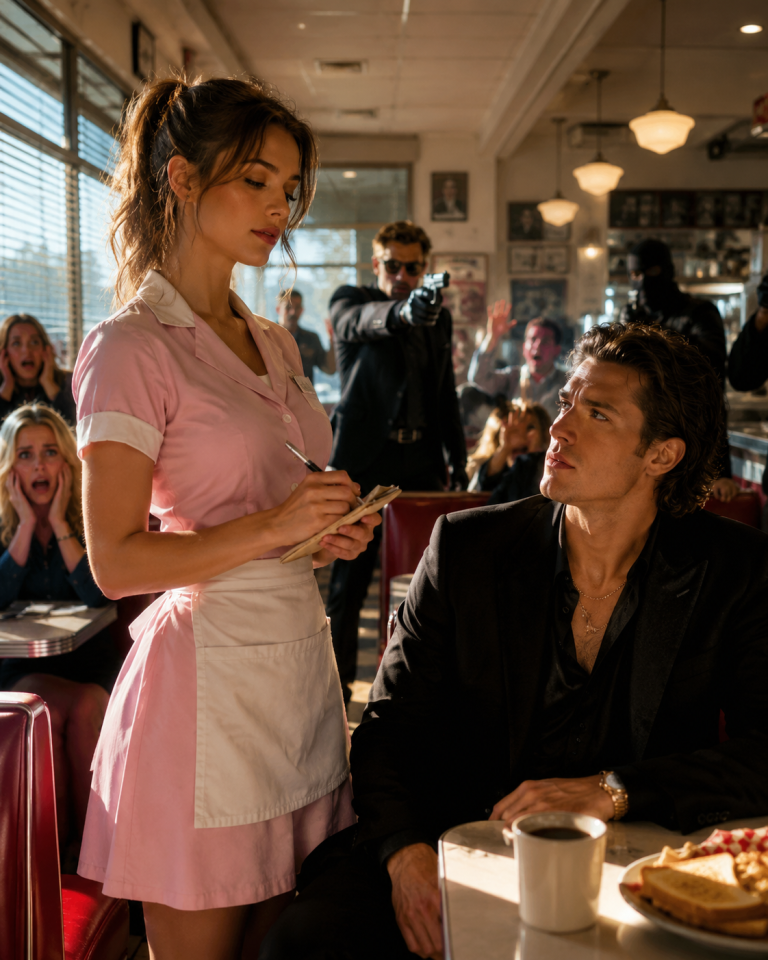
There was a napkin under her water glass.
Her pen was in her jacket pocket. She had been a reporter for six years. She always had a pen.
Her hand was not entirely steady when she wrote the word.
HELP.
She slid the napkin to the edge of the table.
The two men started walking.
The man at the corner table looked at her.
Not at the room. Not at the wine. At her, with the focused attention of someone who had already been watching and had just understood what they were watching.
His eyes moved from her face to the napkin, then to the men.
He stood.
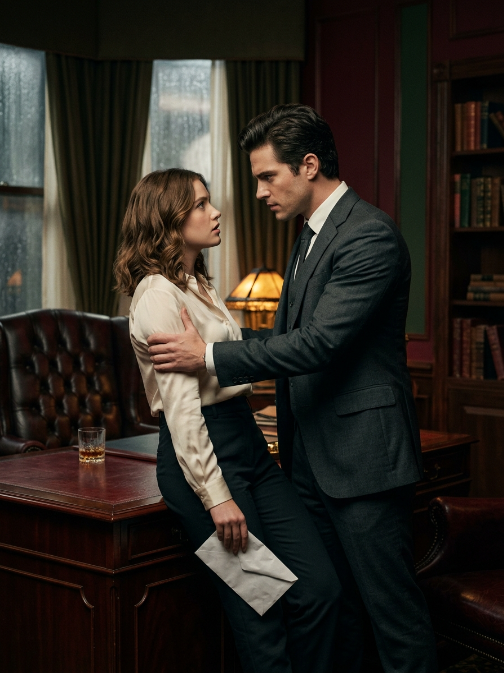
He crossed the room without hurrying — not slow, not fast, the unhurried certainty of a man who had made a decision and was implementing it — and sat down across from her.
He picked up the napkin.
He folded it in half.
He put it in his jacket pocket.
“You’re having a complicated evening,” he said.
His voice was low and even, and he said it the way a person says something they already know the answer to.
Mira looked at the two men, who had stopped six feet away.
They were not looking at her now.
They were looking at him.
—
## PART 2
The men did not approach.
Something had changed in the geometry of the room, and they could feel it even if they could not name it. They stood for eight seconds — Mira counted — and then the first man took out his phone, looked at the screen, and said something to the second man in a voice too low to carry.
They left.
No confrontation. No scene.
Just two men walking back through the front door into the rain as if they had simply changed their minds about dinner.
Mira watched the door close.
The man across from her had not moved to watch them go. He had remained facing her with his hands folded on the table, patient in the way of someone who did not need to confirm the outcome because he already knew what it would be.
“Who are you?” she said.
“My name is Renzo Conti.” He picked up his wine glass. “I believe you already know enough about my family to understand why those two men found a different table.”
She did.
She had not recognized him from photographs because she had not been looking for Renzo Conti. She had been looking at his family’s peripheral connections — the Sartori name, the port contracts, the external security firm. The Conti name appeared in her research the way powerful names appeared in organized crime research: as the thing everyone else was organized around, the weight that made all the other elements line up.
“The Sartori family works for you,” she said.
“Adjacent to us. At a remove.”
“Three women are missing from restaurants connected to Sartori’s port security contracts.”
He looked at her.
Not surprised.
Something else.
“Tell me the three names,” he said.
She told him.
He set down the wine glass.
The movement was small. Deliberate. The kind that meant something had landed.
“When did you find the connection to Sartori?” he said.
“Eleven days ago.”
“Who else have you told?”
“My editor has the files. He doesn’t know the Sartori connection yet. I was waiting until I had the port logs verified.”
“Why?”
“Because an accusation without documentation is just noise.”
He looked at her for a long moment.
Then he reached into his jacket and set a business card on the table.
Not his card.
A number handwritten on the back of a blank white card.
“Call that number in exactly one hour,” he said. “From a different phone than the one in your pocket.”
“What is it?”
“An answer to a question you have not asked yet,” he said. “But you will.”
He stood.
Left cash on the table.
Walked to the door.
Mira sat with the card in her hand and her story in her head and the two men’s departure replaying in a loop, and she understood, with the particular clarity of someone who had just watched a room rearrange itself around a person who hadn’t raised their voice, that she was no longer reporting on the edge of something.
She was inside it.
—
## PART 3
She went to a convenience store four blocks away, bought a prepaid phone, and called the number at exactly ten-oh-seven.
A woman answered.
“Ms. Calloway,” she said, as if she had been expecting the call for some time. “My name is Agent Krista Melling. I’m with the FBI’s Organized Crime Division out of Newark. I’ve been told to speak with you.”
Mira sat down on the curb outside the convenience store in the rain.
“Tell me what you have,” Melling said.
“Why would I tell you what I have.”
“Because those three women are part of a trafficking operation that we have been building a case on for fourteen months, and you just made contact with the one person who can give us the piece we’re missing.”
“Renzo Conti.”
“He’s been cooperating with us for six weeks,” Melling said. “He came to us. That is not something I can explain in detail, but I need you to understand that the man who sat down across from you tonight is not the threat.”
“Then who is.”
“The Sartori network is operating without his knowledge or sanction. They’ve been using his family name as cover for operations he doesn’t know about. When we approached him six weeks ago and showed him what Sartori was doing under his umbrella, his cooperation was immediate.”
Mira looked at the rain falling on the street.
“The women,” she said.
“Two are confirmed in temporary safe locations. We moved them when the network started tightening. Dana Wells—”
“She’s still in the restaurant.”
“She went out the service entrance forty minutes ago. She’s with our people.”
Mira exhaled.
“What do you need from me.”
“Your documentation,” Melling said. “The port logs. The camera outage patterns. The Sartori employee records. You’ve built a public-record case that we have not been able to construct through official channels because the port authority contact who would normally provide this information has been compromised.”
“I have a source.”
“Your source has a name, and we need to protect them.”
“My source agrees to that or nothing moves.”
“Understood.”
“And I want the story.”
A pause.
“Some of it,” Melling said.
“Most of it.”
“We’ll negotiate that once the operation concludes.”
“No. We negotiate it now. I’m not providing documentation based on a promise.”
Another pause.
Then: “What are your conditions.”
Mira stood up from the curb.
She had been keeping records for nineteen days. She had her notes in a secure cloud backup and a copy on a drive at Thomas’s office that he did not know contained more than research summaries. She had been doing this long enough to understand that evidence was only as valuable as the structure around it.
“My port authority contact is protected, full stop, no circumstances under which their name appears in any federal documentation without prior written consent. My byline runs on the primary story. The families of all three women are notified before any public statement. And I receive a full briefing on the operation outcome before anything goes to press.”
Melling said, “The families are already being notified tonight.”
“Good.”
“The rest I can agree to. The byline is your publication’s decision, not mine.”
“I know. I’m saying I want it in writing that the FBI will not brief competing outlets before briefing me.”
“I can do that.”
“Tonight.”
“An agent will meet you within the hour.”
The meeting happened in a federal building in Jersey City, in a conference room with bad lighting and good coffee, at midnight. Two agents. Melling in person, which confirmed that the phone call had been serious. An attorney reviewing the terms Mira had outlined.
She handed over the port logs.
The Sartori employee records.
The camera outage pattern, which Melling spread on the table and looked at for a long time without speaking.
“How long did this take you?” Melling asked.
“Eleven days for this part. Nineteen total.”
“Our analysts spent six weeks on it and didn’t get here.”
“Your analysts were looking for what they already suspected,” Mira said. “I was looking at what was there.”
Melling folded the pattern carefully.
“Michelle Torres,” she said. “Her mother. Have you told her anything?”
“I told her I believed her. That’s all I was able to say that I could stand behind.”
“She’ll hear from us tonight.”
“I know.” Mira looked at her hands. “Tell her Michelle was not careless. The text about brunch — tell her that mattered. That it was the thing that mattered.”
Melling looked at her.
“I’ll tell her,” she said.
—
The Sartori operation was concluded in three phases over the following eight days.
Not dramatically. Federal operations rarely were — no cinematic confrontations, no speeches in public places. A series of warrants, a series of arrests, a series of men being escorted from buildings at hours when the streets were empty enough not to require crowd management. Two warehouses near the port were searched. A third location outside Newark yielded documentation that extended the case beyond the three women.
The false twist came on day four.
A preliminary press release from the Newark FBI field office announced the arrest of a “port security contractor” connected to a trafficking network. The release named no individuals. It did not mention Sartori. It did not mention Renzo Conti.
Mira read it in the *Dispatch* newsroom and understood immediately what it meant: the office was managing the narrative, protecting the cooperation agreement that had made the operation possible. If Sartori was named and Conti was not, the story would assemble itself incorrectly in the public record — one contractor, one operation, no larger structure, no cooperating source, no reason to look further.
She called Melling.
“This release is wrong,” she said.
“It is incomplete,” Melling said. “There is a difference.”
“The difference is that every reporter in the tri-state area will see an incomplete release and fill in the blanks incorrectly.”
“That is the point.”
“For eight more days,” Mira said. “You need eight more days before the cooperation arrangement can be disclosed. I understand that. I am not going to print the Conti cooperation before you tell me I can. But I need your commitment that when it becomes disclosable, it is disclosed accurately.”
“You have that.”
“And the Port Authority contact—”
“Protected. As agreed.”
“And the families were notified.”
“Yes.” A pause. “Michelle Torres’s mother called the field office twice to ask about the brunch place.”
Mira closed her eyes for a moment.
“Did anyone tell her?”
“An agent gave her the address.”
—
Yesenia Park’s camera had been in evidence storage.
Mira learned this on day six, when she was allowed limited access to the case file summary for background purposes. The camera had been recovered from one of the warehouse locations. It had been taken with Yesenia, which was the first piece of information that confirmed she had been alive past her last-seen date.
Yesenia was alive.
Both Michelle and Yesenia had been located within forty-eight hours of the operation beginning. Dana Wells had been in FBI protective custody since the night in the restaurant. All three were in different stages of recovery — not physical recovery primarily, but the slower, harder kind.
The case that emerged as the operation concluded was not only about three women from the Jersey City port district.
It was larger.
The Sartori network had been operating across four cities, using the legitimate security contracts as access infrastructure. The port camera outages that Mira had documented in her kitchen with painter’s tape and colored markers were replicated at ports in Baltimore, Providence, and Newark. The same external firm, different local contractors, same methodology.
Melling showed her the map in the conference room on day seven.
“You were looking at one node,” she said.
“I was working with what I had,” Mira said.
“You found the pattern in nineteen days.” Melling set down the map. “We have been aware of something like this for fourteen months. We did not have a clean public-record documentation of the access methodology until you handed it to us.”
Mira looked at the map.
Twenty-three women across four cities, over a period of roughly two years.
She had started with three faces.
“The story I run,” she said.
“Ready when you are.”
“I want the scope in it. Not just three women. Not just Jersey City.”
“Yes.”
“And I want Renzo Conti mentioned accurately.”
Melling was quiet for a moment.
“What do you mean by accurately?”
“I mean I don’t want the story to say he was an unwitting victim of his own name being used. I want it to say he made a decision to cooperate when the information was presented to him, and that cooperation was material to the operation.” Mira looked at her. “He is not a hero. He runs an organization that has done things that are not in this case file. But the specific decision he made in this case was the right one, and I’m not going to pretend he had no agency in it.”
“That’s a fair position.”
“It’s an accurate one.”
Melling nodded slowly.
“Then write it that way,” she said.
—
The story ran on a Thursday, thirty-one days after Mira had first pinned Michelle Torres’s photograph to her kitchen wall.
It was forty-two hundred words. Front page, online edition, with a sidebar on each of the three women — not as victims, but as people. Michelle’s brunch plans. Yesenia’s camera, recovered and returned to her that week. Dana’s documented pattern of restaurant changes, which Mira wrote about as exactly what it had been: a woman trying to stay ahead of something that moved faster than she could.
Thomas read the draft at six in the morning and said nothing for four minutes.
Then he said: “What do you need from me.”
“A fact-checker and four hours.”
“You have them.”
The response was significant. It was the kind of significant that happened when a well-documented story about a well-documented crime was published in a mid-size metro paper that had a reputation for not getting these things wrong. Three major outlets picked it up by noon. By evening, a Senate subcommittee chair had issued a statement about port security oversight.
Mira sat at her kitchen table — cleared now, the utility bills sorted, the painter’s tape removed from the wall — and read the subcommittee statement on her phone.
The language was careful and noncommittal and designed to signal concern without promising action.
She had been a reporter long enough to know what that looked like.
She also knew how fast careful language could become uncareful when the documentation stayed in the public record.
She added the subcommittee statement to her notes.
Began a new document.
—
She met Renzo Conti once more, twelve days after the story ran.
Not arranged. He was at a restaurant in the Flatiron district — not one of the places connected to any part of her reporting — and she was there because Thomas had told her to have lunch somewhere that did not involve a working laptop, and this place had been recommended by a colleague who owed him a favor.
She recognized him when she walked in.
He was at a corner table again.
She considered turning around.
Then did not, because turning around was the decision of a person who had decided the meeting was something other than what it was.
She walked to his table.
“Ms. Calloway,” he said.
“I’m not here professionally.”
“I know. Sit down.”
She sat.
He poured water from the carafe on the table without being asked.
“The piece was accurate,” he said.
“I try for accurate.”
“You wrote that I made a decision when information was presented to me.” He set the carafe down. “That is the most generous framing of what I did.”
“It’s the accurate framing.”
“Most reporters would not frame it that way.”
“Most reporters weren’t in the room when you chose to sit down.”
He looked at her.
She met his gaze across the table.
The napkin had stayed with her, in the way objects stayed with her that contained moments she needed to understand. She had taken it back from the evidence bag after the operation concluded — Melling had arranged it, quietly, because it was technically Mira’s property — and she had put it in the drawer where she kept the things she returned to when she needed to remember what the work was for.
Three capital letters on a restaurant napkin.
A man in a suit who had been watching the room.
The rest of it built out from there.
“The women,” Renzo said. “I want to know how they are.”
She studied him.
“Why.”
“Because I have been told, in general terms, that they are safe. I would like to know how they are.”
“That’s not your information to have.”
“I know.”
“But you’re asking.”
“Yes.”
She thought about Yesenia Park’s camera, sitting on its shelf in evidence storage, and then returned to its owner with a property receipt that Yesenia had apparently signed without looking up, just pressed her thumb against the pen and moved the item from evidence to her arms.
She thought about Michelle Torres, who had already called her mother twice.
She thought about Dana Wells, who had gone out the service entrance and kept moving.
“They are recovering,” Mira said. “At different speeds, in different directions. That is as much as I can tell you.”
He nodded.
“Thank you.”
“Don’t.” She picked up the menu. “Don’t thank me for telling you the minimum I could say without lying.”
“All right.”
They ate lunch.
He talked about a restoration project his family had been involved in — a warehouse conversion in Red Hook that had been delayed by permitting issues for two years and had finally broken ground last month. She told him about a follow-up piece she was developing on port security accountability, which would not involve him directly but would reference the operation in its context.
He asked one question about sourcing.
She told him no.
He did not ask again.
Outside, the afternoon was cold and grey and the city was doing what it always did: moving, indifferent, full of things happening in ordinary places that would become extraordinary stories if someone was patient enough to document them.
Mira flagged a cab.
“Ms. Calloway,” Renzo said.
She turned.
“The napkin,” he said. “You could have written more.”
“HELP was sufficient.”
“You could have written a name. A location. More information.”
“There wasn’t time.”
“There was.” He looked at her. “You chose the minimum because you were trained to give the minimum that would accomplish the goal. It is the same principle as your reporting.”
She considered this.
“That’s a flattering interpretation.”
“It’s the accurate one,” he said, using her word.
She got into the cab.
She had three open documents on her laptop when she got back to the newsroom. Two were follow-up pieces. One was a note she had been adding to for thirty-one days — not for publication, just for herself, the kind of document that accumulated the things she had seen and thought and decided.
She opened it.
Added two lines.
*The napkin is still in the drawer. Not as a souvenir. As a record of the moment I stopped having a plan and trusted that the right person would read what I wrote.*
*I was right about that. It did not make me less afraid in the moment. It made the fear worth something afterward.*
She closed the document.
Went back to work.
THE END